+
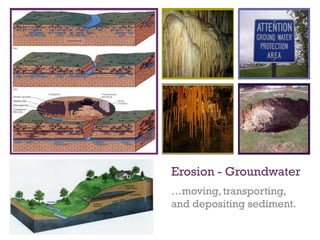
Erosion - Groundwater
…moving, transporting,
and depositing sediment.
+
June 27, 2013
2
+
Groundwater
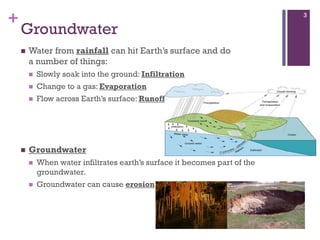
 Water from rainfall can hit Earth’s surface and do
a number of things:
 Slowly soak into the ground: Infiltration
 Change to a gas: Evaporation
 Flow across Earth’s surface: Runoff
3
 Groundwater
 When water infiltrates earth’s surface it becomes part of the
groundwater.
 Groundwater can cause erosion
+
Factors affecting infiltration
June 27, 2013
4
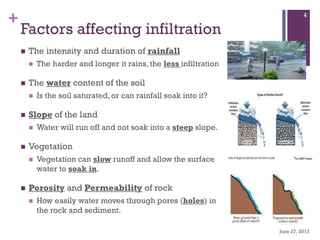
 The intensity and duration of rainfall
 The harder and longer it rains, the less infiltration
 The water content of the soil
 Is the soil saturated, or can rainfall soak into it?
 Slope of the land
 Water will run off and not soak into a steep slope.
 Vegetation
 Vegetation can slow runoff and allow the surface
water to soak in.
 Porosity and Permeability of rock
 How easily water moves through pores (holes) in
the rock and sediment.
+
Groundwater
 Groundwater is the water found beneath Earth’s surface that
soaks into cracks and crevices in soil and rock.
 Once water infiltrates the ground, it collects below earth’s
surface as groundwater.
 There are 3 layers:
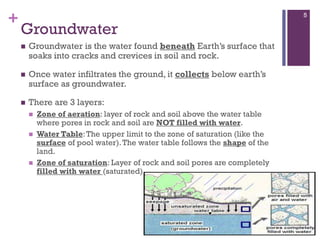
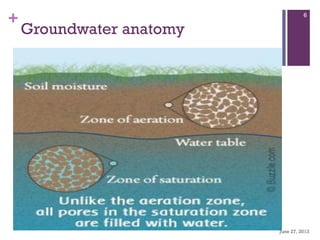
 Zone of aeration: layer of rock and soil above the water table
where pores in rock and soil are NOT filled with water.
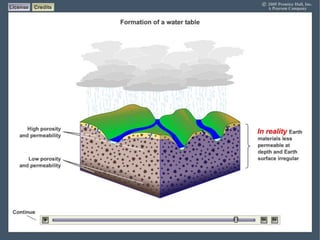
 Water Table:The upper limit to the zone of saturation (like the
surface of pool water).The water table follows the shape of the
land.
 Zone of saturation: Layer of rock and soil pores are completely
filled with water (saturated).
5
+
Groundwater anatomy
June 27, 2013
6
+
June 27, 2013
7
+
How Groundwater Moves
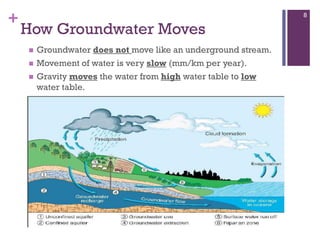
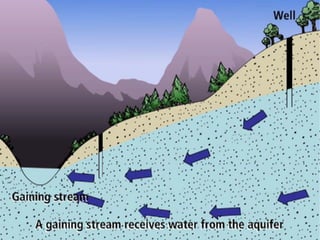
 Groundwater does not move like an underground stream.
 Movement of water is very slow (mm/km per year).
 Gravity moves the water from high water table to low
water table.
8
+
June 27, 2013
9
+
How Groundwater Moves
10
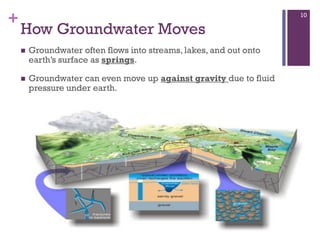
 Groundwater often flows into streams, lakes, and out onto
earth’s surface as springs.
 Groundwater can even move up against gravity due to fluid
pressure under earth.
+
Factors influencing the storage and
movement of groundwater.
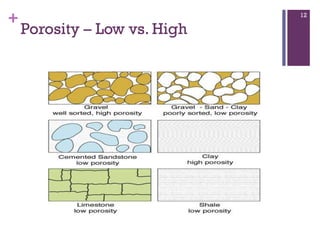
 Porosity:
 Amount of empty space or holes in sediment and rock that can
be used to store water.
 Depends on the size, shape, and packing of sediments in rock
and soil.
 The larger the sediments and the more sorted they are – the
more space to hold water.
 Permeability:
 How easily water flows through sediment and rock.
 Large pores = fast movement = highly permeable.
 Small pores = slow movement = highly impermeable.
 Clays have unconnected pores that do not allow water to travel
through it as well as sand and gravel.
June 27, 2013
11
+
Porosity – Low vs. High
12
+
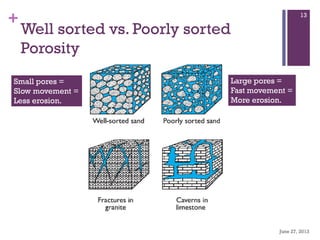
Well sorted vs. Poorly sorted
Porosity
June 27, 2013
13
Large pores =
Fast movement =
More erosion.
Small pores =
Slow movement =
Less erosion.
+
Common Groundwater Features
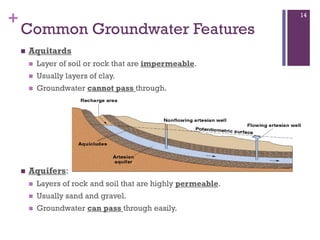
 Aquitards
 Layer of soil or rock that are impermeable.
 Usually layers of clay.
 Groundwater cannot pass through.
 Aquifers:
 Layers of rock and soil that are highly permeable.
 Usually sand and gravel.
 Groundwater can pass through easily.
14
+
Common groundwater features
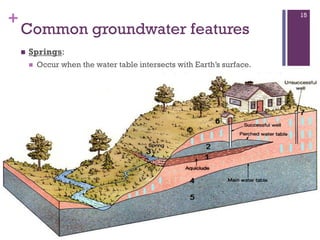
 Springs:
 Occur when the water table intersects with Earth’s surface.
15
+
Common groundwater features
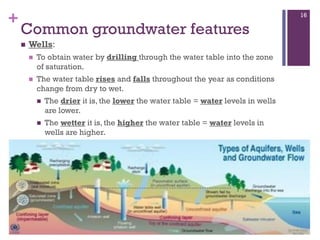
 Wells:
 To obtain water by drilling through the water table into the zone
of saturation.
 The water table rises and falls throughout the year as conditions
change from dry to wet.
 The drier it is, the lower the water table = water levels in wells
are lower.
 The wetter it is, the higher the water table = water levels in
wells are higher.
16
+
Common groundwater features
17
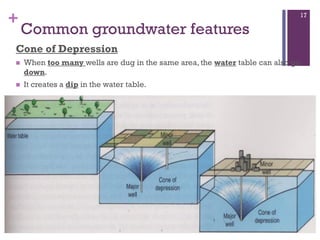
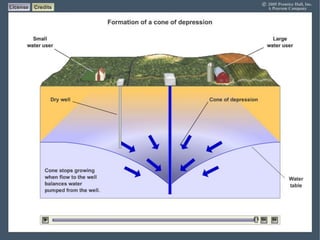
Cone of Depression
 When too many wells are dug in the same area, the water table can also go
down.
 It creates a dip in the water table.
+
June 27, 2013
18
+
Common groundwater features
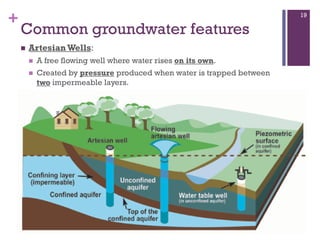
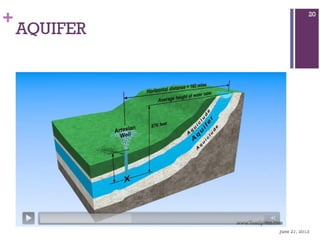
 Artesian Wells:
 A free flowing well where water rises on its own.
 Created by pressure produced when water is trapped between
two impermeable layers.
19
+
AQUIFER
June 27, 2013
20
+
Common Groundwater Features
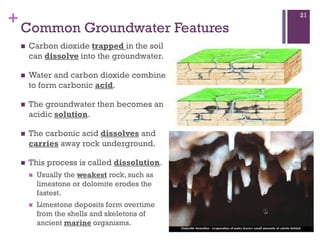
 Carbon dioxide trapped in the soil
can dissolve into the groundwater.
 Water and carbon dioxide combine
to form carbonic acid.
 The groundwater then becomes an
acidic solution.
 The carbonic acid dissolves and
carries away rock underground.
 This process is called dissolution.
 Usually the weakest rock, such as
limestone or dolomite erodes the
fastest.
 Limestone deposits form overtime
from the shells and skeletons of
ancient marine organisms.
21
+
Common Groundwater Features
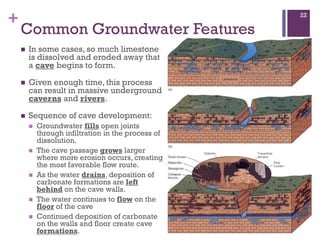
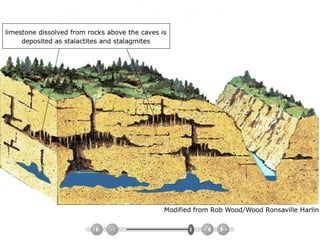
 In some cases, so much limestone
is dissolved and eroded away that
a cave begins to form.
 Given enough time, this process
can result in massive underground
caverns and rivers.
 Sequence of cave development:
 Groundwater fills open joints
through infiltration in the process of
dissolution.
 The cave passage grows larger
where more erosion occurs, creating
the most favorable flow route.
 As the water drains, deposition of
carbonate formations are left
behind on the cave walls.
 The water continues to flow on the
floor of the cave
 Continued deposition of carbonate
on the walls and floor create cave
formations. June 27, 2013
22
+
June 27, 2013
23
+
Cave Formations
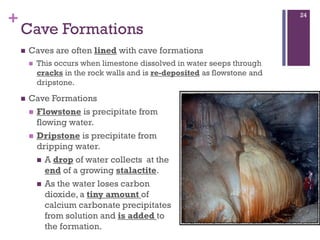
 Caves are often lined with cave formations
 This occurs when limestone dissolved in water seeps through
cracks in the rock walls and is re-deposited as flowstone and
dripstone.
24
 Cave Formations
 Flowstone is precipitate from
flowing water.
 Dripstone is precipitate from
dripping water.
 A drop of water collects at the
end of a growing stalactite.
 As the water loses carbon
dioxide, a tiny amount of
calcium carbonate precipitates
from solution and is added to
the formation.
+
Cave Formations
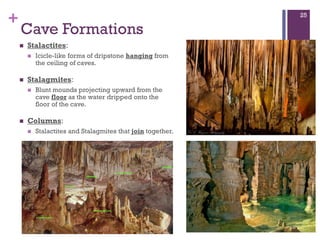
 Stalactites:
 Icicle-like forms of dripstone hanging from
the ceiling of caves.
 Stalagmites:
 Blunt mounds projecting upward from the
cave floor as the water dripped onto the
floor of the cave.
 Columns:
 Stalactites and Stalagmites that join together.
25
+
Sinkholes and Karst Topography
 In some regions, underground valleys and
caves are fairly common.
 As the limestone or dolomite is dissolved by
acidic groundwater, layers of earth are
hollowed out to form caves.
 Often times, after a cave has formed, the
ground above it is weakened.
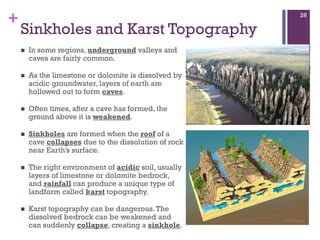
 Sinkholes are formed when the roof of a
cave collapses due to the dissolution of rock
near Earth’s surface.
 The right environment of acidic soil, usually
layers of limestone or dolomite bedrock,
and rainfall can produce a unique type of
landform called karst topography.
 Karst topography can be dangerous.The
dissolved bedrock can be weakened and
can suddenly collapse, creating a sinkhole.
26

Groundwater

  • 1.
    + Erosion - Groundwater …moving,transporting, and depositing sediment.
  • 2.
  • 3.
    + Groundwater  Water fromrainfall can hit Earth’s surface and do a number of things:  Slowly soak into the ground: Infiltration  Change to a gas: Evaporation  Flow across Earth’s surface: Runoff 3  Groundwater  When water infiltrates earth’s surface it becomes part of the groundwater.  Groundwater can cause erosion
  • 4.
    + Factors affecting infiltration June27, 2013 4  The intensity and duration of rainfall  The harder and longer it rains, the less infiltration  The water content of the soil  Is the soil saturated, or can rainfall soak into it?  Slope of the land  Water will run off and not soak into a steep slope.  Vegetation  Vegetation can slow runoff and allow the surface water to soak in.  Porosity and Permeability of rock  How easily water moves through pores (holes) in the rock and sediment.
  • 5.
    + Groundwater  Groundwater isthe water found beneath Earth’s surface that soaks into cracks and crevices in soil and rock.  Once water infiltrates the ground, it collects below earth’s surface as groundwater.  There are 3 layers:  Zone of aeration: layer of rock and soil above the water table where pores in rock and soil are NOT filled with water.  Water Table:The upper limit to the zone of saturation (like the surface of pool water).The water table follows the shape of the land.  Zone of saturation: Layer of rock and soil pores are completely filled with water (saturated). 5
  • 6.
  • 7.
  • 8.
    + How Groundwater Moves Groundwater does not move like an underground stream.  Movement of water is very slow (mm/km per year).  Gravity moves the water from high water table to low water table. 8
  • 9.
  • 10.
    + How Groundwater Moves 10 Groundwater often flows into streams, lakes, and out onto earth’s surface as springs.  Groundwater can even move up against gravity due to fluid pressure under earth.
  • 11.
    + Factors influencing thestorage and movement of groundwater.  Porosity:  Amount of empty space or holes in sediment and rock that can be used to store water.  Depends on the size, shape, and packing of sediments in rock and soil.  The larger the sediments and the more sorted they are – the more space to hold water.  Permeability:  How easily water flows through sediment and rock.  Large pores = fast movement = highly permeable.  Small pores = slow movement = highly impermeable.  Clays have unconnected pores that do not allow water to travel through it as well as sand and gravel. June 27, 2013 11
  • 12.
    + Porosity – Lowvs. High 12
  • 13.
    + Well sorted vs.Poorly sorted Porosity June 27, 2013 13 Large pores = Fast movement = More erosion. Small pores = Slow movement = Less erosion.
  • 14.
    + Common Groundwater Features Aquitards  Layer of soil or rock that are impermeable.  Usually layers of clay.  Groundwater cannot pass through.  Aquifers:  Layers of rock and soil that are highly permeable.  Usually sand and gravel.  Groundwater can pass through easily. 14
  • 15.
    + Common groundwater features Springs:  Occur when the water table intersects with Earth’s surface. 15
  • 16.
    + Common groundwater features Wells:  To obtain water by drilling through the water table into the zone of saturation.  The water table rises and falls throughout the year as conditions change from dry to wet.  The drier it is, the lower the water table = water levels in wells are lower.  The wetter it is, the higher the water table = water levels in wells are higher. 16
  • 17.
    + Common groundwater features 17 Coneof Depression  When too many wells are dug in the same area, the water table can also go down.  It creates a dip in the water table.
  • 18.
  • 19.
    + Common groundwater features Artesian Wells:  A free flowing well where water rises on its own.  Created by pressure produced when water is trapped between two impermeable layers. 19
  • 20.
  • 21.
    + Common Groundwater Features Carbon dioxide trapped in the soil can dissolve into the groundwater.  Water and carbon dioxide combine to form carbonic acid.  The groundwater then becomes an acidic solution.  The carbonic acid dissolves and carries away rock underground.  This process is called dissolution.  Usually the weakest rock, such as limestone or dolomite erodes the fastest.  Limestone deposits form overtime from the shells and skeletons of ancient marine organisms. 21
  • 22.
    + Common Groundwater Features In some cases, so much limestone is dissolved and eroded away that a cave begins to form.  Given enough time, this process can result in massive underground caverns and rivers.  Sequence of cave development:  Groundwater fills open joints through infiltration in the process of dissolution.  The cave passage grows larger where more erosion occurs, creating the most favorable flow route.  As the water drains, deposition of carbonate formations are left behind on the cave walls.  The water continues to flow on the floor of the cave  Continued deposition of carbonate on the walls and floor create cave formations. June 27, 2013 22
  • 23.
  • 24.
    + Cave Formations  Cavesare often lined with cave formations  This occurs when limestone dissolved in water seeps through cracks in the rock walls and is re-deposited as flowstone and dripstone. 24  Cave Formations  Flowstone is precipitate from flowing water.  Dripstone is precipitate from dripping water.  A drop of water collects at the end of a growing stalactite.  As the water loses carbon dioxide, a tiny amount of calcium carbonate precipitates from solution and is added to the formation.
  • 25.
    + Cave Formations  Stalactites: Icicle-like forms of dripstone hanging from the ceiling of caves.  Stalagmites:  Blunt mounds projecting upward from the cave floor as the water dripped onto the floor of the cave.  Columns:  Stalactites and Stalagmites that join together. 25
  • 26.
    + Sinkholes and KarstTopography  In some regions, underground valleys and caves are fairly common.  As the limestone or dolomite is dissolved by acidic groundwater, layers of earth are hollowed out to form caves.  Often times, after a cave has formed, the ground above it is weakened.  Sinkholes are formed when the roof of a cave collapses due to the dissolution of rock near Earth’s surface.  The right environment of acidic soil, usually layers of limestone or dolomite bedrock, and rainfall can produce a unique type of landform called karst topography.  Karst topography can be dangerous.The dissolved bedrock can be weakened and can suddenly collapse, creating a sinkhole. 26