Groundwater

Dr. V. R Ghodake
Sinhgad College Of Engg., Pune.
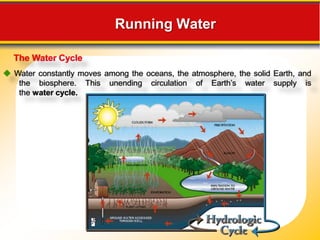
The Water Cycle
Running Water
 Water constantly moves among the oceans, the atmosphere, the solid Earth, and
the biosphere. This unending circulation of Earth’s water supply is
the water cycle.
The Water Cycle
Running Water
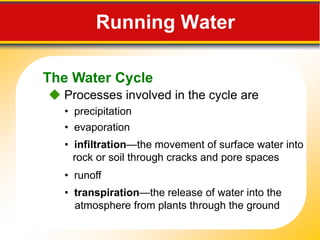
 Processes involved in the cycle are
• infiltration—the movement of surface water into
rock or soil through cracks and pore spaces
• transpiration—the release of water into the
atmosphere from plants through the ground
• precipitation
• evaporation
• runoff
Earth’s Water Balance
Running Water
 Balance in the water cycle means the
average annual precipitation over Earth
equals the amount of water that
evaporates.
Distribution of Earth’s Water
Stream flow
Running Water
 The ability of a stream to erode and
transport materials depends largely on its
velocity.
• Gradient is the slope or steepness of a stream
channel.
Streamflow
Running Water
• Channel Characteristics
• Discharge of a stream is the volume of water
flowing past a certain point in a given unit of time.
- The stream channel is the course the water in
a stream follows.
Changes from Upstream to Downstream
Running Water
• Cross-sectional view of a stream
• From head (source) to mouth
 Profile
- Profile is a smooth curve
- Gradient decreases from the head to the
mouth
Sea Level and Streams
Floods and Flood Control
The Work of Streams
 A flood occurs when the discharge of a
stream becomes so great that it exceeds
the capacity of its channel and overflows its
banks.
 Measures to control flooding include
artificial levees, flood control dams, and
placing limits on floodplain development.
Ohio River Flooding
Drainage Basins
The Work of Streams
 A drainage basin is the land area that
contributes water to a stream.
 A divide is an imaginary line that separates
the drainage basins of one stream from
another.
Distribution and Movement of Water
Underground
Water Beneath the Surface
 Much of the water in soil seeps downward
until it reaches the zone of saturation.
 The zone of saturation is the area where
water fills all of the open spaces in
sediment and rock.
• Groundwater is the water within this zone.
• The water table is the upper level of the
saturation zone of groundwater.
Distribution and Movement of Water
Underground
Water Beneath the Surface
 Movement
• Groundwater moves by twisting and turning
through interconnected small openings.
• The groundwater moves more slowly when the
pore spaces are smaller.
 Movement
• Porosity
• Permeability
- The percentage of pore spaces
- Determines how much groundwater can be stored
- Ability to transmit water through connected
pore spaces
- Aquifers are permeable rock layers or sediments
that transmit groundwater freely
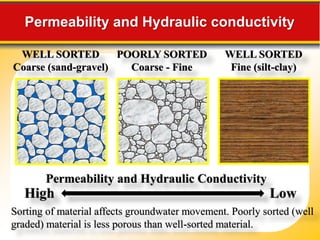
WELL SORTED
Coarse (sand-gravel)
POORLY SORTED
Coarse - Fine
WELL SORTED
Fine (silt-clay)
Permeability and Hydraulic Conductivity
High Low
Sorting of material affects groundwater movement. Poorly sorted (well
graded) material is less porous than well-sorted material.
Permeability and Hydraulic conductivity
Features Associated with
Subsurface Water
Springs
Water Beneath the Surface
 A spring forms whenever the water table
intersects the ground surface.
• Intermittent hot springs
 Hot Springs
 Geysers
• Water is 6–9ºC warmer than the mean air
temperature of the locality.
• Water is heated by hot igneous rock.
• Water turns to steam and erupts.
Geyser Eruption Cycle
Wells
Water Beneath the Surface
 A well is a hole bored into the zone of
saturation.
• An artesian well is any formation in which
groundwater rises on its own under pressure.
• Pumping can cause a drawdown (lowering) of
the water table.
• Pumping can form a cone of depression in the
water table.
Cone of Depression
Caverns
Water Beneath the Surface
 Erosion forms most caverns at or below the
water table in the zone of saturation.
 A cavern is a naturally formed underground
chamber.
 Travertine is a form of limestone that is
deposited by hot springs or as a cave
deposit.
Dissolving of Groundwater
Creates Caverns
Caverns
Water Beneath the Surface
 Characteristics of features found within
caverns
• Formed in the zone of aeration
• Composed of dripstone
• Formed from calcite deposited as dripping
water evaporates
• Common features include stalactites (hanging
from the ceiling) and stalagmites (growing
upward from the floor).
Karst Topography
Water Beneath the Surface
 Formed by dissolving rock at, or near,
Earth's surface
• Sinkholes—surface depressions
- Sinkholes form when bedrock dissolves and
caverns collapse.
• Caves and caverns
 Common features
 Area lacks good surface drainage.
Sinkhole Formation
Potholes
Water Beneath the Surface
Groundwater

Groundwater

  • 1.
    Groundwater  Dr. V. RGhodake Sinhgad College Of Engg., Pune.
  • 2.
    The Water Cycle RunningWater  Water constantly moves among the oceans, the atmosphere, the solid Earth, and the biosphere. This unending circulation of Earth’s water supply is the water cycle.
  • 3.
    The Water Cycle RunningWater  Processes involved in the cycle are • infiltration—the movement of surface water into rock or soil through cracks and pore spaces • transpiration—the release of water into the atmosphere from plants through the ground • precipitation • evaporation • runoff
  • 4.
    Earth’s Water Balance RunningWater  Balance in the water cycle means the average annual precipitation over Earth equals the amount of water that evaporates.
  • 5.
  • 6.
    Stream flow Running Water The ability of a stream to erode and transport materials depends largely on its velocity. • Gradient is the slope or steepness of a stream channel.
  • 7.
    Streamflow Running Water • ChannelCharacteristics • Discharge of a stream is the volume of water flowing past a certain point in a given unit of time. - The stream channel is the course the water in a stream follows.
  • 8.
    Changes from Upstreamto Downstream Running Water • Cross-sectional view of a stream • From head (source) to mouth  Profile - Profile is a smooth curve - Gradient decreases from the head to the mouth
  • 9.
  • 10.
    Floods and FloodControl The Work of Streams  A flood occurs when the discharge of a stream becomes so great that it exceeds the capacity of its channel and overflows its banks.  Measures to control flooding include artificial levees, flood control dams, and placing limits on floodplain development.
  • 11.
  • 12.
    Drainage Basins The Workof Streams  A drainage basin is the land area that contributes water to a stream.  A divide is an imaginary line that separates the drainage basins of one stream from another.
  • 13.
    Distribution and Movementof Water Underground Water Beneath the Surface  Much of the water in soil seeps downward until it reaches the zone of saturation.  The zone of saturation is the area where water fills all of the open spaces in sediment and rock. • Groundwater is the water within this zone. • The water table is the upper level of the saturation zone of groundwater.
  • 14.
    Distribution and Movementof Water Underground Water Beneath the Surface  Movement • Groundwater moves by twisting and turning through interconnected small openings. • The groundwater moves more slowly when the pore spaces are smaller.
  • 15.
     Movement • Porosity •Permeability - The percentage of pore spaces - Determines how much groundwater can be stored - Ability to transmit water through connected pore spaces - Aquifers are permeable rock layers or sediments that transmit groundwater freely
  • 16.
    WELL SORTED Coarse (sand-gravel) POORLYSORTED Coarse - Fine WELL SORTED Fine (silt-clay) Permeability and Hydraulic Conductivity High Low Sorting of material affects groundwater movement. Poorly sorted (well graded) material is less porous than well-sorted material. Permeability and Hydraulic conductivity
  • 17.
  • 18.
    Springs Water Beneath theSurface  A spring forms whenever the water table intersects the ground surface. • Intermittent hot springs  Hot Springs  Geysers • Water is 6–9ºC warmer than the mean air temperature of the locality. • Water is heated by hot igneous rock. • Water turns to steam and erupts.
  • 19.
  • 20.
    Wells Water Beneath theSurface  A well is a hole bored into the zone of saturation. • An artesian well is any formation in which groundwater rises on its own under pressure. • Pumping can cause a drawdown (lowering) of the water table. • Pumping can form a cone of depression in the water table.
  • 21.
  • 22.
    Caverns Water Beneath theSurface  Erosion forms most caverns at or below the water table in the zone of saturation.  A cavern is a naturally formed underground chamber.  Travertine is a form of limestone that is deposited by hot springs or as a cave deposit.
  • 23.
  • 24.
    Caverns Water Beneath theSurface  Characteristics of features found within caverns • Formed in the zone of aeration • Composed of dripstone • Formed from calcite deposited as dripping water evaporates • Common features include stalactites (hanging from the ceiling) and stalagmites (growing upward from the floor).
  • 25.
    Karst Topography Water Beneaththe Surface  Formed by dissolving rock at, or near, Earth's surface • Sinkholes—surface depressions - Sinkholes form when bedrock dissolves and caverns collapse. • Caves and caverns  Common features  Area lacks good surface drainage.
  • 26.
  • 27.
  • 29.