Geotechnics & Applied Geology 
• Prepare by : 
• Rashmik Diwani 
• Tushar Pokar 
• Nikul Vasani 
• Hardik Chaudhari 
• Setul Paravadiya 
• Guidance by: 
• Kaustubh sane 
• HJD Institute Of Technical Education & Research
HYDROLOGIC CYCLE & 
GROUND WATER
Topic 
• Hydrologic Cycle 
• Sources Of Ground water 
• Occurance of Ground water 
• Terms related to Ground water 
• Types of Aquifers 
• Different Rocks as Aquifers 
• Artificial Recharge
Water never leaves the Earth. It is constantly being 
cycled through the atmosphere, ocean, and land. 
This process, known as the water cycle, is driven by 
energy from the sun. The water cycle is crucial to the 
existence of life on our planet.
Evaporation 
• During part of the water 
cycle, the sun heats up 
liquid water and changes 
it to a gas by the process 
of evaporation. Water 
that evaporates from 
Earth’s oceans, lakes, 
rivers, and moist soil rises 
up into the atmosphere.
Transpiration 
• The process of 
evaporation from 
plants is called 
transpiration. (In 
other words, it’s 
like plants 
sweating.)
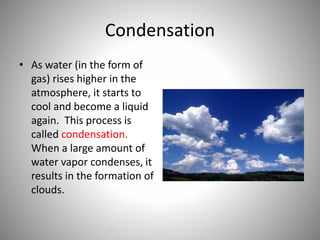
Condensation 
• As water (in the form of 
gas) rises higher in the 
atmosphere, it starts to 
cool and become a liquid 
again. This process is 
called condensation. 
When a large amount of 
water vapor condenses, it 
results in the formation of 
clouds.
Precipitation 
• When the water in the 
clouds gets too heavy, 
the water falls back to 
the earth. This is called 
precipitation.
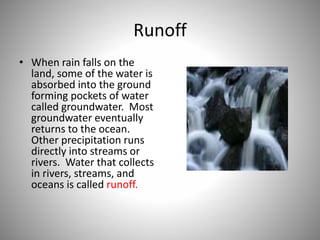
Runoff 
• When rain falls on the 
land, some of the water is 
absorbed into the ground 
forming pockets of water 
called groundwater. Most 
groundwater eventually 
returns to the ocean. 
Other precipitation runs 
directly into streams or 
rivers. Water that collects 
in rivers, streams, and 
oceans is called runoff.
Meteorological factors affecting 
surface (over soil) runoff 
- Type of precipitation 
- Rainfall intensity 
- Rainfall amount 
- Rainfall duration 
- Distribution of rainfall over the drainage basin 
- Direction of storm movement 
- Precipitation that occurred earlier and resulting soil 
moisture 
- Meteorological conditions that affect 
evapotranspiration
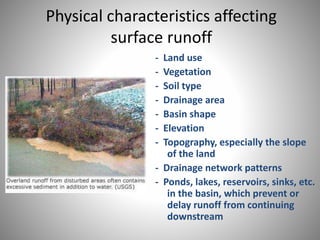
Physical characteristics affecting 
surface runoff 
- Land use 
- Vegetation 
- Soil type 
- Drainage area 
- Basin shape 
- Elevation 
- Topography, especially the slope 
of the land 
- Drainage network patterns 
- Ponds, lakes, reservoirs, sinks, etc. 
in the basin, which prevent or 
delay runoff from continuing 
downstream
Groundwater begins as INFILTRATION 
Precipitation falls and 
infiltrates into the 
subsurface soil and 
rock 
•Can remain in shallow soil layer 
•Might seep into a stream bank 
•May infiltrate deeper, recharging an aquifer 
•May travel long distances 
•May stay in storage as ground water
Factors affecting infiltration 
• Precipitation (greatest factor) 
• Magnitude, intensity, duration 
• Characteristics (rain, snow) 
• Soil Characteristics 
– Clay absorbs less water at a slower rate than sand 
• Soil Saturation 
– Higher saturation leads to more runoff instead 
• Land Cover 
• Slope of the Land 
– Hills enhance runoff velocity 
• Evapotranspiration 
– Plants use soil moisture to grow and transpire
Source of Ground Water 
• springs 
• Infiltration Galleries 
• Well 
• Karez
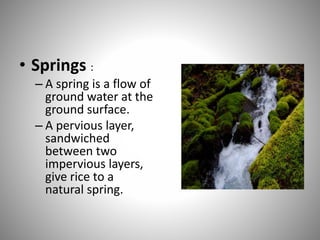
• Springs : 
– A spring is a flow of 
ground water at the 
ground surface. 
– A pervious layer, 
sandwiched 
between two 
impervious layers, 
give rice to a 
natural spring.
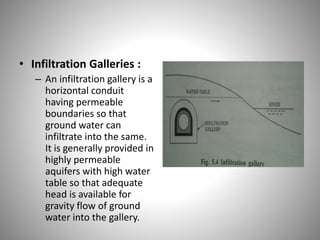
• Infiltration Galleries : 
– An infiltration gallery is a 
horizontal conduit 
having permeable 
boundaries so that 
ground water can 
infiltrate into the same. 
It is generally provided in 
highly permeable 
aquifers with high water 
table so that adequate 
head is available for 
gravity flow of ground 
water into the gallery.
Occurance of Ground Water 
• The rainfall that percolates below the ground 
surface, passes through the voids of the rocks, 
and joints the water table. This voids are 
generally interconnected, permitting the 
movement of the ground water. 
• Occurance of ground water mainly depends 
upon two geological features : 
– The porosity of the rocks 
– The permeability of the rocks
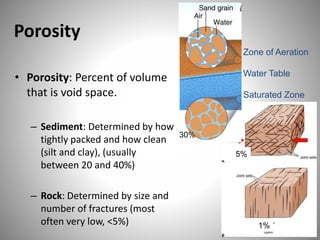
Porosity 
• Porosity: Percent of volume 
that is void space. 
– Sediment: Determined by how 
tightly packed and how clean 
(silt and clay), (usually 
between 20 and 40%) 
Zone of Aeration 
Water Table 
Saturated Zone 
5% 
30% 
– Rock: Determined by size and 
number of fractures (most 
often very low, <5%) 1%
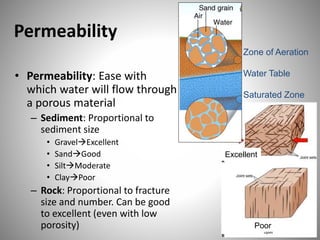
Permeability 
• Permeability: Ease with 
which water will flow through 
a porous material 
– Sediment: Proportional to 
sediment size 
• GravelExcellent 
• SandGood 
• SiltModerate 
• ClayPoor 
– Rock: Proportional to fracture 
size and number. Can be good 
to excellent (even with low 
porosity) 
Zone of Aeration 
Water Table 
Saturated Zone 
Excellent 
Poor
Terms Related to Ground Water 
• Aquifer 
• Aquiclude 
• Aquitard 
• Aquifuge 
• Porosity 
• Specific yield 
• Specific retention 
• Storage co-efficient 
• Co-efficient of permeability 
• Co-efficient of transmissibility 
• Water table
• Aquifer: 
Saturated 
sediment or 
porous rock that is 
sufficiently 
permeable to 
supply useable 
amounts of water
• Aquiclude : 
– An aquiclude may be define as a geological 
formation of relatively in permeable material 
which permits storage of water but it is not 
capable of transmitting water in sufficient 
quantity. 
– For example, 
• Clay
• Aquitard : 
– A geological formation that as poor permeability, 
but through which seepage is possible, and hence, 
it does not yield water freely to wells. 
– It may be transmit vertically appreciable 
quantities of water to or from adjacent aquifers. 
– For example, 
• Sandy clay
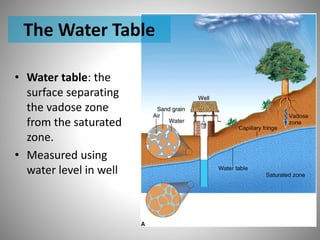
The Water Table 
• Water table: the 
surface separating 
the vadose zone 
from the saturated 
zone. 
• Measured using 
water level in well
Types of Aquifers 
• Unconfined 
aquifer 
• Confined 
aquifer
Unconfined and Confined Aquifer 
• Unconfined Aquifer: open to atmosphere 
e.g., overlain by permeable rocks and soils 
• Confined aquifer: sandwiched between 
aquitards 
–Artesian System: Water rises above the 
level in aquifer because of hydrostatic 
pressure
Different Rocks as Aquifers 
• Igneous rocks : 
– It are either intrusive or extrusive in nature. 
– The intrusive igneous rocks like Granites, 
Syenites. etc.
• Sedimentary rocks : 
– Among sedimentary rocks, the most common ones 
are shales, sandstones and limestone shales are 
impermeable rocks, though considerably porous. 
– Clay may have 50-60% porosity. 
– For example, 
• Gravels 
• Sand beds 
• Sandstones 
• limestones
• Metamorphic rocks : 
–Non-foliated metamorphic rocks like 
marble and quartzite are generally 
impermeable. 
–These rocks, thus behave as 
aquicludes.
Artificial Recharge 
• Due to rapid industrialisation, 
population increase, intensive 
agriculture, etc. the use of water has 
been considerably increased. 
• For these purpose water is pumped 
from the ground water sources.
Methods of Recharging 
• Recharging of open wells 
• Infiltration bore well 
• Hidden dam 
• Infiltration tank 
• Infiltration tank in river bed 
• Infiltration borewell or tube well in river bed 
• Recharging of lost rivers 
• Check dam
Hydrologic cycle & groundwater

Hydrologic cycle & groundwater

  • 1.
    Geotechnics & AppliedGeology • Prepare by : • Rashmik Diwani • Tushar Pokar • Nikul Vasani • Hardik Chaudhari • Setul Paravadiya • Guidance by: • Kaustubh sane • HJD Institute Of Technical Education & Research
  • 2.
    HYDROLOGIC CYCLE & GROUND WATER
  • 3.
    Topic • HydrologicCycle • Sources Of Ground water • Occurance of Ground water • Terms related to Ground water • Types of Aquifers • Different Rocks as Aquifers • Artificial Recharge
  • 5.
    Water never leavesthe Earth. It is constantly being cycled through the atmosphere, ocean, and land. This process, known as the water cycle, is driven by energy from the sun. The water cycle is crucial to the existence of life on our planet.
  • 6.
    Evaporation • Duringpart of the water cycle, the sun heats up liquid water and changes it to a gas by the process of evaporation. Water that evaporates from Earth’s oceans, lakes, rivers, and moist soil rises up into the atmosphere.
  • 7.
    Transpiration • Theprocess of evaporation from plants is called transpiration. (In other words, it’s like plants sweating.)
  • 8.
    Condensation • Aswater (in the form of gas) rises higher in the atmosphere, it starts to cool and become a liquid again. This process is called condensation. When a large amount of water vapor condenses, it results in the formation of clouds.
  • 9.
    Precipitation • Whenthe water in the clouds gets too heavy, the water falls back to the earth. This is called precipitation.
  • 10.
    Runoff • Whenrain falls on the land, some of the water is absorbed into the ground forming pockets of water called groundwater. Most groundwater eventually returns to the ocean. Other precipitation runs directly into streams or rivers. Water that collects in rivers, streams, and oceans is called runoff.
  • 11.
    Meteorological factors affecting surface (over soil) runoff - Type of precipitation - Rainfall intensity - Rainfall amount - Rainfall duration - Distribution of rainfall over the drainage basin - Direction of storm movement - Precipitation that occurred earlier and resulting soil moisture - Meteorological conditions that affect evapotranspiration
  • 12.
    Physical characteristics affecting surface runoff - Land use - Vegetation - Soil type - Drainage area - Basin shape - Elevation - Topography, especially the slope of the land - Drainage network patterns - Ponds, lakes, reservoirs, sinks, etc. in the basin, which prevent or delay runoff from continuing downstream
  • 13.
    Groundwater begins asINFILTRATION Precipitation falls and infiltrates into the subsurface soil and rock •Can remain in shallow soil layer •Might seep into a stream bank •May infiltrate deeper, recharging an aquifer •May travel long distances •May stay in storage as ground water
  • 14.
    Factors affecting infiltration • Precipitation (greatest factor) • Magnitude, intensity, duration • Characteristics (rain, snow) • Soil Characteristics – Clay absorbs less water at a slower rate than sand • Soil Saturation – Higher saturation leads to more runoff instead • Land Cover • Slope of the Land – Hills enhance runoff velocity • Evapotranspiration – Plants use soil moisture to grow and transpire
  • 15.
    Source of GroundWater • springs • Infiltration Galleries • Well • Karez
  • 16.
    • Springs : – A spring is a flow of ground water at the ground surface. – A pervious layer, sandwiched between two impervious layers, give rice to a natural spring.
  • 17.
    • Infiltration Galleries: – An infiltration gallery is a horizontal conduit having permeable boundaries so that ground water can infiltrate into the same. It is generally provided in highly permeable aquifers with high water table so that adequate head is available for gravity flow of ground water into the gallery.
  • 18.
    Occurance of GroundWater • The rainfall that percolates below the ground surface, passes through the voids of the rocks, and joints the water table. This voids are generally interconnected, permitting the movement of the ground water. • Occurance of ground water mainly depends upon two geological features : – The porosity of the rocks – The permeability of the rocks
  • 19.
    Porosity • Porosity:Percent of volume that is void space. – Sediment: Determined by how tightly packed and how clean (silt and clay), (usually between 20 and 40%) Zone of Aeration Water Table Saturated Zone 5% 30% – Rock: Determined by size and number of fractures (most often very low, <5%) 1%
  • 20.
    Permeability • Permeability:Ease with which water will flow through a porous material – Sediment: Proportional to sediment size • GravelExcellent • SandGood • SiltModerate • ClayPoor – Rock: Proportional to fracture size and number. Can be good to excellent (even with low porosity) Zone of Aeration Water Table Saturated Zone Excellent Poor
  • 21.
    Terms Related toGround Water • Aquifer • Aquiclude • Aquitard • Aquifuge • Porosity • Specific yield • Specific retention • Storage co-efficient • Co-efficient of permeability • Co-efficient of transmissibility • Water table
  • 22.
    • Aquifer: Saturated sediment or porous rock that is sufficiently permeable to supply useable amounts of water
  • 23.
    • Aquiclude : – An aquiclude may be define as a geological formation of relatively in permeable material which permits storage of water but it is not capable of transmitting water in sufficient quantity. – For example, • Clay
  • 24.
    • Aquitard : – A geological formation that as poor permeability, but through which seepage is possible, and hence, it does not yield water freely to wells. – It may be transmit vertically appreciable quantities of water to or from adjacent aquifers. – For example, • Sandy clay
  • 25.
    The Water Table • Water table: the surface separating the vadose zone from the saturated zone. • Measured using water level in well
  • 26.
    Types of Aquifers • Unconfined aquifer • Confined aquifer
  • 27.
    Unconfined and ConfinedAquifer • Unconfined Aquifer: open to atmosphere e.g., overlain by permeable rocks and soils • Confined aquifer: sandwiched between aquitards –Artesian System: Water rises above the level in aquifer because of hydrostatic pressure
  • 28.
    Different Rocks asAquifers • Igneous rocks : – It are either intrusive or extrusive in nature. – The intrusive igneous rocks like Granites, Syenites. etc.
  • 29.
    • Sedimentary rocks: – Among sedimentary rocks, the most common ones are shales, sandstones and limestone shales are impermeable rocks, though considerably porous. – Clay may have 50-60% porosity. – For example, • Gravels • Sand beds • Sandstones • limestones
  • 30.
    • Metamorphic rocks: –Non-foliated metamorphic rocks like marble and quartzite are generally impermeable. –These rocks, thus behave as aquicludes.
  • 31.
    Artificial Recharge •Due to rapid industrialisation, population increase, intensive agriculture, etc. the use of water has been considerably increased. • For these purpose water is pumped from the ground water sources.
  • 32.
    Methods of Recharging • Recharging of open wells • Infiltration bore well • Hidden dam • Infiltration tank • Infiltration tank in river bed • Infiltration borewell or tube well in river bed • Recharging of lost rivers • Check dam