CHAPTER 1 – ENVIRONMENTAL CHANGE AND
TRAIT DISTRIBUTION
1.6.1:WARM-UP
Warm-Up
Replace a nonscientific explanation for changes in a moth population with your own scientific explanations.
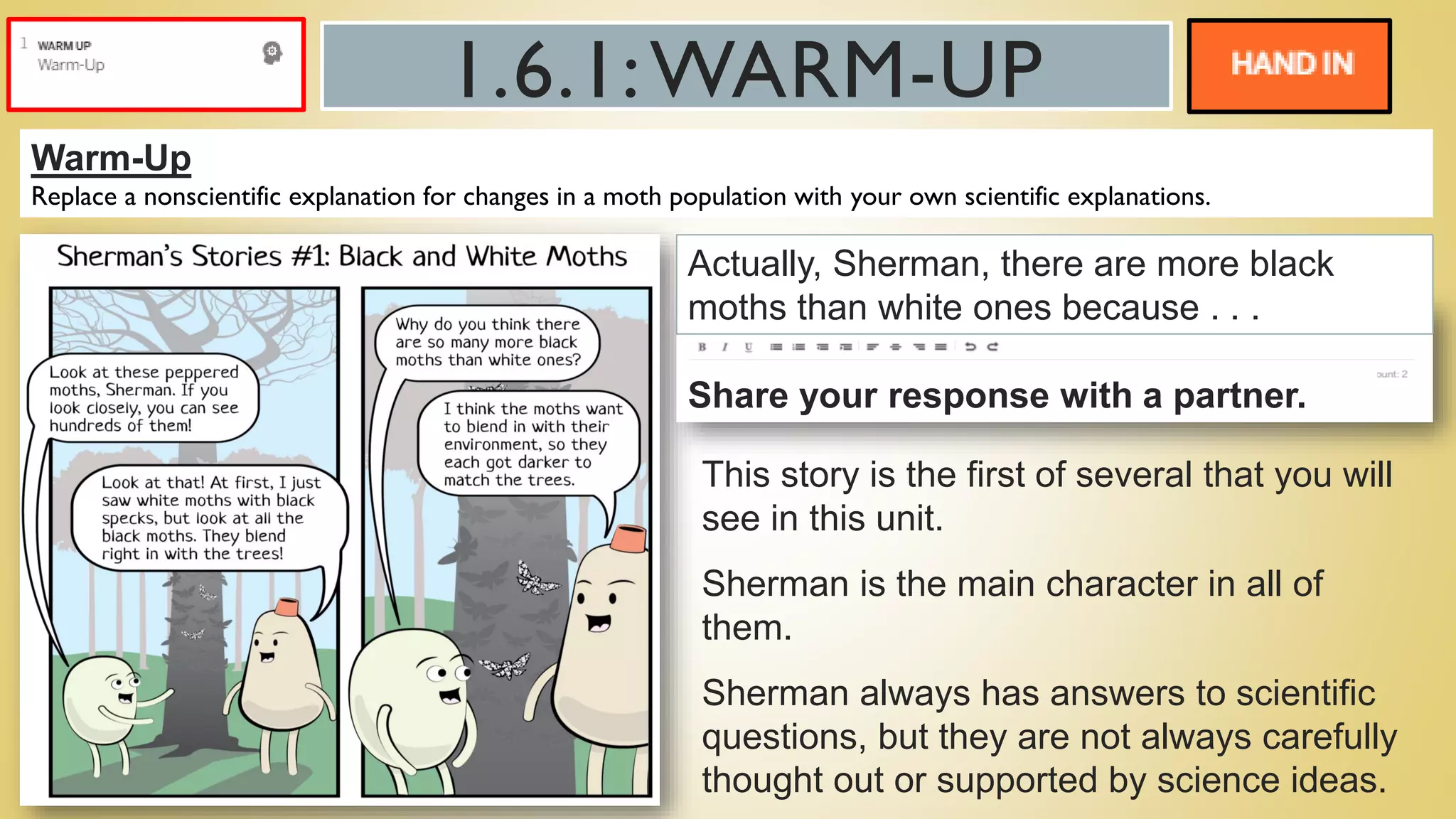
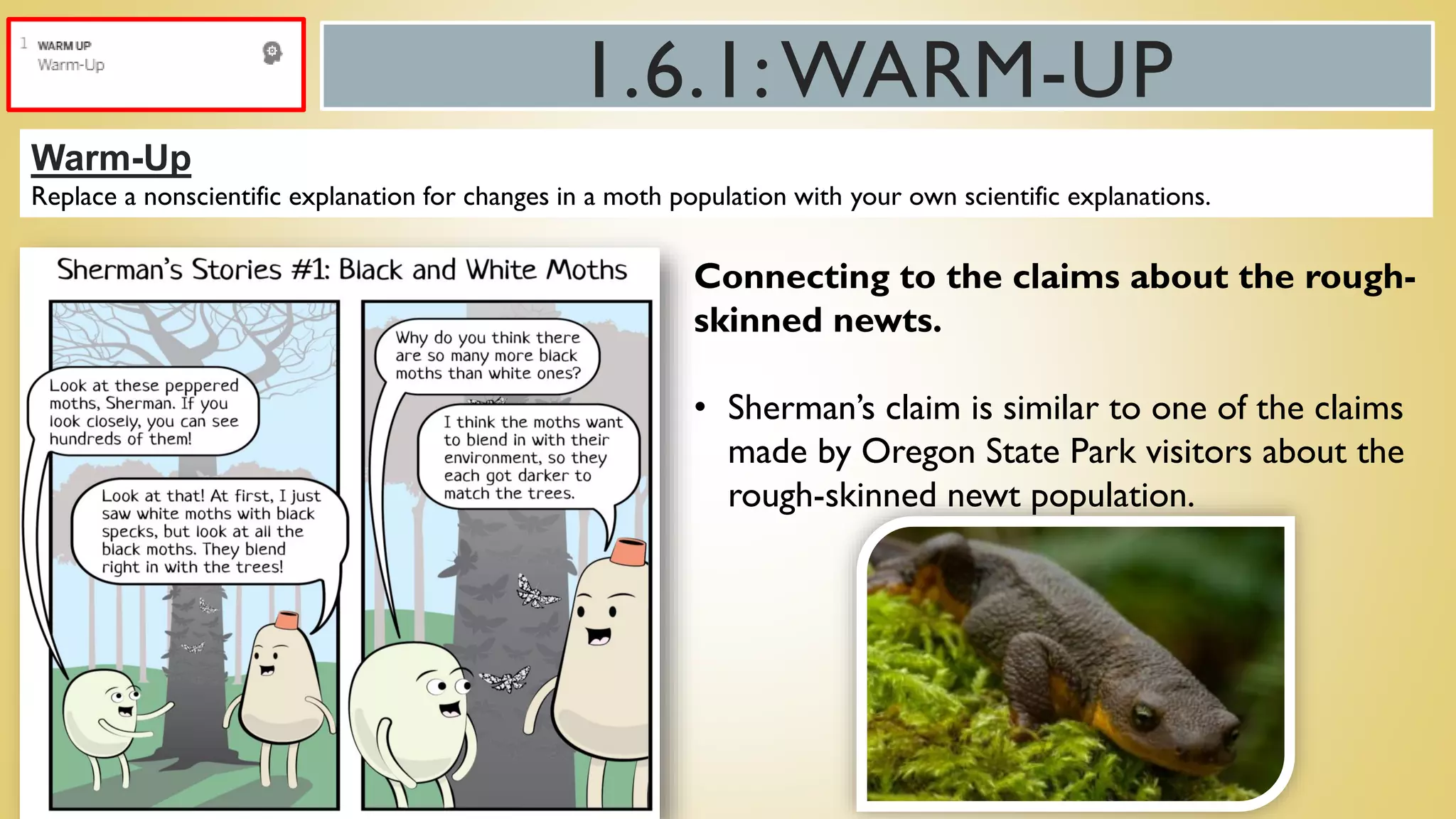
Actually, Sherman, there are more black
moths than white ones because . . .
Share your response with a partner.
This story is the first of several that you will
see in this unit.
Sherman is the main character in all of
them.
Sherman always has answers to scientific
questions, but they are not always carefully
thought out or supported by science ideas.
1.6.1:WARM-UP
Warm-Up
Replace a nonscientific explanation for changes in a moth population with your own scientific explanations.
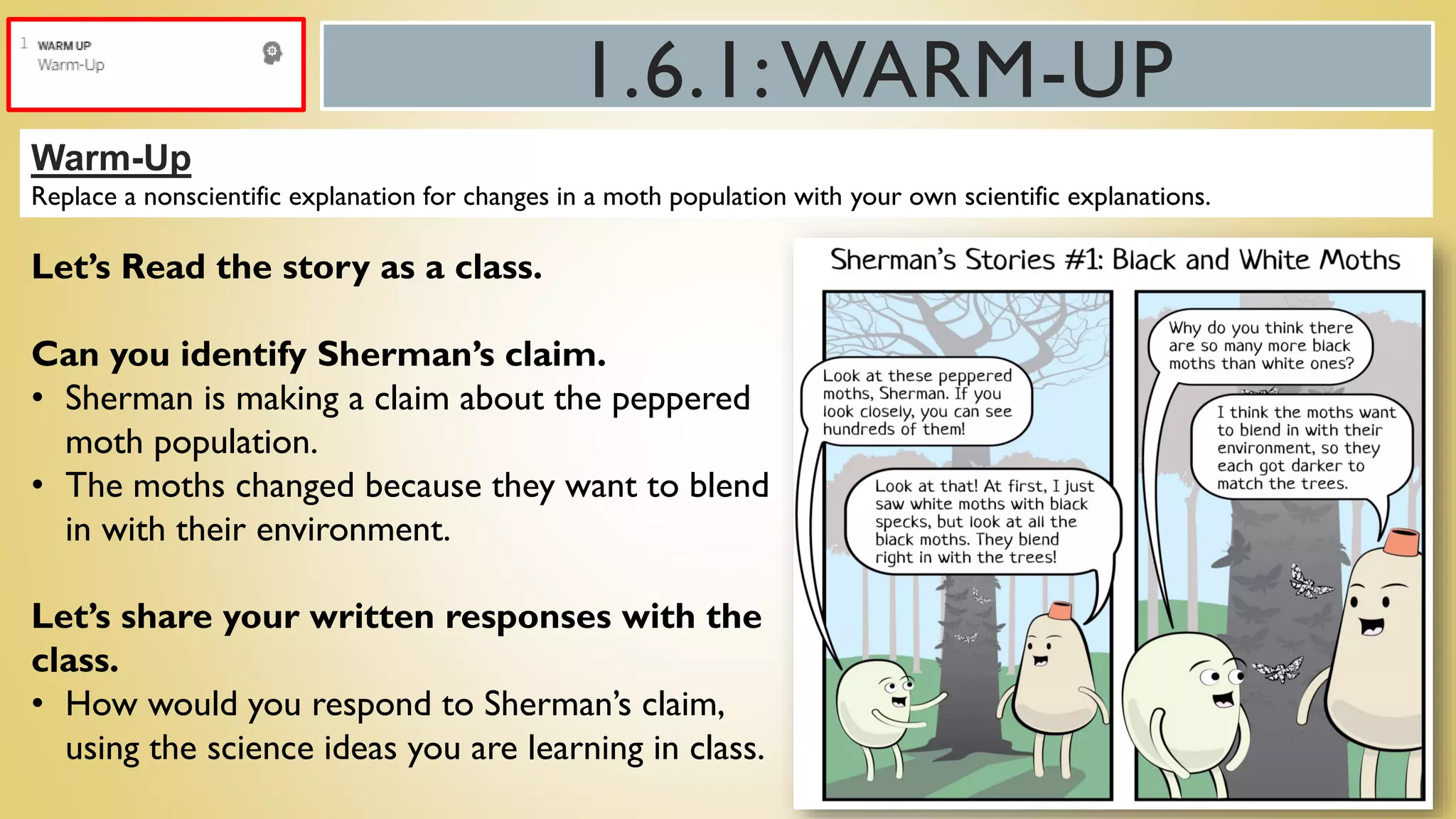
Let’s Read the story as a class.
Can you identify Sherman’s claim.
• Sherman is making a claim about the peppered
moth population.
• The moths changed because they want to blend
in with their environment.
Let’s share your written responses with the
class.
• How would you respond to Sherman’s claim,
using the science ideas you are learning in class.
1.6.1:WARM-UP
Warm-Up
Replace a nonscientific explanation for changes in a moth population with your own scientific explanations.
Actually, Sherman, there are more black
moths than white ones because . . .
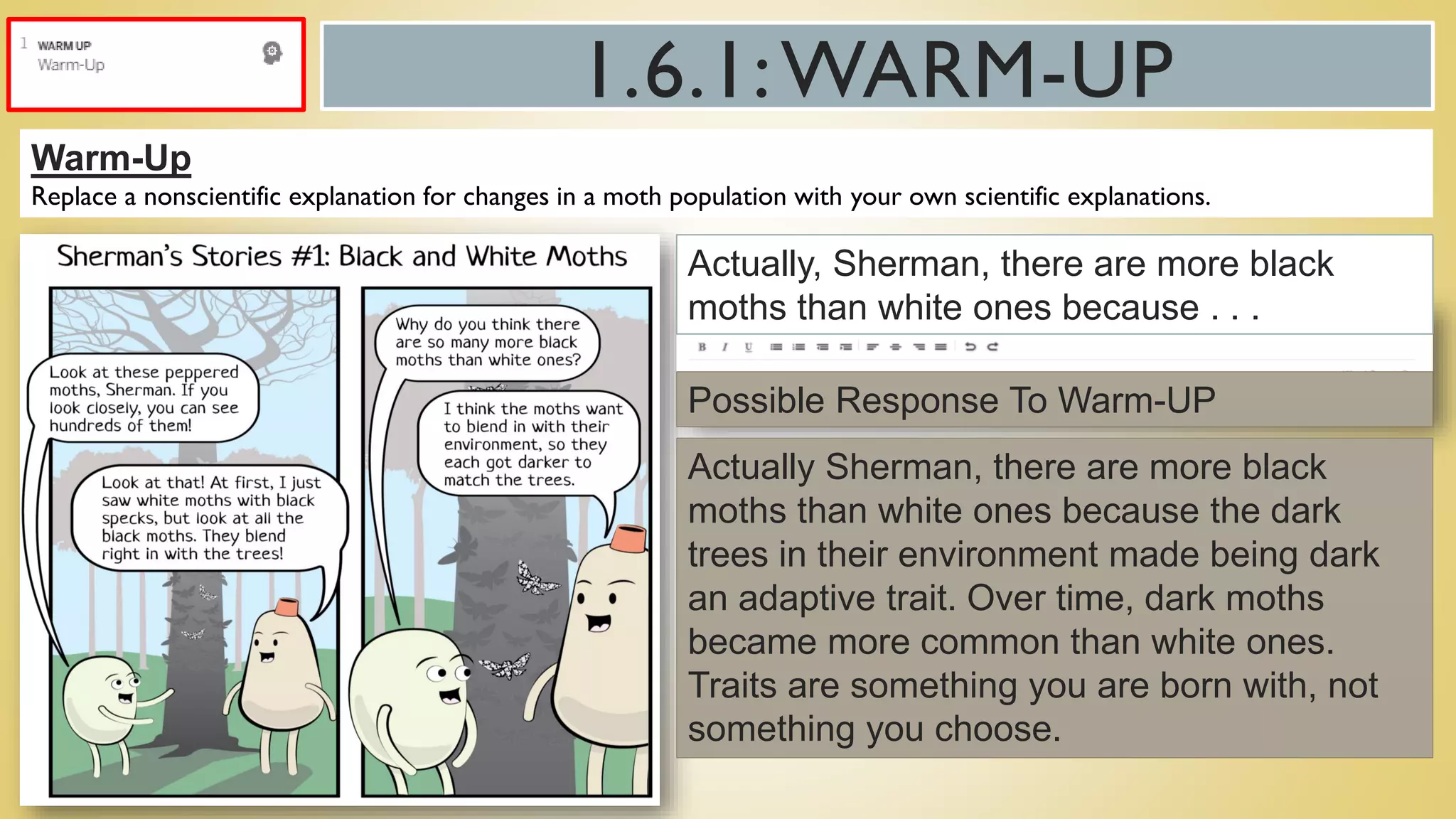
Actually Sherman, there are more black
moths than white ones because the dark
trees in their environment made being dark
an adaptive trait. Over time, dark moths
became more common than white ones.
Traits are something you are born with, not
something you choose.
Possible Response To Warm-UP
1.6.1:WARM-UP
Warm-Up
Replace a nonscientific explanation for changes in a moth population with your own scientific explanations.
Connecting to the claims about the rough-
skinned newts.
• Sherman’s claim is similar to one of the claims
made by Oregon State Park visitors about the
rough-skinned newt population.
1.6.1:WARM-UP
Warm-Up
Replace a nonscientific explanation for changes in a moth population with your own scientific explanations.
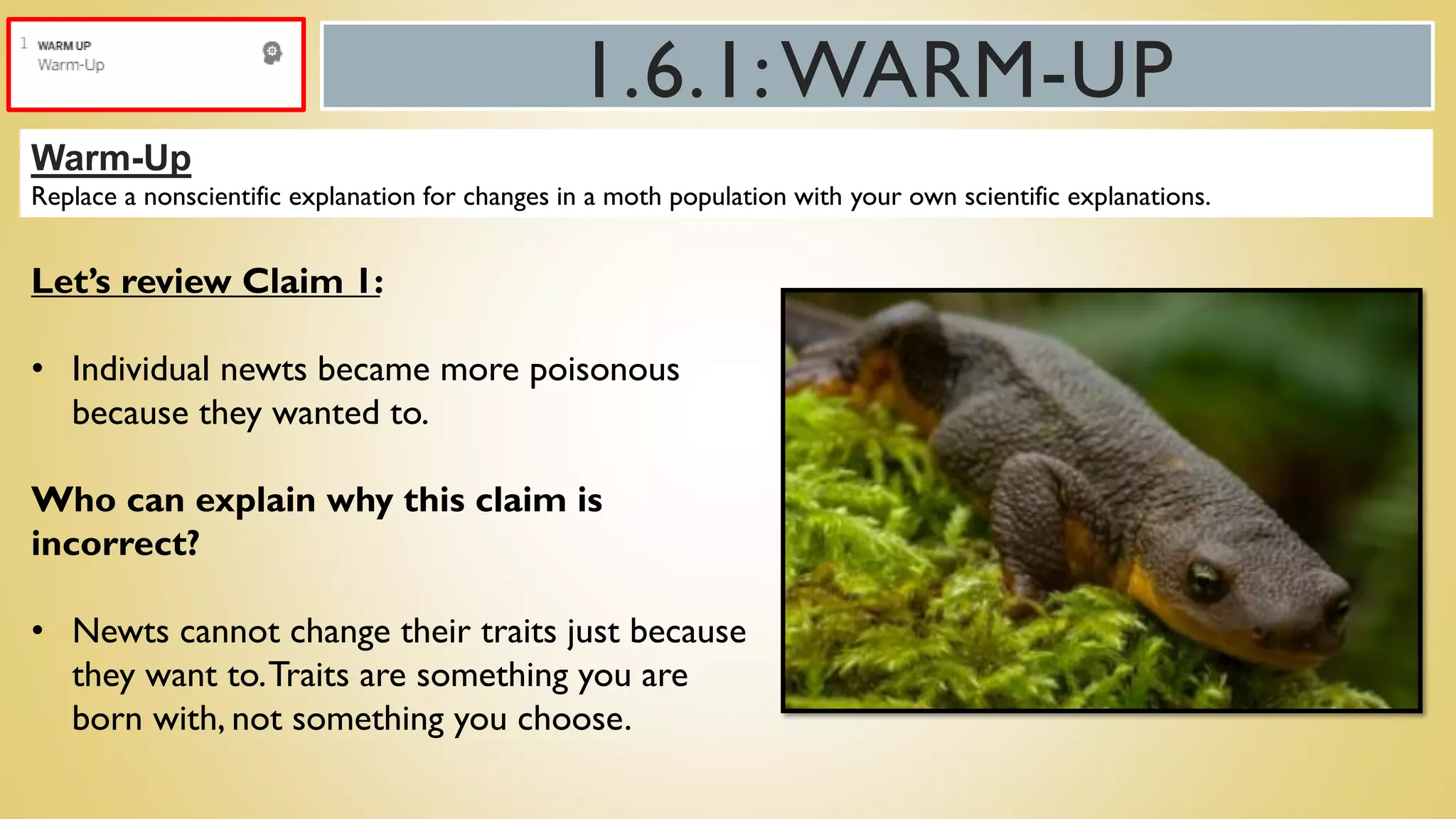
Let’s review Claim 1:
• Individual newts became more poisonous
because they wanted to.
Who can explain why this claim is
incorrect?
• Newts cannot change their traits just because
they want to.Traits are something you are
born with, not something you choose.
1.6.1:WARM-UP
Warm-Up
Replace a nonscientific explanation for changes in a moth population with your own scientific explanations.
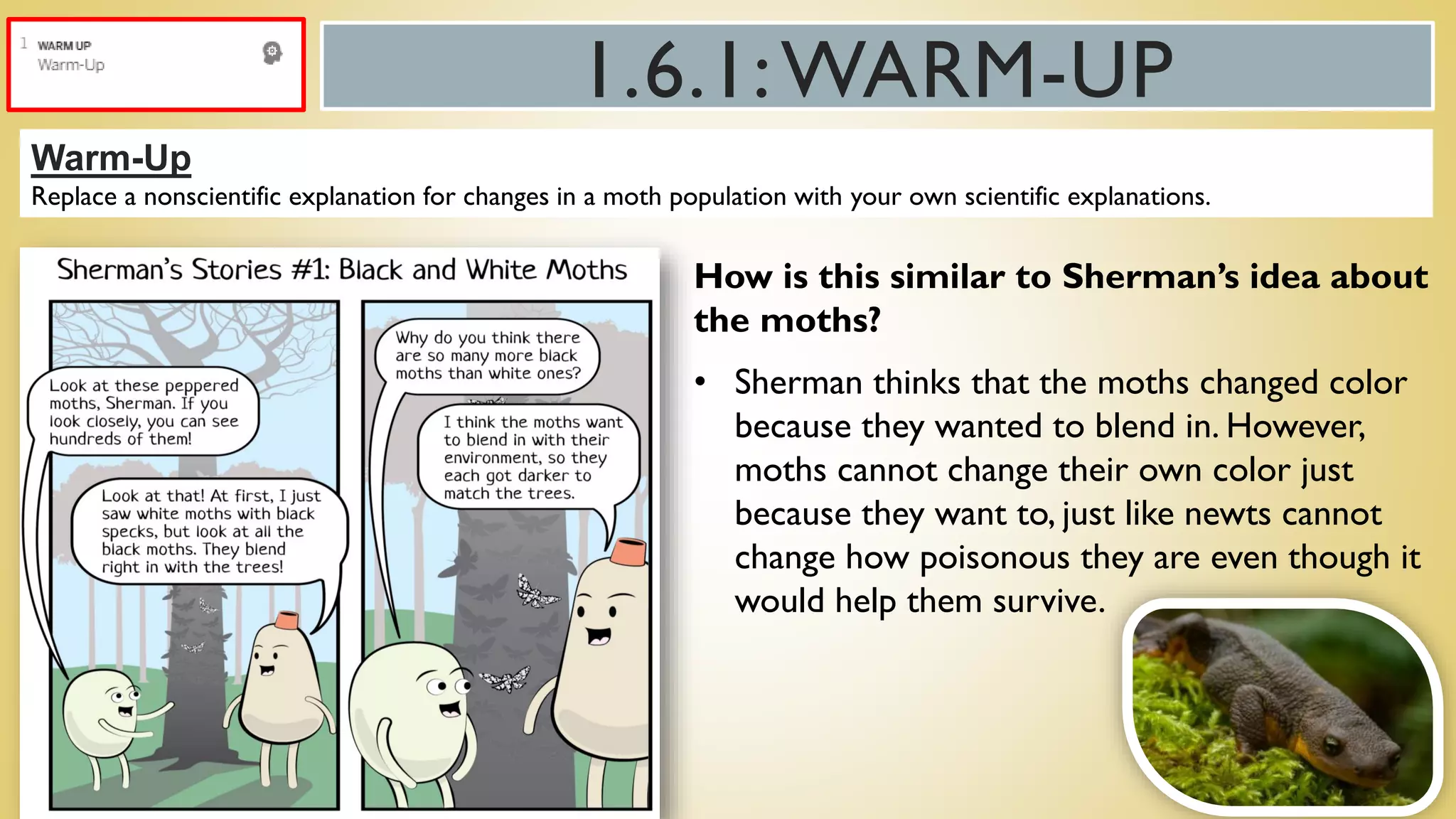
How is this similar to Sherman’s idea about
the moths?
• Sherman thinks that the moths changed color
because they wanted to blend in. However,
moths cannot change their own color just
because they want to, just like newts cannot
change how poisonous they are even though it
would help them survive.
The Write and Share routine, which you use to demonstrate your
understanding of why the distribution of traits in a population changes.
Write and
Share
Purpose of Activity:
Today, we finalize our answer to the
Investigation Question: What makes
the distribution of traits in a
population change?
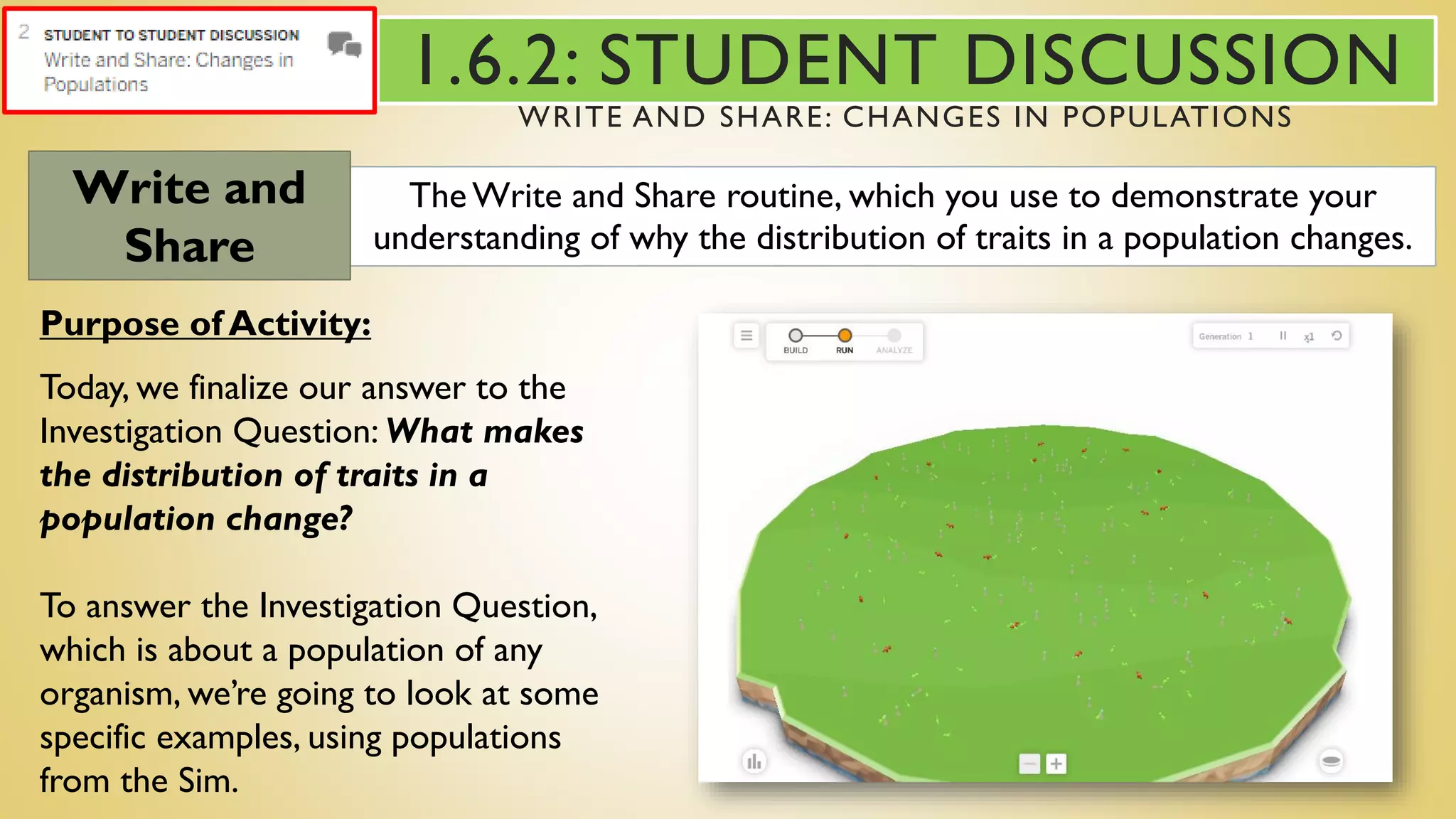
To answer the Investigation Question,
which is about a population of any
organism, we’re going to look at some
specific examples, using populations
from the Sim.
1.6.2: STUDENT DISCUSSION
WRITE AND SHARE: CHANGES IN POPULATIONS
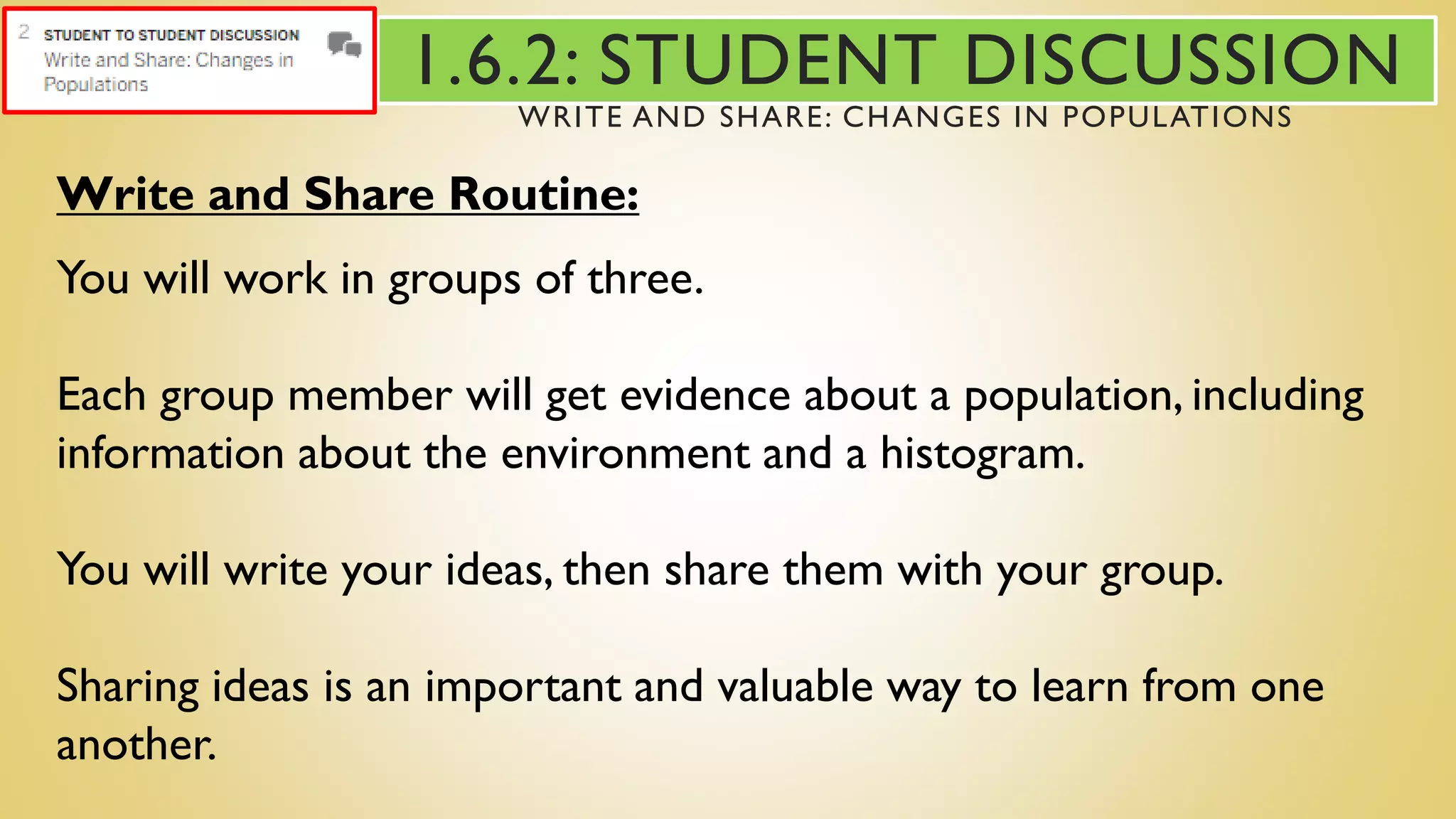
Write and Share Routine:
You will work in groups of three.
Each group member will get evidence about a population, including
information about the environment and a histogram.
You will write your ideas, then share them with your group.
Sharing ideas is an important and valuable way to learn from one
another.
1.6.2: STUDENT DISCUSSION
WRITE AND SHARE: CHANGES IN POPULATIONS
1.6.2: STUDENT DISCUSSION
WRITE AND SHARE: CHANGES IN POPULATIONS
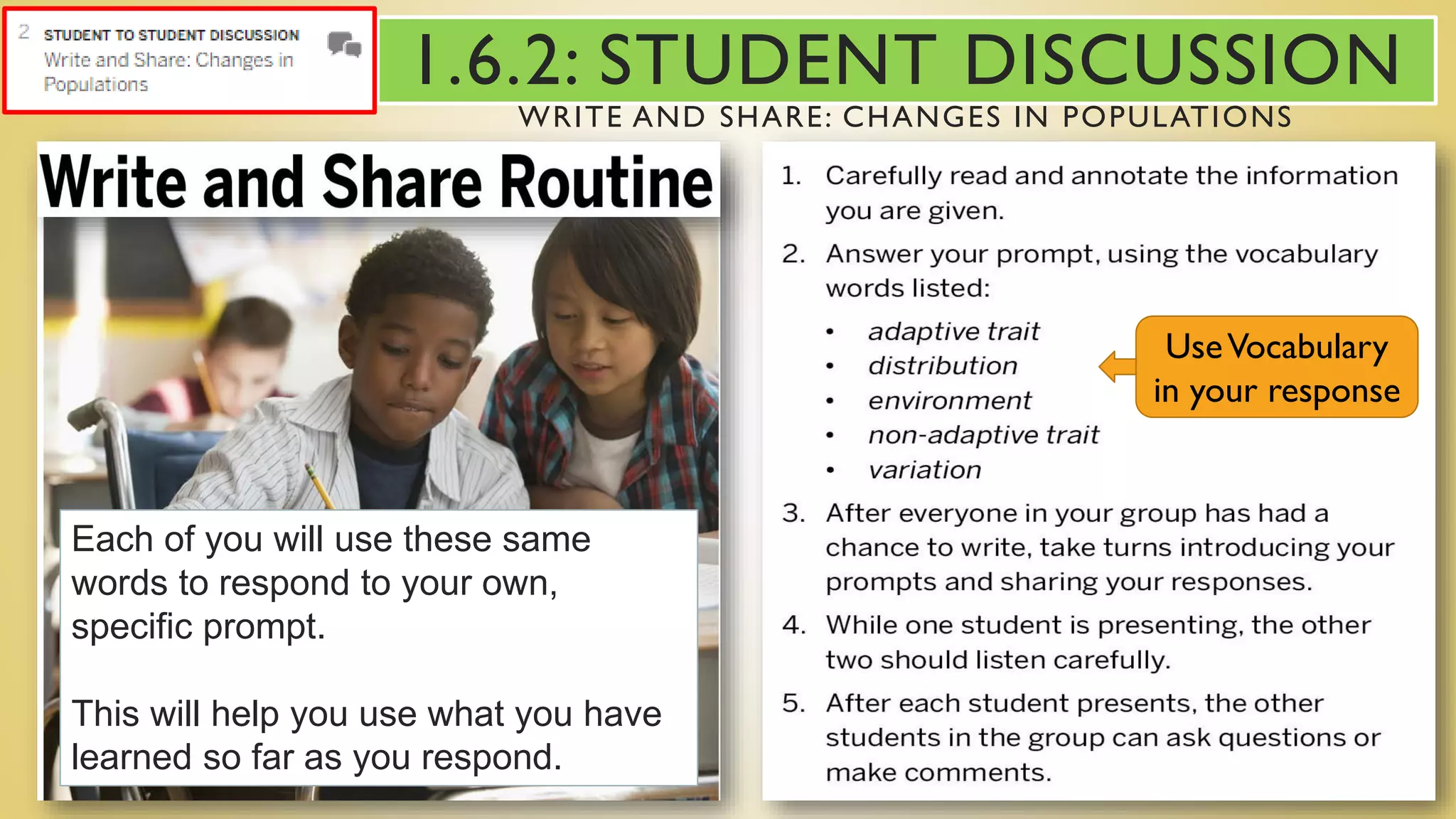
UseVocabulary
in your response
Each of you will use these same
words to respond to your own,
specific prompt.
This will help you use what you have
learned so far as you respond.
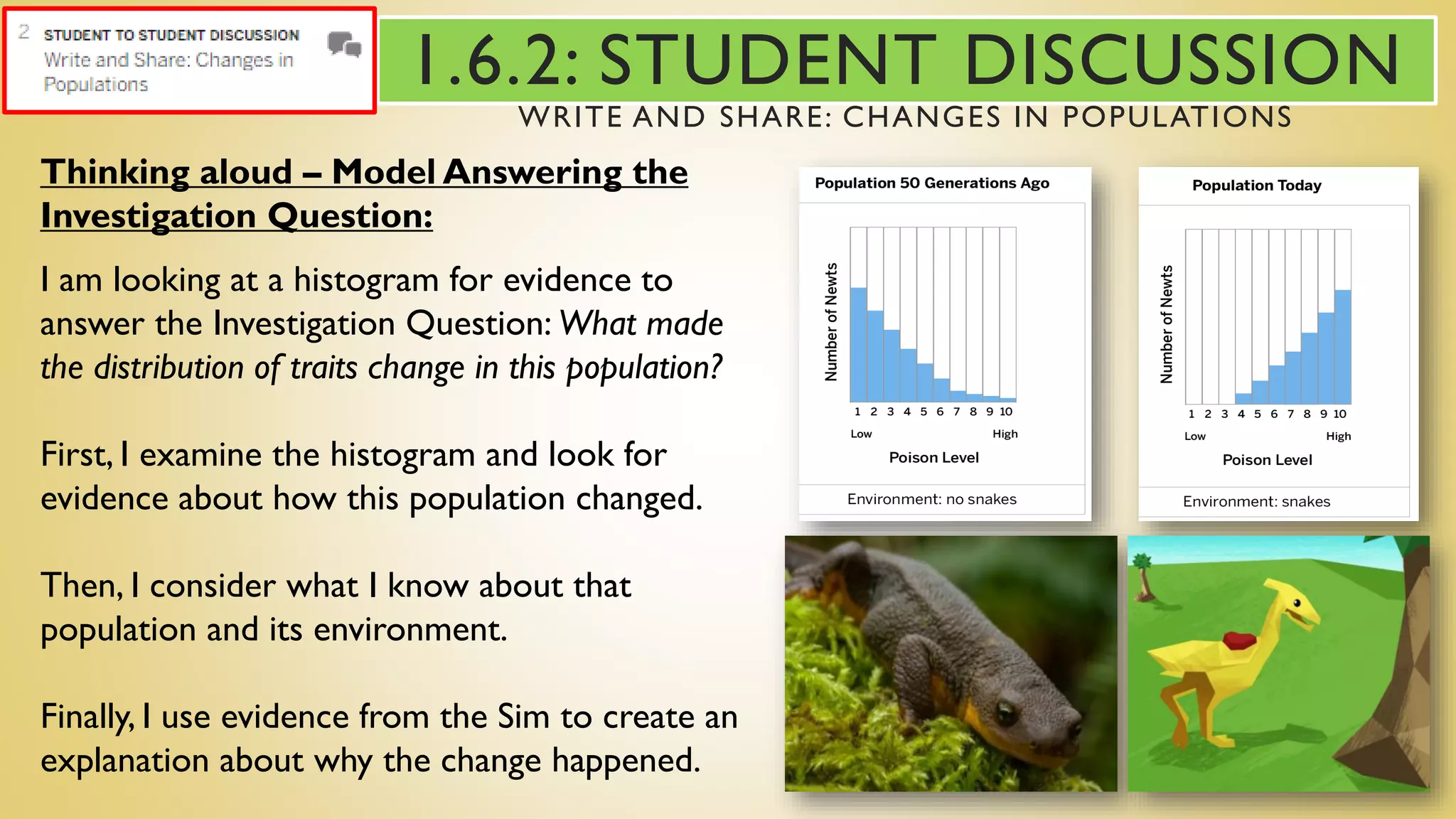
Thinking aloud – Model Answering the
Investigation Question:
I am looking at a histogram for evidence to
answer the Investigation Question: What made
the distribution of traits change in this population?
First, I examine the histogram and look for
evidence about how this population changed.
Then, I consider what I know about that
population and its environment.
Finally, I use evidence from the Sim to create an
explanation about why the change happened.
1.6.2: STUDENT DISCUSSION
WRITE AND SHARE: CHANGES IN POPULATIONS
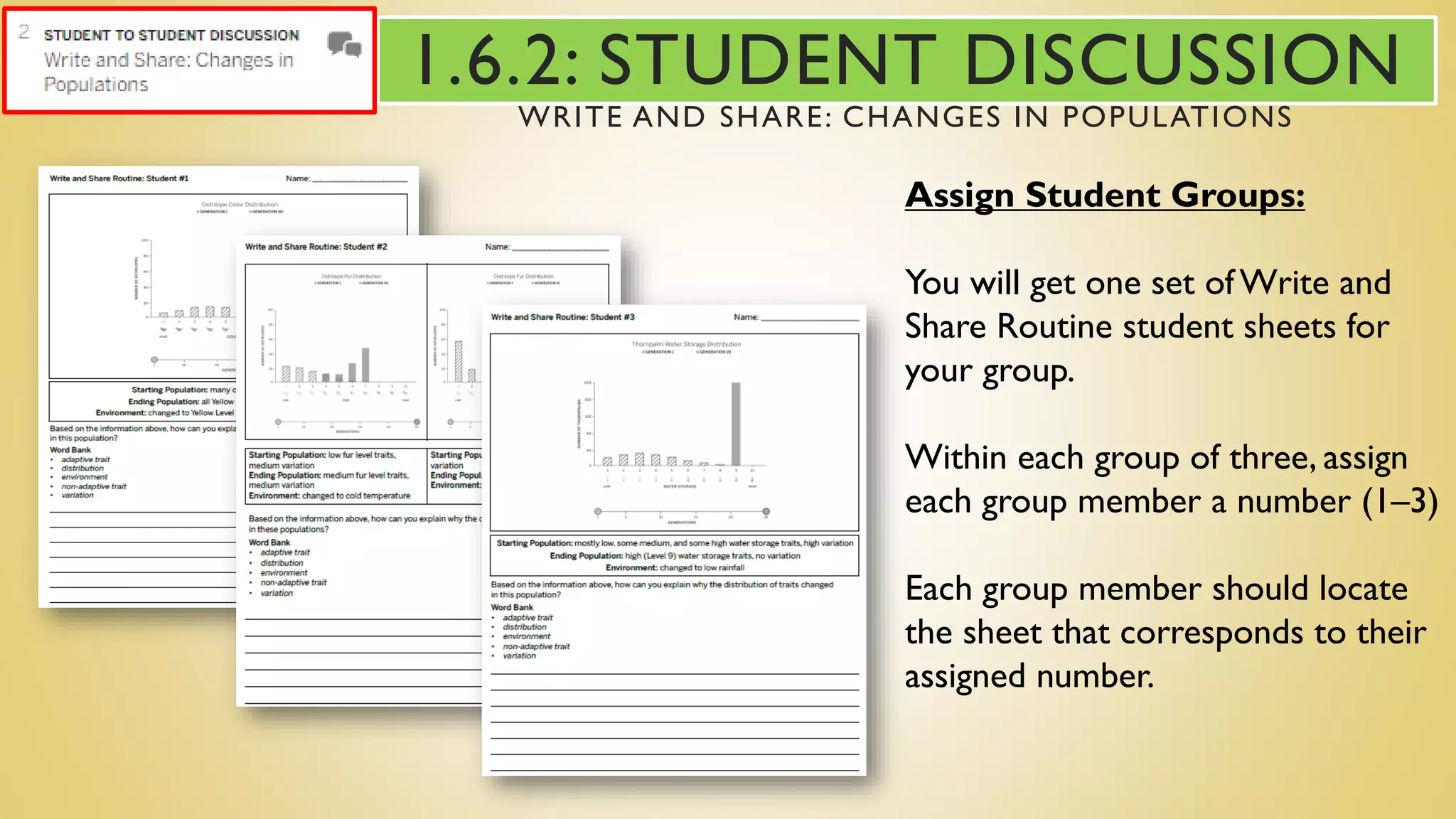
Assign Student Groups:
You will get one set of Write and
Share Routine student sheets for
your group.
Within each group of three, assign
each group member a number (1–3)
Each group member should locate
the sheet that corresponds to their
assigned number.
1.6.2: STUDENT DISCUSSION
WRITE AND SHARE: CHANGES IN POPULATIONS
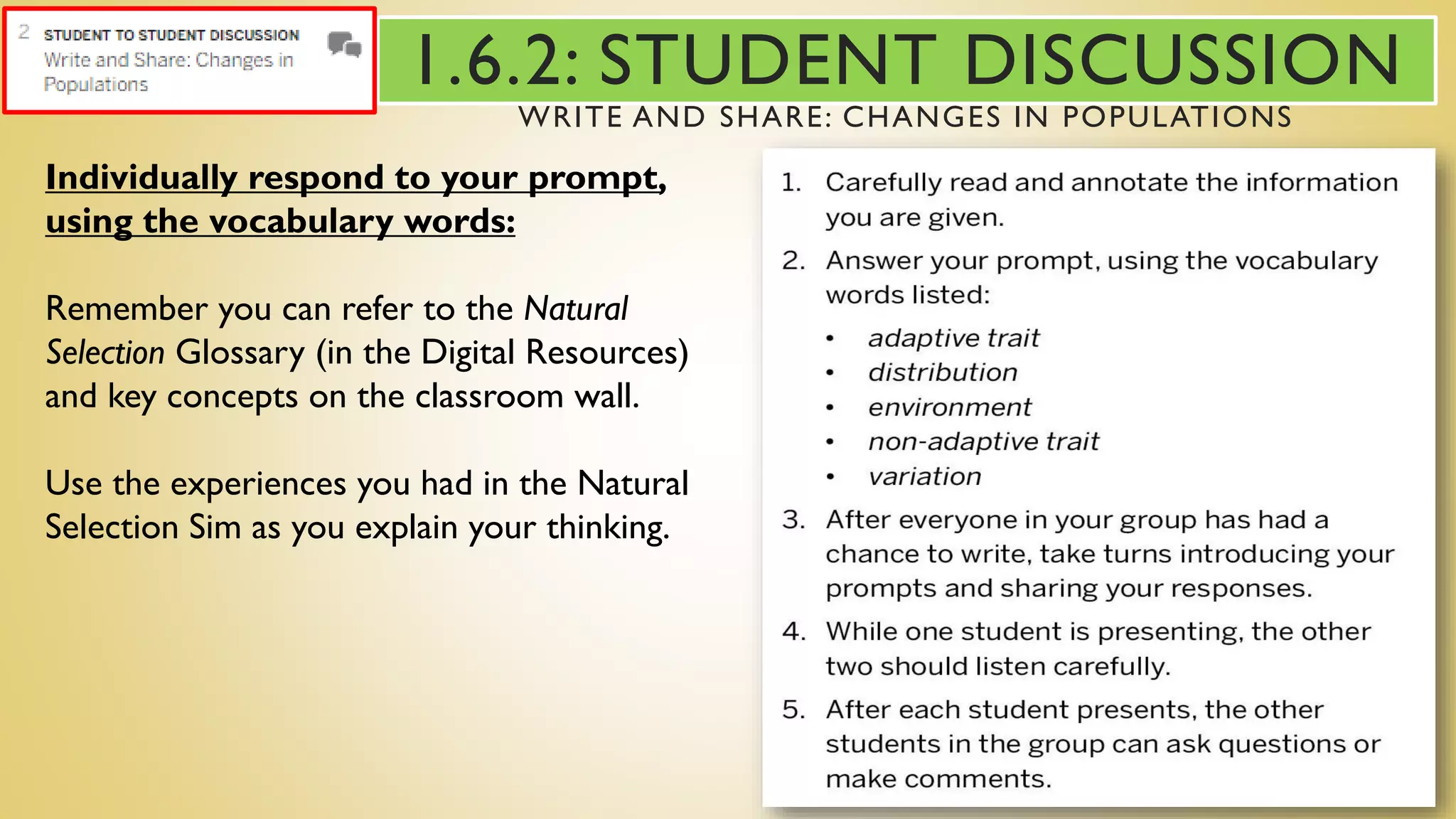
Individually respond to your prompt,
using the vocabulary words:
Remember you can refer to the Natural
Selection Glossary (in the Digital Resources)
and key concepts on the classroom wall.
Use the experiences you had in the Natural
Selection Sim as you explain your thinking.
1.6.2: STUDENT DISCUSSION
WRITE AND SHARE: CHANGES IN POPULATIONS
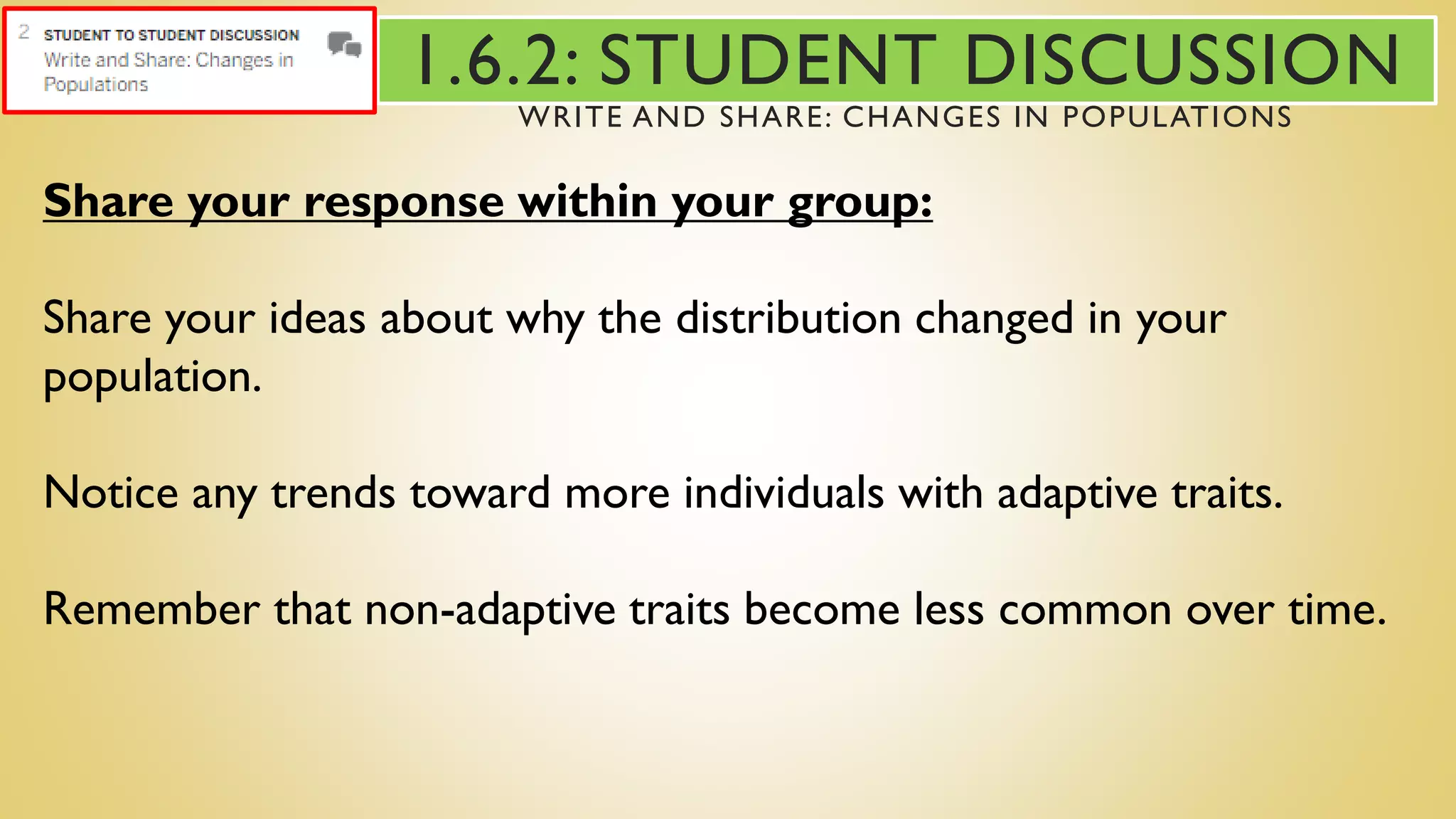
Share your response within your group:
Share your ideas about why the distribution changed in your
population.
Notice any trends toward more individuals with adaptive traits.
Remember that non-adaptive traits become less common over time.
1.6.2: STUDENT DISCUSSION
WRITE AND SHARE: CHANGES IN POPULATIONS
Let’s share your ideas with
the class:
Listening to and learning from
your peers is a powerful and
important way to better
understand science ideas.
Did you change your ideas based
on what another group member
said?
1.6.2: STUDENT DISCUSSION
WRITE AND SHARE: CHANGES IN POPULATIONS
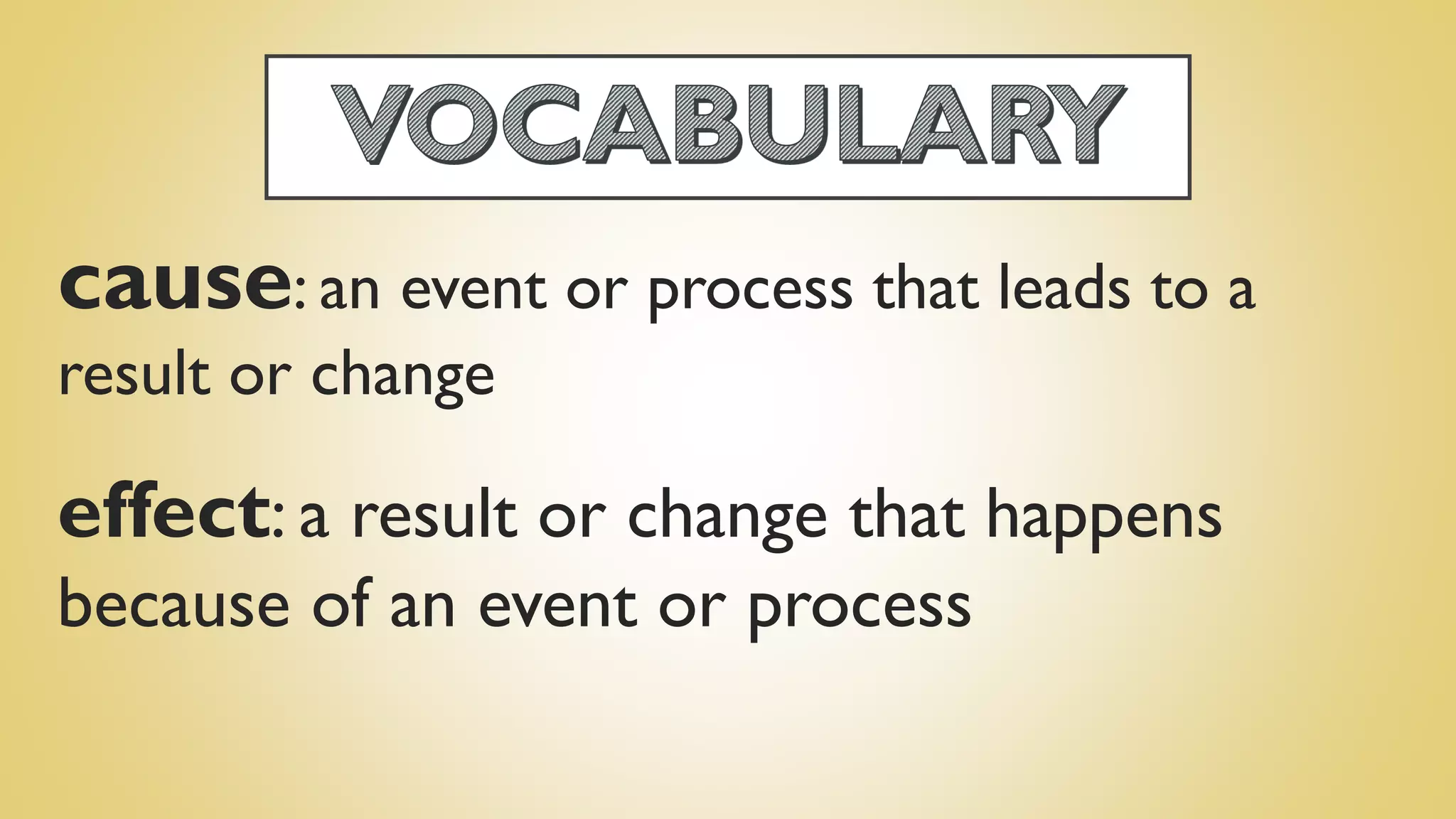
cause: an event or process that leads to a
result or change
effect: a result or change that happens
because of an event or process
1.6.2: STUDENT DISCUSSION
WRITE AND SHARE: CHANGES IN POPULATIONS
As you explained the change
in distribution in the ostrilope
and thornpalm populations,
you looked for effects and
interpreted data to
understand their causes.
The work you just did interpreting histograms and data about
populations and environments is exactly the kind of work that biologists
do all the time in order to understand why the distribution of traits in
populations can change over time.
1.6.2: STUDENT DISCUSSION
WRITE AND SHARE: CHANGES IN POPULATIONS
1.6.3:WRITING
EXPLAINING CHANGES IN THE NEWT POPULATION
Use what you have learned to discuss and write about the claims in
order to answer the Chapter 1 Question.GOAL
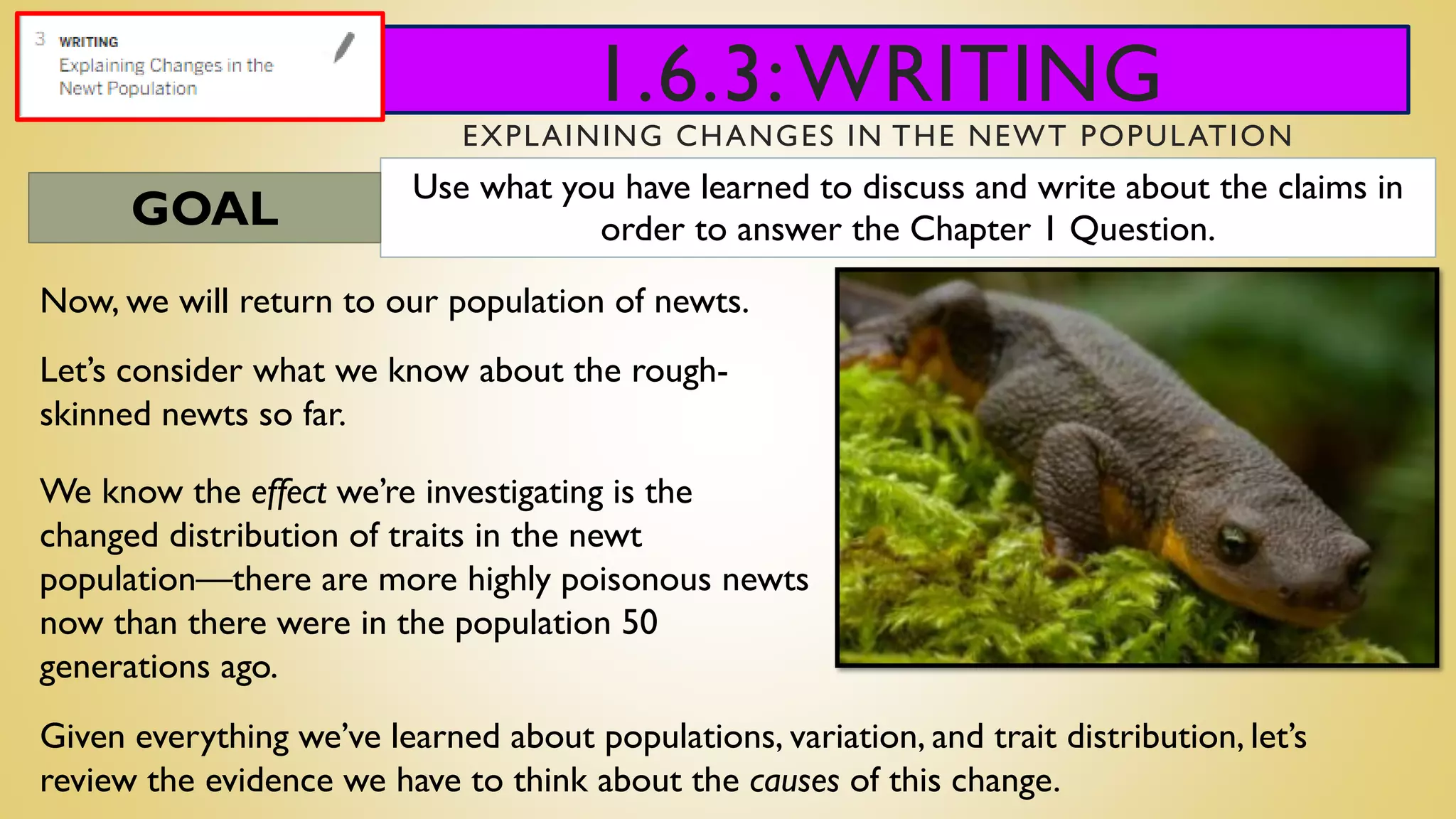
Now, we will return to our population of newts.
Let’s consider what we know about the rough-
skinned newts so far.
Given everything we’ve learned about populations, variation, and trait distribution, let’s
review the evidence we have to think about the causes of this change.
We know the effect we’re investigating is the
changed distribution of traits in the newt
population—there are more highly poisonous newts
now than there were in the population 50
generations ago.
1.6.3:WRITING
EXPLAINING CHANGES IN THE NEWT POPULATION
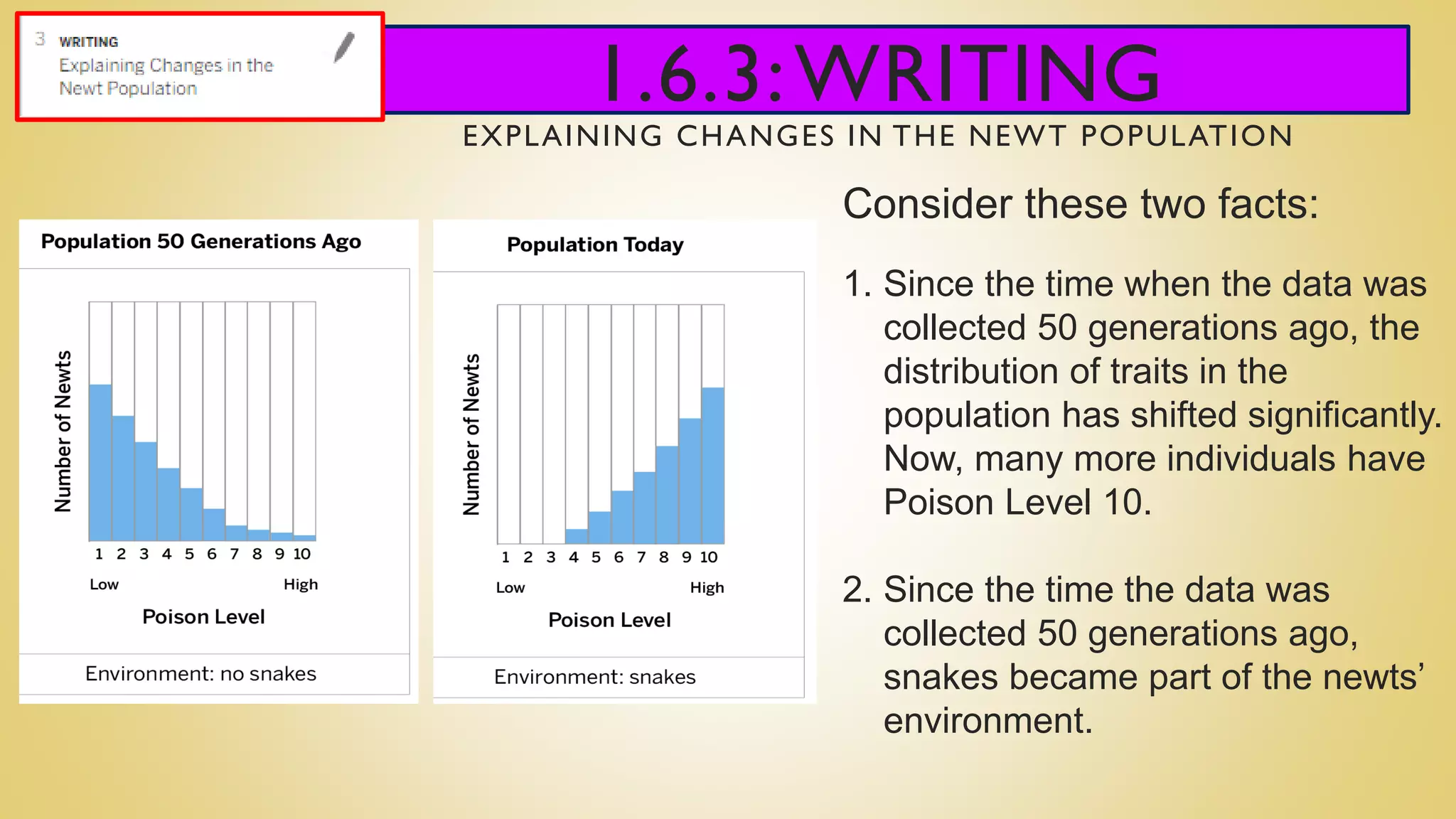
Consider these two facts:
1. Since the time when the data was
collected 50 generations ago, the
distribution of traits in the
population has shifted significantly.
Now, many more individuals have
Poison Level 10.
2. Since the time the data was
collected 50 generations ago,
snakes became part of the newts’
environment.
1.6.3:WRITING
EXPLAINING CHANGES IN THE NEWT POPULATION
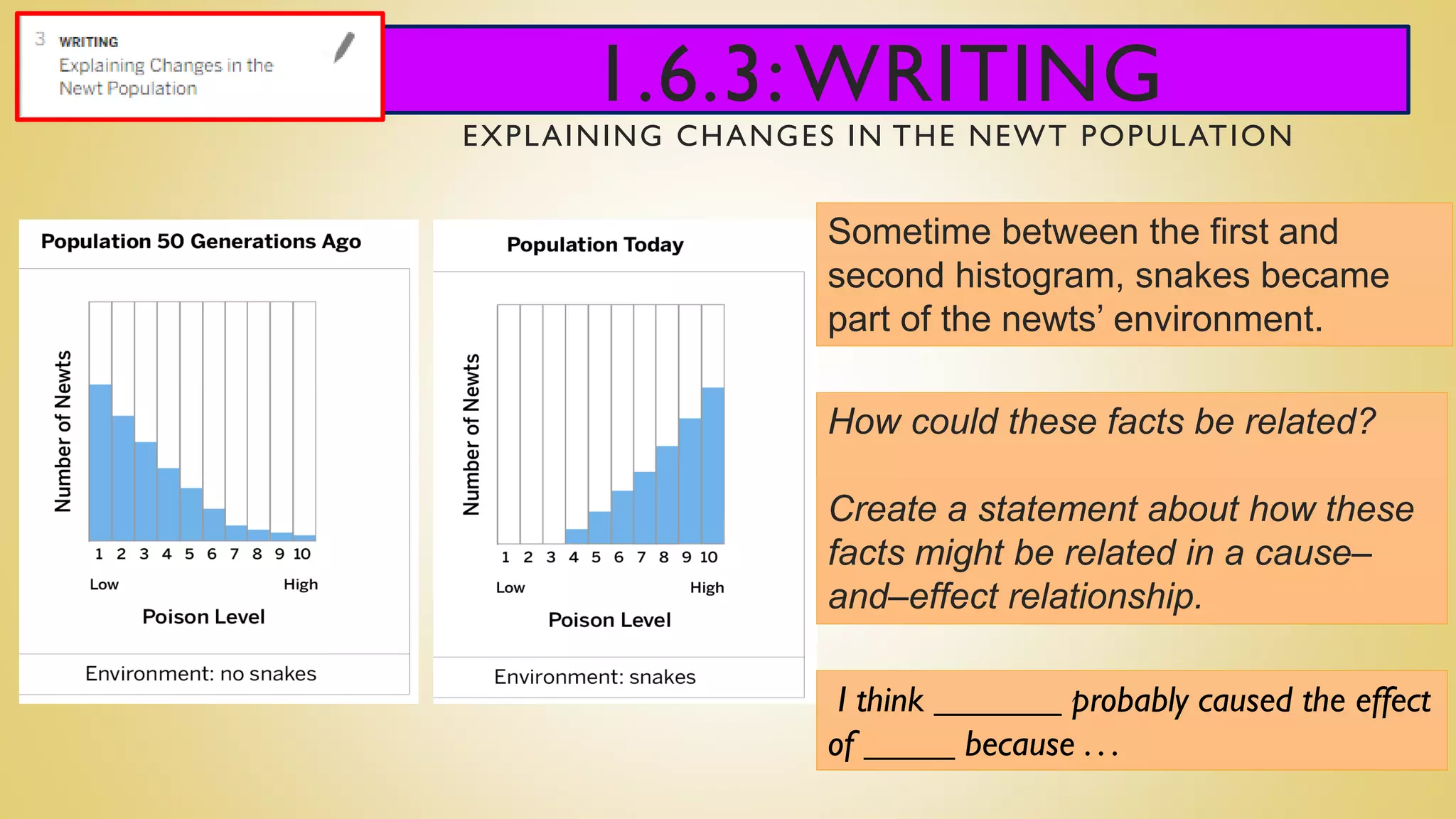
Sometime between the first and
second histogram, snakes became
part of the newts’ environment.
How could these facts be related?
Create a statement about how these
facts might be related in a cause–
and–effect relationship.
I think _______ probably caused the effect
of _____ because . . .
1.6.3:WRITING
EXPLAINING CHANGES IN THE NEWT POPULATION
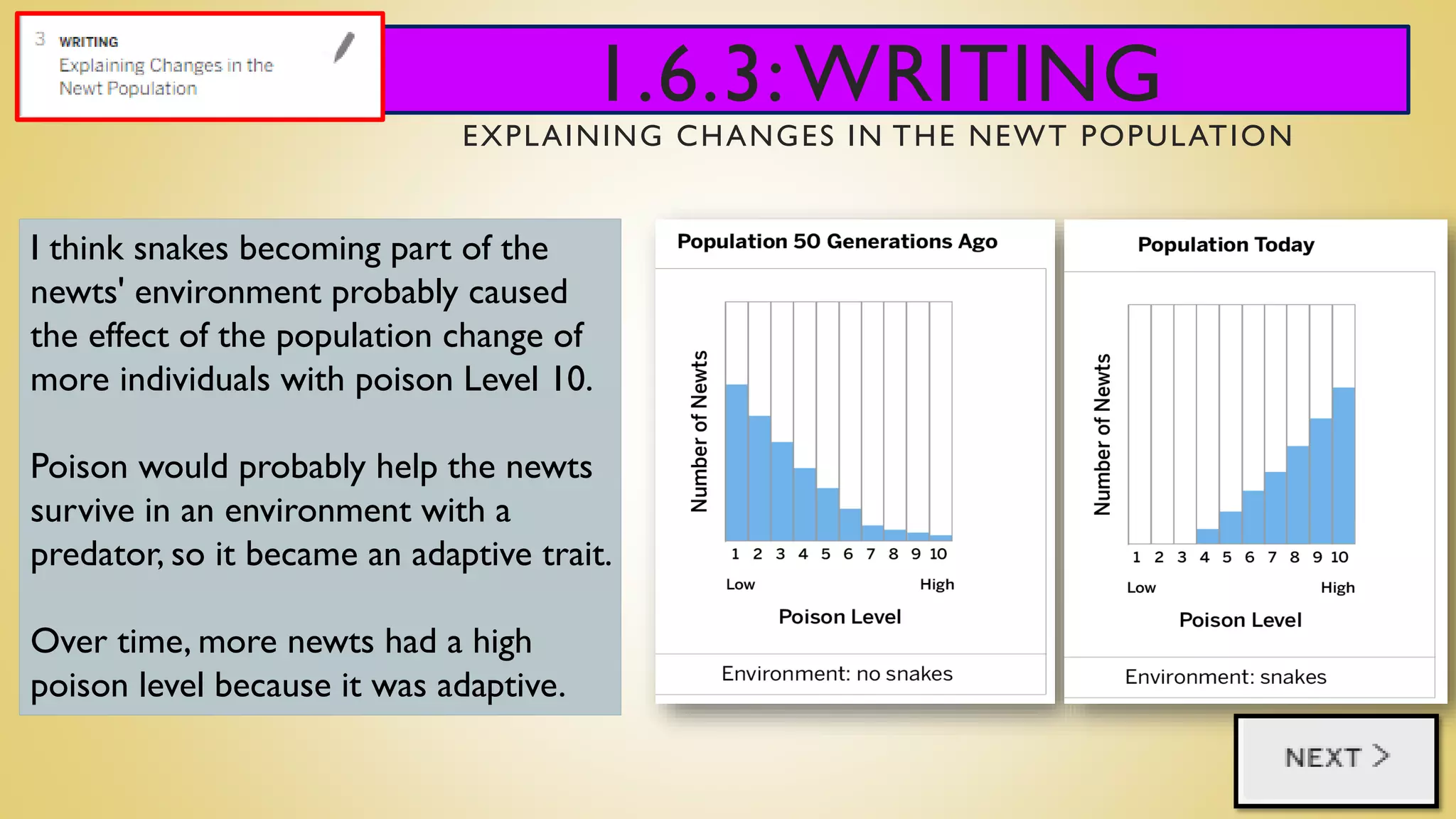
I think snakes becoming part of the
newts' environment probably caused
the effect of the population change of
more individuals with poison Level 10.
Poison would probably help the newts
survive in an environment with a
predator, so it became an adaptive trait.
Over time, more newts had a high
poison level because it was adaptive.
1.6.3: MODELING TOOL
EXPLAINING CHANGES IN THE NEWT POPULATION
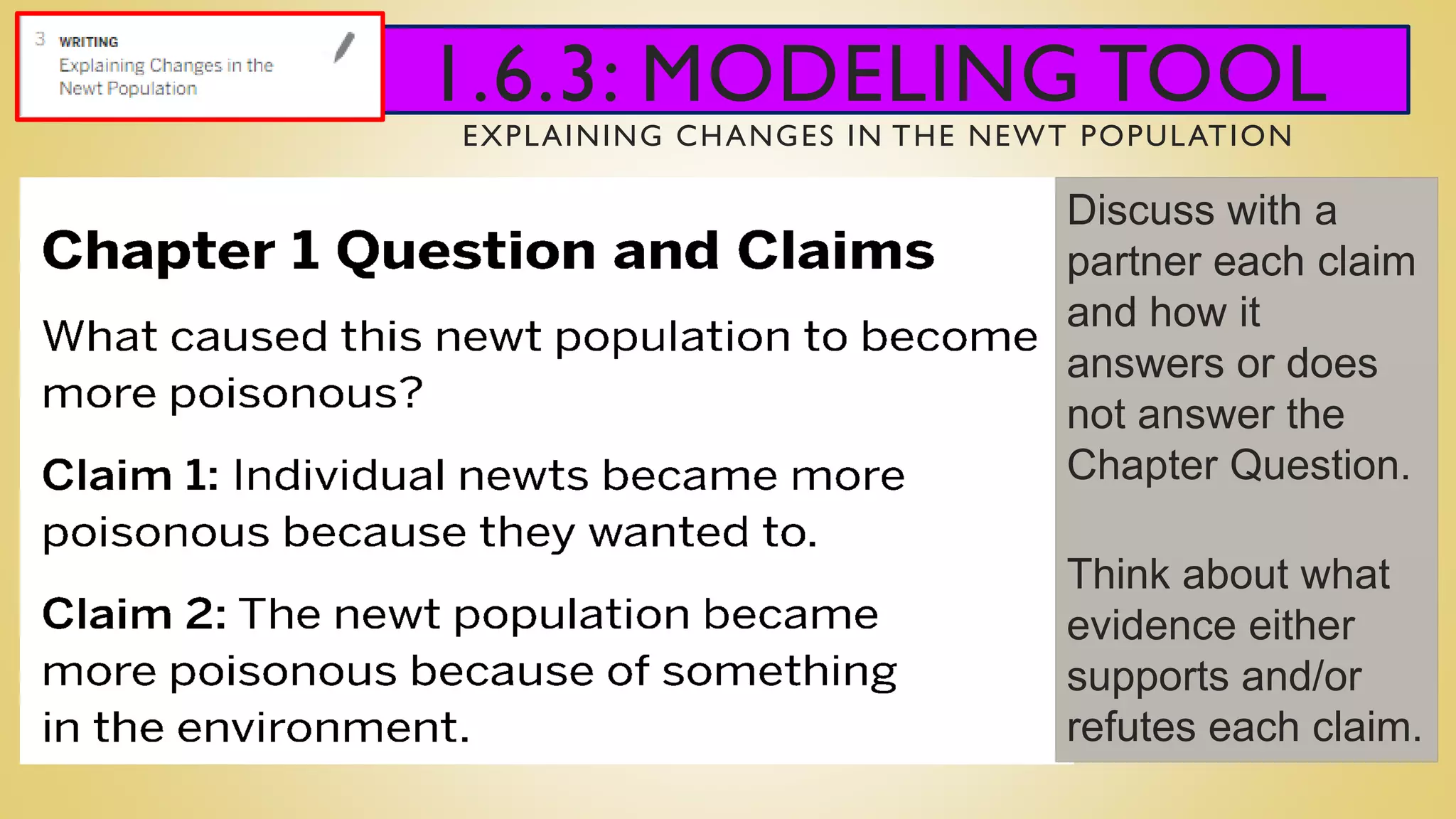
Discuss with a
partner each claim
and how it
answers or does
not answer the
Chapter Question.
Think about what
evidence either
supports and/or
refutes each claim.
1.6.3:WRITING
EXPLAINING CHANGES IN THE NEWT POPULATION
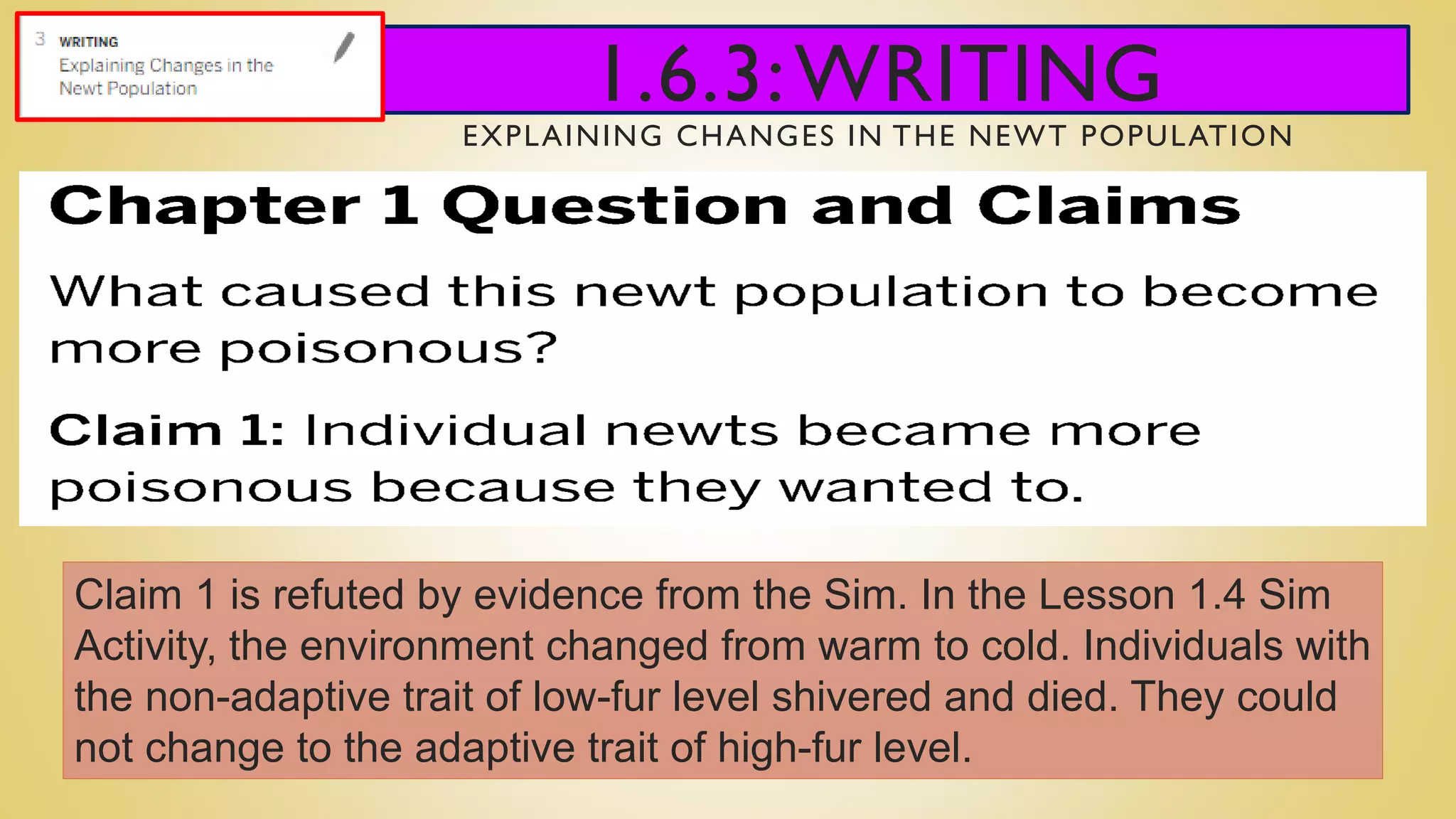
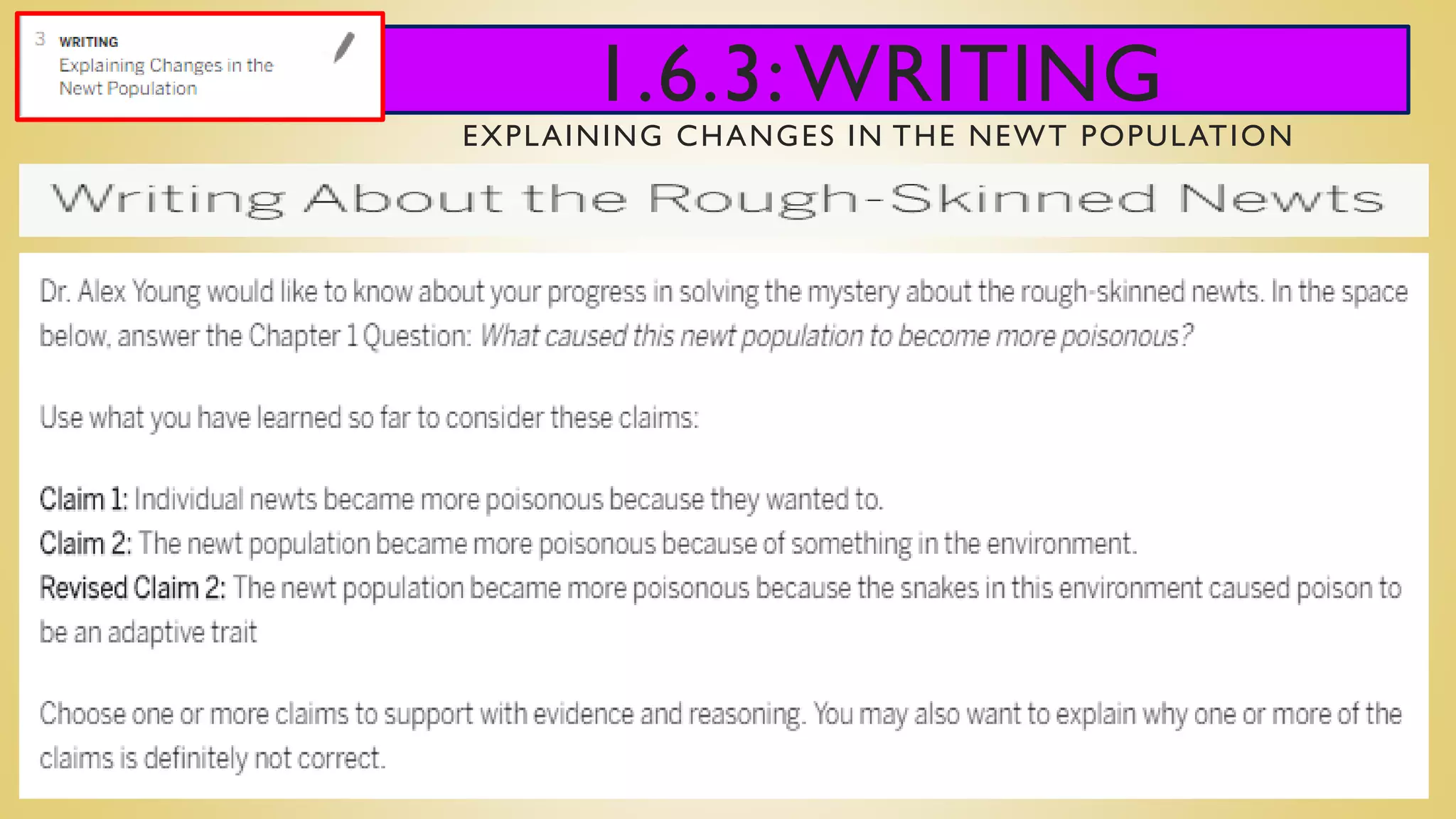
Claim 1 is refuted by evidence from the Sim. In the Lesson 1.4 Sim
Activity, the environment changed from warm to cold. Individuals with
the non-adaptive trait of low-fur level shivered and died. They could
not change to the adaptive trait of high-fur level.
1.6.3:WRITING
EXPLAINING CHANGES IN THE NEWT POPULATION
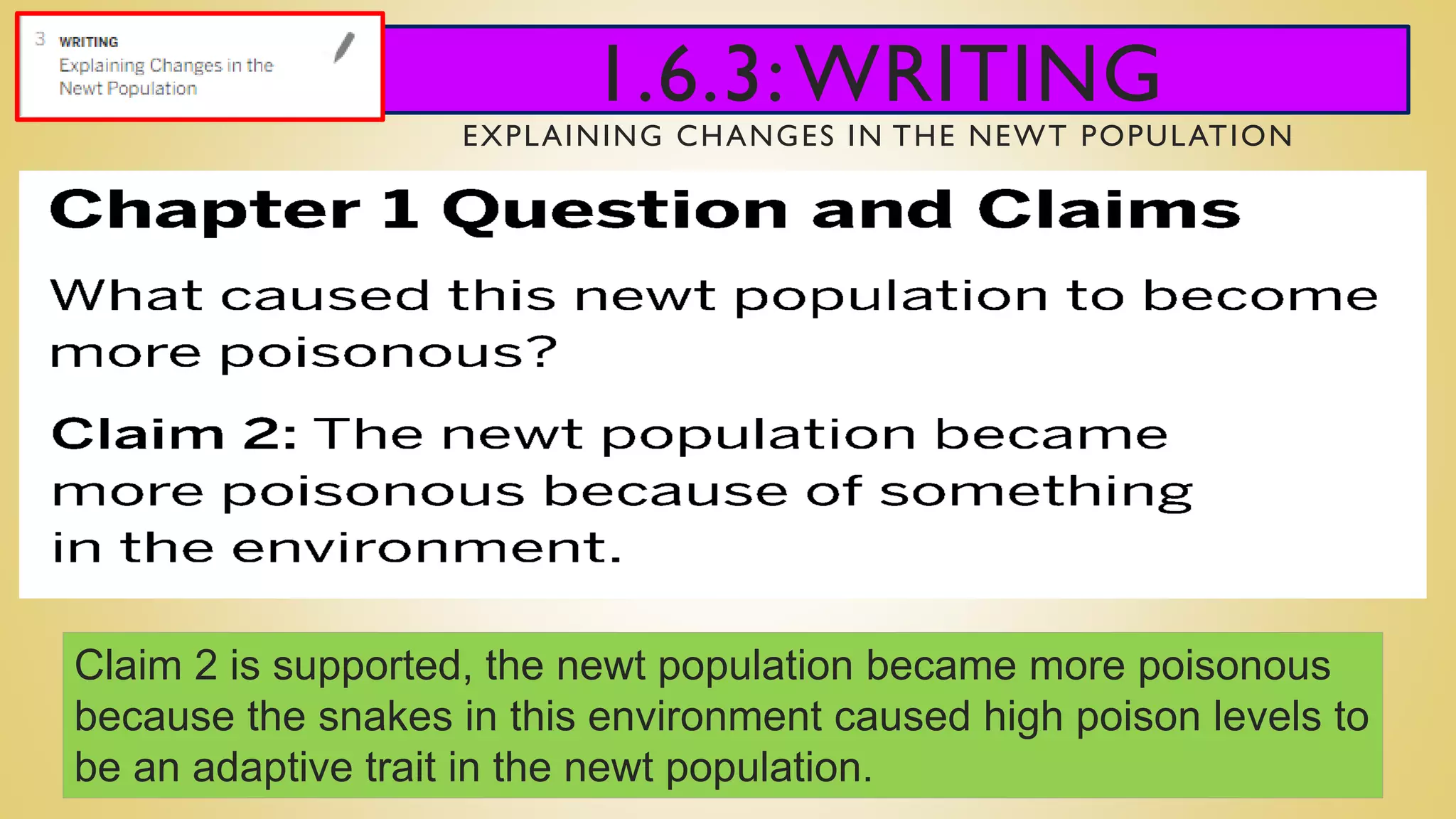
Claim 2 is supported, the newt population became more poisonous
because the snakes in this environment caused high poison levels to
be an adaptive trait in the newt population.
1.6.3:WRITING
EXPLAINING CHANGES IN THE NEWT POPULATION
1.6.3:WRITING
EXPLAINING CHANGES IN THE NEWT POPULATION
1.6.3:WRITING
EXPLAINING CHANGES IN THE NEWT POPULATION
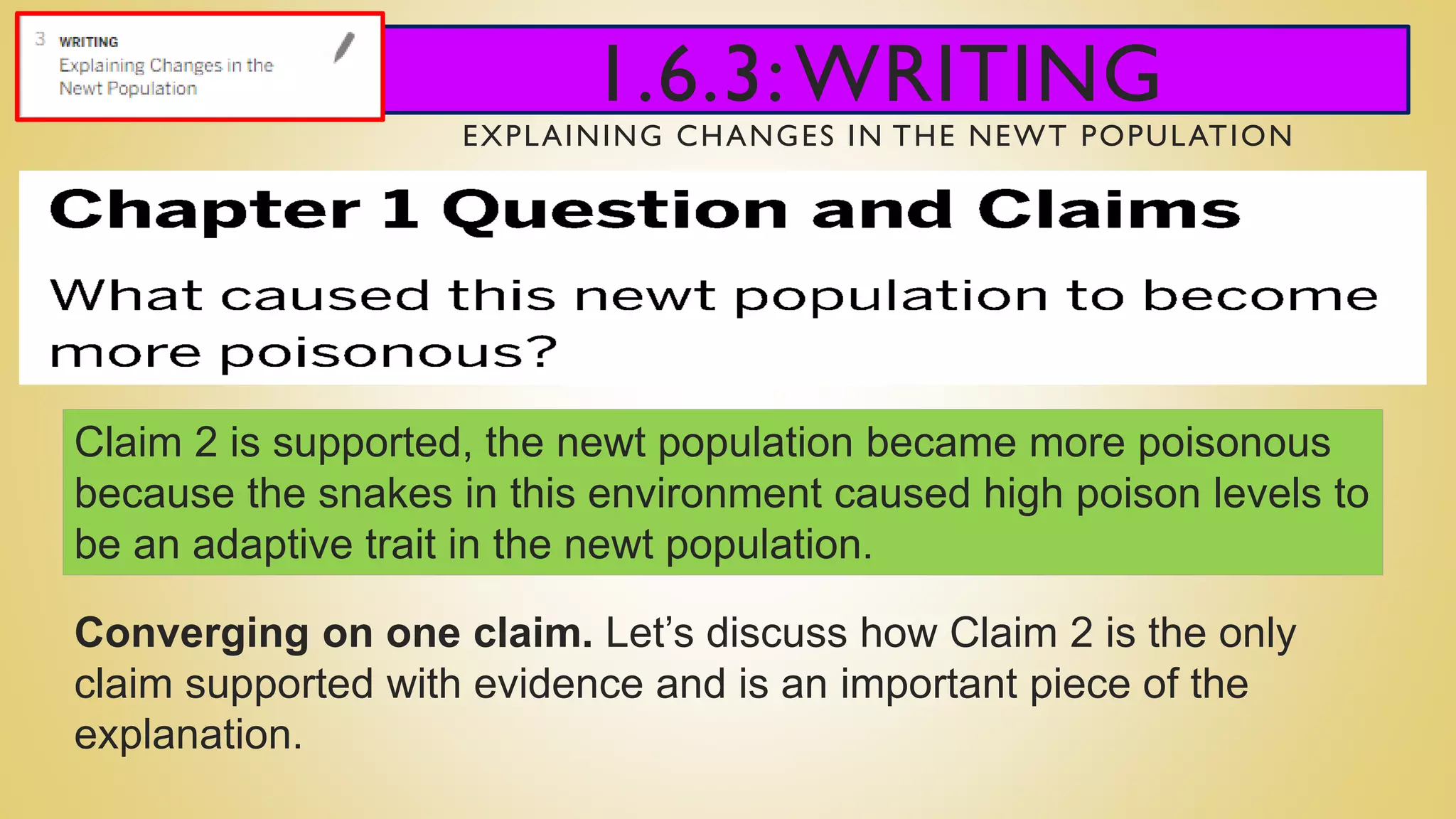
Claim 2 is supported, the newt population became more poisonous
because the snakes in this environment caused high poison levels to
be an adaptive trait in the newt population.
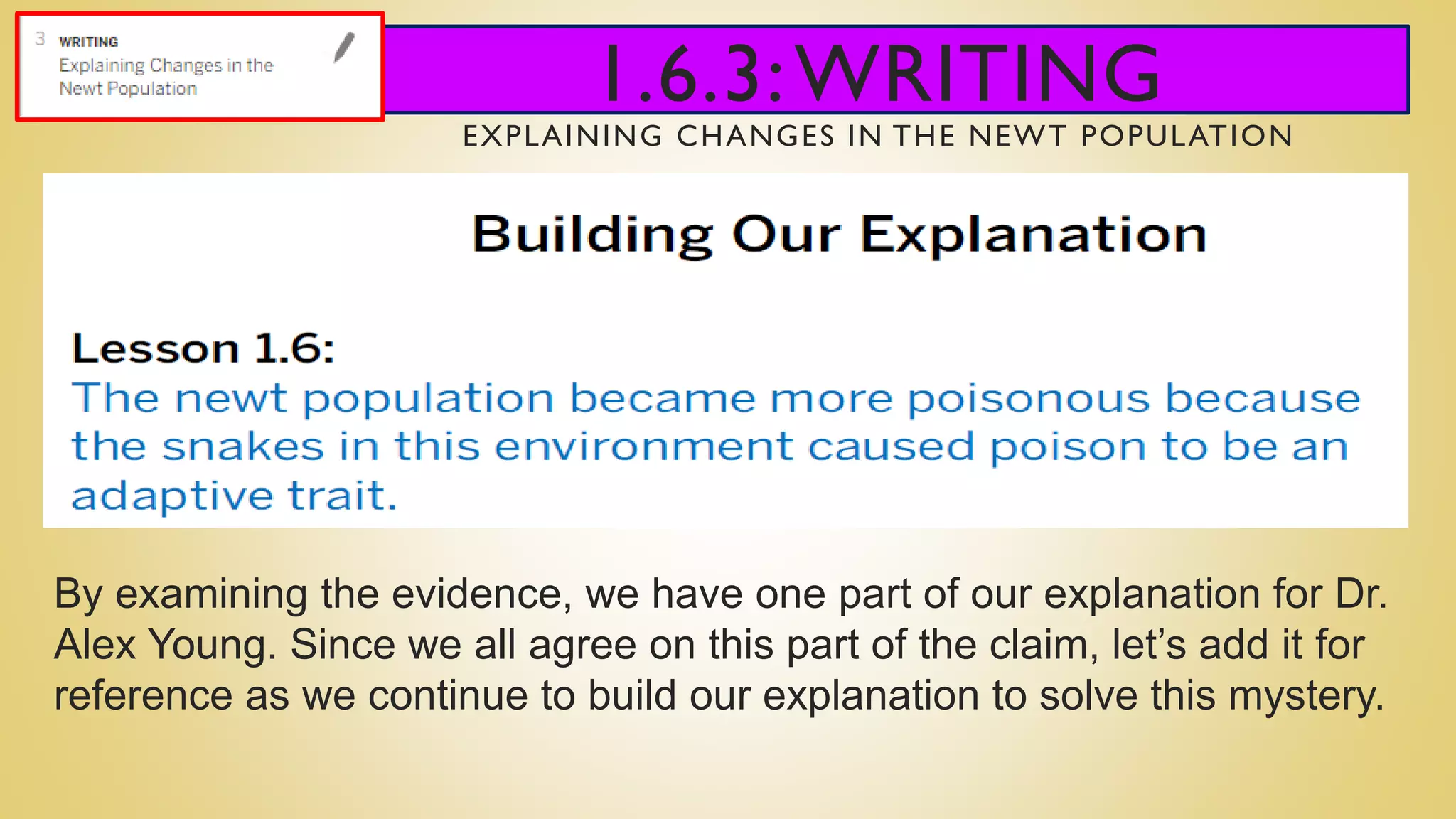
Converging on one claim. Let’s discuss how Claim 2 is the only
claim supported with evidence and is an important piece of the
explanation.
1.6.3:WRITING
EXPLAINING CHANGES IN THE NEWT POPULATION
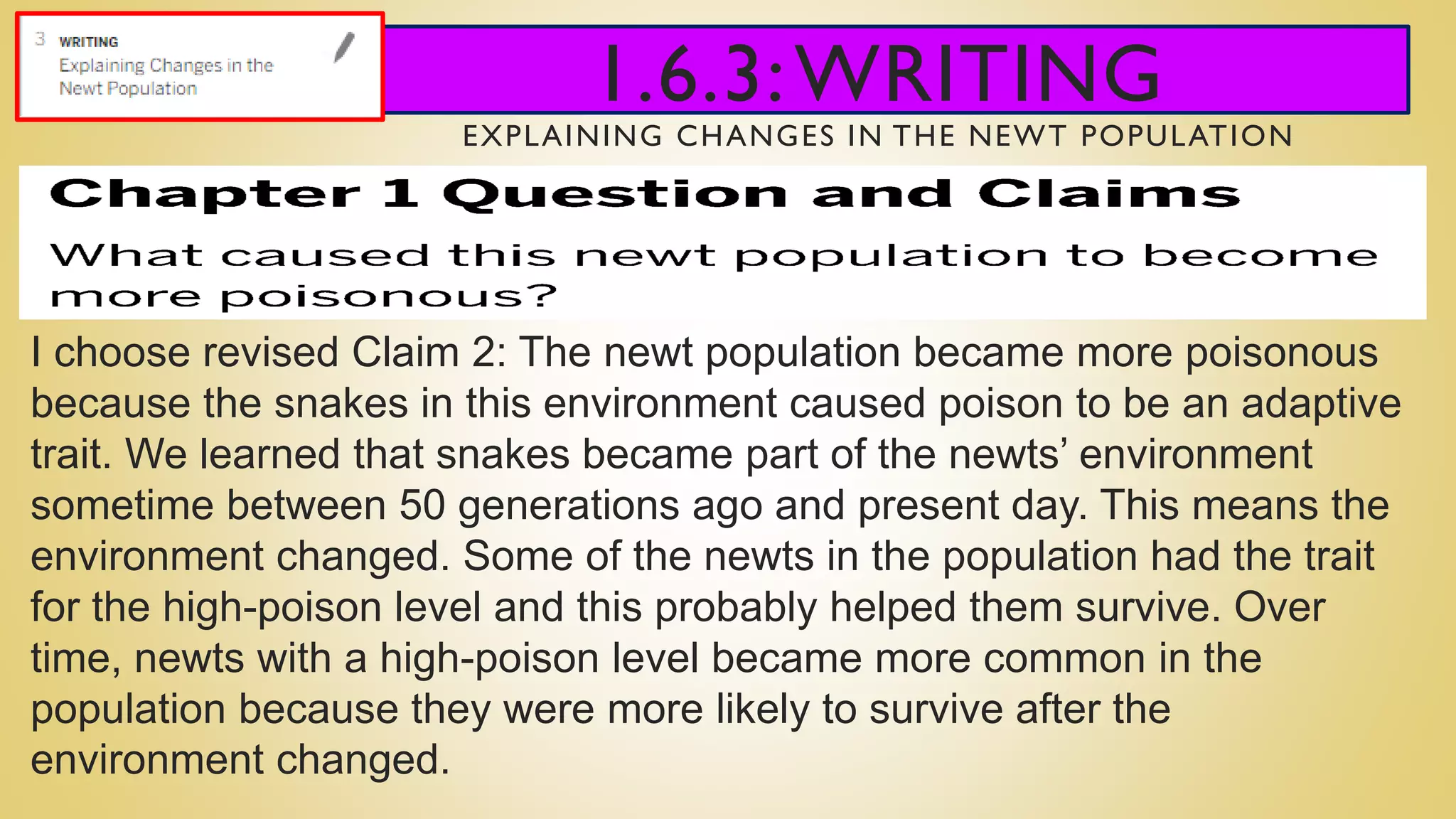
I choose revised Claim 2: The newt population became more poisonous
because the snakes in this environment caused poison to be an adaptive
trait. We learned that snakes became part of the newts’ environment
sometime between 50 generations ago and present day. This means the
environment changed. Some of the newts in the population had the trait
for the high-poison level and this probably helped them survive. Over
time, newts with a high-poison level became more common in the
population because they were more likely to survive after the
environment changed.
1.6.3:WRITING
EXPLAINING CHANGES IN THE NEWT POPULATION
By examining the evidence, we have one part of our explanation for Dr.
Alex Young. Since we all agree on this part of the claim, let’s add it for
reference as we continue to build our explanation to solve this mystery.
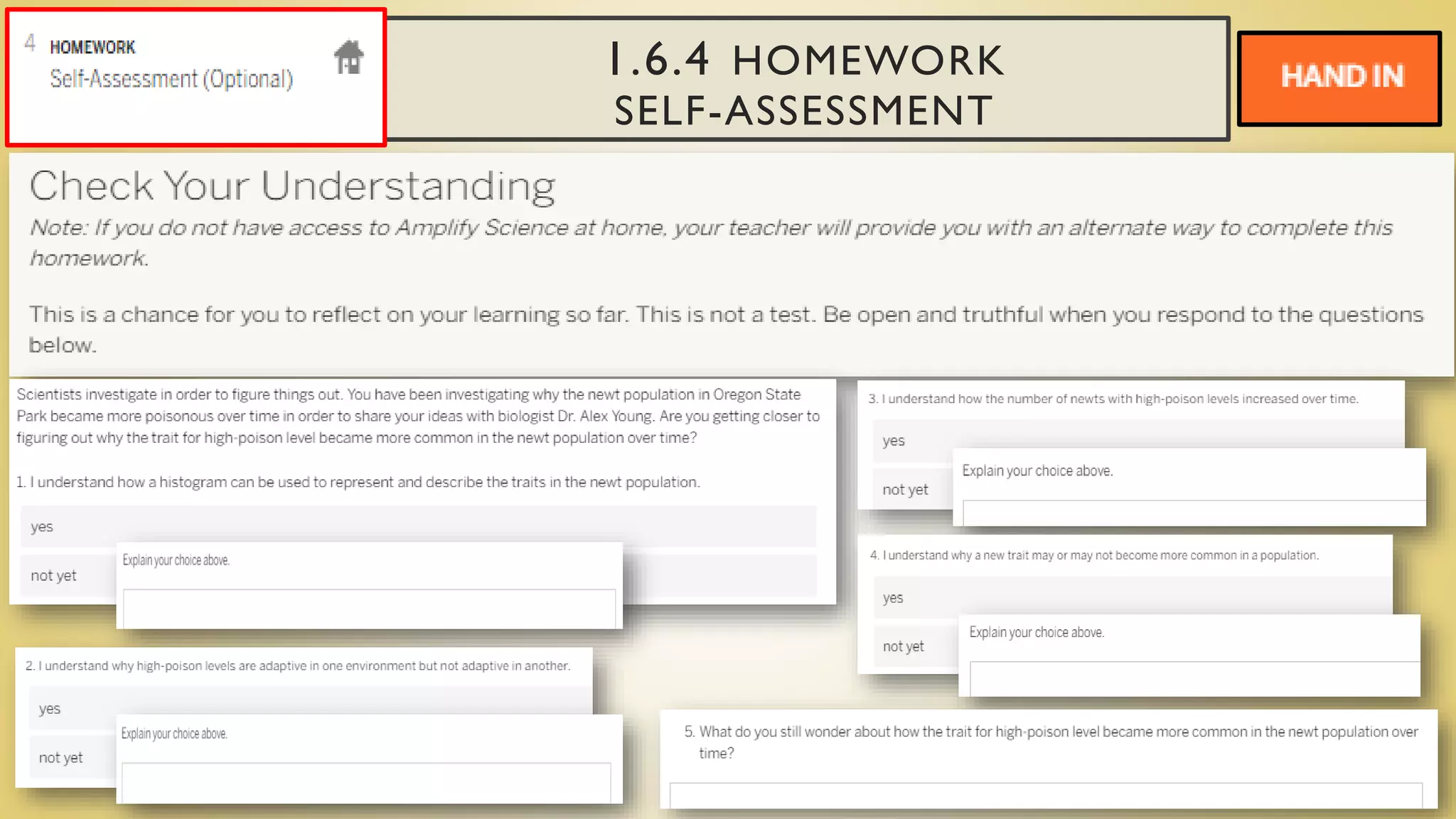
1.6.4 HOMEWORK
SELF-ASSESSMENT

Explaining Changes in Trait Distribution

  • 1.
    CHAPTER 1 –ENVIRONMENTAL CHANGE AND TRAIT DISTRIBUTION
  • 2.
    1.6.1:WARM-UP Warm-Up Replace a nonscientificexplanation for changes in a moth population with your own scientific explanations. Actually, Sherman, there are more black moths than white ones because . . . Share your response with a partner. This story is the first of several that you will see in this unit. Sherman is the main character in all of them. Sherman always has answers to scientific questions, but they are not always carefully thought out or supported by science ideas.
  • 3.
    1.6.1:WARM-UP Warm-Up Replace a nonscientificexplanation for changes in a moth population with your own scientific explanations. Let’s Read the story as a class. Can you identify Sherman’s claim. • Sherman is making a claim about the peppered moth population. • The moths changed because they want to blend in with their environment. Let’s share your written responses with the class. • How would you respond to Sherman’s claim, using the science ideas you are learning in class.
  • 4.
    1.6.1:WARM-UP Warm-Up Replace a nonscientificexplanation for changes in a moth population with your own scientific explanations. Actually, Sherman, there are more black moths than white ones because . . . Actually Sherman, there are more black moths than white ones because the dark trees in their environment made being dark an adaptive trait. Over time, dark moths became more common than white ones. Traits are something you are born with, not something you choose. Possible Response To Warm-UP
  • 5.
    1.6.1:WARM-UP Warm-Up Replace a nonscientificexplanation for changes in a moth population with your own scientific explanations. Connecting to the claims about the rough- skinned newts. • Sherman’s claim is similar to one of the claims made by Oregon State Park visitors about the rough-skinned newt population.
  • 6.
    1.6.1:WARM-UP Warm-Up Replace a nonscientificexplanation for changes in a moth population with your own scientific explanations. Let’s review Claim 1: • Individual newts became more poisonous because they wanted to. Who can explain why this claim is incorrect? • Newts cannot change their traits just because they want to.Traits are something you are born with, not something you choose.
  • 7.
    1.6.1:WARM-UP Warm-Up Replace a nonscientificexplanation for changes in a moth population with your own scientific explanations. How is this similar to Sherman’s idea about the moths? • Sherman thinks that the moths changed color because they wanted to blend in. However, moths cannot change their own color just because they want to, just like newts cannot change how poisonous they are even though it would help them survive.
  • 8.
    The Write andShare routine, which you use to demonstrate your understanding of why the distribution of traits in a population changes. Write and Share Purpose of Activity: Today, we finalize our answer to the Investigation Question: What makes the distribution of traits in a population change? To answer the Investigation Question, which is about a population of any organism, we’re going to look at some specific examples, using populations from the Sim. 1.6.2: STUDENT DISCUSSION WRITE AND SHARE: CHANGES IN POPULATIONS
  • 9.
    Write and ShareRoutine: You will work in groups of three. Each group member will get evidence about a population, including information about the environment and a histogram. You will write your ideas, then share them with your group. Sharing ideas is an important and valuable way to learn from one another. 1.6.2: STUDENT DISCUSSION WRITE AND SHARE: CHANGES IN POPULATIONS
  • 10.
    1.6.2: STUDENT DISCUSSION WRITEAND SHARE: CHANGES IN POPULATIONS UseVocabulary in your response Each of you will use these same words to respond to your own, specific prompt. This will help you use what you have learned so far as you respond.
  • 11.
    Thinking aloud –Model Answering the Investigation Question: I am looking at a histogram for evidence to answer the Investigation Question: What made the distribution of traits change in this population? First, I examine the histogram and look for evidence about how this population changed. Then, I consider what I know about that population and its environment. Finally, I use evidence from the Sim to create an explanation about why the change happened. 1.6.2: STUDENT DISCUSSION WRITE AND SHARE: CHANGES IN POPULATIONS
  • 12.
    Assign Student Groups: Youwill get one set of Write and Share Routine student sheets for your group. Within each group of three, assign each group member a number (1–3) Each group member should locate the sheet that corresponds to their assigned number. 1.6.2: STUDENT DISCUSSION WRITE AND SHARE: CHANGES IN POPULATIONS
  • 13.
    Individually respond toyour prompt, using the vocabulary words: Remember you can refer to the Natural Selection Glossary (in the Digital Resources) and key concepts on the classroom wall. Use the experiences you had in the Natural Selection Sim as you explain your thinking. 1.6.2: STUDENT DISCUSSION WRITE AND SHARE: CHANGES IN POPULATIONS
  • 14.
    Share your responsewithin your group: Share your ideas about why the distribution changed in your population. Notice any trends toward more individuals with adaptive traits. Remember that non-adaptive traits become less common over time. 1.6.2: STUDENT DISCUSSION WRITE AND SHARE: CHANGES IN POPULATIONS
  • 15.
    Let’s share yourideas with the class: Listening to and learning from your peers is a powerful and important way to better understand science ideas. Did you change your ideas based on what another group member said? 1.6.2: STUDENT DISCUSSION WRITE AND SHARE: CHANGES IN POPULATIONS
  • 16.
    cause: an eventor process that leads to a result or change effect: a result or change that happens because of an event or process
  • 17.
    1.6.2: STUDENT DISCUSSION WRITEAND SHARE: CHANGES IN POPULATIONS As you explained the change in distribution in the ostrilope and thornpalm populations, you looked for effects and interpreted data to understand their causes. The work you just did interpreting histograms and data about populations and environments is exactly the kind of work that biologists do all the time in order to understand why the distribution of traits in populations can change over time.
  • 18.
    1.6.2: STUDENT DISCUSSION WRITEAND SHARE: CHANGES IN POPULATIONS
  • 19.
    1.6.3:WRITING EXPLAINING CHANGES INTHE NEWT POPULATION Use what you have learned to discuss and write about the claims in order to answer the Chapter 1 Question.GOAL Now, we will return to our population of newts. Let’s consider what we know about the rough- skinned newts so far. Given everything we’ve learned about populations, variation, and trait distribution, let’s review the evidence we have to think about the causes of this change. We know the effect we’re investigating is the changed distribution of traits in the newt population—there are more highly poisonous newts now than there were in the population 50 generations ago.
  • 20.
    1.6.3:WRITING EXPLAINING CHANGES INTHE NEWT POPULATION Consider these two facts: 1. Since the time when the data was collected 50 generations ago, the distribution of traits in the population has shifted significantly. Now, many more individuals have Poison Level 10. 2. Since the time the data was collected 50 generations ago, snakes became part of the newts’ environment.
  • 21.
    1.6.3:WRITING EXPLAINING CHANGES INTHE NEWT POPULATION Sometime between the first and second histogram, snakes became part of the newts’ environment. How could these facts be related? Create a statement about how these facts might be related in a cause– and–effect relationship. I think _______ probably caused the effect of _____ because . . .
  • 22.
    1.6.3:WRITING EXPLAINING CHANGES INTHE NEWT POPULATION I think snakes becoming part of the newts' environment probably caused the effect of the population change of more individuals with poison Level 10. Poison would probably help the newts survive in an environment with a predator, so it became an adaptive trait. Over time, more newts had a high poison level because it was adaptive.
  • 23.
    1.6.3: MODELING TOOL EXPLAININGCHANGES IN THE NEWT POPULATION Discuss with a partner each claim and how it answers or does not answer the Chapter Question. Think about what evidence either supports and/or refutes each claim.
  • 24.
    1.6.3:WRITING EXPLAINING CHANGES INTHE NEWT POPULATION Claim 1 is refuted by evidence from the Sim. In the Lesson 1.4 Sim Activity, the environment changed from warm to cold. Individuals with the non-adaptive trait of low-fur level shivered and died. They could not change to the adaptive trait of high-fur level.
  • 25.
    1.6.3:WRITING EXPLAINING CHANGES INTHE NEWT POPULATION Claim 2 is supported, the newt population became more poisonous because the snakes in this environment caused high poison levels to be an adaptive trait in the newt population.
  • 26.
  • 27.
  • 28.
    1.6.3:WRITING EXPLAINING CHANGES INTHE NEWT POPULATION Claim 2 is supported, the newt population became more poisonous because the snakes in this environment caused high poison levels to be an adaptive trait in the newt population. Converging on one claim. Let’s discuss how Claim 2 is the only claim supported with evidence and is an important piece of the explanation.
  • 29.
    1.6.3:WRITING EXPLAINING CHANGES INTHE NEWT POPULATION I choose revised Claim 2: The newt population became more poisonous because the snakes in this environment caused poison to be an adaptive trait. We learned that snakes became part of the newts’ environment sometime between 50 generations ago and present day. This means the environment changed. Some of the newts in the population had the trait for the high-poison level and this probably helped them survive. Over time, newts with a high-poison level became more common in the population because they were more likely to survive after the environment changed.
  • 30.
    1.6.3:WRITING EXPLAINING CHANGES INTHE NEWT POPULATION By examining the evidence, we have one part of our explanation for Dr. Alex Young. Since we all agree on this part of the claim, let’s add it for reference as we continue to build our explanation to solve this mystery.
  • 31.