Chapter 4
Groundwater Hydrology
Prof. Dr. Ali El-Naqa
Hashemite University
June 2013
Groundwater Hydrology
 What is Groundwater?
 What is Groundwater Hydrology?
 The Geology of Groundwater
 Groundwater Recharge
 Aquifers
 Groundwater Movement
 Age of Groundwater
 Locating and Mapping Groundwater
 Drilling a Groundwater Well
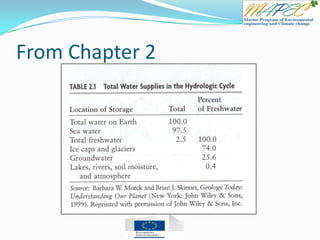
From Chapter 2
Groundwater Hydrology
 What is Groundwater?
 What is Groundwater Hydrology?
 The Geology of Groundwater
 Groundwater Recharge
 Aquifers
 Groundwater Movement
 Age of Groundwater
 Locating and Mapping Groundwater
 Drilling a Groundwater Well
What is Groundwater?
 Found in the subsurface, inside pores within soil
and rock
 Spelled either as two words, Ground Water, or as
one, Groundwater
 Groundwater is the largest source of freshwater on
earth, and was little used until recently.
 With electricity and the modern pump,
groundwater has become very important to
agriculture, cities, and industries.
 It is usually much cleaner than surface water.
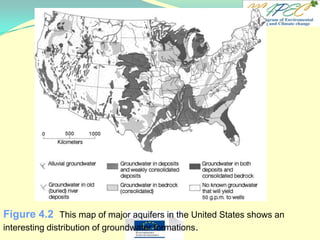
Figure 4.2 This map of major aquifers in the United States shows an
interesting distribution of groundwater formations.
Groundwater Hydrology
 What is Groundwater?
 What is Groundwater Hydrology?
 The Geology of Groundwater
 Groundwater Recharge
 Aquifers
 Groundwater Movement
 Age of Groundwater
 Locating and Mapping Groundwater
 Drilling a Groundwater Well
What is Groundwater Hydrology?
 It is the study of the characteristics, movement,
and occurrence of water found below the
surface.
 Groundwater and aquifers are like surface water
and watersheds
 An aquifer is a geologic unit that transmits water.
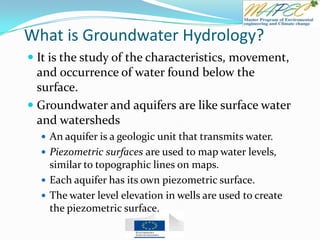
 Piezometric surfaces are used to map water levels,
similar to topographic lines on maps.
 Each aquifer has its own piezometric surface.
 The water level elevation in wells are used to create
the piezometric surface.
Groundwater Hydrology
 What is Groundwater?
 What is Groundwater Hydrology?
 The Geology of Groundwater
 Groundwater Recharge
 Aquifers
 Groundwater Movement
 Age of Groundwater
 Locating and Mapping Groundwater
 Drilling a Groundwater Well
The Geology of Groundwater
 Sedimentary Rocks
 sandstone, shale, limestone, conglomerate
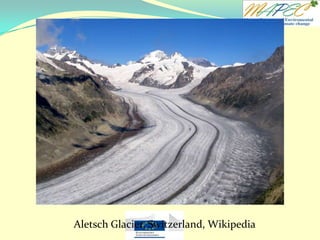
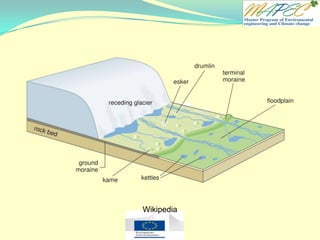
 Glaciated Terrain
 large valleys and basins were carved out
 sediments (sands, clays) were left behind
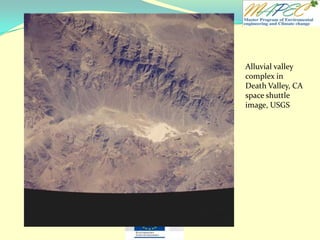
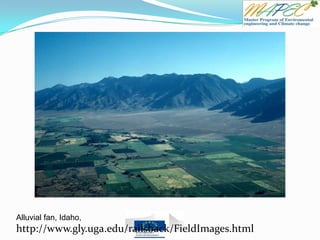
 Alluvial Valleys and Fans
 along rivers and streams
 Tectonic Formations
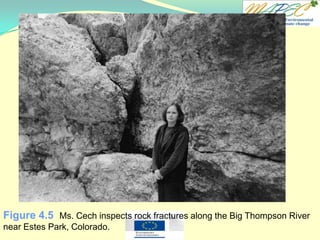
 solid rock is fractured by pressures due to earth’s
movement
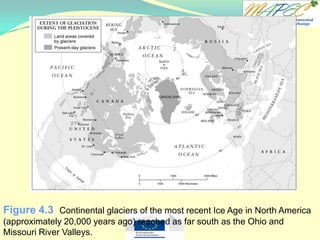
Figure 4.3 Continental glaciers of the most recent Ice Age in North America
(approximately 20,000 years ago) reached as far south as the Ohio and
Missouri River Valleys.
Aletsch Glacier, Switzerland, Wikipedia
Wikipedia
Alluvial valley
complex in
Death Valley, CA
space shuttle
image, USGS
Alluvial fan, Idaho,
http://www.gly.uga.edu/railsback/FieldImages.html
Figure 4.5 Ms. Cech inspects rock fractures along the Big Thompson River
near Estes Park, Colorado.
Groundwater Hydrology
 What is Groundwater?
 What is Groundwater Hydrology?
 The Geology of Groundwater
 Groundwater Recharge
 Aquifers
 Groundwater Movement
 Age of Groundwater
 Locating and Mapping Groundwater
 Drilling a Groundwater Well
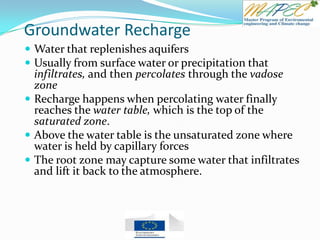
Groundwater Recharge
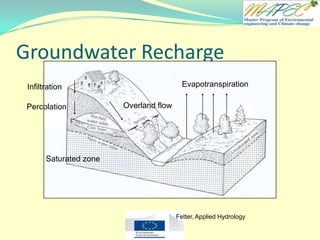
 Water that replenishes aquifers
 Usually from surface water or precipitation that
infiltrates, and then percolates through the vadose
zone
 Recharge happens when percolating water finally
reaches the water table, which is the top of the
saturated zone.
 Above the water table is the unsaturated zone where
water is held by capillary forces
 The root zone may capture some water that infiltrates
and lift it back to the atmosphere.
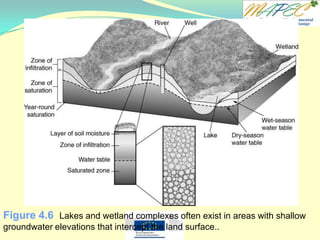
Figure 4.6 Lakes and wetland complexes often exist in areas with shallow
groundwater elevations that intercept the land surface..
Groundwater Recharge
Fetter, Applied Hydrology
Infiltration
Percolation
Saturated zone
Evapotranspiration
Overland flow
Groundwater Hydrology
 What is Groundwater?
 What is Groundwater Hydrology?
 The Geology of Groundwater
 Groundwater Recharge
 Aquifers
 Groundwater Movement
 Age of Groundwater
 Locating and Mapping Groundwater
 Drilling a Groundwater Well
Aquifers
 Water-bearing geologic formation that can
store and yield usable amounts of water
 Aquifer types:
 unconsolidated, consolidated, fractured
 perched, unconfined, confined, artesian
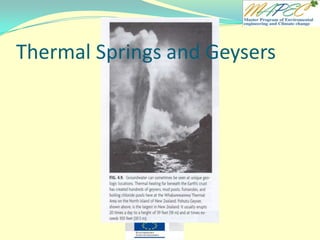
 thermal springs
 Aquifer properties
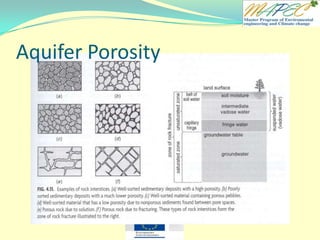
 porosity = volume of pores (voids) per total volume
of aquifer
 n = Vv / Tt
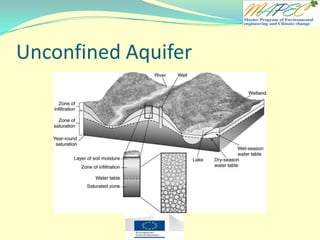
Unconfined Aquifer
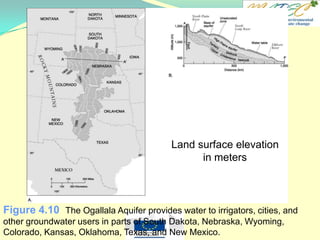
Figure 4.10 The Ogallala Aquifer provides water to irrigators, cities, and
other groundwater users in parts of South Dakota, Nebraska, Wyoming,
Colorado, Kansas, Oklahoma, Texas, and New Mexico.
Land surface elevation
in meters
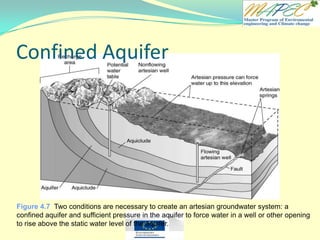
Figure 4.7 Two conditions are necessary to create an artesian groundwater system: a
confined aquifer and sufficient pressure in the aquifer to force water in a well or other opening
to rise above the static water level of the aquifer.
Confined Aquifer
Thermal Springs and Geysers
Aquifer Porosity
Example Porosity Calculation
 Take a 1000-mL beaker (1 liter)
 Fill it with sand to the top
 Measure how much water it takes to fill the beaker
to the top (say 300 mL)
 The porosity = (300 mL) / (1000 mL) = 30%
Groundwater Hydrology
 What is Groundwater?
 What is Groundwater Hydrology?
 The Geology of Groundwater
 Groundwater Recharge
 Aquifers
 Groundwater Movement
 Age of Groundwater
 Locating and Mapping Groundwater
 Drilling a Groundwater Well
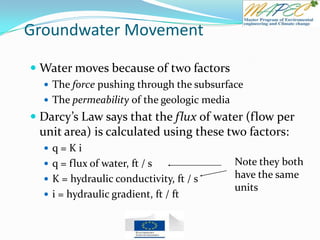
Groundwater Movement
 Water moves because of two factors
 The force pushing through the subsurface
 The permeability of the geologic media
 Darcy’s Law says that the flux of water (flow per
unit area) is calculated using these two factors:
 q = K i
 q = flux of water, ft / s
 K = hydraulic conductivity, ft / s
 i = hydraulic gradient, ft / ft
Note they both
have the same
units
 The hydraulic conductivity, K, is a measure of the
permeability of the aquifer
 gravels have large hydraulic conductivities
 clays and solid rock have small values
 The hydraulic gradient is a measure of the force acting
on the water
 it is like the slope of the land surface, water flows faster where it
is steep
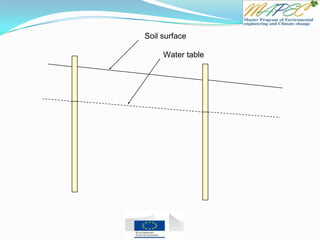
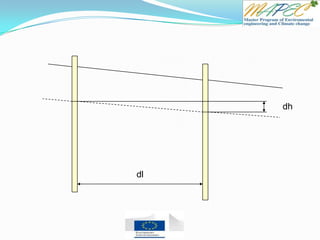
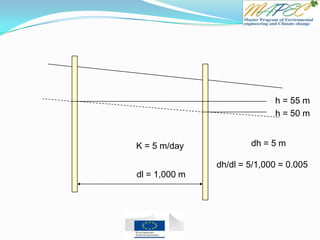
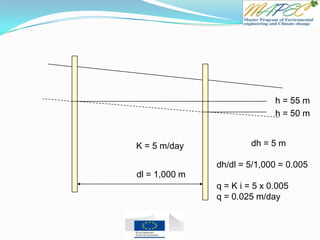
 i = dh / dl = slope of the water surface
 h is the hydraulic head, or water level in a well
 dh is the change in water level between two wells
 dl is the distance between the wells
 determines the direction of flow.
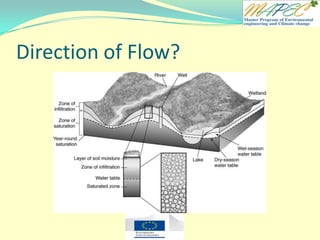
Direction of Flow?
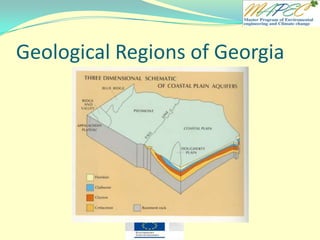
Geological Regions of Georgia
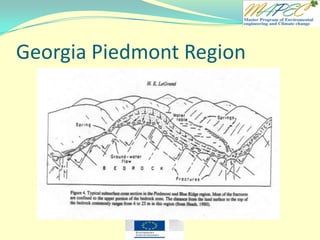
Georgia Piedmont Region
Soil surface
Water table
dh
dl
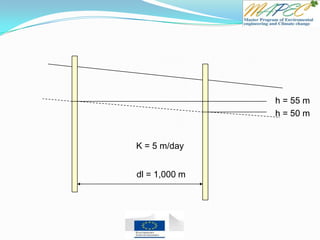
dl = 1,000 m
h = 50 m
h = 55 m
K = 5 m/day
dl = 1,000 m
h = 50 m
h = 55 m
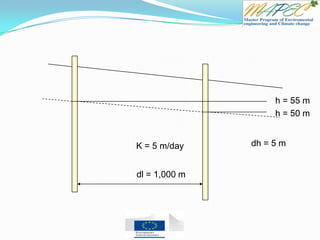
K = 5 m/day dh = 5 m
dl = 1,000 m
h = 50 m
h = 55 m
K = 5 m/day dh = 5 m
dh/dl = 5/1,000 = 0.005
dl = 1,000 m
h = 50 m
h = 55 m
K = 5 m/day dh = 5 m
dh/dl = 5/1,000 = 0.005
q = K i = 5 x 0.005
q = 0.025 m/day
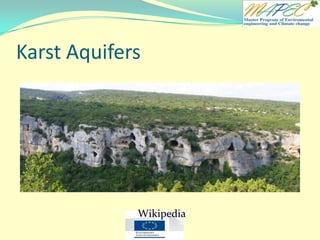
Karst Aquifers
Wikipedia
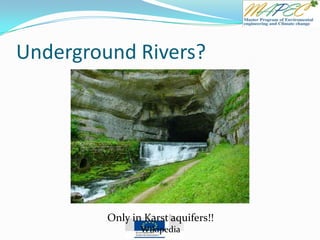
Underground Rivers?
Only in Karst aquifers!!
Wikipedia
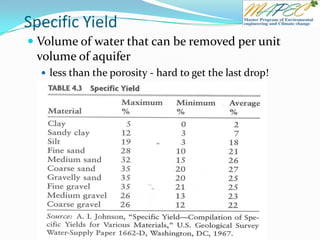
Specific Yield
 Volume of water that can be removed per unit
volume of aquifer
 less than the porosity - hard to get the last drop!
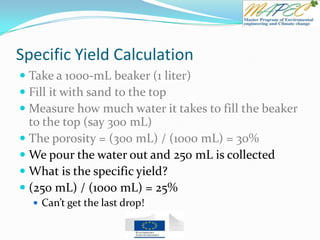
Specific Yield Calculation
 Take a 1000-mL beaker (1 liter)
 Fill it with sand to the top
 Measure how much water it takes to fill the beaker
to the top (say 300 mL)
 The porosity = (300 mL) / (1000 mL) = 30%
 We pour the water out and 250 mL is collected
 What is the specific yield?
 (250 mL) / (1000 mL) = 25%
 Can’t get the last drop!
Groundwater Hydrology
 What is Groundwater?
 What is Groundwater Hydrology?
 The Geology of Groundwater
 Groundwater Recharge
 Aquifers
 Groundwater Movement
 Age of Groundwater
 Locating and Mapping Groundwater
 Drilling a Groundwater Well
Age of Groundwater
 Time it takes for water to move through the subsurface
 Maybe 1 to 25 years in aquifers near Athens
 Up to 30,000 years for water down on the coast
Groundwater Hydrology
 What is Groundwater?
 What is Groundwater Hydrology?
 The Geology of Groundwater
 Groundwater Recharge
 Aquifers
 Groundwater Movement
 Age of Groundwater
 Locating and Mapping Groundwater
 Drilling a Groundwater Well
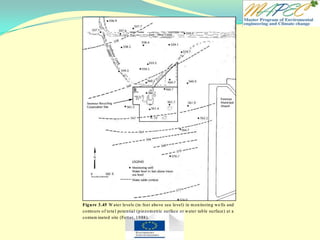
Locating and Mapping Groundwater
 The first step is to generate a piezometric surface,
which maps water table elevation
 Wells are plotted on a map, and water levels in the wells
are indicated
 Lines of constant water level elevations are plotted
(called equipotentials)
 Flowlines (also call streamlines) are drawn so that they
are perpendicular to the equipotential lines
 Local rivers, lakes, and other surface water features are
plotted on the map.
Figure 3.45 W ater levels (in feet above sea level) in monitoring we lls and
contours of tota l potential (piezometric surface or water table surface) at a
contam inated site (Fetter, 1988).
Figure 3.45 W ater levels (in feet above sea level) in monitoring we lls and
contours of tota l potential (piezometric surface or water table surface) at a
contam inated site (Fetter, 1988).
Groundwater Hydrology
 What is Groundwater?
 What is Groundwater Hydrology?
 The Geology of Groundwater
 Groundwater Recharge
 Aquifers
 Groundwater Movement
 Age of Groundwater
 Locating and Mapping Groundwater
 Drilling a Groundwater Well
Drilling a Groundwater Well
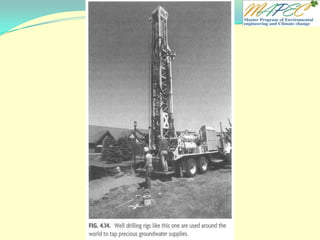
 Various methods are available for drilling a well
 A simple method is the auger method, which uses
a screw-like bit. This works in soft materials
 For solid rock, a simple technique is the hammer
or percussion method which pounds a hole in the
rock
 Rotary methods uses a harden steel bit tipped with
diamonds to cut through the rock. Either water, air
or mud can be used to lubricate and to lift the
cuttings.
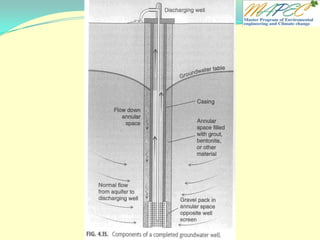
Well Components
 A well pad is placed on the surface to hold up
the well.
 A blank casing is used from the surface down
to the aquifer. Clay or concrete fills the space
outside the casing.
 A screened casing is used in the aquifer. Sand or
gravel fills the space outside the casing
 A submerged turbine pump lifts the water to
the surface. The motor that drives the pump is
either on the surface or also submerged.
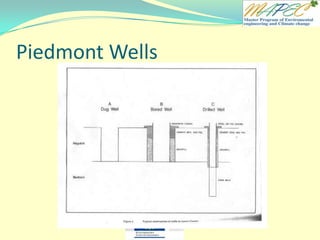
Piedmont Wells
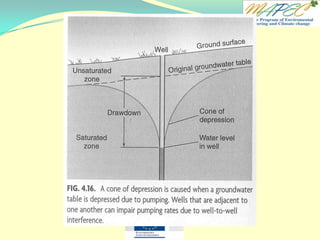
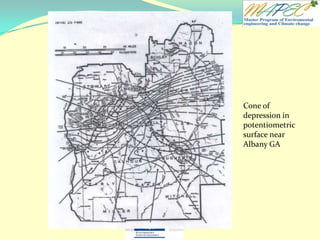
Cone of
depression in
potentiometric
surface near
Albany GA
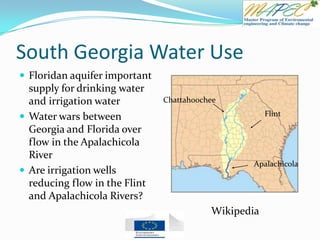
South Georgia Water Use
 Floridan aquifer important
supply for drinking water
and irrigation water
 Water wars between
Georgia and Florida over
flow in the Apalachicola
River
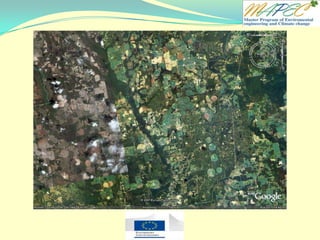
 Are irrigation wells
reducing flow in the Flint
and Apalachicola Rivers?
Wikipedia
Flint
Chattahoochee
Apalachicola
Stream Depletion Factors
 Used to assess the effects of well pumping on stream
flow
 Depend on
 the distance to the stream (less effect with greater
distance)
 properties of the aquifer
Quiz 4 Two wells are located 1 km (1,000 meters) apart. Well A has a water level of 105 m
and Well B has a water level of 102 m.
 Which direction is the groundwater flowing? From Well ____ to Well ____
 What is the hydraulic gradient between the two wells?
 What is the flux (flow rate) if the hydraulic conductivity is K = 10 m/day?
 A one-liter (1,000 mL) beaker is filled with sand and filled to the top with water.
 What is the porosity of the material if 250 mL was required to fill the beaker?
 We pour the water out, and 200 mL is collected. What happened to the rest of the water?
 What would the porosity be if we use clay instead of sand? (more, less, the same)
 How much water would pour out if we use clay instead of sand? (more, less, the same)
 True - False Questions
 [T / F] An aquiclude is a geologic formation that holds a lot of water.
 [T / F] Perched aquifers are a kind of artesian aquifer.
 [T / F] The Ogallala aquifer is the major aquifer in the Southeastern U.S.
 [T / F] The water table is found at the top of the saturated zone.
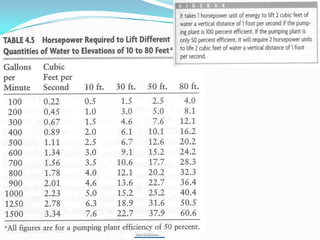
 [T / F] The two factors that determine how much horsepower is needed to lift water are
the amount of water that must be lifted and the height that you must lift the water.
 Explain what Stream Depletion Factors are used for

Chapter 4 groundwater hydrology

  • 1.
    Chapter 4 Groundwater Hydrology Prof.Dr. Ali El-Naqa Hashemite University June 2013
  • 2.
    Groundwater Hydrology  Whatis Groundwater?  What is Groundwater Hydrology?  The Geology of Groundwater  Groundwater Recharge  Aquifers  Groundwater Movement  Age of Groundwater  Locating and Mapping Groundwater  Drilling a Groundwater Well
  • 3.
  • 4.
    Groundwater Hydrology  Whatis Groundwater?  What is Groundwater Hydrology?  The Geology of Groundwater  Groundwater Recharge  Aquifers  Groundwater Movement  Age of Groundwater  Locating and Mapping Groundwater  Drilling a Groundwater Well
  • 5.
    What is Groundwater? Found in the subsurface, inside pores within soil and rock  Spelled either as two words, Ground Water, or as one, Groundwater  Groundwater is the largest source of freshwater on earth, and was little used until recently.  With electricity and the modern pump, groundwater has become very important to agriculture, cities, and industries.  It is usually much cleaner than surface water.
  • 6.
    Figure 4.2 Thismap of major aquifers in the United States shows an interesting distribution of groundwater formations.
  • 7.
    Groundwater Hydrology  Whatis Groundwater?  What is Groundwater Hydrology?  The Geology of Groundwater  Groundwater Recharge  Aquifers  Groundwater Movement  Age of Groundwater  Locating and Mapping Groundwater  Drilling a Groundwater Well
  • 8.
    What is GroundwaterHydrology?  It is the study of the characteristics, movement, and occurrence of water found below the surface.  Groundwater and aquifers are like surface water and watersheds  An aquifer is a geologic unit that transmits water.  Piezometric surfaces are used to map water levels, similar to topographic lines on maps.  Each aquifer has its own piezometric surface.  The water level elevation in wells are used to create the piezometric surface.
  • 9.
    Groundwater Hydrology  Whatis Groundwater?  What is Groundwater Hydrology?  The Geology of Groundwater  Groundwater Recharge  Aquifers  Groundwater Movement  Age of Groundwater  Locating and Mapping Groundwater  Drilling a Groundwater Well
  • 10.
    The Geology ofGroundwater  Sedimentary Rocks  sandstone, shale, limestone, conglomerate  Glaciated Terrain  large valleys and basins were carved out  sediments (sands, clays) were left behind  Alluvial Valleys and Fans  along rivers and streams  Tectonic Formations  solid rock is fractured by pressures due to earth’s movement
  • 11.
    Figure 4.3 Continentalglaciers of the most recent Ice Age in North America (approximately 20,000 years ago) reached as far south as the Ohio and Missouri River Valleys.
  • 12.
  • 13.
  • 14.
    Alluvial valley complex in DeathValley, CA space shuttle image, USGS
  • 15.
  • 16.
    Figure 4.5 Ms.Cech inspects rock fractures along the Big Thompson River near Estes Park, Colorado.
  • 17.
    Groundwater Hydrology  Whatis Groundwater?  What is Groundwater Hydrology?  The Geology of Groundwater  Groundwater Recharge  Aquifers  Groundwater Movement  Age of Groundwater  Locating and Mapping Groundwater  Drilling a Groundwater Well
  • 18.
    Groundwater Recharge  Waterthat replenishes aquifers  Usually from surface water or precipitation that infiltrates, and then percolates through the vadose zone  Recharge happens when percolating water finally reaches the water table, which is the top of the saturated zone.  Above the water table is the unsaturated zone where water is held by capillary forces  The root zone may capture some water that infiltrates and lift it back to the atmosphere.
  • 19.
    Figure 4.6 Lakesand wetland complexes often exist in areas with shallow groundwater elevations that intercept the land surface..
  • 20.
    Groundwater Recharge Fetter, AppliedHydrology Infiltration Percolation Saturated zone Evapotranspiration Overland flow
  • 21.
    Groundwater Hydrology  Whatis Groundwater?  What is Groundwater Hydrology?  The Geology of Groundwater  Groundwater Recharge  Aquifers  Groundwater Movement  Age of Groundwater  Locating and Mapping Groundwater  Drilling a Groundwater Well
  • 22.
    Aquifers  Water-bearing geologicformation that can store and yield usable amounts of water  Aquifer types:  unconsolidated, consolidated, fractured  perched, unconfined, confined, artesian  thermal springs  Aquifer properties  porosity = volume of pores (voids) per total volume of aquifer  n = Vv / Tt
  • 23.
  • 24.
    Figure 4.10 TheOgallala Aquifer provides water to irrigators, cities, and other groundwater users in parts of South Dakota, Nebraska, Wyoming, Colorado, Kansas, Oklahoma, Texas, and New Mexico. Land surface elevation in meters
  • 25.
    Figure 4.7 Twoconditions are necessary to create an artesian groundwater system: a confined aquifer and sufficient pressure in the aquifer to force water in a well or other opening to rise above the static water level of the aquifer. Confined Aquifer
  • 26.
  • 27.
  • 28.
    Example Porosity Calculation Take a 1000-mL beaker (1 liter)  Fill it with sand to the top  Measure how much water it takes to fill the beaker to the top (say 300 mL)  The porosity = (300 mL) / (1000 mL) = 30%
  • 30.
    Groundwater Hydrology  Whatis Groundwater?  What is Groundwater Hydrology?  The Geology of Groundwater  Groundwater Recharge  Aquifers  Groundwater Movement  Age of Groundwater  Locating and Mapping Groundwater  Drilling a Groundwater Well
  • 31.
    Groundwater Movement  Watermoves because of two factors  The force pushing through the subsurface  The permeability of the geologic media  Darcy’s Law says that the flux of water (flow per unit area) is calculated using these two factors:  q = K i  q = flux of water, ft / s  K = hydraulic conductivity, ft / s  i = hydraulic gradient, ft / ft Note they both have the same units
  • 33.
     The hydraulicconductivity, K, is a measure of the permeability of the aquifer  gravels have large hydraulic conductivities  clays and solid rock have small values  The hydraulic gradient is a measure of the force acting on the water  it is like the slope of the land surface, water flows faster where it is steep  i = dh / dl = slope of the water surface  h is the hydraulic head, or water level in a well  dh is the change in water level between two wells  dl is the distance between the wells  determines the direction of flow.
  • 34.
  • 35.
  • 36.
  • 37.
  • 38.
  • 39.
    dl = 1,000m h = 50 m h = 55 m K = 5 m/day
  • 40.
    dl = 1,000m h = 50 m h = 55 m K = 5 m/day dh = 5 m
  • 41.
    dl = 1,000m h = 50 m h = 55 m K = 5 m/day dh = 5 m dh/dl = 5/1,000 = 0.005
  • 42.
    dl = 1,000m h = 50 m h = 55 m K = 5 m/day dh = 5 m dh/dl = 5/1,000 = 0.005 q = K i = 5 x 0.005 q = 0.025 m/day
  • 43.
  • 44.
    Underground Rivers? Only inKarst aquifers!! Wikipedia
  • 45.
    Specific Yield  Volumeof water that can be removed per unit volume of aquifer  less than the porosity - hard to get the last drop!
  • 46.
    Specific Yield Calculation Take a 1000-mL beaker (1 liter)  Fill it with sand to the top  Measure how much water it takes to fill the beaker to the top (say 300 mL)  The porosity = (300 mL) / (1000 mL) = 30%  We pour the water out and 250 mL is collected  What is the specific yield?  (250 mL) / (1000 mL) = 25%  Can’t get the last drop!
  • 47.
    Groundwater Hydrology  Whatis Groundwater?  What is Groundwater Hydrology?  The Geology of Groundwater  Groundwater Recharge  Aquifers  Groundwater Movement  Age of Groundwater  Locating and Mapping Groundwater  Drilling a Groundwater Well
  • 48.
    Age of Groundwater Time it takes for water to move through the subsurface  Maybe 1 to 25 years in aquifers near Athens  Up to 30,000 years for water down on the coast
  • 50.
    Groundwater Hydrology  Whatis Groundwater?  What is Groundwater Hydrology?  The Geology of Groundwater  Groundwater Recharge  Aquifers  Groundwater Movement  Age of Groundwater  Locating and Mapping Groundwater  Drilling a Groundwater Well
  • 51.
    Locating and MappingGroundwater  The first step is to generate a piezometric surface, which maps water table elevation  Wells are plotted on a map, and water levels in the wells are indicated  Lines of constant water level elevations are plotted (called equipotentials)  Flowlines (also call streamlines) are drawn so that they are perpendicular to the equipotential lines  Local rivers, lakes, and other surface water features are plotted on the map.
  • 52.
    Figure 3.45 Water levels (in feet above sea level) in monitoring we lls and contours of tota l potential (piezometric surface or water table surface) at a contam inated site (Fetter, 1988). Figure 3.45 W ater levels (in feet above sea level) in monitoring we lls and contours of tota l potential (piezometric surface or water table surface) at a contam inated site (Fetter, 1988).
  • 53.
    Groundwater Hydrology  Whatis Groundwater?  What is Groundwater Hydrology?  The Geology of Groundwater  Groundwater Recharge  Aquifers  Groundwater Movement  Age of Groundwater  Locating and Mapping Groundwater  Drilling a Groundwater Well
  • 54.
    Drilling a GroundwaterWell  Various methods are available for drilling a well  A simple method is the auger method, which uses a screw-like bit. This works in soft materials  For solid rock, a simple technique is the hammer or percussion method which pounds a hole in the rock  Rotary methods uses a harden steel bit tipped with diamonds to cut through the rock. Either water, air or mud can be used to lubricate and to lift the cuttings.
  • 56.
    Well Components  Awell pad is placed on the surface to hold up the well.  A blank casing is used from the surface down to the aquifer. Clay or concrete fills the space outside the casing.  A screened casing is used in the aquifer. Sand or gravel fills the space outside the casing  A submerged turbine pump lifts the water to the surface. The motor that drives the pump is either on the surface or also submerged.
  • 58.
  • 60.
  • 62.
    South Georgia WaterUse  Floridan aquifer important supply for drinking water and irrigation water  Water wars between Georgia and Florida over flow in the Apalachicola River  Are irrigation wells reducing flow in the Flint and Apalachicola Rivers? Wikipedia Flint Chattahoochee Apalachicola
  • 64.
    Stream Depletion Factors Used to assess the effects of well pumping on stream flow  Depend on  the distance to the stream (less effect with greater distance)  properties of the aquifer
  • 65.
    Quiz 4 Twowells are located 1 km (1,000 meters) apart. Well A has a water level of 105 m and Well B has a water level of 102 m.  Which direction is the groundwater flowing? From Well ____ to Well ____  What is the hydraulic gradient between the two wells?  What is the flux (flow rate) if the hydraulic conductivity is K = 10 m/day?  A one-liter (1,000 mL) beaker is filled with sand and filled to the top with water.  What is the porosity of the material if 250 mL was required to fill the beaker?  We pour the water out, and 200 mL is collected. What happened to the rest of the water?  What would the porosity be if we use clay instead of sand? (more, less, the same)  How much water would pour out if we use clay instead of sand? (more, less, the same)  True - False Questions  [T / F] An aquiclude is a geologic formation that holds a lot of water.  [T / F] Perched aquifers are a kind of artesian aquifer.  [T / F] The Ogallala aquifer is the major aquifer in the Southeastern U.S.  [T / F] The water table is found at the top of the saturated zone.  [T / F] The two factors that determine how much horsepower is needed to lift water are the amount of water that must be lifted and the height that you must lift the water.  Explain what Stream Depletion Factors are used for