Chapter 1 - Adaptive Traits
1.5.1: WARM-UP
1.5.1: WARM-UP
1.5.1: WARM-UP
1.5.1: WARM-UP
1.5.1: WARM-UP
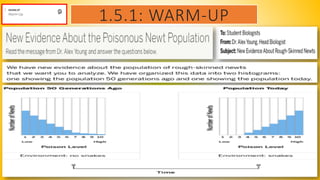
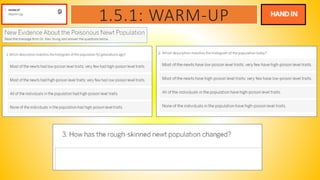
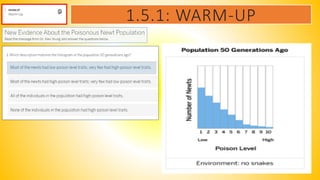
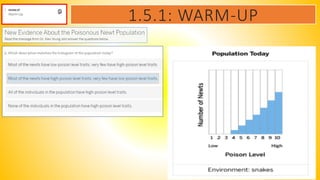
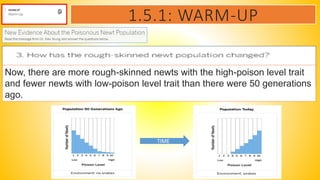
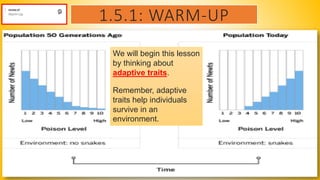
Now, there are more rough-skinned newts with the high-poison level trait
and fewer newts with low-poison level trait than there were 50 generations
ago.
TIME
1.5.1: WARM-UP
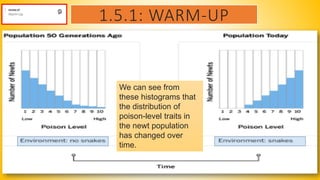
We can see from
these histograms that
the distribution of
poison-level traits in
the newt population
has changed over
time.
1.5.1: WARM-UP
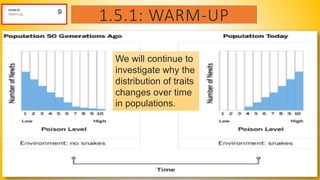
We will continue to
investigate why the
distribution of traits
changes over time
in populations.
1.5.1: WARM-UP
We will begin this lesson
by thinking about
adaptive traits.
Remember, adaptive
traits help individuals
survive in an
environment.
Investigating Adaptive Traits in the Sim
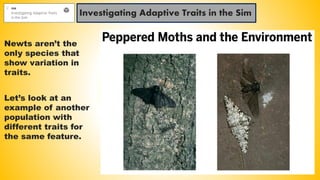
Newts aren’t the
only species that
show variation in
traits.
Let’s look at an
example of another
population with
different traits for
the same feature.
Investigating Adaptive Traits in the Sim
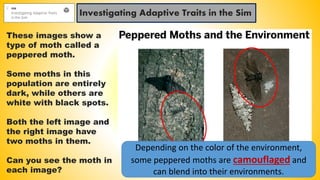
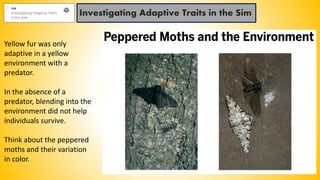
These images show a
type of moth called a
peppered moth.
Some moths in this
population are entirely
dark, while others are
white with black spots.
Both the left image and
the right image have
two moths in them.
Can you see the moth in
each image?
Depending on the color of the environment,
some peppered moths are camouflaged and
can blend into their environments.
Investigating Adaptive Traits in the Sim
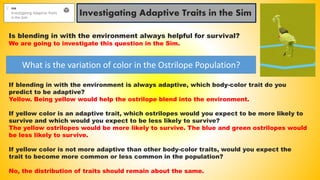
Is blending in with the environment always helpful for survival?
We are going to investigate this question in the Sim.
If blending in with the environment is always adaptive, which body-color trait do you
predict to be adaptive?
Yellow. Being yellow would help the ostrilope blend into the environment.
If yellow color is an adaptive trait, which ostrilopes would you expect to be more likely to
survive and which would you expect to be less likely to survive?
The yellow ostrilopes would be more likely to survive. The blue and green ostrilopes would
be less likely to survive.
If yellow color is not more adaptive than other body-color traits, would you expect the
trait to become more common or less common in the population?
No, the distribution of traits should remain about the same.
What is the variation of color in the Ostrilope Population?
Investigating Adaptive Traits in the Sim
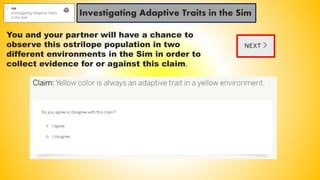
You and your partner will have a chance to
observe this ostrilope population in two
different environments in the Sim in order to
collect evidence for or against this claim.
Investigating Adaptive Traits in the Sim
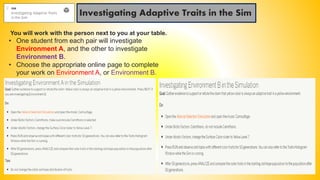
You will work with the person next to you at your table.
• One student from each pair will investigate
Environment A, and the other to investigate
Environment B.
• Choose the appropriate online page to complete
your work on Environment A, or Environment B.
Investigating Adaptive Traits in the Sim
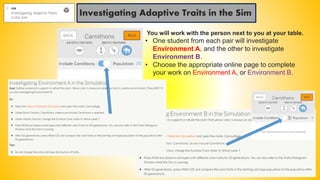
You will work with the person next to you at your table.
• One student from each pair will investigate
Environment A, and the other to investigate
Environment B.
• Choose the appropriate online page to complete
your work on Environment A, or Environment B.
Investigating Adaptive Traits in the Sim
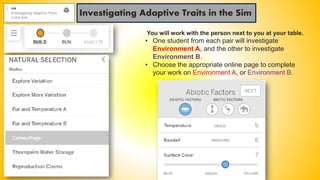
You will work with the person next to you at your table.
• One student from each pair will investigate
Environment A, and the other to investigate
Environment B.
• Choose the appropriate online page to complete
your work on Environment A, or Environment B.
Investigating Adaptive Traits in the Sim
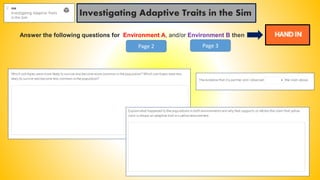
Answer the following questions for Environment A, and/or Environment B then
Page 2 Page 3
Investigating Adaptive Traits in the Sim
Let’s discuss your results by considering how the environments were different and
whether yellow color was always an adaptive trait.
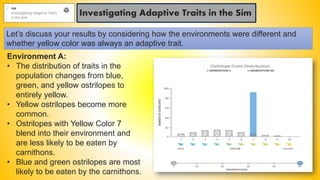
Environment A:
• The distribution of traits in the
population changes from blue,
green, and yellow ostrilopes to
entirely yellow.
• Yellow ostrilopes become more
common.
• Ostrilopes with Yellow Color 7
blend into their environment and
are less likely to be eaten by
carnithons.
• Blue and green ostrilopes are most
likely to be eaten by the carnithons.
Investigating Adaptive Traits in the Sim
Let’s discuss your results by considering how the environments were different and
whether yellow color was always an adaptive trait.
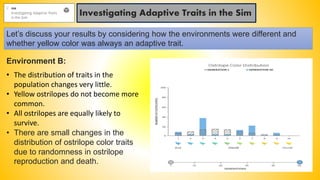
Environment B:
• The distribution of traits in the
population changes very little.
• Yellow ostrilopes do not become more
common.
• All ostrilopes are equally likely to
survive.
• There are small changes in the
distribution of ostrilope color traits
due to randomness in ostrilope
reproduction and death.
Investigating Adaptive Traits in the Sim
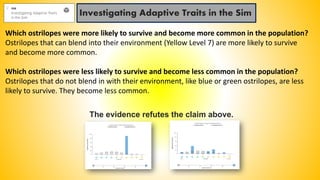
Which ostrilopes were more likely to survive and become more common in the population?
Ostrilopes that can blend into their environment (Yellow Level 7) are more likely to survive
and become more common.
Which ostrilopes were less likely to survive and become less common in the population?
Ostrilopes that do not blend in with their environment, like blue or green ostrilopes, are less
likely to survive. They become less common.
The evidence refutes the claim above.
Investigating Adaptive Traits in the Sim
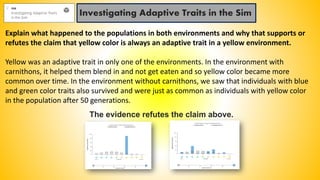
Explain what happened to the populations in both environments and why that supports or
refutes the claim that yellow color is always an adaptive trait in a yellow environment.
Yellow was an adaptive trait in only one of the environments. In the environment with
carnithons, it helped them blend in and not get eaten and so yellow color became more
common over time. In the environment without carnithons, we saw that individuals with blue
and green color traits also survived and were just as common as individuals with yellow color
in the population after 50 generations.
The evidence refutes the claim above.
Investigating Adaptive Traits in the Sim
Yellow fur was only
adaptive in a yellow
environment with a
predator.
In the absence of a
predator, blending into the
environment did not help
individuals survive.
Think about the peppered
moths and their variation
in color.
Modeling Trait Distribution in Thornpalms
One of the reasons scientists use models is to make predictions. Now that you know more
about what makes the distribution of traits in a population change, you will know how to use
the Modeling Tool to make a prediction about a population of thornpalms.
You are already familiar with making
predictions.
In fact, you probably make predictions
all the time.
We made predictions together earlier
in this lesson when we thought about
which traits would become more
common in the ostrilope population
before we ran the Sim.
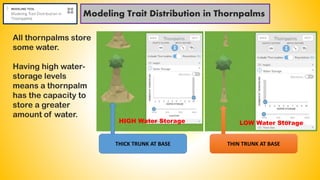
Modeling Trait Distribution in Thornpalms
All thornpalms store
some water.
Having high water-
storage levels
means a thornpalm
has the capacity to
store a greater
amount of water.
HIGH Water Storage LOW Water Storage
THICK TRUNK AT BASE THIN TRUNK AT BASE
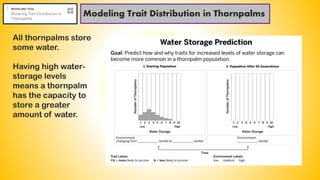
Modeling Trait Distribution in Thornpalms
All thornpalms store
some water.
Having high water-
storage levels
means a thornpalm
has the capacity to
store a greater
amount of water.
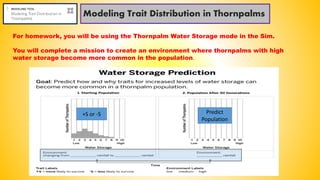
Modeling Trait Distribution in Thornpalms
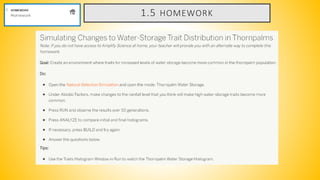
For homework, you will be using the Thornpalm Water Storage mode in the Sim.
You will complete a mission to create an environment where thornpalms with high
water storage become more common in the population.
Predict
Population
+S or -S
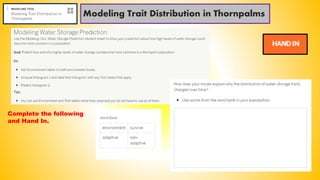
Modeling Trait Distribution in Thornpalms
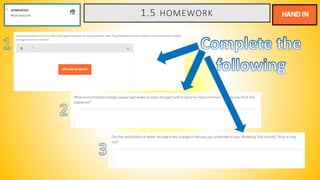
Complete the following
and Hand In.
1.5 HOMEWORK
Modeling Trait Distribution in Thornpalms
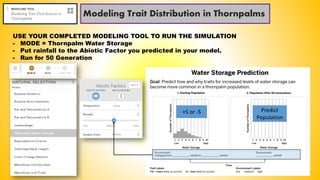
USE YOUR COMPLETED MODELING TOOL TO RUN THE SIMULATION
- MODE = Thornpalm Water Storage
- Put rainfall to the Abiotic Factor you predicted in your model.
- Run for 50 Generation
Predict
Population
+S or -S
1.5 HOMEWORK

Adaptive Traits

  • 1.
    Chapter 1 -Adaptive Traits
  • 2.
  • 3.
  • 4.
  • 5.
  • 6.
    1.5.1: WARM-UP Now, thereare more rough-skinned newts with the high-poison level trait and fewer newts with low-poison level trait than there were 50 generations ago. TIME
  • 7.
    1.5.1: WARM-UP We cansee from these histograms that the distribution of poison-level traits in the newt population has changed over time.
  • 8.
    1.5.1: WARM-UP We willcontinue to investigate why the distribution of traits changes over time in populations.
  • 9.
    1.5.1: WARM-UP We willbegin this lesson by thinking about adaptive traits. Remember, adaptive traits help individuals survive in an environment.
  • 10.
    Investigating Adaptive Traitsin the Sim Newts aren’t the only species that show variation in traits. Let’s look at an example of another population with different traits for the same feature.
  • 11.
    Investigating Adaptive Traitsin the Sim These images show a type of moth called a peppered moth. Some moths in this population are entirely dark, while others are white with black spots. Both the left image and the right image have two moths in them. Can you see the moth in each image? Depending on the color of the environment, some peppered moths are camouflaged and can blend into their environments.
  • 12.
    Investigating Adaptive Traitsin the Sim Is blending in with the environment always helpful for survival? We are going to investigate this question in the Sim. If blending in with the environment is always adaptive, which body-color trait do you predict to be adaptive? Yellow. Being yellow would help the ostrilope blend into the environment. If yellow color is an adaptive trait, which ostrilopes would you expect to be more likely to survive and which would you expect to be less likely to survive? The yellow ostrilopes would be more likely to survive. The blue and green ostrilopes would be less likely to survive. If yellow color is not more adaptive than other body-color traits, would you expect the trait to become more common or less common in the population? No, the distribution of traits should remain about the same. What is the variation of color in the Ostrilope Population?
  • 13.
    Investigating Adaptive Traitsin the Sim You and your partner will have a chance to observe this ostrilope population in two different environments in the Sim in order to collect evidence for or against this claim.
  • 14.
    Investigating Adaptive Traitsin the Sim You will work with the person next to you at your table. • One student from each pair will investigate Environment A, and the other to investigate Environment B. • Choose the appropriate online page to complete your work on Environment A, or Environment B.
  • 15.
    Investigating Adaptive Traitsin the Sim You will work with the person next to you at your table. • One student from each pair will investigate Environment A, and the other to investigate Environment B. • Choose the appropriate online page to complete your work on Environment A, or Environment B.
  • 16.
    Investigating Adaptive Traitsin the Sim You will work with the person next to you at your table. • One student from each pair will investigate Environment A, and the other to investigate Environment B. • Choose the appropriate online page to complete your work on Environment A, or Environment B.
  • 17.
    Investigating Adaptive Traitsin the Sim Answer the following questions for Environment A, and/or Environment B then Page 2 Page 3
  • 18.
    Investigating Adaptive Traitsin the Sim Let’s discuss your results by considering how the environments were different and whether yellow color was always an adaptive trait. Environment A: • The distribution of traits in the population changes from blue, green, and yellow ostrilopes to entirely yellow. • Yellow ostrilopes become more common. • Ostrilopes with Yellow Color 7 blend into their environment and are less likely to be eaten by carnithons. • Blue and green ostrilopes are most likely to be eaten by the carnithons.
  • 19.
    Investigating Adaptive Traitsin the Sim Let’s discuss your results by considering how the environments were different and whether yellow color was always an adaptive trait. Environment B: • The distribution of traits in the population changes very little. • Yellow ostrilopes do not become more common. • All ostrilopes are equally likely to survive. • There are small changes in the distribution of ostrilope color traits due to randomness in ostrilope reproduction and death.
  • 20.
    Investigating Adaptive Traitsin the Sim Which ostrilopes were more likely to survive and become more common in the population? Ostrilopes that can blend into their environment (Yellow Level 7) are more likely to survive and become more common. Which ostrilopes were less likely to survive and become less common in the population? Ostrilopes that do not blend in with their environment, like blue or green ostrilopes, are less likely to survive. They become less common. The evidence refutes the claim above.
  • 21.
    Investigating Adaptive Traitsin the Sim Explain what happened to the populations in both environments and why that supports or refutes the claim that yellow color is always an adaptive trait in a yellow environment. Yellow was an adaptive trait in only one of the environments. In the environment with carnithons, it helped them blend in and not get eaten and so yellow color became more common over time. In the environment without carnithons, we saw that individuals with blue and green color traits also survived and were just as common as individuals with yellow color in the population after 50 generations. The evidence refutes the claim above.
  • 23.
    Investigating Adaptive Traitsin the Sim Yellow fur was only adaptive in a yellow environment with a predator. In the absence of a predator, blending into the environment did not help individuals survive. Think about the peppered moths and their variation in color.
  • 24.
    Modeling Trait Distributionin Thornpalms One of the reasons scientists use models is to make predictions. Now that you know more about what makes the distribution of traits in a population change, you will know how to use the Modeling Tool to make a prediction about a population of thornpalms. You are already familiar with making predictions. In fact, you probably make predictions all the time. We made predictions together earlier in this lesson when we thought about which traits would become more common in the ostrilope population before we ran the Sim.
  • 25.
    Modeling Trait Distributionin Thornpalms All thornpalms store some water. Having high water- storage levels means a thornpalm has the capacity to store a greater amount of water. HIGH Water Storage LOW Water Storage THICK TRUNK AT BASE THIN TRUNK AT BASE
  • 26.
    Modeling Trait Distributionin Thornpalms All thornpalms store some water. Having high water- storage levels means a thornpalm has the capacity to store a greater amount of water.
  • 27.
    Modeling Trait Distributionin Thornpalms For homework, you will be using the Thornpalm Water Storage mode in the Sim. You will complete a mission to create an environment where thornpalms with high water storage become more common in the population. Predict Population +S or -S
  • 28.
    Modeling Trait Distributionin Thornpalms Complete the following and Hand In.
  • 29.
  • 30.
    Modeling Trait Distributionin Thornpalms USE YOUR COMPLETED MODELING TOOL TO RUN THE SIMULATION - MODE = Thornpalm Water Storage - Put rainfall to the Abiotic Factor you predicted in your model. - Run for 50 Generation Predict Population +S or -S
  • 31.