Dr.B.Selvaraj MS;MCh;FICS
Professor of Surgery
Melaka Manipal Medical college
Melaka Malaysia 75150
GROIN SWELLINGS
INGUINAL
HERNIA
Inguinal Hernia- Overview
 Causes of groin swellings
 Classical Clinical Vignette of Inguinal Hernia
 Inguinal Hernia in detail- one pathology in each
episode
 Mind map of Inguinal Hernia
 Algorithm to clinch the correct diagnosis
 Tabular column of differential diagnosis depicting
their characteristic features to differentiate them
from Inguinal Hernia
Causes of Groin swellings
 Inguinal hernia- Indirect & direct
 Femoral hernia
 Undescended testis
 Inguinal lymphadenitis
 Lipoma of spermatic cord
 Encysted hydrocele
 Saphena varix
 Femoral artery aneurysm
 Psoas abscess
 Femoral nerve neuroma
Classical Clinical Vignette
 40 years old male patient, a manual labourer by occupation,
presented with a swelling in his right groin and scrotum for last 2
years and pain over the swelling for last 6 months.
 The swelling appeared insidiously, initially in the right groin and
gradually increased in size for last 2 years and descended into the
right scrotum.
 The swelling disappears completely when the patient lies down, but
the swelling reappears on standing and increases in size as the patient
walks & coughs
 Bladder and bowel habits are normal. No history of chronic
constipation, or difficulty in micturition.
Classical Clinical Vignette
 Patient complains of chronic cough and breathlessness for last 3 years,
which particularly aggravates during the winter season.
 O/E: The swelling is pyriform in shape and there is visible peristalsis
and expansile impulse over the swelling.
 It is not possible to get above the swelling and there is palpable
expansile impulse. The swelling lies above and medial to the pubic
tubercle.
 The content of the swelling reduces with a gurgling sound. The deep
ring occlusion test is positive.
 Bowel sounds are audible over the swelling. Lt inguinoscrotal region is
normal
Inguinal Hernia
Inguinal Hernia
 Hernia is an abnormal protrusion of the whole
or a part of a viscus through an opening in the
wall of the cavity which contains it
 Inguinal hernia occurs either through the deep
inguinal ring (indirect) or through the posterior
wall of inguinal canal (direct hernia).
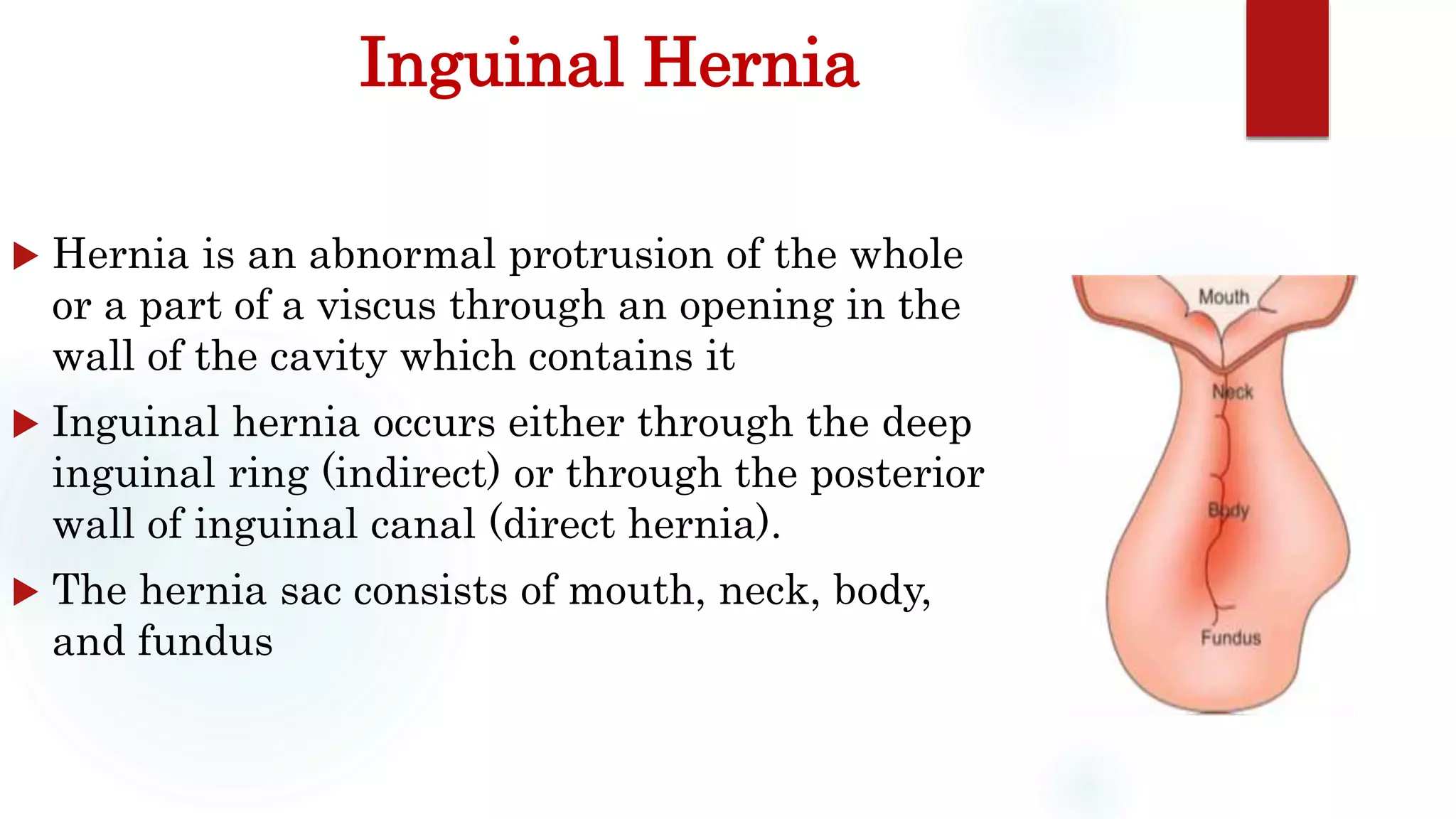
 The hernia sac consists of mouth, neck, body,
and fundus
Inguinal Hernia- Etiology
 Pediatric congenital hernias due to patent PV
 Indirect inguinal hernia due to increased intra abdominal pressure
 Direct inguinal hernia due to weakness of posterior wall of inguinal
canal
 Classification: The European Hernia Society has recently suggested a
simplified system of classification
 Primary or recurrent (P or R);
 Lateral, medial or femoral (L, M or F);
 Defect size in finger breadths assumed to be 1.5 cm.
 A primary, indirect, inguinal hernia with a 3-cm defect size would be
PL2.
Inguinal Hernia- Indirect
 Indirect inguinal hernia is a herniation of abdominal contents
through the deep inguinal ring into the inguinal canal.
 As it traverses the inguinal canal, it is invested by the following
coverings from outside within
 1. Skin
 2. Superficial fascia/dartos muscle in scrotum.
 3. External spermatic fascia derived from external oblique muscle.
 4. Cremasteric fascia derived from the internal oblique muscle.
 5. Internal spermatic fascia derived from fascia transversalis and
 6. The peritoneum which forms the sac.
Inguinal Hernia- Indirect
Types
 Bubonocele: Hernial sac stops within
inguinal canal after entering internal
ring
 Funicular: Hernial sac after emerging
out of external ring stops just above the
testis
 Complete Scrotal: Processus vaginalis is
patent throughout being continuous
with tunica vaginalis of the testis. It is a
congenital hernia, commonly seen in
children but it may appear in adult or
adolescent life.
Inguinal Hernia- Clinical
Features
 Swelling in the inguinal region, this is gradually increasing in size.
 History of dragging pain indicates pull on mesentry in enterocele and
pull on omentum in omentocele
 Age—It occurs in all ages from birth to elderly. Direct hernia is more
common in elderly people while indirect hernia is more common in
younger and adult life.
 Expansile impulse on coughing is present.
 Indirect Pyriform shape; Direct Globular shape
 Direct hernia pops out as soon as patient stands.
 Presence of a scar indicates recurrent hernia
Inguinal Hernia- Clinical
Features
 Swelling is soft and gurgles if it is enterocele. It may be firm or
granular if omentocele
 An expansile impulse is felt at the root of scrotum.
 Getting above the swelling is not possible
 Reducibility: The direct hernia usually reduces immediately and
spontaneously but indirect hernia may require manipulation
 Internal or deep ring occlusion test: swelling does not reappear in
case of indirect hernia; swelling reappears immediately in case of
direct hernia
Inguinal Hernia- Clinical
Features
 Ziemann’s Test: (Three fingers test):Index finger is kept at the deep
ring, Middle finger, at the superficial ring and Ring finger, at fossa
ovalis. Depending on the type of hernia, indirect, direct and femoral,
impulse is felt by the index, middle and ring fingers respectively.
 Examination of respiratory system is done to rule out chronic
bronchitis/ COPD
 Leg raising test (Head raising test): Weakness of the oblique muscles
is manifested by Malgaigne’s bulging- the precursor of a direct
inguinal hernia.
Inguinal Hernia- Clinical
Features
Inguinal Hernia- Clinical
Features
Indirect Vs Direct
Inguinal Hernia
Indirect Vs Direct
Inguinal Hernia
Inguinal Hernia-Special
Types
 Dual/Pantaloon/Saddle Hernia: Both
direct and indirect sacs +
 Sliding Hernia: (Hernia-en-glissade)
Retroperitoneal organ is part of hernial
sac
 Richter’s Hernia: only part of
circumference of the small gut is
obstructed
 Maydl’s Hernia: “W” shaped hernia
 Littre’s Hernia: Meckel’s diverticulum
 Amyand’s Hernia: Appendix
Inguinal Hernia-
Complications
 Irreducible: Hernia is no more reducible
 Obstructed: Lumen of hollow viscera is
blocked. Can not happen in omentocele.
 Strangulated: The blood supply to the
content of hernial sac is cut off
Gangrene Perforation Peritonitis
 Incarcerated: The block of the lumen of
hollow viscera is due to thick fecal matter/
adhesions
 Reduction-en-mass: Taxis is normal
maneuver to reduce; If you forcibly reduce
this complication can occur
Inguinal Hernia-
Complications
Inguinal Hernia-
Treatment
 Pediatric congenital: High ligation of sac/ Herniotomy
 Young adults: Herniorraphy- suturing together patient’s
tissues
1. Bassini’s repair
2. Shouldice repair
3. Maloney’s repair Darning of posterior wall
4. Desarda repair Strip of external oblique
aponeurosis is used to strengthen posterior wall
Inguinal Hernia-
Treatment
 Old people: Hernioplasty
Litchtenstein’s tension free mesh repair
 Prolene Hernia System: PHS- Gilbert’s
open suture less repair
 Open pre-peritoneal repair- Stoppa’s
 Laparoscopic repair: TAPP & TEP
Indications:
1.Recurrent Hernias
2.Bilateral inguinal hernias
Inguinal Hernia-Complications
Of Surgery
 Seroma/ Hematoma
 Urinary retention
 Wound infection
 Recurrence
 Chronic neuralgic pain due to nerve injury or entrapment
 Testicular atrophy due to testicular artery injury
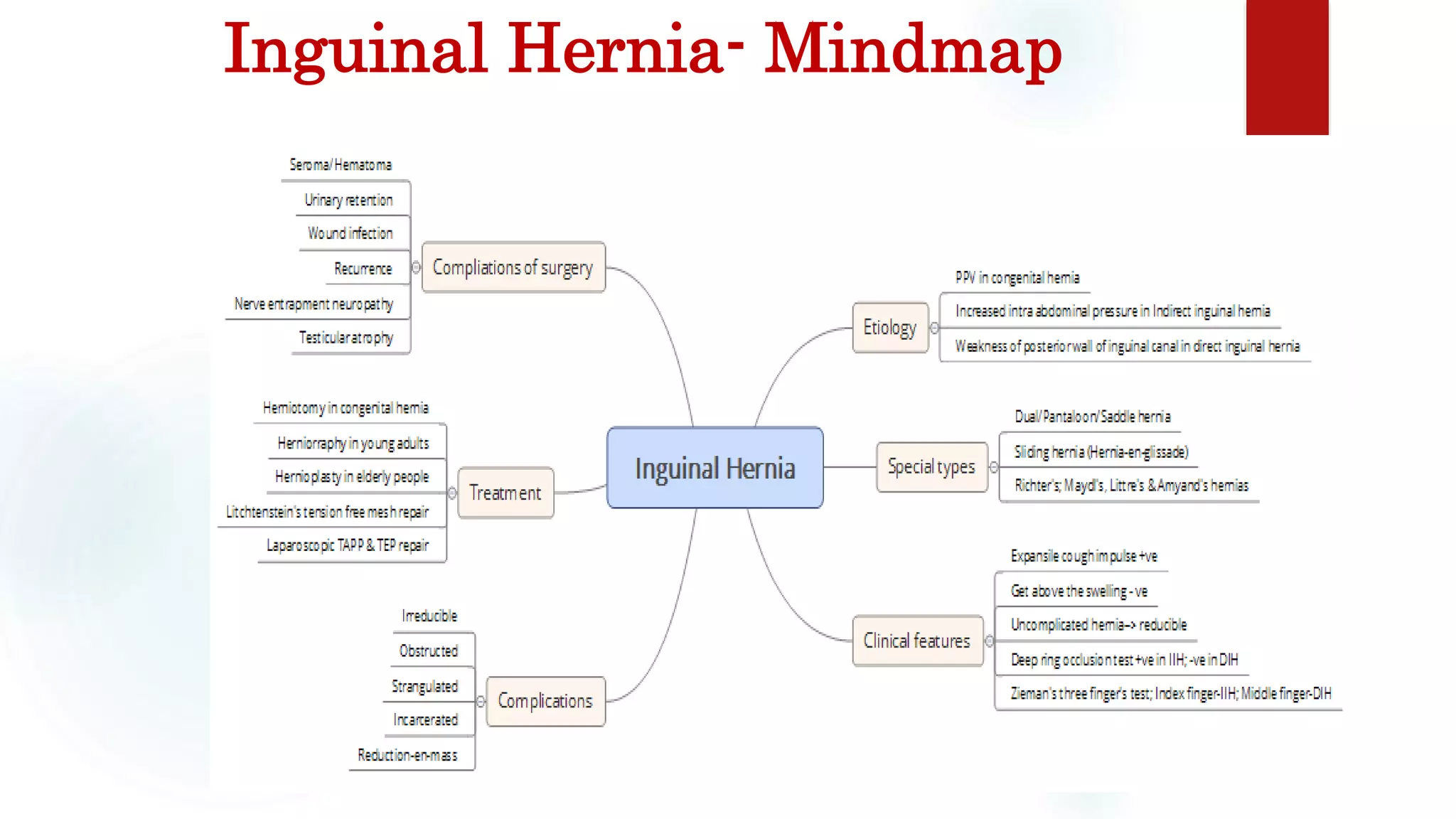
Inguinal Hernia- Mindmap
Algorithm for Groin
Swellings
D/D for Groin Swellings
Compare & Contrast; Vertical reading
Inguinal Hernia- Groin Swellings

Inguinal Hernia- Groin Swellings

  • 1.
    Dr.B.Selvaraj MS;MCh;FICS Professor ofSurgery Melaka Manipal Medical college Melaka Malaysia 75150 GROIN SWELLINGS INGUINAL HERNIA
  • 2.
    Inguinal Hernia- Overview Causes of groin swellings  Classical Clinical Vignette of Inguinal Hernia  Inguinal Hernia in detail- one pathology in each episode  Mind map of Inguinal Hernia  Algorithm to clinch the correct diagnosis  Tabular column of differential diagnosis depicting their characteristic features to differentiate them from Inguinal Hernia
  • 3.
    Causes of Groinswellings  Inguinal hernia- Indirect & direct  Femoral hernia  Undescended testis  Inguinal lymphadenitis  Lipoma of spermatic cord  Encysted hydrocele  Saphena varix  Femoral artery aneurysm  Psoas abscess  Femoral nerve neuroma
  • 4.
    Classical Clinical Vignette 40 years old male patient, a manual labourer by occupation, presented with a swelling in his right groin and scrotum for last 2 years and pain over the swelling for last 6 months.  The swelling appeared insidiously, initially in the right groin and gradually increased in size for last 2 years and descended into the right scrotum.  The swelling disappears completely when the patient lies down, but the swelling reappears on standing and increases in size as the patient walks & coughs  Bladder and bowel habits are normal. No history of chronic constipation, or difficulty in micturition.
  • 5.
    Classical Clinical Vignette Patient complains of chronic cough and breathlessness for last 3 years, which particularly aggravates during the winter season.  O/E: The swelling is pyriform in shape and there is visible peristalsis and expansile impulse over the swelling.  It is not possible to get above the swelling and there is palpable expansile impulse. The swelling lies above and medial to the pubic tubercle.  The content of the swelling reduces with a gurgling sound. The deep ring occlusion test is positive.  Bowel sounds are audible over the swelling. Lt inguinoscrotal region is normal Inguinal Hernia
  • 6.
    Inguinal Hernia  Herniais an abnormal protrusion of the whole or a part of a viscus through an opening in the wall of the cavity which contains it  Inguinal hernia occurs either through the deep inguinal ring (indirect) or through the posterior wall of inguinal canal (direct hernia).  The hernia sac consists of mouth, neck, body, and fundus
  • 7.
    Inguinal Hernia- Etiology Pediatric congenital hernias due to patent PV  Indirect inguinal hernia due to increased intra abdominal pressure  Direct inguinal hernia due to weakness of posterior wall of inguinal canal  Classification: The European Hernia Society has recently suggested a simplified system of classification  Primary or recurrent (P or R);  Lateral, medial or femoral (L, M or F);  Defect size in finger breadths assumed to be 1.5 cm.  A primary, indirect, inguinal hernia with a 3-cm defect size would be PL2.
  • 8.
    Inguinal Hernia- Indirect Indirect inguinal hernia is a herniation of abdominal contents through the deep inguinal ring into the inguinal canal.  As it traverses the inguinal canal, it is invested by the following coverings from outside within  1. Skin  2. Superficial fascia/dartos muscle in scrotum.  3. External spermatic fascia derived from external oblique muscle.  4. Cremasteric fascia derived from the internal oblique muscle.  5. Internal spermatic fascia derived from fascia transversalis and  6. The peritoneum which forms the sac.
  • 9.
    Inguinal Hernia- Indirect Types Bubonocele: Hernial sac stops within inguinal canal after entering internal ring  Funicular: Hernial sac after emerging out of external ring stops just above the testis  Complete Scrotal: Processus vaginalis is patent throughout being continuous with tunica vaginalis of the testis. It is a congenital hernia, commonly seen in children but it may appear in adult or adolescent life.
  • 10.
    Inguinal Hernia- Clinical Features Swelling in the inguinal region, this is gradually increasing in size.  History of dragging pain indicates pull on mesentry in enterocele and pull on omentum in omentocele  Age—It occurs in all ages from birth to elderly. Direct hernia is more common in elderly people while indirect hernia is more common in younger and adult life.  Expansile impulse on coughing is present.  Indirect Pyriform shape; Direct Globular shape  Direct hernia pops out as soon as patient stands.  Presence of a scar indicates recurrent hernia
  • 11.
    Inguinal Hernia- Clinical Features Swelling is soft and gurgles if it is enterocele. It may be firm or granular if omentocele  An expansile impulse is felt at the root of scrotum.  Getting above the swelling is not possible  Reducibility: The direct hernia usually reduces immediately and spontaneously but indirect hernia may require manipulation  Internal or deep ring occlusion test: swelling does not reappear in case of indirect hernia; swelling reappears immediately in case of direct hernia
  • 12.
    Inguinal Hernia- Clinical Features Ziemann’s Test: (Three fingers test):Index finger is kept at the deep ring, Middle finger, at the superficial ring and Ring finger, at fossa ovalis. Depending on the type of hernia, indirect, direct and femoral, impulse is felt by the index, middle and ring fingers respectively.  Examination of respiratory system is done to rule out chronic bronchitis/ COPD  Leg raising test (Head raising test): Weakness of the oblique muscles is manifested by Malgaigne’s bulging- the precursor of a direct inguinal hernia.
  • 13.
  • 14.
  • 15.
  • 16.
  • 17.
    Inguinal Hernia-Special Types  Dual/Pantaloon/SaddleHernia: Both direct and indirect sacs +  Sliding Hernia: (Hernia-en-glissade) Retroperitoneal organ is part of hernial sac  Richter’s Hernia: only part of circumference of the small gut is obstructed  Maydl’s Hernia: “W” shaped hernia  Littre’s Hernia: Meckel’s diverticulum  Amyand’s Hernia: Appendix
  • 18.
    Inguinal Hernia- Complications  Irreducible:Hernia is no more reducible  Obstructed: Lumen of hollow viscera is blocked. Can not happen in omentocele.  Strangulated: The blood supply to the content of hernial sac is cut off Gangrene Perforation Peritonitis  Incarcerated: The block of the lumen of hollow viscera is due to thick fecal matter/ adhesions  Reduction-en-mass: Taxis is normal maneuver to reduce; If you forcibly reduce this complication can occur
  • 19.
  • 20.
    Inguinal Hernia- Treatment  Pediatriccongenital: High ligation of sac/ Herniotomy  Young adults: Herniorraphy- suturing together patient’s tissues 1. Bassini’s repair 2. Shouldice repair 3. Maloney’s repair Darning of posterior wall 4. Desarda repair Strip of external oblique aponeurosis is used to strengthen posterior wall
  • 21.
    Inguinal Hernia- Treatment  Oldpeople: Hernioplasty Litchtenstein’s tension free mesh repair  Prolene Hernia System: PHS- Gilbert’s open suture less repair  Open pre-peritoneal repair- Stoppa’s  Laparoscopic repair: TAPP & TEP Indications: 1.Recurrent Hernias 2.Bilateral inguinal hernias
  • 22.
    Inguinal Hernia-Complications Of Surgery Seroma/ Hematoma  Urinary retention  Wound infection  Recurrence  Chronic neuralgic pain due to nerve injury or entrapment  Testicular atrophy due to testicular artery injury
  • 23.
  • 24.
  • 25.
    D/D for GroinSwellings Compare & Contrast; Vertical reading