HERNIA
HERNIA
Protrusion of whole or a part of
viscus through the wall that
contains it
Dr Manipal Puvvala
CAUSES:
❑Natural weakness
❑Passage of structures
❑Developmental failure
❑Hormonal
❑Trauma
❑Primary neurological or muscle
disease
❑Excessive intra-abdominal pressure
❑Collagen diseases
ABDOMINAL HERNIA
Types – based on site
Inguinal
Femoral
Umbilical
Para umbilical
Epigastric
Obturator
Lumbar
Gluteal
Spigelian
Incisional
• Types – based on complexity
❑Occult
❑Reducible
❑Irreducible
❑Obstructed
❑Strangulated
• Types – based on content
❖Omentocele
❖Enterocele
❖Cystocele
❖Sliding hernia
❖Littre’s hernia
❖Maydl’s hernia
❖Sliding hernia
❖Richter’s hernia
INGUINAL HERNIA
INGUINAL HERNIA
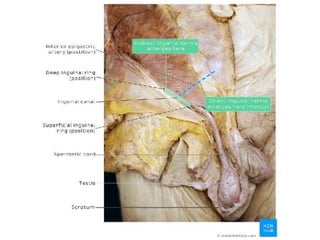
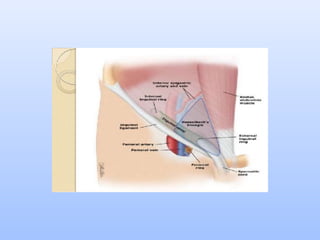
• ANATOMY OF INGUINAL CANAL
CLASSIFICATION
❑Anatomical – Indirect
Direct
Extent – Bubonocele
Funicular
Complete
Indirect hernia
Any age
Pyriform/oval shape
Preexisting sac seen
Herniates through deep ring
Descends obliquely & downward
Direct hernia
Elderly
Globular/round shape
Always acquired
Herniates through posterior wall
Descends directly forwards
MANAGEMENT
NON SURGICAL- SURGICAL TRUSSES
SURGICAL-
– HERNIOTOMY
– OPEN ANATOMICAL REPAIR
• BASSINI
• SHOULDICE
• DESARDA
– OPEN FLAT MESH REPAIR
• LICHTENSTEIN
SURGICAL-
– OPEN COMPLEX MESH REPAIR
• PLUGS
• HERNIA SYSTEMS
– OPEN PRE-PERITONEAL REPAIR
• STOPPA
– LAPAROSCOPIC REPAIR
• TAPP
• TEP
HERNIOTOMY
Hernioplasty: Basics
■ Two fundamental Concepts:
– Aponeurotic closure of the myopectinal
orifice
– Replacement of the defective transversalis
fascia with a prosthesis
– Or the two at the same time
■ Tension is the principal cause of failure
■ Two types:
– Anterior or classical repair
– Posterior or pro-peritoneal
Anterior Classical Groin Hernioplasty
■ Only three approaches are still used:
–Marcy simple repair
–Bassini Repair (modified to Shouldice)
–McVay-Lotheissen Cooper ligament
repair
■ Three parts:
–Dissection of the Inguinal canal
–Repair of the myopectinal orifice
–Closure of the inguinal canal
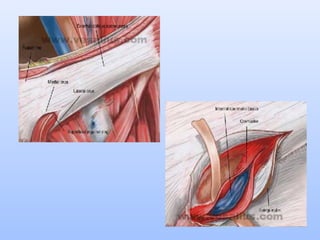
A- Dissection of the canal
■ Opening of the Inguinal Canal
■ Preservation of the ilio-inguinal nerve
■ Division of the cremaster muscle (often
omitted by surgeons!)
■ Exposure of the deep ring
■ Mobilisation of the spermatic cord
■ Division + excision of the weak area in post
wall of the inguinal canal (often omitted by
surgeons!)
■ Elimination of the peritoneal sac
■ Removal of the cord lipoma
■ DISSECTION IS AS IMPORTANT AS REPAIR
B- Repair of the myopectinal
orifice
■ Contrary to the belief of some
surgeons, the anatomy of the deep
ring is such that strangulation of the
spermatic cord by reconstruction of
the posterior wall of the inguinal
canal is virtually impossible.
■ Indeed, insufficient repair of the
deep ring is the principal cause of
indirect recurrence.
Marcy Repair
■ Called simple ring closure
■ It consists of tightening an enlarged
deep ring only
■ Is indicated in men and women who
have indirect hernia with only minimal
damage to the deep ring
■ Is the hernioplasty of choice for women
with indirect inguinal hernia
■ After dividing the round ligament and
eliminating the sac, the deep ring is
abolished with a few permanent sutures
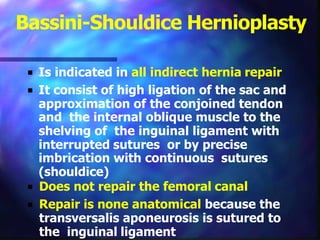
Bassini-Shouldice Hernioplasty
■ Is indicated in all indirect hernia repair
■ It consist of high ligation of the sac and
approximation of the conjoined tendon
and the internal oblique muscle to the
shelving of the inguinal ligament with
interrupted sutures or by precise
imbrication with continuous sutures
(shouldice)
■ Does not repair the femoral canal
■ Repair is none anatomical because the
transversalis aponeurosis is sutured to
the inguinal ligament
BASSINI’S OPERATION 

❑Herniotomy is done
❑The posterior wall is reinforced by suturing
the conjoint tendon to inguinal ligament
!39
!40
SHOULDICE OPERATION
▪ Done in Toronto at Shouldice clinic
▪ Incision: Anterior superior iliac spine to
pubic tubercle
▪ Cremaster muscle excised
▪ Herniotomy done
▪ Redundant fascia transeversalis is excised
from deep ring to pubic tubercle
▪ Lower flap of the fascia transversalis is
sutured behind the upper flap
▪ Upper flap sutured to the inguinal ligament
using stainless steel wire or polypropylene
!42
■ Shouldice
!44
• The posterior wall is further reinforced
by suturing the conjoint tendon to
inguinal ligament as in Bassini’s repair
!45


Lytle’s repair 

When the deep ring is patulous the
fascia transversalis is plicated by
suture narrowing the deep ring
!46
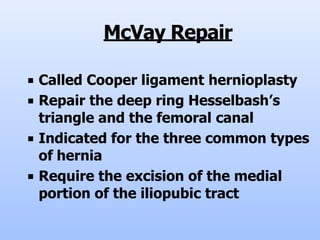
McVay Repair
■ Called Cooper ligament hernioplasty
■ Repair the deep ring Hesselbash’s
triangle and the femoral canal
■ Indicated for the three common types
of hernia
■ Require the excision of the medial
portion of the iliopubic tract
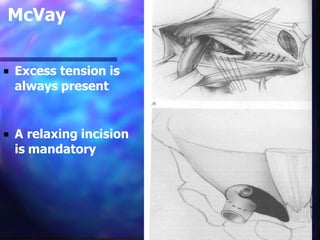
McVay
■ Excess tension is
always present
■ A relaxing incision
is mandatory
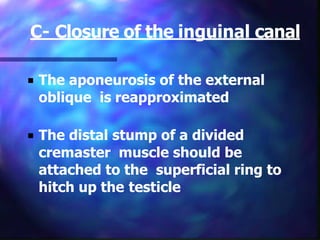
C- Closure of the inguinal canal
■ The aponeurosis of the external
oblique is reapproximated
■ The distal stump of a divided
cremaster muscle should be
attached to the superficial ring to
hitch up the testicle
HERNIOPLASTY
• Reinforcement of the posterior wall by
synthetic prosthetic material
LICHTENSTEIN’S tension less repair
After Herniotomy,a polypropylene mesh of size
8cm x 6cm
❑Inferior edge:the lower edge of pubic
tubercle,lacunar ligament and inguinal
ligament.
❑Medial edge is sutured to rectus sheath
❑Superior edge to the conjoint tendon
❑Lateral edge is split around the cord at the
deep ring, crossed over each other and sutured!51
LICHTENSTEIN
POSTERIOR PROSTHETIC
HERNIOPLASTY
■ Properitoneal or Stoppa procedure
■ Functionally replace the transversalis fascia
■ The prosthesis adhere to the peritoneum and
render it inextensible so it cannot protrude
(Mersilene is preferable)
■ Repair of the wall defect is unnecessary
■ Can be performed unilaterally or bilaterally
■ Use Transverse or ant groin incision for
unilateral approach
■ Use Pfannensteil incision for bilateral approach
STOPPAS REPAIR
STOPPAS REPAIR (Contd.)
Laparoscopic Repair
■ Include:
– Trans-abdominal pre-peritoneal (TAPP) repair (uses intra-
peritoneal trocars and the creation of a peritoneal flap
over the posterior inguinal area)
– Totally extra-peritoneal approach (TEPA). (access to the
pre-peritoneal space without entering the peritoneal
cavity).
■ Repair is similar in both these techniques.
■ Medial to the inferior epigastric vessels, the mesh is
secured to the Cooper ligament, the lacunar ligament,
the posterior rectus musculature, and the transversus
abdominis aponeurotic arch.
■ Laterally, the mesh is attached to the lateral extension
of the transversus aponeurotic arch and the superior
Laparoscopic Repair
■ Staples should not be placed below the lateral ilio-
pubic tract because of potential injury to the genito-
femoral nerve and the lateral femoral cutaneous nerve
in this region.
■ Stapling is also avoided in the triangular area inferior
to the internal inguinal ring, called the triangle of
doom.
■ The triangle is bordered by the ductus deferens
medially and the spermatic vessels laterally in the
male where the external iliac artery and vein and the
femoral nerve are located.
■ The obturator artery is located medial to the triangle
of doom but should also be avoided when securing
the mesh to the cooper‘s
TAPP
INGUINAL HERNIA-MANAGEMENT
• TAPP
INGUINAL HERNIA-MANAGEMENT
TEP
PLUGS & HERNIA SYSTEMS
Complications of hernia surgery
• General :
• 1) Pulmonary :
• a) Atelectasis
b) Pulmonary embolism
• c)Bronchitis
• d) Broncho- Pneumonia
• 2) Cardiac: CCF
•
• 3) Urinary retention !69
Local complications
❖ Hemorrhage
❖ Urinary bladder/bowel injury during
dissection
❖ Injury to testicular vessels → testicular
swelling / testicular atrophy
❖ Tight closure of the external ring → testicular
swelling / testicular atrophy
❖ Injury to vas deferens,
❖ Injury to nerves : Ilio-inguinal, ilio-
hypogastric, genital branch of genito-femoral
❖ Wound infection
❖ Recurrence of hernia
!70
❖Hydrocele
❖Edema of the penis due to injury to
external pudendal vein
!71
FEMORAL HERNIA SURGERY
LOW OPERATION OF LOCK WOOD
• Done when there is NO STRANGULATION
• Incision :1 cm below and parallel to inguinal
ligament
• Thinned out cribriform fascia incised
• Sac isolated
• Neck freed from the margins of the femoral
canal
• Sac drawn down ,transfixed at the highest point
and cut
• 2or 3 stitches to the fascia forming floor and the
lateral margins
High operation of Lotheisen
• Incision : Parallel to and nearer to inguinal
ligament
• Canal opened
• Cord /round ligament displaced and with the
conjoint tendon pushed upwards
• Transverslis fascia divided in the line of the
incision
• Extra peritoneal fat cleared and the sac can be
identified entering the femoral canal
• Sac opened and dealt with
• Femoral ring obliterated by stitching the conjoint
tendon or inguinal ligament to the pectineal
ligameant
McEvedy’s approach
• Incision : 3 Cms above the pubic tubercle
obliquely upwards and laterally
• Reflect skin flaps to expose the lateral part
of the rectus sheath
• Incise the lower rectus sheath 1-2 cms from
and parallel to its lateral border
• Lift the lateral edge of the rectus sheath
• Incise the transversalis fascia
• Hernial sac is exposed where it enters into
the femoral canal which is dealt with
• Femoral ring is obliterated as in High
Operation
PRECAUTIONS
1. Urgent bladder catheterization
immediately before surgery
( Remember sliding femoral Hernia )
1. Throughout surgery for FH external
Iliac / Femoral vein must be
protected laterally
3. Repair with monofilament poly
propylene 2-0
PRECAUTIONS
4. Some times Lacunar part of Inguinal
Ligament or part of Inguinal Ligament, must
be incised to free the neck of Hernia
5. Damage to abnormal obturator artery
( branch of ext & Iliac Femoral artery ) is
likely, needs prevention
SUMMARY
• Low Lockwood - for un-strangulated
femoral hernia
• High and McEvedy Inguino-femoral
approach for strangulated femoral
hernia…

Hernia

  • 1.
  • 2.
    HERNIA Protrusion of wholeor a part of viscus through the wall that contains it Dr Manipal Puvvala
  • 7.
    CAUSES: ❑Natural weakness ❑Passage ofstructures ❑Developmental failure ❑Hormonal ❑Trauma ❑Primary neurological or muscle disease ❑Excessive intra-abdominal pressure ❑Collagen diseases
  • 11.
    ABDOMINAL HERNIA Types –based on site Inguinal Femoral Umbilical Para umbilical Epigastric Obturator Lumbar Gluteal Spigelian Incisional
  • 12.
    • Types –based on complexity ❑Occult ❑Reducible ❑Irreducible ❑Obstructed ❑Strangulated
  • 13.
    • Types –based on content ❖Omentocele ❖Enterocele ❖Cystocele ❖Sliding hernia ❖Littre’s hernia ❖Maydl’s hernia ❖Sliding hernia ❖Richter’s hernia
  • 14.
  • 15.
    INGUINAL HERNIA • ANATOMYOF INGUINAL CANAL
  • 21.
  • 25.
    Indirect hernia Any age Pyriform/ovalshape Preexisting sac seen Herniates through deep ring Descends obliquely & downward Direct hernia Elderly Globular/round shape Always acquired Herniates through posterior wall Descends directly forwards
  • 27.
    MANAGEMENT NON SURGICAL- SURGICALTRUSSES SURGICAL- – HERNIOTOMY – OPEN ANATOMICAL REPAIR • BASSINI • SHOULDICE • DESARDA – OPEN FLAT MESH REPAIR • LICHTENSTEIN
  • 28.
    SURGICAL- – OPEN COMPLEXMESH REPAIR • PLUGS • HERNIA SYSTEMS – OPEN PRE-PERITONEAL REPAIR • STOPPA – LAPAROSCOPIC REPAIR • TAPP • TEP
  • 29.
  • 31.
    Hernioplasty: Basics ■ Twofundamental Concepts: – Aponeurotic closure of the myopectinal orifice – Replacement of the defective transversalis fascia with a prosthesis – Or the two at the same time ■ Tension is the principal cause of failure ■ Two types: – Anterior or classical repair – Posterior or pro-peritoneal
  • 32.
    Anterior Classical GroinHernioplasty ■ Only three approaches are still used: –Marcy simple repair –Bassini Repair (modified to Shouldice) –McVay-Lotheissen Cooper ligament repair ■ Three parts: –Dissection of the Inguinal canal –Repair of the myopectinal orifice –Closure of the inguinal canal
  • 34.
    A- Dissection ofthe canal ■ Opening of the Inguinal Canal ■ Preservation of the ilio-inguinal nerve ■ Division of the cremaster muscle (often omitted by surgeons!) ■ Exposure of the deep ring ■ Mobilisation of the spermatic cord ■ Division + excision of the weak area in post wall of the inguinal canal (often omitted by surgeons!) ■ Elimination of the peritoneal sac ■ Removal of the cord lipoma ■ DISSECTION IS AS IMPORTANT AS REPAIR
  • 36.
    B- Repair ofthe myopectinal orifice ■ Contrary to the belief of some surgeons, the anatomy of the deep ring is such that strangulation of the spermatic cord by reconstruction of the posterior wall of the inguinal canal is virtually impossible. ■ Indeed, insufficient repair of the deep ring is the principal cause of indirect recurrence.
  • 37.
    Marcy Repair ■ Calledsimple ring closure ■ It consists of tightening an enlarged deep ring only ■ Is indicated in men and women who have indirect hernia with only minimal damage to the deep ring ■ Is the hernioplasty of choice for women with indirect inguinal hernia ■ After dividing the round ligament and eliminating the sac, the deep ring is abolished with a few permanent sutures
  • 38.
    Bassini-Shouldice Hernioplasty ■ Isindicated in all indirect hernia repair ■ It consist of high ligation of the sac and approximation of the conjoined tendon and the internal oblique muscle to the shelving of the inguinal ligament with interrupted sutures or by precise imbrication with continuous sutures (shouldice) ■ Does not repair the femoral canal ■ Repair is none anatomical because the transversalis aponeurosis is sutured to the inguinal ligament
  • 39.
    BASSINI’S OPERATION 
 ❑Herniotomyis done ❑The posterior wall is reinforced by suturing the conjoint tendon to inguinal ligament !39
  • 40.
  • 42.
    SHOULDICE OPERATION ▪ Donein Toronto at Shouldice clinic ▪ Incision: Anterior superior iliac spine to pubic tubercle ▪ Cremaster muscle excised ▪ Herniotomy done ▪ Redundant fascia transeversalis is excised from deep ring to pubic tubercle ▪ Lower flap of the fascia transversalis is sutured behind the upper flap ▪ Upper flap sutured to the inguinal ligament using stainless steel wire or polypropylene !42
  • 43.
  • 44.
  • 45.
    • The posteriorwall is further reinforced by suturing the conjoint tendon to inguinal ligament as in Bassini’s repair !45
  • 46.
    
 Lytle’s repair 
 Whenthe deep ring is patulous the fascia transversalis is plicated by suture narrowing the deep ring !46
  • 47.
    McVay Repair ■ CalledCooper ligament hernioplasty ■ Repair the deep ring Hesselbash’s triangle and the femoral canal ■ Indicated for the three common types of hernia ■ Require the excision of the medial portion of the iliopubic tract
  • 48.
    McVay ■ Excess tensionis always present ■ A relaxing incision is mandatory
  • 50.
    C- Closure ofthe inguinal canal ■ The aponeurosis of the external oblique is reapproximated ■ The distal stump of a divided cremaster muscle should be attached to the superficial ring to hitch up the testicle
  • 51.
    HERNIOPLASTY • Reinforcement ofthe posterior wall by synthetic prosthetic material LICHTENSTEIN’S tension less repair After Herniotomy,a polypropylene mesh of size 8cm x 6cm ❑Inferior edge:the lower edge of pubic tubercle,lacunar ligament and inguinal ligament. ❑Medial edge is sutured to rectus sheath ❑Superior edge to the conjoint tendon ❑Lateral edge is split around the cord at the deep ring, crossed over each other and sutured!51
  • 52.
  • 55.
    POSTERIOR PROSTHETIC HERNIOPLASTY ■ Properitonealor Stoppa procedure ■ Functionally replace the transversalis fascia ■ The prosthesis adhere to the peritoneum and render it inextensible so it cannot protrude (Mersilene is preferable) ■ Repair of the wall defect is unnecessary ■ Can be performed unilaterally or bilaterally ■ Use Transverse or ant groin incision for unilateral approach ■ Use Pfannensteil incision for bilateral approach
  • 56.
  • 57.
  • 59.
    Laparoscopic Repair ■ Include: –Trans-abdominal pre-peritoneal (TAPP) repair (uses intra- peritoneal trocars and the creation of a peritoneal flap over the posterior inguinal area) – Totally extra-peritoneal approach (TEPA). (access to the pre-peritoneal space without entering the peritoneal cavity). ■ Repair is similar in both these techniques. ■ Medial to the inferior epigastric vessels, the mesh is secured to the Cooper ligament, the lacunar ligament, the posterior rectus musculature, and the transversus abdominis aponeurotic arch. ■ Laterally, the mesh is attached to the lateral extension of the transversus aponeurotic arch and the superior
  • 60.
    Laparoscopic Repair ■ Staplesshould not be placed below the lateral ilio- pubic tract because of potential injury to the genito- femoral nerve and the lateral femoral cutaneous nerve in this region. ■ Stapling is also avoided in the triangular area inferior to the internal inguinal ring, called the triangle of doom. ■ The triangle is bordered by the ductus deferens medially and the spermatic vessels laterally in the male where the external iliac artery and vein and the femoral nerve are located. ■ The obturator artery is located medial to the triangle of doom but should also be avoided when securing the mesh to the cooper‘s
  • 63.
  • 65.
  • 66.
  • 67.
  • 68.
  • 69.
    Complications of herniasurgery • General : • 1) Pulmonary : • a) Atelectasis b) Pulmonary embolism • c)Bronchitis • d) Broncho- Pneumonia • 2) Cardiac: CCF • • 3) Urinary retention !69
  • 70.
    Local complications ❖ Hemorrhage ❖Urinary bladder/bowel injury during dissection ❖ Injury to testicular vessels → testicular swelling / testicular atrophy ❖ Tight closure of the external ring → testicular swelling / testicular atrophy ❖ Injury to vas deferens, ❖ Injury to nerves : Ilio-inguinal, ilio- hypogastric, genital branch of genito-femoral ❖ Wound infection ❖ Recurrence of hernia !70
  • 71.
    ❖Hydrocele ❖Edema of thepenis due to injury to external pudendal vein !71
  • 74.
  • 76.
    LOW OPERATION OFLOCK WOOD • Done when there is NO STRANGULATION • Incision :1 cm below and parallel to inguinal ligament • Thinned out cribriform fascia incised • Sac isolated • Neck freed from the margins of the femoral canal • Sac drawn down ,transfixed at the highest point and cut • 2or 3 stitches to the fascia forming floor and the lateral margins
  • 78.
    High operation ofLotheisen • Incision : Parallel to and nearer to inguinal ligament • Canal opened • Cord /round ligament displaced and with the conjoint tendon pushed upwards • Transverslis fascia divided in the line of the incision • Extra peritoneal fat cleared and the sac can be identified entering the femoral canal • Sac opened and dealt with • Femoral ring obliterated by stitching the conjoint tendon or inguinal ligament to the pectineal ligameant
  • 80.
    McEvedy’s approach • Incision: 3 Cms above the pubic tubercle obliquely upwards and laterally • Reflect skin flaps to expose the lateral part of the rectus sheath • Incise the lower rectus sheath 1-2 cms from and parallel to its lateral border • Lift the lateral edge of the rectus sheath • Incise the transversalis fascia • Hernial sac is exposed where it enters into the femoral canal which is dealt with • Femoral ring is obliterated as in High Operation
  • 82.
    PRECAUTIONS 1. Urgent bladdercatheterization immediately before surgery ( Remember sliding femoral Hernia ) 1. Throughout surgery for FH external Iliac / Femoral vein must be protected laterally 3. Repair with monofilament poly propylene 2-0
  • 83.
    PRECAUTIONS 4. Some timesLacunar part of Inguinal Ligament or part of Inguinal Ligament, must be incised to free the neck of Hernia 5. Damage to abnormal obturator artery ( branch of ext & Iliac Femoral artery ) is likely, needs prevention
  • 84.
    SUMMARY • Low Lockwood- for un-strangulated femoral hernia • High and McEvedy Inguino-femoral approach for strangulated femoral hernia…