PERIODONTAL ABSCESS : A REVIEW
• PUNIT VAIBHAV PATEL,SHEETAL KUMAR,AMRITA PATEL
• JCDR – JOURNAL OF CLINICAL AND DIAGNOSTIC RESEARCH
• YEAR: 2011 |MONTH: April|Volume :5 | Issue: 2
• By-
• Navneet Singh Randhawa
• MDS 1st year-
• Deptt.of Periodontology and Oral Implantology
INTRODUCTION
• Among several acute conditions occuring in the
periodontium,the abscess is the most important.
• Abscesses of the periodontium are localised
acute baterial infections confined to tissues of the
periodontium.
• The Periodontal abscess represents a chronic and
refractory form of the disease.
• It is a destructive process resulting in localized
collection of pus,communicating with oral cavity
predominantly through gingival sulcus
CHARACTERISTICS
• Localised accumulation of pus in gingival wall
of periodontal pockets
• Usually occuring on the lateral aspect of the
tooth
• Oedematous red and shiny gingiva
• Dome like appearance or may come to a
distinct point
PREVALENCE
• Prevalence of periodontal abscess is relatively
high
• Accounts for 6-14% of all emergencies
• It is the 3d most common dental emergency
after pulpal infection and pericoronitis
• Among dental emergencies periodontal
abscesses represent appr. 8% of all dental
emergencies in the world
CLASSIFCATION
3 types of classifications :-
--Based on anatomic locations
--Based on course of disease
--Based on number
• Based on anatomic locations :-
Gingival abscess which is a localised purulent
infection involving marginal gngiva
Pericoronal abscesses
Combined perio/endo abscesses
Parietal abscesses
• Based on course of disease
Acute periodontal abscess
Chronic periodontal absce
• Based on number
Single abscess - confined to a single tooth
Multiple abscess – Abscess confined to more
than one tooth
MICROBIOLOGY
• Micro organisms colonizing periodontal abscesses
are primarily Gram negative anaerobic rods
• Porphyromonas gingivalis has highest prevalence
present in about 55-100% of cases
• Fusobacterium nucleatum comes next with
presence in 44-65%
• Capylobacter rectus ,another common bacteria,
has a prevalence rate of about 36%
• Prevotella intermedia,Prevotella melaninogenica
have a prevalence rate of 25-100% and 22-30%
respectively
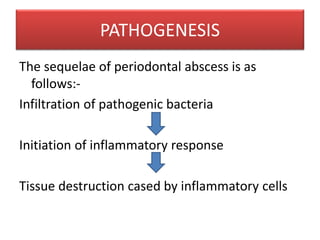
PATHOGENESIS
The sequelae of periodontal abscess is as
follows:-
Infiltration of pathogenic bacteria
Initiation of inflammatory response
Tissue destruction cased by inflammatory cells
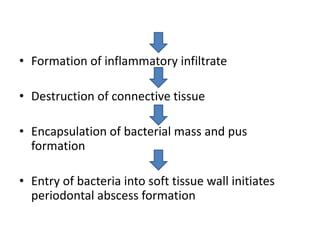
• Formation of inflammatory infiltrate
• Destruction of connective tissue
• Encapsulation of bacterial mass and pus
formation
• Entry of bacteria into soft tissue wall initiates
periodontal abscess formation
PREDISPOSING FACTORS
• Changes in composition of microflora,bacterial
virulence and host defence
• Closure of the margins of periodontal pockets can lead
to extension of infection in surrounding tissue
• Fibrin secretions lead to local accumulation of pus
• Tortuous periodontal pockets assoiated with furcation
defects become isolated and favour the formation of
periodontal abscess
• Inadequate scaling allows calculus to remain in deep
pockets,resolution occurs in coronal portion which
subsequentely blocks drainage
In absence of periodontitis periodontal
abscess can develop due to:-
Impaction
Infection of lateral cysts
Local factors affecting the morphology of
root
IATROGENIC FACTORS ASSOSIATED
WITH PERIDONTAL ABSCESS
• Post non surgical periodontal abscess can occur due to
presence of small remaining fragment of calculus
which obstructs pocket entrance
• Post surgical periodontal abscess occurs immediately
following periodontal surgery
• It can be due to:-
Incomplete removal of subgingival calculus
Perforation of tooth wall by endodontic instrument
Presence of foreign body in periodontal tissue
Post antibiotic periodontal abscess
Treatment with systemic antibiotics without subgingival
debridement in patients with advanced periodontitis
DIAGNOSIS
• The diagnosis of periodontal abscess is based
on the chief complaint and the history of
presenting illness
• Points to be noted while taking history are:-
Any medical condition
Whether patient is currently on medication or not
Any previous dental treatment
Smoking history
• The main steps and aids in diagnosis are:-
• GENERAL EXAMINATION
– Examination of features that may indicate on going
systemic diseases, immune status, fatigue, extremes of age
etc
• EXTRA ORAL EXAMINATION
– Includes evaluation of symmetry of face for swelling,
redness, fluctuance, sinus, trismus and examination of
cervical lymph nodes
• INTRA ORAL EXAMINATION
– Examination of the oral mucosa and dentition for gingival
swelling, redness and tenderness, checking for
suppuration, checking for mobility and elevation,
evaluation of oral hygiene and examination of
periodontium including periodontal screening
• Supplemental diagnostic aids are:-
RADIOGRAPHS
PULP VIALITY TESTS
MICROBIAL TESTS
LAB FINDINGS
• RADIOGRAPHS
– Radiographical techniques such as IOPA,BITEWIGS,OPG are
useful in detection of level of crestal bone,marginal bone loss
and periapical condition of tooth involved
• PULP VITALTY TEST
– Thermal tests or electrical tests are used to assess the viality
of tooth and the subsequent ruling out of the pulpal
infections
• MICROBIAL TESTS
– Samples of pus from sinus/abscess expressed from
gingival sulcus could be sent for culture and senstivity
tests.
• LAB FINDINGS
– Lab tests such as TLC,DLC whose elevated levels can
be an indication of inflammatory response of body to
bacterial toxins
– Assesment of blood glucose level through HbA1c
test/random blood glucose test/fasting blood glucose
levels is mandatory in diabetic patients as it can
predispose to abscess formation
DIFFRENTIAL DIAGNOSIS
• The periodontal abscess should be ruled out
from the following similar conditions and
lesions:-
• GINGIVAL ABSCESS
– Diffrentiating features of gingival abscess are:-
History of recent trauma
Localisation to the gingiva
No periodontal pocket
• PERIAPICAL ABSCESS
– Diffrentiated from periodontal abscess by the
following:-
Located over root apex
Non vital tooth
Large caries with pulpal involvement
Senstivity to hot and cold
Periapical radiolucency on IOPA
• PERIO-ENDO LESION
– Diffrentiated from periodontal abscess by:-
Severe periodontal disease involving furcation
Severe bone loss close to apex
Non vital tooth which is sound or minimally restored
• ENDO-PERIO LESION
– Differentiated from periodontal abscess by :-
Pulp infection spreading via lateral canals
Tooth nonvital with periapical radiolucency
Localised deep pocketing
• CRACKED TOOTH SYNDROME:-
– Diffrentiated from periodontal abscess by:-
History of pain on mastication
Crack line noted on the crown
Vital tooth
Pain upon release after biting on cotton roll
No relief of pain after endodontic treatment
• ROOT FRACTURE
– Diffrentiated from periodontal abscess by:-
Heavily restored crown
Nonvital tooth with mobility
Post crown with threaded post
Possible fracture line and halo radiolucency
around the root which are visible in IOPAs
Localised deep pocketing
TREATMENT
• Principles for the management of simple dental
infections are:-
• LOCAL MEASURES:-
Drainage
Maintain drainage
Eliminate cause
• SYSTEMIC MANAGEMENT IN 3 STAGES
Immediate management
Initial management
Definitive therapy
IMMEDIATE MANAGEMENT
• Advocated in life threatening infections which
lead to space infections of orofacial regions
• Hospitalization with supportive therapy plus
systemic antibiotics is recommended
• In non life threatening infections oral
analgesics and antimicrobial chemotherapy
are sufficient
• Dosage of antibiotics depends on severity of
infection
• Common antibiotics used are:-
1. Phenoxymethylpenicillin 250-500mg qid 5/7
2. Amoxycillin 250-500 mg tds 5-7 days
3. Metronidazole 200-400 mg tds 5-7 days
• In case of allergy to pencilln:-
1. Erythromycin 250-500 mg qid 5-7 days
2. Doxycyline 100 mg bd 7-14 days
3. Clindamycin 150-300 mg qid 5-7 days
INITIAL THERAPY
• It comprises of:-
1) Irrigation of abscessed pocket with saline
2) Removal of foreign bodies if present
3) Drainage through sulcus with a probe
4) Compression and debridement of soft tissue
5) Oral hygiene instructions
6) Review after 24-48 hrs
• Drainage through periodontal pocket
Treatment of choice if no other complication
Steps are:-
Topical/local anaesthesia
Retraction of pocket wall with probe/curette
Gentle digital pressure
If lesion is small and has good access then treatment
modality Scaling + Curettage
If lesion is large and drainage cannot be established
then treatment modality Antibiotic therapy +Scaling +
Curettage
• Drainage through an external incision:-
• If lesion is large,pin pointing and fluctuating,an
external incision can be made to drain the abscess
• The steps are as follows:-
Topical/local anaesthesia
Vertical incision placed with #11 or #15 blade
The tissue lateral to incision is separated with a periosteal
elevator
Digital pressure applied with gauze
In patients with marked swelling tension and pain systemic
antibiotics only should be used as initial treatment
After acute condition has receded mechanical
debridement is performed
• Periodontal surgery:-
• Main objective of surgical therapy is to
eliminate remaining calculus and to obtain
drainage
• Surgical therapy is advocated in cases of:-
Deep vertical defects
When calculus is left subgingivally after treatment
• Systemic antibiotics with or without local
drainage
• Antibiotics are the prefferred mode of treatment
• Local drainge of abscess is mandatory to eliminate etiological factors
• Recommended antibiotic regimen is as follows:-
1. Phenoxymethylpenicillin 250-500mg qid 5/7
2. Amoxycillin 250-500 mg tds 5-7 days
3. Metronidazole 200-400 mg tds 5-7 days
• In case of allergy to pencilln:-
1. Erythromycin 250-500 mg qid 5-7 days
2. Doxycyline 100 mg bd 7-14 days
3. Clindamycin 150-300 mg qid 5-7 days
• Extraction of teeth
• Extraction of teeth/tooth is the last resort to treat
the periodontal abscess
• Certain guidelines for assessing poor prognosis
before extracting tooth are:-
a) Horizontal mobility more than 1mm
b) Class 2-3 furcation involvement of a molar
c) Probing depth >8 mm
d) Poor response to therapy
e) More than 40% alveolar bone loss
DEFINITIVE TREATMENT
• The treatment following reassessment after
the initial therapy is to restore the function
and aesthetics and to enable the patient to
maintain the health of the periodotium.
• Definitive treatment is done according to the
treatment needs of the patient
CONCLUSION
• Early diagnosis and appropiate intervention
are extremely important for the management
of periodontal abscess
• A single tooth diagnosed with periodontal
abscess that responds favourably to treatment
will not affect longevity of tooth
• Decision to extract a tooth should be taken
only after through clinical assessment

Periodontal abscess : A Review

  • 1.
    PERIODONTAL ABSCESS :A REVIEW • PUNIT VAIBHAV PATEL,SHEETAL KUMAR,AMRITA PATEL • JCDR – JOURNAL OF CLINICAL AND DIAGNOSTIC RESEARCH • YEAR: 2011 |MONTH: April|Volume :5 | Issue: 2 • By- • Navneet Singh Randhawa • MDS 1st year- • Deptt.of Periodontology and Oral Implantology
  • 2.
    INTRODUCTION • Among severalacute conditions occuring in the periodontium,the abscess is the most important. • Abscesses of the periodontium are localised acute baterial infections confined to tissues of the periodontium. • The Periodontal abscess represents a chronic and refractory form of the disease. • It is a destructive process resulting in localized collection of pus,communicating with oral cavity predominantly through gingival sulcus
  • 3.
    CHARACTERISTICS • Localised accumulationof pus in gingival wall of periodontal pockets • Usually occuring on the lateral aspect of the tooth • Oedematous red and shiny gingiva • Dome like appearance or may come to a distinct point
  • 4.
    PREVALENCE • Prevalence ofperiodontal abscess is relatively high • Accounts for 6-14% of all emergencies • It is the 3d most common dental emergency after pulpal infection and pericoronitis • Among dental emergencies periodontal abscesses represent appr. 8% of all dental emergencies in the world
  • 5.
    CLASSIFCATION 3 types ofclassifications :- --Based on anatomic locations --Based on course of disease --Based on number • Based on anatomic locations :- Gingival abscess which is a localised purulent infection involving marginal gngiva Pericoronal abscesses Combined perio/endo abscesses Parietal abscesses
  • 6.
    • Based oncourse of disease Acute periodontal abscess Chronic periodontal absce • Based on number Single abscess - confined to a single tooth Multiple abscess – Abscess confined to more than one tooth
  • 7.
    MICROBIOLOGY • Micro organismscolonizing periodontal abscesses are primarily Gram negative anaerobic rods • Porphyromonas gingivalis has highest prevalence present in about 55-100% of cases • Fusobacterium nucleatum comes next with presence in 44-65% • Capylobacter rectus ,another common bacteria, has a prevalence rate of about 36% • Prevotella intermedia,Prevotella melaninogenica have a prevalence rate of 25-100% and 22-30% respectively
  • 8.
    PATHOGENESIS The sequelae ofperiodontal abscess is as follows:- Infiltration of pathogenic bacteria Initiation of inflammatory response Tissue destruction cased by inflammatory cells
  • 9.
    • Formation ofinflammatory infiltrate • Destruction of connective tissue • Encapsulation of bacterial mass and pus formation • Entry of bacteria into soft tissue wall initiates periodontal abscess formation
  • 10.
    PREDISPOSING FACTORS • Changesin composition of microflora,bacterial virulence and host defence • Closure of the margins of periodontal pockets can lead to extension of infection in surrounding tissue • Fibrin secretions lead to local accumulation of pus • Tortuous periodontal pockets assoiated with furcation defects become isolated and favour the formation of periodontal abscess • Inadequate scaling allows calculus to remain in deep pockets,resolution occurs in coronal portion which subsequentely blocks drainage
  • 11.
    In absence ofperiodontitis periodontal abscess can develop due to:- Impaction Infection of lateral cysts Local factors affecting the morphology of root
  • 12.
    IATROGENIC FACTORS ASSOSIATED WITHPERIDONTAL ABSCESS • Post non surgical periodontal abscess can occur due to presence of small remaining fragment of calculus which obstructs pocket entrance • Post surgical periodontal abscess occurs immediately following periodontal surgery • It can be due to:- Incomplete removal of subgingival calculus Perforation of tooth wall by endodontic instrument Presence of foreign body in periodontal tissue Post antibiotic periodontal abscess Treatment with systemic antibiotics without subgingival debridement in patients with advanced periodontitis
  • 13.
    DIAGNOSIS • The diagnosisof periodontal abscess is based on the chief complaint and the history of presenting illness • Points to be noted while taking history are:- Any medical condition Whether patient is currently on medication or not Any previous dental treatment Smoking history
  • 14.
    • The mainsteps and aids in diagnosis are:- • GENERAL EXAMINATION – Examination of features that may indicate on going systemic diseases, immune status, fatigue, extremes of age etc • EXTRA ORAL EXAMINATION – Includes evaluation of symmetry of face for swelling, redness, fluctuance, sinus, trismus and examination of cervical lymph nodes • INTRA ORAL EXAMINATION – Examination of the oral mucosa and dentition for gingival swelling, redness and tenderness, checking for suppuration, checking for mobility and elevation, evaluation of oral hygiene and examination of periodontium including periodontal screening
  • 15.
    • Supplemental diagnosticaids are:- RADIOGRAPHS PULP VIALITY TESTS MICROBIAL TESTS LAB FINDINGS • RADIOGRAPHS – Radiographical techniques such as IOPA,BITEWIGS,OPG are useful in detection of level of crestal bone,marginal bone loss and periapical condition of tooth involved • PULP VITALTY TEST – Thermal tests or electrical tests are used to assess the viality of tooth and the subsequent ruling out of the pulpal infections
  • 16.
    • MICROBIAL TESTS –Samples of pus from sinus/abscess expressed from gingival sulcus could be sent for culture and senstivity tests. • LAB FINDINGS – Lab tests such as TLC,DLC whose elevated levels can be an indication of inflammatory response of body to bacterial toxins – Assesment of blood glucose level through HbA1c test/random blood glucose test/fasting blood glucose levels is mandatory in diabetic patients as it can predispose to abscess formation
  • 17.
    DIFFRENTIAL DIAGNOSIS • Theperiodontal abscess should be ruled out from the following similar conditions and lesions:- • GINGIVAL ABSCESS – Diffrentiating features of gingival abscess are:- History of recent trauma Localisation to the gingiva No periodontal pocket
  • 18.
    • PERIAPICAL ABSCESS –Diffrentiated from periodontal abscess by the following:- Located over root apex Non vital tooth Large caries with pulpal involvement Senstivity to hot and cold Periapical radiolucency on IOPA
  • 19.
    • PERIO-ENDO LESION –Diffrentiated from periodontal abscess by:- Severe periodontal disease involving furcation Severe bone loss close to apex Non vital tooth which is sound or minimally restored • ENDO-PERIO LESION – Differentiated from periodontal abscess by :- Pulp infection spreading via lateral canals Tooth nonvital with periapical radiolucency Localised deep pocketing
  • 20.
    • CRACKED TOOTHSYNDROME:- – Diffrentiated from periodontal abscess by:- History of pain on mastication Crack line noted on the crown Vital tooth Pain upon release after biting on cotton roll No relief of pain after endodontic treatment
  • 21.
    • ROOT FRACTURE –Diffrentiated from periodontal abscess by:- Heavily restored crown Nonvital tooth with mobility Post crown with threaded post Possible fracture line and halo radiolucency around the root which are visible in IOPAs Localised deep pocketing
  • 22.
    TREATMENT • Principles forthe management of simple dental infections are:- • LOCAL MEASURES:- Drainage Maintain drainage Eliminate cause • SYSTEMIC MANAGEMENT IN 3 STAGES Immediate management Initial management Definitive therapy
  • 23.
    IMMEDIATE MANAGEMENT • Advocatedin life threatening infections which lead to space infections of orofacial regions • Hospitalization with supportive therapy plus systemic antibiotics is recommended • In non life threatening infections oral analgesics and antimicrobial chemotherapy are sufficient • Dosage of antibiotics depends on severity of infection
  • 24.
    • Common antibioticsused are:- 1. Phenoxymethylpenicillin 250-500mg qid 5/7 2. Amoxycillin 250-500 mg tds 5-7 days 3. Metronidazole 200-400 mg tds 5-7 days • In case of allergy to pencilln:- 1. Erythromycin 250-500 mg qid 5-7 days 2. Doxycyline 100 mg bd 7-14 days 3. Clindamycin 150-300 mg qid 5-7 days
  • 25.
    INITIAL THERAPY • Itcomprises of:- 1) Irrigation of abscessed pocket with saline 2) Removal of foreign bodies if present 3) Drainage through sulcus with a probe 4) Compression and debridement of soft tissue 5) Oral hygiene instructions 6) Review after 24-48 hrs
  • 26.
    • Drainage throughperiodontal pocket Treatment of choice if no other complication Steps are:- Topical/local anaesthesia Retraction of pocket wall with probe/curette Gentle digital pressure If lesion is small and has good access then treatment modality Scaling + Curettage If lesion is large and drainage cannot be established then treatment modality Antibiotic therapy +Scaling + Curettage
  • 27.
    • Drainage throughan external incision:- • If lesion is large,pin pointing and fluctuating,an external incision can be made to drain the abscess • The steps are as follows:- Topical/local anaesthesia Vertical incision placed with #11 or #15 blade The tissue lateral to incision is separated with a periosteal elevator Digital pressure applied with gauze In patients with marked swelling tension and pain systemic antibiotics only should be used as initial treatment After acute condition has receded mechanical debridement is performed
  • 28.
    • Periodontal surgery:- •Main objective of surgical therapy is to eliminate remaining calculus and to obtain drainage • Surgical therapy is advocated in cases of:- Deep vertical defects When calculus is left subgingivally after treatment
  • 29.
    • Systemic antibioticswith or without local drainage • Antibiotics are the prefferred mode of treatment • Local drainge of abscess is mandatory to eliminate etiological factors • Recommended antibiotic regimen is as follows:- 1. Phenoxymethylpenicillin 250-500mg qid 5/7 2. Amoxycillin 250-500 mg tds 5-7 days 3. Metronidazole 200-400 mg tds 5-7 days • In case of allergy to pencilln:- 1. Erythromycin 250-500 mg qid 5-7 days 2. Doxycyline 100 mg bd 7-14 days 3. Clindamycin 150-300 mg qid 5-7 days
  • 30.
    • Extraction ofteeth • Extraction of teeth/tooth is the last resort to treat the periodontal abscess • Certain guidelines for assessing poor prognosis before extracting tooth are:- a) Horizontal mobility more than 1mm b) Class 2-3 furcation involvement of a molar c) Probing depth >8 mm d) Poor response to therapy e) More than 40% alveolar bone loss
  • 31.
    DEFINITIVE TREATMENT • Thetreatment following reassessment after the initial therapy is to restore the function and aesthetics and to enable the patient to maintain the health of the periodotium. • Definitive treatment is done according to the treatment needs of the patient
  • 32.
    CONCLUSION • Early diagnosisand appropiate intervention are extremely important for the management of periodontal abscess • A single tooth diagnosed with periodontal abscess that responds favourably to treatment will not affect longevity of tooth • Decision to extract a tooth should be taken only after through clinical assessment