By Antonio Boyett
   Imperfect           Future
   Preterit              Irregular
     Car/Gar/Zar         Conditional
     Spock             Superlatives
     Cucaracha         Formal Commands
     Snake/Snakey      Prepositions
   Modal Verbs         Demonstratives
   Adverbs
   Progressive
     Present
     Past
   You would use an             EXAMPLES:
    imperfect verb                 De vez en cuando, yo
    conjugation when                hablaba con Ivana.
    talking about                  Todos los días, comías
    something that has              hamburgesas.
    happened with no
    definite beginning or
    end. It’s almost like a
    movie. The action just
    keeps on happening.
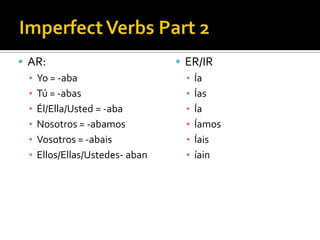
 AR:                            ER/IR
  ▪ Yo = -aba                     ▪ Ía
  ▪ Tú = -abas                    ▪ Ías
  ▪ Él/Ella/Usted = -aba          ▪ Ía
  ▪ Nosotros = -abamos            ▪ Íamos
  ▪ Vosotros = -abais             ▪ Íais
  ▪ Ellos/Ellas/Ustedes- aban     ▪ íain
 The preterit tense is used when talking about a
  specific event in the past. All you have to do is
  change the endings of the verbs for the
  appropriate conjugation.
 AR                          ER/IR
       -e                   -i
       -aste                -iste
       -o                   -io
       -amos                -imos
       -aron                 -ieron
   Car – que
   Gar- gue
   Zar - ce
   Dar
   Ver
   Ir
   Ser
   Hacer
   Andar – anduv          Producir – Produj
   Estar – estuv          Traducir – Traduj
   Poder – pud            Decir – Dej
   Poner – pus            Traer - Traj
   Quere – Quis
   Saber – Sup
   Tener – Tuv
   Venir – Vin
   Conducir – Conduj
 Dormir – the “o” changes to a “u” DURING
            the 3rd person
 Leer – The second “e’’ changes to a “y” WHILE
         in the 3rd person
Others:
-Creer
-Oir
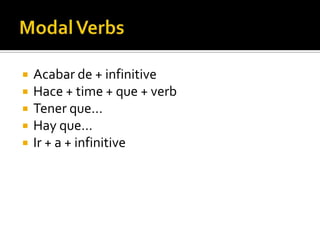
   Acabar de + infinitive
   Hace + time + que + verb
   Tener que…
   Hay que…
   Ir + a + infinitive
   Take an adjective
   Put it in the feminine
   Add -mente
   Estar (change to present or past)
   Then take your following verb and add –ando
    for “ar” and –iendo for “er/ir”
   Infinitive of the verb + …
     E
     As
    A
     Emos
     An
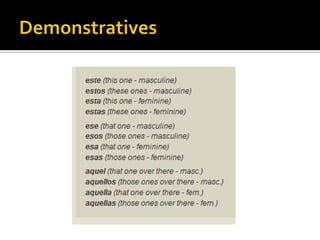
   Este libro es mas grande que ese libro…

   That’s all there is to it…
   Take the verb, put it in the “yo” and swtich it
    to the opposite vowel.
     EX: Hable
     Means: You (Formal) Speak!
     You can add DOP’s too! Same rules apply.
Gb
Gb

Gb

  • 1.
  • 2.
    Imperfect  Future  Preterit  Irregular  Car/Gar/Zar  Conditional  Spock  Superlatives  Cucaracha  Formal Commands  Snake/Snakey  Prepositions  Modal Verbs  Demonstratives  Adverbs  Progressive  Present  Past
  • 3.
    You would use an  EXAMPLES: imperfect verb  De vez en cuando, yo conjugation when hablaba con Ivana. talking about  Todos los días, comías something that has hamburgesas. happened with no definite beginning or end. It’s almost like a movie. The action just keeps on happening.
  • 4.
     AR:  ER/IR ▪ Yo = -aba ▪ Ía ▪ Tú = -abas ▪ Ías ▪ Él/Ella/Usted = -aba ▪ Ía ▪ Nosotros = -abamos ▪ Íamos ▪ Vosotros = -abais ▪ Íais ▪ Ellos/Ellas/Ustedes- aban ▪ íain
  • 5.
     The preterittense is used when talking about a specific event in the past. All you have to do is change the endings of the verbs for the appropriate conjugation.  AR ER/IR  -e -i  -aste -iste  -o -io  -amos -imos  -aron -ieron
  • 6.
    Car – que  Gar- gue  Zar - ce
  • 7.
    Dar  Ver  Ir  Ser  Hacer
  • 8.
    Andar – anduv  Producir – Produj  Estar – estuv  Traducir – Traduj  Poder – pud  Decir – Dej  Poner – pus  Traer - Traj  Quere – Quis  Saber – Sup  Tener – Tuv  Venir – Vin  Conducir – Conduj
  • 9.
     Dormir –the “o” changes to a “u” DURING the 3rd person  Leer – The second “e’’ changes to a “y” WHILE in the 3rd person Others: -Creer -Oir
  • 10.
    Acabar de + infinitive  Hace + time + que + verb  Tener que…  Hay que…  Ir + a + infinitive
  • 11.
    Take an adjective  Put it in the feminine  Add -mente
  • 12.
    Estar (change to present or past)  Then take your following verb and add –ando for “ar” and –iendo for “er/ir”
  • 13.
    Infinitive of the verb + …  E  As A  Emos  An
  • 14.
    Este libro es mas grande que ese libro…  That’s all there is to it…
  • 15.
    Take the verb, put it in the “yo” and swtich it to the opposite vowel.  EX: Hable  Means: You (Formal) Speak!  You can add DOP’s too! Same rules apply.