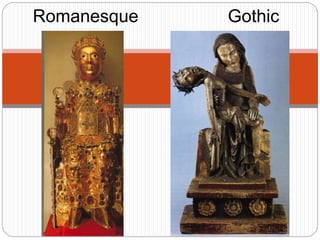
Romanesque Gothic
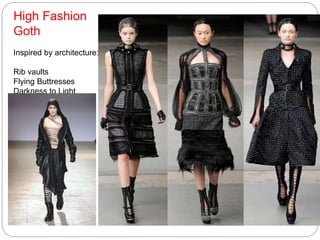
High Fashion
Goth
Inspired by architecture:
Rib vaults
Flying Buttresses
Darkness to Light
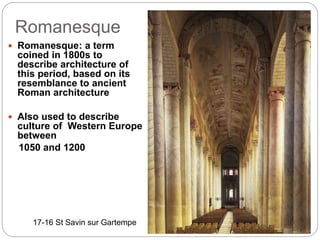
Romanesque
 Romanesque: a term
coined in 1800s to
describe architecture of
this period, based on its
resemblance to ancient
Roman architecture
 Also used to describe
culture of Western Europe
between
1050 and 1200
17-16 St Savin sur Gartempe
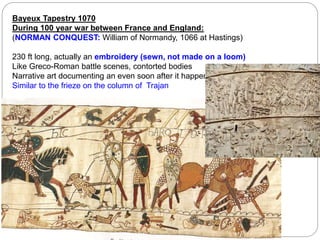
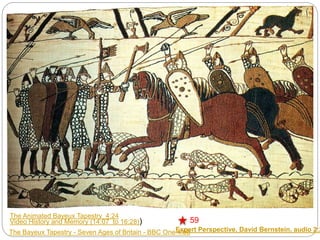
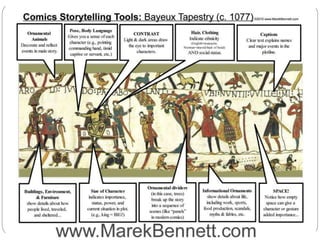
Bayeux Tapestry 1070
During 100 year war between France and England:
(NORMAN CONQUEST: William of Normandy, 1066 at Hastings)
230 ft long, actually an embroidery (sewn, not made on a loom)
Like Greco-Roman battle scenes, contorted bodies
Narrative art documenting an even soon after it happened.
Similar to the frieze on the column of Trajan
The Animated Bayeux Tapestry 4:24
Video History and Memory (14:07 to 16:28))
The Bayeux Tapestry - Seven Ages of Britain - BBC One 4:56Expert Perspective, David Bernstein, audio 2:2
59
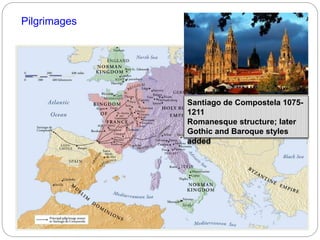
Pilgrimages
Santiago de Compostela 1075-
1211
Romanesque structure; later
Gothic and Baroque styles
added
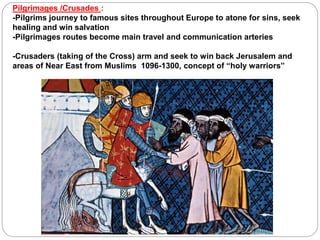
Pilgrimages /Crusades :
-Pilgrims journey to famous sites throughout Europe to atone for sins, seek
healing and win salvation
-Pilgrimages routes become main travel and communication arteries
-Crusaders (taking of the Cross) arm and seek to win back Jerusalem and
areas of Near East from Muslims 1096-1300, concept of “holy warriors”
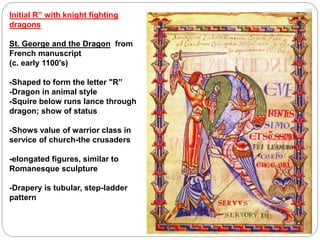
Initial R” with knight fighting
dragons
St. George and the Dragon from
French manuscript
(c. early 1100's)
-Shaped to form the letter "R”
-Dragon in animal style
-Squire below runs lance through
dragon; show of status
-Shows value of warrior class in
service of church-the crusaders
-elongated figures, similar to
Romanesque sculpture
-Drapery is tubular, step-ladder
pattern
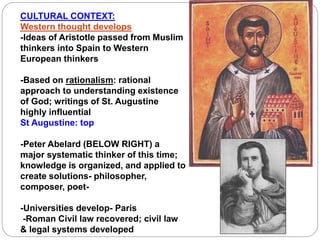
CULTURAL CONTEXT:
Western thought develops
-Ideas of Aristotle passed from Muslim
thinkers into Spain to Western
European thinkers
-Based on rationalism: rational
approach to understanding existence
of God; writings of St. Augustine
highly influential
St Augustine: top
-Peter Abelard (BELOW RIGHT) a
major systematic thinker of this time;
knowledge is organized, and applied to
create solutions- philosopher,
composer, poet-
-Universities develop- Paris
-Roman Civil law recovered; civil law
& legal systems developed
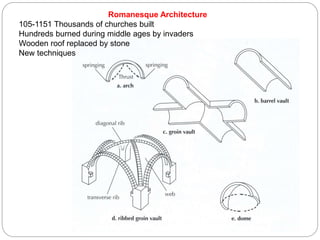
Romanesque Architecture
105-1151 Thousands of churches built
Hundreds burned during middle ages by invaders
Wooden roof replaced by stone
New techniques
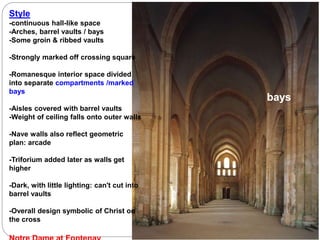
Style
-continuous hall-like space
-Arches, barrel vaults / bays
-Some groin & ribbed vaults
-Strongly marked off crossing square
-Romanesque interior space divided
into separate compartments /marked
bays
-Aisles covered with barrel vaults
-Weight of ceiling falls onto outer walls
-Nave walls also reflect geometric
plan: arcade
-Triforium added later as walls get
higher
-Dark, with little lighting: can't cut into
barrel vaults
-Overall design symbolic of Christ on
the cross
bays
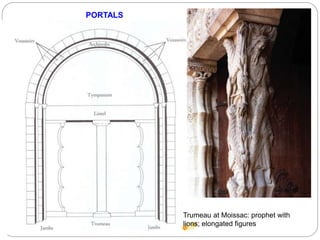
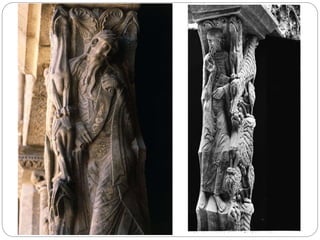
Trumeau at Moissac: prophet with
lions; elongated figures
PORTALS
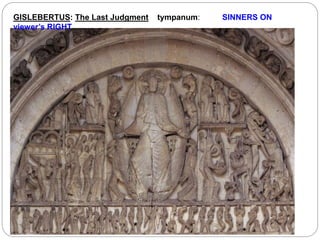
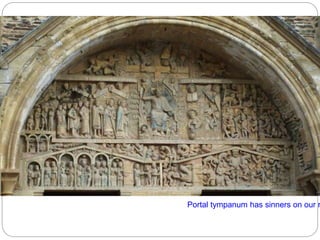
GISLEBERTUS: The Last Judgment tympanum: SINNERS ON
viewer’s RIGHT
58
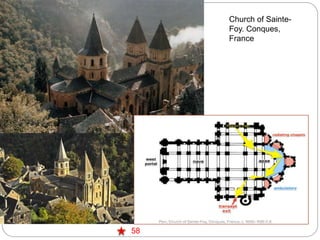
Church of Sainte-
Foy. Conques,
France
Portal tympanum has sinners on our r
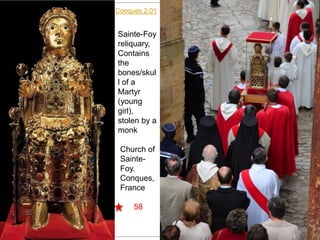
Conques 2:01
58
Sainte-Foy
reliquary,
Contains
the
bones/skul
l of a
Martyr
(young
girl),
stolen by a
monk
Church of
Sainte-
Foy.
Conques,
France
58
17
9
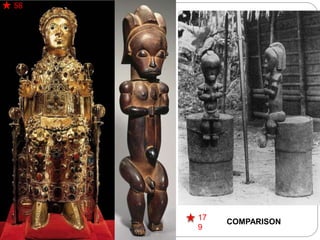
COMPARISON
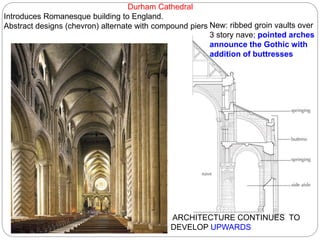
Durham Cathedral
Introduces Romanesque building to England.
Abstract designs (chevron) alternate with compound piers New: ribbed groin vaults over
3 story nave; pointed arches
announce the Gothic with
addition of buttresses
ARCHITECTURE CONTINUES TO
DEVELOP UPWARDS
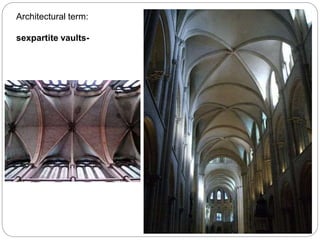
Architectural term:
sexpartite vaults-
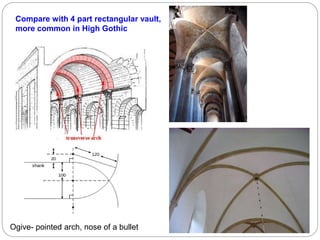
Compare with 4 part rectangular vault,
more common in High Gothic
Ogive- pointed arch, nose of a bullet
GOTHIC ART (1140-1400) CULTURAL CONTEXT
-Overlaps Romanesque approximately 50 years;
ends with Renaissance
-Mainly takes place in France
1. Church: Based in Rome. A papacy with absolute power
-St. Francis begins Franciscan order, based on humble,
loving approach to God and mankind;
-God no longer a remote, severe, damming judge, but a
savior who walked amongst men; he is knowable on earth,
through love of self and others
-St. Bernard: faith is mystical and intuitive, not rational
-Cult of Mary: spiritual love exalted; spirituality allows a
wider place for women and sensuality;
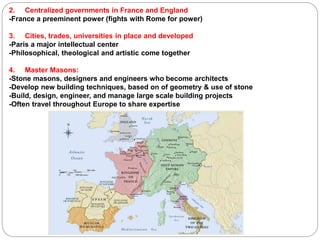
2. Centralized governments in France and England
-France a preeminent power (fights with Rome for power)
3. Cities, trades, universities in place and developed
-Paris a major intellectual center
-Philosophical, theological and artistic come together
4. Master Masons:
-Stone masons, designers and engineers who become architects
-Develop new building techniques, based on of geometry & use of stone
-Build, design, engineer, and manage large scale building projects
-Often travel throughout Europe to share expertise
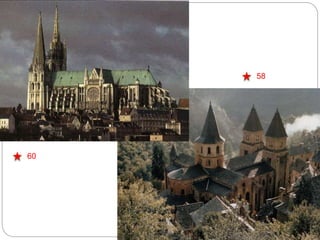
60
58
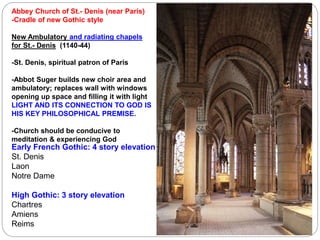
Early French Gothic: 4 story elevation
St. Denis
Laon
Notre Dame
High Gothic: 3 story elevation
Chartres
Amiens
Reims
Abbey Church of St.- Denis (near Paris)
-Cradle of new Gothic style
New Ambulatory and radiating chapels
for St.- Denis (1140-44)
-St. Denis, spiritual patron of Paris
-Abbot Suger builds new choir area and
ambulatory; replaces wall with windows
opening up space and filling it with light
LIGHT AND ITS CONNECTION TO GOD IS
HIS KEY PHILOSOPHICAL PREMISE.
-Church should be conducive to
meditation & experiencing God
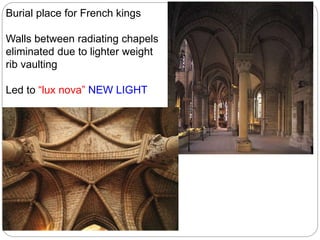
Burial place for French kings
Walls between radiating chapels
eliminated due to lighter weight
rib vaulting
Led to “lux nova” NEW LIGHT
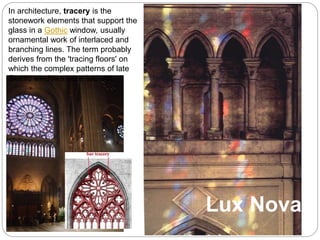
Lux Nova
In architecture, tracery is the
stonework elements that support the
glass in a Gothic window, usually
ornamental work of interlaced and
branching lines. The term probably
derives from the 'tracing floors' on
which the complex patterns of late
Gothic windows were laid out.
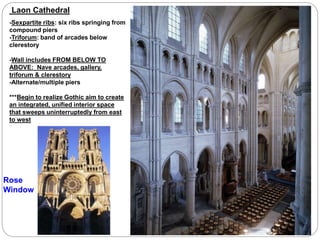
Laon Cathedral
-Sexpartite ribs: six ribs springing from
compound piers
-Triforum: band of arcades below
clerestory
-Wall includes FROM BELOW TO
ABOVE: Nave arcades, gallery,
triforum & clerestory
-Alternate/multiple piers
***Begin to realize Gothic aim to create
an integrated, unified interior space
that sweeps uninterruptedly from east
to west
Rose
Window
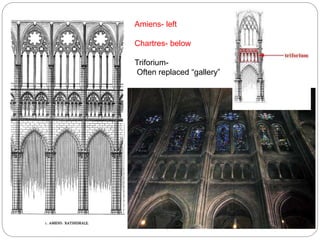
Amiens- left
Chartres- below
Triforium-
Often replaced “gallery”
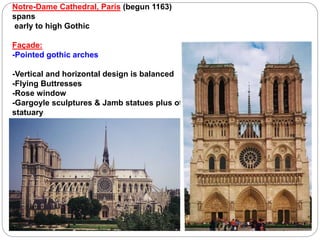
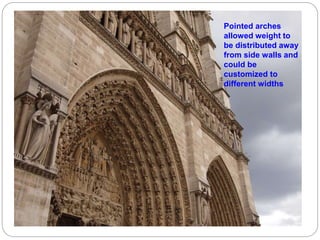
Notre-Dame Cathedral, Paris (begun 1163)
spans
early to high Gothic
Façade:
-Pointed gothic arches
-Vertical and horizontal design is balanced
-Flying Buttresses
-Rose window
-Gargoyle sculptures & Jamb statues plus other
statuary
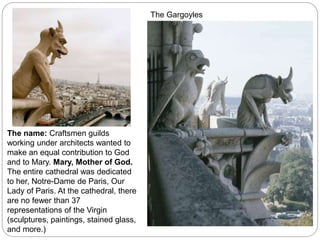
The name: Craftsmen guilds
working under architects wanted to
make an equal contribution to God
and to Mary. Mary, Mother of God.
The entire cathedral was dedicated
to her, Notre-Dame de Paris, Our
Lady of Paris. At the cathedral, there
are no fewer than 37
representations of the Virgin
(sculptures, paintings, stained glass,
and more.)
The Gargoyles
Pointed arches
allowed weight to
be distributed away
from side walls and
could be
customized to
different widths
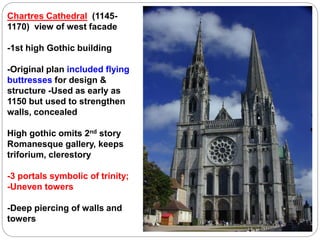
Chartres Cathedral (1145-
1170) view of west facade
-1st high Gothic building
-Original plan included flying
buttresses for design &
structure -Used as early as
1150 but used to strengthen
walls, concealed
High gothic omits 2nd story
Romanesque gallery, keeps
triforium, clerestory
-3 portals symbolic of trinity;
-Uneven towers
-Deep piercing of walls and
towers
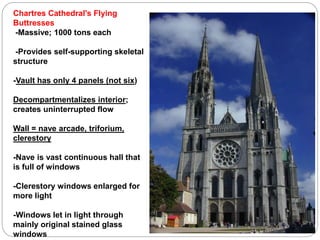
Chartres Cathedral's Flying
Buttresses
-Massive; 1000 tons each
-Provides self-supporting skeletal
structure
-Vault has only 4 panels (not six)
Decompartmentalizes interior;
creates uninterrupted flow
Wall = nave arcade, triforium,
clerestory
-Nave is vast continuous hall that
is full of windows
-Clerestory windows enlarged for
more light
-Windows let in light through
mainly original stained glass
windows
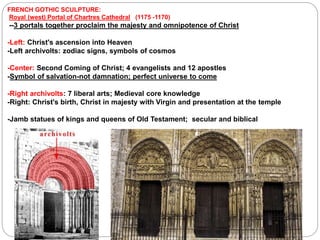
FRENCH GOTHIC SCULPTURE:
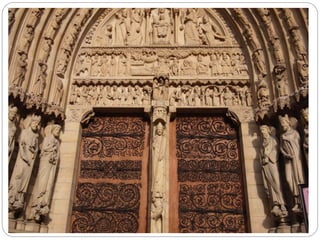
Royal (west) Portal of Chartres Cathedral (1175 -1170)
--3 portals together proclaim the majesty and omnipotence of Christ
-Left: Christ's ascension into Heaven
-Left archivolts: zodiac signs, symbols of cosmos
-Center: Second Coming of Christ; 4 evangelists and 12 apostles
-Symbol of salvation-not damnation; perfect universe to come
-Right archivolts: 7 liberal arts; Medieval core knowledge
-Right: Christ's birth, Christ in majesty with Virgin and presentation at the temple
-Jamb statues of kings and queens of Old Testament; secular and biblical
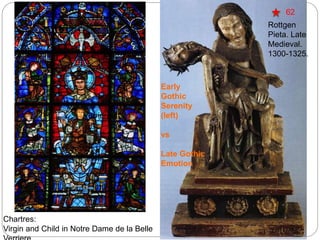
Verriere
62
Early
Gothic
Serenity
(left)
vs
Late Gothic
Emotion
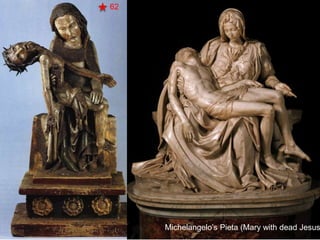
Chartres:
Virgin and Child in Notre Dame de la Belle
Rottgen
Pieta. Late
Medieval.
1300-1325.
62
Michelangelo’s Pieta (Mary with dead Jesus
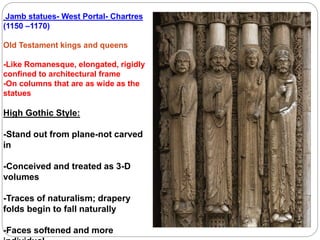
Jamb statues- West Portal- Chartres
(1150 –1170)
Old Testament kings and queens
-Like Romanesque, elongated, rigidly
confined to architectural frame
-On columns that are as wide as the
statues
High Gothic Style:
-Stand out from plane-not carved
in
-Conceived and treated as 3-D
volumes
-Traces of naturalism; drapery
folds begin to fall naturally
-Faces softened and more
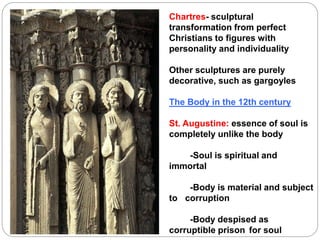
Chartres- sculptural
transformation from perfect
Christians to figures with
personality and individuality
Other sculptures are purely
decorative, such as gargoyles
The Body in the 12th century
St. Augustine: essence of soul is
completely unlike the body
-Soul is spiritual and
immortal
-Body is material and subject
to corruption
-Body despised as
corruptible prison for soul
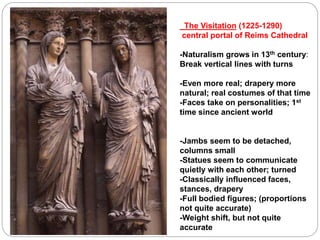
The Visitation (1225-1290)
central portal of Reims Cathedral
-Naturalism grows in 13th century:
Break vertical lines with turns
-Even more real; drapery more
natural; real costumes of that time
-Faces take on personalities; 1st
time since ancient world
-Jambs seem to be detached,
columns small
-Statues seem to communicate
quietly with each other; turned
-Classically influenced faces,
stances, drapery
-Full bodied figures; (proportions
not quite accurate)
-Weight shift, but not quite
accurate
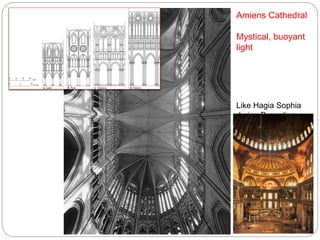
Amiens Cathedral
Mystical, buoyant
light
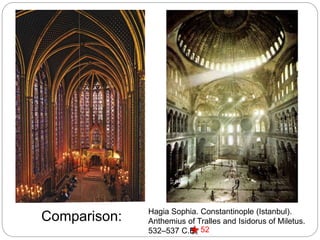
Like Hagia Sophia
during Byzantium
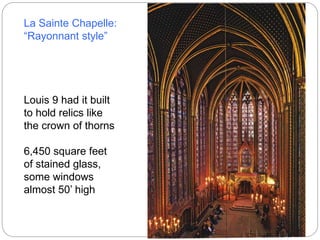
La Sainte Chapelle:
“Rayonnant style”
Louis 9 had it built
to hold relics like
the crown of thorns
6,450 square feet
of stained glass,
some windows
almost 50’ high
52
Comparison: Hagia Sophia. Constantinople (Istanbul).
Anthemius of Tralles and Isidorus of Miletus.
532–537 C.E
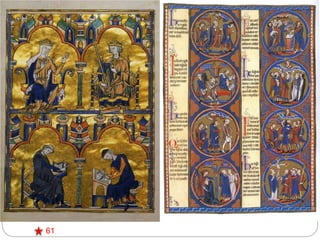
61
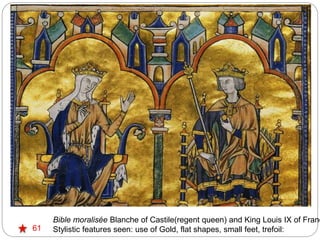
61
Bible moralisée Blanche of Castile(regent queen) and King Louis IX of Franc
Stylistic features seen: use of Gold, flat shapes, small feet, trefoil:

Romanesque gothic 2018

  • 1.
  • 2.
    High Fashion Goth Inspired byarchitecture: Rib vaults Flying Buttresses Darkness to Light
  • 3.
    Romanesque  Romanesque: aterm coined in 1800s to describe architecture of this period, based on its resemblance to ancient Roman architecture  Also used to describe culture of Western Europe between 1050 and 1200 17-16 St Savin sur Gartempe
  • 4.
    Bayeux Tapestry 1070 During100 year war between France and England: (NORMAN CONQUEST: William of Normandy, 1066 at Hastings) 230 ft long, actually an embroidery (sewn, not made on a loom) Like Greco-Roman battle scenes, contorted bodies Narrative art documenting an even soon after it happened. Similar to the frieze on the column of Trajan
  • 5.
    The Animated BayeuxTapestry 4:24 Video History and Memory (14:07 to 16:28)) The Bayeux Tapestry - Seven Ages of Britain - BBC One 4:56Expert Perspective, David Bernstein, audio 2:2 59
  • 7.
    Pilgrimages Santiago de Compostela1075- 1211 Romanesque structure; later Gothic and Baroque styles added
  • 8.
    Pilgrimages /Crusades : -Pilgrimsjourney to famous sites throughout Europe to atone for sins, seek healing and win salvation -Pilgrimages routes become main travel and communication arteries -Crusaders (taking of the Cross) arm and seek to win back Jerusalem and areas of Near East from Muslims 1096-1300, concept of “holy warriors”
  • 9.
    Initial R” withknight fighting dragons St. George and the Dragon from French manuscript (c. early 1100's) -Shaped to form the letter "R” -Dragon in animal style -Squire below runs lance through dragon; show of status -Shows value of warrior class in service of church-the crusaders -elongated figures, similar to Romanesque sculpture -Drapery is tubular, step-ladder pattern
  • 10.
    CULTURAL CONTEXT: Western thoughtdevelops -Ideas of Aristotle passed from Muslim thinkers into Spain to Western European thinkers -Based on rationalism: rational approach to understanding existence of God; writings of St. Augustine highly influential St Augustine: top -Peter Abelard (BELOW RIGHT) a major systematic thinker of this time; knowledge is organized, and applied to create solutions- philosopher, composer, poet- -Universities develop- Paris -Roman Civil law recovered; civil law & legal systems developed
  • 11.
    Romanesque Architecture 105-1151 Thousandsof churches built Hundreds burned during middle ages by invaders Wooden roof replaced by stone New techniques
  • 12.
    Style -continuous hall-like space -Arches,barrel vaults / bays -Some groin & ribbed vaults -Strongly marked off crossing square -Romanesque interior space divided into separate compartments /marked bays -Aisles covered with barrel vaults -Weight of ceiling falls onto outer walls -Nave walls also reflect geometric plan: arcade -Triforium added later as walls get higher -Dark, with little lighting: can't cut into barrel vaults -Overall design symbolic of Christ on the cross bays
  • 13.
    Trumeau at Moissac:prophet with lions; elongated figures PORTALS
  • 15.
    GISLEBERTUS: The LastJudgment tympanum: SINNERS ON viewer’s RIGHT
  • 16.
  • 17.
    Portal tympanum hassinners on our r
  • 18.
    Conques 2:01 58 Sainte-Foy reliquary, Contains the bones/skul l ofa Martyr (young girl), stolen by a monk Church of Sainte- Foy. Conques, France
  • 19.
  • 20.
    Durham Cathedral Introduces Romanesquebuilding to England. Abstract designs (chevron) alternate with compound piers New: ribbed groin vaults over 3 story nave; pointed arches announce the Gothic with addition of buttresses ARCHITECTURE CONTINUES TO DEVELOP UPWARDS
  • 21.
  • 22.
    Compare with 4part rectangular vault, more common in High Gothic Ogive- pointed arch, nose of a bullet
  • 23.
    GOTHIC ART (1140-1400)CULTURAL CONTEXT -Overlaps Romanesque approximately 50 years; ends with Renaissance -Mainly takes place in France 1. Church: Based in Rome. A papacy with absolute power -St. Francis begins Franciscan order, based on humble, loving approach to God and mankind; -God no longer a remote, severe, damming judge, but a savior who walked amongst men; he is knowable on earth, through love of self and others -St. Bernard: faith is mystical and intuitive, not rational -Cult of Mary: spiritual love exalted; spirituality allows a wider place for women and sensuality;
  • 24.
    2. Centralized governmentsin France and England -France a preeminent power (fights with Rome for power) 3. Cities, trades, universities in place and developed -Paris a major intellectual center -Philosophical, theological and artistic come together 4. Master Masons: -Stone masons, designers and engineers who become architects -Develop new building techniques, based on of geometry & use of stone -Build, design, engineer, and manage large scale building projects -Often travel throughout Europe to share expertise
  • 25.
  • 26.
    Early French Gothic:4 story elevation St. Denis Laon Notre Dame High Gothic: 3 story elevation Chartres Amiens Reims Abbey Church of St.- Denis (near Paris) -Cradle of new Gothic style New Ambulatory and radiating chapels for St.- Denis (1140-44) -St. Denis, spiritual patron of Paris -Abbot Suger builds new choir area and ambulatory; replaces wall with windows opening up space and filling it with light LIGHT AND ITS CONNECTION TO GOD IS HIS KEY PHILOSOPHICAL PREMISE. -Church should be conducive to meditation & experiencing God
  • 27.
    Burial place forFrench kings Walls between radiating chapels eliminated due to lighter weight rib vaulting Led to “lux nova” NEW LIGHT
  • 28.
    Lux Nova In architecture,tracery is the stonework elements that support the glass in a Gothic window, usually ornamental work of interlaced and branching lines. The term probably derives from the 'tracing floors' on which the complex patterns of late Gothic windows were laid out.
  • 29.
    Laon Cathedral -Sexpartite ribs:six ribs springing from compound piers -Triforum: band of arcades below clerestory -Wall includes FROM BELOW TO ABOVE: Nave arcades, gallery, triforum & clerestory -Alternate/multiple piers ***Begin to realize Gothic aim to create an integrated, unified interior space that sweeps uninterruptedly from east to west Rose Window
  • 30.
  • 31.
    Notre-Dame Cathedral, Paris(begun 1163) spans early to high Gothic Façade: -Pointed gothic arches -Vertical and horizontal design is balanced -Flying Buttresses -Rose window -Gargoyle sculptures & Jamb statues plus other statuary
  • 32.
    The name: Craftsmenguilds working under architects wanted to make an equal contribution to God and to Mary. Mary, Mother of God. The entire cathedral was dedicated to her, Notre-Dame de Paris, Our Lady of Paris. At the cathedral, there are no fewer than 37 representations of the Virgin (sculptures, paintings, stained glass, and more.) The Gargoyles
  • 33.
    Pointed arches allowed weightto be distributed away from side walls and could be customized to different widths
  • 35.
    Chartres Cathedral (1145- 1170)view of west facade -1st high Gothic building -Original plan included flying buttresses for design & structure -Used as early as 1150 but used to strengthen walls, concealed High gothic omits 2nd story Romanesque gallery, keeps triforium, clerestory -3 portals symbolic of trinity; -Uneven towers -Deep piercing of walls and towers
  • 36.
    Chartres Cathedral's Flying Buttresses -Massive;1000 tons each -Provides self-supporting skeletal structure -Vault has only 4 panels (not six) Decompartmentalizes interior; creates uninterrupted flow Wall = nave arcade, triforium, clerestory -Nave is vast continuous hall that is full of windows -Clerestory windows enlarged for more light -Windows let in light through mainly original stained glass windows
  • 37.
    FRENCH GOTHIC SCULPTURE: Royal(west) Portal of Chartres Cathedral (1175 -1170) --3 portals together proclaim the majesty and omnipotence of Christ -Left: Christ's ascension into Heaven -Left archivolts: zodiac signs, symbols of cosmos -Center: Second Coming of Christ; 4 evangelists and 12 apostles -Symbol of salvation-not damnation; perfect universe to come -Right archivolts: 7 liberal arts; Medieval core knowledge -Right: Christ's birth, Christ in majesty with Virgin and presentation at the temple -Jamb statues of kings and queens of Old Testament; secular and biblical
  • 39.
    Verriere 62 Early Gothic Serenity (left) vs Late Gothic Emotion Chartres: Virgin andChild in Notre Dame de la Belle Rottgen Pieta. Late Medieval. 1300-1325.
  • 40.
  • 41.
    Jamb statues- WestPortal- Chartres (1150 –1170) Old Testament kings and queens -Like Romanesque, elongated, rigidly confined to architectural frame -On columns that are as wide as the statues High Gothic Style: -Stand out from plane-not carved in -Conceived and treated as 3-D volumes -Traces of naturalism; drapery folds begin to fall naturally -Faces softened and more
  • 42.
    Chartres- sculptural transformation fromperfect Christians to figures with personality and individuality Other sculptures are purely decorative, such as gargoyles The Body in the 12th century St. Augustine: essence of soul is completely unlike the body -Soul is spiritual and immortal -Body is material and subject to corruption -Body despised as corruptible prison for soul
  • 43.
    The Visitation (1225-1290) centralportal of Reims Cathedral -Naturalism grows in 13th century: Break vertical lines with turns -Even more real; drapery more natural; real costumes of that time -Faces take on personalities; 1st time since ancient world -Jambs seem to be detached, columns small -Statues seem to communicate quietly with each other; turned -Classically influenced faces, stances, drapery -Full bodied figures; (proportions not quite accurate) -Weight shift, but not quite accurate
  • 44.
    Amiens Cathedral Mystical, buoyant light LikeHagia Sophia during Byzantium
  • 45.
    La Sainte Chapelle: “Rayonnantstyle” Louis 9 had it built to hold relics like the crown of thorns 6,450 square feet of stained glass, some windows almost 50’ high
  • 46.
    52 Comparison: Hagia Sophia.Constantinople (Istanbul). Anthemius of Tralles and Isidorus of Miletus. 532–537 C.E
  • 47.
  • 48.
    61 Bible moralisée Blancheof Castile(regent queen) and King Louis IX of Franc Stylistic features seen: use of Gold, flat shapes, small feet, trefoil:

Editor's Notes

  • #6 59. Bayeux Tapestry. Romanesque Europe (English or Norman). c. 1066–1080 C.E. Embroidery on linen. Video History and Memory (14:07 to 16:28)
  • #14 Romanesque portal; trumeau at St Pierre, Moissac (cloisters)
  • #17 58. Church of Sainte-Foy. Conques, France. Romanesque Europe. Church: c. 1050–1130 C.E.; Reliquary of Saint Foy: ninth century C.E., with later additions. Stone (architecture); stone and paint (tympanum); gold, silver, gemstones, and enamel over wood (reliquary).
  • #20 Sainte-Foy reliquary, 58. Church of Sainte-Foy. Conques, France. Romanesque Europe. Church: c. 1050–1130 C.E.; Reliquary of Saint Foy: ninth century C.E., with later additions. Stone (architecture); stone and paint (tympanum); gold, silver, gemstones, and enamel over wood (reliquary).
  • #26 58. Church of Sainte-Foy. Conques, France. Romanesque Europe. Church: c. 1050–1130 C.E.; Reliquary of Saint Foy: ninth century C.E., with later additions. Stone (architecture); stone and paint (tympanum); gold, silver, gemstones, and enamel over wood (reliquary). 60. Chartres Cathedral. Chartres, France. Gothic Europe. Original construction c. 1145–1155 C.E.; reconstructed c. 1194–1220 C.E. Limestone, stained glass.
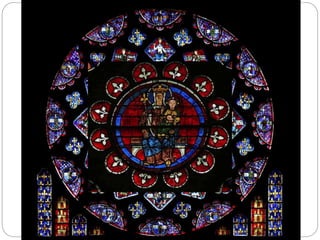
  • #39 NOTE: While the Course Planning and Pacing Guide says we look at the WEST rose window, we will examine the NORTH one instead, since it follows the theme of the veneration of the Virgin. http://en.wikipedia.org/wiki/Chartres_Cathedral#Rose_windows: “The north transept rose (10.5 m diameter, made c.1235), like much of the sculpture in the north porch beneath it, is dedicated to the Virgin.[29] The central oculus shows the Virgin and Child and is surrounded by 12 small petal-shaped windows, 4 with doves (the 'Four Gifts of the Spirit'), the rest with adoring angels carrying candlesticks. Beyond this is a ring of 12 diamond-shaped openings containing the Old Testament Kings of Judah, another ring of smaller lozenges containing the arms of France and Castille, and finally a ring of semicircles containing Old Testament Prophets holding scrolls. The presence of the arms of the French king (yellow fleurs-de-lis on a blue background) and of his mother, Blanche of Castile (yellow castles on a red background) are taken as a sign of royal patronage for this window. Beneath the rose itself are five tall lancet windows (7.5 m high) showing, in the centre, the Virgin as an infant held by her mother, St Anne – the same subject as the trumeau in the portal beneath it. Flanking this lancet are four more containing Old Testament figures. Each of these standing figures is shown symbolically triumphing over an enemy depicted in the base of the lancet beneath them – David over Saul, Aaron over Pharaoh, St Anne over Synagoga, etc.”
  • #40 Virgin and Child in Notre Dame de la Belle Verriere . 62. Rottgen Pieta. Late Medieval. 1300-1325. Painted wood.
  • #41 62. Rottgen Pieta Michelangelo’s Pieta
  • #47 52. Hagia Sophia. Constantinople (Istanbul). Anthemius of Tralles and Isidorus of Miletus. 532–537 C.E. Brick and ceramic elements with stone and mosaic veneer.
  • #48 61. Dedication Page with Blanche of Castile and King Louis IX of France and Scenes from the Apocalypse, from a Bible moralisée. Gothic Europe. c. 1226–1234 C.E. Illuminated manuscript (ink, tempera, and gold leaf on vellum).
  • #49 61. Dedication Page with Blanche of Castile and King Louis IX of France, from a Bible moralisée. Gothic Europe. c. 1226–1234 C.E. Illuminated manuscript (ink, tempera, and gold leaf on vellum).