Renaissance Art Revision
Renaissance Architecture Renaissance architecture  is the architecture of the period between the early 15th and early 17th centuries in different regions of Europe, in which there was a conscious revival and development of certain elements of  Classical Greek  and  Roman  thought and material culture. The Renaissance style places emphasis on  symmetry ,  proportion , geometry and the regularity of parts as they are demonstrated in the architecture of Classical antiquity and in particular, the architecture of  Ancient Rome , of which many examples remained. Orderly arrangements of  columns ,  pilasters  and  lintels , as well as the use of semicircular arches, hemispherical  domes ,  niches  and  aedicules  replaced the more complex proportional systems and irregular profiles of  medieval  buildings
Renaissance Architecture Historians often use the following designations: Renaissance (ca. 1400–1500); also known as the  Quattrocento  and sometimes Early Renaissance  High Renaissance  (ca.1500–1525)  Mannerism  (ca. 1520–1600)
Renaissance Architecture Quattrocento In the  Quattrocento , concepts of architectural order were explored and rules were formulated. The study of classical antiquity led in particular to the adoption of Classical detail and ornamentation. Space, as an element of architecture, was utilised differently to the way it had been in the  Middle Ages . Space was organised by proportional logic, its form and rhythm subject to geometry, rather than being created by intuition as in Medieval buildings. The prime example of this is the  Basilica  di  San Lorenzo  in  Florence  by  Filippo   Brunelleschi  (1377–1446
Renaissance Architecture High Renaissance During the  High Renaissance , concepts derived from classical antiquity were developed and used with greater surety. The most representative architect is  Bramante  (1444–1514) who expanded the applicability of classical architecture to contemporary buildings. His  San  Pietro  in  Montorio  (1503) was directly inspired by circular  Roman temples . He was, however, hardly a slave to the classical forms and it was his style that was to dominate Italian architecture in the 16th century
Renaissance Architecture Mannerism During the  Mannerist  period, architects experimented with using architectural forms to emphasize solid and spatial relationships. The Renaissance ideal of harmony gave way to freer and more imaginative rhythms. The best known architect associated with the Mannerist style was  Michelangelo  (1475–1564), who is credited with inventing the  giant order , a large pilaster that stretches from the bottom to the top of a facade. He used this in his design for the  Campidoglio  in Rome. Prior to the 20th century, the term  Mannerism  had negative connotations, but it is now used to describe the historical period in more general non-judgemental terms
Renaissance Architecture Characteristics of Renaissance architecture: The obvious distinguishing features of Classical Roman architecture were adopted by Renaissance architects. However, the forms and purposes of buildings had changed over time. So had the structure of cities.  Among the earliest buildings of the reborn Classicism were churches of a type that the Romans had never constructed. Neither were there models for the type of large city dwellings required by wealthy merchants of the 15th century.  Conversely, there was no call for enormous sporting fixtures and public bath houses such as the Romans had built. The ancient orders were analysed and reconstructed to serve new purposes
Renaissance Architecture Elements: Plan The plans of Renaissance buildings have a square, symmetrical appearance in which proportions are usually based on a module. Within a church the module is often the width of an aisle. The need to integrate the design of the plan with the façade was introduced as an issue in the work of  Filippo   Brunelleschi , but he was never able to carry this aspect of his work into fruition. The first building to demonstrate this was  St. Andrea  in Mantua by  Alberti .  The development of the plan in secular architecture was to take place in the 16th century and culminated with the work of  Palladio
Renaissance Architecture Elements:  Facade Façades are symmetrical around their vertical axis. Church facades are generally surmounted by a pediment and organized by a system of pilasters, arches and entablatures. The columns and windows show a progression towards the centre.  Domestic buildings are often surmounted by a  cornice . There is a regular repetition of openings on each floor, and the centrally placed door is marked by a feature such as a balcony, or rusticated surround. An early and much copied prototype was the façade for the  Palazzo  Rucellai  (1446 and 1451) in Florence with its three registers of  pilasters
Renaissance Architecture Elements:  Columns and Pilasters The Roman orders of columns are used:- Tuscan, Doric, Ionic, Corinthian and Composite.  The orders can either be structural, supporting an arcade or architrave, or purely decorative, set against a wall in the form of pilasters. During the Renaissance, architects aimed to use columns, pilasters, and  entablatures  as an integrated system.
Renaissance Architecture Elements:  Arches Arches are semi-circular or (in the Mannerist style) segmental. Arches are often used in arcades, supported on piers or columns with capitals.  There may be a section of entablature between the capital and the springing of the arch.  Vaults Elements:  Vaults Vaults do not have ribs.  They are semi-circular or segmental and on a square plan, unlike the Gothic vault which is frequently rectangular.  The  barrel vault , is returned to architectural vocabulary.
Renaissance Architecture Elements: Domes     The dome is used frequently, both as a very large structural feature that is visible from the exterior, and also as a means of roofing smaller spaces where they are only visible internally.  Domes had been used only rarely in the Middle Ages, but after the success of the dome in Brunelleschi’s design for the  Basilica  di  Santa Maria del Fiore  and its use in Bramante’s plan for  St. Peter's Basilica  (1506) in Rome, the dome became an indispensable element in church architecture and later even for secular architecture, such as Palladio's  Villa Rotonda . [12] Elements: Ceilings Roofs are fitted with flat or coffered ceilings.  They are not left open as in Medieval architecture.  They are frequently painted or decorated.
Renaissance Architecture Elements: Doors Door usually have square lintels.  They may be set within an arch or surmounted by a triangular or segmental pediment.  Openings that do not have doors are usually arched and frequently have a large or decorative keystone. Elements: Windows Windows may be paired and set within a semi-circular arch. They may have square lintels and triangular or segmental pediments, which are often used alternately.  Windows are used to bring light into the building and in domestic architecture, to give views.  Stained glass, although sometimes present, is not a feature.
Renaissance Architecture Elements: Walls External walls are generally of highly-finished  ashlar  masonry, laid in straight courses.  The corners of buildings are often emphasised by rusticated “quoins”. Basements and ground floors were often rusticated.  Internal walls are smoothly plastered and surfaced with white-chalk paint. For more formal spaces, internal surfaces are decorated with frescoes. Elements: Details Courses, mouldings and all decorative details are carved with great precision. Studying and mastering the details of the ancient Romans was one of the important aspects of Renaissance theory. The different orders each required different sets of details. Mouldings stand out around doors and windows rather than being recessed, as in Gothic Architecture.  Sculptured figures may be set in niches or placed on plinths. They are not integral to the building as in Medieval architecture
Renaissance Architecture Influences of the Italian Renaissance: Italy never fully adopted Gothic style. Independent cities influenced in the movement of artists. Cities had a prosperous trade. The return of the Pope to Rome gave new impetus to religiosity. The development of printing made possible the expansion of ideas and the desire of acquiring knowledge. Humanism made of the man the centre of Univers. Patronage made possible artists’ work.
Renaissance Architecture Quattocento: Brunelleschi The underlying feature of the work of Brunelleschi was "order". The buildings remaining among the ruins of ancient Rome appeared to respect a simple mathematical order in the way that Gothic buildings did not. One incontrovertible rule governed all  Ancient Roman architecture —a semi-circular arch is exactly twice as wide as it is high.  From the observation of the architecture of Rome came a desire for symmetry and careful proportion in which the form and composition of the building as a whole and all its subsidiary details have fixed relationships, each section in proportion to the next, and the architectural features serving to define exactly what those rules of proportion are. Works: Florencia’s Cathedral dome, Hospital degli Innocenti, San Lorenzo
Renaissance Architecture Quattrocento: Michelozzo He was an architect under the patronage of the  Medici  family, his most famous work being the  Palazzo Medici  Riccardi . A decade later he built the Villa Medici at  Fiesole .  He was one of the first architects to work in the Renaissance style outside Italy. The Palazzo Medici Riccardi is Classical in the details of its pedimented window and recessed doors, but, unlike the works of Brunelleschi and Alberti, there are no  orders  of columns in evidence. Instead, Michelozzo has respected the Florentine liking for rusticated stone. He has seemingly created three orders out of the three defined rusticated levels, the whole being surmounted by an enormous Roman-style cornice which juts out over the street by 2.5 meters.
Renaissance Architecture Quattrocento: Alberti Alberti perceived the architect as a person with great social responsibilities. He designed a number of buildings, but unlike Brunelleschi, he did not see himself as a builder in a practical sense and so left the supervision of the work  Dynamic buildings. Triumphal façades marked by extreme contrasts. Projection of the order of pilasters that define the architectural elements. The light and shade play dramatically over the surface of the building.  Works: San Andres of Mantua, Palazzo Rucellai and Santa Maria Novella.
Renaissance Architecture High Renaissance: Bramante In Rome Bramante created what has been described as "a perfect architectural gem", the  Tempietto  in the Cloister of  San  Pietro  in  Montorio . This small circular temple marks the spot where St Peter was martyred. The building adapts the style apparent in the remains of the  Temple of  Vesta , the most sacred site of Ancient Rome. It is enclosed by and in spatial contrast with the cloister which surrounds it.  Bramante went on to work at the  Vatican  where he designed the impressive Cortili of St. Damaso and of the  Belvedere . In 1506 Bramante’s design for  Pope Julius  II’s  rebuilding of  St. Peter’s Basilica  was selected, and the foundation stone laid.  Works: San Pietro in Montorio, Santa Maria delle Grazie
Renaissance Architecture High Renaissance: Sangallo His fame rests upon his association with the  Farnese  Palace , “the grandest palace of this period”, started in 1530. The impression of grandness lies in part in its sheer size, (56 m long by 29.5 meters high) and in its lofty location overlooking a broad piazza. It is also a building of beautiful proportion, unusual for such a large and luxurious house of the date in having been built principally of stuccoed brick, rather than of stone. Against the smooth pink-washed walls the stone  quoins  of the corners, the massive rusticated portal and the stately repetition of finely-detailed windows give a powerful effect, setting a new standard of elegance in palace-building.
Renaissance Architecture Mannerism: Michelangelo Michelangelo’s dome of Saint Peter was a masterpiece of design using two masonry shells, one within the other and crowned by a massive lantern supported, as at Florence, on ribs. For the exterior of the building he designed a giant order which defines every external bay, the whole lot being held together by a wide cornice which runs unbroken like a rippling ribbon around the entire building. Laurentian library: It is a long low building with an ornate wooden ceiling, a matching floor and crowded with corrals. But it is a light room, the natural lighting streaming through a long row of windows that appear positively crammed between the order of pilasters that march along the wall. The vestibule, on the other hand, is tall, taller than it is wide and is crowded by a large staircase that pours out of the library, and bursts in three directions when it meets the balustrade of the landing. It is an intimidating staircase, made all the more so because the rise of the stairs at the centre is steeper than at the two sides, fitting only eight steps into the space of nine.
Renaissance Architecture Mannerism: Palladio Palladio was to transform the architectural style of both palaces and churches by taking a different perspective on the notion of Classicism. When he used the “ triumphal arch ” motif of a large arched opening with lower square-topped opening on either side, he invariably applied it on a small scale, such as windows.  This Ancient Roman motif is often referred to as the  Palladian Arch . Works: Villa Capra, San Giorgio Maggiore.
Renaissance Architecture Geography: France During the early years of the 16th century the French were involved in wars in northern Italy, bringing back to France not just the Renaissance art treasures as their war  booty , but also stylistic ideas.  In the  Loire Valley  a wave of building was carried and many Renaissance chateaux appeared at this time, the earliest example being the  Château  d'Amboise  (c. 1495) in which  Leonardo  da  Vinci  spent his last years. The style became dominant under  Francis I  .
Renaissance Architecture Geography: Netherlands As in painting, Renaissance architecture took some time to reach the Netherlands and did not entirely supplant the Gothic elements.  In the early 17th century developed the  Amsterdam Renaissance  style, not slavishly following the classical style but incorporating many decorative elements, and giving a result that could also be categorized as  Mannerism .  Local characteristics include the prevalence of tall narrow town-houses, the "trapgevel" or  Dutch gable  and the employment of decorative triangular pediments over doors and windows in which the apex rises much more steeply than in most other Renaissance architecture, but in keeping with the profile of the gable.
Renaissance Architecture Geography: England Renaissance architecture arrived in England during the reign of  Elizabeth I , having first spread through the  Low countries  where among other features it acquired versions of the  Dutch gable , and  Flemish  strap work in geometric designs adorning the walls. The new style tended to manifest itself in large square tall houses such as  Longleat  House . The first great exponent of Renaissance architecture in England was  Inigo  Jones  ( 1573 – 1652 ), who had studied architecture in Italy where the influence of Palladio was very strong. He began to design such buildings as the  Queen's House  at  Greenwich  and the Banqueting House at  Whitehall . These works, with their clean lines, and symmetry were revolutionary in a country still enamoured with mullion windows, crenelations and turrets
Renaissance Architecture Geography: Spain In Spain, Renaissance began to be grafted to Gothic forms in the last decades of the  15th century .  The new style is called  Plateresque , because of the extremely decorated facades, that brought to the mind the decorative motifs of the intricately detailed work of  silversmiths , the “Plateros”.  Classical orders and candelabra motifs ( a candelieri ) combined freely into symmetrical wholes. From the mid-sixteenth century, under such architects as Pedro Machuca,  Juan Bautista de Toledo  and  Juan de Herrera  there was a closer adherence to the art of ancient Rome, sometimes anticipating  Manierism , examples of which include the  palace of Charles V  in  Granada  and the  Escorial .
Renaissance Sculpture The discovery of the nature and the human body were more important than the imitation of Antiquity. The polychromes, the gilding and the various techniques employed emphasize the pictorial quality of the works.  An innovation was that the artist was no longer content to be a mere craftsman, but he had the mission of adorn. Sculpture and painting are going to be together many times. Projects were important in cities such as Florence were competitions were hold when they had to command an important work, as in the case of the Doors of the Baptistery.
Renaissance Sculpture During the Quattrocento there is an intention to define an idealized, perfect bur naturalistic representation of the human body. The novelty is the concept of beauty embodied by youth, whereas the gerontocracy in power strove to relegate the young and adolescent to the sidelines of social life. The sculptures have three characteristics: Gothic tradition Renewal of Antiquity Resource to the single point of view that underlines frontality.
Renaissance Sculpture Tomb sculpture. The wall tomb was the favourite framework used by the Renaissance sculpture. The backed tombs were contaminated by the successive forms taken by altarpieces: the recess was surrounded by statuette aligned vertically on the pilasters. Artists adopted a tripartite structure, contrasting the central arcade, which emphasized the image of the deceased with lateral niches containing statues of saints or virtues. The development of the representation of the dead denoted a new conception of the portrait. Depiction of faces was often dictated by the concept of the ideal
Renaissance Sculpture Revival of the equestrian statue Life-size representation of a horse and rider was and attractive subject for sculptors but did not become possible until the second half of the century, due to the cost of execution and technical problems to cast the bronze. The monuments were reserved to the representation of the civic and secular virtues of illustrious men and took as a model the Marcus Aurelius. Previously other models in short-lived materials were used. The best examples are the Condottiero Gattamelata made by Donatello, and the Condottiero Colleoni, work of Verrochio.
Renaissance Sculpture The portrait  The art of medallist developed  They tended to specify and define the natural features of an individual, with attention to physiognomy and its psychological bearing, and without forgetting the course of the time. Female portraits implied a searching focus on the beauty of woman, and inspired the artist to a celebration of beauty, with a softer and more tender treatment.
Renaissance Sculpture Nude  There is a predominance of male nudes. They follow the Gothic tradition. Female nudes appear in small bronze statues, imitating the antique statuary. Male nude kept the workshops especially busy. Some of the models are those made by Michelangelo: Bacchus and, later on, David.
Renaissance Sculpture Mannerism  Works oscillated between the fantastic and the  maniera  (following the example of Michelangelo) Sometimes the ideal took preference Powerful images opposed to elongated weightless ones Undulating spirals animated groups and twisted sinuous bodies Exaggerated expression to the point of morbidity and the bizarre was preferred Instead of being a sign of decadence, the diversity shows an art in search of itself.
Renaissance Sculpture Materials and technique Bronze substituted other precious materials. It was casted and finished by chisel. At the beginning it was not highly polished Extensive use of marble and fine calcareous stones Details of images are sometimes gilded Backgrounds can be coloured
Renaissance Sculpture Authors and examples: Ghiberti: Doors of the Baptistery in Florence (East Doors and Paradise Doors) Donatello: David, Condottiero Gattamelata Michelangelo: ( Terribilita ) Pieties, David, Medici’s Tombs Mannerism: Cellini: Perseus Berruguete: Toledo’s Choir stalls Leoni: Charles V’s portraits
Renaissance Sculpture Mannerism: Materials: stucco, a mix of plaster, lime and sometimes powdered marble is well suited for modelling. The search for effect was often concentrate on polychrome sculpture. Fountains appear combining sculpture with the effects of water. In tombs marble and bronze are the main materials. Artists were itinerant, attracted by rulers to their courts.
Renaissance Painting Naturalism:  people must be represented as they are observation is essential Rationalism: Things are represented following the reason Use of perspective and backgrounds Universalism: Subjects general for any culture Related to human beings
Renaissance Painting Idealisation: Characters are idealised They do not have deformations Order, proportion and harmony: Things transmit calm and serenity Perfection: Works perfectly finished Attention to the small detail
Renaissance Painting Supports Wall painting was frequent in Italy; mosaic left way to mural painting in Venice Even if the canvas advanced, wood was of frequent use Poliptics were common in Spain and Northern Europe whereas in Italy they used an only panel.
Renaissance Painting Techniques: In Italy the fresco continued Book illumination lost importance with the printed books Engraving on wood and on copper developed Drawing became more important Temple was replaced by oil systematically
Renaissance Painting Themes: Religious continued being important, mainly in Northern Europe and Spain. In Italy mythology was more important Portrait developed  Landscape, without being independent, acquired more importance in the paintings
Renaissance Painting Composition: Space was rationalised with the resource to lineal and atmospheric perspective The organization of the painting put more attention in the centre than in the periphery Sometimes the shapes are organised following simple shapes. The background used traditional motives or architectures of Roman inspiration.
Renaissance Painting Drawing, colour and brushstroke: Gold disappeared, the same as light colours in the strategic areas of the painting Palette diversified, being commonly light Oil painting permitted the use of delicate nuances (transparencies, luminosity) Triumph of the  sfumato .
Renaissance Painting Images: Faces are full of a new realism Bodies must be convinced by the imitation of real forms. Worry for idealization, especially in nudes, using canons of beauty The normalisation of beauty led to the apparition of their antagonists, with grotesque or caricaturized images.
Mannerist Painting Technique and support: Are the same as those of the Renaissance Format of paintings: Big in churches and palaces Small for stamps Themes: Religious were frequent Mythology and allegory depiction improved Portrait developed more
Mannerist Painting Composition, drawing, colour and brushstrokes: Everything tried to create surprise Compositions are not centred  Colours are not common Images are numerous Images: They try to surprise Deformations and complicated lines
Renaissance Painters Massacio: Material characters with power and dignity Perfection of detail Sense of tactile values He painted frescoes Works: Brancaci Chapel
Renaissance Painters Ucello: Famous for his paintings that remain medieval period Interested in perspective Figures appeared solid and real He did not know how to use light and shade Preocupation with applied geometry Works: San Romano’s Battle
Renaissance Painters Filippo Lippi: Author of crowded fresco scenes Madonnas and saints holy, serene His works were more naturalistic with the time. He used tempera. Work of precision, depth and fluidity Works: Madonna
Renaissance Painters Fra Angelico: He used a simple style, sacrificing perspective to it. He produced many frescoes His works are elegant and delicate Works: Annunciation, frescoes at San Marco’s convent.
Renaissance Painters Piero della Francesca Perspective and geometry are dominant in his works He liked to organise large, plain masses of colour in patters which suggest and underlyin geometrical scheme Light palette Large areas of white or near-white Works: The Baptism of Christ, The Nativity.
Renaissance Painters Botticelli Individual and graceful style Pure visual poetry Denial of rational spatial construction and no attempt to model solid-looking figures Figures float on the forward plane, agains a decorative landscape Form outlined Personal type of femenine beauty Works: The Spring, The Birth of Venus
Renaissance Painters Mantegna Mastery of perspective Adapt the scene to low viewpoint Scorzo Works: Death Christ Bellini Famous for his portraits Large-scale narrative paintings Works: Portrait of the Dux
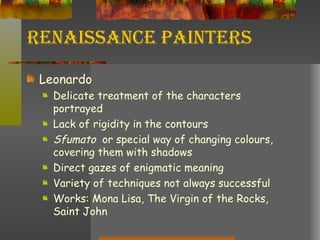
Renaissance Painters Leonardo Delicate treatment of the characters portrayed Lack of rigidity in the contours Sfumato  or special way of changing colours, covering them with shadows Direct gazes of enigmatic meaning Variety of techniques not always successful Works: Mona Lisa, The Virgin of the Rocks, Saint John
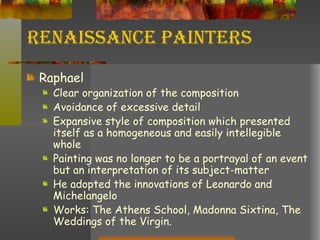
Renaissance Painters Raphael Clear organization of the composition Avoidance of excessive detail Expansive style of composition which presented itself as a homogeneous and easily intellegible whole Painting was no longer to be a portrayal of an event but an interpretation of its subject-matter He adopted the innovations of Leonardo and Michelangelo Works: The Athens School, Madonna Sixtina, The Weddings of the Virgin.
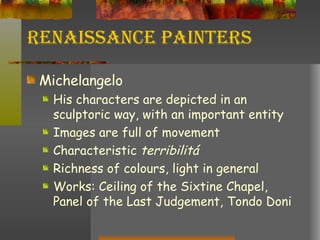
Renaissance Painters Michelangelo His characters are depicted in an sculptoric way, with an important entity Images are full of movement  Characteristic  terribilitá Richness of colours, light in general Works: Ceiling of the Sixtine Chapel, Panel of the Last Judgement, Tondo Doni
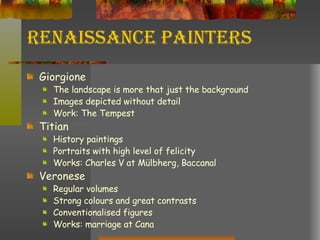
Renaissance Painters Giorgione The landscape is more that just the background Images depicted without detail Work: The Tempest Titian History paintings Portraits with high level of felicity Works: Charles V at Mülbherg, Baccanal Veronese Regular volumes Strong colours and great contrasts Conventionalised figures Works: marriage at Cana
Renaissance Painters Dürer The greatest artist of Northern Renaissance First author who painted self-portraits Woodcuts and engravings Author of magnificent altarpieces and powerful portraits Diversity of subjects in his watercolours Works: Adan  and Eve, Self-portrait
Renaissance Painters Grünewald Religious paintings of visionary expressiveness Intense colours and agitated lines Work: The Isenheim Altarpiece Holbeing the Younger Excellent portratist Portraits do not reveal the personality Taste for illusionist effects Works: Henry VIII , The Ambassadors Cranach the Elder Portraits and female nudes Works: Luther, Duke Henry of Saxony
Renaissance Painters Yañez de la Almedina Introduced the High Renaissance in Spain Masip Combined Italian and Netherlandish influences Juan de Juanes Ideal Counter-Reformation images Influences of Leonardo and Raphael Sfumato  effects
Mannerist Painters Corregio Conscious elegance, soft sfumato and gestures of captivating charm Sensuous mythologies, as his Venuses Tintoretto Figures full of heath Effects of light and shadow Colossal conception of the human but with elegance
Mannerist Painters Morales Devotional images influenced by Leonardo Sanchez Coello Pioneer of the Spanish portrait painting Ease of pose and execution, dignity and sobriety and warmth of colouring El Greco Influenced by the mysticism of Counter-Reformation Elongated figures Intense and unusual colour Ardour and energy

Renaissance Revision

  • 1.
  • 2.
    Renaissance Architecture Renaissancearchitecture is the architecture of the period between the early 15th and early 17th centuries in different regions of Europe, in which there was a conscious revival and development of certain elements of Classical Greek and Roman thought and material culture. The Renaissance style places emphasis on symmetry , proportion , geometry and the regularity of parts as they are demonstrated in the architecture of Classical antiquity and in particular, the architecture of Ancient Rome , of which many examples remained. Orderly arrangements of columns , pilasters and lintels , as well as the use of semicircular arches, hemispherical domes , niches and aedicules replaced the more complex proportional systems and irregular profiles of medieval buildings
  • 3.
    Renaissance Architecture Historiansoften use the following designations: Renaissance (ca. 1400–1500); also known as the Quattrocento and sometimes Early Renaissance High Renaissance (ca.1500–1525) Mannerism (ca. 1520–1600)
  • 4.
    Renaissance Architecture QuattrocentoIn the Quattrocento , concepts of architectural order were explored and rules were formulated. The study of classical antiquity led in particular to the adoption of Classical detail and ornamentation. Space, as an element of architecture, was utilised differently to the way it had been in the Middle Ages . Space was organised by proportional logic, its form and rhythm subject to geometry, rather than being created by intuition as in Medieval buildings. The prime example of this is the Basilica di San Lorenzo in Florence by Filippo Brunelleschi (1377–1446
  • 5.
    Renaissance Architecture HighRenaissance During the High Renaissance , concepts derived from classical antiquity were developed and used with greater surety. The most representative architect is Bramante (1444–1514) who expanded the applicability of classical architecture to contemporary buildings. His San Pietro in Montorio (1503) was directly inspired by circular Roman temples . He was, however, hardly a slave to the classical forms and it was his style that was to dominate Italian architecture in the 16th century
  • 6.
    Renaissance Architecture MannerismDuring the Mannerist period, architects experimented with using architectural forms to emphasize solid and spatial relationships. The Renaissance ideal of harmony gave way to freer and more imaginative rhythms. The best known architect associated with the Mannerist style was Michelangelo (1475–1564), who is credited with inventing the giant order , a large pilaster that stretches from the bottom to the top of a facade. He used this in his design for the Campidoglio in Rome. Prior to the 20th century, the term Mannerism had negative connotations, but it is now used to describe the historical period in more general non-judgemental terms
  • 7.
    Renaissance Architecture Characteristicsof Renaissance architecture: The obvious distinguishing features of Classical Roman architecture were adopted by Renaissance architects. However, the forms and purposes of buildings had changed over time. So had the structure of cities. Among the earliest buildings of the reborn Classicism were churches of a type that the Romans had never constructed. Neither were there models for the type of large city dwellings required by wealthy merchants of the 15th century. Conversely, there was no call for enormous sporting fixtures and public bath houses such as the Romans had built. The ancient orders were analysed and reconstructed to serve new purposes
  • 8.
    Renaissance Architecture Elements:Plan The plans of Renaissance buildings have a square, symmetrical appearance in which proportions are usually based on a module. Within a church the module is often the width of an aisle. The need to integrate the design of the plan with the façade was introduced as an issue in the work of Filippo Brunelleschi , but he was never able to carry this aspect of his work into fruition. The first building to demonstrate this was St. Andrea in Mantua by Alberti . The development of the plan in secular architecture was to take place in the 16th century and culminated with the work of Palladio
  • 9.
    Renaissance Architecture Elements: Facade Façades are symmetrical around their vertical axis. Church facades are generally surmounted by a pediment and organized by a system of pilasters, arches and entablatures. The columns and windows show a progression towards the centre. Domestic buildings are often surmounted by a cornice . There is a regular repetition of openings on each floor, and the centrally placed door is marked by a feature such as a balcony, or rusticated surround. An early and much copied prototype was the façade for the Palazzo Rucellai (1446 and 1451) in Florence with its three registers of pilasters
  • 10.
    Renaissance Architecture Elements: Columns and Pilasters The Roman orders of columns are used:- Tuscan, Doric, Ionic, Corinthian and Composite. The orders can either be structural, supporting an arcade or architrave, or purely decorative, set against a wall in the form of pilasters. During the Renaissance, architects aimed to use columns, pilasters, and entablatures as an integrated system.
  • 11.
    Renaissance Architecture Elements: Arches Arches are semi-circular or (in the Mannerist style) segmental. Arches are often used in arcades, supported on piers or columns with capitals. There may be a section of entablature between the capital and the springing of the arch. Vaults Elements: Vaults Vaults do not have ribs. They are semi-circular or segmental and on a square plan, unlike the Gothic vault which is frequently rectangular. The barrel vault , is returned to architectural vocabulary.
  • 12.
    Renaissance Architecture Elements:Domes The dome is used frequently, both as a very large structural feature that is visible from the exterior, and also as a means of roofing smaller spaces where they are only visible internally. Domes had been used only rarely in the Middle Ages, but after the success of the dome in Brunelleschi’s design for the Basilica di Santa Maria del Fiore and its use in Bramante’s plan for St. Peter's Basilica (1506) in Rome, the dome became an indispensable element in church architecture and later even for secular architecture, such as Palladio's Villa Rotonda . [12] Elements: Ceilings Roofs are fitted with flat or coffered ceilings. They are not left open as in Medieval architecture. They are frequently painted or decorated.
  • 13.
    Renaissance Architecture Elements:Doors Door usually have square lintels. They may be set within an arch or surmounted by a triangular or segmental pediment. Openings that do not have doors are usually arched and frequently have a large or decorative keystone. Elements: Windows Windows may be paired and set within a semi-circular arch. They may have square lintels and triangular or segmental pediments, which are often used alternately. Windows are used to bring light into the building and in domestic architecture, to give views. Stained glass, although sometimes present, is not a feature.
  • 14.
    Renaissance Architecture Elements:Walls External walls are generally of highly-finished ashlar masonry, laid in straight courses. The corners of buildings are often emphasised by rusticated “quoins”. Basements and ground floors were often rusticated. Internal walls are smoothly plastered and surfaced with white-chalk paint. For more formal spaces, internal surfaces are decorated with frescoes. Elements: Details Courses, mouldings and all decorative details are carved with great precision. Studying and mastering the details of the ancient Romans was one of the important aspects of Renaissance theory. The different orders each required different sets of details. Mouldings stand out around doors and windows rather than being recessed, as in Gothic Architecture. Sculptured figures may be set in niches or placed on plinths. They are not integral to the building as in Medieval architecture
  • 15.
    Renaissance Architecture Influencesof the Italian Renaissance: Italy never fully adopted Gothic style. Independent cities influenced in the movement of artists. Cities had a prosperous trade. The return of the Pope to Rome gave new impetus to religiosity. The development of printing made possible the expansion of ideas and the desire of acquiring knowledge. Humanism made of the man the centre of Univers. Patronage made possible artists’ work.
  • 16.
    Renaissance Architecture Quattocento:Brunelleschi The underlying feature of the work of Brunelleschi was "order". The buildings remaining among the ruins of ancient Rome appeared to respect a simple mathematical order in the way that Gothic buildings did not. One incontrovertible rule governed all Ancient Roman architecture —a semi-circular arch is exactly twice as wide as it is high. From the observation of the architecture of Rome came a desire for symmetry and careful proportion in which the form and composition of the building as a whole and all its subsidiary details have fixed relationships, each section in proportion to the next, and the architectural features serving to define exactly what those rules of proportion are. Works: Florencia’s Cathedral dome, Hospital degli Innocenti, San Lorenzo
  • 17.
    Renaissance Architecture Quattrocento:Michelozzo He was an architect under the patronage of the Medici family, his most famous work being the Palazzo Medici Riccardi . A decade later he built the Villa Medici at Fiesole . He was one of the first architects to work in the Renaissance style outside Italy. The Palazzo Medici Riccardi is Classical in the details of its pedimented window and recessed doors, but, unlike the works of Brunelleschi and Alberti, there are no orders of columns in evidence. Instead, Michelozzo has respected the Florentine liking for rusticated stone. He has seemingly created three orders out of the three defined rusticated levels, the whole being surmounted by an enormous Roman-style cornice which juts out over the street by 2.5 meters.
  • 18.
    Renaissance Architecture Quattrocento:Alberti Alberti perceived the architect as a person with great social responsibilities. He designed a number of buildings, but unlike Brunelleschi, he did not see himself as a builder in a practical sense and so left the supervision of the work Dynamic buildings. Triumphal façades marked by extreme contrasts. Projection of the order of pilasters that define the architectural elements. The light and shade play dramatically over the surface of the building. Works: San Andres of Mantua, Palazzo Rucellai and Santa Maria Novella.
  • 19.
    Renaissance Architecture HighRenaissance: Bramante In Rome Bramante created what has been described as "a perfect architectural gem", the Tempietto in the Cloister of San Pietro in Montorio . This small circular temple marks the spot where St Peter was martyred. The building adapts the style apparent in the remains of the Temple of Vesta , the most sacred site of Ancient Rome. It is enclosed by and in spatial contrast with the cloister which surrounds it. Bramante went on to work at the Vatican where he designed the impressive Cortili of St. Damaso and of the Belvedere . In 1506 Bramante’s design for Pope Julius II’s rebuilding of St. Peter’s Basilica was selected, and the foundation stone laid. Works: San Pietro in Montorio, Santa Maria delle Grazie
  • 20.
    Renaissance Architecture HighRenaissance: Sangallo His fame rests upon his association with the Farnese Palace , “the grandest palace of this period”, started in 1530. The impression of grandness lies in part in its sheer size, (56 m long by 29.5 meters high) and in its lofty location overlooking a broad piazza. It is also a building of beautiful proportion, unusual for such a large and luxurious house of the date in having been built principally of stuccoed brick, rather than of stone. Against the smooth pink-washed walls the stone quoins of the corners, the massive rusticated portal and the stately repetition of finely-detailed windows give a powerful effect, setting a new standard of elegance in palace-building.
  • 21.
    Renaissance Architecture Mannerism:Michelangelo Michelangelo’s dome of Saint Peter was a masterpiece of design using two masonry shells, one within the other and crowned by a massive lantern supported, as at Florence, on ribs. For the exterior of the building he designed a giant order which defines every external bay, the whole lot being held together by a wide cornice which runs unbroken like a rippling ribbon around the entire building. Laurentian library: It is a long low building with an ornate wooden ceiling, a matching floor and crowded with corrals. But it is a light room, the natural lighting streaming through a long row of windows that appear positively crammed between the order of pilasters that march along the wall. The vestibule, on the other hand, is tall, taller than it is wide and is crowded by a large staircase that pours out of the library, and bursts in three directions when it meets the balustrade of the landing. It is an intimidating staircase, made all the more so because the rise of the stairs at the centre is steeper than at the two sides, fitting only eight steps into the space of nine.
  • 22.
    Renaissance Architecture Mannerism:Palladio Palladio was to transform the architectural style of both palaces and churches by taking a different perspective on the notion of Classicism. When he used the “ triumphal arch ” motif of a large arched opening with lower square-topped opening on either side, he invariably applied it on a small scale, such as windows. This Ancient Roman motif is often referred to as the Palladian Arch . Works: Villa Capra, San Giorgio Maggiore.
  • 23.
    Renaissance Architecture Geography:France During the early years of the 16th century the French were involved in wars in northern Italy, bringing back to France not just the Renaissance art treasures as their war booty , but also stylistic ideas. In the Loire Valley a wave of building was carried and many Renaissance chateaux appeared at this time, the earliest example being the Château d'Amboise (c. 1495) in which Leonardo da Vinci spent his last years. The style became dominant under Francis I .
  • 24.
    Renaissance Architecture Geography:Netherlands As in painting, Renaissance architecture took some time to reach the Netherlands and did not entirely supplant the Gothic elements. In the early 17th century developed the Amsterdam Renaissance style, not slavishly following the classical style but incorporating many decorative elements, and giving a result that could also be categorized as Mannerism . Local characteristics include the prevalence of tall narrow town-houses, the "trapgevel" or Dutch gable and the employment of decorative triangular pediments over doors and windows in which the apex rises much more steeply than in most other Renaissance architecture, but in keeping with the profile of the gable.
  • 25.
    Renaissance Architecture Geography:England Renaissance architecture arrived in England during the reign of Elizabeth I , having first spread through the Low countries where among other features it acquired versions of the Dutch gable , and Flemish strap work in geometric designs adorning the walls. The new style tended to manifest itself in large square tall houses such as Longleat House . The first great exponent of Renaissance architecture in England was Inigo Jones ( 1573 – 1652 ), who had studied architecture in Italy where the influence of Palladio was very strong. He began to design such buildings as the Queen's House at Greenwich and the Banqueting House at Whitehall . These works, with their clean lines, and symmetry were revolutionary in a country still enamoured with mullion windows, crenelations and turrets
  • 26.
    Renaissance Architecture Geography:Spain In Spain, Renaissance began to be grafted to Gothic forms in the last decades of the 15th century . The new style is called Plateresque , because of the extremely decorated facades, that brought to the mind the decorative motifs of the intricately detailed work of silversmiths , the “Plateros”. Classical orders and candelabra motifs ( a candelieri ) combined freely into symmetrical wholes. From the mid-sixteenth century, under such architects as Pedro Machuca, Juan Bautista de Toledo and Juan de Herrera there was a closer adherence to the art of ancient Rome, sometimes anticipating Manierism , examples of which include the palace of Charles V in Granada and the Escorial .
  • 27.
    Renaissance Sculpture Thediscovery of the nature and the human body were more important than the imitation of Antiquity. The polychromes, the gilding and the various techniques employed emphasize the pictorial quality of the works. An innovation was that the artist was no longer content to be a mere craftsman, but he had the mission of adorn. Sculpture and painting are going to be together many times. Projects were important in cities such as Florence were competitions were hold when they had to command an important work, as in the case of the Doors of the Baptistery.
  • 28.
    Renaissance Sculpture Duringthe Quattrocento there is an intention to define an idealized, perfect bur naturalistic representation of the human body. The novelty is the concept of beauty embodied by youth, whereas the gerontocracy in power strove to relegate the young and adolescent to the sidelines of social life. The sculptures have three characteristics: Gothic tradition Renewal of Antiquity Resource to the single point of view that underlines frontality.
  • 29.
    Renaissance Sculpture Tombsculpture. The wall tomb was the favourite framework used by the Renaissance sculpture. The backed tombs were contaminated by the successive forms taken by altarpieces: the recess was surrounded by statuette aligned vertically on the pilasters. Artists adopted a tripartite structure, contrasting the central arcade, which emphasized the image of the deceased with lateral niches containing statues of saints or virtues. The development of the representation of the dead denoted a new conception of the portrait. Depiction of faces was often dictated by the concept of the ideal
  • 30.
    Renaissance Sculpture Revivalof the equestrian statue Life-size representation of a horse and rider was and attractive subject for sculptors but did not become possible until the second half of the century, due to the cost of execution and technical problems to cast the bronze. The monuments were reserved to the representation of the civic and secular virtues of illustrious men and took as a model the Marcus Aurelius. Previously other models in short-lived materials were used. The best examples are the Condottiero Gattamelata made by Donatello, and the Condottiero Colleoni, work of Verrochio.
  • 31.
    Renaissance Sculpture Theportrait The art of medallist developed They tended to specify and define the natural features of an individual, with attention to physiognomy and its psychological bearing, and without forgetting the course of the time. Female portraits implied a searching focus on the beauty of woman, and inspired the artist to a celebration of beauty, with a softer and more tender treatment.
  • 32.
    Renaissance Sculpture Nude There is a predominance of male nudes. They follow the Gothic tradition. Female nudes appear in small bronze statues, imitating the antique statuary. Male nude kept the workshops especially busy. Some of the models are those made by Michelangelo: Bacchus and, later on, David.
  • 33.
    Renaissance Sculpture Mannerism Works oscillated between the fantastic and the maniera (following the example of Michelangelo) Sometimes the ideal took preference Powerful images opposed to elongated weightless ones Undulating spirals animated groups and twisted sinuous bodies Exaggerated expression to the point of morbidity and the bizarre was preferred Instead of being a sign of decadence, the diversity shows an art in search of itself.
  • 34.
    Renaissance Sculpture Materialsand technique Bronze substituted other precious materials. It was casted and finished by chisel. At the beginning it was not highly polished Extensive use of marble and fine calcareous stones Details of images are sometimes gilded Backgrounds can be coloured
  • 35.
    Renaissance Sculpture Authorsand examples: Ghiberti: Doors of the Baptistery in Florence (East Doors and Paradise Doors) Donatello: David, Condottiero Gattamelata Michelangelo: ( Terribilita ) Pieties, David, Medici’s Tombs Mannerism: Cellini: Perseus Berruguete: Toledo’s Choir stalls Leoni: Charles V’s portraits
  • 36.
    Renaissance Sculpture Mannerism:Materials: stucco, a mix of plaster, lime and sometimes powdered marble is well suited for modelling. The search for effect was often concentrate on polychrome sculpture. Fountains appear combining sculpture with the effects of water. In tombs marble and bronze are the main materials. Artists were itinerant, attracted by rulers to their courts.
  • 37.
    Renaissance Painting Naturalism: people must be represented as they are observation is essential Rationalism: Things are represented following the reason Use of perspective and backgrounds Universalism: Subjects general for any culture Related to human beings
  • 38.
    Renaissance Painting Idealisation:Characters are idealised They do not have deformations Order, proportion and harmony: Things transmit calm and serenity Perfection: Works perfectly finished Attention to the small detail
  • 39.
    Renaissance Painting SupportsWall painting was frequent in Italy; mosaic left way to mural painting in Venice Even if the canvas advanced, wood was of frequent use Poliptics were common in Spain and Northern Europe whereas in Italy they used an only panel.
  • 40.
    Renaissance Painting Techniques:In Italy the fresco continued Book illumination lost importance with the printed books Engraving on wood and on copper developed Drawing became more important Temple was replaced by oil systematically
  • 41.
    Renaissance Painting Themes:Religious continued being important, mainly in Northern Europe and Spain. In Italy mythology was more important Portrait developed Landscape, without being independent, acquired more importance in the paintings
  • 42.
    Renaissance Painting Composition:Space was rationalised with the resource to lineal and atmospheric perspective The organization of the painting put more attention in the centre than in the periphery Sometimes the shapes are organised following simple shapes. The background used traditional motives or architectures of Roman inspiration.
  • 43.
    Renaissance Painting Drawing,colour and brushstroke: Gold disappeared, the same as light colours in the strategic areas of the painting Palette diversified, being commonly light Oil painting permitted the use of delicate nuances (transparencies, luminosity) Triumph of the sfumato .
  • 44.
    Renaissance Painting Images:Faces are full of a new realism Bodies must be convinced by the imitation of real forms. Worry for idealization, especially in nudes, using canons of beauty The normalisation of beauty led to the apparition of their antagonists, with grotesque or caricaturized images.
  • 45.
    Mannerist Painting Techniqueand support: Are the same as those of the Renaissance Format of paintings: Big in churches and palaces Small for stamps Themes: Religious were frequent Mythology and allegory depiction improved Portrait developed more
  • 46.
    Mannerist Painting Composition,drawing, colour and brushstrokes: Everything tried to create surprise Compositions are not centred Colours are not common Images are numerous Images: They try to surprise Deformations and complicated lines
  • 47.
    Renaissance Painters Massacio:Material characters with power and dignity Perfection of detail Sense of tactile values He painted frescoes Works: Brancaci Chapel
  • 48.
    Renaissance Painters Ucello:Famous for his paintings that remain medieval period Interested in perspective Figures appeared solid and real He did not know how to use light and shade Preocupation with applied geometry Works: San Romano’s Battle
  • 49.
    Renaissance Painters FilippoLippi: Author of crowded fresco scenes Madonnas and saints holy, serene His works were more naturalistic with the time. He used tempera. Work of precision, depth and fluidity Works: Madonna
  • 50.
    Renaissance Painters FraAngelico: He used a simple style, sacrificing perspective to it. He produced many frescoes His works are elegant and delicate Works: Annunciation, frescoes at San Marco’s convent.
  • 51.
    Renaissance Painters Pierodella Francesca Perspective and geometry are dominant in his works He liked to organise large, plain masses of colour in patters which suggest and underlyin geometrical scheme Light palette Large areas of white or near-white Works: The Baptism of Christ, The Nativity.
  • 52.
    Renaissance Painters BotticelliIndividual and graceful style Pure visual poetry Denial of rational spatial construction and no attempt to model solid-looking figures Figures float on the forward plane, agains a decorative landscape Form outlined Personal type of femenine beauty Works: The Spring, The Birth of Venus
  • 53.
    Renaissance Painters MantegnaMastery of perspective Adapt the scene to low viewpoint Scorzo Works: Death Christ Bellini Famous for his portraits Large-scale narrative paintings Works: Portrait of the Dux
  • 54.
    Renaissance Painters LeonardoDelicate treatment of the characters portrayed Lack of rigidity in the contours Sfumato or special way of changing colours, covering them with shadows Direct gazes of enigmatic meaning Variety of techniques not always successful Works: Mona Lisa, The Virgin of the Rocks, Saint John
  • 55.
    Renaissance Painters RaphaelClear organization of the composition Avoidance of excessive detail Expansive style of composition which presented itself as a homogeneous and easily intellegible whole Painting was no longer to be a portrayal of an event but an interpretation of its subject-matter He adopted the innovations of Leonardo and Michelangelo Works: The Athens School, Madonna Sixtina, The Weddings of the Virgin.
  • 56.
    Renaissance Painters MichelangeloHis characters are depicted in an sculptoric way, with an important entity Images are full of movement Characteristic terribilitá Richness of colours, light in general Works: Ceiling of the Sixtine Chapel, Panel of the Last Judgement, Tondo Doni
  • 57.
    Renaissance Painters GiorgioneThe landscape is more that just the background Images depicted without detail Work: The Tempest Titian History paintings Portraits with high level of felicity Works: Charles V at Mülbherg, Baccanal Veronese Regular volumes Strong colours and great contrasts Conventionalised figures Works: marriage at Cana
  • 58.
    Renaissance Painters DürerThe greatest artist of Northern Renaissance First author who painted self-portraits Woodcuts and engravings Author of magnificent altarpieces and powerful portraits Diversity of subjects in his watercolours Works: Adan and Eve, Self-portrait
  • 59.
    Renaissance Painters GrünewaldReligious paintings of visionary expressiveness Intense colours and agitated lines Work: The Isenheim Altarpiece Holbeing the Younger Excellent portratist Portraits do not reveal the personality Taste for illusionist effects Works: Henry VIII , The Ambassadors Cranach the Elder Portraits and female nudes Works: Luther, Duke Henry of Saxony
  • 60.
    Renaissance Painters Yañezde la Almedina Introduced the High Renaissance in Spain Masip Combined Italian and Netherlandish influences Juan de Juanes Ideal Counter-Reformation images Influences of Leonardo and Raphael Sfumato effects
  • 61.
    Mannerist Painters CorregioConscious elegance, soft sfumato and gestures of captivating charm Sensuous mythologies, as his Venuses Tintoretto Figures full of heath Effects of light and shadow Colossal conception of the human but with elegance
  • 62.
    Mannerist Painters MoralesDevotional images influenced by Leonardo Sanchez Coello Pioneer of the Spanish portrait painting Ease of pose and execution, dignity and sobriety and warmth of colouring El Greco Influenced by the mysticism of Counter-Reformation Elongated figures Intense and unusual colour Ardour and energy