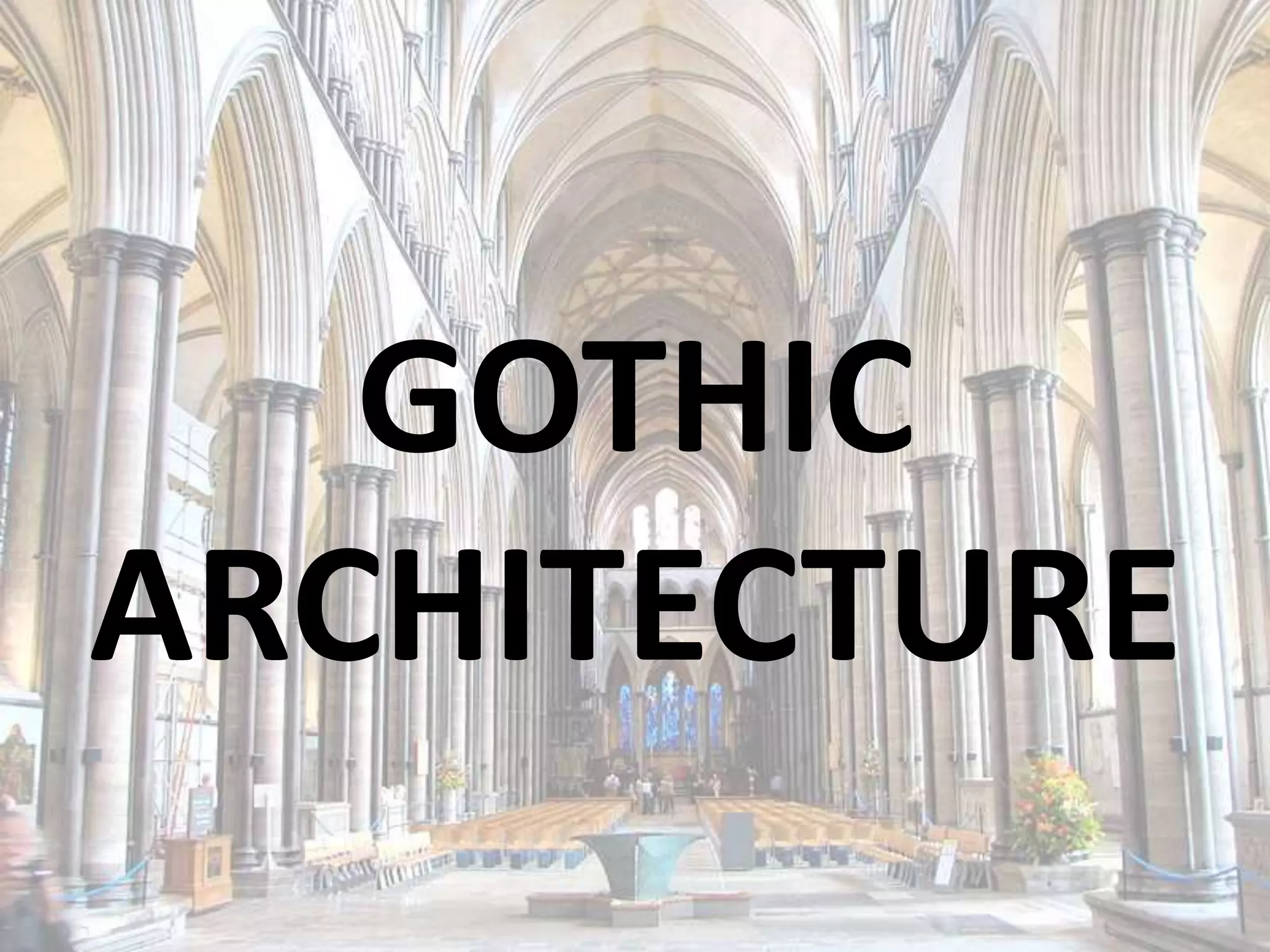
GOTHIC
ARCHITECTURE
Gothic architecture began mainly in France, where architects were
inspired by Romanesque architecture and the pointed arches of Spanish
Moorish architecture.
It's easy to recognise Gothic buildings because of their
arches, ribbed vaulting, flying buttresses, elaborate sculptures (like
gargoyles) and stained glass windows.
Gothic architecture was originally known as “French Style”. During the
period of Renaissance it fell out of fashion and it wasnot respected by many
artists. They marked it as “Gothic” to suggest it was the crude work of German
barbarians (Goths).
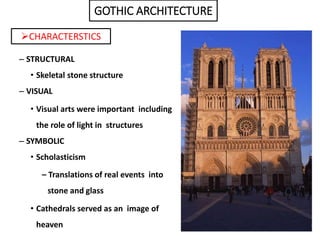
Examples of Gothic architecture: Notre Dame Cathedral in Paris and St.
Patrick's Cathedral in Dublin.
GOTHIC ARCHITECTURE
GOTHIC ARCHITECTURE
– STRUCTURAL
• Skeletal stone structure
– VISUAL
• Visual arts were important including
the role of light in structures
– SYMBOLIC
• Scholasticism
– Translations of real events into
stone and glass
• Cathedrals served as an image of
heaven
CHARACTERSTICS
GOTHIC ARCHITECTURE
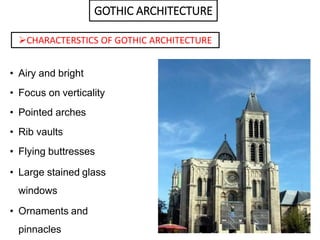
CHARACTERSTICS OF GOTHIC ARCHITECTURE
• Airy and bright
• Focus on verticality
• Pointed arches
• Rib vaults
• Flying buttresses
• Large stained glass
windows
• Ornaments and
pinnacles
GOTHIC ARCHITECTURE
POINTED ARCH
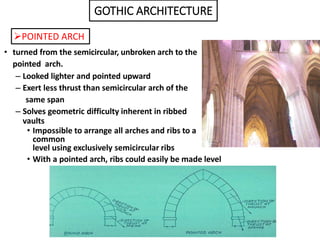
• turned from the semicircular, unbroken arch to the
pointed arch.
– Looked lighter and pointed upward
– Exert less thrust than semicircular arch of the
same span
– Solves geometric difficulty inherent in ribbed
vaults
• Impossible to arrange all arches and ribs to a
common
level using exclusively semicircular ribs
• With a pointed arch, ribs could easily be made level
GOTHIC ARCHITECTURE
RIB VAULTS
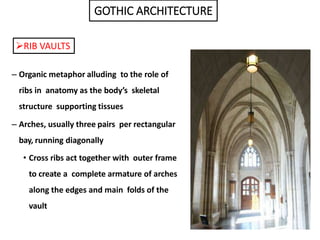
– Organic metaphor alluding to the role of
ribs in anatomy as the body’s skeletal
structure supporting tissues
– Arches, usually three pairs per rectangular
bay, running diagonally
• Cross ribs act together with outer frame
to create a complete armature of arches
along the edges and main folds of the
vault
GOTHIC ARCHITECTURE
RIBBED VAULTING
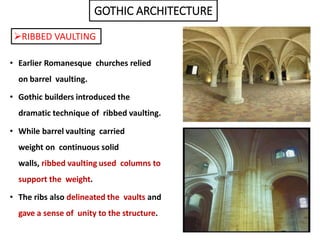
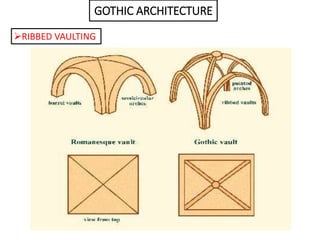
• Earlier Romanesque churches relied
on barrel vaulting.
• Gothic builders introduced the
dramatic technique of ribbed vaulting.
• While barrel vaulting carried
weight on continuous solid
walls, ribbed vaulting used columns to
support the weight.
• The ribs also delineated the vaults and
gave a sense of unity to the structure.
GOTHIC ARCHITECTURE
RIBBED VAULTING
GOTHIC ARCHITECTURE
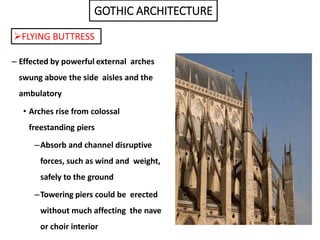
FLYING BUTTRESS
– Effected by powerful external arches
swung above the side aisles and the
ambulatory
• Arches rise from colossal
freestanding piers
–Absorb and channel disruptive
forces, such as wind and weight,
safely to the ground
–Towering piers could be erected
without much affecting the nave
or choir interior
GOTHIC ARCHITECTURE
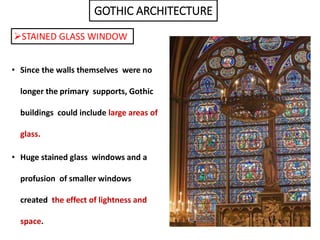
STAINED GLASS WINDOW
• Since the walls themselves were no
longer the primary supports, Gothic
buildings could include large areas of
glass.
• Huge stained glass windows and a
profusion of smaller windows
created the effect of lightness and
space.
GOTHIC ARCHITECTURE
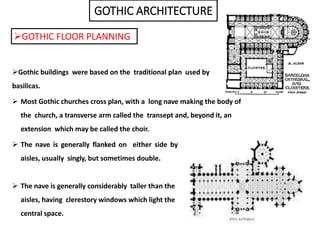
GOTHIC FLOOR PLANNING
Gothic buildings were based on the traditional plan used by
basilicas.
 Most Gothic churches cross plan, with a long nave making the body of
the church, a transverse arm called the transept and, beyond it, an
extension which may be called the choir.
 The nave is generally flanked on either side by
aisles, usually singly, but sometimes double.
 The nave is generally considerably taller than the
aisles, having clerestory windows which light the
central space.
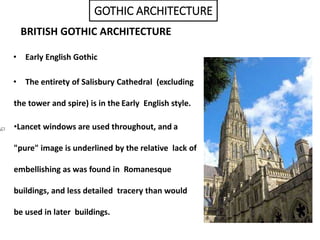
BRITISH GOTHIC ARCHITECTURE
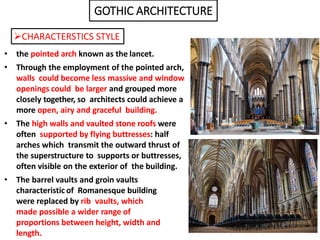
• Early English Gothic
• The entirety of Salisbury Cathedral (excluding
the tower and spire) is in the Early English style.
•Lancet windows are used throughout, and a
"pure" image is underlined by the relative lack of
embellishing as was found in Romanesque
buildings, and less detailed tracery than would
be used in later buildings.
GOTHIC ARCHITECTURE
• the pointed arch known as the lancet.
• Through the employment of the pointed arch,
walls could become less massive and window
openings could be larger and grouped more
closely together, so architects could achieve a
more open, airy and graceful building.
• The high walls and vaulted stone roofs were
often supported by flying buttresses: half
arches which transmit the outward thrust of
the superstructure to supports or buttresses,
often visible on the exterior of the building.
• The barrel vaults and groin vaults
characteristic of Romanesque building
were replaced by rib vaults, which
made possible a wider range of
proportions between height, width and
length.
GOTHIC ARCHITECTURE
CHARACTERSTICS STYLE
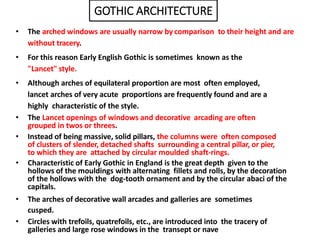
• The arched windows are usually narrow by comparison to their height and are
without tracery.
• For this reason Early English Gothic is sometimes known as the
"Lancet" style.
• Although arches of equilateral proportion are most often employed,
lancet arches of very acute proportions are frequently found and are a
highly characteristic of the style.
• The Lancet openings of windows and decorative arcading are often
grouped in twos or threes.
• Instead of being massive, solid pillars, the columns were often composed
of clusters of slender, detached shafts surrounding a central pillar, or pier,
to which they are attached by circular moulded shaft-rings.
• Characteristic of Early Gothic in England is the great depth given to the
hollows of the mouldings with alternating fillets and rolls, by the decoration
of the hollows with the dog-tooth ornament and by the circular abaci of the
capitals.
• The arches of decorative wall arcades and galleries are sometimes
cusped.
• Circles with trefoils, quatrefoils, etc., are introduced into the tracery of
galleries and large rose windows in the transept or nave
GOTHIC ARCHITECTURE
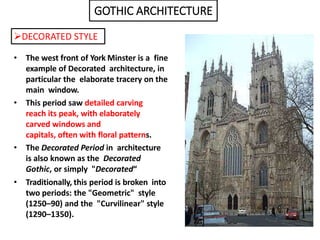
• The west front of York Minster is a fine
example of Decorated architecture, in
particular the elaborate tracery on the
main window.
• This period saw detailed carving
reach its peak, with elaborately
carved windows and
capitals, often with floral patterns.
• The Decorated Period in architecture
is also known as the Decorated
Gothic, or simply "Decorated“
• Traditionally, this period is broken into
two periods: the "Geometric" style
(1250–90) and the "Curvilinear" style
(1290–1350).
GOTHIC ARCHITECTURE
DECORATED STYLE
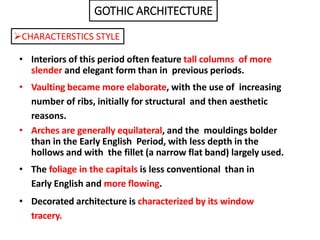
• Interiors of this period often feature tall columns of more
slender and elegant form than in previous periods.
• Vaulting became more elaborate, with the use of increasing
number of ribs, initially for structural and then aesthetic
reasons.
• Arches are generally equilateral, and the mouldings bolder
than in the Early English Period, with less depth in the
hollows and with the fillet (a narrow flat band) largely used.
• The foliage in the capitals is less conventional than in
Early English and more flowing.
• Decorated architecture is characterized by its window
tracery.
GOTHIC ARCHITECTURE
CHARACTERSTICS STYLE
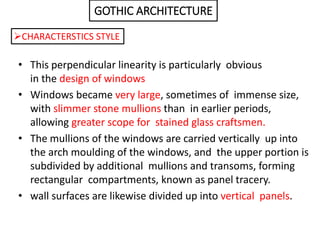
• The interior of Gloucester Cathedral conveys an
impression of a "cage" of stone and
glass, typical of Perpendicular architecture.
• Elaborate Decorated style tracery is no longer
in evidence, and the lines on both
walls and windows have become sharper and
less flamboyant.
• is so-called because it is characterised by an
emphasis on vertical lines; it is also known as
International Gothic, the Rectilinear style, or
Late Gothic.
GOTHIC ARCHITECTURE
PERPENDICULAR GOTHIC
• This perpendicular linearity is particularly obvious
in the design of windows
• Windows became very large, sometimes of immense size,
with slimmer stone mullions than in earlier periods,
allowing greater scope for stained glass craftsmen.
• The mullions of the windows are carried vertically up into
the arch moulding of the windows, and the upper portion is
subdivided by additional mullions and transoms, forming
rectangular compartments, known as panel tracery.
• wall surfaces are likewise divided up into vertical panels.
GOTHIC ARCHITECTURE
CHARACTERSTICS STYLE
• Doorways are frequently enclosed within a square head
over the arch mouldings, the spandrels being filled with
quatrefoils or tracery.
• Pointed arches were still used throughout the period, but ogee
and four-centred Tudor arches were also introduced.
• Inside the church the triforium disappears, or its
place is filled with
panelling, and greater importance is given to the clerestory
windows, which are often the finest features in the churches
of this period.
• The mouldings are flatter than those of the earlier periods
• Some of the finest features of this period are the magnificent
timber roofs
GOTHIC ARCHITECTURE
CHARACTERSTICS STYLE
Thank
you!!!..

Gothic

  • 1.
  • 2.
    Gothic architecture beganmainly in France, where architects were inspired by Romanesque architecture and the pointed arches of Spanish Moorish architecture. It's easy to recognise Gothic buildings because of their arches, ribbed vaulting, flying buttresses, elaborate sculptures (like gargoyles) and stained glass windows. Gothic architecture was originally known as “French Style”. During the period of Renaissance it fell out of fashion and it wasnot respected by many artists. They marked it as “Gothic” to suggest it was the crude work of German barbarians (Goths). Examples of Gothic architecture: Notre Dame Cathedral in Paris and St. Patrick's Cathedral in Dublin. GOTHIC ARCHITECTURE
  • 3.
    GOTHIC ARCHITECTURE – STRUCTURAL •Skeletal stone structure – VISUAL • Visual arts were important including the role of light in structures – SYMBOLIC • Scholasticism – Translations of real events into stone and glass • Cathedrals served as an image of heaven CHARACTERSTICS
  • 4.
    GOTHIC ARCHITECTURE CHARACTERSTICS OFGOTHIC ARCHITECTURE • Airy and bright • Focus on verticality • Pointed arches • Rib vaults • Flying buttresses • Large stained glass windows • Ornaments and pinnacles
  • 5.
    GOTHIC ARCHITECTURE POINTED ARCH •turned from the semicircular, unbroken arch to the pointed arch. – Looked lighter and pointed upward – Exert less thrust than semicircular arch of the same span – Solves geometric difficulty inherent in ribbed vaults • Impossible to arrange all arches and ribs to a common level using exclusively semicircular ribs • With a pointed arch, ribs could easily be made level
  • 6.
    GOTHIC ARCHITECTURE RIB VAULTS –Organic metaphor alluding to the role of ribs in anatomy as the body’s skeletal structure supporting tissues – Arches, usually three pairs per rectangular bay, running diagonally • Cross ribs act together with outer frame to create a complete armature of arches along the edges and main folds of the vault
  • 7.
    GOTHIC ARCHITECTURE RIBBED VAULTING •Earlier Romanesque churches relied on barrel vaulting. • Gothic builders introduced the dramatic technique of ribbed vaulting. • While barrel vaulting carried weight on continuous solid walls, ribbed vaulting used columns to support the weight. • The ribs also delineated the vaults and gave a sense of unity to the structure.
  • 8.
  • 9.
    GOTHIC ARCHITECTURE FLYING BUTTRESS –Effected by powerful external arches swung above the side aisles and the ambulatory • Arches rise from colossal freestanding piers –Absorb and channel disruptive forces, such as wind and weight, safely to the ground –Towering piers could be erected without much affecting the nave or choir interior
  • 10.
    GOTHIC ARCHITECTURE STAINED GLASSWINDOW • Since the walls themselves were no longer the primary supports, Gothic buildings could include large areas of glass. • Huge stained glass windows and a profusion of smaller windows created the effect of lightness and space.
  • 11.
    GOTHIC ARCHITECTURE GOTHIC FLOORPLANNING Gothic buildings were based on the traditional plan used by basilicas.  Most Gothic churches cross plan, with a long nave making the body of the church, a transverse arm called the transept and, beyond it, an extension which may be called the choir.  The nave is generally flanked on either side by aisles, usually singly, but sometimes double.  The nave is generally considerably taller than the aisles, having clerestory windows which light the central space.
  • 12.
    BRITISH GOTHIC ARCHITECTURE •Early English Gothic • The entirety of Salisbury Cathedral (excluding the tower and spire) is in the Early English style. •Lancet windows are used throughout, and a "pure" image is underlined by the relative lack of embellishing as was found in Romanesque buildings, and less detailed tracery than would be used in later buildings. GOTHIC ARCHITECTURE
  • 13.
    • the pointedarch known as the lancet. • Through the employment of the pointed arch, walls could become less massive and window openings could be larger and grouped more closely together, so architects could achieve a more open, airy and graceful building. • The high walls and vaulted stone roofs were often supported by flying buttresses: half arches which transmit the outward thrust of the superstructure to supports or buttresses, often visible on the exterior of the building. • The barrel vaults and groin vaults characteristic of Romanesque building were replaced by rib vaults, which made possible a wider range of proportions between height, width and length. GOTHIC ARCHITECTURE CHARACTERSTICS STYLE
  • 14.
    • The archedwindows are usually narrow by comparison to their height and are without tracery. • For this reason Early English Gothic is sometimes known as the "Lancet" style. • Although arches of equilateral proportion are most often employed, lancet arches of very acute proportions are frequently found and are a highly characteristic of the style. • The Lancet openings of windows and decorative arcading are often grouped in twos or threes. • Instead of being massive, solid pillars, the columns were often composed of clusters of slender, detached shafts surrounding a central pillar, or pier, to which they are attached by circular moulded shaft-rings. • Characteristic of Early Gothic in England is the great depth given to the hollows of the mouldings with alternating fillets and rolls, by the decoration of the hollows with the dog-tooth ornament and by the circular abaci of the capitals. • The arches of decorative wall arcades and galleries are sometimes cusped. • Circles with trefoils, quatrefoils, etc., are introduced into the tracery of galleries and large rose windows in the transept or nave GOTHIC ARCHITECTURE
  • 15.
    • The westfront of York Minster is a fine example of Decorated architecture, in particular the elaborate tracery on the main window. • This period saw detailed carving reach its peak, with elaborately carved windows and capitals, often with floral patterns. • The Decorated Period in architecture is also known as the Decorated Gothic, or simply "Decorated“ • Traditionally, this period is broken into two periods: the "Geometric" style (1250–90) and the "Curvilinear" style (1290–1350). GOTHIC ARCHITECTURE DECORATED STYLE
  • 16.
    • Interiors ofthis period often feature tall columns of more slender and elegant form than in previous periods. • Vaulting became more elaborate, with the use of increasing number of ribs, initially for structural and then aesthetic reasons. • Arches are generally equilateral, and the mouldings bolder than in the Early English Period, with less depth in the hollows and with the fillet (a narrow flat band) largely used. • The foliage in the capitals is less conventional than in Early English and more flowing. • Decorated architecture is characterized by its window tracery. GOTHIC ARCHITECTURE CHARACTERSTICS STYLE
  • 17.
    • The interiorof Gloucester Cathedral conveys an impression of a "cage" of stone and glass, typical of Perpendicular architecture. • Elaborate Decorated style tracery is no longer in evidence, and the lines on both walls and windows have become sharper and less flamboyant. • is so-called because it is characterised by an emphasis on vertical lines; it is also known as International Gothic, the Rectilinear style, or Late Gothic. GOTHIC ARCHITECTURE PERPENDICULAR GOTHIC
  • 18.
    • This perpendicularlinearity is particularly obvious in the design of windows • Windows became very large, sometimes of immense size, with slimmer stone mullions than in earlier periods, allowing greater scope for stained glass craftsmen. • The mullions of the windows are carried vertically up into the arch moulding of the windows, and the upper portion is subdivided by additional mullions and transoms, forming rectangular compartments, known as panel tracery. • wall surfaces are likewise divided up into vertical panels. GOTHIC ARCHITECTURE CHARACTERSTICS STYLE
  • 19.
    • Doorways arefrequently enclosed within a square head over the arch mouldings, the spandrels being filled with quatrefoils or tracery. • Pointed arches were still used throughout the period, but ogee and four-centred Tudor arches were also introduced. • Inside the church the triforium disappears, or its place is filled with panelling, and greater importance is given to the clerestory windows, which are often the finest features in the churches of this period. • The mouldings are flatter than those of the earlier periods • Some of the finest features of this period are the magnificent timber roofs GOTHIC ARCHITECTURE CHARACTERSTICS STYLE
  • 20.