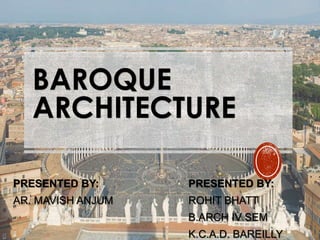
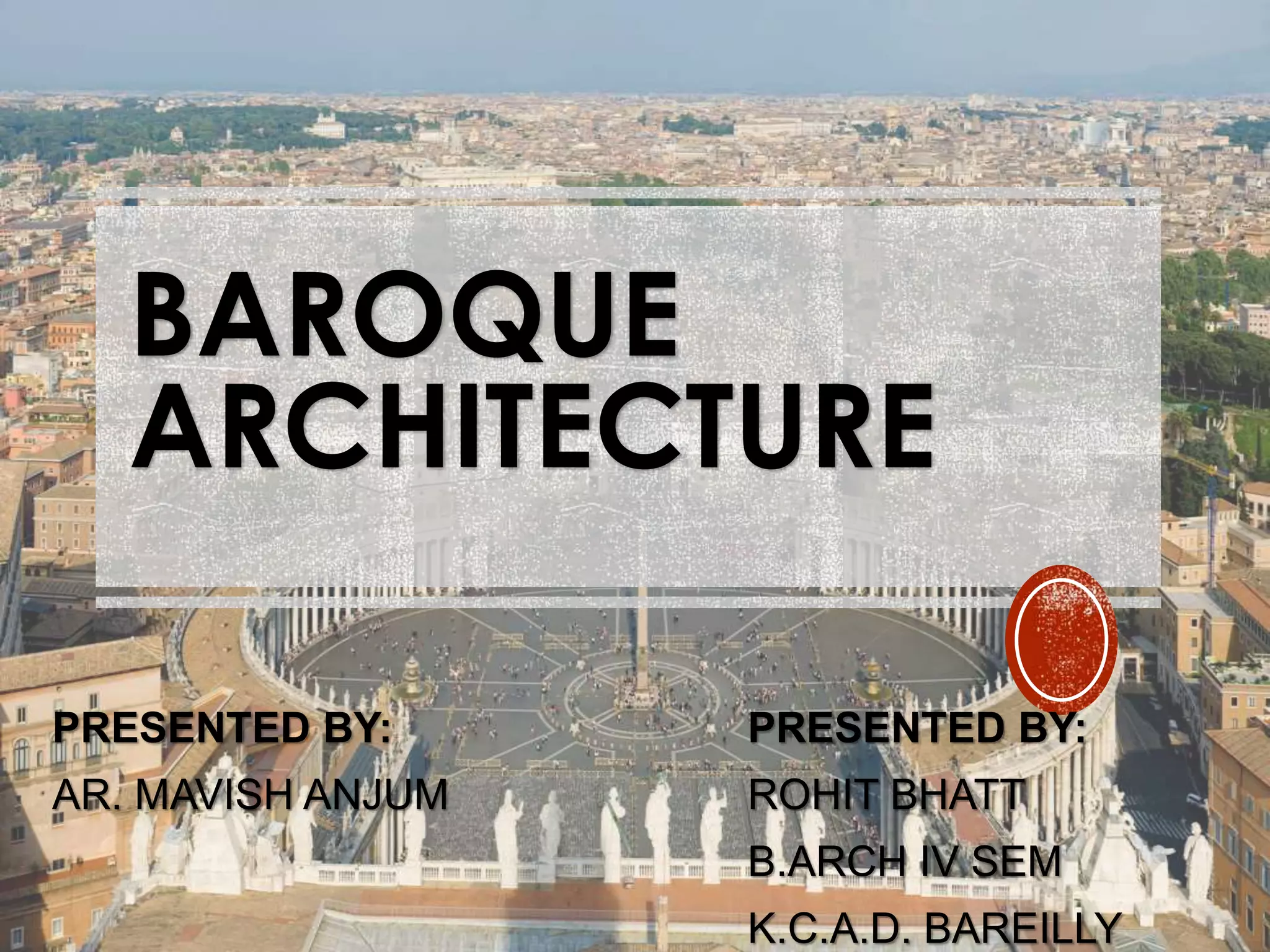
BAROQUE
ARCHITECTURE
PRESENTED BY:
ROHIT BHATT
B.ARCH IV SEM
K.C.A.D. BAREILLY
PRESENTED BY:
AR. MAVISH ANJUM
 The building style of the Baroque era, begun in late 16th-
century Italy, that took the Roman vocabulary of Renaissance
architecture and used it in a new theatrical fashion, often to
express the triumph of the Catholic Church and the absolutist
state.
 It was characterized by new explorations of form, light and
shadow, and dramatic intensity.
 In Spain the term 'Baroque' originally denoted an irregular,
oddly-shaped pearl, whereas in Italy it meant a pedantic,
contorted argument of little dialectic value.
 Instead of straight lines of classicism, curved and broken line
appeared.
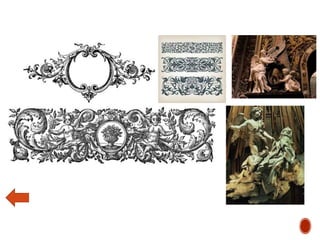
 Decoration became more important and elaborate, and shapes
became more complex.
 As the 16th century unfolded, the religious, political and philosophical
certainties which had prevailed during the Early (c.1400-85) and High
(1486-1520) Renaissance periods, began to unravel.
 In 1517, Martin Luther sparked the Protestant Reformation, casting
European-wide doubt on the integrity and theology of the Roman
Church. This was the catalyst for several wars involving France, Italy,
Spain and England, and led directly to the Counter-Reformation
movement, launched by Rome, to attract the masses away from
Protestantism.
 For the rest of the century, this more dynamic style was known as
Mannerism (style-ishness), and thereafter, Baroque - a term derived
from the Portugese word barocco, meaning 'an irregular pearl'.
 Baroque architecture and its embellishments were on the one
hand more accessible to the emotions and on the other hand, a
visible statement of the wealth and power of the Church.
 The new style manifested itself in particular in the context of the
new religious orders, like the Theatines and the Jesuits who
aimed to improve popular piety.
 A synthesis of Bernini, Borromini and Cortona’s architecture can
be seen in the late Baroque architecture of northern Europe
which paved the way for the more decorative Rococo style.
 In general, Baroque architecture constituted part of the struggle
for religious superiority and for the hearts and minds of
worshippers across Europe.
 Michelangelo's late Roman buildings, particularly St. Peter's
Basilica, may be considered precursors to Baroque
architecture.
 His pupil Giacomo della Porta continued this work in Rome,
particularly in the façade of the Jesuit church Il Gesù, which
leads directly to the most important church façade of the early
Baroque, Santa Susanna (1603), by Carlo Maderno.
 Its facade is "the first truly baroque façade", introducing the
baroque style into architecture.
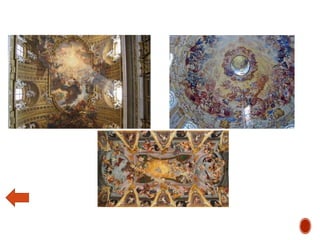
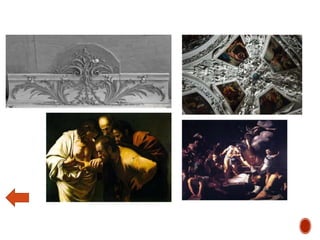
 Baroque paintings are brilliant, colourful, theatrical and
passionate.
 They are fascinated with light, they have used light and colour
to dissolve form, by having dark background.
 Portrayed emotional intensity- facial expressions and dramatic
movements.
 The skills of reproducing reallistic effects in all media were
developed, e.g.- marble, oil on canvas, etching etc.
 Boroque mingled what was real with what was only apparent-
created a feeling of illusion.
EARLY BAROQUE
HIGH BAROQUE
LATE BAROQUE
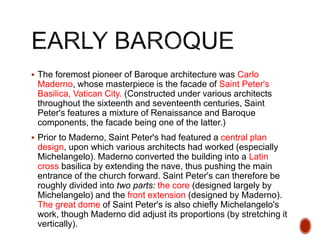
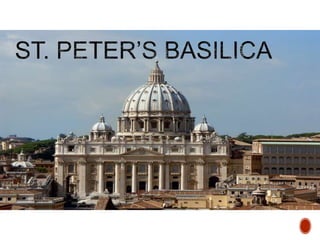
 The foremost pioneer of Baroque architecture was Carlo
Maderno, whose masterpiece is the facade of Saint Peter's
Basilica, Vatican City. (Constructed under various architects
throughout the sixteenth and seventeenth centuries, Saint
Peter's features a mixture of Renaissance and Baroque
components, the facade being one of the latter.)
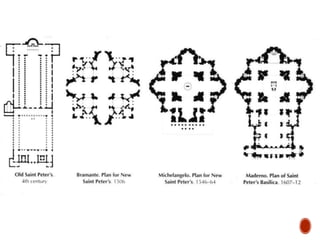
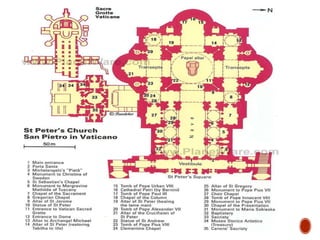
 Prior to Maderno, Saint Peter's had featured a central plan
design, upon which various architects had worked (especially
Michelangelo). Maderno converted the building into a Latin
cross basilica by extending the nave, thus pushing the main
entrance of the church forward. Saint Peter's can therefore be
roughly divided into two parts: the core (designed largely by
Michelangelo) and the front extension (designed by Maderno).
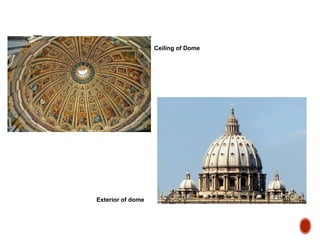
The great dome of Saint Peter's is also chiefly Michelangelo's
work, though Maderno did adjust its proportions (by stretching it
vertically).
Ceiling of Dome
Exterior of dome
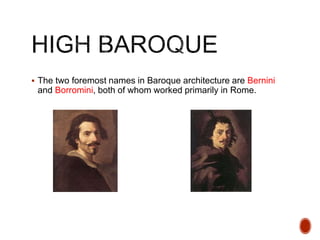
 The two foremost names in Baroque architecture are Bernini
and Borromini, both of whom worked primarily in Rome.
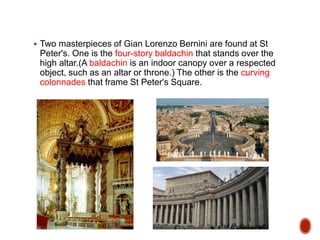
 Two masterpieces of Gian Lorenzo Bernini are found at St
Peter's. One is the four-story baldachin that stands over the
high altar.(A baldachin is an indoor canopy over a respected
object, such as an altar or throne.) The other is the curving
colonnades that frame St Peter's Square.
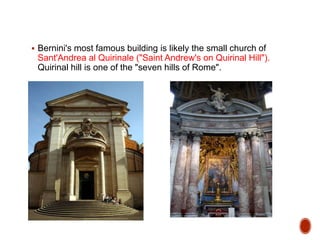
 Bernini's most famous building is likely the small church of
Sant'Andrea al Quirinale ("Saint Andrew's on Quirinal Hill").
Quirinal hill is one of the "seven hills of Rome".
 Bernini's most famous
building is likely the small
church of Sant'Andrea al
Quirinale ("Saint Andrew's
on Quirinal Hill"). Quirinal
hill is one of the "seven hills
of Rome".
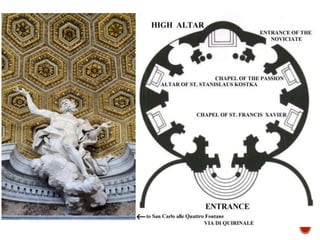
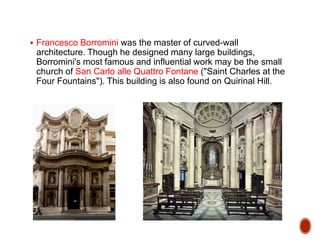
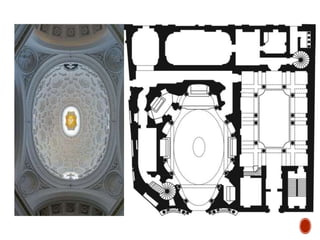
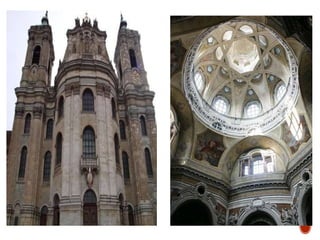
 Francesco Borromini was the master of curved-wall
architecture. Though he designed many large buildings,
Borromini's most famous and influential work may be the small
church of San Carlo alle Quattro Fontane ("Saint Charles at the
Four Fountains"). This building is also found on Quirinal Hill.
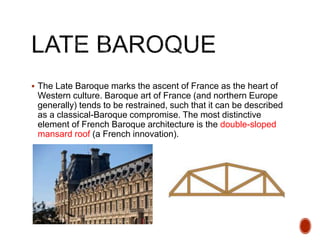
 The Late Baroque marks the ascent of France as the heart of
Western culture. Baroque art of France (and northern Europe
generally) tends to be restrained, such that it can be described
as a classical-Baroque compromise. The most distinctive
element of French Baroque architecture is the double-sloped
mansard roof (a French innovation).
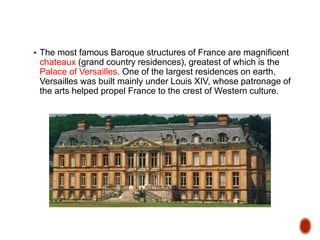
 The most famous Baroque structures of France are magnificent
chateaux (grand country residences), greatest of which is the
Palace of Versailles. One of the largest residences on earth,
Versailles was built mainly under Louis XIV, whose patronage of
the arts helped propel France to the crest of Western culture.
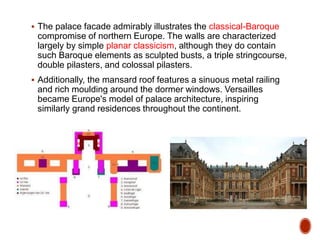
 The palace facade admirably illustrates the classical-Baroque
compromise of northern Europe. The walls are characterized
largely by simple planar classicism, although they do contain
such Baroque elements as sculpted busts, a triple stringcourse,
double pilasters, and colossal pilasters.
 Additionally, the mansard roof features a sinuous metal railing
and rich moulding around the dormer windows. Versailles
became Europe's model of palace architecture, inspiring
similarly grand residences throughout the continent.
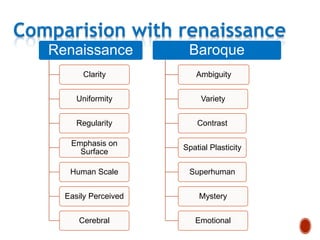
Renaissance
Clarity
Uniformity
Regularity
Emphasis on
Surface
Human Scale
Easily Perceived
Cerebral
Baroque
Ambiguity
Variety
Contrast
Spatial Plasticity
Superhuman
Mystery
Emotional
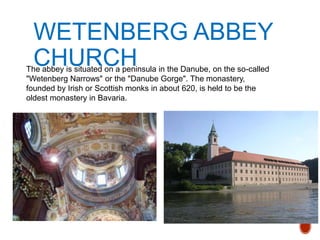
WETENBERG ABBEY
CHURCHThe abbey is situated on a peninsula in the Danube, on the so-called
"Wetenberg Narrows" or the "Danube Gorge". The monastery,
founded by Irish or Scottish monks in about 620, is held to be the
oldest monastery in Bavaria.
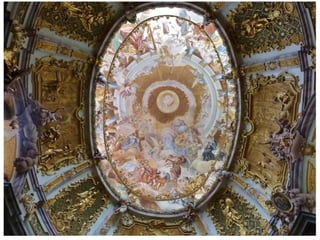
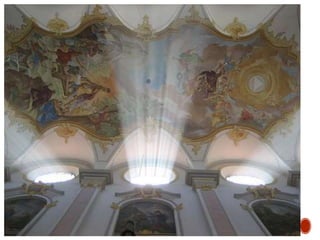
 In this church they use the lighting effects which
called chiaroscuro.
 Chiaroscuro is a type of lighting effects, which
means dark and light effects.
 Chiaroscuro literally means clear-obscure or light-
dark. It refers to the use of strong contrast or
unusual lighting to create a strong dramatic effect in
art.
 Chiaroscuro is of Latin origin with Chiaro meaning
‘light’ or ‘clear’ & ‘oscuro’ meaning ‘obscure’ or
‘dark.’
LIGHTING
WEINGAR
TEN
ABBEY
CHURCH
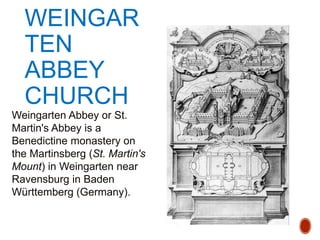
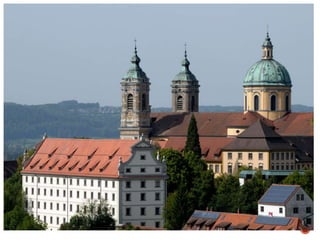
Weingarten Abbey or St.
Martin's Abbey is a
Benedictine monastery on
the Martinsberg (St. Martin's
Mount) in Weingarten near
Ravensburg in Baden
Württemberg (Germany).
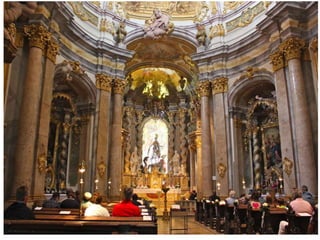
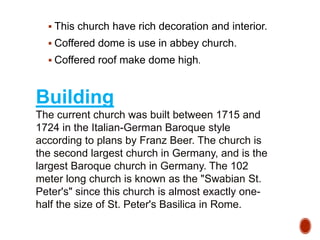
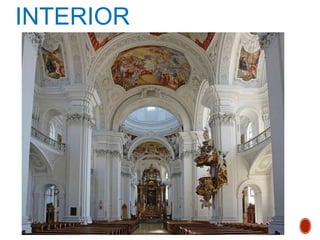
 This church have rich decoration and interior.
 Coffered dome is use in abbey church.
 Coffered roof make dome high.
Building
The current church was built between 1715 and
1724 in the Italian-German Baroque style
according to plans by Franz Beer. The church is
the second largest church in Germany, and is the
largest Baroque church in Germany. The 102
meter long church is known as the "Swabian St.
Peter's" since this church is almost exactly one-
half the size of St. Peter's Basilica in Rome.
INTERIOR
Baroque Architecture

Baroque Architecture

  • 1.
    BAROQUE ARCHITECTURE PRESENTED BY: ROHIT BHATT B.ARCHIV SEM K.C.A.D. BAREILLY PRESENTED BY: AR. MAVISH ANJUM
  • 2.
     The buildingstyle of the Baroque era, begun in late 16th- century Italy, that took the Roman vocabulary of Renaissance architecture and used it in a new theatrical fashion, often to express the triumph of the Catholic Church and the absolutist state.  It was characterized by new explorations of form, light and shadow, and dramatic intensity.  In Spain the term 'Baroque' originally denoted an irregular, oddly-shaped pearl, whereas in Italy it meant a pedantic, contorted argument of little dialectic value.  Instead of straight lines of classicism, curved and broken line appeared.  Decoration became more important and elaborate, and shapes became more complex.
  • 3.
     As the16th century unfolded, the religious, political and philosophical certainties which had prevailed during the Early (c.1400-85) and High (1486-1520) Renaissance periods, began to unravel.  In 1517, Martin Luther sparked the Protestant Reformation, casting European-wide doubt on the integrity and theology of the Roman Church. This was the catalyst for several wars involving France, Italy, Spain and England, and led directly to the Counter-Reformation movement, launched by Rome, to attract the masses away from Protestantism.  For the rest of the century, this more dynamic style was known as Mannerism (style-ishness), and thereafter, Baroque - a term derived from the Portugese word barocco, meaning 'an irregular pearl'.
  • 4.
     Baroque architectureand its embellishments were on the one hand more accessible to the emotions and on the other hand, a visible statement of the wealth and power of the Church.  The new style manifested itself in particular in the context of the new religious orders, like the Theatines and the Jesuits who aimed to improve popular piety.  A synthesis of Bernini, Borromini and Cortona’s architecture can be seen in the late Baroque architecture of northern Europe which paved the way for the more decorative Rococo style.  In general, Baroque architecture constituted part of the struggle for religious superiority and for the hearts and minds of worshippers across Europe.
  • 5.
     Michelangelo's lateRoman buildings, particularly St. Peter's Basilica, may be considered precursors to Baroque architecture.  His pupil Giacomo della Porta continued this work in Rome, particularly in the façade of the Jesuit church Il Gesù, which leads directly to the most important church façade of the early Baroque, Santa Susanna (1603), by Carlo Maderno.  Its facade is "the first truly baroque façade", introducing the baroque style into architecture.
  • 6.
     Baroque paintingsare brilliant, colourful, theatrical and passionate.  They are fascinated with light, they have used light and colour to dissolve form, by having dark background.  Portrayed emotional intensity- facial expressions and dramatic movements.  The skills of reproducing reallistic effects in all media were developed, e.g.- marble, oil on canvas, etching etc.  Boroque mingled what was real with what was only apparent- created a feeling of illusion.
  • 7.
  • 8.
     The foremostpioneer of Baroque architecture was Carlo Maderno, whose masterpiece is the facade of Saint Peter's Basilica, Vatican City. (Constructed under various architects throughout the sixteenth and seventeenth centuries, Saint Peter's features a mixture of Renaissance and Baroque components, the facade being one of the latter.)  Prior to Maderno, Saint Peter's had featured a central plan design, upon which various architects had worked (especially Michelangelo). Maderno converted the building into a Latin cross basilica by extending the nave, thus pushing the main entrance of the church forward. Saint Peter's can therefore be roughly divided into two parts: the core (designed largely by Michelangelo) and the front extension (designed by Maderno). The great dome of Saint Peter's is also chiefly Michelangelo's work, though Maderno did adjust its proportions (by stretching it vertically).
  • 13.
  • 14.
     The twoforemost names in Baroque architecture are Bernini and Borromini, both of whom worked primarily in Rome.
  • 15.
     Two masterpiecesof Gian Lorenzo Bernini are found at St Peter's. One is the four-story baldachin that stands over the high altar.(A baldachin is an indoor canopy over a respected object, such as an altar or throne.) The other is the curving colonnades that frame St Peter's Square.
  • 16.
     Bernini's mostfamous building is likely the small church of Sant'Andrea al Quirinale ("Saint Andrew's on Quirinal Hill"). Quirinal hill is one of the "seven hills of Rome".
  • 17.
     Bernini's mostfamous building is likely the small church of Sant'Andrea al Quirinale ("Saint Andrew's on Quirinal Hill"). Quirinal hill is one of the "seven hills of Rome".
  • 18.
     Francesco Borrominiwas the master of curved-wall architecture. Though he designed many large buildings, Borromini's most famous and influential work may be the small church of San Carlo alle Quattro Fontane ("Saint Charles at the Four Fountains"). This building is also found on Quirinal Hill.
  • 20.
     The LateBaroque marks the ascent of France as the heart of Western culture. Baroque art of France (and northern Europe generally) tends to be restrained, such that it can be described as a classical-Baroque compromise. The most distinctive element of French Baroque architecture is the double-sloped mansard roof (a French innovation).
  • 21.
     The mostfamous Baroque structures of France are magnificent chateaux (grand country residences), greatest of which is the Palace of Versailles. One of the largest residences on earth, Versailles was built mainly under Louis XIV, whose patronage of the arts helped propel France to the crest of Western culture.
  • 22.
     The palacefacade admirably illustrates the classical-Baroque compromise of northern Europe. The walls are characterized largely by simple planar classicism, although they do contain such Baroque elements as sculpted busts, a triple stringcourse, double pilasters, and colossal pilasters.  Additionally, the mansard roof features a sinuous metal railing and rich moulding around the dormer windows. Versailles became Europe's model of palace architecture, inspiring similarly grand residences throughout the continent.
  • 23.
    Renaissance Clarity Uniformity Regularity Emphasis on Surface Human Scale EasilyPerceived Cerebral Baroque Ambiguity Variety Contrast Spatial Plasticity Superhuman Mystery Emotional
  • 25.
    WETENBERG ABBEY CHURCHThe abbeyis situated on a peninsula in the Danube, on the so-called "Wetenberg Narrows" or the "Danube Gorge". The monastery, founded by Irish or Scottish monks in about 620, is held to be the oldest monastery in Bavaria.
  • 27.
     In thischurch they use the lighting effects which called chiaroscuro.  Chiaroscuro is a type of lighting effects, which means dark and light effects.  Chiaroscuro literally means clear-obscure or light- dark. It refers to the use of strong contrast or unusual lighting to create a strong dramatic effect in art.  Chiaroscuro is of Latin origin with Chiaro meaning ‘light’ or ‘clear’ & ‘oscuro’ meaning ‘obscure’ or ‘dark.’
  • 30.
  • 31.
    WEINGAR TEN ABBEY CHURCH Weingarten Abbey orSt. Martin's Abbey is a Benedictine monastery on the Martinsberg (St. Martin's Mount) in Weingarten near Ravensburg in Baden Württemberg (Germany).
  • 32.
     This churchhave rich decoration and interior.  Coffered dome is use in abbey church.  Coffered roof make dome high. Building The current church was built between 1715 and 1724 in the Italian-German Baroque style according to plans by Franz Beer. The church is the second largest church in Germany, and is the largest Baroque church in Germany. The 102 meter long church is known as the "Swabian St. Peter's" since this church is almost exactly one- half the size of St. Peter's Basilica in Rome.
  • 34.