
Dr. Binumol Tom
                          Professor,
        Department of Architecture,
College of Engineering, Trivandrum
Historic context
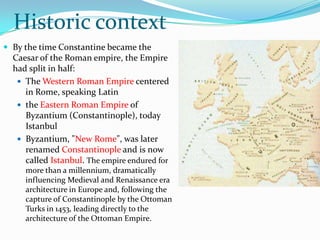
 By the time Constantine became the
  Caesar of the Roman empire, the Empire
  had split in half:
    The Western Roman Empire centered
     in Rome, speaking Latin
    the Eastern Roman Empire of
     Byzantium (Constantinople), today
     Istanbul
    Byzantium, "New Rome", was later
     renamed Constantinople and is now
     called Istanbul. The empire endured for
     more than a millennium, dramatically
     influencing Medieval and Renaissance era
     architecture in Europe and, following the
     capture of Constantinople by the Ottoman
     Turks in 1453, leading directly to the
     architecture of the Ottoman Empire.
Historic context
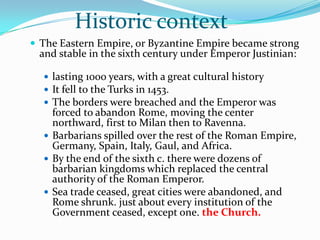
 The Eastern Empire, or Byzantine Empire became strong
 and stable in the sixth century under Emperor Justinian:

   lasting 1000 years, with a great cultural history
   It fell to the Turks in 1453.
   The borders were breached and the Emperor was
    forced to abandon Rome, moving the center
    northward, first to Milan then to Ravenna.
   Barbarians spilled over the rest of the Roman Empire,
    Germany, Spain, Italy, Gaul, and Africa.
   By the end of the sixth c. there were dozens of
    barbarian kingdoms which replaced the central
    authority of the Roman Emperor.
   Sea trade ceased, great cities were abandoned, and
    Rome shrunk. just about every institution of the
    Government ceased, except one. the Church.
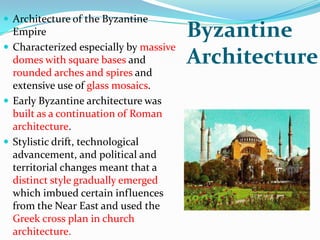
 Architecture of the Byzantine
  Empire                                Byzantine
 Characterized especially by massive
  domes with square bases and           Architecture
  rounded arches and spires and
  extensive use of glass mosaics.
 Early Byzantine architecture was
  built as a continuation of Roman
  architecture.
 Stylistic drift, technological
  advancement, and political and
  territorial changes meant that a
  distinct style gradually emerged
  which imbued certain influences
  from the Near East and used the
  Greek cross plan in church
  architecture.
Byzantine architecture
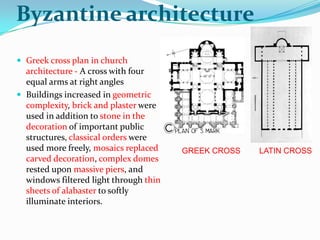
 Greek cross plan in church
  architecture - A cross with four
  equal arms at right angles
 Buildings increased in geometric
  complexity, brick and plaster were
  used in addition to stone in the
  decoration of important public
  structures, classical orders were
  used more freely, mosaics replaced    GREEK CROSS   LATIN CROSS
  carved decoration, complex domes
  rested upon massive piers, and
  windows filtered light through thin
  sheets of alabaster to softly
  illuminate interiors.
Greek Cross
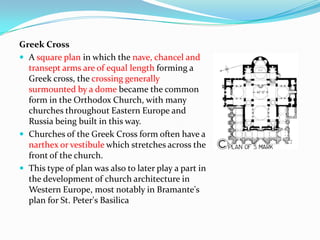
 A square plan in which the nave, chancel and
  transept arms are of equal length forming a
  Greek cross, the crossing generally
  surmounted by a dome became the common
  form in the Orthodox Church, with many
  churches throughout Eastern Europe and
  Russia being built in this way.
 Churches of the Greek Cross form often have a
  narthex or vestibule which stretches across the
  front of the church.
 This type of plan was also to later play a part in
  the development of church architecture in
  Western Europe, most notably in Bramante's
  plan for St. Peter's Basilica
Greek and Latin Cross Plans


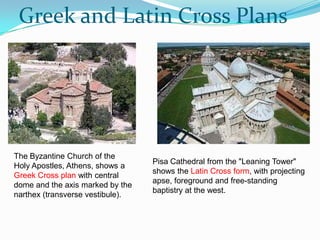
The Byzantine Church of the
                                  Pisa Cathedral from the "Leaning Tower"
Holy Apostles, Athens, shows a
                                  shows the Latin Cross form, with projecting
Greek Cross plan with central
                                  apse, foreground and free-standing
dome and the axis marked by the
                                  baptistry at the west.
narthex (transverse vestibule).
Byzantine Dome construction
         The most distinctive feature was the domed roof.
         The dome, which had always been a traditional
          feature in the East, became the prevailing motif of
          Byzantine architecture, which was a fusion of the
          domical construction with the Classical columnar
          style.
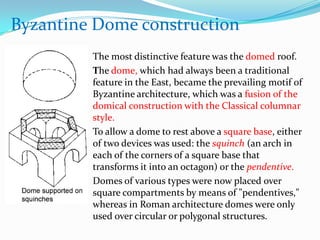
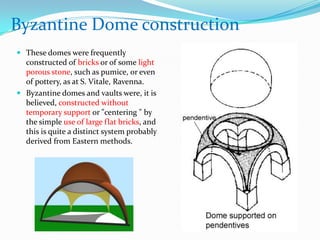
         To allow a dome to rest above a square base, either
          of two devices was used: the squinch (an arch in
          each of the corners of a square base that
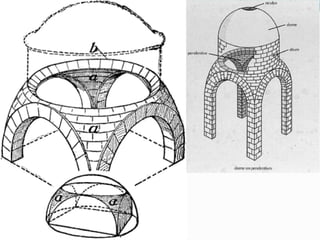
          transforms it into an octagon) or the pendentive.
         Domes of various types were now placed over
          square compartments by means of "pendentives,"
          whereas in Roman architecture domes were only
          used over circular or polygonal structures.
Byzantine Dome construction
 These domes were frequently
  constructed of bricks or of some light
  porous stone, such as pumice, or even
  of pottery, as at S. Vitale, Ravenna.
 Byzantine domes and vaults were, it is
  believed, constructed without
  temporary support or "centering " by
  the simple use of large flat bricks, and
  this is quite a distinct system probably
  derived from Eastern methods.
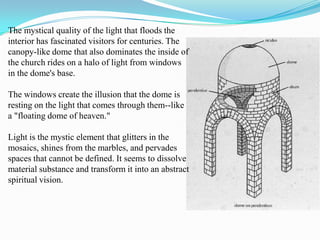
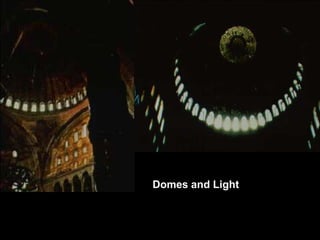
The mystical quality of the light that floods the
interior has fascinated visitors for centuries. The
canopy-like dome that also dominates the inside of
the church rides on a halo of light from windows
in the dome's base.

The windows create the illusion that the dome is
resting on the light that comes through them--like
a "floating dome of heaven."

Light is the mystic element that glitters in the
mosaics, shines from the marbles, and pervades
spaces that cannot be defined. It seems to dissolve
material substance and transform it into an abstract
spiritual vision.
Byzantine Dome construction
 Windows were formed in the lower
  portion of the dome which, in the
  later period, was hoisted upon a
  high "drum" - a feature which was
  still further embellished in the
  Renaissance period by the addition
  of an external peristyle.
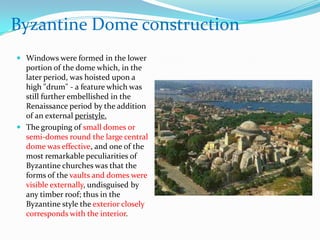
 The grouping of small domes or
  semi-domes round the large central
  dome was effective, and one of the
  most remarkable peculiarities of
  Byzantine churches was that the
  forms of the vaults and domes were
  visible externally, undisguised by
  any timber roof; thus in the
  Byzantine style the exterior closely
  corresponds with the interior.
Materials used in construction
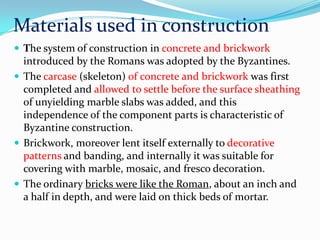
 The system of construction in concrete and brickwork
  introduced by the Romans was adopted by the Byzantines.
 The carcase (skeleton) of concrete and brickwork was first
  completed and allowed to settle before the surface sheathing
  of unyielding marble slabs was added, and this
  independence of the component parts is characteristic of
  Byzantine construction.
 Brickwork, moreover lent itself externally to decorative
  patterns and banding, and internally it was suitable for
  covering with marble, mosaic, and fresco decoration.
 The ordinary bricks were like the Roman, about an inch and
  a half in depth, and were laid on thick beds of mortar.
Materials used in construction
 brickwork necessitated special care in making
  mortar, which was composed of lime and sand with
  crushed pottery, tiles, or bricks, and much of it
  remains as hard as that in the best buildings of Rome,
  while the core of the wall was sometimes of concrete,
  as in the Roman period.
 The decorative character of external facades
  depended largely on the arrangement of the facing
  bricks, which were not always laid horizontally, but
  sometimes obliquely, sometimes in the form of the
  meander fret, sometimes in the chevron or
  herringbone pattern, and in many other similar
  designs, giving great variety to the facades.
 An attempt was also made to ornament the rough
  brick exteriors by the use of stone bands and
  decorative arches.
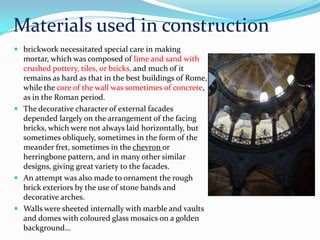
 Walls were sheeted internally with marble and vaults
  and domes with coloured glass mosaics on a golden
  background...
Features of Byzantine Architecture
Greek Roman and Oriental
  elements in architecture and its
  decoration
 Greco- Roman
  Columns, arches, vaults, domes
  over square bases
 Oriental (Eastern)
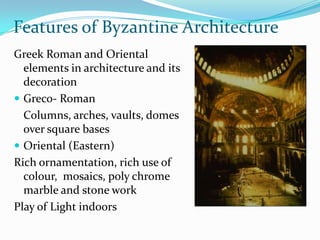
Rich ornamentation, rich use of
  colour, mosaics, poly chrome
  marble and stone work
Play of Light indoors
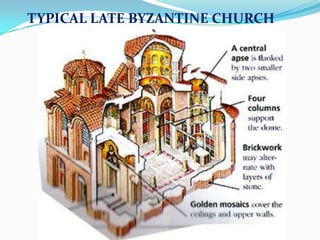
TYPICAL LATE BYZANTINE CHURCH
Hagia Sophia
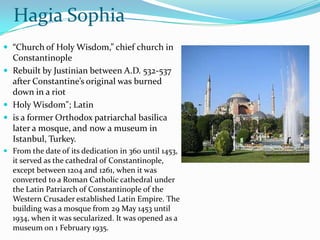
 “Church of Holy Wisdom,” chief church in
  Constantinople
 Rebuilt by Justinian between A.D. 532-537
  after Constantine’s original was burned
  down in a riot
 Holy Wisdom"; Latin
 is a former Orthodox patriarchal basilica
  later a mosque, and now a museum in
  Istanbul, Turkey.
 From the date of its dedication in 360 until 1453,
  it served as the cathedral of Constantinople,
  except between 1204 and 1261, when it was
  converted to a Roman Catholic cathedral under
  the Latin Patriarch of Constantinople of the
  Western Crusader established Latin Empire. The
  building was a mosque from 29 May 1453 until
  1934, when it was secularized. It was opened as a
  museum on 1 February 1935.
Hagia Sophia
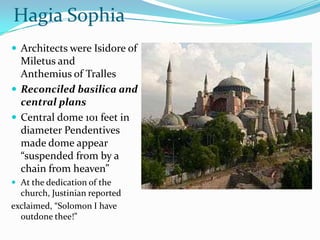
 Architects were Isidore of
  Miletus and
  Anthemius of Tralles
 Reconciled basilica and
  central plans
 Central dome 101 feet in
  diameter Pendentives
  made dome appear
  “suspended from by a
  chain from heaven”
 At the dedication of the
  church, Justinian reported
exclaimed, “Solomon I have
  outdone thee!”
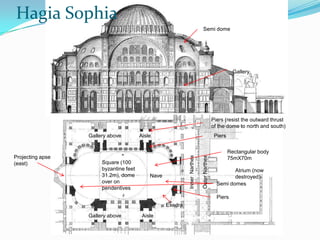
Hagia Sophia
                                                                            Semi dome


                                                                                                       Gallery


                                                                                            Piers (resist the outward thrust
                                                                                            of the dome to north and south)
                  Gallery above         Aisle                                                Piers

                                                                                                     Rectangular body
Projecting apse


                                                            Inner Narthex

                                                                            Outer Narthex
                                                                                                     75mX70m
(east)                 Square (100
                       byzantine feet                                                                Atrium (now
                       31.2m), dome         Nave                                                     destroyed)
                       over on                                                                Semi domes
                       pendentives
                                                                                              Piers
                                                   Exedra

                  Gallery above          Aisle
Style of Hagia Sophia (Church of Divine Wisdom)

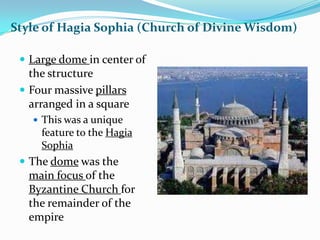
  Large dome in center of
   the structure
  Four massive pillars
   arranged in a square
    This was a unique
     feature to the Hagia
     Sophia
  The dome was the
  main focus of the
  Byzantine Church for
  the remainder of the
  empire
FROM CLASSICAL MATERIALISM TO CHRISTIAN
TRANSCENDENTALISM.
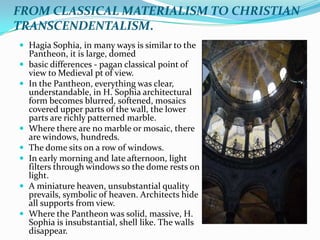
 Hagia Sophia, in many ways is similar to the
    Pantheon, it is large, domed
   basic differences - pagan classical point of
    view to Medieval pt of view.
   In the Pantheon, everything was clear,
    understandable, in H. Sophia architectural
    form becomes blurred, softened, mosaics
    covered upper parts of the wall, the lower
    parts are richly patterned marble.
   Where there are no marble or mosaic, there
    are windows, hundreds.
   The dome sits on a row of windows.
   In early morning and late afternoon, light
    filters through windows so the dome rests on
    light.
   A miniature heaven, unsubstantial quality
    prevails, symbolic of heaven. Architects hide
    all supports from view.
   Where the Pantheon was solid, massive, H.
    Sophia is insubstantial, shell like. The walls
    disappear.
Domes and Light
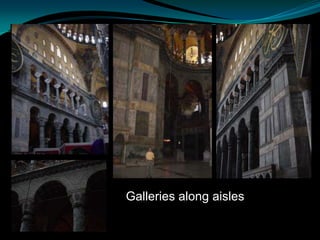
Galleries along aisles
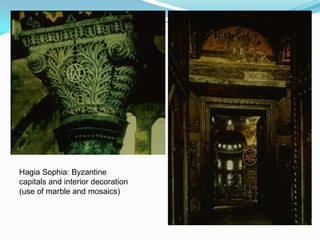
Hagia Sophia: Byzantine
capitals and interior decoration
(use of marble and mosaics)
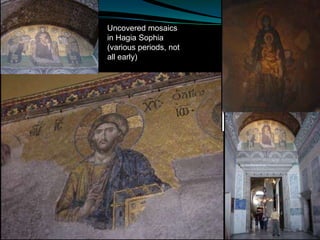
Uncovered mosaics
in Hagia Sophia
(various periods, not
all early)
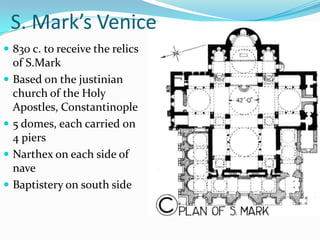
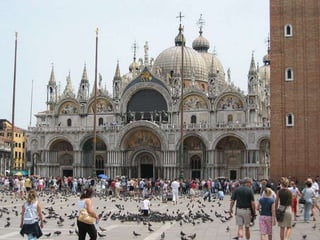
S. Mark’s Venice
 830 c. to receive the relics
  of S.Mark
 Based on the justinian
  church of the Holy
  Apostles, Constantinople
 5 domes, each carried on
  4 piers
 Narthex on each side of
  nave
 Baptistery on south side
How to recognize a Byzantine Church?
 Ground plan could be basilican, cruciform, circular or
  polygonal
 Main entrance from the west
 Altar at the eastern end of the church
 Principal building material was brick, arranged in
  decorative patterns or covered in plaster
 Roofs were either tiled or covered by sheets of lead
 Brilliant mosaic work in the interiors (most
  recognizable feature)
 Exterior – rather plain, with austere entrances flanked
  by blind arcades
 Domes supported on pendentives
How to recognize a Byzantine Church?
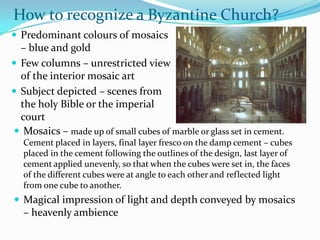
 Predominant colours of mosaics
  – blue and gold
 Few columns – unrestricted view
  of the interior mosaic art
 Subject depicted – scenes from
  the holy Bible or the imperial
  court
 Mosaics – made up of small cubes of marble or glass set in cement.
   Cement placed in layers, final layer fresco on the damp cement – cubes
   placed in the cement following the outlines of the design, last layer of
   cement applied unevenly, so that when the cubes were set in, the faces
   of the different cubes were at angle to each other and reflected light
   from one cube to another.
 Magical impression of light and depth conveyed by mosaics
   – heavenly ambience
How to recognize a Byzantine Church?

  Columns and capitals – classical prototypes
  Carvings of the capitals – deeply incised lines
   and drilled holes- strong black and white effect
  Dome – structural feature (over a square opening –
   important consequence in Renaissance Architecture )
  No human figures in Byzantine decoration
  Decorative features – scrolls, circles and other geometric
   forms or by depicting leaves and flowers
  Wind blown acanthus leaves were a popular
   subject
Thank you

Byzantine architecture

  • 1.
    Dr. Binumol Tom Professor, Department of Architecture, College of Engineering, Trivandrum
  • 2.
    Historic context  Bythe time Constantine became the Caesar of the Roman empire, the Empire had split in half:  The Western Roman Empire centered in Rome, speaking Latin  the Eastern Roman Empire of Byzantium (Constantinople), today Istanbul  Byzantium, "New Rome", was later renamed Constantinople and is now called Istanbul. The empire endured for more than a millennium, dramatically influencing Medieval and Renaissance era architecture in Europe and, following the capture of Constantinople by the Ottoman Turks in 1453, leading directly to the architecture of the Ottoman Empire.
  • 3.
    Historic context  TheEastern Empire, or Byzantine Empire became strong and stable in the sixth century under Emperor Justinian:  lasting 1000 years, with a great cultural history  It fell to the Turks in 1453.  The borders were breached and the Emperor was forced to abandon Rome, moving the center northward, first to Milan then to Ravenna.  Barbarians spilled over the rest of the Roman Empire, Germany, Spain, Italy, Gaul, and Africa.  By the end of the sixth c. there were dozens of barbarian kingdoms which replaced the central authority of the Roman Emperor.  Sea trade ceased, great cities were abandoned, and Rome shrunk. just about every institution of the Government ceased, except one. the Church.
  • 4.
     Architecture ofthe Byzantine Empire Byzantine  Characterized especially by massive domes with square bases and Architecture rounded arches and spires and extensive use of glass mosaics.  Early Byzantine architecture was built as a continuation of Roman architecture.  Stylistic drift, technological advancement, and political and territorial changes meant that a distinct style gradually emerged which imbued certain influences from the Near East and used the Greek cross plan in church architecture.
  • 5.
    Byzantine architecture  Greekcross plan in church architecture - A cross with four equal arms at right angles  Buildings increased in geometric complexity, brick and plaster were used in addition to stone in the decoration of important public structures, classical orders were used more freely, mosaics replaced GREEK CROSS LATIN CROSS carved decoration, complex domes rested upon massive piers, and windows filtered light through thin sheets of alabaster to softly illuminate interiors.
  • 6.
    Greek Cross  Asquare plan in which the nave, chancel and transept arms are of equal length forming a Greek cross, the crossing generally surmounted by a dome became the common form in the Orthodox Church, with many churches throughout Eastern Europe and Russia being built in this way.  Churches of the Greek Cross form often have a narthex or vestibule which stretches across the front of the church.  This type of plan was also to later play a part in the development of church architecture in Western Europe, most notably in Bramante's plan for St. Peter's Basilica
  • 7.
    Greek and LatinCross Plans The Byzantine Church of the Pisa Cathedral from the "Leaning Tower" Holy Apostles, Athens, shows a shows the Latin Cross form, with projecting Greek Cross plan with central apse, foreground and free-standing dome and the axis marked by the baptistry at the west. narthex (transverse vestibule).
  • 8.
    Byzantine Dome construction  The most distinctive feature was the domed roof.  The dome, which had always been a traditional feature in the East, became the prevailing motif of Byzantine architecture, which was a fusion of the domical construction with the Classical columnar style.  To allow a dome to rest above a square base, either of two devices was used: the squinch (an arch in each of the corners of a square base that transforms it into an octagon) or the pendentive.  Domes of various types were now placed over square compartments by means of "pendentives," whereas in Roman architecture domes were only used over circular or polygonal structures.
  • 9.
    Byzantine Dome construction These domes were frequently constructed of bricks or of some light porous stone, such as pumice, or even of pottery, as at S. Vitale, Ravenna.  Byzantine domes and vaults were, it is believed, constructed without temporary support or "centering " by the simple use of large flat bricks, and this is quite a distinct system probably derived from Eastern methods.
  • 11.
    The mystical qualityof the light that floods the interior has fascinated visitors for centuries. The canopy-like dome that also dominates the inside of the church rides on a halo of light from windows in the dome's base. The windows create the illusion that the dome is resting on the light that comes through them--like a "floating dome of heaven." Light is the mystic element that glitters in the mosaics, shines from the marbles, and pervades spaces that cannot be defined. It seems to dissolve material substance and transform it into an abstract spiritual vision.
  • 12.
    Byzantine Dome construction Windows were formed in the lower portion of the dome which, in the later period, was hoisted upon a high "drum" - a feature which was still further embellished in the Renaissance period by the addition of an external peristyle.  The grouping of small domes or semi-domes round the large central dome was effective, and one of the most remarkable peculiarities of Byzantine churches was that the forms of the vaults and domes were visible externally, undisguised by any timber roof; thus in the Byzantine style the exterior closely corresponds with the interior.
  • 13.
    Materials used inconstruction  The system of construction in concrete and brickwork introduced by the Romans was adopted by the Byzantines.  The carcase (skeleton) of concrete and brickwork was first completed and allowed to settle before the surface sheathing of unyielding marble slabs was added, and this independence of the component parts is characteristic of Byzantine construction.  Brickwork, moreover lent itself externally to decorative patterns and banding, and internally it was suitable for covering with marble, mosaic, and fresco decoration.  The ordinary bricks were like the Roman, about an inch and a half in depth, and were laid on thick beds of mortar.
  • 14.
    Materials used inconstruction  brickwork necessitated special care in making mortar, which was composed of lime and sand with crushed pottery, tiles, or bricks, and much of it remains as hard as that in the best buildings of Rome, while the core of the wall was sometimes of concrete, as in the Roman period.  The decorative character of external facades depended largely on the arrangement of the facing bricks, which were not always laid horizontally, but sometimes obliquely, sometimes in the form of the meander fret, sometimes in the chevron or herringbone pattern, and in many other similar designs, giving great variety to the facades.  An attempt was also made to ornament the rough brick exteriors by the use of stone bands and decorative arches.  Walls were sheeted internally with marble and vaults and domes with coloured glass mosaics on a golden background...
  • 15.
    Features of ByzantineArchitecture Greek Roman and Oriental elements in architecture and its decoration  Greco- Roman Columns, arches, vaults, domes over square bases  Oriental (Eastern) Rich ornamentation, rich use of colour, mosaics, poly chrome marble and stone work Play of Light indoors
  • 16.
  • 17.
    Hagia Sophia  “Churchof Holy Wisdom,” chief church in Constantinople  Rebuilt by Justinian between A.D. 532-537 after Constantine’s original was burned down in a riot  Holy Wisdom"; Latin  is a former Orthodox patriarchal basilica later a mosque, and now a museum in Istanbul, Turkey.  From the date of its dedication in 360 until 1453, it served as the cathedral of Constantinople, except between 1204 and 1261, when it was converted to a Roman Catholic cathedral under the Latin Patriarch of Constantinople of the Western Crusader established Latin Empire. The building was a mosque from 29 May 1453 until 1934, when it was secularized. It was opened as a museum on 1 February 1935.
  • 18.
    Hagia Sophia  Architectswere Isidore of Miletus and Anthemius of Tralles  Reconciled basilica and central plans  Central dome 101 feet in diameter Pendentives made dome appear “suspended from by a chain from heaven”  At the dedication of the church, Justinian reported exclaimed, “Solomon I have outdone thee!”
  • 19.
    Hagia Sophia Semi dome Gallery Piers (resist the outward thrust of the dome to north and south) Gallery above Aisle Piers Rectangular body Projecting apse Inner Narthex Outer Narthex 75mX70m (east) Square (100 byzantine feet Atrium (now 31.2m), dome Nave destroyed) over on Semi domes pendentives Piers Exedra Gallery above Aisle
  • 20.
    Style of HagiaSophia (Church of Divine Wisdom)  Large dome in center of the structure  Four massive pillars arranged in a square  This was a unique feature to the Hagia Sophia  The dome was the main focus of the Byzantine Church for the remainder of the empire
  • 21.
    FROM CLASSICAL MATERIALISMTO CHRISTIAN TRANSCENDENTALISM.  Hagia Sophia, in many ways is similar to the Pantheon, it is large, domed  basic differences - pagan classical point of view to Medieval pt of view.  In the Pantheon, everything was clear, understandable, in H. Sophia architectural form becomes blurred, softened, mosaics covered upper parts of the wall, the lower parts are richly patterned marble.  Where there are no marble or mosaic, there are windows, hundreds.  The dome sits on a row of windows.  In early morning and late afternoon, light filters through windows so the dome rests on light.  A miniature heaven, unsubstantial quality prevails, symbolic of heaven. Architects hide all supports from view.  Where the Pantheon was solid, massive, H. Sophia is insubstantial, shell like. The walls disappear.
  • 22.
  • 23.
  • 24.
    Hagia Sophia: Byzantine capitalsand interior decoration (use of marble and mosaics)
  • 25.
    Uncovered mosaics in HagiaSophia (various periods, not all early)
  • 26.
    S. Mark’s Venice 830 c. to receive the relics of S.Mark  Based on the justinian church of the Holy Apostles, Constantinople  5 domes, each carried on 4 piers  Narthex on each side of nave  Baptistery on south side
  • 28.
    How to recognizea Byzantine Church?  Ground plan could be basilican, cruciform, circular or polygonal  Main entrance from the west  Altar at the eastern end of the church  Principal building material was brick, arranged in decorative patterns or covered in plaster  Roofs were either tiled or covered by sheets of lead  Brilliant mosaic work in the interiors (most recognizable feature)  Exterior – rather plain, with austere entrances flanked by blind arcades  Domes supported on pendentives
  • 29.
    How to recognizea Byzantine Church?  Predominant colours of mosaics – blue and gold  Few columns – unrestricted view of the interior mosaic art  Subject depicted – scenes from the holy Bible or the imperial court  Mosaics – made up of small cubes of marble or glass set in cement. Cement placed in layers, final layer fresco on the damp cement – cubes placed in the cement following the outlines of the design, last layer of cement applied unevenly, so that when the cubes were set in, the faces of the different cubes were at angle to each other and reflected light from one cube to another.  Magical impression of light and depth conveyed by mosaics – heavenly ambience
  • 30.
    How to recognizea Byzantine Church?  Columns and capitals – classical prototypes  Carvings of the capitals – deeply incised lines and drilled holes- strong black and white effect  Dome – structural feature (over a square opening – important consequence in Renaissance Architecture )  No human figures in Byzantine decoration  Decorative features – scrolls, circles and other geometric forms or by depicting leaves and flowers  Wind blown acanthus leaves were a popular subject
  • 31.