Introduction
• The periodin which this style thrived is between 13th – 15th century.
• At this period the modern nations were starting to take form.
•The climate in the northern parts was more suitable for the style.
• Christianity represented by the pope and the clergy were at the peak of their
power.
• The Holy Roman Empire was shaking, and Europe was filled with kings.
• The crusades resulted in a strong interaction with the middle-east.
• The whole idea of Medieval architecture stands on Nationalism and Romanticism
• Gothic architecture was used for churches and cathedrals mainly, but in its late
times it was used for educational buildings also, like colleges and universities.
• This is a result of the idea of Gothic buildings as educational buildings, which
were meant for popular education.
• The buildings and their sculptures, paintings and decorations were used as
source of knowledge, history and tell biblical stories
3.
Architectural Character
• Thestyle is a strong alteration on its Romanesque precedent.
• The Gothic architects changed many things which suggests a
strong interruption with the Roman architecture.
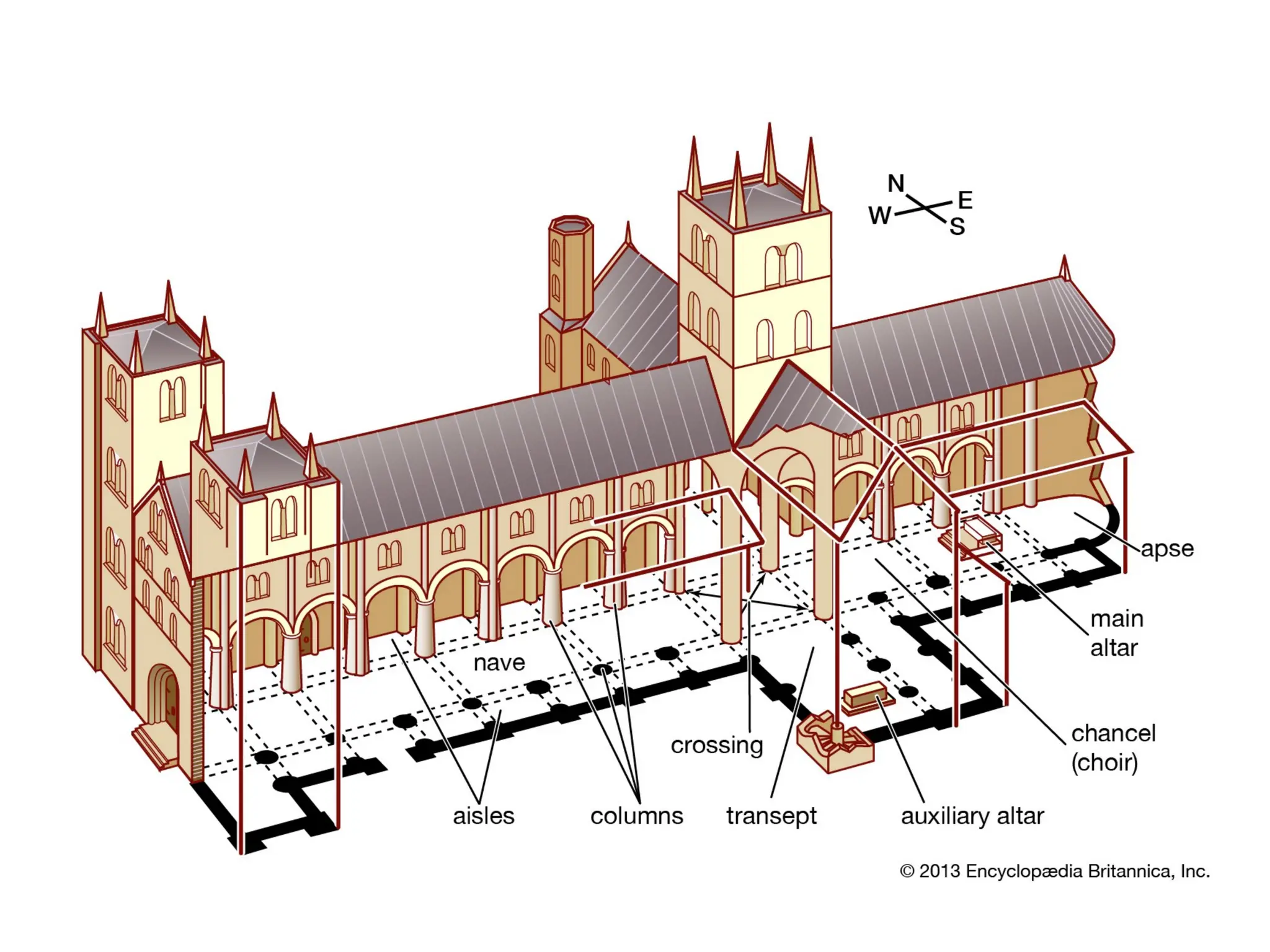
• Gothic churches’ plans were like Romanesque, mainly a Latin
cross
. • Gothic architecture was innovative on many levels, Mostly
three levels: structural, visual and spiritual.
• The first level is the structural level, where they used three new
important elements and techniques
4.
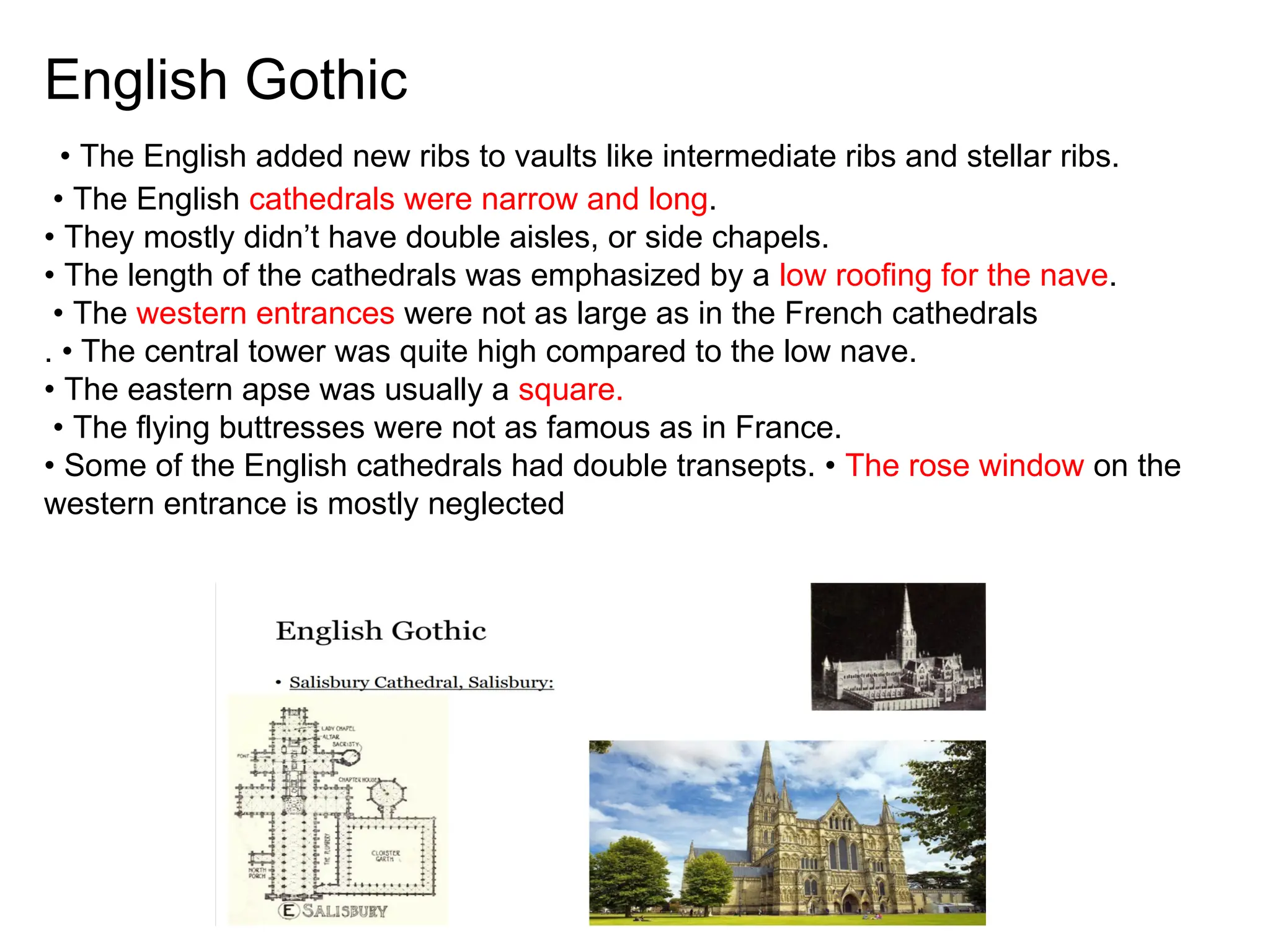
English Gothic
• TheEnglish added new ribs to vaults like intermediate ribs and stellar ribs.
• The English cathedrals were narrow and long.
• They mostly didn’t have double aisles, or side chapels.
• The length of the cathedrals was emphasized by a low roofing for the nave.
• The western entrances were not as large as in the French cathedrals
. • The central tower was quite high compared to the low nave.
• The eastern apse was usually a square.
• The flying buttresses were not as famous as in France.
• Some of the English cathedrals had double transepts. • The rose window on the
western entrance is mostly neglected
5.
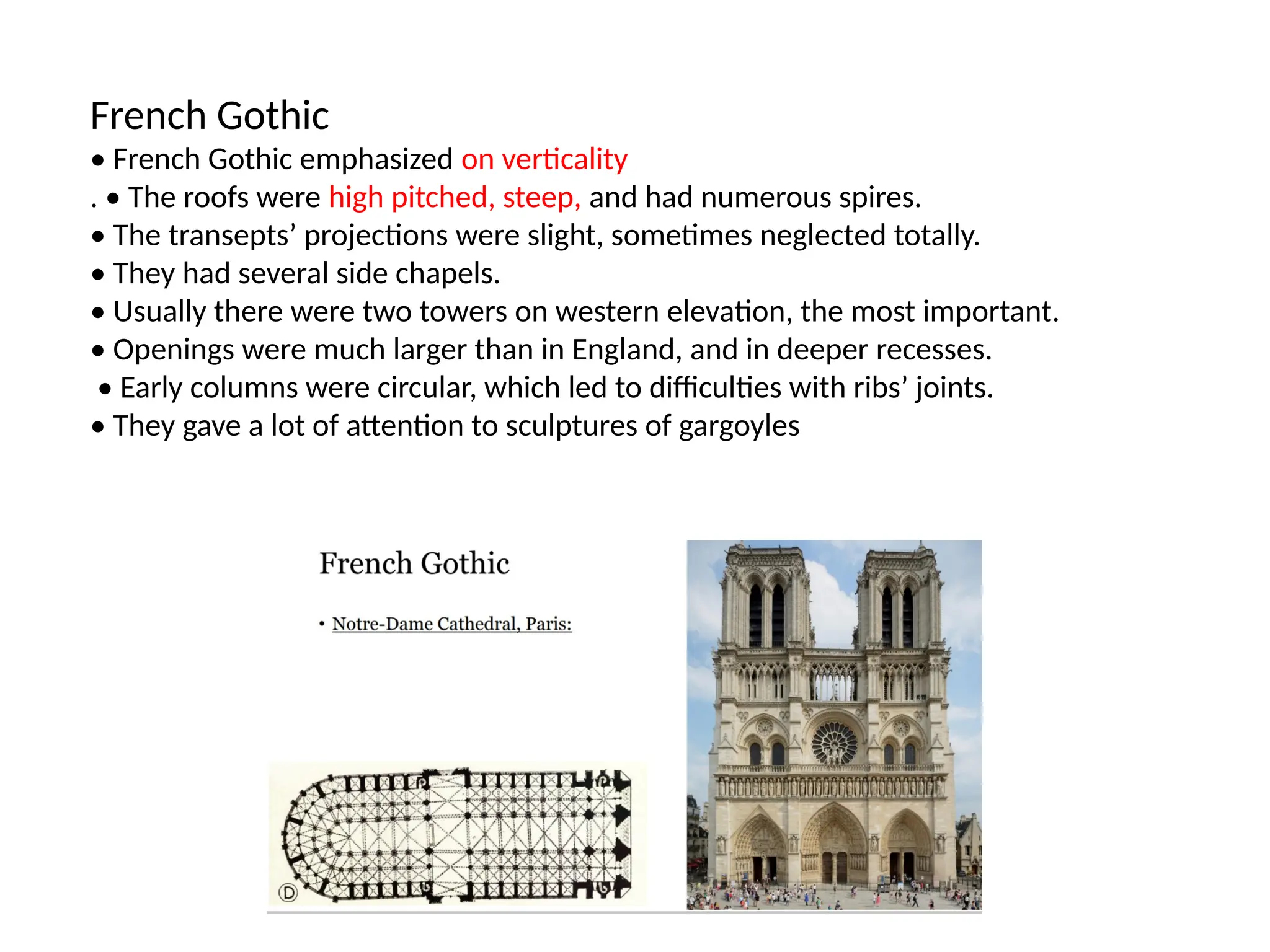
French Gothic
• FrenchGothic emphasized on verticality
. • The roofs were high pitched, steep, and had numerous spires.
• The transepts’ projections were slight, sometimes neglected totally.
• They had several side chapels.
• Usually there were two towers on western elevation, the most important.
• Openings were much larger than in England, and in deeper recesses.
• Early columns were circular, which led to difficulties with ribs’ joints.
• They gave a lot of attention to sculptures of gargoyles
6.
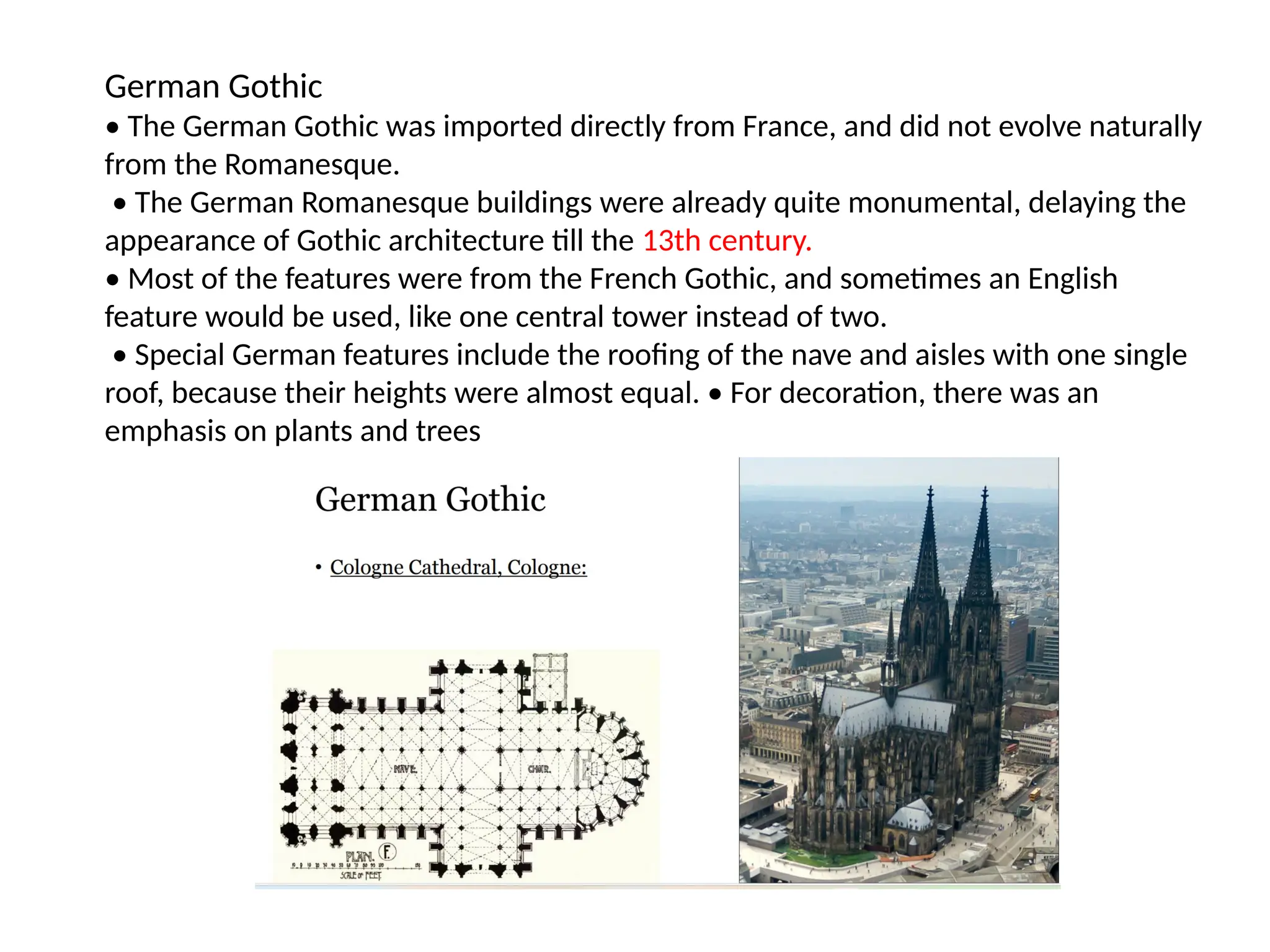
German Gothic
• TheGerman Gothic was imported directly from France, and did not evolve naturally
from the Romanesque.
• The German Romanesque buildings were already quite monumental, delaying the
appearance of Gothic architecture till the 13th century.
• Most of the features were from the French Gothic, and sometimes an English
feature would be used, like one central tower instead of two.
• Special German features include the roofing of the nave and aisles with one single
roof, because their heights were almost equal. • For decoration, there was an
emphasis on plants and trees
7.
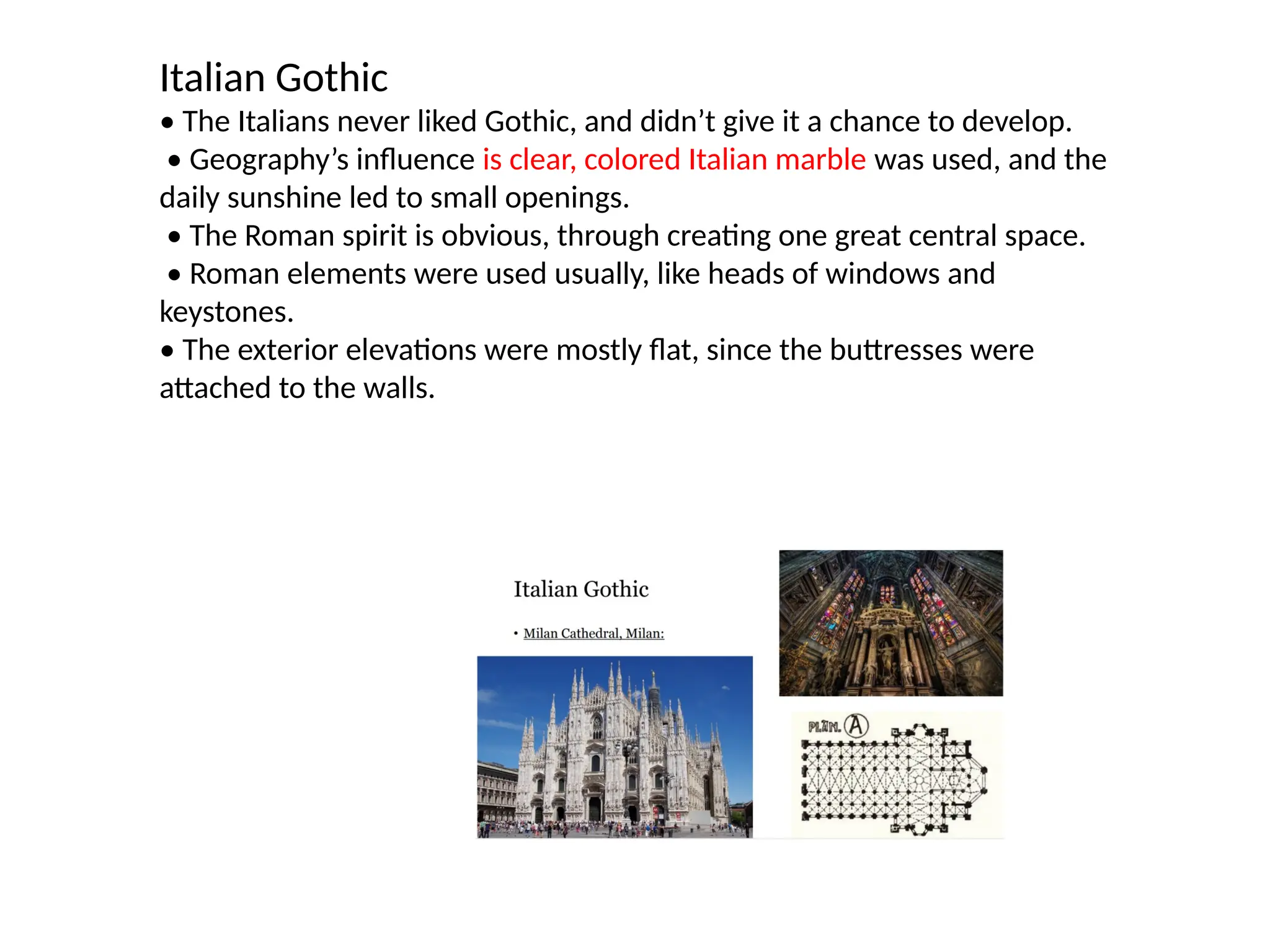
Italian Gothic
• TheItalians never liked Gothic, and didn’t give it a chance to develop.
• Geography’s influence is clear, colored Italian marble was used, and the
daily sunshine led to small openings.
• The Roman spirit is obvious, through creating one great central space.
• Roman elements were used usually, like heads of windows and
keystones.
• The exterior elevations were mostly flat, since the buttresses were
attached to the walls.
8.
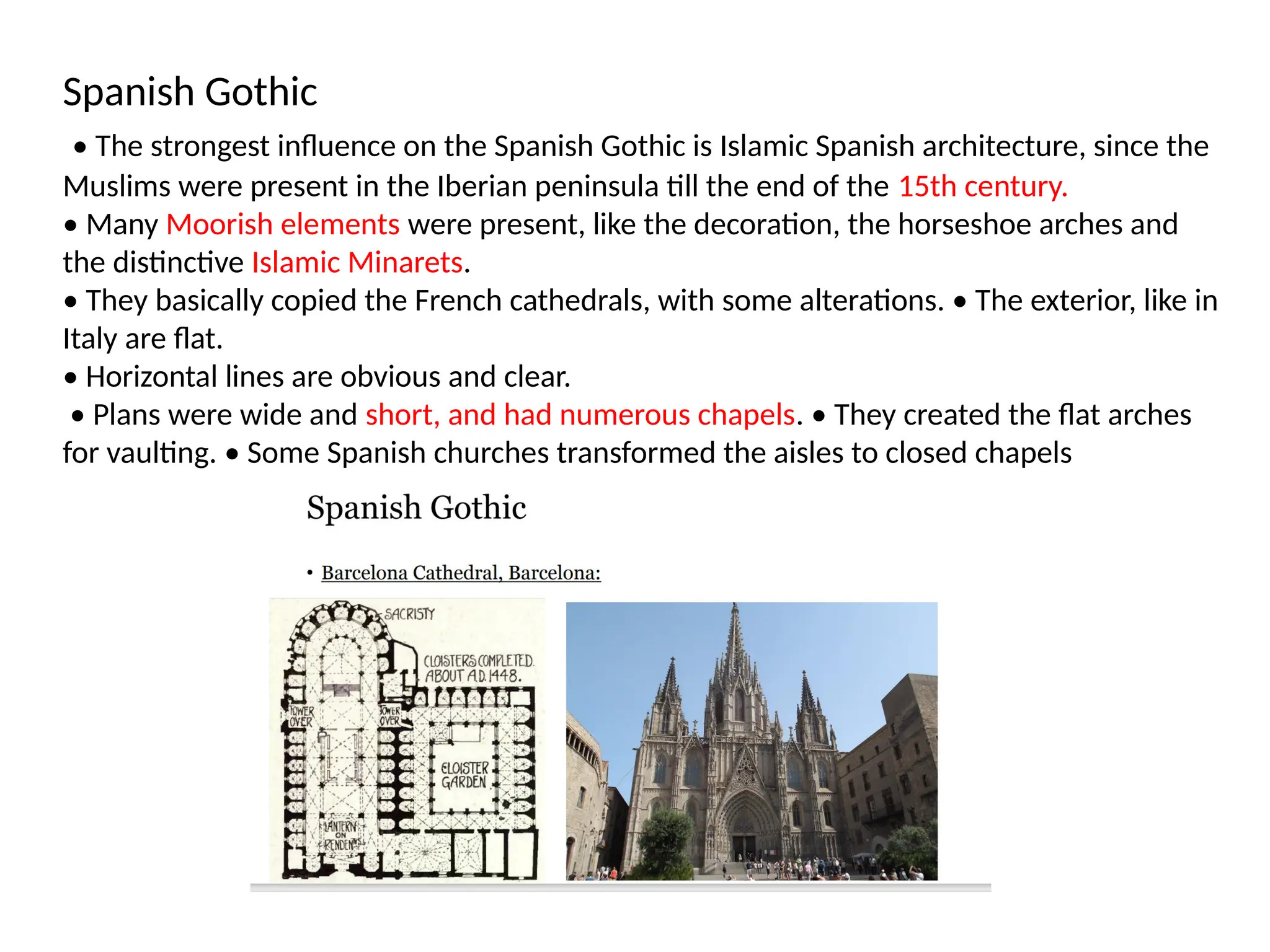
Spanish Gothic
• Thestrongest influence on the Spanish Gothic is Islamic Spanish architecture, since the
Muslims were present in the Iberian peninsula till the end of the 15th century.
• Many Moorish elements were present, like the decoration, the horseshoe arches and
the distinctive Islamic Minarets.
• They basically copied the French cathedrals, with some alterations. • The exterior, like in
Italy are flat.
• Horizontal lines are obvious and clear.
• Plans were wide and short, and had numerous chapels. • They created the flat arches
for vaulting. • Some Spanish churches transformed the aisles to closed chapels
Pointed arches
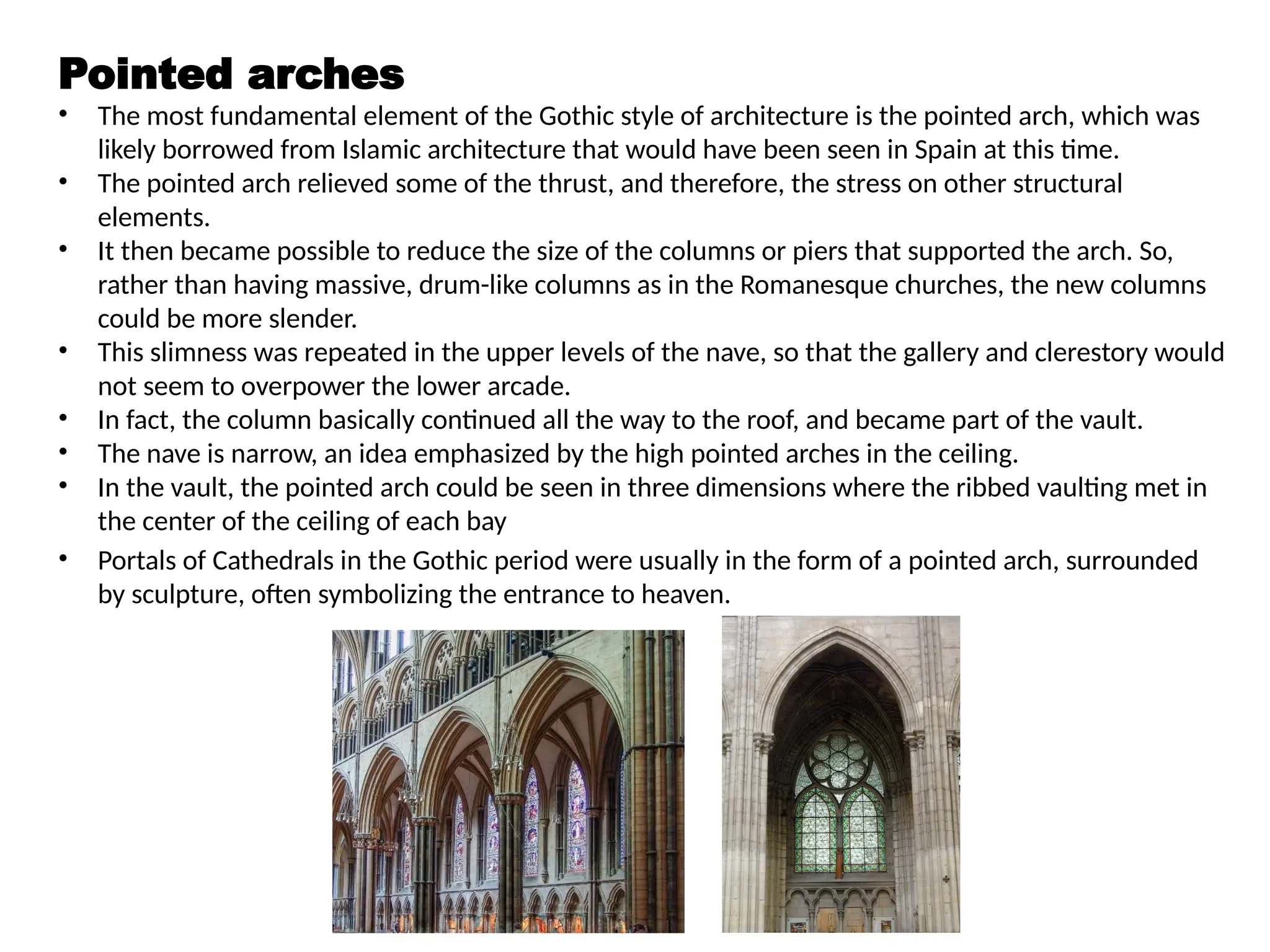
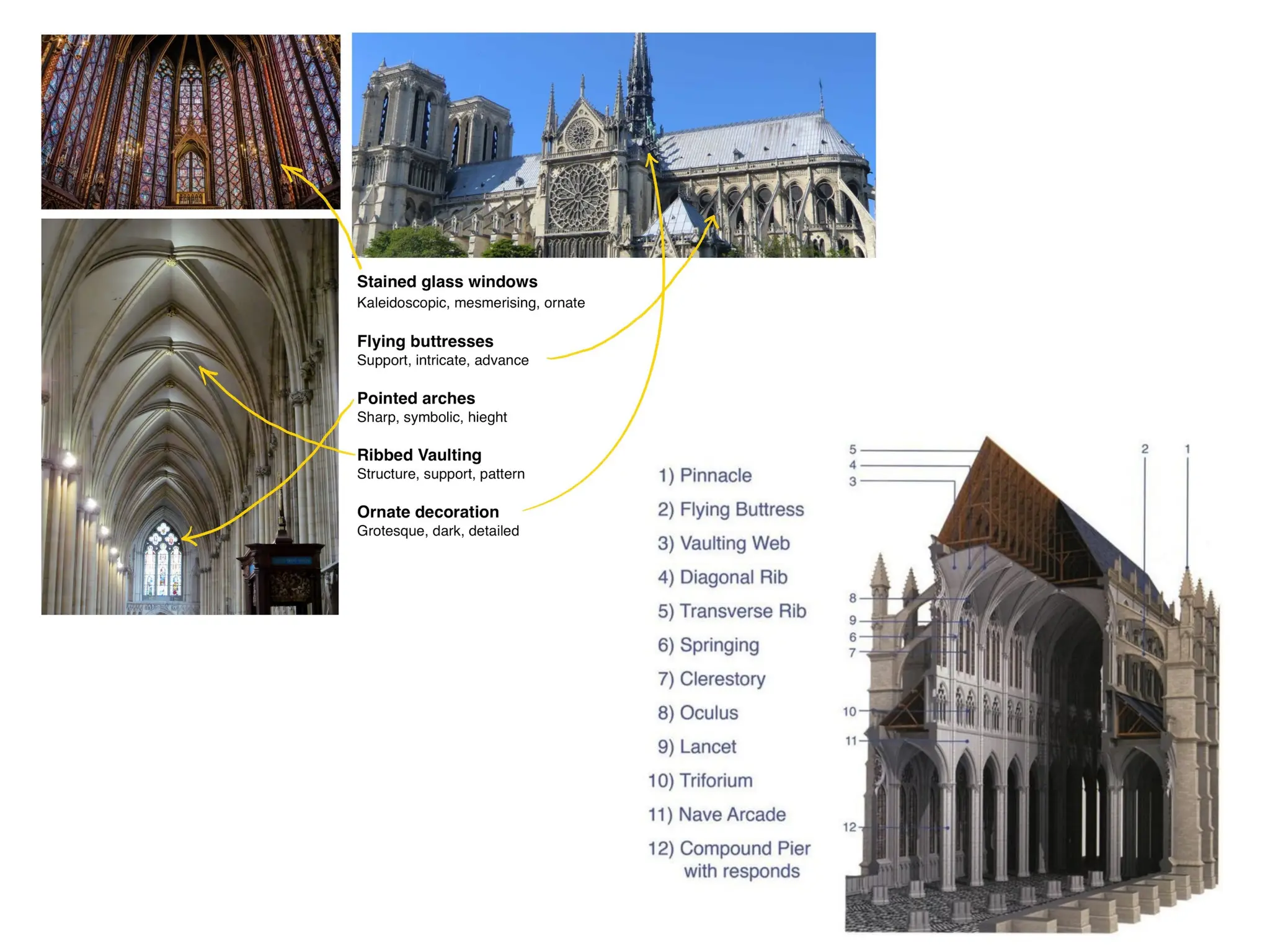
• Themost fundamental element of the Gothic style of architecture is the pointed arch, which was
likely borrowed from Islamic architecture that would have been seen in Spain at this time.
• The pointed arch relieved some of the thrust, and therefore, the stress on other structural
elements.
• It then became possible to reduce the size of the columns or piers that supported the arch. So,
rather than having massive, drum-like columns as in the Romanesque churches, the new columns
could be more slender.
• This slimness was repeated in the upper levels of the nave, so that the gallery and clerestory would
not seem to overpower the lower arcade.
• In fact, the column basically continued all the way to the roof, and became part of the vault.
• The nave is narrow, an idea emphasized by the high pointed arches in the ceiling.
• In the vault, the pointed arch could be seen in three dimensions where the ribbed vaulting met in
the center of the ceiling of each bay
• Portals of Cathedrals in the Gothic period were usually in the form of a pointed arch, surrounded
by sculpture, often symbolizing the entrance to heaven.
11.
Vaulting-
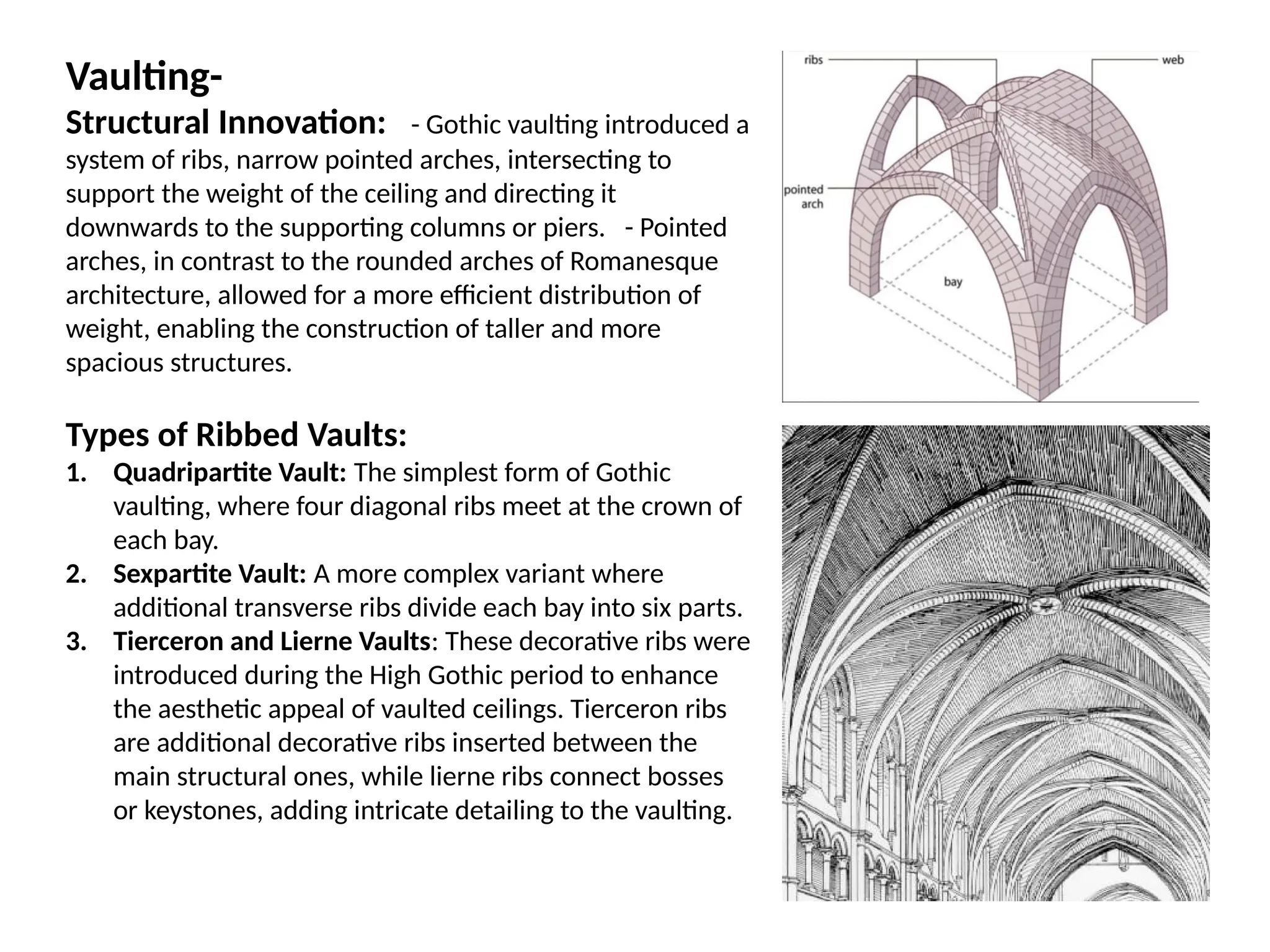
Structural Innovation: -Gothic vaulting introduced a
system of ribs, narrow pointed arches, intersecting to
support the weight of the ceiling and directing it
downwards to the supporting columns or piers. - Pointed
arches, in contrast to the rounded arches of Romanesque
architecture, allowed for a more efficient distribution of
weight, enabling the construction of taller and more
spacious structures.
Types of Ribbed Vaults:
1. Quadripartite Vault: The simplest form of Gothic
vaulting, where four diagonal ribs meet at the crown of
each bay.
2. Sexpartite Vault: A more complex variant where
additional transverse ribs divide each bay into six parts.
3. Tierceron and Lierne Vaults: These decorative ribs were
introduced during the High Gothic period to enhance
the aesthetic appeal of vaulted ceilings. Tierceron ribs
are additional decorative ribs inserted between the
main structural ones, while lierne ribs connect bosses
or keystones, adding intricate detailing to the vaulting.
12.
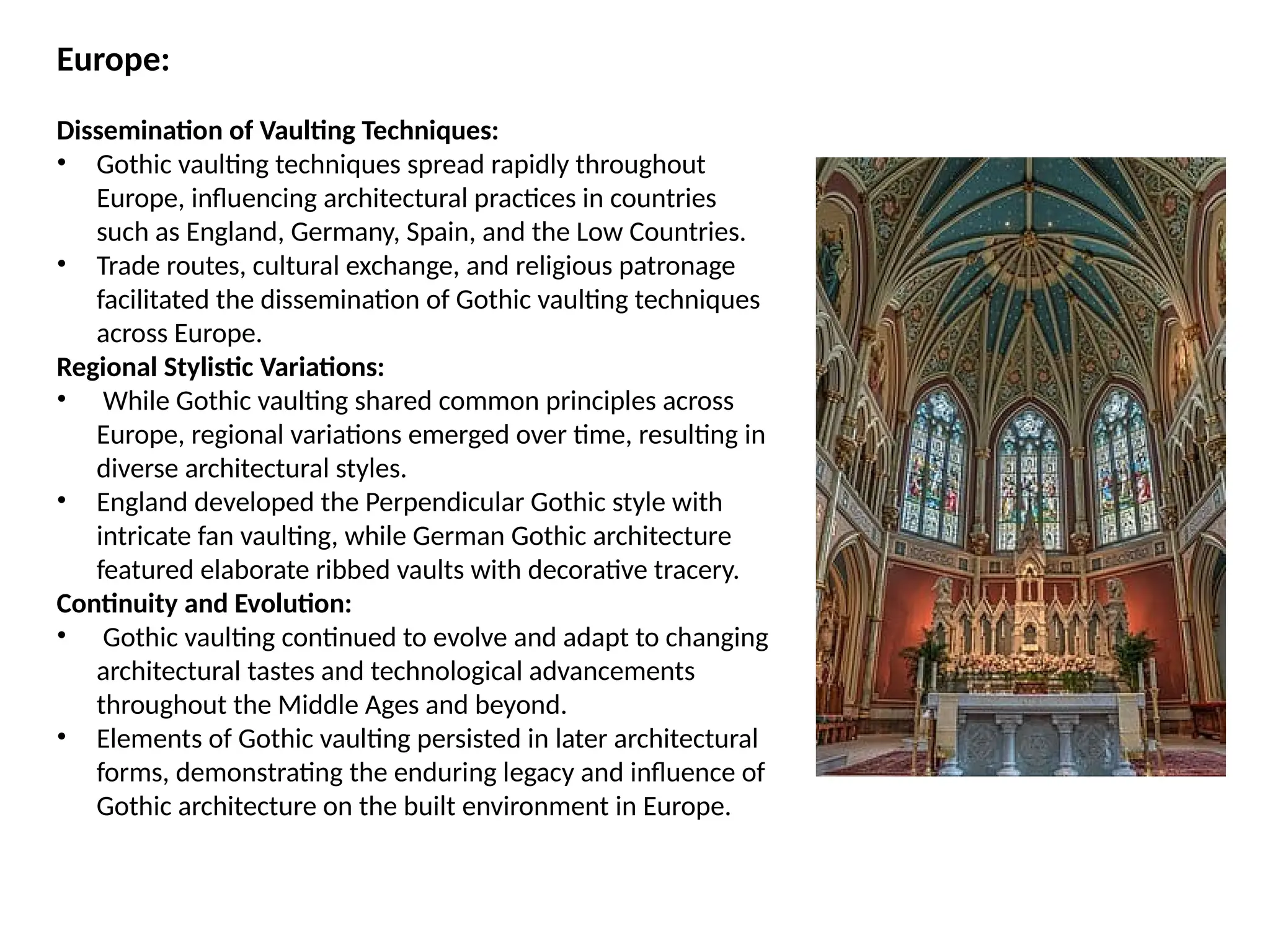
Fan Vaulting:
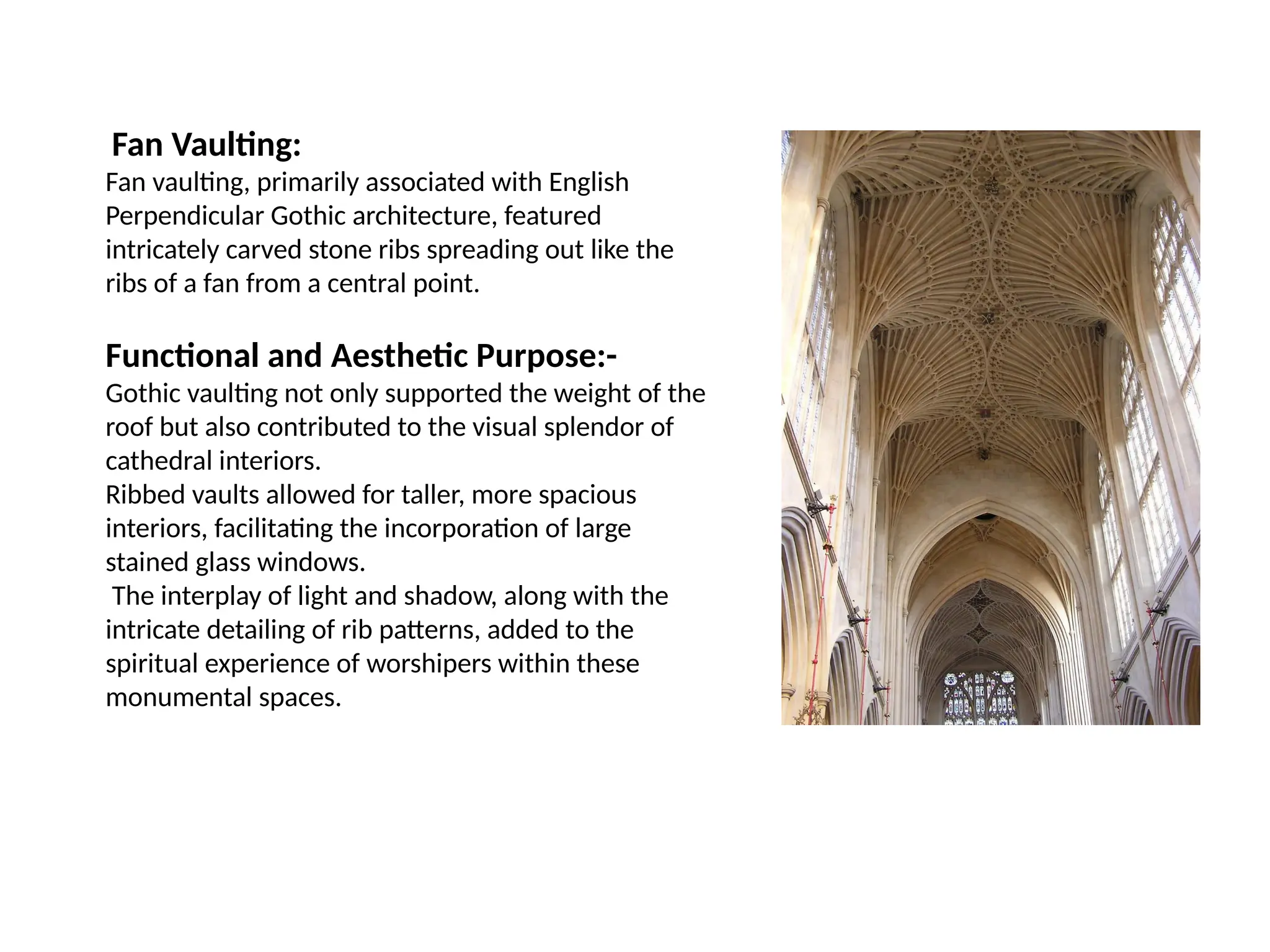
Fan vaulting,primarily associated with English
Perpendicular Gothic architecture, featured
intricately carved stone ribs spreading out like the
ribs of a fan from a central point.
Functional and Aesthetic Purpose:-
Gothic vaulting not only supported the weight of the
roof but also contributed to the visual splendor of
cathedral interiors.
Ribbed vaults allowed for taller, more spacious
interiors, facilitating the incorporation of large
stained glass windows.
The interplay of light and shadow, along with the
intricate detailing of rib patterns, added to the
spiritual experience of worshipers within these
monumental spaces.
13.
Italy-
1. Italian Adaptationof Vaulting: In Italy, Gothic vaulting techniques were adapted to suit local
architectural traditions and preferences, resulting in unique variations of ribbed vaults.
• Italian Gothic architecture integrated elements of Gothic vaulting with regional building
techniques, blending French and German influences with Italian artistic traditions.
1. Regional Stylistic Variations:
• Different regions of Italy developed their own styles of vaulting, reflecting regional variations
in design and execution.
• Northern Italy favored intricate decorative detailing and symbolism in ribbed vaults, while
central and southern Italy exhibited more restrained designs with simpler ribbed pattern.
1. Integration with Italian Architecture:
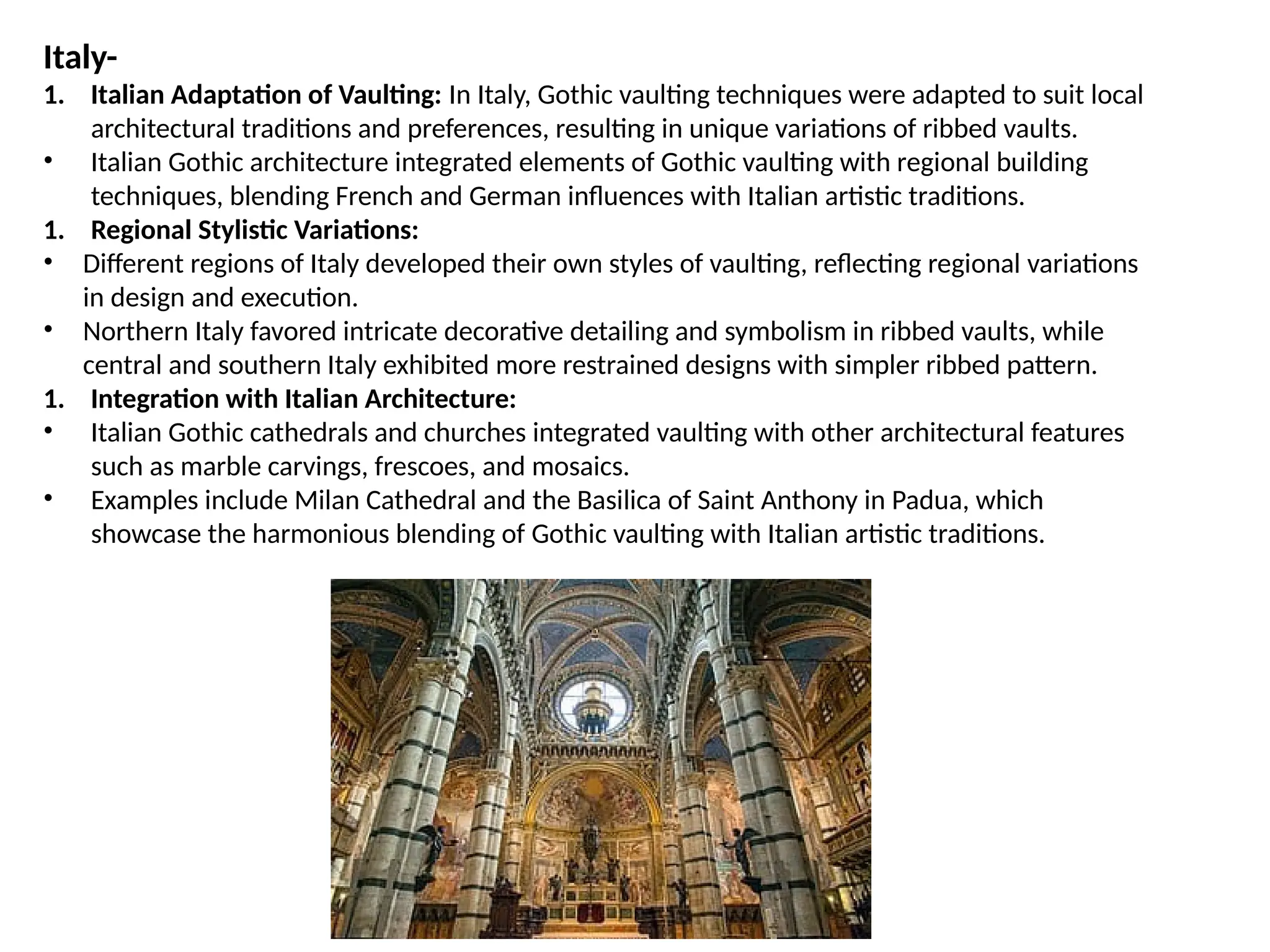
• Italian Gothic cathedrals and churches integrated vaulting with other architectural features
such as marble carvings, frescoes, and mosaics.
• Examples include Milan Cathedral and the Basilica of Saint Anthony in Padua, which
showcase the harmonious blending of Gothic vaulting with Italian artistic traditions.
14.
Europe:
Dissemination of VaultingTechniques:
• Gothic vaulting techniques spread rapidly throughout
Europe, influencing architectural practices in countries
such as England, Germany, Spain, and the Low Countries.
• Trade routes, cultural exchange, and religious patronage
facilitated the dissemination of Gothic vaulting techniques
across Europe.
Regional Stylistic Variations:
• While Gothic vaulting shared common principles across
Europe, regional variations emerged over time, resulting in
diverse architectural styles.
• England developed the Perpendicular Gothic style with
intricate fan vaulting, while German Gothic architecture
featured elaborate ribbed vaults with decorative tracery.
Continuity and Evolution:
• Gothic vaulting continued to evolve and adapt to changing
architectural tastes and technological advancements
throughout the Middle Ages and beyond.
• Elements of Gothic vaulting persisted in later architectural
forms, demonstrating the enduring legacy and influence of
Gothic architecture on the built environment in Europe.
15.
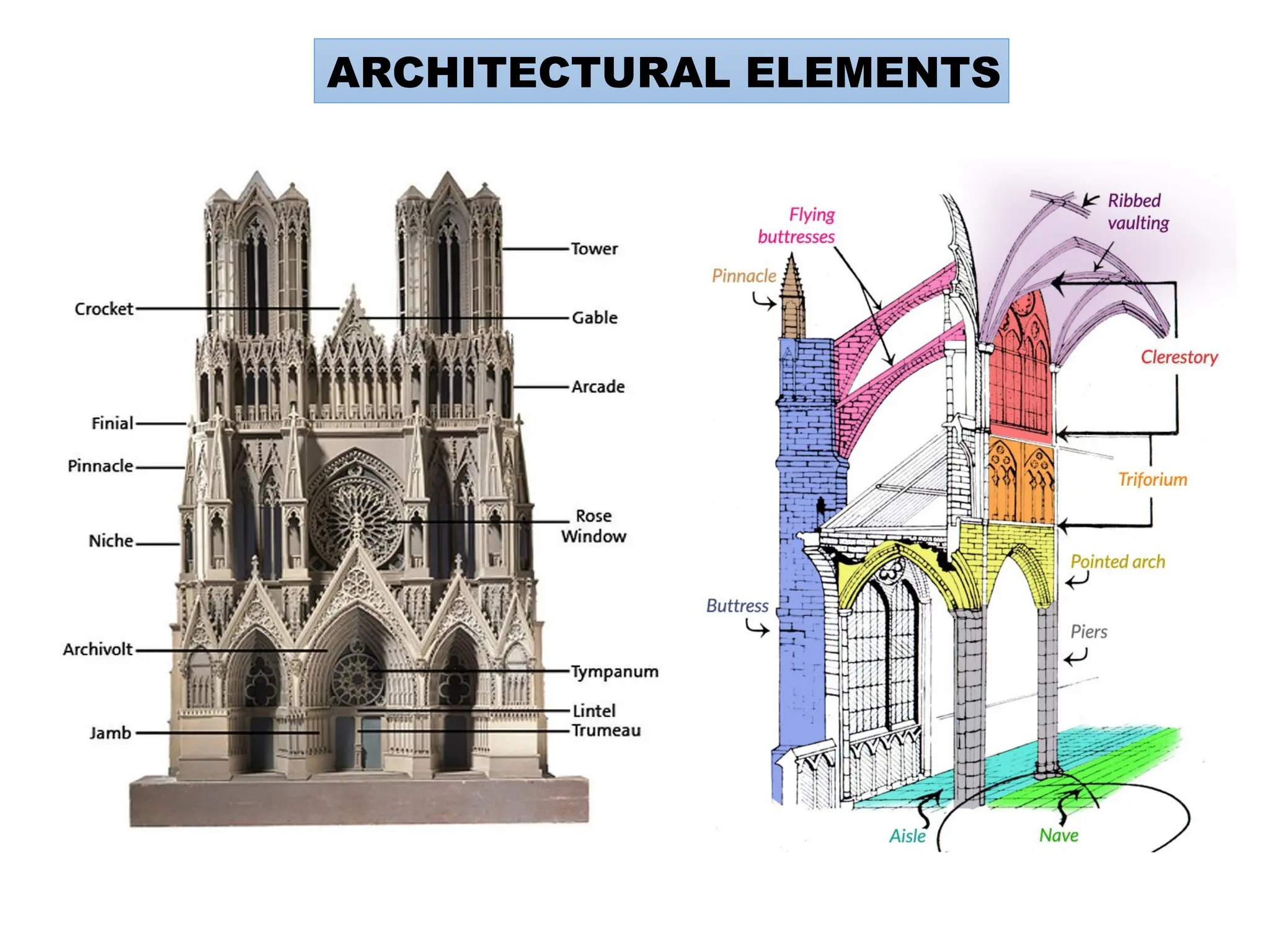
Flying Buttress
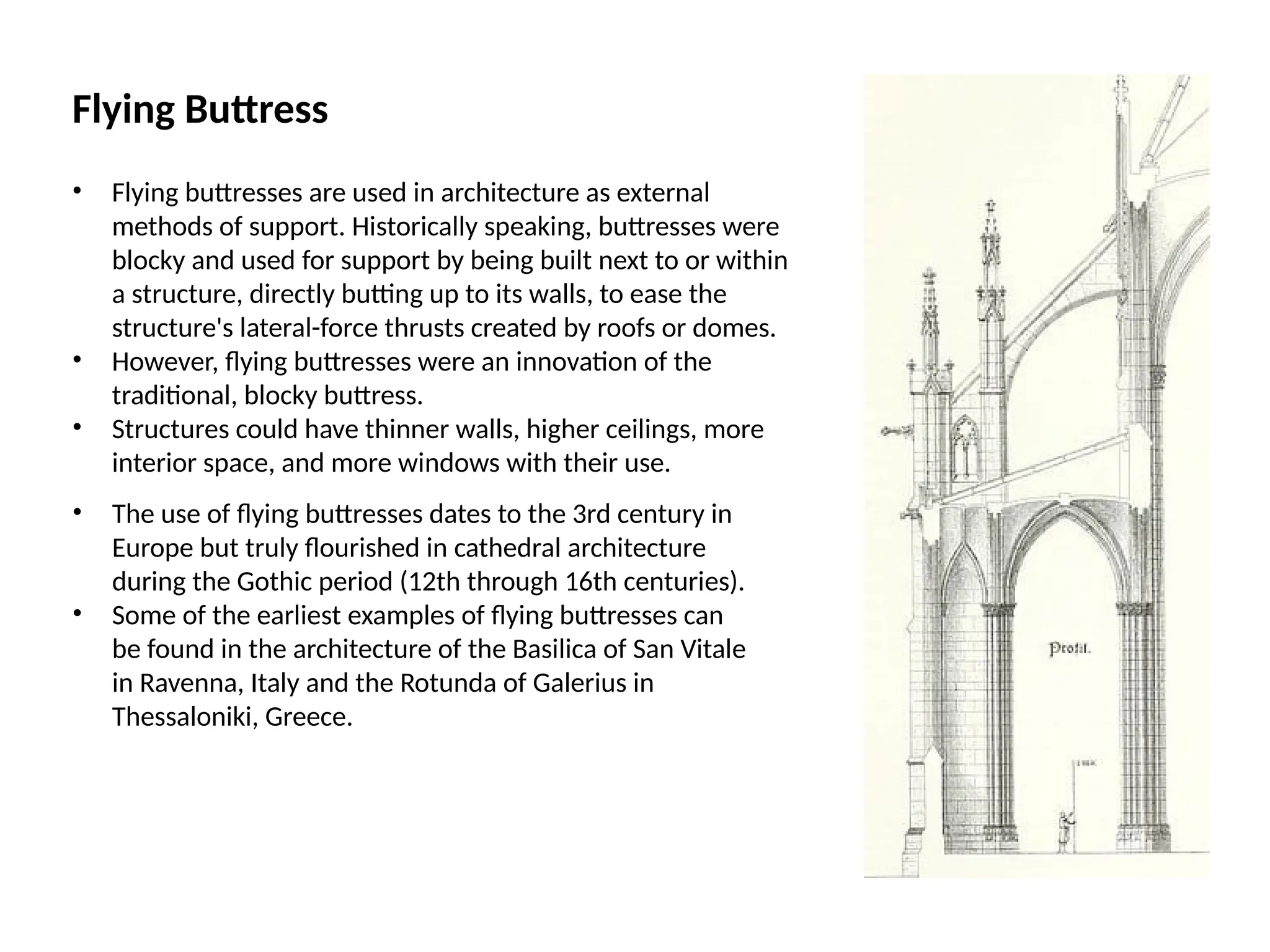
• Flyingbuttresses are used in architecture as external
methods of support. Historically speaking, buttresses were
blocky and used for support by being built next to or within
a structure, directly butting up to its walls, to ease the
structure's lateral-force thrusts created by roofs or domes.
• However, flying buttresses were an innovation of the
traditional, blocky buttress.
• Structures could have thinner walls, higher ceilings, more
interior space, and more windows with their use.
• The use of flying buttresses dates to the 3rd century in
Europe but truly flourished in cathedral architecture
during the Gothic period (12th through 16th centuries).
• Some of the earliest examples of flying buttresses can
be found in the architecture of the Basilica of San Vitale
in Ravenna, Italy and the Rotunda of Galerius in
Thessaloniki, Greece.
16.
• The designof Gothic cathedrals focused on verticality and
light.
• One of the defining features of Gothic cathedrals, the
stained-glass window, allowed for an immense amount of
light to flood through the beautifully colored glass to create
an ethereal effect.
• It dazzled the churchgoer and directly connects to why
Gothic cathedrals include flying buttresses.
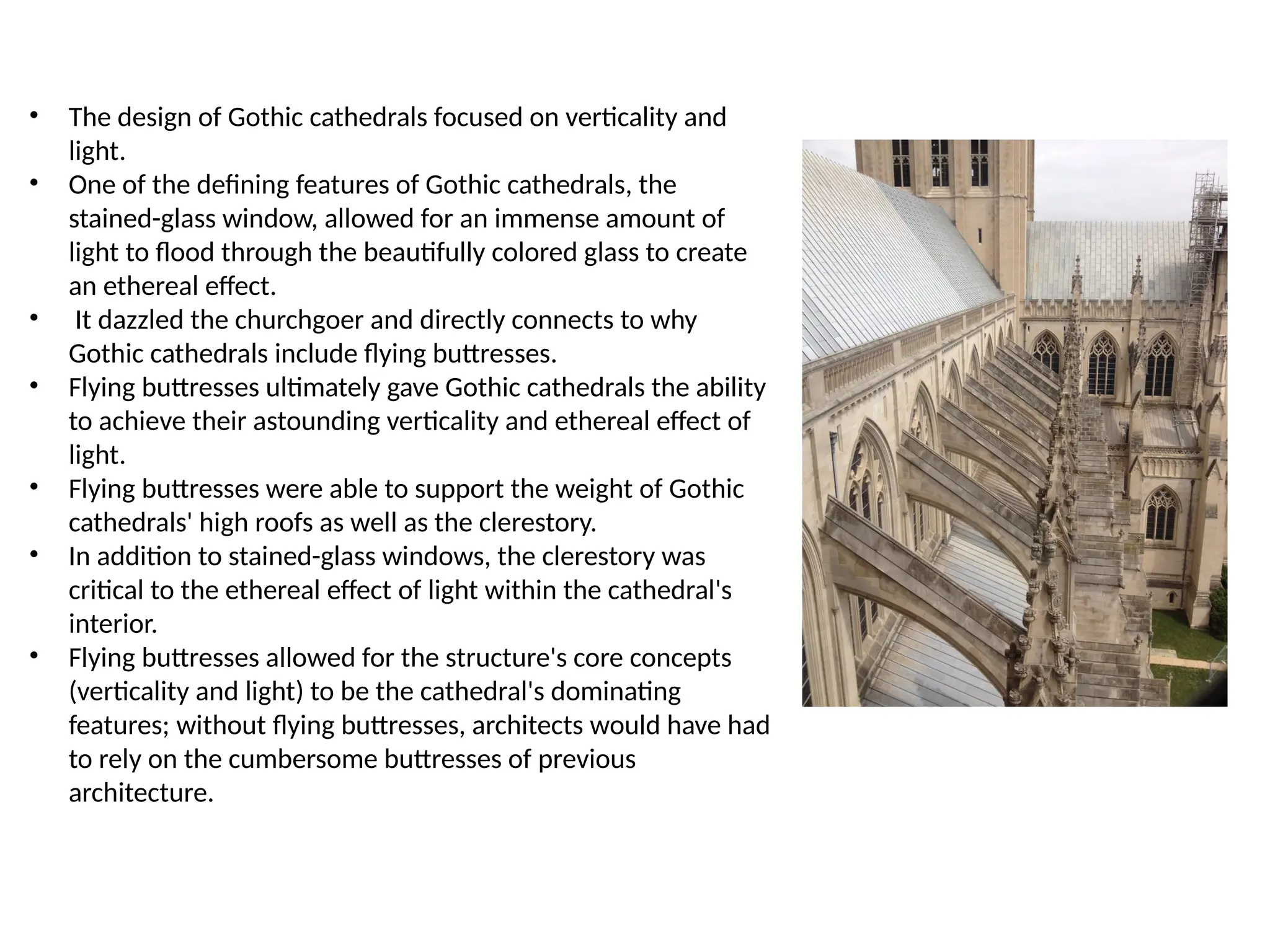
• Flying buttresses ultimately gave Gothic cathedrals the ability
to achieve their astounding verticality and ethereal effect of
light.
• Flying buttresses were able to support the weight of Gothic
cathedrals' high roofs as well as the clerestory.
• In addition to stained-glass windows, the clerestory was
critical to the ethereal effect of light within the cathedral's
interior.
• Flying buttresses allowed for the structure's core concepts
(verticality and light) to be the cathedral's dominating
features; without flying buttresses, architects would have had
to rely on the cumbersome buttresses of previous
architecture.
17.
Window tracery-
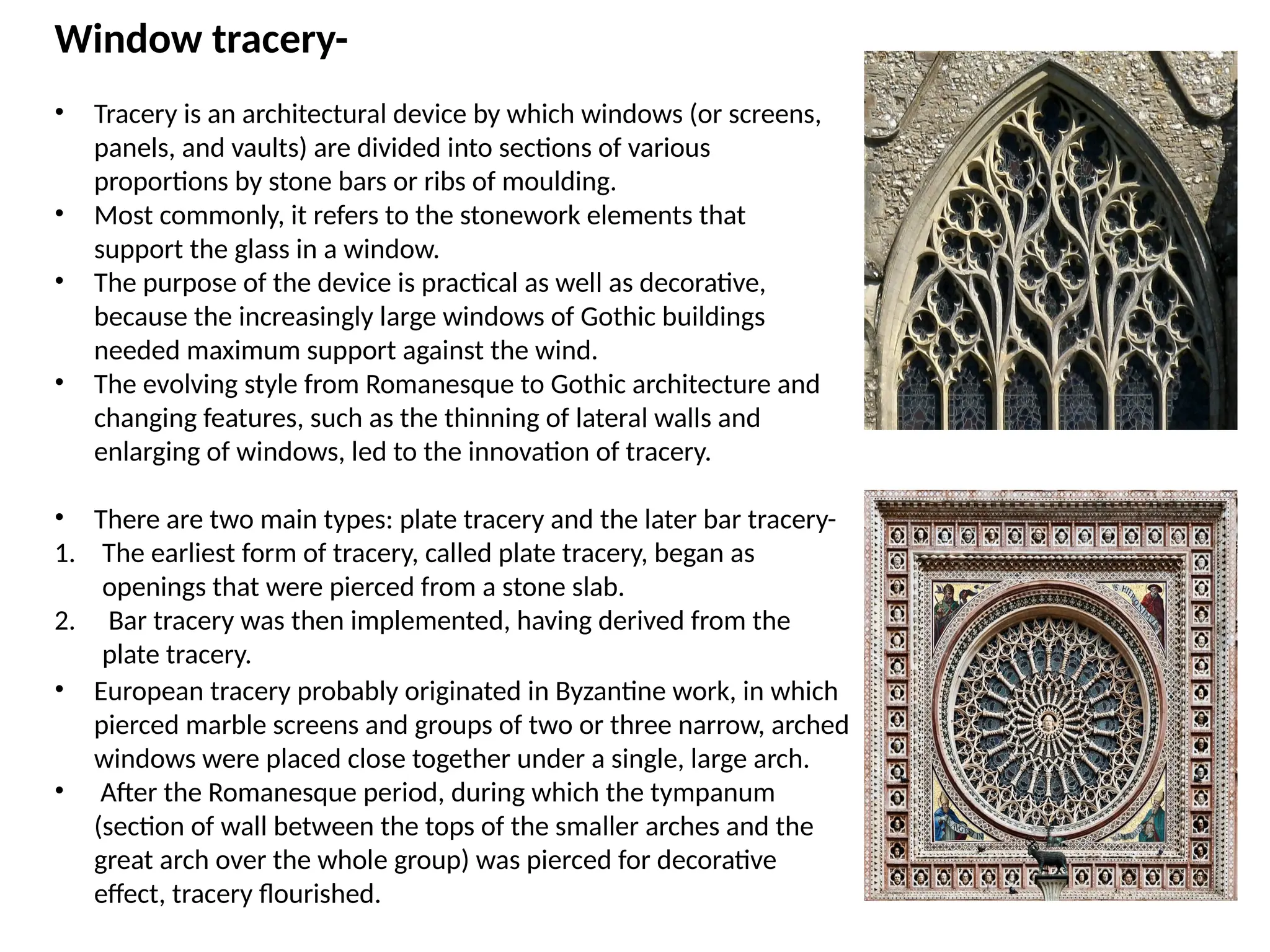
• Traceryis an architectural device by which windows (or screens,
panels, and vaults) are divided into sections of various
proportions by stone bars or ribs of moulding.
• Most commonly, it refers to the stonework elements that
support the glass in a window.
• The purpose of the device is practical as well as decorative,
because the increasingly large windows of Gothic buildings
needed maximum support against the wind.
• The evolving style from Romanesque to Gothic architecture and
changing features, such as the thinning of lateral walls and
enlarging of windows, led to the innovation of tracery.
• There are two main types: plate tracery and the later bar tracery-
1. The earliest form of tracery, called plate tracery, began as
openings that were pierced from a stone slab.
2. Bar tracery was then implemented, having derived from the
plate tracery.
• European tracery probably originated in Byzantine work, in which
pierced marble screens and groups of two or three narrow, arched
windows were placed close together under a single, large arch.
• After the Romanesque period, during which the tympanum
(section of wall between the tops of the smaller arches and the
great arch over the whole group) was pierced for decorative
effect, tracery flourished.
18.
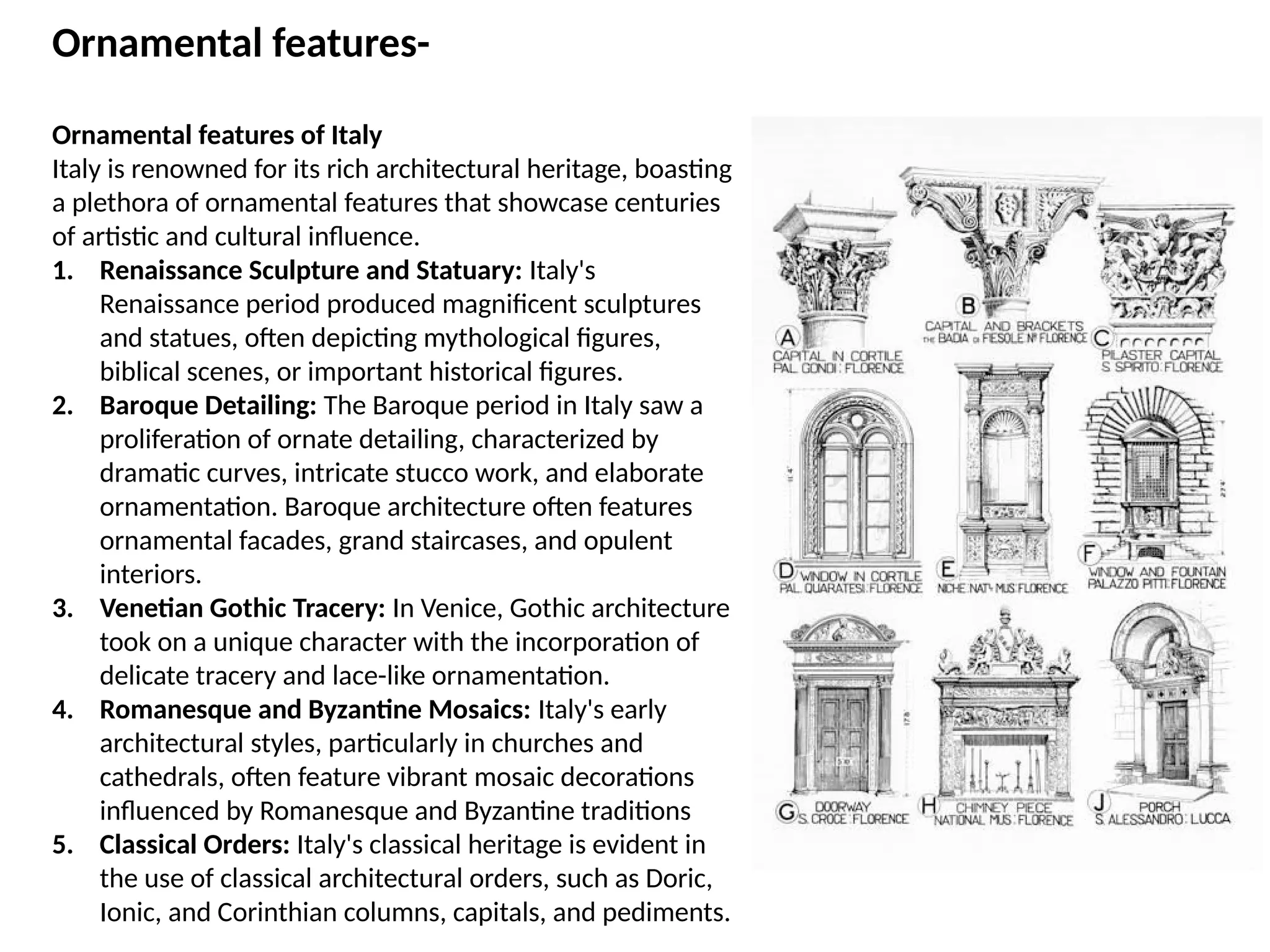
Ornamental features-
Ornamental featuresof Italy
Italy is renowned for its rich architectural heritage, boasting
a plethora of ornamental features that showcase centuries
of artistic and cultural influence.
1. Renaissance Sculpture and Statuary: Italy's
Renaissance period produced magnificent sculptures
and statues, often depicting mythological figures,
biblical scenes, or important historical figures.
2. Baroque Detailing: The Baroque period in Italy saw a
proliferation of ornate detailing, characterized by
dramatic curves, intricate stucco work, and elaborate
ornamentation. Baroque architecture often features
ornamental facades, grand staircases, and opulent
interiors.
3. Venetian Gothic Tracery: In Venice, Gothic architecture
took on a unique character with the incorporation of
delicate tracery and lace-like ornamentation.
4. Romanesque and Byzantine Mosaics: Italy's early
architectural styles, particularly in churches and
cathedrals, often feature vibrant mosaic decorations
influenced by Romanesque and Byzantine traditions
5. Classical Orders: Italy's classical heritage is evident in
the use of classical architectural orders, such as Doric,
Ionic, and Corinthian columns, capitals, and pediments.
19.
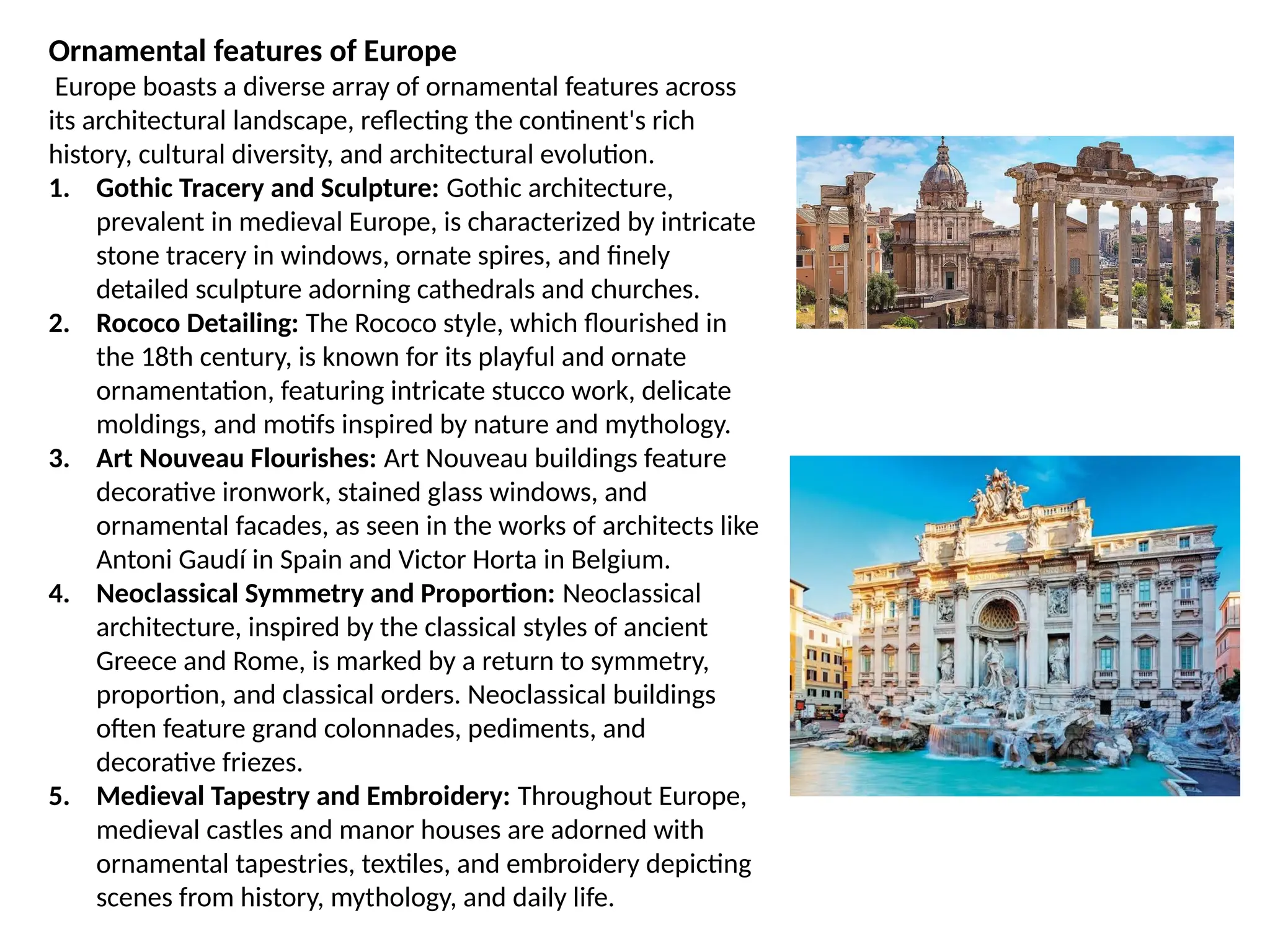
Ornamental features ofEurope
Europe boasts a diverse array of ornamental features across
its architectural landscape, reflecting the continent's rich
history, cultural diversity, and architectural evolution.
1. Gothic Tracery and Sculpture: Gothic architecture,
prevalent in medieval Europe, is characterized by intricate
stone tracery in windows, ornate spires, and finely
detailed sculpture adorning cathedrals and churches.
2. Rococo Detailing: The Rococo style, which flourished in
the 18th century, is known for its playful and ornate
ornamentation, featuring intricate stucco work, delicate
moldings, and motifs inspired by nature and mythology.
3. Art Nouveau Flourishes: Art Nouveau buildings feature
decorative ironwork, stained glass windows, and
ornamental facades, as seen in the works of architects like
Antoni Gaudí in Spain and Victor Horta in Belgium.
4. Neoclassical Symmetry and Proportion: Neoclassical
architecture, inspired by the classical styles of ancient
Greece and Rome, is marked by a return to symmetry,
proportion, and classical orders. Neoclassical buildings
often feature grand colonnades, pediments, and
decorative friezes.
5. Medieval Tapestry and Embroidery: Throughout Europe,
medieval castles and manor houses are adorned with
ornamental tapestries, textiles, and embroidery depicting
scenes from history, mythology, and daily life.
20.
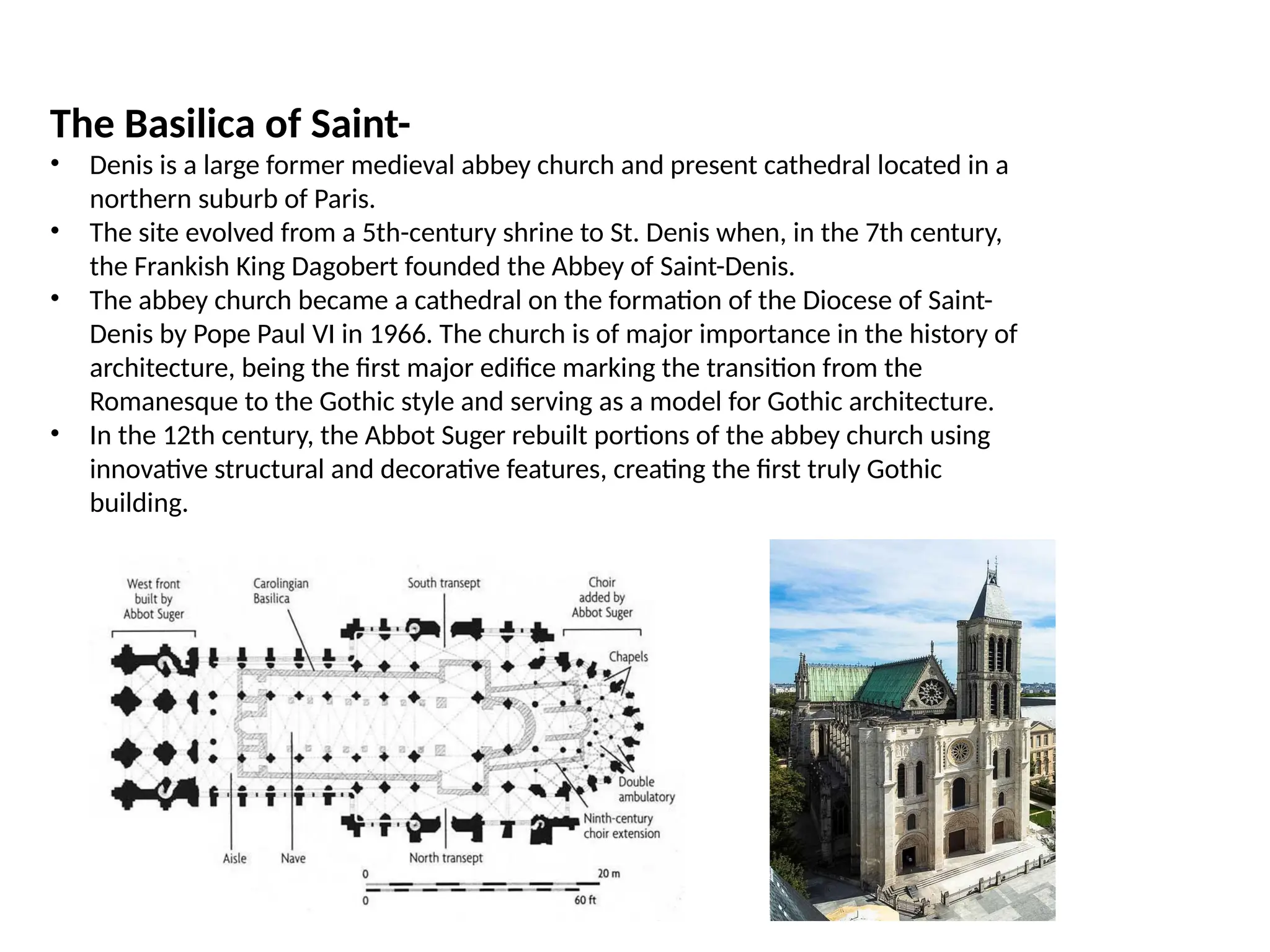
The Basilica ofSaint-
• Denis is a large former medieval abbey church and present cathedral located in a
northern suburb of Paris.
• The site evolved from a 5th-century shrine to St. Denis when, in the 7th century,
the Frankish King Dagobert founded the Abbey of Saint-Denis.
• The abbey church became a cathedral on the formation of the Diocese of Saint-
Denis by Pope Paul VI in 1966. The church is of major importance in the history of
architecture, being the first major edifice marking the transition from the
Romanesque to the Gothic style and serving as a model for Gothic architecture.
• In the 12th century, the Abbot Suger rebuilt portions of the abbey church using
innovative structural and decorative features, creating the first truly Gothic
building.
21.
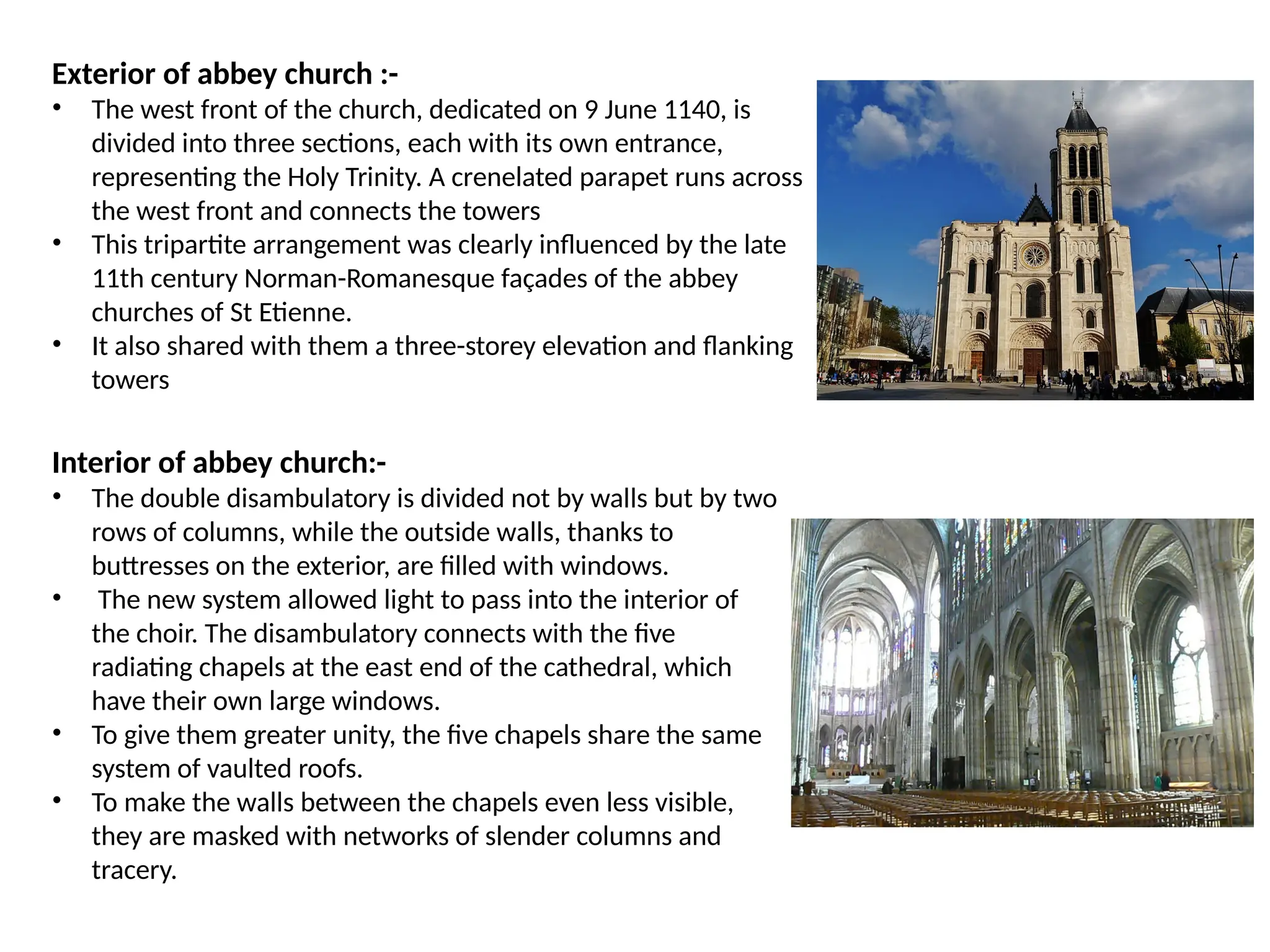
Exterior of abbeychurch :-
• The west front of the church, dedicated on 9 June 1140, is
divided into three sections, each with its own entrance,
representing the Holy Trinity. A crenelated parapet runs across
the west front and connects the towers
• This tripartite arrangement was clearly influenced by the late
11th century Norman-Romanesque façades of the abbey
churches of St Etienne.
• It also shared with them a three-storey elevation and flanking
towers
Interior of abbey church:-
• The double disambulatory is divided not by walls but by two
rows of columns, while the outside walls, thanks to
buttresses on the exterior, are filled with windows.
• The new system allowed light to pass into the interior of
the choir. The disambulatory connects with the five
radiating chapels at the east end of the cathedral, which
have their own large windows.
• To give them greater unity, the five chapels share the same
system of vaulted roofs.
• To make the walls between the chapels even less visible,
they are masked with networks of slender columns and
tracery.
22.
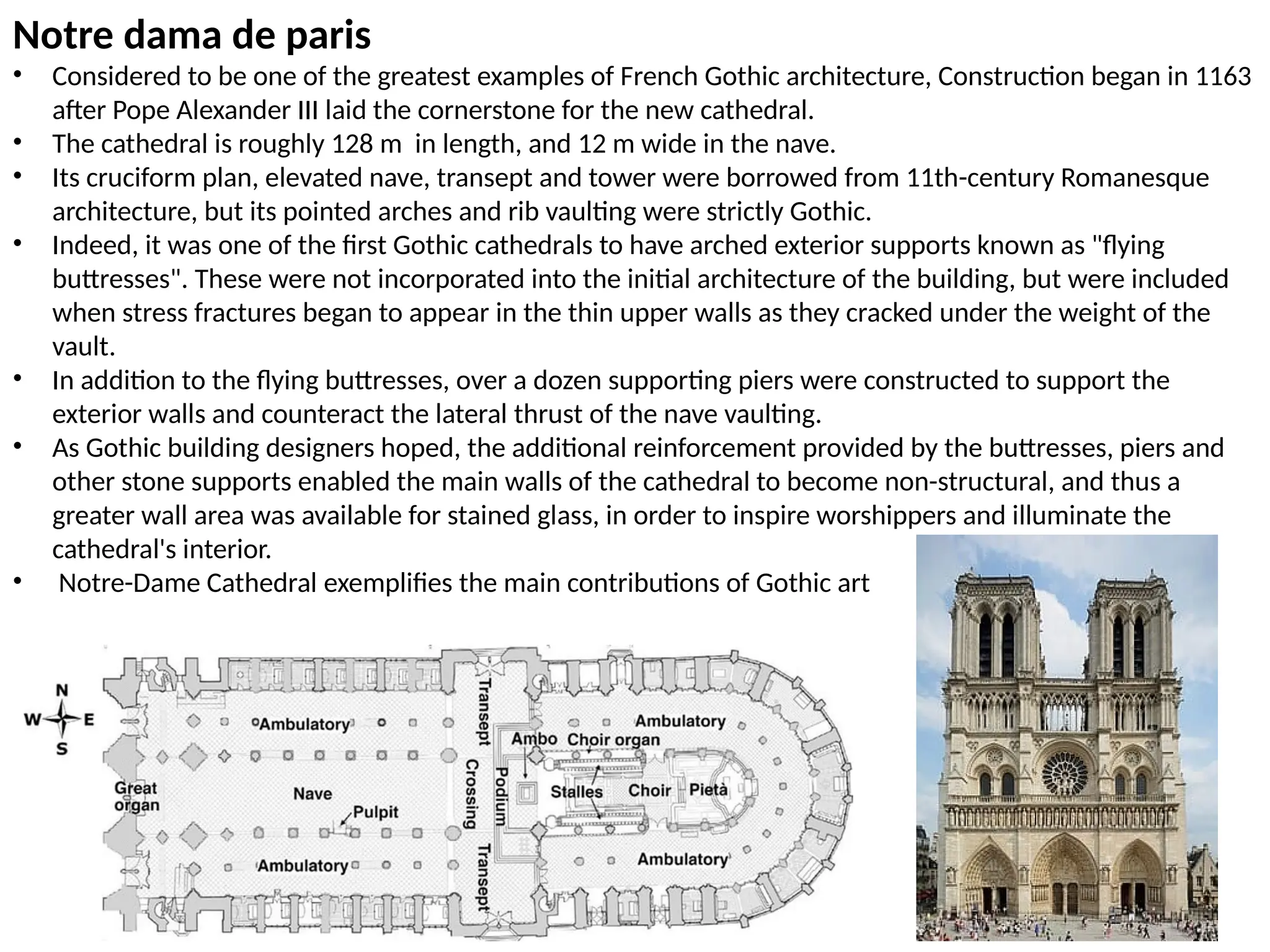
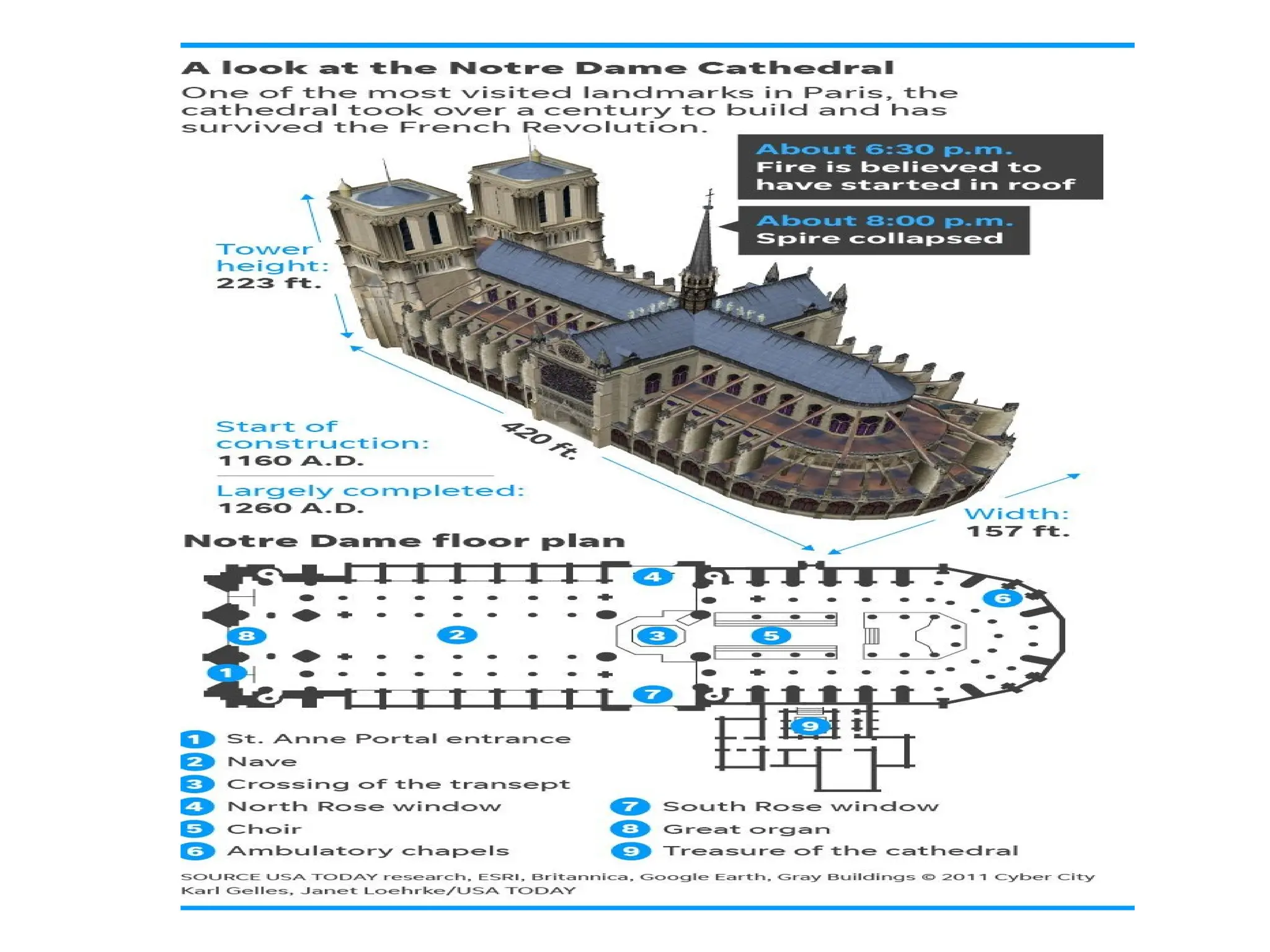
Notre dama deparis
• Considered to be one of the greatest examples of French Gothic architecture, Construction began in 1163
after Pope Alexander III laid the cornerstone for the new cathedral.
• The cathedral is roughly 128 m in length, and 12 m wide in the nave.
• Its cruciform plan, elevated nave, transept and tower were borrowed from 11th-century Romanesque
architecture, but its pointed arches and rib vaulting were strictly Gothic.
• Indeed, it was one of the first Gothic cathedrals to have arched exterior supports known as "flying
buttresses". These were not incorporated into the initial architecture of the building, but were included
when stress fractures began to appear in the thin upper walls as they cracked under the weight of the
vault.
• In addition to the flying buttresses, over a dozen supporting piers were constructed to support the
exterior walls and counteract the lateral thrust of the nave vaulting.
• As Gothic building designers hoped, the additional reinforcement provided by the buttresses, piers and
other stone supports enabled the main walls of the cathedral to become non-structural, and thus a
greater wall area was available for stained glass, in order to inspire worshippers and illuminate the
cathedral's interior.
• Notre-Dame Cathedral exemplifies the main contributions of Gothic art
23.
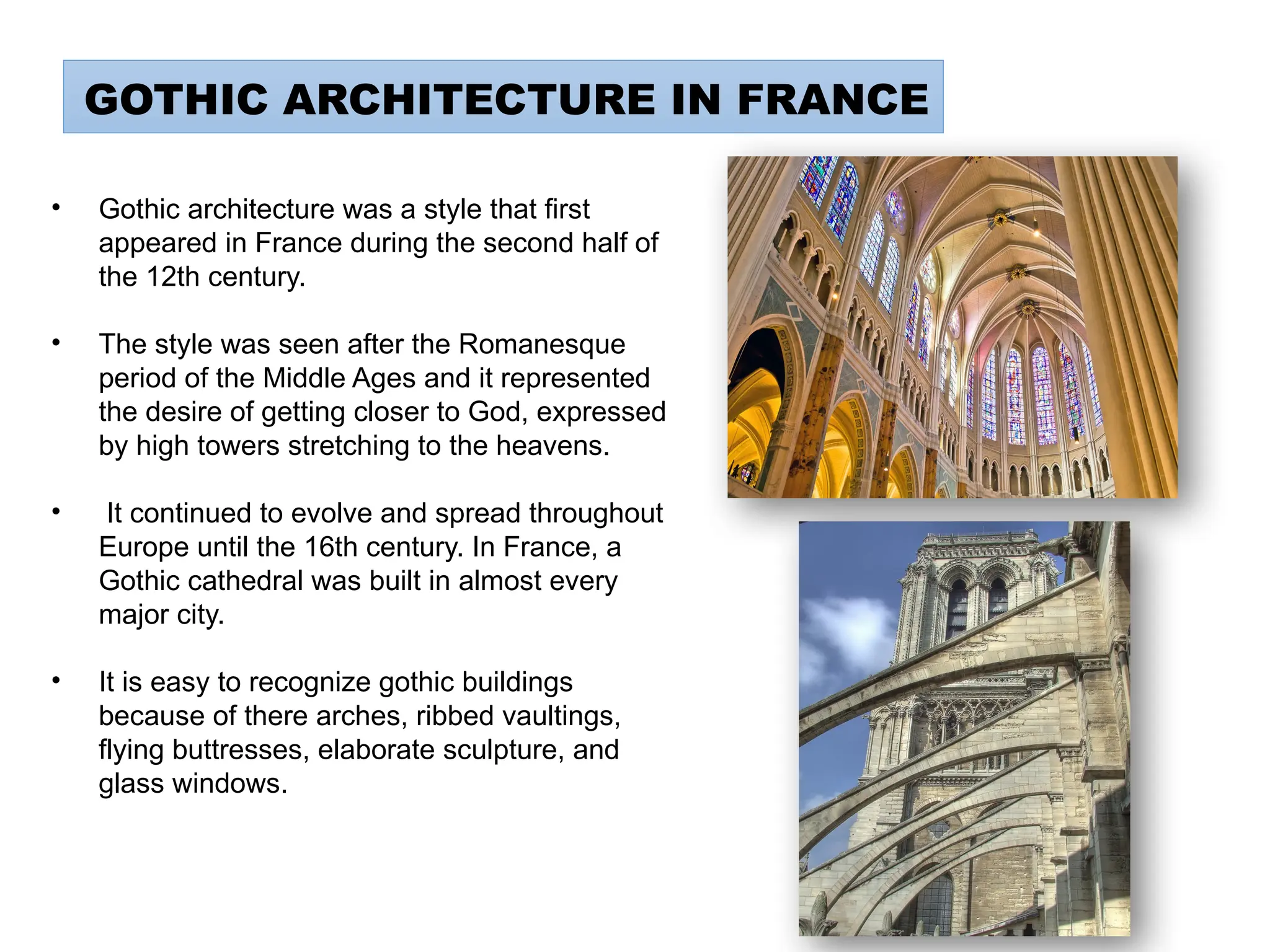
GOTHIC ARCHITECTURE INFRANCE
• Gothic architecture was a style that first
appeared in France during the second half of
the 12th century.
• The style was seen after the Romanesque
period of the Middle Ages and it represented
the desire of getting closer to God, expressed
by high towers stretching to the heavens.
• It continued to evolve and spread throughout
Europe until the 16th century. In France, a
Gothic cathedral was built in almost every
major city.
• It is easy to recognize gothic buildings
because of there arches, ribbed vaultings,
flying buttresses, elaborate sculpture, and
glass windows.
CHARACTERISTICS OF GOTHICARCHITECTURE
• Focus on Verticality
• Airy and Bright
• Rib Vaults
• Flying Buttresses
• Large Stained Glass Windows
• Ornaments and pinnacle
26.
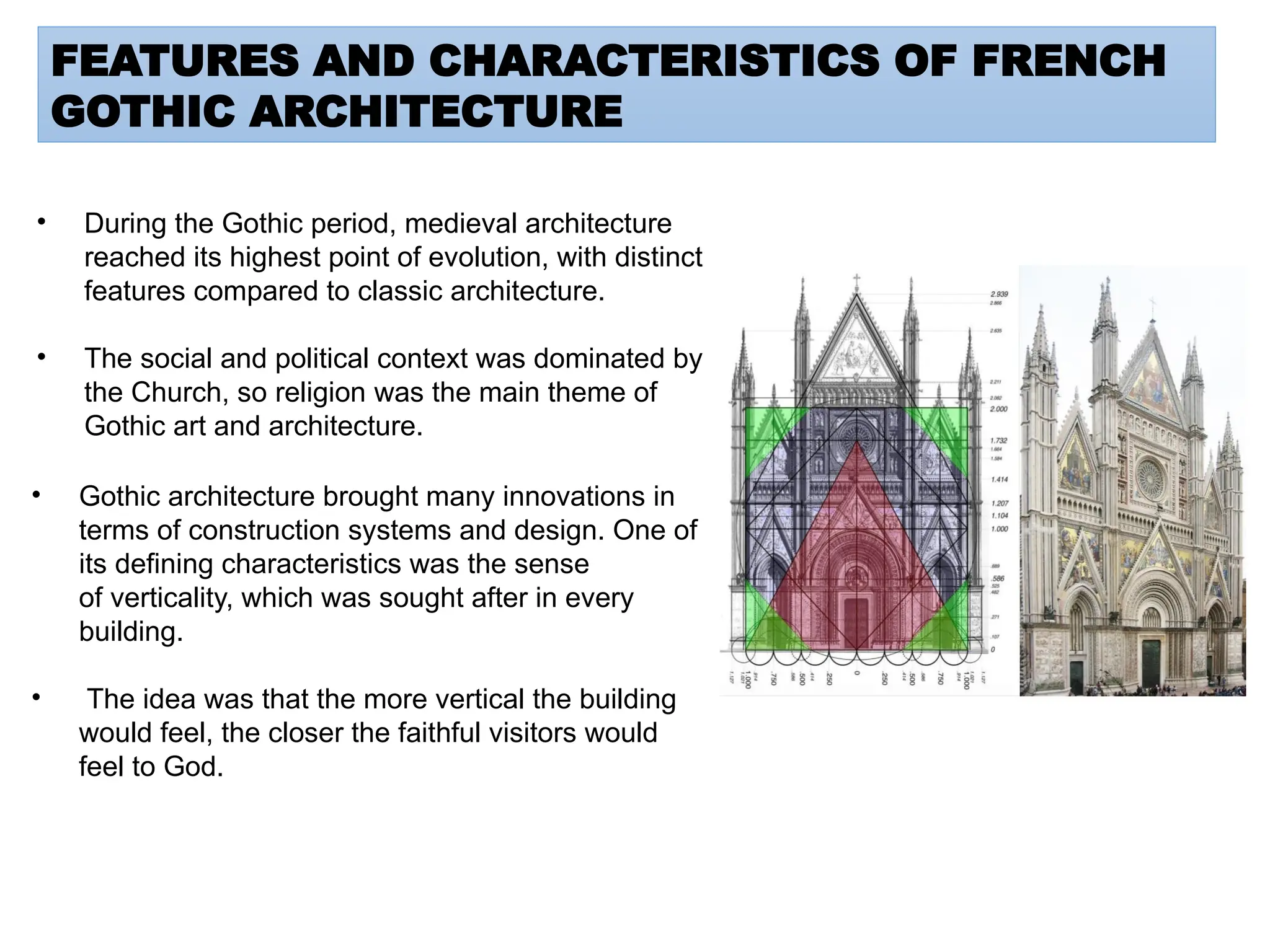
FEATURES AND CHARACTERISTICSOF FRENCH
GOTHIC ARCHITECTURE
• During the Gothic period, medieval architecture
reached its highest point of evolution, with distinct
features compared to classic architecture.
• The social and political context was dominated by
the Church, so religion was the main theme of
Gothic art and architecture.
• Gothic architecture brought many innovations in
terms of construction systems and design. One of
its defining characteristics was the sense
of verticality, which was sought after in every
building.
• The idea was that the more vertical the building
would feel, the closer the faithful visitors would
feel to God.
27.
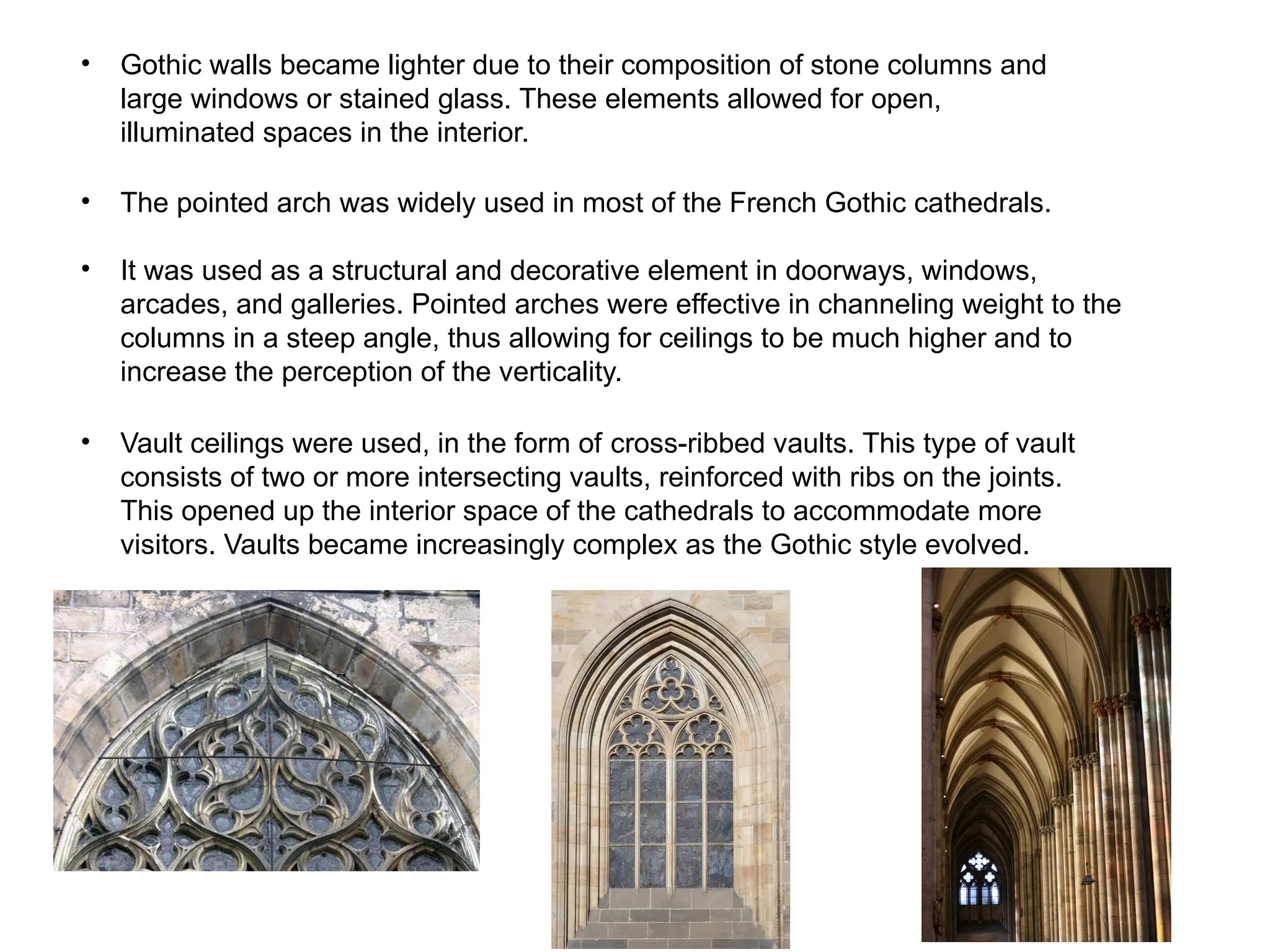
• Gothic wallsbecame lighter due to their composition of stone columns and
large windows or stained glass. These elements allowed for open,
illuminated spaces in the interior.
• The pointed arch was widely used in most of the French Gothic cathedrals.
• It was used as a structural and decorative element in doorways, windows,
arcades, and galleries. Pointed arches were effective in channeling weight to the
columns in a steep angle, thus allowing for ceilings to be much higher and to
increase the perception of the verticality.
• Vault ceilings were used, in the form of cross-ribbed vaults. This type of vault
consists of two or more intersecting vaults, reinforced with ribs on the joints.
This opened up the interior space of the cathedrals to accommodate more
visitors. Vaults became increasingly complex as the Gothic style evolved.
28.
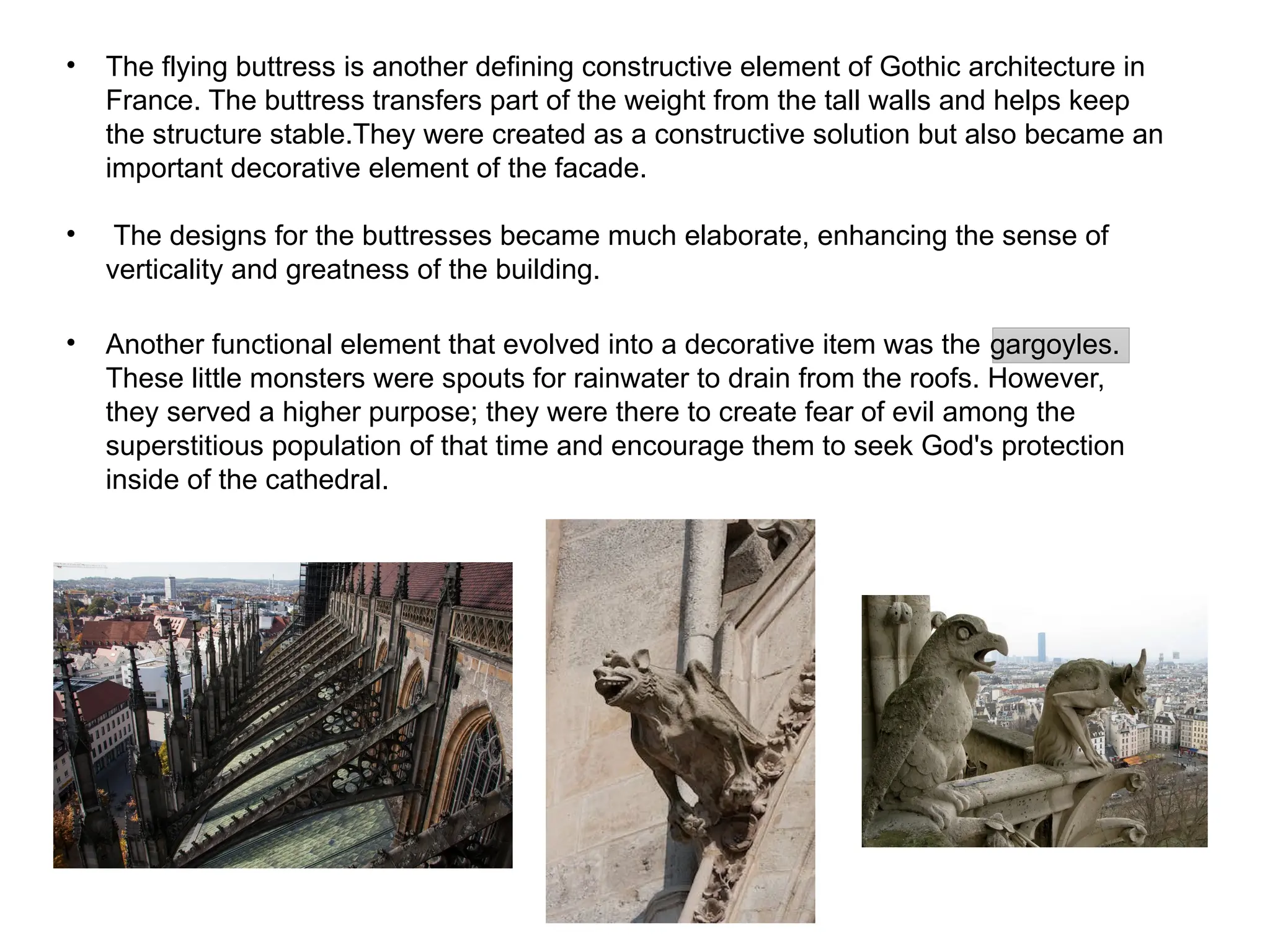
• The flyingbuttress is another defining constructive element of Gothic architecture in
France. The buttress transfers part of the weight from the tall walls and helps keep
the structure stable.They were created as a constructive solution but also became an
important decorative element of the facade.
• The designs for the buttresses became much elaborate, enhancing the sense of
verticality and greatness of the building.
• Another functional element that evolved into a decorative item was the gargoyles.
These little monsters were spouts for rainwater to drain from the roofs. However,
they served a higher purpose; they were there to create fear of evil among the
superstitious population of that time and encourage them to seek God's protection
inside of the cathedral.
HISTORY
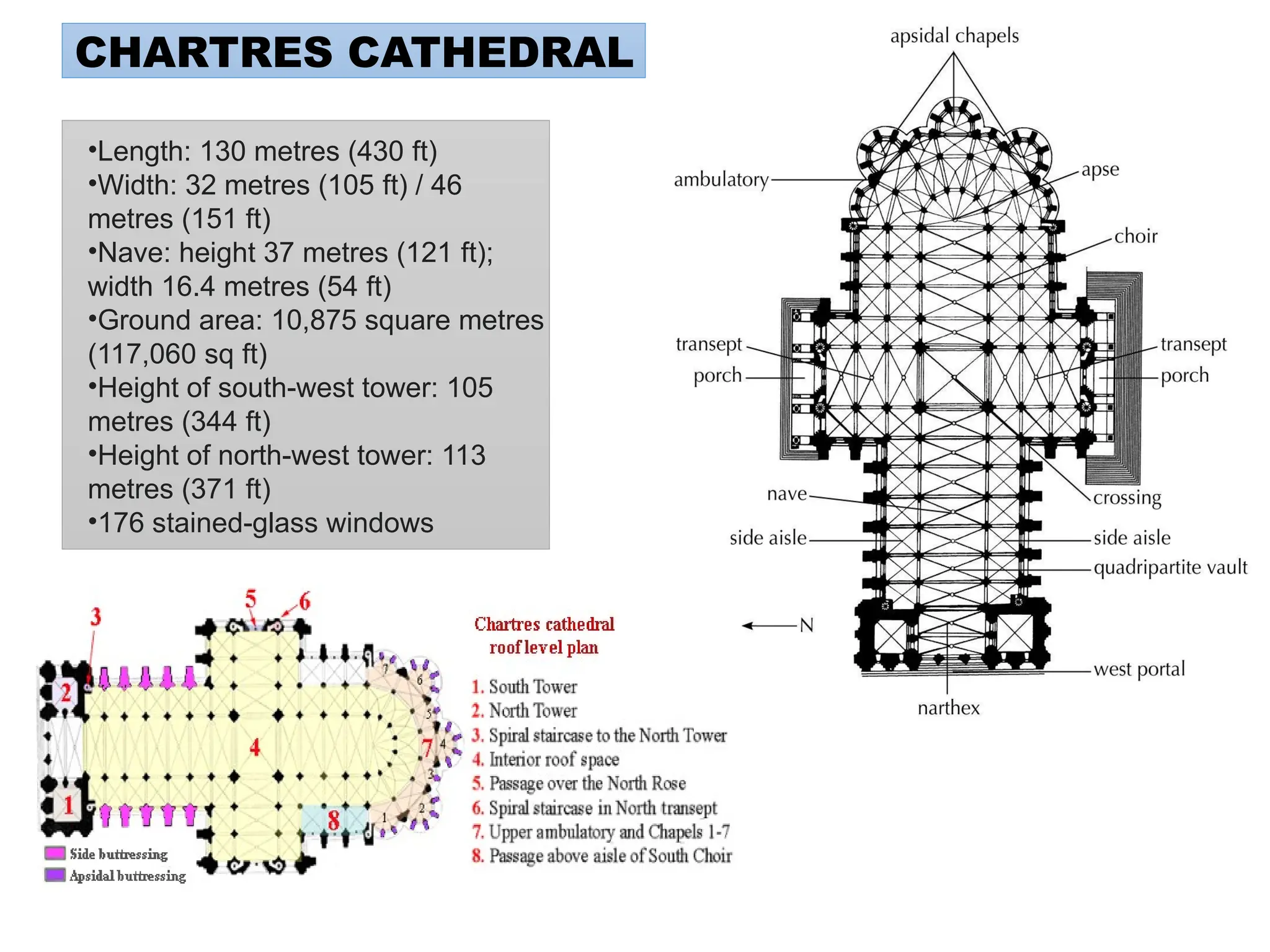
• The ChartresCathedral is located in Chartres, France, which is
about 56 miles from Paris.
• It is said that the construction of it started in the year of 1194 and
ended in 1220.
• Although the construction of the Chartres Cathedral began in
1194, there were many other churches that were built before it on
the same ground, but were burnt down by fires. After the fire on
10th
1194 the construction of famous cathedral started. It stands
on the site of at least five cathedrals that have occupied the site.
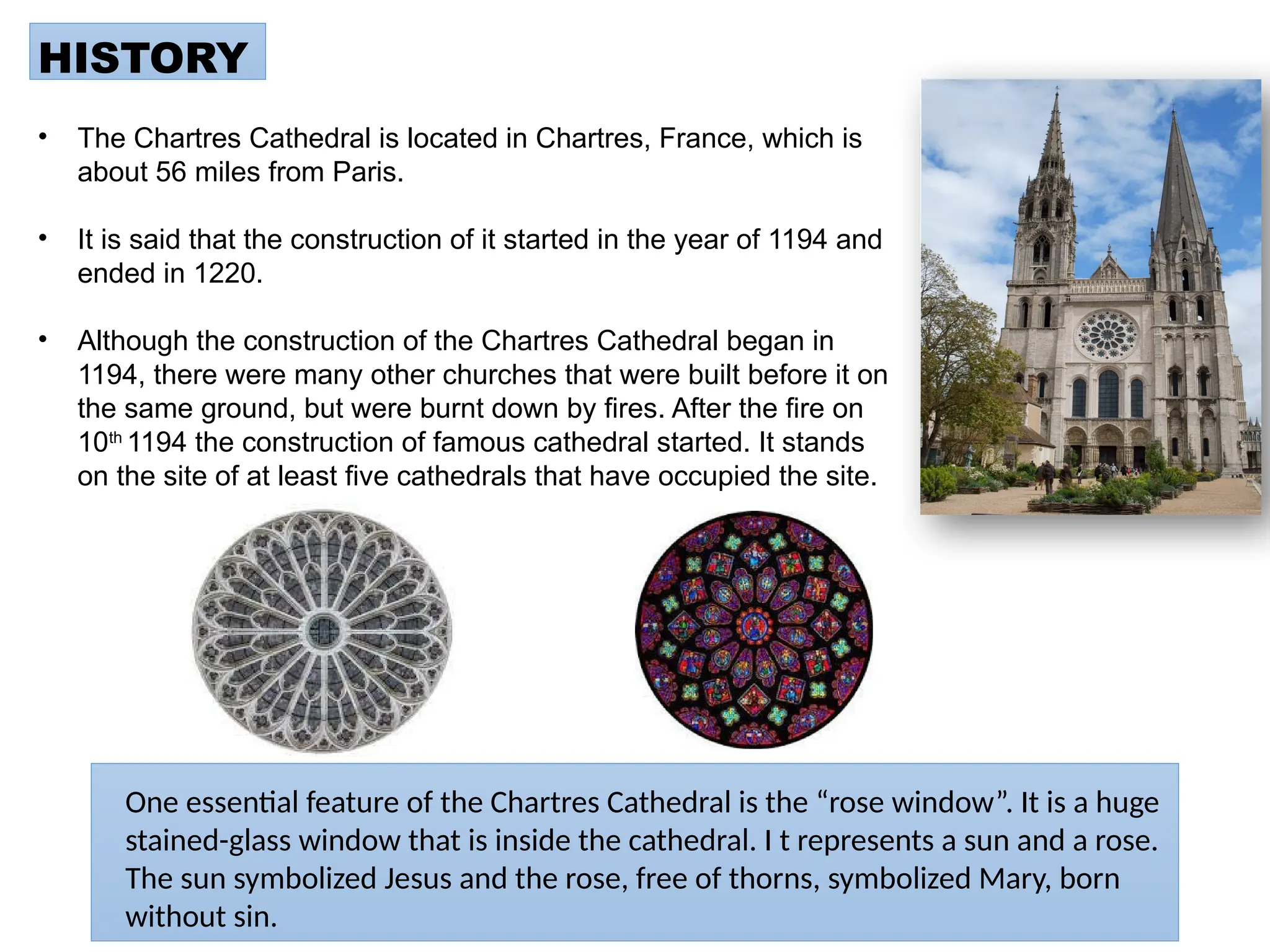
One essential feature of the Chartres Cathedral is the “rose window”. It is a huge
stained-glass window that is inside the cathedral. I t represents a sun and a rose.
The sun symbolized Jesus and the rose, free of thorns, symbolized Mary, born
without sin.
32.
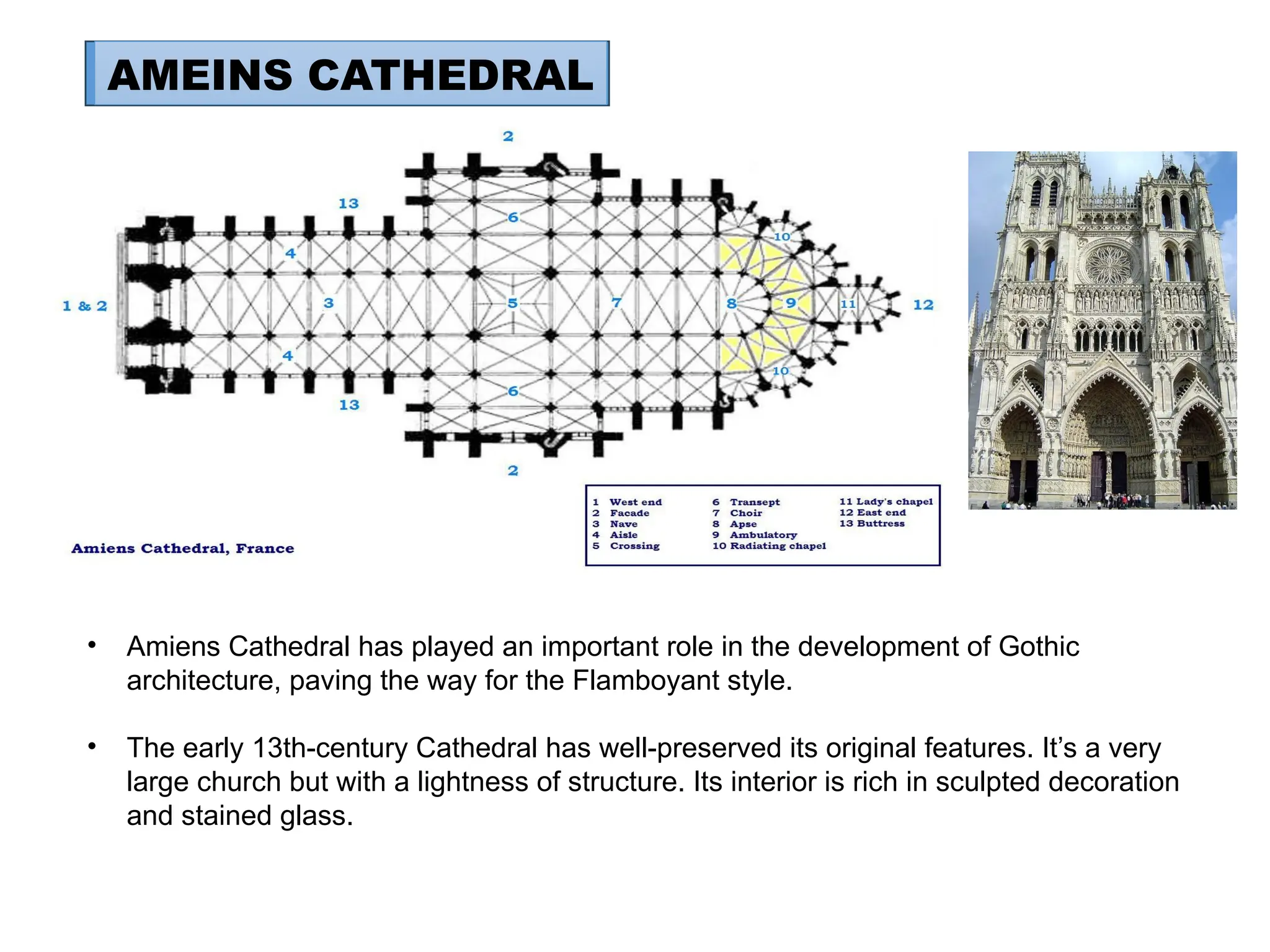
AMEINS CATHEDRAL
• AmiensCathedral has played an important role in the development of Gothic
architecture, paving the way for the Flamboyant style.
• The early 13th-century Cathedral has well-preserved its original features. It’s a very
large church but with a lightness of structure. Its interior is rich in sculpted decoration
and stained glass.
33.
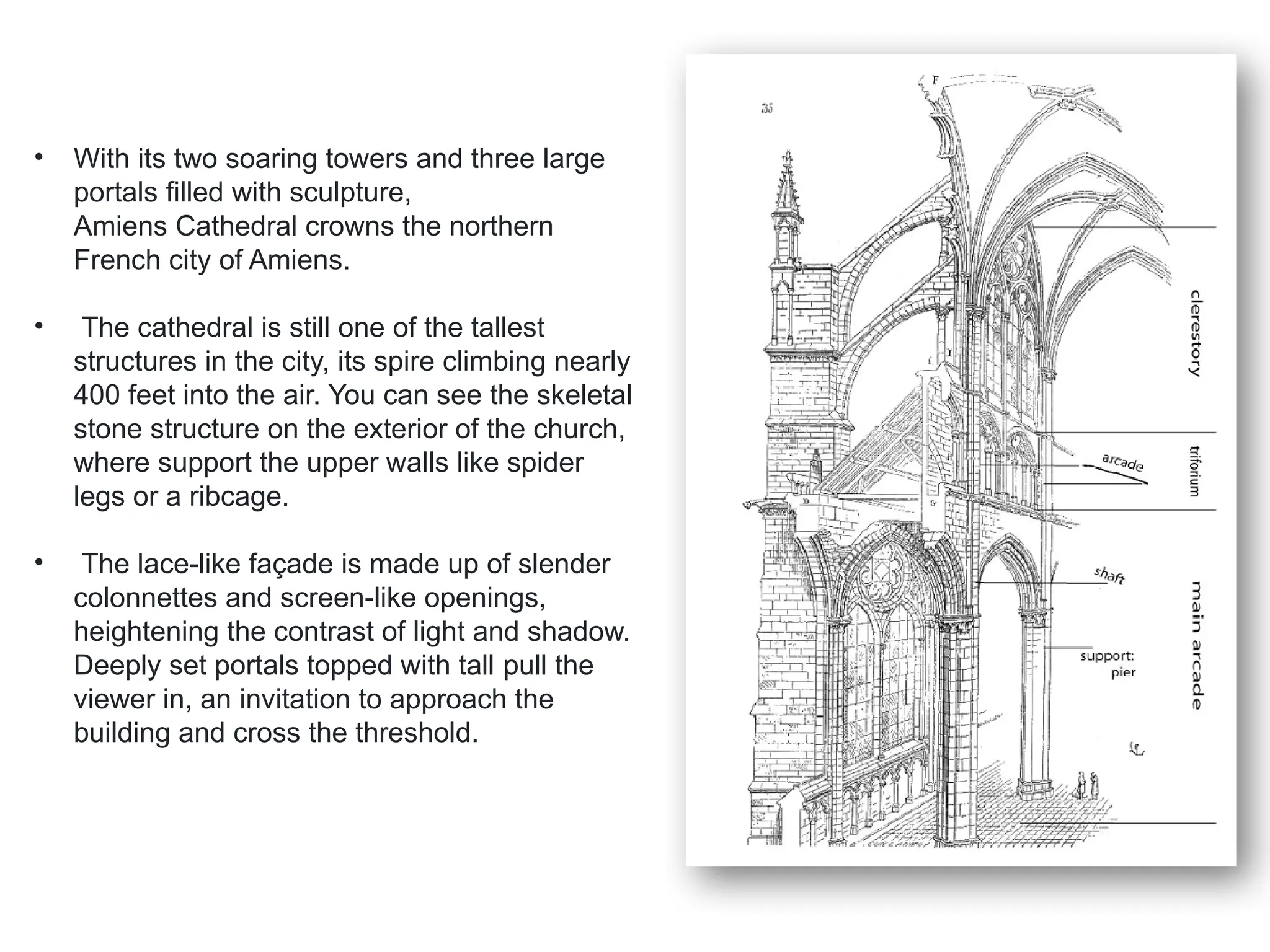
• With itstwo soaring towers and three large
portals filled with sculpture,
Amiens Cathedral crowns the northern
French city of Amiens.
• The cathedral is still one of the tallest
structures in the city, its spire climbing nearly
400 feet into the air. You can see the skeletal
stone structure on the exterior of the church,
where support the upper walls like spider
legs or a ribcage.
• The lace-like façade is made up of slender
colonnettes and screen-like openings,
heightening the contrast of light and shadow.
Deeply set portals topped with tall pull the
viewer in, an invitation to approach the
building and cross the threshold.
34.
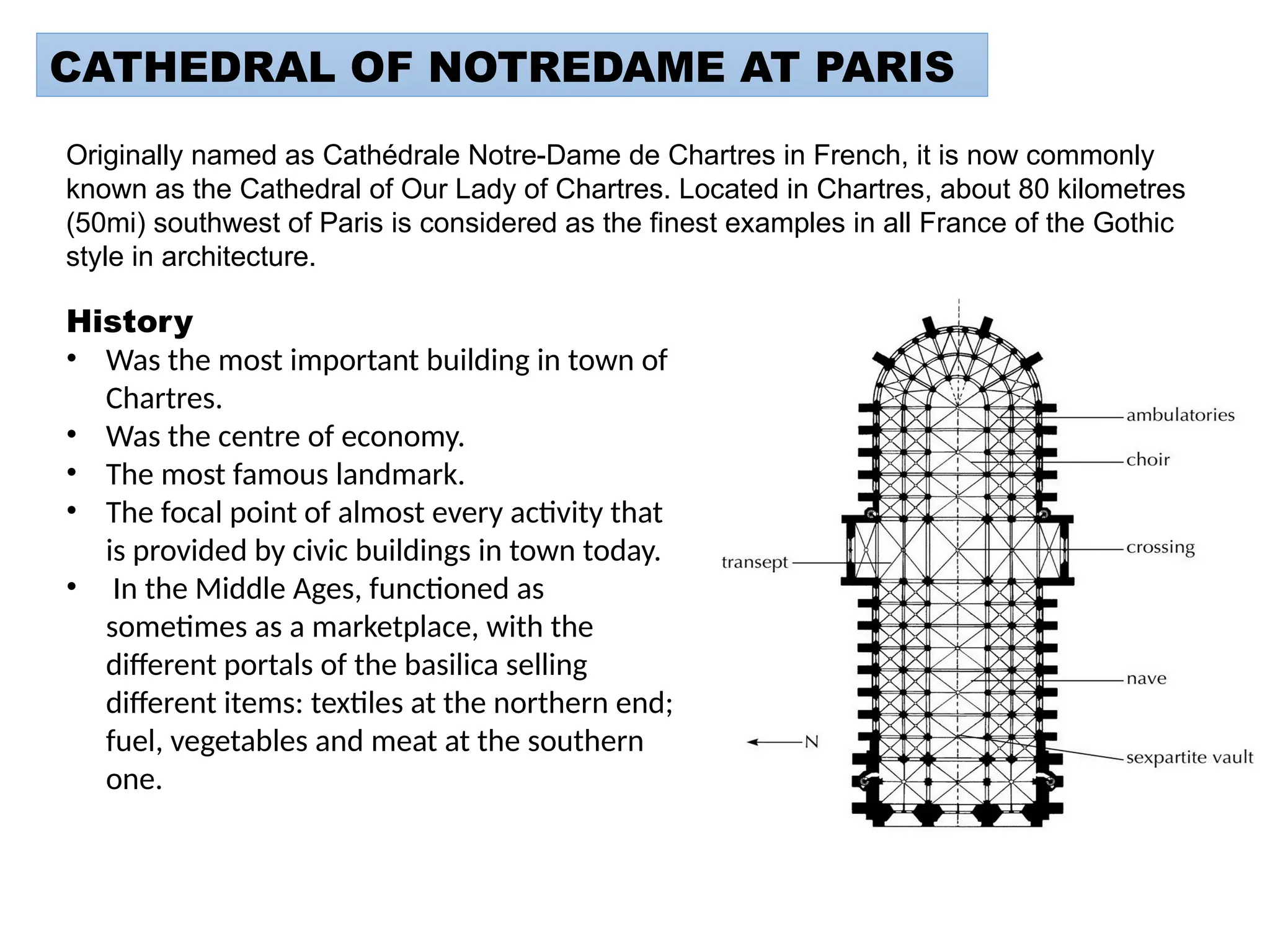
CATHEDRAL OF NOTREDAMEAT PARIS
Originally named as Cathédrale Notre-Dame de Chartres in French, it is now commonly
known as the Cathedral of Our Lady of Chartres. Located in Chartres, about 80 kilometres
(50mi) southwest of Paris is considered as the finest examples in all France of the Gothic
style in architecture.
History
• Was the most important building in town of
Chartres.
• Was the centre of economy.
• The most famous landmark.
• The focal point of almost every activity that
is provided by civic buildings in town today.
• In the Middle Ages, functioned as
sometimes as a marketplace, with the
different portals of the basilica selling
different items: textiles at the northern end;
fuel, vegetables and meat at the southern
one.
36.
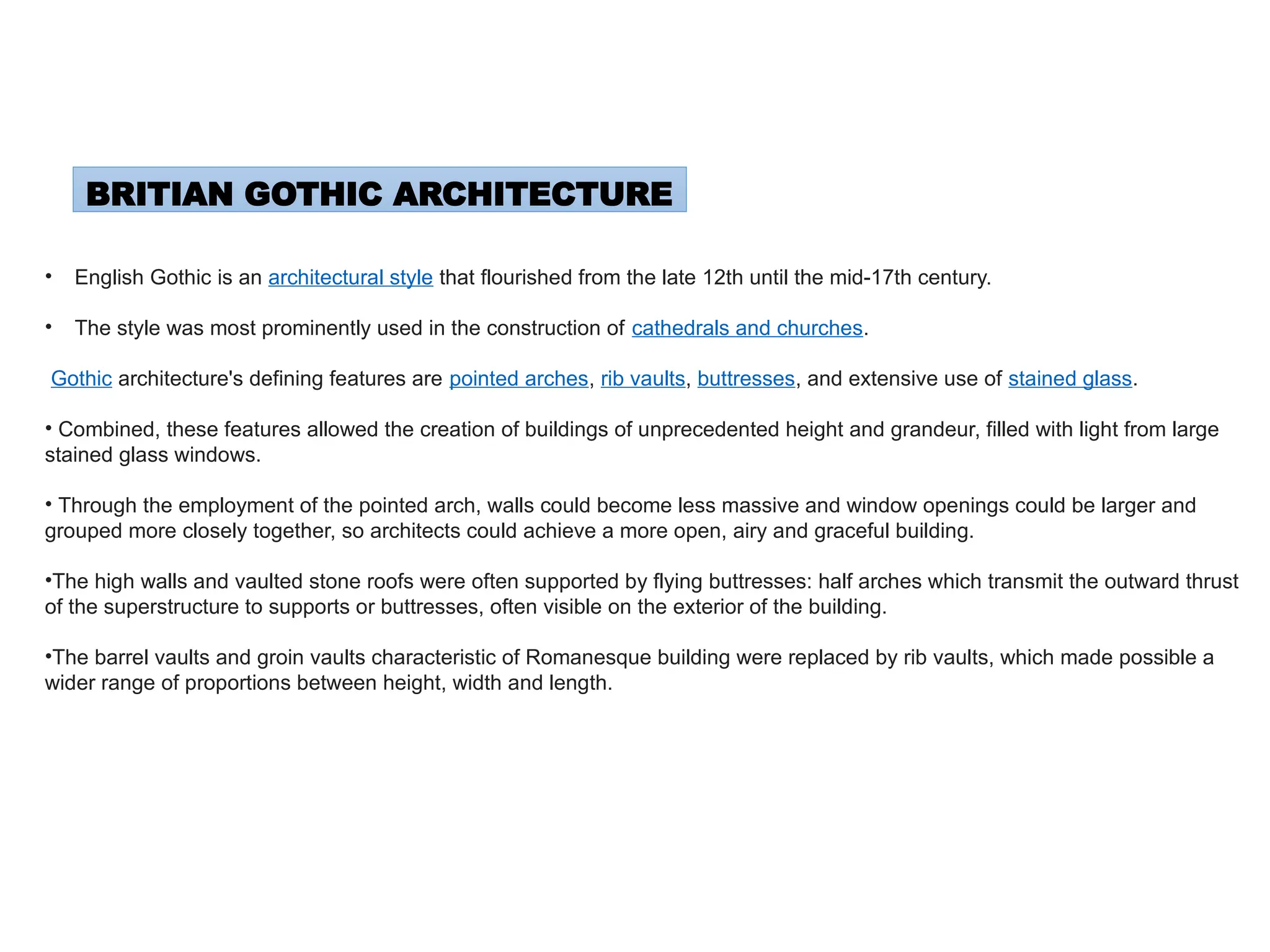
BRITIAN GOTHIC ARCHITECTURE
•English Gothic is an architectural style that flourished from the late 12th until the mid-17th century.
• The style was most prominently used in the construction of cathedrals and churches.
Gothic architecture's defining features are pointed arches, rib vaults, buttresses, and extensive use of stained glass.
• Combined, these features allowed the creation of buildings of unprecedented height and grandeur, filled with light from large
stained glass windows.
• Through the employment of the pointed arch, walls could become less massive and window openings could be larger and
grouped more closely together, so architects could achieve a more open, airy and graceful building.
•The high walls and vaulted stone roofs were often supported by flying buttresses: half arches which transmit the outward thrust
of the superstructure to supports or buttresses, often visible on the exterior of the building.
•The barrel vaults and groin vaults characteristic of Romanesque building were replaced by rib vaults, which made possible a
wider range of proportions between height, width and length.
• They arecomparatively short and wide, and are often completely surrounded
by chapels. Spanish Cathedrals are stylistically diverse.
• Influences on both decoration and form are Islamic architecture, and towards
the end of the period, Renaissance details combined with the Gothic in a
distinctive manner.
• The West front resembles a French west front, There are spires of German
style.
• There are often towers and domes of a great variety of shapes and structural
invention rising above the roof.
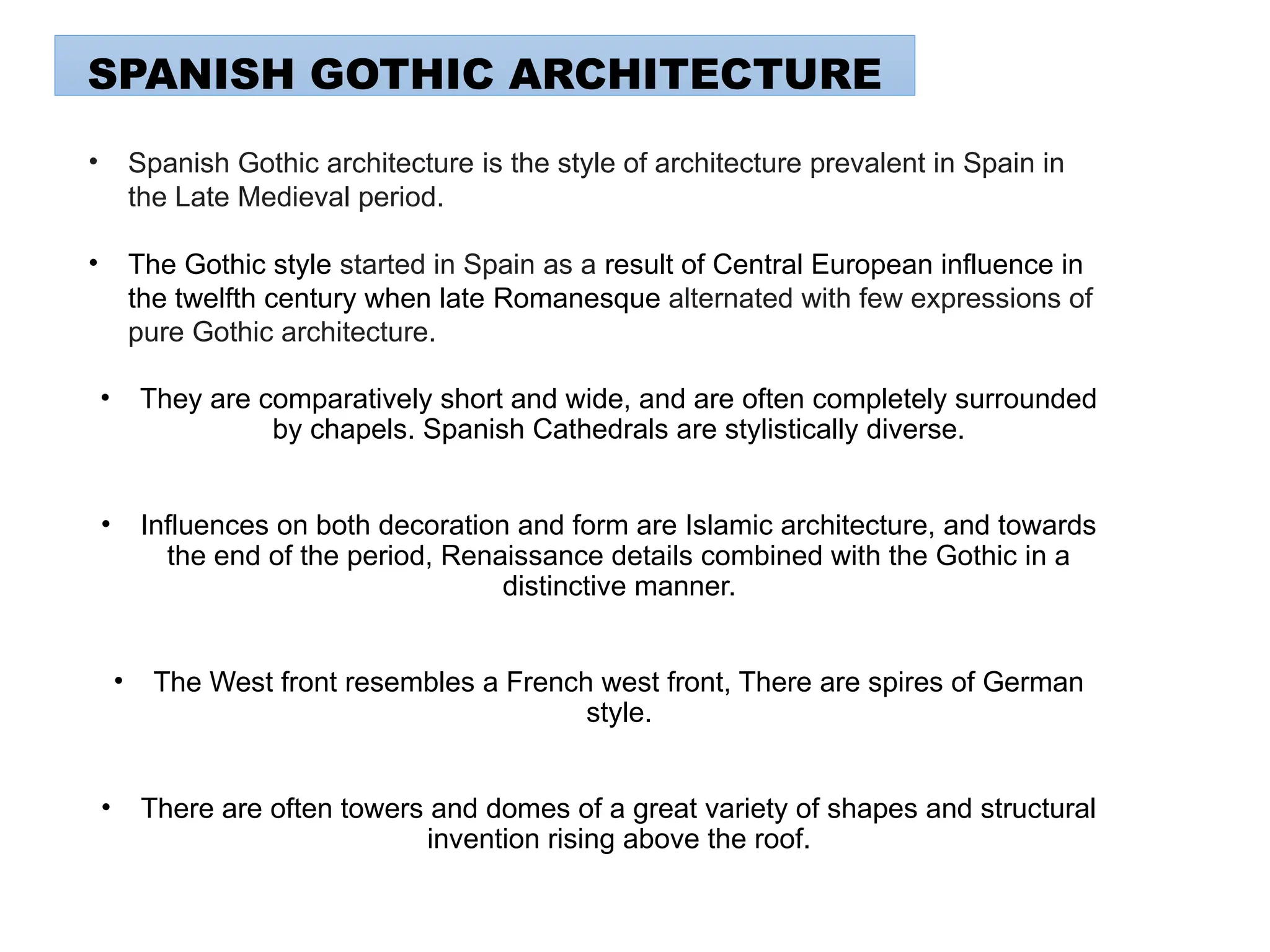
SPANISH GOTHIC ARCHITECTURE
• Spanish Gothic architecture is the style of architecture prevalent in Spain in
the Late Medieval period.
• The Gothic style started in Spain as a result of Central European influence in
the twelfth century when late Romanesque alternated with few expressions of
pure Gothic architecture.
40.
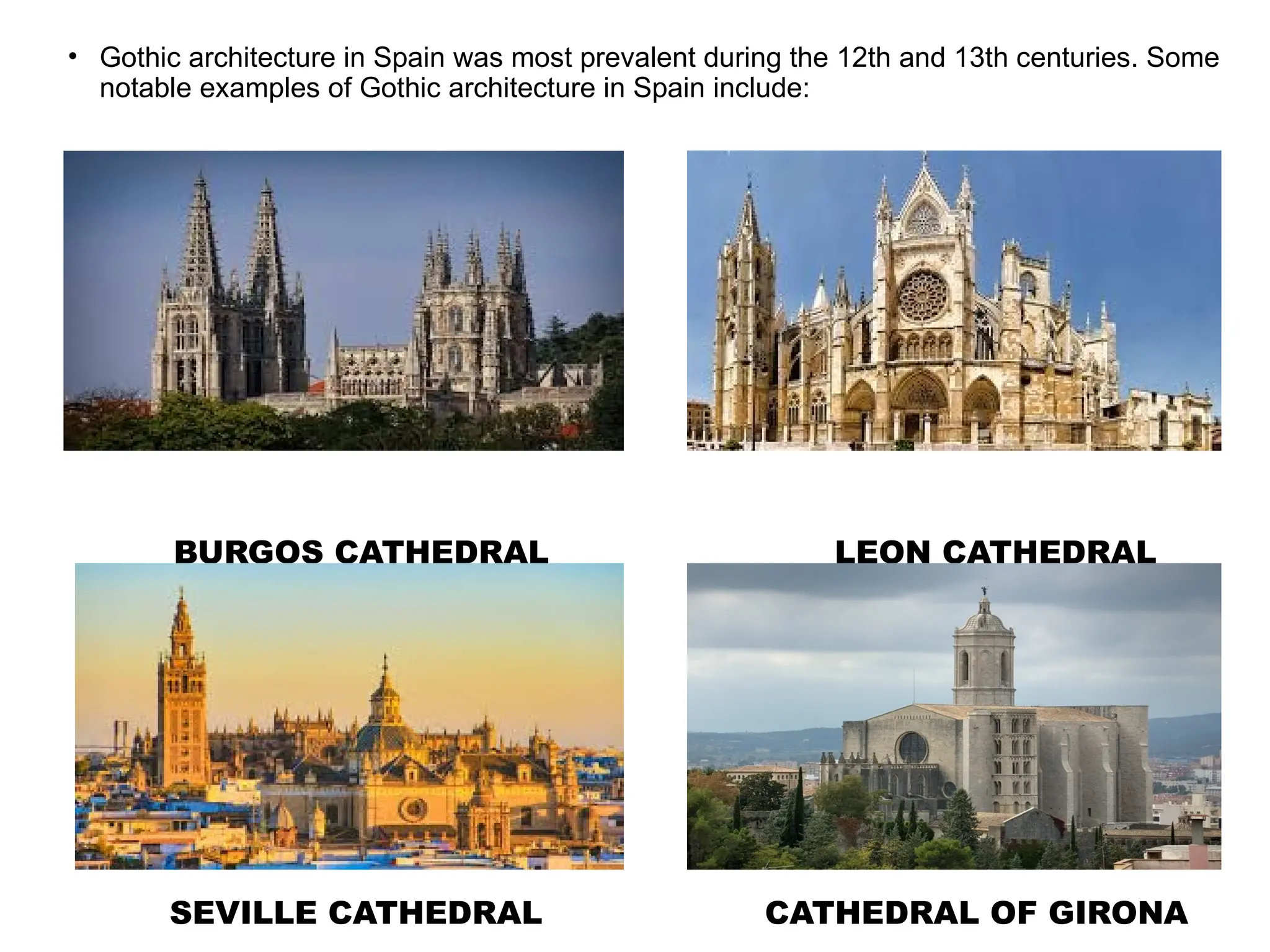
• Gothic architecturein Spain was most prevalent during the 12th and 13th centuries. Some
notable examples of Gothic architecture in Spain include:
BURGOS CATHEDRAL LEON CATHEDRAL
SEVILLE CATHEDRAL CATHEDRAL OF GIRONA
41.
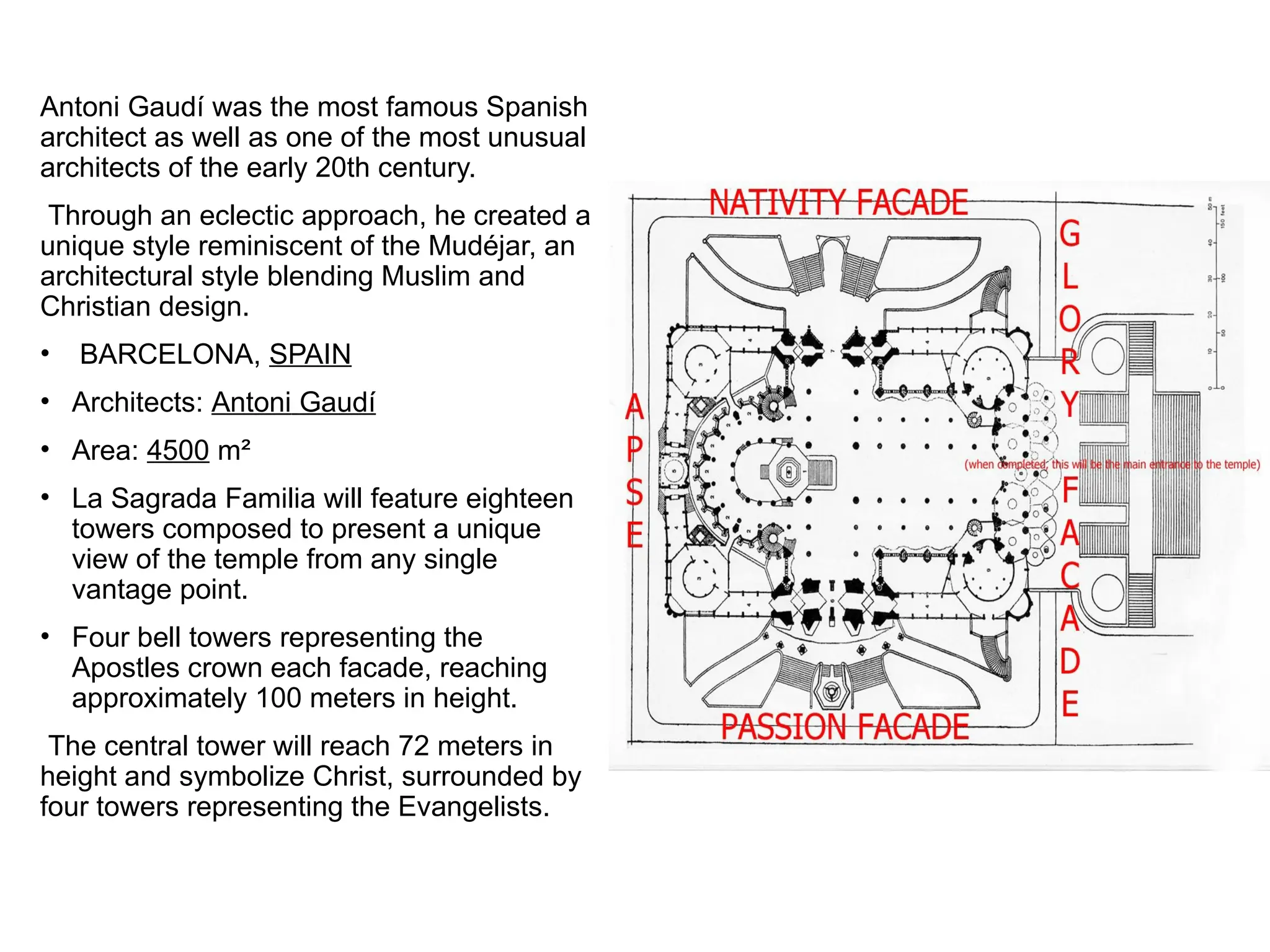
Antoni Gaudí wasthe most famous Spanish
architect as well as one of the most unusual
architects of the early 20th century.
Through an eclectic approach, he created a
unique style reminiscent of the Mudéjar, an
architectural style blending Muslim and
Christian design.
• BARCELONA, SPAIN
• Architects: Antoni Gaudí
• Area: 4500 m²
• La Sagrada Familia will feature eighteen
towers composed to present a unique
view of the temple from any single
vantage point.
• Four bell towers representing the
Apostles crown each facade, reaching
approximately 100 meters in height.
The central tower will reach 72 meters in
height and symbolize Christ, surrounded by
four towers representing the Evangelists.