HUMANITIES
Old saint peters BASILICA.
Subhashini R.
Harshada bhandarkar.
Shreya Shetty
Sarthak gholap
Mrunmayi ghorpade.
Tejas dhuri
Peathmesh mane
Siddhant jadhav
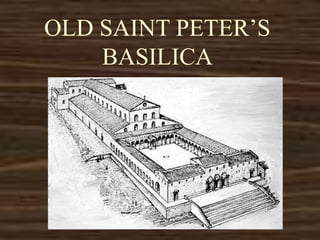
OLD SAINT PETER’S
BASILICA
Introduction
Old St. Peter's Basilica was a prototype for
developments in Christian architecture.
Old St. Peter's, was both a martyrium (built over
the grave site of Saint Peter, it marked and
commemorated his martyrdom) and a basilica
used for worship.
The size of Old St. Peter's mirrors the triumphant
attitude of Christianity following the Edict of
Milan in 313, which granted religious freedom
to the Christians
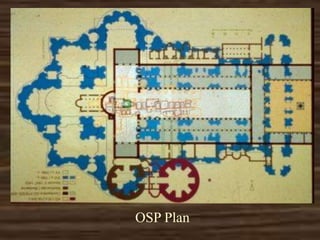
It is a five aisled basilican- plan church with
apsed transept at the west end.
TIME LINE
It is the first basilica of saint
peter in Rome.
Its construction begun between
326 and 333 at the order of
the Roman emperor
Constantine.
It took about 30 years to
complete.
Old St. Peter’s was torn down
in the early 16th century and
replaced by new St. Peter’s
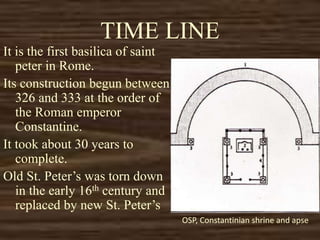
OSP, Constantinian shrine and apse
EARLY CHRISTIAN
ARCHITECTURE
Basilical church developed from Roman
secular basilica; centralized type from Roman
tombs.
Basilical plan modified for liturgical
requirements; congregation and clergy
segregated in nave and aisles vs. transept and
apse. Different variants in East and West.
The plan was initially adapted from the
Roman basilica which was usually entered on its
long side, but the Christian church was entered
through an atrium and narthex (entrance hall) on
its short side.
This narthex was usually on the west, and the
altar was toward the east, an orientation followed
in most later medieval churches.
OSP Plan
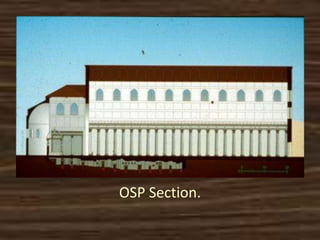
OSP Section.
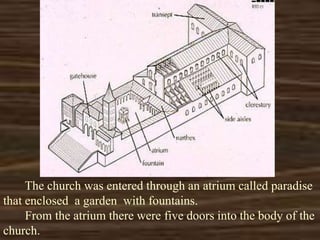
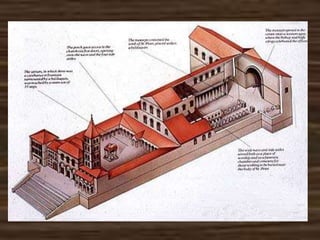
The church was entered through an atrium called paradise
that enclosed a garden with fountains.
From the atrium there were five doors into the body of the
church.
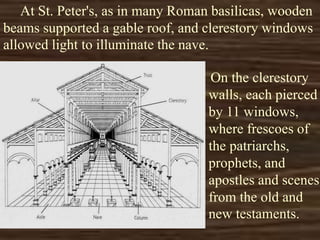
At St. Peter's, as in many Roman basilicas, wooden
beams supported a gable roof, and clerestory windows
allowed light to illuminate the nave.
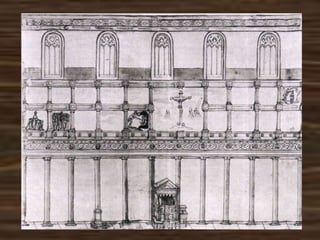
On the clerestory
walls, each pierced
by 11 windows,
where frescoes of
the patriarchs,
prophets, and
apostles and scenes
from the old and
new testaments.
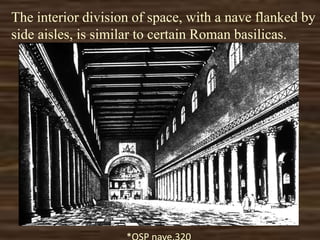
The interior division of space, with a nave flanked by
side aisles, is similar to certain Roman basilicas.
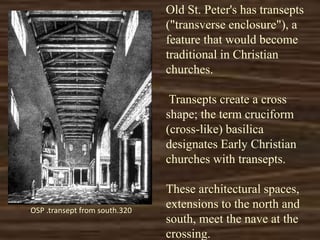
*OSP .transept from south.320
Old St. Peter's has transepts
("transverse enclosure"), a
feature that would become
traditional in Christian
churches.
Transepts create a cross
shape; the term cruciform
(cross-like) basilica
designates Early Christian
churches with transepts.
These architectural spaces,
extensions to the north and
south, meet the nave at the
crossing.
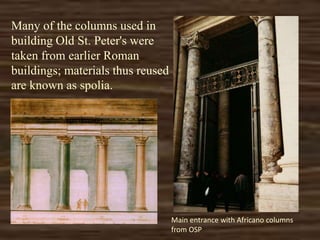
Many of the columns used in
building Old St. Peter's were
taken from earlier Roman
buildings; materials thus reused
are known as spolia.
Main entrance with Africano columns
from OSP
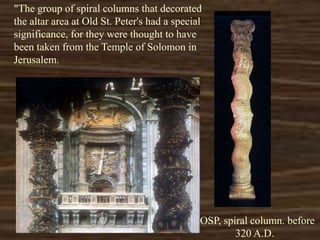
"The group of spiral columns that decorated
the altar area at Old St. Peter's had a special
significance, for they were thought to have
been taken from the Temple of Solomon in
Jerusalem.
*OSP, spiral column. before
320 A.D.
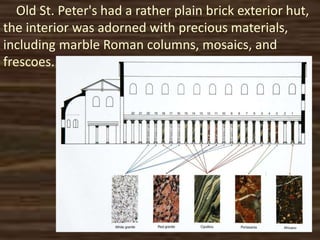
Old St. Peter's had a rather plain brick exterior hut,
the interior was adorned with precious materials,
including marble Roman columns, mosaics, and
frescoes.
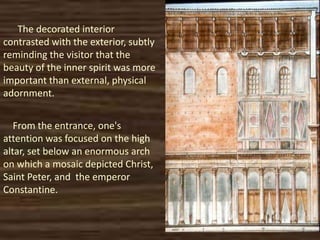
The decorated interior
contrasted with the exterior, subtly
reminding the visitor that the
beauty of the inner spirit was more
important than external, physical
adornment.
From the entrance, one's
attention was focused on the high
altar, set below an enormous arch
on which a mosaic depicted Christ,
Saint Peter, and the emperor
Constantine.
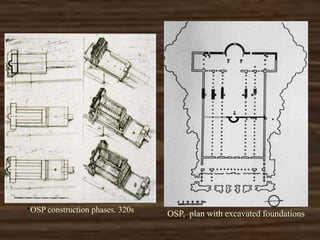
*OSP construction phases. 320s OSP, plan with excavated foundations
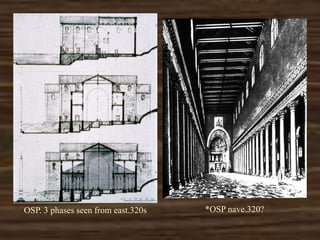
OSP. 3 phases seen from east.320s *OSP nave.320?
Old saint peter’s basilica

Old saint peter’s basilica

  • 1.
    HUMANITIES Old saint petersBASILICA. Subhashini R. Harshada bhandarkar. Shreya Shetty Sarthak gholap Mrunmayi ghorpade. Tejas dhuri Peathmesh mane Siddhant jadhav
  • 2.
  • 3.
    Introduction Old St. Peter'sBasilica was a prototype for developments in Christian architecture. Old St. Peter's, was both a martyrium (built over the grave site of Saint Peter, it marked and commemorated his martyrdom) and a basilica used for worship. The size of Old St. Peter's mirrors the triumphant attitude of Christianity following the Edict of Milan in 313, which granted religious freedom to the Christians It is a five aisled basilican- plan church with apsed transept at the west end.
  • 4.
    TIME LINE It isthe first basilica of saint peter in Rome. Its construction begun between 326 and 333 at the order of the Roman emperor Constantine. It took about 30 years to complete. Old St. Peter’s was torn down in the early 16th century and replaced by new St. Peter’s OSP, Constantinian shrine and apse
  • 5.
    EARLY CHRISTIAN ARCHITECTURE Basilical churchdeveloped from Roman secular basilica; centralized type from Roman tombs. Basilical plan modified for liturgical requirements; congregation and clergy segregated in nave and aisles vs. transept and apse. Different variants in East and West.
  • 6.
    The plan wasinitially adapted from the Roman basilica which was usually entered on its long side, but the Christian church was entered through an atrium and narthex (entrance hall) on its short side. This narthex was usually on the west, and the altar was toward the east, an orientation followed in most later medieval churches.
  • 7.
  • 8.
  • 9.
    The church wasentered through an atrium called paradise that enclosed a garden with fountains. From the atrium there were five doors into the body of the church.
  • 10.
    At St. Peter's,as in many Roman basilicas, wooden beams supported a gable roof, and clerestory windows allowed light to illuminate the nave. On the clerestory walls, each pierced by 11 windows, where frescoes of the patriarchs, prophets, and apostles and scenes from the old and new testaments.
  • 11.
    The interior divisionof space, with a nave flanked by side aisles, is similar to certain Roman basilicas.
  • 12.
    *OSP .transept fromsouth.320 Old St. Peter's has transepts ("transverse enclosure"), a feature that would become traditional in Christian churches. Transepts create a cross shape; the term cruciform (cross-like) basilica designates Early Christian churches with transepts. These architectural spaces, extensions to the north and south, meet the nave at the crossing.
  • 13.
    Many of thecolumns used in building Old St. Peter's were taken from earlier Roman buildings; materials thus reused are known as spolia. Main entrance with Africano columns from OSP
  • 14.
    "The group ofspiral columns that decorated the altar area at Old St. Peter's had a special significance, for they were thought to have been taken from the Temple of Solomon in Jerusalem. *OSP, spiral column. before 320 A.D.
  • 15.
    Old St. Peter'shad a rather plain brick exterior hut, the interior was adorned with precious materials, including marble Roman columns, mosaics, and frescoes.
  • 16.
    The decorated interior contrastedwith the exterior, subtly reminding the visitor that the beauty of the inner spirit was more important than external, physical adornment. From the entrance, one's attention was focused on the high altar, set below an enormous arch on which a mosaic depicted Christ, Saint Peter, and the emperor Constantine.
  • 18.
    *OSP construction phases.320s OSP, plan with excavated foundations
  • 19.
    OSP. 3 phasesseen from east.320s *OSP nave.320?