Glucosuria
An Overview
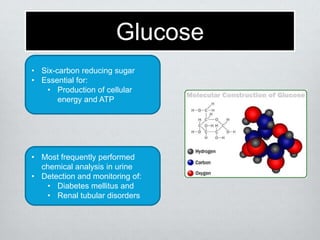
Glucose
• Six-carbon reducing sugar
• Essential for:
• Production of cellular
energy and ATP

• Most frequently performed
chemical analysis in urine
• Detection and monitoring of:
• Diabetes mellitus and
• Renal tubular disorders
What is Glycosuria?
 Appearance of glucose in urine following cessation

of active transport (tubular reabsorption) as renal
threshold is exceeded
160 – 180 mg/dL

 What is the renal threshold?
 90% filtered glucose is reabsorbed

in the PCT

Tubular maximum for
glucose reabsorption: 260350 mg/min/1.73 m2

 Remaining: proximal straight tubule,

loop of Henle, collecting duct
 0.05% of renal glucose load -> excreted in urine
Glucose Reagent Strip
 Provides a specific test for glucose
 Strip pads are impregnated with glucose oxidase

and peroxidase ( double sequential enzyme
reaction)
 False positive: detergent, peroxide, strong

oxidizing agents
 False negative: ascorbic acid, ketones, high

specific gravity, low temperature and improper
preservation of long-standing urine
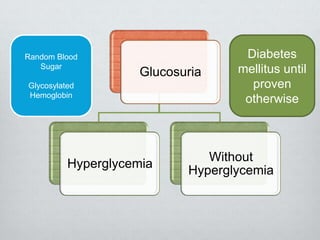
Random Blood
Sugar

Glucosuria

Glycosylated
Hemoglobin

Hyperglycemia

Diabetes
mellitus until
proven
otherwise

Without
Hyperglycemia
Causes of glycosuria
 Glycosuria with hyperglycaemia-

diabetes,acromegaly, cushing’s disease,
hyperthyroidism, drugs like corticosteroids.
 Glycosuria without hyperglycaemia- renal tubular

dysfunction
Diabetes mellitus


Diabetes mellitus (DM) is an important endocrine disorder that
presents commonly in children and adolescents.
Diabetes mellitus Type I





Diabetes mellitus Type II

one of the most common
chronic diseases in children



Characterized by insulin
deficiency as a result of
autoimmune destruction of
pancreatic beta islet cells;

Presence of high blood
glucose with insulin
resistance and relative
insulin deficiency



Estimated 3600/100,000
cases of type 2 DM in
Canadian adolescents and
Diabetes mellitus Type I


Approximately 2/3 of all new diabetes diagnoses in patients less than
19 years of age in the United States are type 1 DM.



Age of onset has a bimodal distribution,



first peak in children 4-6 years old, and the
second peak in children 10-14 years old (early puberty).
Glycosuria with Hyperglycemia
Diabetes mellitus Type I


autoimmune-mediated destruction of insulin-producing
pancreatic beta cells that results in insulin deficiency.



It is a progressive condition



A large number of functional beta cells must be lost before
clinical symptoms like hyperglycemia occurs.

Classic new onset:
Hyperglycemia without
acidosis
Glycosuria with Hyperglycemia
Diabetes mellitus Type I





Symptoms include:
Polyuria – serum glucose
> 10 mmol/L (exceeding
renal threshold for glucose
à increased urinary glucose
excretion)
Can present as nocturia,
bedwetting, daytime
incontinence in a previously
continent child

 Polydipsia – due to

increased serum
osmolality and
hypovolemia
 Weight loss – due to

hypovolemia and
increased catabolism


Impaired glucose
utilization in skeletal
muscle and increased
fat and muscle
breakdown
Glycosuria with Hyperglycemia
Diabetes mellitus Type I




Clinical: polydipsia, polyuria,
dehydration, hypotension,
ketosis, etc.
Metabolic: hyperglycemia,
glycosuria, metabolic
acidosis, ketonemia, etc.



Reported frequency varies
between 15-67%



Young children (<6) from low
socioeconomic backgrounds
are more likely to present
with diabetic ketoacidosis

 Silent Presentation
 Diagnosis before

onset of clinical
symptoms
 Typically occurs in

children with a family
member with type 1
DM (close
monitoring)
Glycosuria without Hyperglycemia
Renal Glycosuria Dysfunction
• Rare metabolic disorder;

• excretion of glucose in the urine in the presence of normal plasma
glucose levels.
• Inherited form: involves a reduction in the glucose transport
maximum (the maximum rate at which glucose can be resorbed)
and subsequent escape of glucose in the urine.
• Glucose transporters:
•

Acquired form: occurs primarily in advanced chronic kidney
disease.
Glycosuria without Hyperglycemia
Renal Glycosuria Dysfunction
 Variable amounts of glucose are excreted in the

urine at normal concentrations of blood glucose
 Renal defect is specific for glucose only
 A benign condition

 The metabolism, storage and use of carbohydrates

and insulin secretions are normal
Glycosuria without Hyperglycemia
Renal Glycosuria Dysfunction
 The disorder is typically initially noted on routine

urinalysis.
 Diagnosis is based on finding glucose in a 24-h urine

collection (when the diet contains 50% carbohydrate) in
the absence of hyperglycemia (serum glucose < 140
mg/dL).
 To confirm that the excreted sugar is glucose and to

exclude pentosuria, fructosuria, sucrosuria, maltosuria,
galactosuria, and lactosuria, the glucose oxidase
 Method should be used for all laboratory measurements.

Some experts require a normal result on an oral glucose
tolerance test for the diagnosis.
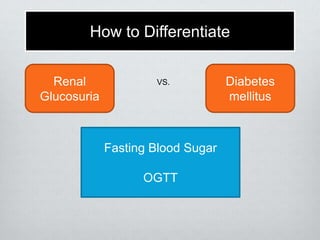
How to Differentiate
Renal
Glucosuria

VS.

Fasting Blood Sugar
OGTT

Diabetes
mellitus
Glycosuria without Hyperglycemia
Renal Glycosuria Dysfunction


Autosomal recessive, some autosomal dominant



Mechanism: isolated, selective defect in the proximal tubular
glucose trasnport



Two Types:


Type A or Classic Renal Glycosuria:
 Minimal glucose threshold and maximum rate of glucose

reabsorption are reduced
 Reflects reduction in the capacity of the glucose transport

system which might arise from a uniform defect in all nephrons



Type B
 Minimal glucose threshold is reduced
 Decrease in the affinity of the transport system
Glycosuria without Hyperglycemia
Renal Glycosuria Dysfunction

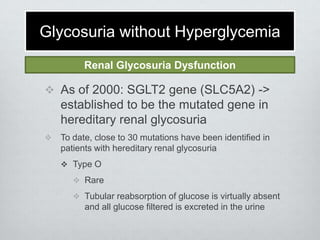
 As of 2000: SGLT2 gene (SLC5A2) ->

established to be the mutated gene in
hereditary renal glycosuria


To date, close to 30 mutations have been identified in
patients with hereditary renal glycosuria
 Type O
 Rare

 Tubular reabsorption of glucose is virtually absent

and all glucose filtered is excreted in the urine
Glycosuria without Hyperglycemia
Renal Glycosuria Dysfunction
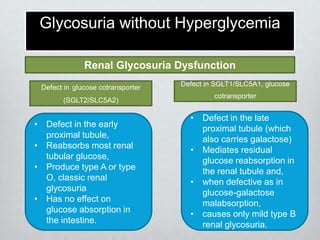
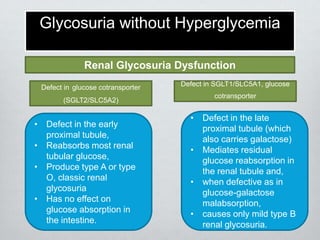
Defect in glucose cotransporter
(SGLT2/SLC5A2)

• Defect in the early
proximal tubule,
• Reabsorbs most renal
tubular glucose,
• Produce type A or type
O, classic renal
glycosuria
• Has no effect on
glucose absorption in
the intestine.

Defect in SGLT1/SLC5A1, glucose

cotransporter

• Defect in the late
proximal tubule (which
also carries galactose)
• Mediates residual
glucose reabsorption in
the renal tubule and,
• when defective as in
glucose-galactose
malabsorption,
• causes only mild type B
renal glycosuria.
Glycosuria without Hyperglycemia
Renal Glycosuria Dysfunction

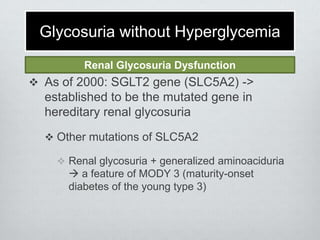
 As of 2000: SGLT2 gene (SLC5A2) ->

established to be the mutated gene in
hereditary renal glycosuria
 Other mutations of SLC5A2
 Renal glycosuria + generalized aminoaciduria

 a feature of MODY 3 (maturity-onset
diabetes of the young type 3)
Glycosuria without Hyperglycemia
Renal Glycosuria Dysfunction
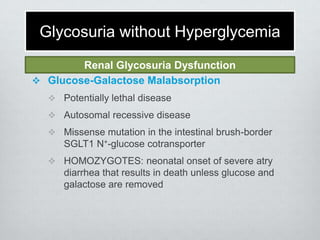
 Glucose-Galactose Malabsorption
 Potentially lethal disease
 Autosomal recessive disease
 Missense mutation in the intestinal brush-border

SGLT1 N+-glucose cotransporter
 HOMOZYGOTES: neonatal onset of severe atry

diarrhea that results in death unless glucose and
galactose are removed
Glycosuria without Hyperglycemia
Renal Glycosuria Dysfunction
 Glucose-Galactose Malabsorption
 Jejunal biopsy: defect in intestinal Na+- dependent

glucose transport
 Mild defect in renal tubular reabsorption of glucose

with decreased renal threshold for glucose
 Renal glycosuria: mutation in SGLT2
 No defect in intestinal D-gluose absorption
Glycosuria without Hyperglycemia
Renal Glycosuria Dysfunction
Defect in glucose cotransporter
(SGLT2/SLC5A2)

• Defect in the early
proximal tubule,
• Reabsorbs most renal
tubular glucose,
• Produce type A or type
O, classic renal
glycosuria
• Has no effect on
glucose absorption in
the intestine.

Defect in SGLT1/SLC5A1, glucose

cotransporter

• Defect in the late
proximal tubule (which
also carries galactose)
• Mediates residual
glucose reabsorption in
the renal tubule and,
• when defective as in
glucose-galactose
malabsorption,
• causes only mild type B
renal glycosuria.
Glycosuria without Hyperglycemia
Renal Glycosuria Dysfunction
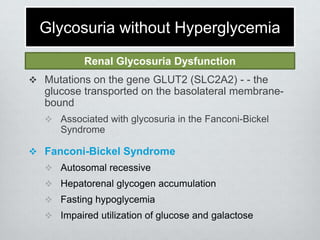
 Mutations on the gene GLUT2 (SLC2A2) - - the

glucose transported on the basolateral membranebound
 Associated with glycosuria in the Fanconi-Bickel

Syndrome
 Fanconi-Bickel Syndrome
 Autosomal recessive
 Hepatorenal glycogen accumulation
 Fasting hypoglycemia
 Impaired utilization of glucose and galactose
Glycosuria without Hyperglycemia
Renal Glycosuria Dysfunction
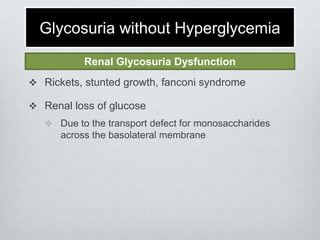
 Rickets, stunted growth, fanconi syndrome
 Renal loss of glucose
 Due to the transport defect for monosaccharides

across the basolateral membrane
Glucosuria

Glucosuria

  • 1.
  • 2.
    Glucose • Six-carbon reducingsugar • Essential for: • Production of cellular energy and ATP • Most frequently performed chemical analysis in urine • Detection and monitoring of: • Diabetes mellitus and • Renal tubular disorders
  • 3.
    What is Glycosuria? Appearance of glucose in urine following cessation of active transport (tubular reabsorption) as renal threshold is exceeded 160 – 180 mg/dL  What is the renal threshold?  90% filtered glucose is reabsorbed in the PCT Tubular maximum for glucose reabsorption: 260350 mg/min/1.73 m2  Remaining: proximal straight tubule, loop of Henle, collecting duct  0.05% of renal glucose load -> excreted in urine
  • 4.
    Glucose Reagent Strip Provides a specific test for glucose  Strip pads are impregnated with glucose oxidase and peroxidase ( double sequential enzyme reaction)  False positive: detergent, peroxide, strong oxidizing agents  False negative: ascorbic acid, ketones, high specific gravity, low temperature and improper preservation of long-standing urine
  • 5.
  • 6.
    Causes of glycosuria Glycosuria with hyperglycaemia- diabetes,acromegaly, cushing’s disease, hyperthyroidism, drugs like corticosteroids.  Glycosuria without hyperglycaemia- renal tubular dysfunction
  • 7.
    Diabetes mellitus  Diabetes mellitus(DM) is an important endocrine disorder that presents commonly in children and adolescents. Diabetes mellitus Type I   Diabetes mellitus Type II one of the most common chronic diseases in children  Characterized by insulin deficiency as a result of autoimmune destruction of pancreatic beta islet cells; Presence of high blood glucose with insulin resistance and relative insulin deficiency  Estimated 3600/100,000 cases of type 2 DM in Canadian adolescents and
  • 8.
    Diabetes mellitus TypeI  Approximately 2/3 of all new diabetes diagnoses in patients less than 19 years of age in the United States are type 1 DM.  Age of onset has a bimodal distribution,   first peak in children 4-6 years old, and the second peak in children 10-14 years old (early puberty).
  • 9.
    Glycosuria with Hyperglycemia Diabetesmellitus Type I  autoimmune-mediated destruction of insulin-producing pancreatic beta cells that results in insulin deficiency.  It is a progressive condition  A large number of functional beta cells must be lost before clinical symptoms like hyperglycemia occurs. Classic new onset: Hyperglycemia without acidosis
  • 10.
    Glycosuria with Hyperglycemia Diabetesmellitus Type I    Symptoms include: Polyuria – serum glucose > 10 mmol/L (exceeding renal threshold for glucose à increased urinary glucose excretion) Can present as nocturia, bedwetting, daytime incontinence in a previously continent child  Polydipsia – due to increased serum osmolality and hypovolemia  Weight loss – due to hypovolemia and increased catabolism  Impaired glucose utilization in skeletal muscle and increased fat and muscle breakdown
  • 11.
    Glycosuria with Hyperglycemia Diabetesmellitus Type I   Clinical: polydipsia, polyuria, dehydration, hypotension, ketosis, etc. Metabolic: hyperglycemia, glycosuria, metabolic acidosis, ketonemia, etc.  Reported frequency varies between 15-67%  Young children (<6) from low socioeconomic backgrounds are more likely to present with diabetic ketoacidosis  Silent Presentation  Diagnosis before onset of clinical symptoms  Typically occurs in children with a family member with type 1 DM (close monitoring)
  • 12.
    Glycosuria without Hyperglycemia RenalGlycosuria Dysfunction • Rare metabolic disorder; • excretion of glucose in the urine in the presence of normal plasma glucose levels. • Inherited form: involves a reduction in the glucose transport maximum (the maximum rate at which glucose can be resorbed) and subsequent escape of glucose in the urine. • Glucose transporters: • Acquired form: occurs primarily in advanced chronic kidney disease.
  • 13.
    Glycosuria without Hyperglycemia RenalGlycosuria Dysfunction  Variable amounts of glucose are excreted in the urine at normal concentrations of blood glucose  Renal defect is specific for glucose only  A benign condition  The metabolism, storage and use of carbohydrates and insulin secretions are normal
  • 14.
    Glycosuria without Hyperglycemia RenalGlycosuria Dysfunction  The disorder is typically initially noted on routine urinalysis.  Diagnosis is based on finding glucose in a 24-h urine collection (when the diet contains 50% carbohydrate) in the absence of hyperglycemia (serum glucose < 140 mg/dL).  To confirm that the excreted sugar is glucose and to exclude pentosuria, fructosuria, sucrosuria, maltosuria, galactosuria, and lactosuria, the glucose oxidase  Method should be used for all laboratory measurements. Some experts require a normal result on an oral glucose tolerance test for the diagnosis.
  • 15.
    How to Differentiate Renal Glucosuria VS. FastingBlood Sugar OGTT Diabetes mellitus
  • 16.
    Glycosuria without Hyperglycemia RenalGlycosuria Dysfunction  Autosomal recessive, some autosomal dominant  Mechanism: isolated, selective defect in the proximal tubular glucose trasnport  Two Types:  Type A or Classic Renal Glycosuria:  Minimal glucose threshold and maximum rate of glucose reabsorption are reduced  Reflects reduction in the capacity of the glucose transport system which might arise from a uniform defect in all nephrons  Type B  Minimal glucose threshold is reduced  Decrease in the affinity of the transport system
  • 17.
    Glycosuria without Hyperglycemia RenalGlycosuria Dysfunction  As of 2000: SGLT2 gene (SLC5A2) -> established to be the mutated gene in hereditary renal glycosuria  To date, close to 30 mutations have been identified in patients with hereditary renal glycosuria  Type O  Rare  Tubular reabsorption of glucose is virtually absent and all glucose filtered is excreted in the urine
  • 18.
    Glycosuria without Hyperglycemia RenalGlycosuria Dysfunction Defect in glucose cotransporter (SGLT2/SLC5A2) • Defect in the early proximal tubule, • Reabsorbs most renal tubular glucose, • Produce type A or type O, classic renal glycosuria • Has no effect on glucose absorption in the intestine. Defect in SGLT1/SLC5A1, glucose cotransporter • Defect in the late proximal tubule (which also carries galactose) • Mediates residual glucose reabsorption in the renal tubule and, • when defective as in glucose-galactose malabsorption, • causes only mild type B renal glycosuria.
  • 19.
    Glycosuria without Hyperglycemia RenalGlycosuria Dysfunction  As of 2000: SGLT2 gene (SLC5A2) -> established to be the mutated gene in hereditary renal glycosuria  Other mutations of SLC5A2  Renal glycosuria + generalized aminoaciduria  a feature of MODY 3 (maturity-onset diabetes of the young type 3)
  • 20.
    Glycosuria without Hyperglycemia RenalGlycosuria Dysfunction  Glucose-Galactose Malabsorption  Potentially lethal disease  Autosomal recessive disease  Missense mutation in the intestinal brush-border SGLT1 N+-glucose cotransporter  HOMOZYGOTES: neonatal onset of severe atry diarrhea that results in death unless glucose and galactose are removed
  • 21.
    Glycosuria without Hyperglycemia RenalGlycosuria Dysfunction  Glucose-Galactose Malabsorption  Jejunal biopsy: defect in intestinal Na+- dependent glucose transport  Mild defect in renal tubular reabsorption of glucose with decreased renal threshold for glucose  Renal glycosuria: mutation in SGLT2  No defect in intestinal D-gluose absorption
  • 22.
    Glycosuria without Hyperglycemia RenalGlycosuria Dysfunction Defect in glucose cotransporter (SGLT2/SLC5A2) • Defect in the early proximal tubule, • Reabsorbs most renal tubular glucose, • Produce type A or type O, classic renal glycosuria • Has no effect on glucose absorption in the intestine. Defect in SGLT1/SLC5A1, glucose cotransporter • Defect in the late proximal tubule (which also carries galactose) • Mediates residual glucose reabsorption in the renal tubule and, • when defective as in glucose-galactose malabsorption, • causes only mild type B renal glycosuria.
  • 23.
    Glycosuria without Hyperglycemia RenalGlycosuria Dysfunction  Mutations on the gene GLUT2 (SLC2A2) - - the glucose transported on the basolateral membranebound  Associated with glycosuria in the Fanconi-Bickel Syndrome  Fanconi-Bickel Syndrome  Autosomal recessive  Hepatorenal glycogen accumulation  Fasting hypoglycemia  Impaired utilization of glucose and galactose
  • 24.
    Glycosuria without Hyperglycemia RenalGlycosuria Dysfunction  Rickets, stunted growth, fanconi syndrome  Renal loss of glucose  Due to the transport defect for monosaccharides across the basolateral membrane

Editor's Notes

  • #8 There are two types of diabetes mellitus: type 1 and type 2. whereas type 2 DM is the presence of high blood glucose with insulin resistance and relative insulin deficiency. Diabetes mellitus is a chronic condition that requires long-term follow-up and adequate patient (and parent) education to maintain good glycemic control to prevent long-term complications.
  • #9  Unlikeother autoimmune diseases, the overall incidence appears to be equal in both genders. There is a higher risk of developing this condition in children with close relatives who have type 1 DM.
  • #10  Unlikeother autoimmune diseases, the overall incidence appears to be equal in both genders. There is a higher risk of developing this condition in children with close relatives who have type 1 DM.
  • #11  Unlikeother autoimmune diseases, the overall incidence appears to be equal in both genders. There is a higher risk of developing this condition in children with close relatives who have type 1 DM.
  • #14 results from either an acquired or an inherited, isolated defect in glucose transport or occurs with other renal tubule disorders.
  • #20 Defect in the low-affinity/high- capacity, 1 Na+:1 glucose cotransporter (SGLT2/SLC5A2)
  • #24 Defect in the low-affinity/high- capacity, 1 Na+:1 glucose cotransporter (SGLT2/SLC5A2)