GALACTOSEMIA
BY:
GOKULABALAJI.V
II MSC BIOCHEMISTRY &
MOLECULAR BIOLOGY
PONDICHERRY UNIVERSITY
WHAT IS GALACTOSEMIA?
It is a rare genetic metabolic disorder that affects
how the body processes a simple sugar called
galactose.
Inability of the body to use galactose to produce
energy.
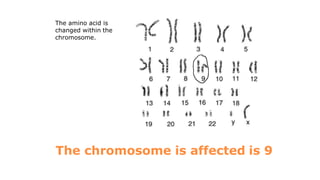
The chromosome is affected is 9
The amino acid is
changed within the
chromosome.
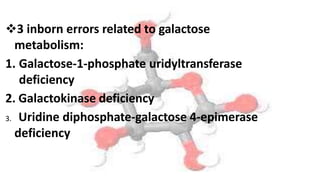
3 inborn errors related to galactose
metabolism:
1. Galactose-1-phosphate uridyltransferase
deficiency
2. Galactokinase deficiency
3. Uridine diphosphate-galactose 4-epimerase
deficiency
TYPES:
Type OMIM Gene Locu
s
Enzyme Name
Type 1 230400 GALT 9P13 Galactose1- phosphat
uridyl transferase
Classic galactosemia
Type 2 230200 GALK1 17q24 galactokinase Galactokinase
deficiency
Type 3 230350 GALE 1p36-
p35
UDP galactose
epimerase
UDP-Galactose- 4-
epimerase deficiency
Galactose is converted into glucose by the action of three enzymes,
known as the Leloir pathway:
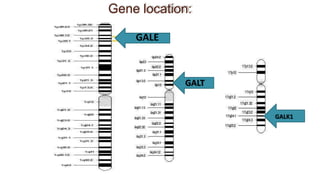
Gene location:
GALE
GALT
GALK1
GALE
GALT
GALK1
Frequency
Classic galactosemia occurs
in 1 in 30,000 to 60,000
newborns. Galactosemia
type II and type III are less
common; type II probably
affects fewer than 1 in
100,000 newborns and type
III appears to be very rare.
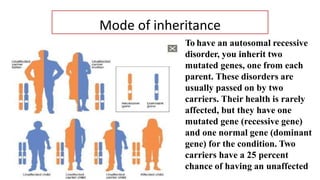
Mode of inheritance
To have an autosomal recessive
disorder, you inherit two
mutated genes, one from each
parent. These disorders are
usually passed on by two
carriers. Their health is rarely
affected, but they have one
mutated gene (recessive gene)
and one normal gene (dominant
gene) for the condition. Two
carriers have a 25 percent
chance of having an unaffected
Galactosemia is due to deficiency of the enzyme galactose
1-phosphate uridyltransferase.
It is a rare congenital disease in infants, inherited as autosomal
recessive disorder.
Mutation in the GALT gene located on chromosome 9 is
responsible for this disorder.
1. Galactose metabolism is impaired leading to increased galactose
levels in blood (galactosemia) and urine (galactosuria).
2. Accumulated galactose is diverted for production of galactitol by
the enzyme aldol reductase. Galactitol has been implicated in the
development of cataract.
3. The accumulation of galactose 1-phosphate and
galactitol in various tissues like liver, nervous tissue,
lens and kidney leads to impairment in their function.
4. The accumulation of galactose 1-phosphate in liver
results in the depletion of inorganic phosphate for
other metabolic functions.
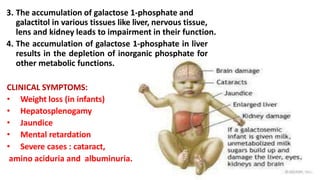
CLINICAL SYMPTOMS:
• Weight loss (in infants)
• Hepatosplenogamy
• Jaundice
• Mental retardation
• Severe cases : cataract,
amino aciduria and albuminuria.
Diagnosis
Prenatal Testing A doctor can determine during
a woman’s pregnancy whether her baby has
galactosemia through:
a. amniocentesis . This procedure involves using
a needle to withdraw a sample of amniotic
fluid from the womb, and then examining the
cells.
b. chronic villus sampling or CVS
c. NewBorn Screening -Babies are tested for
Galactosemia at birth using a tiny blood
sample taken from the baby’s heel, the test for
low level of the GALT enzyme.
• Defect in the enzyme galactokinase responsible for
phosphorylation of galactose.
• Mutation in GALK1 gene.
• Galactose is shunted to the formation of galactitol.
• Cataract development at a very early age, sometimes
within an year after birth.
• Treatment involves removal of galactose and lactose
from the diet.
• Extremely rare.
• Mutations in GALE gene is responsible.
• Symptoms vary from mild to severe and can include
cataracts, delayed growth and development,
intellectual disability, liver disease and kidney
problems.
Treatment
• No treatment or cannot be cure but with
maturation most children develop another
enzyme capable of metabolizing galactose.
• As a consequence, they are able to tolerate
galactose as they mature.
• Dietary restriction, avoid food and drinks
containing galactose like milk, cheese,
legumes (dried beans), fermented soy
products, organ meat and hydrolyzed proteins.
Recent trials
1. Applied Therapeutics Inc.
(Nasdaq:APLT), a clinical-stage
biopharmaceutical company
developing a pipeline of novel
drug candidates against
validated molecular targets in
indications of high unmet
medical need, June 24, 2019
announced the initiation of a
Phase 1/2 study of AT-007 in
Galactosemia
2. arginine is an amino acid that is
therapeutically widely used with
no side effects described, we
propose to use it in a pilot-clinical
study. We aim to evaluate the
effects of arginine in classic
galactosemia patients, in order to
determine its potential
therapeutic role in this disease.
https://www.ncbi.nlm.nih.gov/pmc/articles/PMC5391384/
https://www.globenewswire.com/news-
release/2019/06/24/1872873/0/en/Applied-
Therapeutics-Announces-Initiation-of-Phase-
1-2-Study-of-AT-007-in-Galactosemia.html
• http://www.galactosemia.org/understanding-
galactosemia/
• https://www.semanticscholar.org/paper/Galactosem
ia-%3A-A-Genetic-Disease-of-Leloir-Pathway-Ali-
Khan/dac8ff14d4f2662b4e8c0b5377aeca0ba9df15b
4
• https://rarediseases.info.nih.gov/diseases/2424/gala
ctosemia
Galactosemia ppt

Galactosemia ppt

  • 1.
    GALACTOSEMIA BY: GOKULABALAJI.V II MSC BIOCHEMISTRY& MOLECULAR BIOLOGY PONDICHERRY UNIVERSITY
  • 2.
    WHAT IS GALACTOSEMIA? Itis a rare genetic metabolic disorder that affects how the body processes a simple sugar called galactose. Inability of the body to use galactose to produce energy.
  • 3.
    The chromosome isaffected is 9 The amino acid is changed within the chromosome.
  • 6.
    3 inborn errorsrelated to galactose metabolism: 1. Galactose-1-phosphate uridyltransferase deficiency 2. Galactokinase deficiency 3. Uridine diphosphate-galactose 4-epimerase deficiency
  • 7.
    TYPES: Type OMIM GeneLocu s Enzyme Name Type 1 230400 GALT 9P13 Galactose1- phosphat uridyl transferase Classic galactosemia Type 2 230200 GALK1 17q24 galactokinase Galactokinase deficiency Type 3 230350 GALE 1p36- p35 UDP galactose epimerase UDP-Galactose- 4- epimerase deficiency Galactose is converted into glucose by the action of three enzymes, known as the Leloir pathway:
  • 8.
  • 9.
    Frequency Classic galactosemia occurs in1 in 30,000 to 60,000 newborns. Galactosemia type II and type III are less common; type II probably affects fewer than 1 in 100,000 newborns and type III appears to be very rare.
  • 10.
    Mode of inheritance Tohave an autosomal recessive disorder, you inherit two mutated genes, one from each parent. These disorders are usually passed on by two carriers. Their health is rarely affected, but they have one mutated gene (recessive gene) and one normal gene (dominant gene) for the condition. Two carriers have a 25 percent chance of having an unaffected
  • 11.
    Galactosemia is dueto deficiency of the enzyme galactose 1-phosphate uridyltransferase. It is a rare congenital disease in infants, inherited as autosomal recessive disorder. Mutation in the GALT gene located on chromosome 9 is responsible for this disorder. 1. Galactose metabolism is impaired leading to increased galactose levels in blood (galactosemia) and urine (galactosuria). 2. Accumulated galactose is diverted for production of galactitol by the enzyme aldol reductase. Galactitol has been implicated in the development of cataract.
  • 12.
    3. The accumulationof galactose 1-phosphate and galactitol in various tissues like liver, nervous tissue, lens and kidney leads to impairment in their function. 4. The accumulation of galactose 1-phosphate in liver results in the depletion of inorganic phosphate for other metabolic functions. CLINICAL SYMPTOMS: • Weight loss (in infants) • Hepatosplenogamy • Jaundice • Mental retardation • Severe cases : cataract, amino aciduria and albuminuria.
  • 13.
    Diagnosis Prenatal Testing Adoctor can determine during a woman’s pregnancy whether her baby has galactosemia through: a. amniocentesis . This procedure involves using a needle to withdraw a sample of amniotic fluid from the womb, and then examining the cells. b. chronic villus sampling or CVS c. NewBorn Screening -Babies are tested for Galactosemia at birth using a tiny blood sample taken from the baby’s heel, the test for low level of the GALT enzyme.
  • 14.
    • Defect inthe enzyme galactokinase responsible for phosphorylation of galactose. • Mutation in GALK1 gene. • Galactose is shunted to the formation of galactitol. • Cataract development at a very early age, sometimes within an year after birth. • Treatment involves removal of galactose and lactose from the diet.
  • 15.
    • Extremely rare. •Mutations in GALE gene is responsible. • Symptoms vary from mild to severe and can include cataracts, delayed growth and development, intellectual disability, liver disease and kidney problems.
  • 16.
    Treatment • No treatmentor cannot be cure but with maturation most children develop another enzyme capable of metabolizing galactose. • As a consequence, they are able to tolerate galactose as they mature. • Dietary restriction, avoid food and drinks containing galactose like milk, cheese, legumes (dried beans), fermented soy products, organ meat and hydrolyzed proteins.
  • 17.
    Recent trials 1. AppliedTherapeutics Inc. (Nasdaq:APLT), a clinical-stage biopharmaceutical company developing a pipeline of novel drug candidates against validated molecular targets in indications of high unmet medical need, June 24, 2019 announced the initiation of a Phase 1/2 study of AT-007 in Galactosemia 2. arginine is an amino acid that is therapeutically widely used with no side effects described, we propose to use it in a pilot-clinical study. We aim to evaluate the effects of arginine in classic galactosemia patients, in order to determine its potential therapeutic role in this disease.
  • 18.
  • 19.
  • 20.