GTT
Test to evaluate the degree of tolerance of
an individual to a glucose load .
In a normal individual our body has the
ability to absorb glucose and metabolize it
by secreting adequate insulin.
Test Preparation/ Instructions:
• Should consume a mixed diet with at least 150 g of
carbohydrate on the 3 days prior to oral glucose
tolerance testing.
• The patient should arrive fasting for a minimum of
eight hours before the test.
• The fasting sample should be taken and the time
point should be notated.
• The patient should then consume the correct
amount of glucose (75 grams) over a maximum of a
5-minute period.
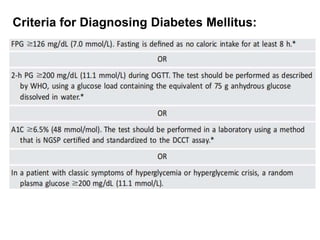
Criteria for Diagnosing Diabetes Mellitus:
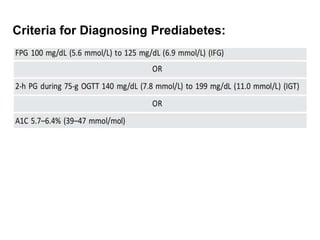
Criteria for Diagnosing Prediabetes:
Normal
Person
Prediabetes
Person
Diabetes
Person
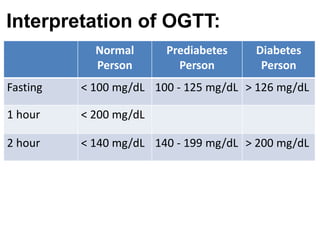
Fasting < 100 mg/dL 100 - 125 mg/dL > 126 mg/dL
1 hour < 200 mg/dL
2 hour < 140 mg/dL 140 - 199 mg/dL > 200 mg/dL
Interpretation of OGTT:
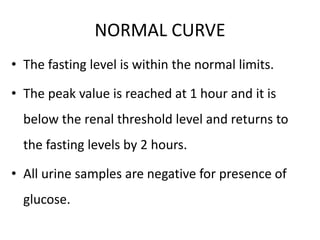
NORMAL CURVE
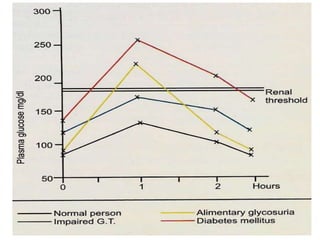
• The fasting level is within the normal limits.
• The peak value is reached at 1 hour and it is
below the renal threshold level and returns to
the fasting levels by 2 hours.
• All urine samples are negative for presence of
glucose.
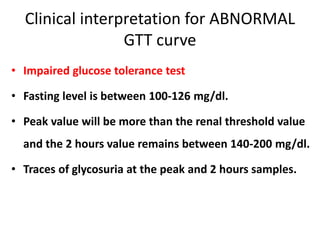
Clinical interpretation for ABNORMAL
GTT curve
• Impaired glucose tolerance test
• Fasting level is between 100-126 mg/dl.
• Peak value will be more than the renal threshold value
and the 2 hours value remains between 140-200 mg/dl.
• Traces of glycosuria at the peak and 2 hours samples.
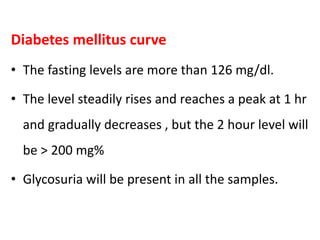
Diabetes mellitus curve
• The fasting levels are more than 126 mg/dl.
• The level steadily rises and reaches a peak at 1 hr
and gradually decreases , but the 2 hour level will
be > 200 mg%
• Glycosuria will be present in all the samples.
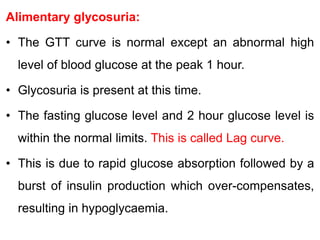
Alimentary glycosuria:
• The GTT curve is normal except an abnormal high
level of blood glucose at the peak 1 hour.
• Glycosuria is present at this time.
• The fasting glucose level and 2 hour glucose level is
within the normal limits. This is called Lag curve.
• This is due to rapid glucose absorption followed by a
burst of insulin production which over-compensates,
resulting in hypoglycaemia.
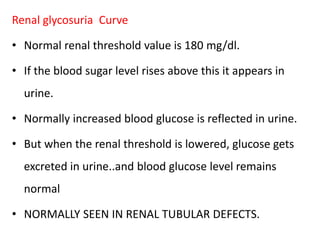
Renal glycosuria Curve
• Normal renal threshold value is 180 mg/dl.
• If the blood sugar level rises above this it appears in
urine.
• Normally increased blood glucose is reflected in urine.
• But when the renal threshold is lowered, glucose gets
excreted in urine..and blood glucose level remains
normal
• NORMALLY SEEN IN RENAL TUBULAR DEFECTS.
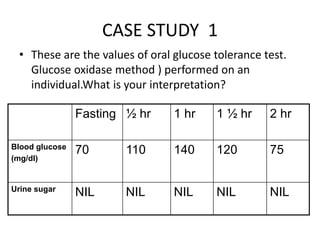
CASE STUDY 1
• These are the values of oral glucose tolerance test.
Glucose oxidase method ) performed on an
individual.What is your interpretation?
Fasting ½ hr 1 hr 1 ½ hr 2 hr
Blood glucose
(mg/dl)
70 110 140 120 75
Urine sugar
NIL NIL NIL NIL NIL
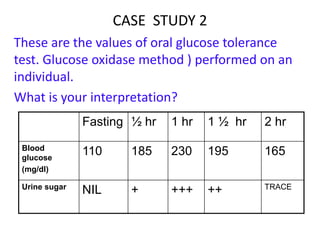
CASE STUDY 2
These are the values of oral glucose tolerance
test. Glucose oxidase method ) performed on an
individual.
What is your interpretation?
Fasting ½ hr 1 hr 1 ½ hr 2 hr
Blood
glucose
(mg/dl)
110 185 230 195 165
Urine sugar
NIL + +++ ++ TRACE
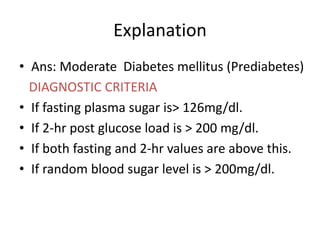
Explanation
• Ans: Moderate Diabetes mellitus (Prediabetes)
DIAGNOSTIC CRITERIA
• If fasting plasma sugar is> 126mg/dl.
• If 2-hr post glucose load is > 200 mg/dl.
• If both fasting and 2-hr values are above this.
• If random blood sugar level is > 200mg/dl.
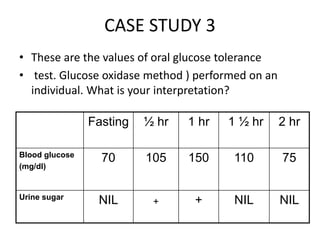
CASE STUDY 3
• These are the values of oral glucose tolerance
• test. Glucose oxidase method ) performed on an
individual. What is your interpretation?
Fasting ½ hr 1 hr 1 ½ hr 2 hr
Blood glucose
(mg/dl)
70 105 150 110 75
Urine sugar
NIL + + NIL NIL
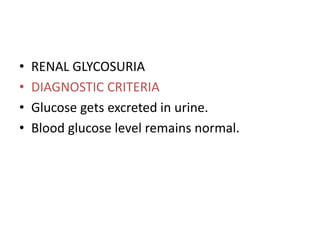
• RENAL GLYCOSURIA
• DIAGNOSTIC CRITERIA
• Glucose gets excreted in urine.
• Blood glucose level remains normal.
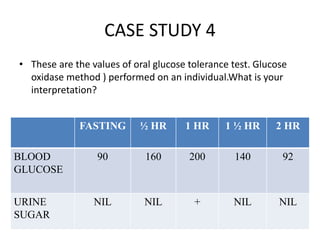
CASE STUDY 4
• These are the values of oral glucose tolerance test. Glucose
oxidase method ) performed on an individual.What is your
interpretation?
FASTING ½ HR 1 HR 1 ½ HR 2 HR
BLOOD
GLUCOSE
90 160 200 140 92
URINE
SUGAR
NIL NIL + NIL NIL
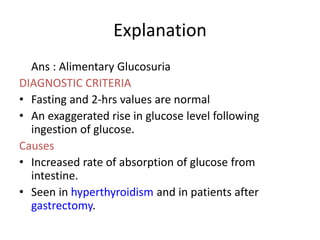
Explanation
Ans : Alimentary Glucosuria
DIAGNOSTIC CRITERIA
• Fasting and 2-hrs values are normal
• An exaggerated rise in glucose level following
ingestion of glucose.
Causes
• Increased rate of absorption of glucose from
intestine.
• Seen in hyperthyroidism and in patients after
gastrectomy.
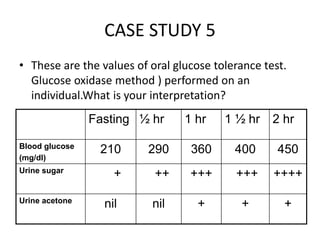
CASE STUDY 5
• These are the values of oral glucose tolerance test.
Glucose oxidase method ) performed on an
individual.What is your interpretation?
Fasting ½ hr 1 hr 1 ½ hr 2 hr
Blood glucose
(mg/dl)
210 290 360 400 450
Urine sugar
+ ++ +++ +++ ++++
Urine acetone
nil nil + + +
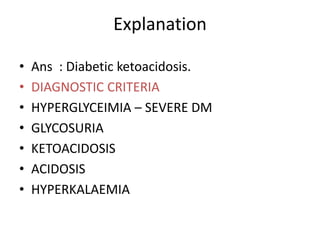
Explanation
• Ans : Diabetic ketoacidosis.
• DIAGNOSTIC CRITERIA
• HYPERGLYCEIMIA – SEVERE DM
• GLYCOSURIA
• KETOACIDOSIS
• ACIDOSIS
• HYPERKALAEMIA
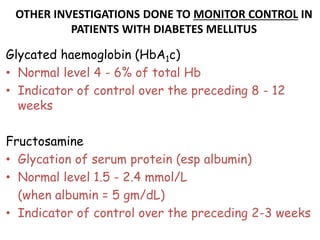
OTHER INVESTIGATIONS DONE TO MONITOR CONTROL IN
PATIENTS WITH DIABETES MELLITUS
Glycated haemoglobin (HbA1c)
• Normal level 4 - 6% of total Hb
• Indicator of control over the preceding 8 - 12
weeks
Fructosamine
• Glycation of serum protein (esp albumin)
• Normal level 1.5 - 2.4 mmol/L
(when albumin = 5 gm/dL)
• Indicator of control over the preceding 2-3 weeks

GTT.pptx

  • 1.
    GTT Test to evaluatethe degree of tolerance of an individual to a glucose load . In a normal individual our body has the ability to absorb glucose and metabolize it by secreting adequate insulin.
  • 2.
    Test Preparation/ Instructions: •Should consume a mixed diet with at least 150 g of carbohydrate on the 3 days prior to oral glucose tolerance testing. • The patient should arrive fasting for a minimum of eight hours before the test. • The fasting sample should be taken and the time point should be notated. • The patient should then consume the correct amount of glucose (75 grams) over a maximum of a 5-minute period.
  • 3.
    Criteria for DiagnosingDiabetes Mellitus:
  • 4.
  • 5.
    Normal Person Prediabetes Person Diabetes Person Fasting < 100mg/dL 100 - 125 mg/dL > 126 mg/dL 1 hour < 200 mg/dL 2 hour < 140 mg/dL 140 - 199 mg/dL > 200 mg/dL Interpretation of OGTT:
  • 6.
    NORMAL CURVE • Thefasting level is within the normal limits. • The peak value is reached at 1 hour and it is below the renal threshold level and returns to the fasting levels by 2 hours. • All urine samples are negative for presence of glucose.
  • 8.
    Clinical interpretation forABNORMAL GTT curve • Impaired glucose tolerance test • Fasting level is between 100-126 mg/dl. • Peak value will be more than the renal threshold value and the 2 hours value remains between 140-200 mg/dl. • Traces of glycosuria at the peak and 2 hours samples.
  • 9.
    Diabetes mellitus curve •The fasting levels are more than 126 mg/dl. • The level steadily rises and reaches a peak at 1 hr and gradually decreases , but the 2 hour level will be > 200 mg% • Glycosuria will be present in all the samples.
  • 10.
    Alimentary glycosuria: • TheGTT curve is normal except an abnormal high level of blood glucose at the peak 1 hour. • Glycosuria is present at this time. • The fasting glucose level and 2 hour glucose level is within the normal limits. This is called Lag curve. • This is due to rapid glucose absorption followed by a burst of insulin production which over-compensates, resulting in hypoglycaemia.
  • 11.
    Renal glycosuria Curve •Normal renal threshold value is 180 mg/dl. • If the blood sugar level rises above this it appears in urine. • Normally increased blood glucose is reflected in urine. • But when the renal threshold is lowered, glucose gets excreted in urine..and blood glucose level remains normal • NORMALLY SEEN IN RENAL TUBULAR DEFECTS.
  • 12.
    CASE STUDY 1 •These are the values of oral glucose tolerance test. Glucose oxidase method ) performed on an individual.What is your interpretation? Fasting ½ hr 1 hr 1 ½ hr 2 hr Blood glucose (mg/dl) 70 110 140 120 75 Urine sugar NIL NIL NIL NIL NIL
  • 13.
    CASE STUDY 2 Theseare the values of oral glucose tolerance test. Glucose oxidase method ) performed on an individual. What is your interpretation? Fasting ½ hr 1 hr 1 ½ hr 2 hr Blood glucose (mg/dl) 110 185 230 195 165 Urine sugar NIL + +++ ++ TRACE
  • 14.
    Explanation • Ans: ModerateDiabetes mellitus (Prediabetes) DIAGNOSTIC CRITERIA • If fasting plasma sugar is> 126mg/dl. • If 2-hr post glucose load is > 200 mg/dl. • If both fasting and 2-hr values are above this. • If random blood sugar level is > 200mg/dl.
  • 15.
    CASE STUDY 3 •These are the values of oral glucose tolerance • test. Glucose oxidase method ) performed on an individual. What is your interpretation? Fasting ½ hr 1 hr 1 ½ hr 2 hr Blood glucose (mg/dl) 70 105 150 110 75 Urine sugar NIL + + NIL NIL
  • 16.
    • RENAL GLYCOSURIA •DIAGNOSTIC CRITERIA • Glucose gets excreted in urine. • Blood glucose level remains normal.
  • 17.
    CASE STUDY 4 •These are the values of oral glucose tolerance test. Glucose oxidase method ) performed on an individual.What is your interpretation? FASTING ½ HR 1 HR 1 ½ HR 2 HR BLOOD GLUCOSE 90 160 200 140 92 URINE SUGAR NIL NIL + NIL NIL
  • 18.
    Explanation Ans : AlimentaryGlucosuria DIAGNOSTIC CRITERIA • Fasting and 2-hrs values are normal • An exaggerated rise in glucose level following ingestion of glucose. Causes • Increased rate of absorption of glucose from intestine. • Seen in hyperthyroidism and in patients after gastrectomy.
  • 19.
    CASE STUDY 5 •These are the values of oral glucose tolerance test. Glucose oxidase method ) performed on an individual.What is your interpretation? Fasting ½ hr 1 hr 1 ½ hr 2 hr Blood glucose (mg/dl) 210 290 360 400 450 Urine sugar + ++ +++ +++ ++++ Urine acetone nil nil + + +
  • 20.
    Explanation • Ans :Diabetic ketoacidosis. • DIAGNOSTIC CRITERIA • HYPERGLYCEIMIA – SEVERE DM • GLYCOSURIA • KETOACIDOSIS • ACIDOSIS • HYPERKALAEMIA
  • 21.
    OTHER INVESTIGATIONS DONETO MONITOR CONTROL IN PATIENTS WITH DIABETES MELLITUS Glycated haemoglobin (HbA1c) • Normal level 4 - 6% of total Hb • Indicator of control over the preceding 8 - 12 weeks Fructosamine • Glycation of serum protein (esp albumin) • Normal level 1.5 - 2.4 mmol/L (when albumin = 5 gm/dL) • Indicator of control over the preceding 2-3 weeks