Serum bilirubin
Dr.Ghulam Murtaza
Resident Chemical Pathology
1
Out lines
• Biochemistry
• Clinical significance
• Inherited disorder of bilirubin metabolism
• Analytical methods
• References
2
Definition
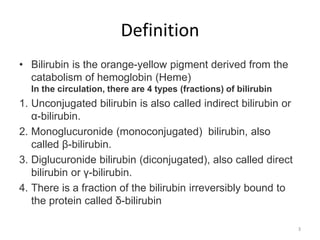
• Bilirubin is the orange-yellow pigment derived from the
catabolism of hemoglobin (Heme)
In the circulation, there are 4 types (fractions) of bilirubin
1. Unconjugated bilirubin is also called indirect bilirubin or
α-bilirubin.
2. Monoglucuronide (monoconjugated) bilirubin, also
called β-bilirubin.
3. Diglucuronide bilirubin (diconjugated), also called direct
bilirubin or γ-bilirubin.
4. There is a fraction of the bilirubin irreversibly bound to
the protein called δ-bilirubin
3
Pathophysiology Of The Bilirubin
4
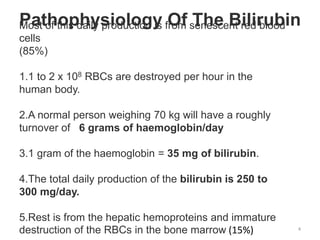
Most of this daily production is from senescent red blood
cells
(85%)
1.1 to 2 x 10⁸ RBCs are destroyed per hour in the
human body.
2.A normal person weighing 70 kg will have a roughly
turnover of 6 grams of haemoglobin/day
3.1 gram of the haemoglobin = 35 mg of bilirubin.
4.The total daily production of the bilirubin is 250 to
300 mg/day.
5.Rest is from the hepatic hemoproteins and immature
destruction of the RBCs in the bone marrow (15%)
Metabolism of bilirubin
1.The bilirubin metabolism can be described
in three stages:
1.The first stage is RBCs’ breakdown, the formation of
heme and biliverdin, bilirubin IXα by the mononuclear
phagocytic system.
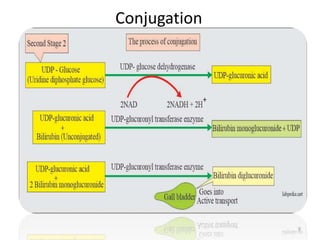
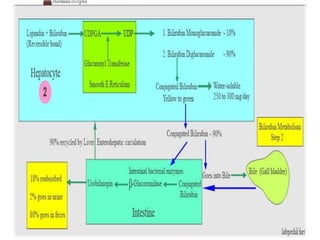
2.The second stage is the conjugation of the bilirubin,
and this takes place in the hepatocytes.
3.The third stage is the secretion of the bile into the gall
bladder and intestine.
5
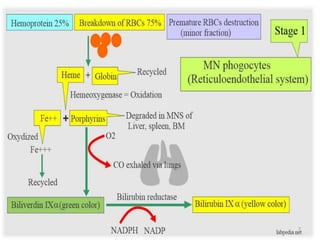
Stage one ;
1. Hemoglobin from RBC is released and gives rise to
Heme and Globin.
2. Heme from the RBC gives rise to protoporphyrin's.
3. Now protoporphyrin's by microsomal heme
oxygenase form Biliverdin IXα.
4. Biliverdin reductase enzyme transforms it into
bilirubin IXα.
5. Globin is degraded to its components like amino
acids, which are reused or recycled.
6. Microsomal heme-oxygenase enzyme degrades the
heme into iron Fe++, which will be oxidized to
Fe+++ form and is reutilized again.
6
First stage:
7
8
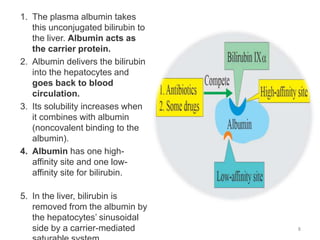
1. The plasma albumin takes
this unconjugated bilirubin to
the liver. Albumin acts as
the carrier protein.
2. Albumin delivers the bilirubin
into the hepatocytes and
goes back to blood
circulation.
3. Its solubility increases when
it combines with albumin
(noncovalent binding to the
albumin).
4. Albumin has one high-
affinity site and one low-
affinity site for bilirubin.
5. In the liver, bilirubin is
removed from the albumin by
the hepatocytes’ sinusoidal
side by a carrier-mediated
Conjugation
9
10
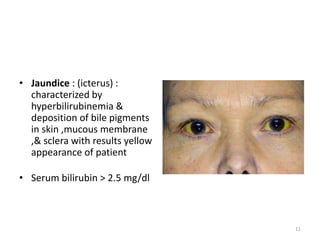
• Jaundice : (icterus) :
characterized by
hyperbilirubinemia &
deposition of bile pigments
in skin ,mucous membrane
,& sclera with results yellow
appearance of patient
• Serum bilirubin > 2.5 mg/dl
11
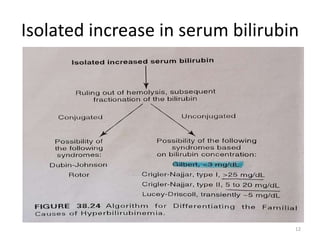
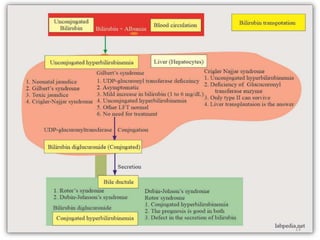
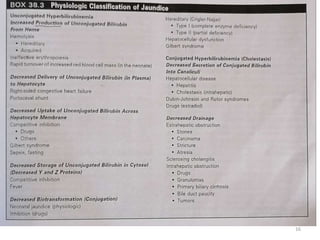
Isolated increase in serum bilirubin
12
13
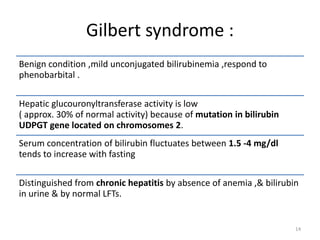
Gilbert syndrome :
Benign condition ,mild unconjugated bilirubinemia ,respond to
phenobarbital .
Hepatic glucouronyltransferase activity is low
( approx. 30% of normal activity) because of mutation in bilirubin
UDPGT gene located on chromosomes 2.
Serum concentration of bilirubin fluctuates between 1.5 -4 mg/dl
tends to increase with fasting
Distinguished from chronic hepatitis by absence of anemia ,& bilirubin
in urine & by normal LFTs.
14
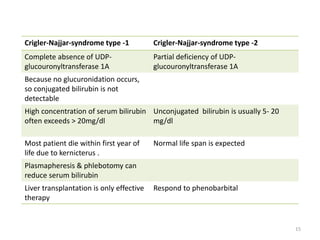
Crigler-Najjar-syndrome type -1 Crigler-Najjar-syndrome type -2
Complete absence of UDP-
glucouronyltransferase 1A
Partial deficiency of UDP-
glucouronyltransferase 1A
Because no glucuronidation occurs,
so conjugated bilirubin is not
detectable
High concentration of serum bilirubin
often exceeds > 20mg/dl
Unconjugated bilirubin is usually 5- 20
mg/dl
Most patient die within first year of
life due to kernicterus .
Normal life span is expected
Plasmapheresis & phlebotomy can
reduce serum bilirubin
Liver transplantation is only effective
therapy
Respond to phenobarbital
15
16
Analytical methods :
• There are four analytical method
• Diazo method (m0st commonly used method)
• HPLC
• Enzymatic method
• Transcutaneous measurement of bilirubin
17
Hx of bilirubin estimation
Ehrlich(1883)
Described the reaction of bilirubin with diazotized sulfanilic acid= DIAZO
REACTION
• Malloy and Evelyn (1937)
Diazo reaction with 50% methanol as an accelerator
• Jendrassik and Grof ( 1938)
Diazo reaction with caffeine-benzoate-acetate as accelerator – Increased
sensitivity
18
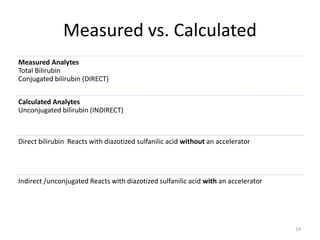
Measured vs. Calculated
Measured Analytes
Total Bilirubin
Conjugated bilirubin (DIRECT)
Calculated Analytes
Unconjugated bilirubin (INDIRECT)
Direct bilirubin Reacts with diazotized sulfanilic acid without an accelerator
Indirect /unconjugated Reacts with diazotized sulfanilic acid with an accelerator
19
Specimen Collection and Storage
Bilirubin is extremely photosensitive, care should be taken to protect
from both daylight & fluorescent light to avoid photodegradation .
Sample should be stored at 4centigrade & analyzed within 5 days .
Serum or plasma preferred
Avoid hemolytic & lipemic samples
20
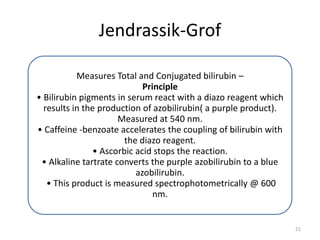
Jendrassik-Grof
Measures Total and Conjugated bilirubin –
Principle
• Bilirubin pigments in serum react with a diazo reagent which
results in the production of azobilirubin( a purple product).
Measured at 540 nm.
• Caffeine -benzoate accelerates the coupling of bilirubin with
the diazo reagent.
• Ascorbic acid stops the reaction.
• Alkaline tartrate converts the purple azobilirubin to a blue
azobilirubin.
• This product is measured spectrophotometrically @ 600
nm.
21
ADVANTAGES :
• Not affected by pH changes
• Maintains optical sensitivity at low bilirubin
concentrations
• Insensitive to high protein concentrations
22
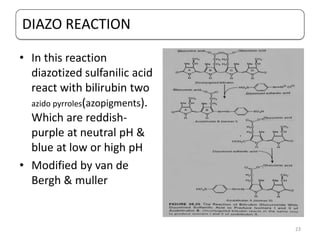
DIAZO REACTION
• In this reaction
diazotized sulfanilic acid
react with bilirubin two
azido pyrroles(azopigments).
Which are reddish-
purple at neutral pH &
blue at low or high pH
• Modified by van de
Bergh & muller
23
Method used in our deptt
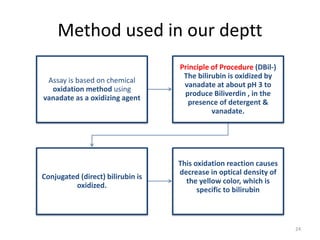
Assay is based on chemical
oxidation method using
vanadate as a oxidizing agent
Principle of Procedure (DBil-)
The bilirubin is oxidized by
vanadate at about pH 3 to
produce Biliverdin , in the
presence of detergent &
vanadate.
Conjugated (direct) bilirubin is
oxidized.
This oxidation reaction causes
decrease in optical density of
the yellow color, which is
specific to bilirubin
24
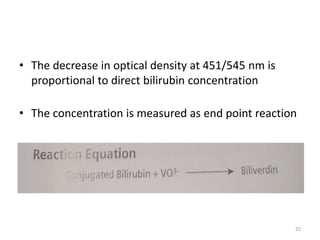
• The decrease in optical density at 451/545 nm is
proportional to direct bilirubin concentration
• The concentration is measured as end point reaction
25
Total bilirubin
•
26
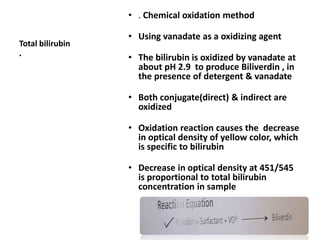
• . Chemical oxidation method
• Using vanadate as a oxidizing agent
• The bilirubin is oxidized by vanadate at
about pH 2.9 to produce Biliverdin , in
the presence of detergent & vanadate
• Both conjugate(direct) & indirect are
oxidized
• Oxidation reaction causes the decrease
in optical density of yellow color, which
is specific to bilirubin
• Decrease in optical density at 451/545
is proportional to total bilirubin
concentration in sample
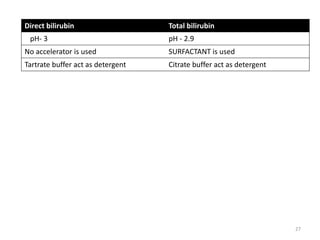
Direct bilirubin Total bilirubin
pH- 3 pH - 2.9
No accelerator is used SURFACTANT is used
Tartrate buffer act as detergent Citrate buffer act as detergent
27
Thank you …
28
References
• Chapter 38 ,Tietz Text book of clinical
chemistry volume-2 sixth edition
(hemoglobin, iron bilirubin analytes)
29

Serum bilirubin (ANALYTICAL )

  • 1.
  • 2.
    Out lines • Biochemistry •Clinical significance • Inherited disorder of bilirubin metabolism • Analytical methods • References 2
  • 3.
    Definition • Bilirubin isthe orange-yellow pigment derived from the catabolism of hemoglobin (Heme) In the circulation, there are 4 types (fractions) of bilirubin 1. Unconjugated bilirubin is also called indirect bilirubin or α-bilirubin. 2. Monoglucuronide (monoconjugated) bilirubin, also called β-bilirubin. 3. Diglucuronide bilirubin (diconjugated), also called direct bilirubin or γ-bilirubin. 4. There is a fraction of the bilirubin irreversibly bound to the protein called δ-bilirubin 3
  • 4.
    Pathophysiology Of TheBilirubin 4 Most of this daily production is from senescent red blood cells (85%) 1.1 to 2 x 10⁸ RBCs are destroyed per hour in the human body. 2.A normal person weighing 70 kg will have a roughly turnover of 6 grams of haemoglobin/day 3.1 gram of the haemoglobin = 35 mg of bilirubin. 4.The total daily production of the bilirubin is 250 to 300 mg/day. 5.Rest is from the hepatic hemoproteins and immature destruction of the RBCs in the bone marrow (15%)
  • 5.
    Metabolism of bilirubin 1.Thebilirubin metabolism can be described in three stages: 1.The first stage is RBCs’ breakdown, the formation of heme and biliverdin, bilirubin IXα by the mononuclear phagocytic system. 2.The second stage is the conjugation of the bilirubin, and this takes place in the hepatocytes. 3.The third stage is the secretion of the bile into the gall bladder and intestine. 5
  • 6.
    Stage one ; 1.Hemoglobin from RBC is released and gives rise to Heme and Globin. 2. Heme from the RBC gives rise to protoporphyrin's. 3. Now protoporphyrin's by microsomal heme oxygenase form Biliverdin IXα. 4. Biliverdin reductase enzyme transforms it into bilirubin IXα. 5. Globin is degraded to its components like amino acids, which are reused or recycled. 6. Microsomal heme-oxygenase enzyme degrades the heme into iron Fe++, which will be oxidized to Fe+++ form and is reutilized again. 6
  • 7.
  • 8.
    8 1. The plasmaalbumin takes this unconjugated bilirubin to the liver. Albumin acts as the carrier protein. 2. Albumin delivers the bilirubin into the hepatocytes and goes back to blood circulation. 3. Its solubility increases when it combines with albumin (noncovalent binding to the albumin). 4. Albumin has one high- affinity site and one low- affinity site for bilirubin. 5. In the liver, bilirubin is removed from the albumin by the hepatocytes’ sinusoidal side by a carrier-mediated
  • 9.
  • 10.
  • 11.
    • Jaundice :(icterus) : characterized by hyperbilirubinemia & deposition of bile pigments in skin ,mucous membrane ,& sclera with results yellow appearance of patient • Serum bilirubin > 2.5 mg/dl 11
  • 12.
    Isolated increase inserum bilirubin 12
  • 13.
  • 14.
    Gilbert syndrome : Benigncondition ,mild unconjugated bilirubinemia ,respond to phenobarbital . Hepatic glucouronyltransferase activity is low ( approx. 30% of normal activity) because of mutation in bilirubin UDPGT gene located on chromosomes 2. Serum concentration of bilirubin fluctuates between 1.5 -4 mg/dl tends to increase with fasting Distinguished from chronic hepatitis by absence of anemia ,& bilirubin in urine & by normal LFTs. 14
  • 15.
    Crigler-Najjar-syndrome type -1Crigler-Najjar-syndrome type -2 Complete absence of UDP- glucouronyltransferase 1A Partial deficiency of UDP- glucouronyltransferase 1A Because no glucuronidation occurs, so conjugated bilirubin is not detectable High concentration of serum bilirubin often exceeds > 20mg/dl Unconjugated bilirubin is usually 5- 20 mg/dl Most patient die within first year of life due to kernicterus . Normal life span is expected Plasmapheresis & phlebotomy can reduce serum bilirubin Liver transplantation is only effective therapy Respond to phenobarbital 15
  • 16.
  • 17.
    Analytical methods : •There are four analytical method • Diazo method (m0st commonly used method) • HPLC • Enzymatic method • Transcutaneous measurement of bilirubin 17
  • 18.
    Hx of bilirubinestimation Ehrlich(1883) Described the reaction of bilirubin with diazotized sulfanilic acid= DIAZO REACTION • Malloy and Evelyn (1937) Diazo reaction with 50% methanol as an accelerator • Jendrassik and Grof ( 1938) Diazo reaction with caffeine-benzoate-acetate as accelerator – Increased sensitivity 18
  • 19.
    Measured vs. Calculated MeasuredAnalytes Total Bilirubin Conjugated bilirubin (DIRECT) Calculated Analytes Unconjugated bilirubin (INDIRECT) Direct bilirubin Reacts with diazotized sulfanilic acid without an accelerator Indirect /unconjugated Reacts with diazotized sulfanilic acid with an accelerator 19
  • 20.
    Specimen Collection andStorage Bilirubin is extremely photosensitive, care should be taken to protect from both daylight & fluorescent light to avoid photodegradation . Sample should be stored at 4centigrade & analyzed within 5 days . Serum or plasma preferred Avoid hemolytic & lipemic samples 20
  • 21.
    Jendrassik-Grof Measures Total andConjugated bilirubin – Principle • Bilirubin pigments in serum react with a diazo reagent which results in the production of azobilirubin( a purple product). Measured at 540 nm. • Caffeine -benzoate accelerates the coupling of bilirubin with the diazo reagent. • Ascorbic acid stops the reaction. • Alkaline tartrate converts the purple azobilirubin to a blue azobilirubin. • This product is measured spectrophotometrically @ 600 nm. 21
  • 22.
    ADVANTAGES : • Notaffected by pH changes • Maintains optical sensitivity at low bilirubin concentrations • Insensitive to high protein concentrations 22
  • 23.
    DIAZO REACTION • Inthis reaction diazotized sulfanilic acid react with bilirubin two azido pyrroles(azopigments). Which are reddish- purple at neutral pH & blue at low or high pH • Modified by van de Bergh & muller 23
  • 24.
    Method used inour deptt Assay is based on chemical oxidation method using vanadate as a oxidizing agent Principle of Procedure (DBil-) The bilirubin is oxidized by vanadate at about pH 3 to produce Biliverdin , in the presence of detergent & vanadate. Conjugated (direct) bilirubin is oxidized. This oxidation reaction causes decrease in optical density of the yellow color, which is specific to bilirubin 24
  • 25.
    • The decreasein optical density at 451/545 nm is proportional to direct bilirubin concentration • The concentration is measured as end point reaction 25
  • 26.
    Total bilirubin • 26 • .Chemical oxidation method • Using vanadate as a oxidizing agent • The bilirubin is oxidized by vanadate at about pH 2.9 to produce Biliverdin , in the presence of detergent & vanadate • Both conjugate(direct) & indirect are oxidized • Oxidation reaction causes the decrease in optical density of yellow color, which is specific to bilirubin • Decrease in optical density at 451/545 is proportional to total bilirubin concentration in sample
  • 27.
    Direct bilirubin Totalbilirubin pH- 3 pH - 2.9 No accelerator is used SURFACTANT is used Tartrate buffer act as detergent Citrate buffer act as detergent 27
  • 28.
  • 29.
    References • Chapter 38,Tietz Text book of clinical chemistry volume-2 sixth edition (hemoglobin, iron bilirubin analytes) 29