DEFINITION OF GLAUCOMA
A group of disorders characterized by a
progressive optic neuropathy, characteristic
appearance of the optic disc, specific pattern of
irreversible visual field defects , associated
frequently but not invariably with raised IOP.
HOW GLAUCOMA CAN OCCUR?
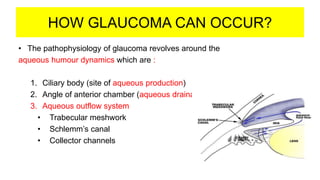
• The pathophysiology of glaucoma revolves around the
aqueous humour dynamics which are :
1. Ciliary body (site of aqueous production)
2. Angle of anterior chamber (aqueous drainage)
3. Aqueous outflow system
• Trabecular meshwork
• Schlemm’s canal
• Collector channels
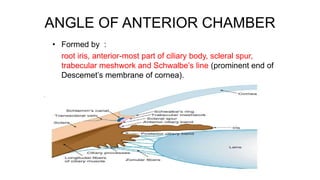
ANGLE OF ANTERIOR CHAMBER
• Formed by :
root iris, anterior-most part of ciliary body, scleral spur,
trabecular meshwork and Schwalbe’s line (prominent end of
Descemet’s membrane of cornea).
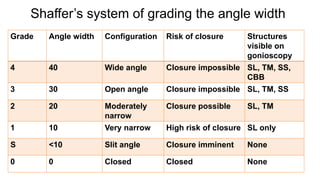
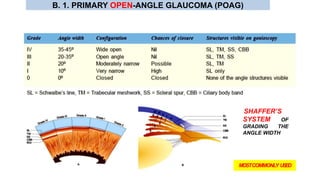
Shaffer’s system of grading the angle width
Grade Angle width Configuration Risk of closure Structures
visible on
gonioscopy
4 40 Wide angle Closure impossible SL, TM, SS,
CBB
3 30 Open angle Closure impossible SL, TM, SS
2 20 Moderately
narrow
Closure possible SL, TM
1 10 Very narrow High risk of closure SL only
S <10 Slit angle Closure imminent None
0 0 Closed Closed None
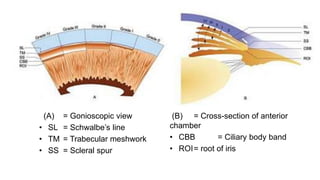
(A) = Gonioscopic view
• SL = Schwalbe’s line
• TM = Trabecular meshwork
• SS = Scleral spur
(B) = Cross-section of anterior
chamber
• CBB = Ciliary body band
• ROI= root of iris
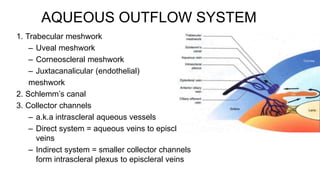
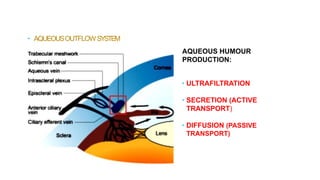
AQUEOUS OUTFLOW SYSTEM
1. Trabecular meshwork
– Uveal meshwork
– Corneoscleral meshwork
– Juxtacanalicular (endothelial)
meshwork
2. Schlemm’s canal
3. Collector channels
– a.k.a intrascleral aqueous vessels
– Direct system = aqueous veins to episcleral
veins
– Indirect system = smaller collector channels
form intrascleral plexus to episcleral veins
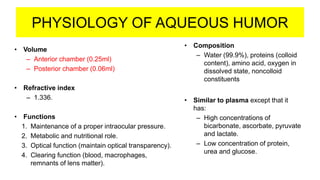
PHYSIOLOGY OF AQUEOUS HUMOR
• Volume
– Anterior chamber (0.25ml)
– Posterior chamber (0.06ml)
• Refractive index
– 1.336.
• Functions
1. Maintenance of a proper intraocular pressure.
2. Metabolic and nutritional role.
3. Optical function (maintain optical transparency).
4. Clearing function (blood, macrophages,
remnants of lens matter).
• Composition
– Water (99.9%), proteins (colloid
content), amino acid, oxygen in
dissolved state, noncolloid
constituents
• Similar to plasma except that it
has:
– High concentrations of
bicarbonate, ascorbate, pyruvate
and lactate.
– Low concentration of protein,
urea and glucose.
• AQUEOUSOUTFLOW SYSTEM
AQUEOUS HUMOUR
PRODUCTION:
• ULTRAFILTRATION
• SECRETION (ACTIVE
TRANSPORT)
• DIFFUSION (PASSIVE
TRANSPORT)
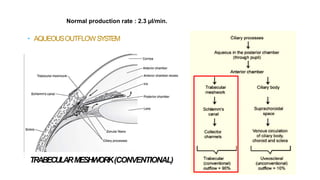
• AQUEOUSOUTFLOW SYSTEM
TRABECULARMESHWORK(CONVENTIONAL)
Normal production rate : 2.3 µl/min.
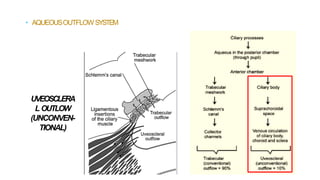
• AQUEOUSOUTFLOW SYSTEM
UVEOSCLERA
LOUTLOW
(UNCONVEN-
TIONAL)
• Intraocular pressure (IOP) refers to the pressure
exerted by the intraocular fluids on the coats of
the eyeball.
• Normal IOP : 10-21mmHg
• Maintained by dynamic equilibrium between the
formation and outflow of the aqueous humour.
• Factors influencing IOP can be grouped as
under:
a) Local factors
b) General factors
• MAINTENANCEOFIOP
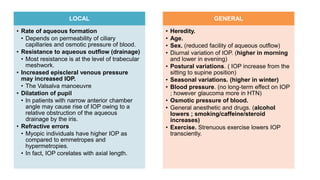
LOCAL
• Rate of aqueous formation
• Depends on permeability of ciliary
capillaries and osmotic pressure of blood.
• Resistance to aqueous outflow (drainage)
• Most resistance is at the level of trabecular
meshwork.
• Increased episcleral venous pressure
may increased IOP.
• The Valsalva manoeuvre
• Dilatation of pupil
• In patients with narrow anterior chamber
angle may cause rise of IOP owing to a
relative obstruction of the aqueous
drainage by the iris.
• Refractive errors
• Myopic individuals have higher IOP as
compared to emmetropes and
hypermetropies.
• In fact, IOP corelates with axial length.
GENERAL
• Heredity.
• Age.
• Sex. (reduced facility of aqueous outflow)
• Diurnal variation of IOP. (higher in morning
and lower in evening)
• Postural variations. ( IOP increase from the
sitting to supine position)
• Seasonal variations. (higher in winter)
• Blood pressure. (no long-term effect on IOP
; however glaucoma more in HTN)
• Osmotic pressure of blood.
• General anesthetic and drugs. (alcohol
lowers ; smoking/caffeine/steroid
increases)
• Exercise. Strenuous exercise lowers IOP
transciently.
CLASSIFICATION OF GLAUCOMA
A.Congenital/developmental glaucoma
1. Primary congenital glaucoma (without associated anomalies)
2. Developmental glaucoma (with associated anomalies)
B.Primary adult glaucoma
1. Primary open-angle glaucoma (POAG)
2. Primary angle-closure glaucoma (PACG)
3. Primary mixed mechanism glaucoma
C.Secondary glaucoma
PATHOGENESIS OF GLAUCOMATOUS
OCULAR DAMAGE
• The death of retinal ganglion cells (RGCs) in a typical pattern which results in
characteristic optic disc appearance and specific visual field defects.
1. Some pathological events block the transport of growth factors (neurotrophin) from
brain to RGC
2. Blockage initiates the damaging cascades and the cell is unable to maintain its
normal function
3. Cell undergoes apoptosis and involves adjacent cells
4. RGC death associated with loss of retinal nerve fibers
5. Characteristic of disc changes and specific visual field defects become apparent
over the time
ETIOLOGICAL FACTORS
A. Primary insults
1. Raised IOP (Mechanical theory)
2. Pressure independent factors
I. Failure of autoregulatory mechanism of blood flow
II. Vasospasm (migranous headache)
III. Systemic hypotension
IV. Other factors (acute blood loss and abnormal coagulability profile)
B. Secondary insults (Excitotoxicity theory)
– Neuronal degeneration is believed to be driven toxic factors such as
glutamate, oxygen-free radicals, or nitric oxide which are released when
RGCs undergo death due to primary insults.
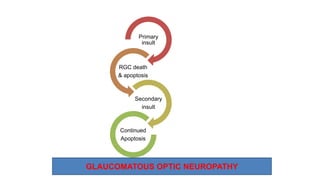
Primary
insult
RGC death
& apoptosis
Secondary
insult
Continued
Apoptosis
GLAUCOMATOUS OPTIC NEUROPATHY
A. CONGENITAL AND
DEVELOPMENTAL
GLAUCOMA
• A group of diverse disorders in which abnormal high IOP results due to
developmental abnormalities of the angle of anterior chamber obstructing
the drainage of aqueous humour.
• Developmental glaucoma preferred in glaucoma that occur after several
years of birth.
• Types:
– Primary congenital/developmental glaucoma (PCG).
– Developmental glaucoma with associated congenital ocular anomalies OR
systemic anomalies.
A. CONGENITAL AND DEVELOPMENTAL GLAUCOMA
1. PRIMARY CONGENITAL / DEVELOPMENTAL GLAUCOMA
• Depending upon the age of onset the developmental glaucoma are termed as:
1. Newborn glaucoma (true congenital glaucoma)[40% of cases]
• When IOP raised during intrauterine life and child is born with ocular enlargement.
2. Infantile glaucoma [55% of cases]
• When the disease manifests prior to the child’s third birthday
3. Juvenile glaucoma (Juvenile open-angle glaucoma/POAG)[5%]
• Develop pressure rise after 3 years but before adulthood.
Bupthalmos (bull-like eyes) = The eyeball enlarges prior to age of 3 years
due to retention of aqueous humour; thus ā€˜hydropthalmos’ suggested
A. CONGENITAL AND DEVELOPMENTAL GLAUCOMA
PATHOGENESIS
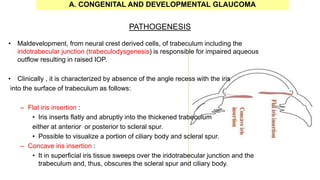
• Maldevelopment, from neural crest derived cells, of trabeculum including the
iridotrabecular junction (trabeculodysgenesis) is responsible for impaired aqueous
outflow resulting in raised IOP.
• Clinically , it is characterized by absence of the angle recess with the iris
into the surface of trabeculum as follows:
– Flat iris insertion :
• Iris inserts flatly and abruptly into the thickened trabeculum
either at anterior or posterior to scleral spur.
• Possible to visualize a portion of ciliary body and scleral spur.
– Concave iris insertion :
• It in superficial iris tissue sweeps over the iridotrabecular junction and the
trabeculum and, thus, obscures the scleral spur and ciliary body.
A. CONGENITAL AND DEVELOPMENTAL GLAUCOMA
CLINICAL FEATURES
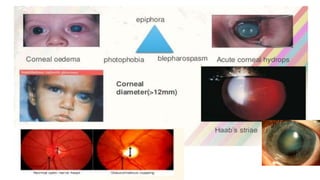
1. Lacrimation, photophobia and blepharospasm
– Classic triad of congenital glaucoma
2. Corneal signs
I. Corneal edema
II. Corneal enlargement [>13mm confirms enlargement]
III. Tears and breaks in Descemet’s membranes (Haab’s striae) [appears as lines with
double contour]
3. Sclera : Thin and appears blue due to underlying uveal tissue.
4. Anterior chamber : Becomes deep
5. Iris : Iridodonesis and atrophic patches in late stage.
6. Lens : Flat due to stretching of zonules and subluxate backward.
7. Optic disc : Variable cupping and atrophy especially after third year.
8. IOP : Raised which is neither marked nor acute.
9. Axial myopia : Increase in axial length leading to anisometropic amblyopia.
A. CONGENITAL AND DEVELOPMENTAL GLAUCOMA
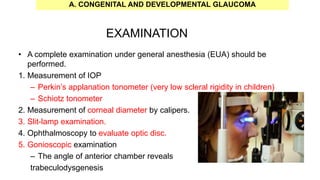
EXAMINATION
• A complete examination under general anesthesia (EUA) should be
performed.
1. Measurement of IOP
– Perkin’s applanation tonometer (very low scleral rigidity in children)
– Schiotz tonometer
2. Measurement of corneal diameter by calipers.
3. Slit-lamp examination.
4. Ophthalmoscopy to evaluate optic disc.
5. Gonioscopic examination
– The angle of anterior chamber reveals
trabeculodysgenesis
A. CONGENITAL AND DEVELOPMENTAL GLAUCOMA
DIFFERENTIAL DIAGNOSIS
• Cloudy cornea
– Trauma/ Interstitial keratitis/ Corneal endothelial injury
• Large cornea
– Megalocornea/ Sclerocornea/ High myopia
• Lacrimation
– Congenital nasolacrimal duct blockage/ Corneal abrasion/ Meesman’s corneal
dystrophy
• Photophobia
– Keratitis / Uveitis
• Raised IOP
– Retinoblastoma/ Secondary congenital glaucoma (rubella/aniridia/Sturge-Weber
syndrome)
• Optic disc changes
– Pit/ Hypoplasia/ Tilted disc/ Large physiological cup
A. CONGENITAL AND DEVELOPMENTAL GLAUCOMA
TREATMENT
• Medical treatment (acetazolamide, beta blocker)
• Surgical procedures
1. Incisional angle surgery
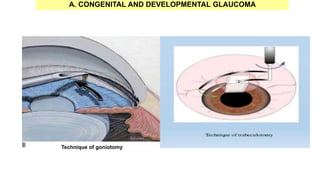
• Internal approach (goniotomy)[85% success rate]
– Barkan’s goniotomy knife (approximately 75o)
• External approach (trabeculectomy)
– Harm’s trabeculotome
2. Filteration surgery
• Trabeculectomy with antimetabolites gives good results.
• Combined trabeculectomy and trabeculectomy with antimetabolites
3. Glaucoma drainage devices (GDD)
• Required in incalcitrant cases.
A. CONGENITAL AND DEVELOPMENTAL GLAUCOMA
Technique of goniotomy
A. CONGENITAL AND DEVELOPMENTAL GLAUCOMA
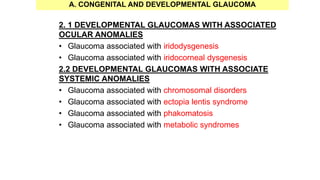
2. 1 DEVELOPMENTAL GLAUCOMAS WITH ASSOCIATED
OCULAR ANOMALIES
• Glaucoma associated with iridodysgenesis
• Glaucoma associated with iridocorneal dysgenesis
2.2 DEVELOPMENTAL GLAUCOMAS WITH ASSOCIATE
SYSTEMIC ANOMALIES
• Glaucoma associated with chromosomal disorders
• Glaucoma associated with ectopia lentis syndrome
• Glaucoma associated with phakomatosis
• Glaucoma associated with metabolic syndromes
A. CONGENITAL AND DEVELOPMENTAL GLAUCOMA
B. 1. PRIMARY OPEN-
ANGLE GLAUCOMA
(POAG)
• Chronic simple glaucoma of adult onset.
• Typical characteristics are:
– Slowly progressive raised IOP (>21mmHg on at least a few occasion)
associated with,
– Open normal appearing anterior chamber angle
– Characteristic optic disc cupping
– Specific visual field defects
• Etiopathogenesis
– Predisposing and risk factors
– Pathogenesis of IOP
– Pathogenesis of optic neuropathy (refer RGC death)
B. 1. PRIMARY OPEN-ANGLE GLAUCOMA (POAG)
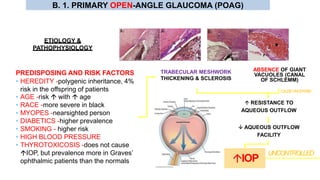
ETIOLOGY &
PATHOPHYSIOLOGY
PREDISPOSING AND RISK FACTORS
• HEREDITY -polygenic inheritance, 4%
risk in the offspring of patients
• AGE -risk  with  age
• RACE -more severe in black
• MYOPES -nearsighted person
• DIABETICS -higher prevalence
• SMOKING - higher risk
• HIGH BLOOD PRESSURE
• THYROTOXICOSIS -does not cause
IOP, but prevalence more in Graves’
ophthalmic patients than the normals IOP
 AQUEOUS OUTFLOW
FACILITY
 RESISTANCE TO
AQUEOUS OUTFLOW
TRABECULAR MESHWORK
THICKENING & SCLEROSIS
ABSENCE OF GIANT
VACUOLES (CANAL
OF SCHLEMM)
CAUSEUNCERTAIN
UNCONTROLLED
B. 1. PRIMARY OPEN-ANGLE GLAUCOMA (POAG)
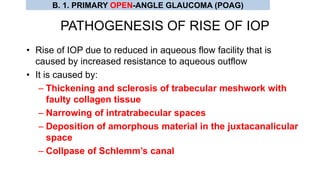
PATHOGENESIS OF RISE OF IOP
• Rise of IOP due to reduced in aqueous flow facility that is
caused by increased resistance to aqueous outflow
• It is caused by:
– Thickening and sclerosis of trabecular meshwork with
faulty collagen tissue
– Narrowing of intratrabecular spaces
– Deposition of amorphous material in the juxtacanalicular
space
– Collpase of Schlemm’s canal
B. 1. PRIMARY OPEN-ANGLE GLAUCOMA (POAG)
SYMPTOMS
1. Asymptomatic
2. Headache and eye ache
3. Scotoma (defects in visual field)
4. Difficulty in reading and close
work
5. Delayed dark adaptation
6. Significant loss of vision and
blindness
B. 1. PRIMARY OPEN-ANGLE GLAUCOMA (POAG)
SIGNS
1. Anterior chamber signs
– Sluggish pupil reflex
– Cornea show slight haze
– A low (<555µm) central corneal
thickness (CCT)
2. Intraocular pressure changes
3. Optic disc changes
– Fundus examination (Slit lamp
biomicroscopic examination)
– Confocal scanning laser topography
(Heidelberg retinal tomography/HRT)
– Optical coherence tomography
(OCT)
4. Visual field defects
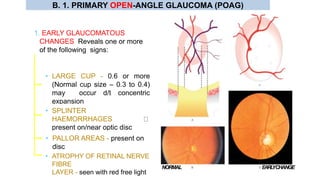
• LARGE CUP - 0.6 or more
(Normal cup size – 0.3 to 0.4)
may occur d/t concentric
expansion
• SPLINTER
HAEMORRHAGES
present on/near optic disc
margin• PALLOR AREAS - present on
disc
• ATROPHY OF RETINAL NERVE
FIBRE
LAYER - seen with red free light
1. EARLY GLAUCOMATOUS
CHANGES Reveals one or more
of the following signs:
NORMAL EARLYCHANGE
B. 1. PRIMARY OPEN-ANGLE GLAUCOMA (POAG)
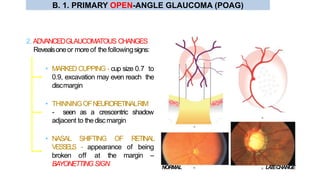
• MARKED CUPPING - cup size 0.7 to
0.9, excavation may even reach the
discmargin
• THINNINGOFNEURORETINALRIM
- seen as a crescentric shadow
adjacent to thediscmargin
• NASAL SHIFTING OF RETINAL
VESSELS - appearance of being
broken off at the margin –
BAYONETTINGSIGN
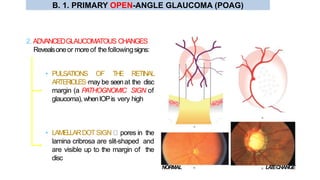
2. ADVANCEDGLAUCOMATOUS CHANGES
Revealsoneor moreof the followingsigns:
NORMAL LATECHANGE
B. 1. PRIMARY OPEN-ANGLE GLAUCOMA (POAG)
• PULSATIONS OF THE RETINAL
ARTERIOLES-may be seenat the disc
margin (a PATHOGNOMIC SIGN of
glaucoma), whenIOPis very high
• LAMELLARDOTSIGN pores in the
lamina cribrosa are slit-shaped and
are visible up to the margin of the
disc
2. ADVANCEDGLAUCOMATOUS CHANGES
Revealsoneor moreof the followingsigns:
NORMAL LATECHANGE
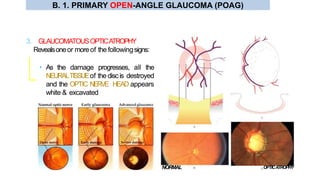
B. 1. PRIMARY OPEN-ANGLE GLAUCOMA (POAG)
• As the damage progresses, all the
NEURALTISSUEof the discis destroyed
and the OPTIC NERVE HEAD appears
white & excavated
3. GLAUCOMATOUSOPTICATROPHY
Revealsoneor moreof the followingsigns:
NORMAL OPTICATROPHY
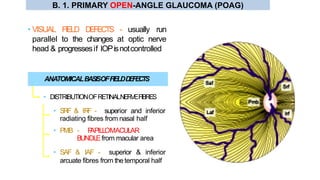
B. 1. PRIMARY OPEN-ANGLE GLAUCOMA (POAG)
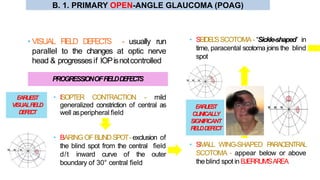
• VISUAL FIELD DEFECTS - usually run
parallel to the changes at optic nerve
head & progressesif IOPisnotcontrolled
• SRF & IRF - superior and inferior
radiating fibres from nasal half
• PMB - PAPILLOMACULAR
BUNDLEfrom macular area
• SAF & IAF - superior & inferior
arcuate fibres from thetemporal half
ANATOMICALBASISOFFIELDDEFECTS
• DISTRIBUTIONOFRETINALNERVEFIBRES
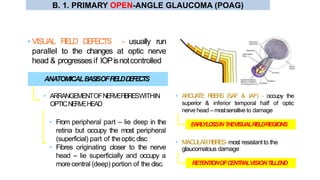
B. 1. PRIMARY OPEN-ANGLE GLAUCOMA (POAG)
• VISUAL FIELD DEFECTS - usually run
parallel to the changes at optic nerve
head & progressesif IOPisnotcontrolled
• From peripheral part – lie deep in the
retina but occupy the most peripheral
(superficial) part of theoptic disc
• Fibres originating closer to the nerve
head – lie superficially and occupy a
morecentral (deep) portion of the disc.
EARLYLOSSINTHEVISUALFIELDREGIONS
RETENTIONOFCENTRALVISIONTILLEND
ANATOMICALBASISOFFIELDDEFECTS
• ARRANGEMENTOFNERVEFIBRESWITHIN
OPTICNERVEHEAD
• ARCUATE FIBERS (SAF & IAF) - occupy the
superior & inferior temporal half of optic
nerve head – mostsensitiveto damage
• MACULARFIBRES-most resistantto the
glaucomatous damage
B. 1. PRIMARY OPEN-ANGLE GLAUCOMA (POAG)
• VISUAL FIELD DEFECTS - usually run
parallel to the changes at optic nerve
head & progressesif IOPisnotcontrolled
PROGRESSIONOFFIELDDEFECTS
• ISOPTER CONTRACTION - mild
generalized constriction of central as
well asperipheral field
EARLIEST
VISUALFIELD
DEFECT
• BARINGOFBLINDSPOT-exclusion of
the blind spot from the central field
d/t inward curve of the outer
boundary of 30° central field
• SMALL WING-SHAPED PARACENTRAL
SCOTOMA - appear below or above
theblind spot in BJERRUM'SAREA
EARLIEST
CLINICALLY
SIGNIFICANT
FIELDDEFECT
• SEIDEL’SSCOTOMA- ā€œSickle-shapedā€ in
time, paracental scotoma joins the blind
spot
B. 1. PRIMARY OPEN-ANGLE GLAUCOMA (POAG)
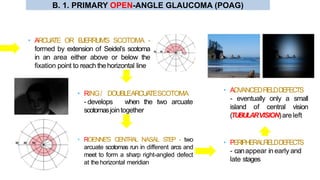
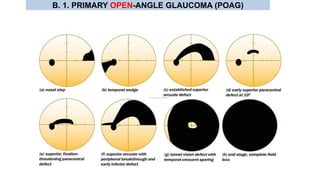
• ARCUATE OR BJERRUM’S SCOTOMA -
formed by extension of Seidel’s scotoma
in an area either above or below the
fixation point to reach thehorizontal line
• RING/ DOUBLEARCUATESCOTOMA
- develops when the two arcuate
scotomasjointogether
• ROENNE'S CENTRAL NASAL STEP - two
arcuate scotomas run in different arcs and
meet to form a sharp right-angled defect
at the horizontal meridian
• PERIPHERALFIELDDEFECTS
- canappear in early and
late stages
• ADVANCEDFIELDDEFECTS
- eventually only a small
island of central vision
(TUBULARVISION)areleft
B. 1. PRIMARY OPEN-ANGLE GLAUCOMA (POAG)
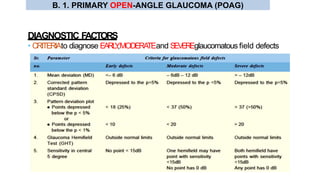
DIAGNOSTIC FACTORS
• CRITERIAto diagnose EARLY,MODERATEand SEVEREglaucomatous field defects
B. 1. PRIMARY OPEN-ANGLE GLAUCOMA (POAG)
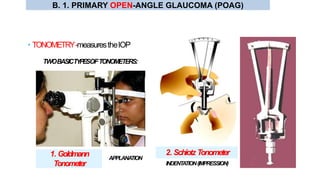
• TONOMETRY-measurestheIOP
TWOBASICTYPESOFTONOMETERS:
INDENTATION(IMPRESSION)
2. Schiotz Tonometer
APPLANATION
1. Goldmann
Tonometer
B. 1. PRIMARY OPEN-ANGLE GLAUCOMA (POAG)
IOP CHANGES
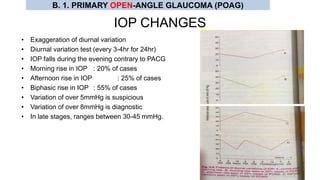
• Exaggeration of diurnal variation
• Diurnal variation test (every 3-4hr for 24hr)
• IOP falls during the evening contrary to PACG
• Morning rise in IOP : 20% of cases
• Afternoon rise in IOP : 25% of cases
• Biphasic rise in IOP : 55% of cases
• Variation of over 5mmHg is suspicious
• Variation of over 8mmHg is diagnostic
• In late stages, ranges between 30-45 mmHg.
B. 1. PRIMARY OPEN-ANGLE GLAUCOMA (POAG)
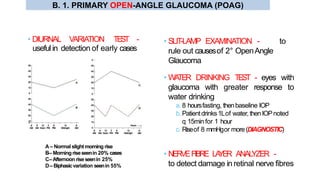
• DIURNAL VARIATION TEST -
usefulin detection of early cases
A – Normal slightmorning rise
B– Morning riseseenin 20% cases
C–Afternoon riseseenin 25%
D– Biphasicvariation seenin 55%
• SLIT-LAMP EXAMINATION - to
rule out causesof 2° OpenAngle
Glaucoma
• WATER DRINKING TEST - eyes with
glaucoma with greater response to
water drinking
a.8 hoursfasting, thenbaseline IOP
b. Patientdrinks1Lof water, thenIOPnoted
q 15min for 1 hour
c. Riseof 8 mmHgor more(DIAGNOSTIC)
• NERVEFIBRE LAYER ANALYZER -
to detect damage in retinal nerve fibres
B. 1. PRIMARY OPEN-ANGLE GLAUCOMA (POAG)
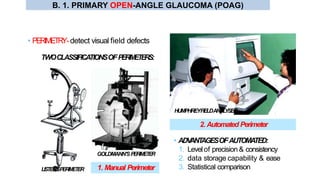
• PERIMETRY-detect visual field defects
TWOCLASSIFICATIONSOFPERIMETERS:
GOLDMANN’SPERIMETER
1. Manual PerimeterLISTER’SPERIMETER
2.Automated Perimeter
HUMPHREYFIELDANALYSER
• ADVANTAGESOFAUTOMATED:
1. Levelof precision& consistency
2. data storage capability & ease
3. Statistical comparison
B. 1. PRIMARY OPEN-ANGLE GLAUCOMA (POAG)
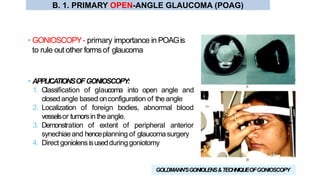
• GONIOSCOPY- primary importance in POAGis
to rule out other formsof glaucoma
GOLDMANN’SGONIOLENS&TECHNIQUEOFGONIOSCOPY
• APPLICATIONSOFGONIOSCOPY:
1. Classification of glaucoma into open angle and
closedangle based onconfiguration of the angle
2. Localization of foreign bodies, abnormal blood
vesselsor tumorsin theangle.
3. Demonstration of extent of peripheral anterior
synechiaeand henceplanning of glaucomasurgery
4. Direct goniolensisusedduringgoniotomy
B. 1. PRIMARY OPEN-ANGLE GLAUCOMA (POAG)
SHAFFER’S
SYSTEM OF
GRADING THE
ANGLE WIDTH
MOSTCOMMONLY USED
B. 1. PRIMARY OPEN-ANGLE GLAUCOMA (POAG)
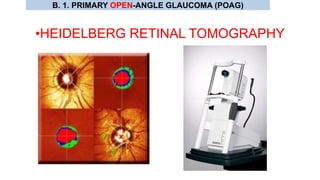
•HEIDELBERG RETINAL TOMOGRAPHY
B. 1. PRIMARY OPEN-ANGLE GLAUCOMA (POAG)
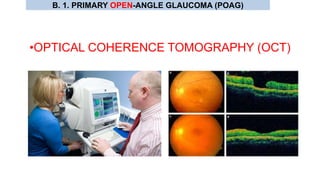
•OPTICAL COHERENCE TOMOGRAPHY (OCT)
B. 1. PRIMARY OPEN-ANGLE GLAUCOMA (POAG)
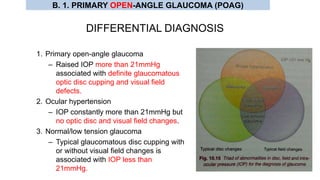
DIFFERENTIAL DIAGNOSIS
1. Primary open-angle glaucoma
– Raised IOP more than 21mmHg
associated with definite glaucomatous
optic disc cupping and visual field
defects.
2. Ocular hypertension
– IOP constantly more than 21mmHg but
no optic disc and visual field changes.
3. Normal/low tension glaucoma
– Typical glaucomatous disc cupping with
or without visual field changes is
associated with IOP less than
21mmHg.
B. 1. PRIMARY OPEN-ANGLE GLAUCOMA (POAG)
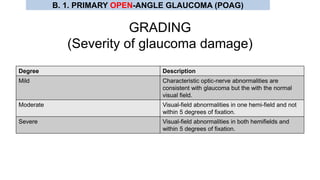
GRADING
(Severity of glaucoma damage)
Degree Description
Mild Characteristic optic-nerve abnormalities are
consistent with glaucoma but the with the normal
visual field.
Moderate Visual-field abnormalities in one hemi-field and not
within 5 degrees of fixation.
Severe Visual-field abnormalities in both hemifields and
within 5 degrees of fixation.
B. 1. PRIMARY OPEN-ANGLE GLAUCOMA (POAG)
MANAGEMENT
• General considerations
• Aim : To lower IOP to a level visual loss does not occur.
• Baseline data need to gather for future progress should include:
– Visual acuity
– Slit lamp examination of anterior chamber
– Tonometry
– Central corneal thickness
– Optic disc evaluation
– Gonioscopy
– Visual field charting
• Evaluate grading of glaucoma
B. 1. PRIMARY OPEN-ANGLE GLAUCOMA (POAG)
MANAGEMENT
1. Therapeutic choices
A. Medical therapy
i. Identification of target pressure
ii. Single drug therapy
iii. Combination therapy
iv. Monitoring therapy
B. Argon or diode laser trabeculectoplasty (ALT)
Complications :
i. Transient acute rise of IOP
ii. Transient inflammation
iii. Hemorrhage/uveitis
C.Filteration surgery
B. 1. PRIMARY OPEN-ANGLE GLAUCOMA (POAG)
TREATMENT REGIMES
A. Single drug therapy
1. Prostaglandin analogues (latanaprost/travoprost)
2. Topical beta-blockers (timolol/betaxolol/levobunolol)
3. Adrenergic drugs (epinephrine hydrochloride/ brimonide)
4. Dorzolamide
5. Pilocarpine
B. Combination topical therapy (timolol + pilocarpine)
C.Role of oral carbonic anhydrase inhibitors in POAG (acetozalamide)
D.Hyperosmotic agents (mannitol)
E. Neuroprotective agents
B. 1. PRIMARY OPEN-ANGLE GLAUCOMA (POAG)
OCULAR HYPERTENSION
• Patient with IOP constantly more than 21mmHg but no optic
disc and visual field changes.
• ā€˜Glaucoma suspect’ is an adult having normal open angle on
gonioscopy and anyone of the following signs in at least one
eye:
– Elevated IOP
– Suspicious disc changes in the form of asymmetric or narrowing of
neuroretinal rim or a disc hemorrhage,
– Visual fields consistent with glaucomatous damage.
RISK FACTOR OF POAG IN OCULAR HYPERTENSION PATIENTS
High risk reported by Ocular Hypertension Study (OHTS) and European Glaucoma
Prevention Study (EGPS) are;
– IOP consistently >30mmHg
– CCT <555µm
– Vertical cup disc ratio of >0.7
– Increase age
– Increased pattern standard deviation on Humphrey visual field test
– Disc hemorrhages (splinter hemorrhages over/near the disc)
– Others
• Family history
• Fellow eye of the unilateral POAG
• Other ocular conditions (myopia/steroid responder)
• Systemic risk factors (DM/HTN/hypothyroidism/ migranous headache)
NORMAL TENSION GLAUCOMA
• Low tension glaucoma is labelled when typical glaucomatous disc
changes with an intraocular field defects are associated with IOP
below 21 mmHg.
• Etiopathogenesis
– Raynaud phenomenon
– Migraine
– Nocturnal systemic hypotension
– Overtreated systemic hypertension
– Reduced blood flow velocity in the ophthalmic artery
B. 2. PRIMARY ANGLE-
CLOSURE GLAUCOMA
(PACG)
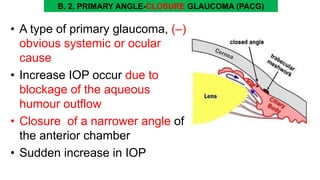
B. 2. PRIMARY ANGLE-CLOSURE GLAUCOMA (PACG)
• A type of primary glaucoma, (–)
obvious systemic or ocular
cause
• Increase IOP occur due to
blockage of the aqueous
humour outflow
• Closure of a narrower angle of
the anterior chamber
• Sudden increase in IOP
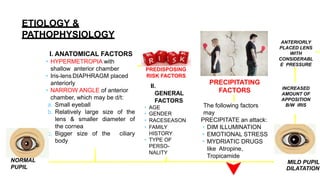
ETIOLOGY &
PATHOPHYSIOLOGY
I. ANATOMICAL FACTORS
• HYPERMETROPIA with
shallow anterior chamber
• Iris-lens DIAPHRAGM placed
anteriorly
• NARROW ANGLE of anterior
chamber, which may be d/t:
a. Small eyeball
b. Relatively large size of the
lens & smaller diameter of
the cornea
c. Bigger size of the ciliary
body
II.
GENERAL
FACTORS
• AGE
• GENDER
• RACESEASON
• FAMILY
HISTORY
• TYPE OF
PERSO-
NALITY
PREDISPOSING
RISK FACTORS
The following factors
may
PRECIPITATE an attack:
• DIM ILLUMINATION
• EMOTIONAL STRESS
• MYDRIATIC DRUGS
like Atropine,
Tropicamide
PRECIPITATING
FACTORS INCREASED
AMOUNT OF
APPOSITION
B/W IRIS
ANTERIORLY
PLACED LENS
WITH
CONSIDERABL
E PRESSURE
NORMAL
PUPIL
MILD PUPIL
DILATATION
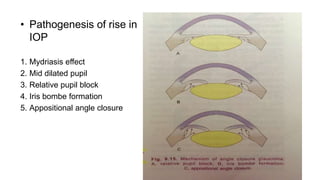
• Pathogenesis of rise in
IOP
1. Mydriasis effect
2. Mid dilated pupil
3. Relative pupil block
4. Iris bombe formation
5. Appositional angle closure
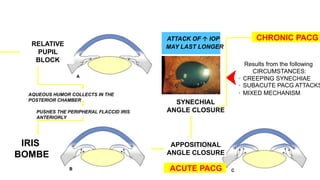
RELATIVE
PUPIL
BLOCK
AQUEOUS HUMOR COLLECTS IN THE
POSTERIOR CHAMBER
PUSHES THE PERIPHERAL FLACCID IRIS
ANTERIORLY
IRIS
BOMBE
APPOSITIONAL
ANGLE CLOSURE
SYNECHIAL
ANGLE CLOSURE
ATTACK OF  IOP
MAY LAST LONGER
ACUTE PACG
CHRONIC PACG
Results from the following
CIRCUMSTANCES:
• CREEPING SYNECHIAE
• SUBACUTE PACG ATTACKS
• MIXED MECHANISM
• Classification (ISGEO Classification)
(International Society of Geographical and Epidemiological Ophthalmology)
1. Primary angle closure suspect (PACS)
2. Primary angle closure (PAC)
3. Primary angle closure glaucoma (PACG)
• Traditional clinical classification
1. Latent primary angle-closure glaucoma
2. Subacute (intermittent) primary angle-closure glaucoma
3. Acute primary angel-closure glaucoma
4. Chronic primary angle-closure glaucoma
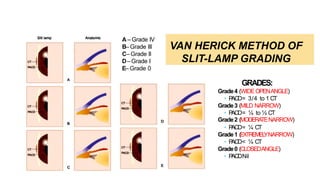
VAN HERICK METHOD OF
SLIT-LAMP GRADING
A – Grade IV
B– Grade III
C– Grade II
D– Grade I
E– Grade 0
GRADES:
Grade4 (WIDEOPENANGLE)
• PACD= 3/4 to 1 CT
Grade3 (MILD NARROW)
• PACD= ¼ to ½ CT
Grade2 (MODERATENARROW)
• PACD= ¼ CT
Grade1 (EXTREMELYNARROW)
• PACD< ¼ CT
Grade0 (CLOSEDANGLE)
• PACDNil
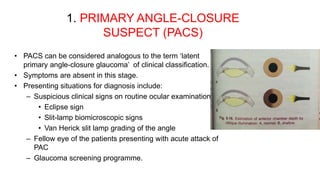
1. PRIMARY ANGLE-CLOSURE
SUSPECT (PACS)
• PACS can be considered analogous to the term ā€˜latent
primary angle-closure glaucoma’ of clinical classification.
• Symptoms are absent in this stage.
• Presenting situations for diagnosis include:
– Suspicious clinical signs on routine ocular examination
• Eclipse sign
• Slit-lamp biomicroscopic signs
• Van Herick slit lamp grading of the angle
– Fellow eye of the patients presenting with acute attack of
PAC
– Glaucoma screening programme.
DIAGNOSTIC TEST
• IOP measurement
• Gonioscopy
• Ultrasonic biomicroscopy
• Anterior segment OCT
• Optic disc evaluation
• Visual field analysis
DIAGNOSTIC CRITERIA FOR PACS
• Gonioscopy with irido-trabecular contact greater than 270 degree angle and
no peripheral anterior synechia (PAS absent)
• IOP normal
• No optic changes
• Normal visual fields
MANAGEMENT
• Provocative test
1. Prone-darkroom
2. Mydriatic provocative
Inferences from provocative test are:
• Positive indicates that angle is capable od spontaneous closure.
• Negative in the presence of occludable angles on gonioscopy does not rule
out a possibility of spontaneous closure. So patient should be warned of
possible symptoms of an acute attack of PAC.
TREATMENT
• Prophylactic laser iridotomy
• Periodic follow up
2. PRIMARY ANGLE CLOSURE (PAC)
• Considered to comprise following entities of clinical classification:
– Subacute primary angle closure
– Acute PAC
– Chronic PAC (asymptomatic)
• Defining criteria for PAC
– Irido-trabecular contact noted on gonioscopy in greater than 270
degree angle
– IOP elevated and/or peripheral anterior synechiae (PAS) present
– Optic disc normal
– Visual field normal
• Impression = Angle is abnormal either in function and/or structure.
3. PRIMARY ANGLE-CLOSURE GLAUCOMA
(PACG)
• Pathogenesis
– Gradual synechial closure of the angle of anterior chamber.
– Untreated patients with PAC may over the period covert to PACG with or without history of
subacute/acute attack of PAC.
• Clinical features
– Subacute and acute PACG
– Chronic PACG
• IOP constantly raised
• Eyeball no congestion and painless except in post acute angle closure cases where
eyes may be congested and irritable.
• Optic disc shows glaucomatous cupping
• Visual field defects similar to POAG occur
• Gonioscopy reveals >270o of angle closure along peripheral anterior synechiae(PAS)
• Defining criteria for PACG
– Irido-trabecular contact greater than 270o of angle
– PAS are formed
– IOP elevated
– Optic disc show glaucomatous damage
– Visual fields show typical glaucomatous defects
• Treatment
– Laser iridotomy
– Trabeculectomy
– Prophylactic laser iridotomy
ABSOLUTE PRIMARY ANGLE-CLOSURE
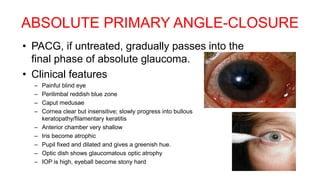
• PACG, if untreated, gradually passes into the
final phase of absolute glaucoma.
• Clinical features
– Painful blind eye
– Perilimbal reddish blue zone
– Caput medusae
– Cornea clear but insensitive; slowly progress into bullous
keratopathy/filamentary keratitis
– Anterior chamber very shallow
– Iris become atrophic
– Pupil fixed and dilated and gives a greenish hue.
– Optic dish shows glaucomatous optic atrophy
– IOP is high, eyeball become stony hard
MANAGEMENT
1. Retrobulbar alcohol injection
– 1ml of 2% xylocaine followed after 5-10 minutes by 1ml of 80%
alcohol
– It destroys ciliary ganglion
2. Destruction of secretory ciliary epithelium
– To lower IOP
3. Enucleation of eyeball
COMPLICATIONS
• Corneal ulceration
• Staphyloma formation
• Atrophic bulbi
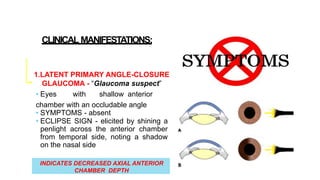
CLINICAL MANIFESTATIONS:
INDICATES DECREASED AXIAL ANTERIOR
CHAMBER DEPTH
1.LATENT PRIMARY ANGLE-CLOSURE
GLAUCOMA - ā€œGlaucoma suspectā€
• Eyes with shallow anterior
chamber with an occludable angle
• SYMPTOMS - absent
• ECLIPSE SIGN - elicited by shining a
penlight across the anterior chamber
from temporal side, noting a shadow
on the nasal side
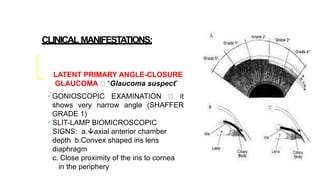
CLINICAL MANIFESTATIONS:
LATENT PRIMARY ANGLE-CLOSURE
GLAUCOMA ā€œGlaucoma suspectā€
• GONIOSCOPIC EXAMINATION it
shows very narrow angle (SHAFFER
GRADE 1)
• SLIT-LAMP BIOMICROSCOPIC
SIGNS: a.axial anterior chamber
depth b.Convex shaped iris lens
diaphragm
c. Close proximity of the iris to cornea
in the periphery
CLINICAL MANIFESTATIONS:
2.SUBACUTE OR INTERMITTENT PACG
• During PE, eye is white & not congested
• All the signs described in LATENT PACG
can be elicited in this phase ALSO
• CLINICAL COURSE - if without
treatment, may follow any of the following:
a. Attack of ACUTE PACG
b. CHRONIC PACG without passing
through acute stage
CLINICAL MANIFESTATIONS:
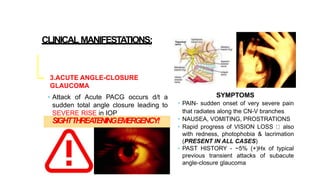
3.ACUTE ANGLE-CLOSURE
GLAUCOMA
• Attack of Acute PACG occurs d/t a
sudden total angle closure leading to
SEVERE RISE in IOP
SIGHTTHREATENINGEMERGENCY!
SYMPTOMS
• PAIN- sudden onset of very severe pain
that radiates along the CN-V branches
• NAUSEA, VOMITING, PROSTRATIONS
• Rapid progress of VISION LOSS also
with redness, photophobia & lacrimation
(PRESENT IN ALL CASES)
• PAST HISTORY - ~5% (+)Hx of typical
previous transient attacks of subacute
angle-closure glaucoma
CLINICAL MANIFESTATIONS:
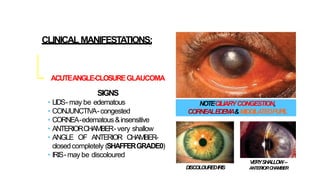
ACUTEANGLE-CLOSUREGLAUCOMA
SIGNS
• LIDS-may be edematous
• CONJUNCTIVA-congested
• CORNEA-edematous&insensitive
• ANTERIORCHAMBER-very shallow
• ANGLE OF ANTERIOR CHAMBER-
closedcompletely (SHAFFERGRADE0)
• IRIS-may be discoloured
NOTECILIARYCONGESTION,
CORNEALEDEMA&MIDDILATEDPUPIL
DISCOLOUREDIRIS
VERYSHALLOW–
ANTERIORCHAMBER
CLINICAL MANIFESTATIONS:
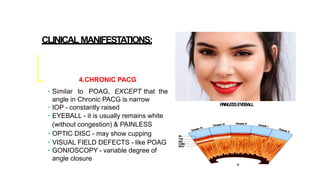
4.CHRONIC PACG
• Similar to POAG, EXCEPT that the
angle in Chronic PACG is narrow
• IOP - constantly raised
• EYEBALL - it is usually remains white
(without congestion) & PAINLESS
• OPTIC DISC - may show cupping
• VISUAL FIELD DEFECTS - like POAG
• GONIOSCOPY - variable degree of
angle closure
PAINLESSEYEBALL
PERIPHERAL IRIDECTOMY
• Indications
– Treatment of all stages of primary angle-closure glaucoma
– Prophylaxis of glaucoma
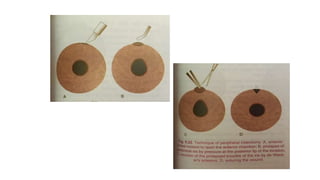
• Technique
– Anterior limbal incision is done at the is done about 4mm
– Prolapse of peripheral iris by pressure at posterior lip of the incision
– Small full thickness piece of iris is excised by de Wecker’s scissors
– Iris is reposited back and wound is closed
– Subconjunctival injection of dexamethasone 0.25 ml and gentamicin 0.5 ml is
given
– Putching of eye with sterile eye pad and plaster
C. SECONDARY
GLAUCOMA
• A group of disorders in which rise of IOP is associated with some primary
ocular/ systemic disease. Therefore, clinical features comprises that of
primary disease and that due to effects of raised IOP.
• Classification
A. Depending upon mechanism of rise in IOP
I. Secondary open angle glaucoma in which aqueous outflow may be
blocked by;
– Pretrabecular membrane
– Trabecular clogging
– Edema and scarring
– Post-trabecular elevated episcleral venous pressure
II. Secondary angle closure glaucoma which may/may not be associated with
pupil block.
B. Depending upon causative primary disease, secondary
glaucomas are named as follows:
1. Lens-induced (Phacogenic) glaucoma
2. Inflammatory glaucoma
3. Pigmentary glaucoma
4. Neovascular glaucoma
5. Glaucoma associated with iridocorneal endothelial syndromes
6. Pseudo exfoliative glaucoma
7. Glaucoma associated with intraocular hemorrhage
8. Steroid-induced glaucoma
9. Traumatic glaucoma
10. Glaucoma-in-aphakia
11. Glaucoma associated with intraocular tumours
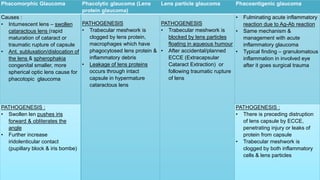
Phacomorphic Glaucoma Phacolytic glaucoma (Lens
protein glaucoma)
Lens particle glaucoma Phacoantigenic glaucoma
Causes :
• Intumescent lens – swollen
cataractous lens (rapid
maturation of cataract or
traumatic rupture of capsule
• Ant. subluxation/dislocation of
the lens & spherophakia
congenital smaller, more
spherical optic lens cause for
phacotopic glaucoma
PATHOGENESIS
• Trabecular meshwork is
clogged by lens protein,
macrophages which have
phagocytosed lens protein &
inflammatory debris
• Leakage of lens proteins
occurs through intact
capsule in hypermature
cataractous lens
PATHOGENESIS
• Trabecular meshwork is
blocked by lens particles
floating in aqueous humour
• After accidental/planned
ECCE (Extracapsular
Cataract Extraction) or
following traumatic rupture
of lens
• Fulminating acute inflammatory
reaction due to Ag-Ab reaction
• Same mechanism &
management with acute
inflammatory glaucoma
• Typical finding – granulomatous
inflammation in involved eye
after it goes surgical trauma
PATHOGENESIS :
• Swollen len pushes iris
forward & obliterates the
angle
• Further increase
iridolenticular contact
(pupillary block & iris bombe)
PATHOGENESIS :
• There is preceding distruption
of lens capsule by ECCE,
penetrating injury or leaks of
protein from capsule
• Trabecular meshwork is
clogged by both inflammatory
cells & lens particles
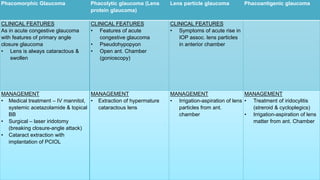
Phacomorphic Glaucoma Phacolytic glaucoma (Lens
protein glaucoma)
Lens particle glaucoma Phacoantigenic glaucoma
CLINICAL FEATURES
As in acute congestive glaucoma
with features of primary angle
closure glaucoma
• Lens is always cataractous &
swollen
CLINICAL FEATURES
• Features of acute
congestive glaucoma
• Pseudohypopyon
• Open ant. Chamber
(gonioscopy)
CLINICAL FEATURES
• Symptoms of acute rise in
IOP assoc. lens particles
in anterior chamber
MANAGEMENT
• Medical treatment – IV mannitol,
systemic acetazolamide & topical
BB
• Surgical – laser iridotomy
(breaking closure-angle attack)
• Cataract extraction with
implantation of PCIOL
MANAGEMENT
• Extraction of hypermature
cataractous lens
MANAGEMENT
• Irrigation-aspiration of lens
particles from ant.
chamber
MANAGEMENT
• Treatment of iridocylitis
(streroid & cycloplegics)
• Irrigation-aspiration of lens
matter from ant. Chamber
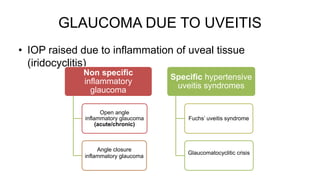
GLAUCOMA DUE TO UVEITIS
• IOP raised due to inflammation of uveal tissue
(iridocyclitis)
Non specific
inflammatory
glaucoma
Open angle
inflammatory glaucoma
(acute/chronic)
Angle closure
inflammatory glaucoma
Specific hypertensive
uveitis syndromes
Fuchs’ uveitis syndrome
Glaucomatocyclitic crisis
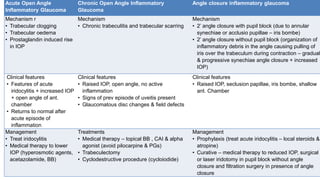
NON SPECIFIC INFLAMMATORY GLAUCOMAAcute Open Angle
Inflammatory Glaucoma
Chronic Open Angle Inflammatory
Glaucoma
Angle closure inflammatory glaucoma
Mechanism r
• Trabecular clogging
• Trabecular oedema
• Prostaglandin induced rise
in IOP
Mechanism
• Chronic trabeculitis and trabecular scarring
Mechanism
• 2’ angle closure with pupil block (due to annular
synechiae or acclusio pupillae – iris bombe)
• 2’ angle closure without pupil block (organization of
inflammatory debris in the angle causing pulling of
iris over the trabeculum during contraction – gradual
& progressive synechiae angle closure + increased
IOP)
Clinical features
• Features of acute
iridocylitis + increased IOP
+ open angle of ant.
chamber
• Returns to normal after
acute episode of
inflammation
Clinical features
• Raised IOP, open angle, no active
inflammation
• Signs of prev episode of uveitis present
• Glaucomatous disc changes & field defects
Clinical features
• Raised IOP, seclusion papillae, iris bombe, shallow
ant. Chamber
Management
• Treat iridocylitis
• Medical therapy to lower
IOP (hyperosmotic agents,
acetazolamide, BB)
Treatments
• Medical therapy – topical BB , CAI & alpha
agonist (avoid pilocarpine & PGs)
• Trabeculectomy
• Cyclodestructive procedure (cycloiodide)
Management
• Prophylaxis (treat acute iridocylitis – local steroids &
atropine)
• Curative – medical therapy to reduced IOP, surgical
or laser iridotomy in pupil block without angle
closure and filtration surgery in presence of angle
closure
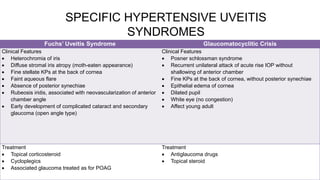
SPECIFIC HYPERTENSIVE UVEITIS
SYNDROMES
Fuchs’ Uveitis Syndrome Glaucomatocyclitic Crisis
Clinical Features
ļ‚· Heterochromia of iris
ļ‚· Diffuse stromal iris atropy (moth-eaten appearance)
ļ‚· Fine stellate KPs at the back of cornea
ļ‚· Faint aqueous flare
ļ‚· Absence of posterior synechiae
ļ‚· Rubeosis iridis, associated with neovascularization of anterior
chamber angle
ļ‚· Early development of complicated cataract and secondary
glaucoma (open angle type)
Clinical Features
ļ‚· Posner schlossman syndrome
ļ‚· Recurrent unilateral attack of acute rise IOP without
shallowing of anterior chamber
ļ‚· Fine KPs at the back of cornea, without posterior synechiae
ļ‚· Epithelial edema of cornea
ļ‚· Dilated pupil
ļ‚· White eye (no congestion)
ļ‚· Affect young adult
Treatment
ļ‚· Topical corticosteroid
ļ‚· Cycloplegics
ļ‚· Associated glaucoma treated as for POAG
Treatment
ļ‚· Antiglaucoma drugs
ļ‚· Topical steroid
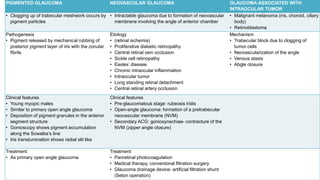
PIGMENTED GLAUCOMA NEOVASCULAR GLAUCOMA GLAUCOMA ASSOCIATED WITH
INTRAOCULAR TUMOR
• Clogging up of trabecular meshwork occurs by
pigment particles
• Intractable glaucoma due to formation of neovascular
membrane involving the angle of anterior chamber
• Malignant melanoma (iris, choroid, ciliary
body)
• Retinoblastoma
Pathogenesis
• Pigment released by mechanical rubbing of
posterior pigment layer of iris with the zonular
fibrils
Etiology
• (retinal ischemia)
• Proliferative diabetic retinopathy
• Central retinal vein occlusion
• Sickle cell retinopathy
• Easles’ disease
• Chronic intraocular inflammation
• Intraocular tumor
• Long standing retinal detachment
• Central retinal artery occlusion
Mechanism
• Trabecular block due to clogging of
tumor cells
• Neovascularization of the angle
• Venous stasis
• Abgle closure
Clinical features
• Young myopic males
• Similar to primary open angle glaucoma
• Deposition of pigment granules in the anterior
segment structure
• Gonioscopy shows pigment accumulation
along the Scwalbe’s line
• Iris translumination shows radial slit like
Clinical features
• Pre-glaucomatous stage: rubeosis iridis
• Open-angle glaucoma: formation of a pretrabecular
neovascular membrane (NVM)
• Secondary ACG: goniosynechiae- contracture of the
NVM (zipper angle closure)
Treatment
• As primary open angle glaucoma
Treatment
• Panretinal photocoagulation
• Medical therapy, conventonal filtration surgery
• Glaucoma drainage device- artificial filtration shunt
(Seton operation)
REFERENCES
• Comprehensive Opthalmology, 6th Edition, AK Khurana,
New Age International publisher, page 219-256
Glaucoma

Glaucoma

  • 2.
    DEFINITION OF GLAUCOMA Agroup of disorders characterized by a progressive optic neuropathy, characteristic appearance of the optic disc, specific pattern of irreversible visual field defects , associated frequently but not invariably with raised IOP.
  • 3.
    HOW GLAUCOMA CANOCCUR? • The pathophysiology of glaucoma revolves around the aqueous humour dynamics which are : 1. Ciliary body (site of aqueous production) 2. Angle of anterior chamber (aqueous drainage) 3. Aqueous outflow system • Trabecular meshwork • Schlemm’s canal • Collector channels
  • 4.
    ANGLE OF ANTERIORCHAMBER • Formed by : root iris, anterior-most part of ciliary body, scleral spur, trabecular meshwork and Schwalbe’s line (prominent end of Descemet’s membrane of cornea).
  • 5.
    Shaffer’s system ofgrading the angle width Grade Angle width Configuration Risk of closure Structures visible on gonioscopy 4 40 Wide angle Closure impossible SL, TM, SS, CBB 3 30 Open angle Closure impossible SL, TM, SS 2 20 Moderately narrow Closure possible SL, TM 1 10 Very narrow High risk of closure SL only S <10 Slit angle Closure imminent None 0 0 Closed Closed None
  • 6.
    (A) = Gonioscopicview • SL = Schwalbe’s line • TM = Trabecular meshwork • SS = Scleral spur (B) = Cross-section of anterior chamber • CBB = Ciliary body band • ROI= root of iris
  • 7.
    AQUEOUS OUTFLOW SYSTEM 1.Trabecular meshwork – Uveal meshwork – Corneoscleral meshwork – Juxtacanalicular (endothelial) meshwork 2. Schlemm’s canal 3. Collector channels – a.k.a intrascleral aqueous vessels – Direct system = aqueous veins to episcleral veins – Indirect system = smaller collector channels form intrascleral plexus to episcleral veins
  • 8.
    PHYSIOLOGY OF AQUEOUSHUMOR • Volume – Anterior chamber (0.25ml) – Posterior chamber (0.06ml) • Refractive index – 1.336. • Functions 1. Maintenance of a proper intraocular pressure. 2. Metabolic and nutritional role. 3. Optical function (maintain optical transparency). 4. Clearing function (blood, macrophages, remnants of lens matter). • Composition – Water (99.9%), proteins (colloid content), amino acid, oxygen in dissolved state, noncolloid constituents • Similar to plasma except that it has: – High concentrations of bicarbonate, ascorbate, pyruvate and lactate. – Low concentration of protein, urea and glucose.
  • 9.
    • AQUEOUSOUTFLOW SYSTEM AQUEOUSHUMOUR PRODUCTION: • ULTRAFILTRATION • SECRETION (ACTIVE TRANSPORT) • DIFFUSION (PASSIVE TRANSPORT)
  • 10.
  • 11.
  • 12.
    • Intraocular pressure(IOP) refers to the pressure exerted by the intraocular fluids on the coats of the eyeball. • Normal IOP : 10-21mmHg • Maintained by dynamic equilibrium between the formation and outflow of the aqueous humour. • Factors influencing IOP can be grouped as under: a) Local factors b) General factors • MAINTENANCEOFIOP
  • 13.
    LOCAL • Rate ofaqueous formation • Depends on permeability of ciliary capillaries and osmotic pressure of blood. • Resistance to aqueous outflow (drainage) • Most resistance is at the level of trabecular meshwork. • Increased episcleral venous pressure may increased IOP. • The Valsalva manoeuvre • Dilatation of pupil • In patients with narrow anterior chamber angle may cause rise of IOP owing to a relative obstruction of the aqueous drainage by the iris. • Refractive errors • Myopic individuals have higher IOP as compared to emmetropes and hypermetropies. • In fact, IOP corelates with axial length. GENERAL • Heredity. • Age. • Sex. (reduced facility of aqueous outflow) • Diurnal variation of IOP. (higher in morning and lower in evening) • Postural variations. ( IOP increase from the sitting to supine position) • Seasonal variations. (higher in winter) • Blood pressure. (no long-term effect on IOP ; however glaucoma more in HTN) • Osmotic pressure of blood. • General anesthetic and drugs. (alcohol lowers ; smoking/caffeine/steroid increases) • Exercise. Strenuous exercise lowers IOP transciently.
  • 14.
    CLASSIFICATION OF GLAUCOMA A.Congenital/developmentalglaucoma 1. Primary congenital glaucoma (without associated anomalies) 2. Developmental glaucoma (with associated anomalies) B.Primary adult glaucoma 1. Primary open-angle glaucoma (POAG) 2. Primary angle-closure glaucoma (PACG) 3. Primary mixed mechanism glaucoma C.Secondary glaucoma
  • 15.
    PATHOGENESIS OF GLAUCOMATOUS OCULARDAMAGE • The death of retinal ganglion cells (RGCs) in a typical pattern which results in characteristic optic disc appearance and specific visual field defects. 1. Some pathological events block the transport of growth factors (neurotrophin) from brain to RGC 2. Blockage initiates the damaging cascades and the cell is unable to maintain its normal function 3. Cell undergoes apoptosis and involves adjacent cells 4. RGC death associated with loss of retinal nerve fibers 5. Characteristic of disc changes and specific visual field defects become apparent over the time
  • 16.
    ETIOLOGICAL FACTORS A. Primaryinsults 1. Raised IOP (Mechanical theory) 2. Pressure independent factors I. Failure of autoregulatory mechanism of blood flow II. Vasospasm (migranous headache) III. Systemic hypotension IV. Other factors (acute blood loss and abnormal coagulability profile) B. Secondary insults (Excitotoxicity theory) – Neuronal degeneration is believed to be driven toxic factors such as glutamate, oxygen-free radicals, or nitric oxide which are released when RGCs undergo death due to primary insults.
  • 17.
  • 18.
  • 19.
    • A groupof diverse disorders in which abnormal high IOP results due to developmental abnormalities of the angle of anterior chamber obstructing the drainage of aqueous humour. • Developmental glaucoma preferred in glaucoma that occur after several years of birth. • Types: – Primary congenital/developmental glaucoma (PCG). – Developmental glaucoma with associated congenital ocular anomalies OR systemic anomalies. A. CONGENITAL AND DEVELOPMENTAL GLAUCOMA
  • 20.
    1. PRIMARY CONGENITAL/ DEVELOPMENTAL GLAUCOMA • Depending upon the age of onset the developmental glaucoma are termed as: 1. Newborn glaucoma (true congenital glaucoma)[40% of cases] • When IOP raised during intrauterine life and child is born with ocular enlargement. 2. Infantile glaucoma [55% of cases] • When the disease manifests prior to the child’s third birthday 3. Juvenile glaucoma (Juvenile open-angle glaucoma/POAG)[5%] • Develop pressure rise after 3 years but before adulthood. Bupthalmos (bull-like eyes) = The eyeball enlarges prior to age of 3 years due to retention of aqueous humour; thus ā€˜hydropthalmos’ suggested A. CONGENITAL AND DEVELOPMENTAL GLAUCOMA
  • 21.
    PATHOGENESIS • Maldevelopment, fromneural crest derived cells, of trabeculum including the iridotrabecular junction (trabeculodysgenesis) is responsible for impaired aqueous outflow resulting in raised IOP. • Clinically , it is characterized by absence of the angle recess with the iris into the surface of trabeculum as follows: – Flat iris insertion : • Iris inserts flatly and abruptly into the thickened trabeculum either at anterior or posterior to scleral spur. • Possible to visualize a portion of ciliary body and scleral spur. – Concave iris insertion : • It in superficial iris tissue sweeps over the iridotrabecular junction and the trabeculum and, thus, obscures the scleral spur and ciliary body. A. CONGENITAL AND DEVELOPMENTAL GLAUCOMA
  • 22.
    CLINICAL FEATURES 1. Lacrimation,photophobia and blepharospasm – Classic triad of congenital glaucoma 2. Corneal signs I. Corneal edema II. Corneal enlargement [>13mm confirms enlargement] III. Tears and breaks in Descemet’s membranes (Haab’s striae) [appears as lines with double contour] 3. Sclera : Thin and appears blue due to underlying uveal tissue. 4. Anterior chamber : Becomes deep 5. Iris : Iridodonesis and atrophic patches in late stage. 6. Lens : Flat due to stretching of zonules and subluxate backward. 7. Optic disc : Variable cupping and atrophy especially after third year. 8. IOP : Raised which is neither marked nor acute. 9. Axial myopia : Increase in axial length leading to anisometropic amblyopia. A. CONGENITAL AND DEVELOPMENTAL GLAUCOMA
  • 24.
    EXAMINATION • A completeexamination under general anesthesia (EUA) should be performed. 1. Measurement of IOP – Perkin’s applanation tonometer (very low scleral rigidity in children) – Schiotz tonometer 2. Measurement of corneal diameter by calipers. 3. Slit-lamp examination. 4. Ophthalmoscopy to evaluate optic disc. 5. Gonioscopic examination – The angle of anterior chamber reveals trabeculodysgenesis A. CONGENITAL AND DEVELOPMENTAL GLAUCOMA
  • 25.
    DIFFERENTIAL DIAGNOSIS • Cloudycornea – Trauma/ Interstitial keratitis/ Corneal endothelial injury • Large cornea – Megalocornea/ Sclerocornea/ High myopia • Lacrimation – Congenital nasolacrimal duct blockage/ Corneal abrasion/ Meesman’s corneal dystrophy • Photophobia – Keratitis / Uveitis • Raised IOP – Retinoblastoma/ Secondary congenital glaucoma (rubella/aniridia/Sturge-Weber syndrome) • Optic disc changes – Pit/ Hypoplasia/ Tilted disc/ Large physiological cup A. CONGENITAL AND DEVELOPMENTAL GLAUCOMA
  • 26.
    TREATMENT • Medical treatment(acetazolamide, beta blocker) • Surgical procedures 1. Incisional angle surgery • Internal approach (goniotomy)[85% success rate] – Barkan’s goniotomy knife (approximately 75o) • External approach (trabeculectomy) – Harm’s trabeculotome 2. Filteration surgery • Trabeculectomy with antimetabolites gives good results. • Combined trabeculectomy and trabeculectomy with antimetabolites 3. Glaucoma drainage devices (GDD) • Required in incalcitrant cases. A. CONGENITAL AND DEVELOPMENTAL GLAUCOMA
  • 27.
    Technique of goniotomy A.CONGENITAL AND DEVELOPMENTAL GLAUCOMA
  • 28.
    2. 1 DEVELOPMENTALGLAUCOMAS WITH ASSOCIATED OCULAR ANOMALIES • Glaucoma associated with iridodysgenesis • Glaucoma associated with iridocorneal dysgenesis 2.2 DEVELOPMENTAL GLAUCOMAS WITH ASSOCIATE SYSTEMIC ANOMALIES • Glaucoma associated with chromosomal disorders • Glaucoma associated with ectopia lentis syndrome • Glaucoma associated with phakomatosis • Glaucoma associated with metabolic syndromes A. CONGENITAL AND DEVELOPMENTAL GLAUCOMA
  • 29.
    B. 1. PRIMARYOPEN- ANGLE GLAUCOMA (POAG)
  • 30.
    • Chronic simpleglaucoma of adult onset. • Typical characteristics are: – Slowly progressive raised IOP (>21mmHg on at least a few occasion) associated with, – Open normal appearing anterior chamber angle – Characteristic optic disc cupping – Specific visual field defects • Etiopathogenesis – Predisposing and risk factors – Pathogenesis of IOP – Pathogenesis of optic neuropathy (refer RGC death) B. 1. PRIMARY OPEN-ANGLE GLAUCOMA (POAG)
  • 31.
    ETIOLOGY & PATHOPHYSIOLOGY PREDISPOSING ANDRISK FACTORS • HEREDITY -polygenic inheritance, 4% risk in the offspring of patients • AGE -risk  with  age • RACE -more severe in black • MYOPES -nearsighted person • DIABETICS -higher prevalence • SMOKING - higher risk • HIGH BLOOD PRESSURE • THYROTOXICOSIS -does not cause IOP, but prevalence more in Graves’ ophthalmic patients than the normals IOP  AQUEOUS OUTFLOW FACILITY  RESISTANCE TO AQUEOUS OUTFLOW TRABECULAR MESHWORK THICKENING & SCLEROSIS ABSENCE OF GIANT VACUOLES (CANAL OF SCHLEMM) CAUSEUNCERTAIN UNCONTROLLED B. 1. PRIMARY OPEN-ANGLE GLAUCOMA (POAG)
  • 32.
    PATHOGENESIS OF RISEOF IOP • Rise of IOP due to reduced in aqueous flow facility that is caused by increased resistance to aqueous outflow • It is caused by: – Thickening and sclerosis of trabecular meshwork with faulty collagen tissue – Narrowing of intratrabecular spaces – Deposition of amorphous material in the juxtacanalicular space – Collpase of Schlemm’s canal B. 1. PRIMARY OPEN-ANGLE GLAUCOMA (POAG)
  • 33.
    SYMPTOMS 1. Asymptomatic 2. Headacheand eye ache 3. Scotoma (defects in visual field) 4. Difficulty in reading and close work 5. Delayed dark adaptation 6. Significant loss of vision and blindness B. 1. PRIMARY OPEN-ANGLE GLAUCOMA (POAG) SIGNS 1. Anterior chamber signs – Sluggish pupil reflex – Cornea show slight haze – A low (<555µm) central corneal thickness (CCT) 2. Intraocular pressure changes 3. Optic disc changes – Fundus examination (Slit lamp biomicroscopic examination) – Confocal scanning laser topography (Heidelberg retinal tomography/HRT) – Optical coherence tomography (OCT) 4. Visual field defects
  • 34.
    • LARGE CUP- 0.6 or more (Normal cup size – 0.3 to 0.4) may occur d/t concentric expansion • SPLINTER HAEMORRHAGES present on/near optic disc margin• PALLOR AREAS - present on disc • ATROPHY OF RETINAL NERVE FIBRE LAYER - seen with red free light 1. EARLY GLAUCOMATOUS CHANGES Reveals one or more of the following signs: NORMAL EARLYCHANGE B. 1. PRIMARY OPEN-ANGLE GLAUCOMA (POAG)
  • 35.
    • MARKED CUPPING- cup size 0.7 to 0.9, excavation may even reach the discmargin • THINNINGOFNEURORETINALRIM - seen as a crescentric shadow adjacent to thediscmargin • NASAL SHIFTING OF RETINAL VESSELS - appearance of being broken off at the margin – BAYONETTINGSIGN 2. ADVANCEDGLAUCOMATOUS CHANGES Revealsoneor moreof the followingsigns: NORMAL LATECHANGE B. 1. PRIMARY OPEN-ANGLE GLAUCOMA (POAG)
  • 36.
    • PULSATIONS OFTHE RETINAL ARTERIOLES-may be seenat the disc margin (a PATHOGNOMIC SIGN of glaucoma), whenIOPis very high • LAMELLARDOTSIGN pores in the lamina cribrosa are slit-shaped and are visible up to the margin of the disc 2. ADVANCEDGLAUCOMATOUS CHANGES Revealsoneor moreof the followingsigns: NORMAL LATECHANGE B. 1. PRIMARY OPEN-ANGLE GLAUCOMA (POAG)
  • 37.
    • As thedamage progresses, all the NEURALTISSUEof the discis destroyed and the OPTIC NERVE HEAD appears white & excavated 3. GLAUCOMATOUSOPTICATROPHY Revealsoneor moreof the followingsigns: NORMAL OPTICATROPHY B. 1. PRIMARY OPEN-ANGLE GLAUCOMA (POAG)
  • 38.
    • VISUAL FIELDDEFECTS - usually run parallel to the changes at optic nerve head & progressesif IOPisnotcontrolled • SRF & IRF - superior and inferior radiating fibres from nasal half • PMB - PAPILLOMACULAR BUNDLEfrom macular area • SAF & IAF - superior & inferior arcuate fibres from thetemporal half ANATOMICALBASISOFFIELDDEFECTS • DISTRIBUTIONOFRETINALNERVEFIBRES B. 1. PRIMARY OPEN-ANGLE GLAUCOMA (POAG)
  • 39.
    • VISUAL FIELDDEFECTS - usually run parallel to the changes at optic nerve head & progressesif IOPisnotcontrolled • From peripheral part – lie deep in the retina but occupy the most peripheral (superficial) part of theoptic disc • Fibres originating closer to the nerve head – lie superficially and occupy a morecentral (deep) portion of the disc. EARLYLOSSINTHEVISUALFIELDREGIONS RETENTIONOFCENTRALVISIONTILLEND ANATOMICALBASISOFFIELDDEFECTS • ARRANGEMENTOFNERVEFIBRESWITHIN OPTICNERVEHEAD • ARCUATE FIBERS (SAF & IAF) - occupy the superior & inferior temporal half of optic nerve head – mostsensitiveto damage • MACULARFIBRES-most resistantto the glaucomatous damage B. 1. PRIMARY OPEN-ANGLE GLAUCOMA (POAG)
  • 40.
    • VISUAL FIELDDEFECTS - usually run parallel to the changes at optic nerve head & progressesif IOPisnotcontrolled PROGRESSIONOFFIELDDEFECTS • ISOPTER CONTRACTION - mild generalized constriction of central as well asperipheral field EARLIEST VISUALFIELD DEFECT • BARINGOFBLINDSPOT-exclusion of the blind spot from the central field d/t inward curve of the outer boundary of 30° central field • SMALL WING-SHAPED PARACENTRAL SCOTOMA - appear below or above theblind spot in BJERRUM'SAREA EARLIEST CLINICALLY SIGNIFICANT FIELDDEFECT • SEIDEL’SSCOTOMA- ā€œSickle-shapedā€ in time, paracental scotoma joins the blind spot B. 1. PRIMARY OPEN-ANGLE GLAUCOMA (POAG)
  • 41.
    • ARCUATE ORBJERRUM’S SCOTOMA - formed by extension of Seidel’s scotoma in an area either above or below the fixation point to reach thehorizontal line • RING/ DOUBLEARCUATESCOTOMA - develops when the two arcuate scotomasjointogether • ROENNE'S CENTRAL NASAL STEP - two arcuate scotomas run in different arcs and meet to form a sharp right-angled defect at the horizontal meridian • PERIPHERALFIELDDEFECTS - canappear in early and late stages • ADVANCEDFIELDDEFECTS - eventually only a small island of central vision (TUBULARVISION)areleft B. 1. PRIMARY OPEN-ANGLE GLAUCOMA (POAG)
  • 42.
    B. 1. PRIMARYOPEN-ANGLE GLAUCOMA (POAG)
  • 43.
    DIAGNOSTIC FACTORS • CRITERIAtodiagnose EARLY,MODERATEand SEVEREglaucomatous field defects B. 1. PRIMARY OPEN-ANGLE GLAUCOMA (POAG)
  • 44.
    • TONOMETRY-measurestheIOP TWOBASICTYPESOFTONOMETERS: INDENTATION(IMPRESSION) 2. SchiotzTonometer APPLANATION 1. Goldmann Tonometer B. 1. PRIMARY OPEN-ANGLE GLAUCOMA (POAG)
  • 45.
    IOP CHANGES • Exaggerationof diurnal variation • Diurnal variation test (every 3-4hr for 24hr) • IOP falls during the evening contrary to PACG • Morning rise in IOP : 20% of cases • Afternoon rise in IOP : 25% of cases • Biphasic rise in IOP : 55% of cases • Variation of over 5mmHg is suspicious • Variation of over 8mmHg is diagnostic • In late stages, ranges between 30-45 mmHg. B. 1. PRIMARY OPEN-ANGLE GLAUCOMA (POAG)
  • 46.
    • DIURNAL VARIATIONTEST - usefulin detection of early cases A – Normal slightmorning rise B– Morning riseseenin 20% cases C–Afternoon riseseenin 25% D– Biphasicvariation seenin 55% • SLIT-LAMP EXAMINATION - to rule out causesof 2° OpenAngle Glaucoma • WATER DRINKING TEST - eyes with glaucoma with greater response to water drinking a.8 hoursfasting, thenbaseline IOP b. Patientdrinks1Lof water, thenIOPnoted q 15min for 1 hour c. Riseof 8 mmHgor more(DIAGNOSTIC) • NERVEFIBRE LAYER ANALYZER - to detect damage in retinal nerve fibres B. 1. PRIMARY OPEN-ANGLE GLAUCOMA (POAG)
  • 47.
    • PERIMETRY-detect visualfield defects TWOCLASSIFICATIONSOFPERIMETERS: GOLDMANN’SPERIMETER 1. Manual PerimeterLISTER’SPERIMETER 2.Automated Perimeter HUMPHREYFIELDANALYSER • ADVANTAGESOFAUTOMATED: 1. Levelof precision& consistency 2. data storage capability & ease 3. Statistical comparison B. 1. PRIMARY OPEN-ANGLE GLAUCOMA (POAG)
  • 48.
    • GONIOSCOPY- primaryimportance in POAGis to rule out other formsof glaucoma GOLDMANN’SGONIOLENS&TECHNIQUEOFGONIOSCOPY • APPLICATIONSOFGONIOSCOPY: 1. Classification of glaucoma into open angle and closedangle based onconfiguration of the angle 2. Localization of foreign bodies, abnormal blood vesselsor tumorsin theangle. 3. Demonstration of extent of peripheral anterior synechiaeand henceplanning of glaucomasurgery 4. Direct goniolensisusedduringgoniotomy B. 1. PRIMARY OPEN-ANGLE GLAUCOMA (POAG)
  • 49.
    SHAFFER’S SYSTEM OF GRADING THE ANGLEWIDTH MOSTCOMMONLY USED B. 1. PRIMARY OPEN-ANGLE GLAUCOMA (POAG)
  • 50.
    •HEIDELBERG RETINAL TOMOGRAPHY B.1. PRIMARY OPEN-ANGLE GLAUCOMA (POAG)
  • 51.
    •OPTICAL COHERENCE TOMOGRAPHY(OCT) B. 1. PRIMARY OPEN-ANGLE GLAUCOMA (POAG)
  • 52.
    DIFFERENTIAL DIAGNOSIS 1. Primaryopen-angle glaucoma – Raised IOP more than 21mmHg associated with definite glaucomatous optic disc cupping and visual field defects. 2. Ocular hypertension – IOP constantly more than 21mmHg but no optic disc and visual field changes. 3. Normal/low tension glaucoma – Typical glaucomatous disc cupping with or without visual field changes is associated with IOP less than 21mmHg. B. 1. PRIMARY OPEN-ANGLE GLAUCOMA (POAG)
  • 53.
    GRADING (Severity of glaucomadamage) Degree Description Mild Characteristic optic-nerve abnormalities are consistent with glaucoma but the with the normal visual field. Moderate Visual-field abnormalities in one hemi-field and not within 5 degrees of fixation. Severe Visual-field abnormalities in both hemifields and within 5 degrees of fixation. B. 1. PRIMARY OPEN-ANGLE GLAUCOMA (POAG)
  • 54.
    MANAGEMENT • General considerations •Aim : To lower IOP to a level visual loss does not occur. • Baseline data need to gather for future progress should include: – Visual acuity – Slit lamp examination of anterior chamber – Tonometry – Central corneal thickness – Optic disc evaluation – Gonioscopy – Visual field charting • Evaluate grading of glaucoma B. 1. PRIMARY OPEN-ANGLE GLAUCOMA (POAG)
  • 55.
    MANAGEMENT 1. Therapeutic choices A.Medical therapy i. Identification of target pressure ii. Single drug therapy iii. Combination therapy iv. Monitoring therapy B. Argon or diode laser trabeculectoplasty (ALT) Complications : i. Transient acute rise of IOP ii. Transient inflammation iii. Hemorrhage/uveitis C.Filteration surgery B. 1. PRIMARY OPEN-ANGLE GLAUCOMA (POAG)
  • 56.
    TREATMENT REGIMES A. Singledrug therapy 1. Prostaglandin analogues (latanaprost/travoprost) 2. Topical beta-blockers (timolol/betaxolol/levobunolol) 3. Adrenergic drugs (epinephrine hydrochloride/ brimonide) 4. Dorzolamide 5. Pilocarpine B. Combination topical therapy (timolol + pilocarpine) C.Role of oral carbonic anhydrase inhibitors in POAG (acetozalamide) D.Hyperosmotic agents (mannitol) E. Neuroprotective agents B. 1. PRIMARY OPEN-ANGLE GLAUCOMA (POAG)
  • 57.
    OCULAR HYPERTENSION • Patientwith IOP constantly more than 21mmHg but no optic disc and visual field changes. • ā€˜Glaucoma suspect’ is an adult having normal open angle on gonioscopy and anyone of the following signs in at least one eye: – Elevated IOP – Suspicious disc changes in the form of asymmetric or narrowing of neuroretinal rim or a disc hemorrhage, – Visual fields consistent with glaucomatous damage.
  • 58.
    RISK FACTOR OFPOAG IN OCULAR HYPERTENSION PATIENTS High risk reported by Ocular Hypertension Study (OHTS) and European Glaucoma Prevention Study (EGPS) are; – IOP consistently >30mmHg – CCT <555µm – Vertical cup disc ratio of >0.7 – Increase age – Increased pattern standard deviation on Humphrey visual field test – Disc hemorrhages (splinter hemorrhages over/near the disc) – Others • Family history • Fellow eye of the unilateral POAG • Other ocular conditions (myopia/steroid responder) • Systemic risk factors (DM/HTN/hypothyroidism/ migranous headache)
  • 59.
    NORMAL TENSION GLAUCOMA •Low tension glaucoma is labelled when typical glaucomatous disc changes with an intraocular field defects are associated with IOP below 21 mmHg. • Etiopathogenesis – Raynaud phenomenon – Migraine – Nocturnal systemic hypotension – Overtreated systemic hypertension – Reduced blood flow velocity in the ophthalmic artery
  • 60.
    B. 2. PRIMARYANGLE- CLOSURE GLAUCOMA (PACG)
  • 61.
    B. 2. PRIMARYANGLE-CLOSURE GLAUCOMA (PACG) • A type of primary glaucoma, (–) obvious systemic or ocular cause • Increase IOP occur due to blockage of the aqueous humour outflow • Closure of a narrower angle of the anterior chamber • Sudden increase in IOP
  • 62.
    ETIOLOGY & PATHOPHYSIOLOGY I. ANATOMICALFACTORS • HYPERMETROPIA with shallow anterior chamber • Iris-lens DIAPHRAGM placed anteriorly • NARROW ANGLE of anterior chamber, which may be d/t: a. Small eyeball b. Relatively large size of the lens & smaller diameter of the cornea c. Bigger size of the ciliary body II. GENERAL FACTORS • AGE • GENDER • RACESEASON • FAMILY HISTORY • TYPE OF PERSO- NALITY PREDISPOSING RISK FACTORS The following factors may PRECIPITATE an attack: • DIM ILLUMINATION • EMOTIONAL STRESS • MYDRIATIC DRUGS like Atropine, Tropicamide PRECIPITATING FACTORS INCREASED AMOUNT OF APPOSITION B/W IRIS ANTERIORLY PLACED LENS WITH CONSIDERABL E PRESSURE NORMAL PUPIL MILD PUPIL DILATATION
  • 63.
    • Pathogenesis ofrise in IOP 1. Mydriasis effect 2. Mid dilated pupil 3. Relative pupil block 4. Iris bombe formation 5. Appositional angle closure
  • 64.
    RELATIVE PUPIL BLOCK AQUEOUS HUMOR COLLECTSIN THE POSTERIOR CHAMBER PUSHES THE PERIPHERAL FLACCID IRIS ANTERIORLY IRIS BOMBE APPOSITIONAL ANGLE CLOSURE SYNECHIAL ANGLE CLOSURE ATTACK OF  IOP MAY LAST LONGER ACUTE PACG CHRONIC PACG Results from the following CIRCUMSTANCES: • CREEPING SYNECHIAE • SUBACUTE PACG ATTACKS • MIXED MECHANISM
  • 65.
    • Classification (ISGEOClassification) (International Society of Geographical and Epidemiological Ophthalmology) 1. Primary angle closure suspect (PACS) 2. Primary angle closure (PAC) 3. Primary angle closure glaucoma (PACG) • Traditional clinical classification 1. Latent primary angle-closure glaucoma 2. Subacute (intermittent) primary angle-closure glaucoma 3. Acute primary angel-closure glaucoma 4. Chronic primary angle-closure glaucoma
  • 66.
    VAN HERICK METHODOF SLIT-LAMP GRADING A – Grade IV B– Grade III C– Grade II D– Grade I E– Grade 0 GRADES: Grade4 (WIDEOPENANGLE) • PACD= 3/4 to 1 CT Grade3 (MILD NARROW) • PACD= ¼ to ½ CT Grade2 (MODERATENARROW) • PACD= ¼ CT Grade1 (EXTREMELYNARROW) • PACD< ¼ CT Grade0 (CLOSEDANGLE) • PACDNil
  • 67.
    1. PRIMARY ANGLE-CLOSURE SUSPECT(PACS) • PACS can be considered analogous to the term ā€˜latent primary angle-closure glaucoma’ of clinical classification. • Symptoms are absent in this stage. • Presenting situations for diagnosis include: – Suspicious clinical signs on routine ocular examination • Eclipse sign • Slit-lamp biomicroscopic signs • Van Herick slit lamp grading of the angle – Fellow eye of the patients presenting with acute attack of PAC – Glaucoma screening programme.
  • 68.
    DIAGNOSTIC TEST • IOPmeasurement • Gonioscopy • Ultrasonic biomicroscopy • Anterior segment OCT • Optic disc evaluation • Visual field analysis DIAGNOSTIC CRITERIA FOR PACS • Gonioscopy with irido-trabecular contact greater than 270 degree angle and no peripheral anterior synechia (PAS absent) • IOP normal • No optic changes • Normal visual fields
  • 69.
    MANAGEMENT • Provocative test 1.Prone-darkroom 2. Mydriatic provocative Inferences from provocative test are: • Positive indicates that angle is capable od spontaneous closure. • Negative in the presence of occludable angles on gonioscopy does not rule out a possibility of spontaneous closure. So patient should be warned of possible symptoms of an acute attack of PAC. TREATMENT • Prophylactic laser iridotomy • Periodic follow up
  • 70.
    2. PRIMARY ANGLECLOSURE (PAC) • Considered to comprise following entities of clinical classification: – Subacute primary angle closure – Acute PAC – Chronic PAC (asymptomatic) • Defining criteria for PAC – Irido-trabecular contact noted on gonioscopy in greater than 270 degree angle – IOP elevated and/or peripheral anterior synechiae (PAS) present – Optic disc normal – Visual field normal • Impression = Angle is abnormal either in function and/or structure.
  • 71.
    3. PRIMARY ANGLE-CLOSUREGLAUCOMA (PACG) • Pathogenesis – Gradual synechial closure of the angle of anterior chamber. – Untreated patients with PAC may over the period covert to PACG with or without history of subacute/acute attack of PAC. • Clinical features – Subacute and acute PACG – Chronic PACG • IOP constantly raised • Eyeball no congestion and painless except in post acute angle closure cases where eyes may be congested and irritable. • Optic disc shows glaucomatous cupping • Visual field defects similar to POAG occur • Gonioscopy reveals >270o of angle closure along peripheral anterior synechiae(PAS)
  • 72.
    • Defining criteriafor PACG – Irido-trabecular contact greater than 270o of angle – PAS are formed – IOP elevated – Optic disc show glaucomatous damage – Visual fields show typical glaucomatous defects • Treatment – Laser iridotomy – Trabeculectomy – Prophylactic laser iridotomy
  • 73.
    ABSOLUTE PRIMARY ANGLE-CLOSURE •PACG, if untreated, gradually passes into the final phase of absolute glaucoma. • Clinical features – Painful blind eye – Perilimbal reddish blue zone – Caput medusae – Cornea clear but insensitive; slowly progress into bullous keratopathy/filamentary keratitis – Anterior chamber very shallow – Iris become atrophic – Pupil fixed and dilated and gives a greenish hue. – Optic dish shows glaucomatous optic atrophy – IOP is high, eyeball become stony hard
  • 74.
    MANAGEMENT 1. Retrobulbar alcoholinjection – 1ml of 2% xylocaine followed after 5-10 minutes by 1ml of 80% alcohol – It destroys ciliary ganglion 2. Destruction of secretory ciliary epithelium – To lower IOP 3. Enucleation of eyeball COMPLICATIONS • Corneal ulceration • Staphyloma formation • Atrophic bulbi
  • 75.
    CLINICAL MANIFESTATIONS: INDICATES DECREASEDAXIAL ANTERIOR CHAMBER DEPTH 1.LATENT PRIMARY ANGLE-CLOSURE GLAUCOMA - ā€œGlaucoma suspectā€ • Eyes with shallow anterior chamber with an occludable angle • SYMPTOMS - absent • ECLIPSE SIGN - elicited by shining a penlight across the anterior chamber from temporal side, noting a shadow on the nasal side
  • 76.
    CLINICAL MANIFESTATIONS: LATENT PRIMARYANGLE-CLOSURE GLAUCOMA ā€œGlaucoma suspectā€ • GONIOSCOPIC EXAMINATION it shows very narrow angle (SHAFFER GRADE 1) • SLIT-LAMP BIOMICROSCOPIC SIGNS: a.axial anterior chamber depth b.Convex shaped iris lens diaphragm c. Close proximity of the iris to cornea in the periphery
  • 77.
    CLINICAL MANIFESTATIONS: 2.SUBACUTE ORINTERMITTENT PACG • During PE, eye is white & not congested • All the signs described in LATENT PACG can be elicited in this phase ALSO • CLINICAL COURSE - if without treatment, may follow any of the following: a. Attack of ACUTE PACG b. CHRONIC PACG without passing through acute stage
  • 78.
    CLINICAL MANIFESTATIONS: 3.ACUTE ANGLE-CLOSURE GLAUCOMA •Attack of Acute PACG occurs d/t a sudden total angle closure leading to SEVERE RISE in IOP SIGHTTHREATENINGEMERGENCY! SYMPTOMS • PAIN- sudden onset of very severe pain that radiates along the CN-V branches • NAUSEA, VOMITING, PROSTRATIONS • Rapid progress of VISION LOSS also with redness, photophobia & lacrimation (PRESENT IN ALL CASES) • PAST HISTORY - ~5% (+)Hx of typical previous transient attacks of subacute angle-closure glaucoma
  • 79.
    CLINICAL MANIFESTATIONS: ACUTEANGLE-CLOSUREGLAUCOMA SIGNS • LIDS-maybe edematous • CONJUNCTIVA-congested • CORNEA-edematous&insensitive • ANTERIORCHAMBER-very shallow • ANGLE OF ANTERIOR CHAMBER- closedcompletely (SHAFFERGRADE0) • IRIS-may be discoloured NOTECILIARYCONGESTION, CORNEALEDEMA&MIDDILATEDPUPIL DISCOLOUREDIRIS VERYSHALLOW– ANTERIORCHAMBER
  • 80.
    CLINICAL MANIFESTATIONS: 4.CHRONIC PACG •Similar to POAG, EXCEPT that the angle in Chronic PACG is narrow • IOP - constantly raised • EYEBALL - it is usually remains white (without congestion) & PAINLESS • OPTIC DISC - may show cupping • VISUAL FIELD DEFECTS - like POAG • GONIOSCOPY - variable degree of angle closure PAINLESSEYEBALL
  • 81.
    PERIPHERAL IRIDECTOMY • Indications –Treatment of all stages of primary angle-closure glaucoma – Prophylaxis of glaucoma • Technique – Anterior limbal incision is done at the is done about 4mm – Prolapse of peripheral iris by pressure at posterior lip of the incision – Small full thickness piece of iris is excised by de Wecker’s scissors – Iris is reposited back and wound is closed – Subconjunctival injection of dexamethasone 0.25 ml and gentamicin 0.5 ml is given – Putching of eye with sterile eye pad and plaster
  • 83.
  • 84.
    • A groupof disorders in which rise of IOP is associated with some primary ocular/ systemic disease. Therefore, clinical features comprises that of primary disease and that due to effects of raised IOP. • Classification A. Depending upon mechanism of rise in IOP I. Secondary open angle glaucoma in which aqueous outflow may be blocked by; – Pretrabecular membrane – Trabecular clogging – Edema and scarring – Post-trabecular elevated episcleral venous pressure II. Secondary angle closure glaucoma which may/may not be associated with pupil block.
  • 85.
    B. Depending uponcausative primary disease, secondary glaucomas are named as follows: 1. Lens-induced (Phacogenic) glaucoma 2. Inflammatory glaucoma 3. Pigmentary glaucoma 4. Neovascular glaucoma 5. Glaucoma associated with iridocorneal endothelial syndromes 6. Pseudo exfoliative glaucoma 7. Glaucoma associated with intraocular hemorrhage 8. Steroid-induced glaucoma 9. Traumatic glaucoma 10. Glaucoma-in-aphakia 11. Glaucoma associated with intraocular tumours
  • 86.
    Phacomorphic Glaucoma Phacolyticglaucoma (Lens protein glaucoma) Lens particle glaucoma Phacoantigenic glaucoma Causes : • Intumescent lens – swollen cataractous lens (rapid maturation of cataract or traumatic rupture of capsule • Ant. subluxation/dislocation of the lens & spherophakia congenital smaller, more spherical optic lens cause for phacotopic glaucoma PATHOGENESIS • Trabecular meshwork is clogged by lens protein, macrophages which have phagocytosed lens protein & inflammatory debris • Leakage of lens proteins occurs through intact capsule in hypermature cataractous lens PATHOGENESIS • Trabecular meshwork is blocked by lens particles floating in aqueous humour • After accidental/planned ECCE (Extracapsular Cataract Extraction) or following traumatic rupture of lens • Fulminating acute inflammatory reaction due to Ag-Ab reaction • Same mechanism & management with acute inflammatory glaucoma • Typical finding – granulomatous inflammation in involved eye after it goes surgical trauma PATHOGENESIS : • Swollen len pushes iris forward & obliterates the angle • Further increase iridolenticular contact (pupillary block & iris bombe) PATHOGENESIS : • There is preceding distruption of lens capsule by ECCE, penetrating injury or leaks of protein from capsule • Trabecular meshwork is clogged by both inflammatory cells & lens particles
  • 87.
    Phacomorphic Glaucoma Phacolyticglaucoma (Lens protein glaucoma) Lens particle glaucoma Phacoantigenic glaucoma CLINICAL FEATURES As in acute congestive glaucoma with features of primary angle closure glaucoma • Lens is always cataractous & swollen CLINICAL FEATURES • Features of acute congestive glaucoma • Pseudohypopyon • Open ant. Chamber (gonioscopy) CLINICAL FEATURES • Symptoms of acute rise in IOP assoc. lens particles in anterior chamber MANAGEMENT • Medical treatment – IV mannitol, systemic acetazolamide & topical BB • Surgical – laser iridotomy (breaking closure-angle attack) • Cataract extraction with implantation of PCIOL MANAGEMENT • Extraction of hypermature cataractous lens MANAGEMENT • Irrigation-aspiration of lens particles from ant. chamber MANAGEMENT • Treatment of iridocylitis (streroid & cycloplegics) • Irrigation-aspiration of lens matter from ant. Chamber
  • 88.
    GLAUCOMA DUE TOUVEITIS • IOP raised due to inflammation of uveal tissue (iridocyclitis) Non specific inflammatory glaucoma Open angle inflammatory glaucoma (acute/chronic) Angle closure inflammatory glaucoma Specific hypertensive uveitis syndromes Fuchs’ uveitis syndrome Glaucomatocyclitic crisis
  • 89.
    NON SPECIFIC INFLAMMATORYGLAUCOMAAcute Open Angle Inflammatory Glaucoma Chronic Open Angle Inflammatory Glaucoma Angle closure inflammatory glaucoma Mechanism r • Trabecular clogging • Trabecular oedema • Prostaglandin induced rise in IOP Mechanism • Chronic trabeculitis and trabecular scarring Mechanism • 2’ angle closure with pupil block (due to annular synechiae or acclusio pupillae – iris bombe) • 2’ angle closure without pupil block (organization of inflammatory debris in the angle causing pulling of iris over the trabeculum during contraction – gradual & progressive synechiae angle closure + increased IOP) Clinical features • Features of acute iridocylitis + increased IOP + open angle of ant. chamber • Returns to normal after acute episode of inflammation Clinical features • Raised IOP, open angle, no active inflammation • Signs of prev episode of uveitis present • Glaucomatous disc changes & field defects Clinical features • Raised IOP, seclusion papillae, iris bombe, shallow ant. Chamber Management • Treat iridocylitis • Medical therapy to lower IOP (hyperosmotic agents, acetazolamide, BB) Treatments • Medical therapy – topical BB , CAI & alpha agonist (avoid pilocarpine & PGs) • Trabeculectomy • Cyclodestructive procedure (cycloiodide) Management • Prophylaxis (treat acute iridocylitis – local steroids & atropine) • Curative – medical therapy to reduced IOP, surgical or laser iridotomy in pupil block without angle closure and filtration surgery in presence of angle closure
  • 90.
    SPECIFIC HYPERTENSIVE UVEITIS SYNDROMES Fuchs’Uveitis Syndrome Glaucomatocyclitic Crisis Clinical Features ļ‚· Heterochromia of iris ļ‚· Diffuse stromal iris atropy (moth-eaten appearance) ļ‚· Fine stellate KPs at the back of cornea ļ‚· Faint aqueous flare ļ‚· Absence of posterior synechiae ļ‚· Rubeosis iridis, associated with neovascularization of anterior chamber angle ļ‚· Early development of complicated cataract and secondary glaucoma (open angle type) Clinical Features ļ‚· Posner schlossman syndrome ļ‚· Recurrent unilateral attack of acute rise IOP without shallowing of anterior chamber ļ‚· Fine KPs at the back of cornea, without posterior synechiae ļ‚· Epithelial edema of cornea ļ‚· Dilated pupil ļ‚· White eye (no congestion) ļ‚· Affect young adult Treatment ļ‚· Topical corticosteroid ļ‚· Cycloplegics ļ‚· Associated glaucoma treated as for POAG Treatment ļ‚· Antiglaucoma drugs ļ‚· Topical steroid
  • 91.
    PIGMENTED GLAUCOMA NEOVASCULARGLAUCOMA GLAUCOMA ASSOCIATED WITH INTRAOCULAR TUMOR • Clogging up of trabecular meshwork occurs by pigment particles • Intractable glaucoma due to formation of neovascular membrane involving the angle of anterior chamber • Malignant melanoma (iris, choroid, ciliary body) • Retinoblastoma Pathogenesis • Pigment released by mechanical rubbing of posterior pigment layer of iris with the zonular fibrils Etiology • (retinal ischemia) • Proliferative diabetic retinopathy • Central retinal vein occlusion • Sickle cell retinopathy • Easles’ disease • Chronic intraocular inflammation • Intraocular tumor • Long standing retinal detachment • Central retinal artery occlusion Mechanism • Trabecular block due to clogging of tumor cells • Neovascularization of the angle • Venous stasis • Abgle closure Clinical features • Young myopic males • Similar to primary open angle glaucoma • Deposition of pigment granules in the anterior segment structure • Gonioscopy shows pigment accumulation along the Scwalbe’s line • Iris translumination shows radial slit like Clinical features • Pre-glaucomatous stage: rubeosis iridis • Open-angle glaucoma: formation of a pretrabecular neovascular membrane (NVM) • Secondary ACG: goniosynechiae- contracture of the NVM (zipper angle closure) Treatment • As primary open angle glaucoma Treatment • Panretinal photocoagulation • Medical therapy, conventonal filtration surgery • Glaucoma drainage device- artificial filtration shunt (Seton operation)
  • 92.
    REFERENCES • Comprehensive Opthalmology,6th Edition, AK Khurana, New Age International publisher, page 219-256