-Suraj Dalal
(2nd Year Student of Hari Jyot
College of Optometry, Navsari)
Objectives
• Why This Talk?
• Growth Of The Lens
• Basic Anatomy Of lens
• Prevalence Of Cataract in India
• Definition of Cataract
• Classification
• Quiz
Why This talk??
• To Diagnose the type of
cataract correctly
• For Providing the patient
a proper guidelines for
its treatment
• For better counselling.
Growth Of Lens
1. Embryonic
(1st 3 months)
2. Foetal
(3 months-till
birth)
3. Juvenile
(Birth – Puberty)
4. Adult
(After Puberty-
rest of the life)
5. Cortex
6. Capsule
Anatomy of Lens
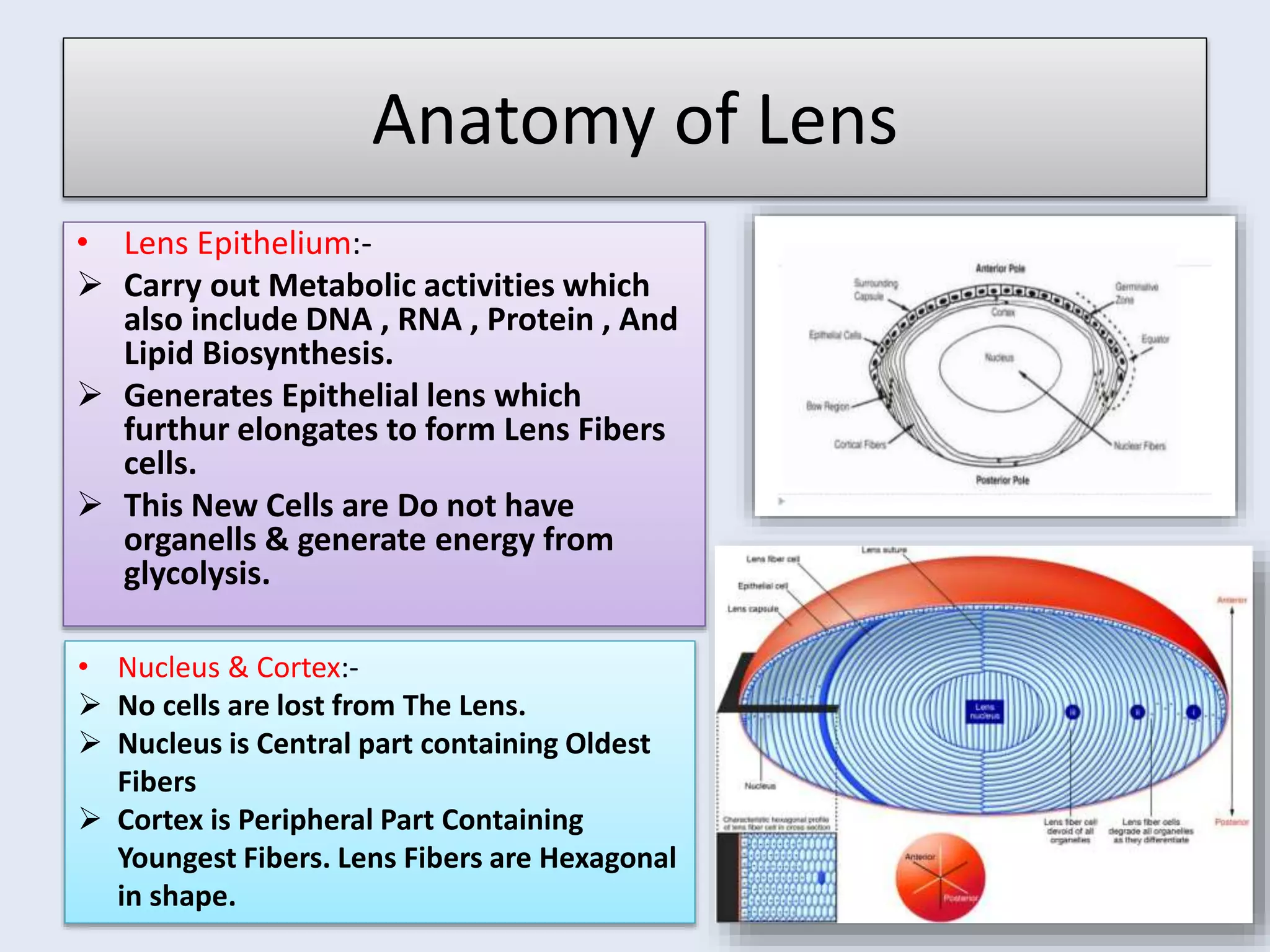
• Lens Epithelium:-
 Carry out Metabolic activities which
also include DNA , RNA , Protein , And
Lipid Biosynthesis.
 Generates Epithelial lens which
furthur elongates to form Lens Fibers
cells.
 This New Cells are Do not have
organells & generate energy from
glycolysis.
• Nucleus & Cortex:-
 No cells are lost from The Lens.
 Nucleus is Central part containing Oldest
Fibers
 Cortex is Peripheral Part Containing
Youngest Fibers. Lens Fibers are Hexagonal
in shape.
Anatomy of Lens
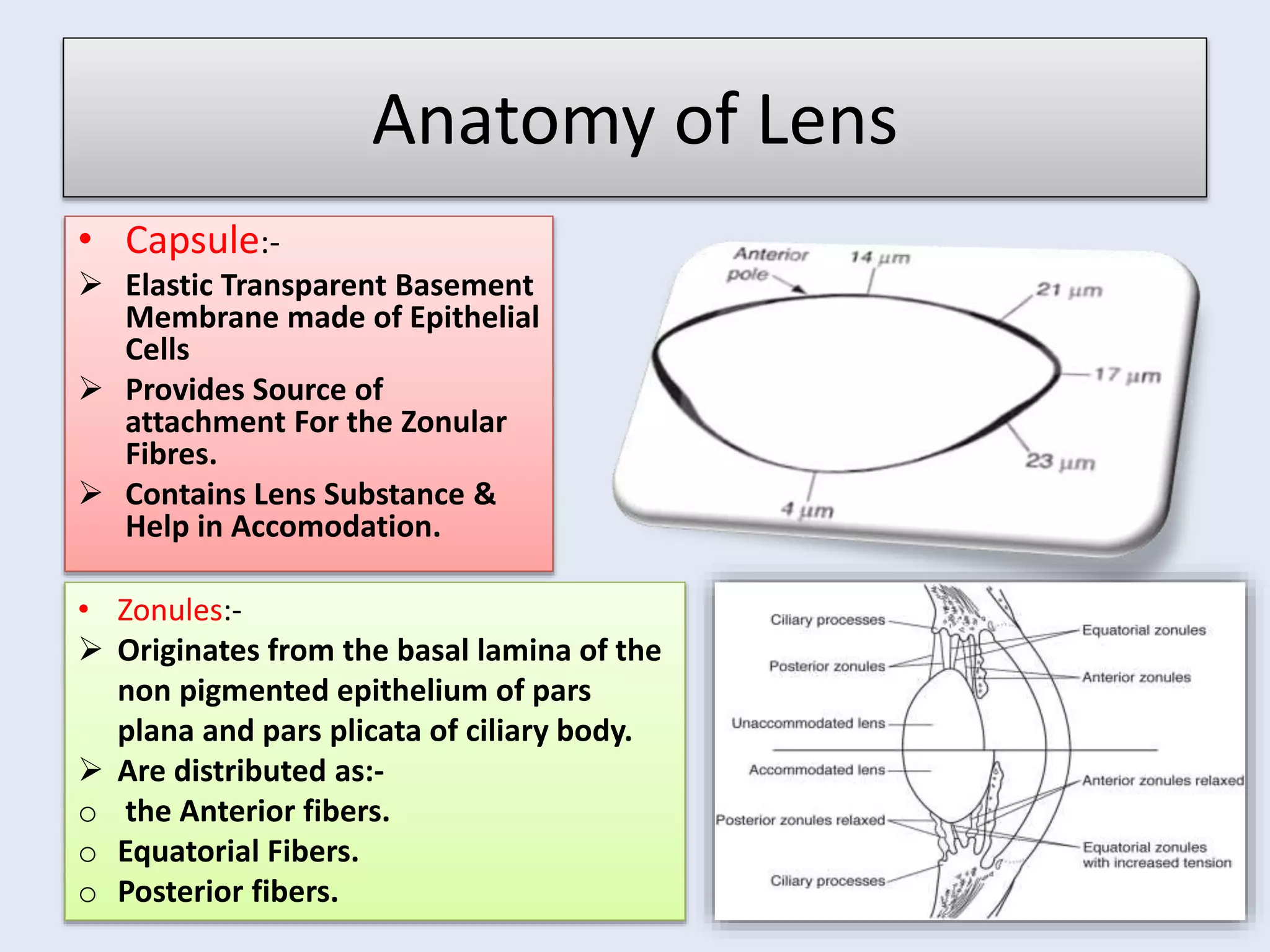
• Capsule:-
 Elastic Transparent Basement
Membrane made of Epithelial
Cells
 Provides Source of
attachment For the Zonular
Fibres.
 Contains Lens Substance &
Help in Accomodation.
• Zonules:-
 Originates from the basal lamina of the
non pigmented epithelium of pars
plana and pars plicata of ciliary body.
 Are distributed as:-
o the Anterior fibers.
o Equatorial Fibers.
o Posterior fibers.
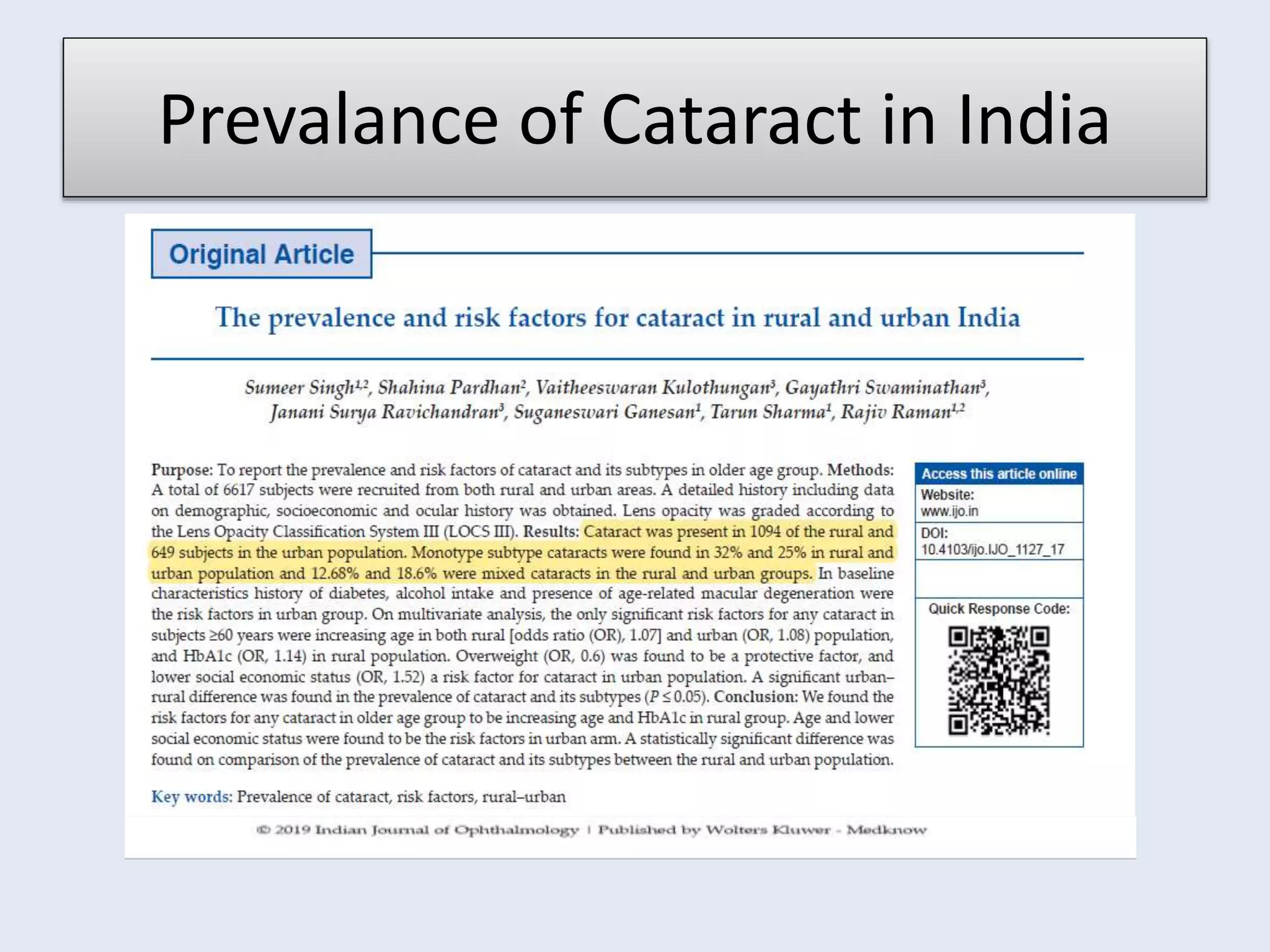
Prevalance of Cataract in India
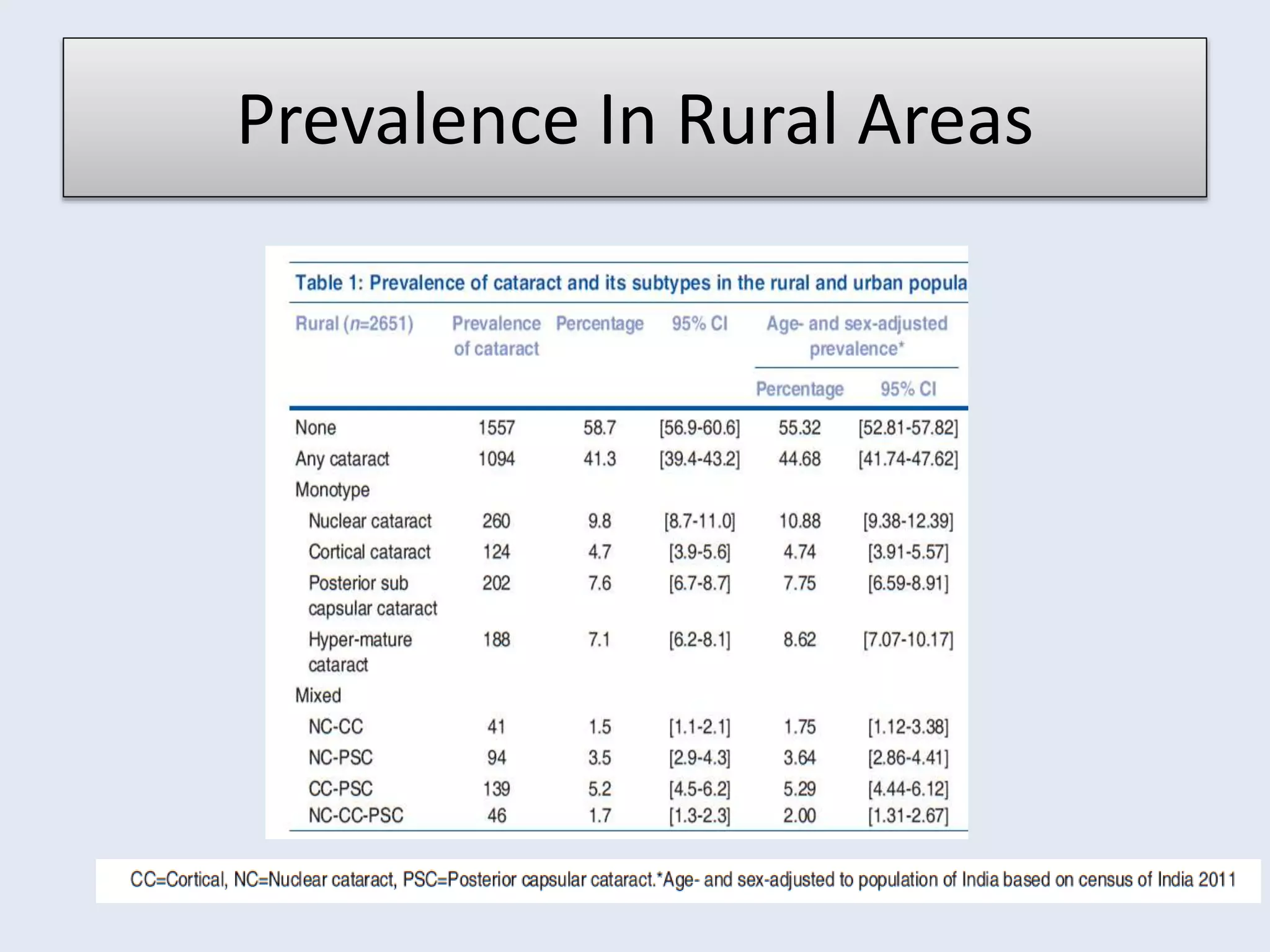
Prevalence In Rural Areas
Prevalence In Urban Areas
One Question??
• Cornea Do Aerobic Respiration & Lens Do
Anaerobic Respiration.
Definition
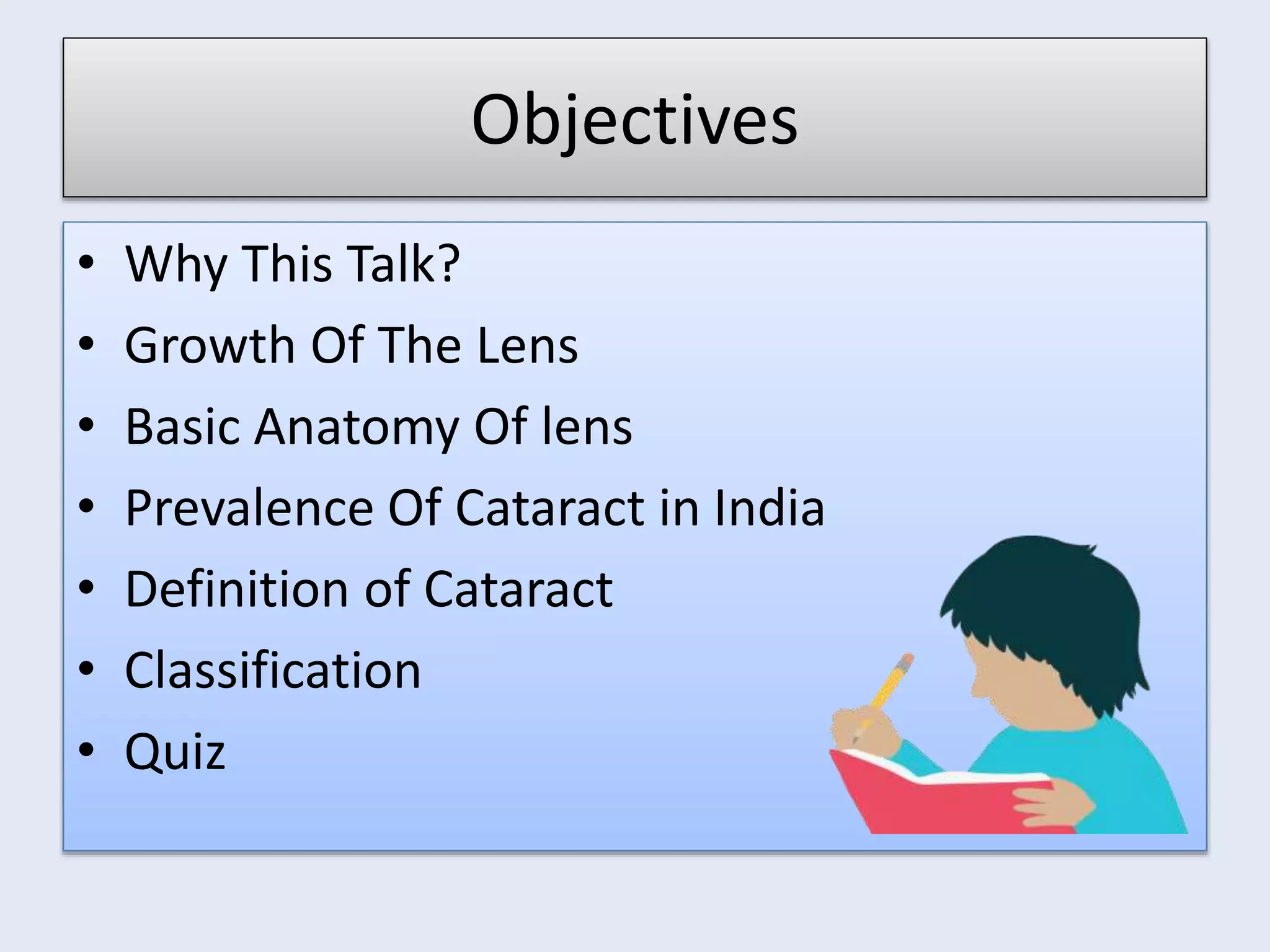
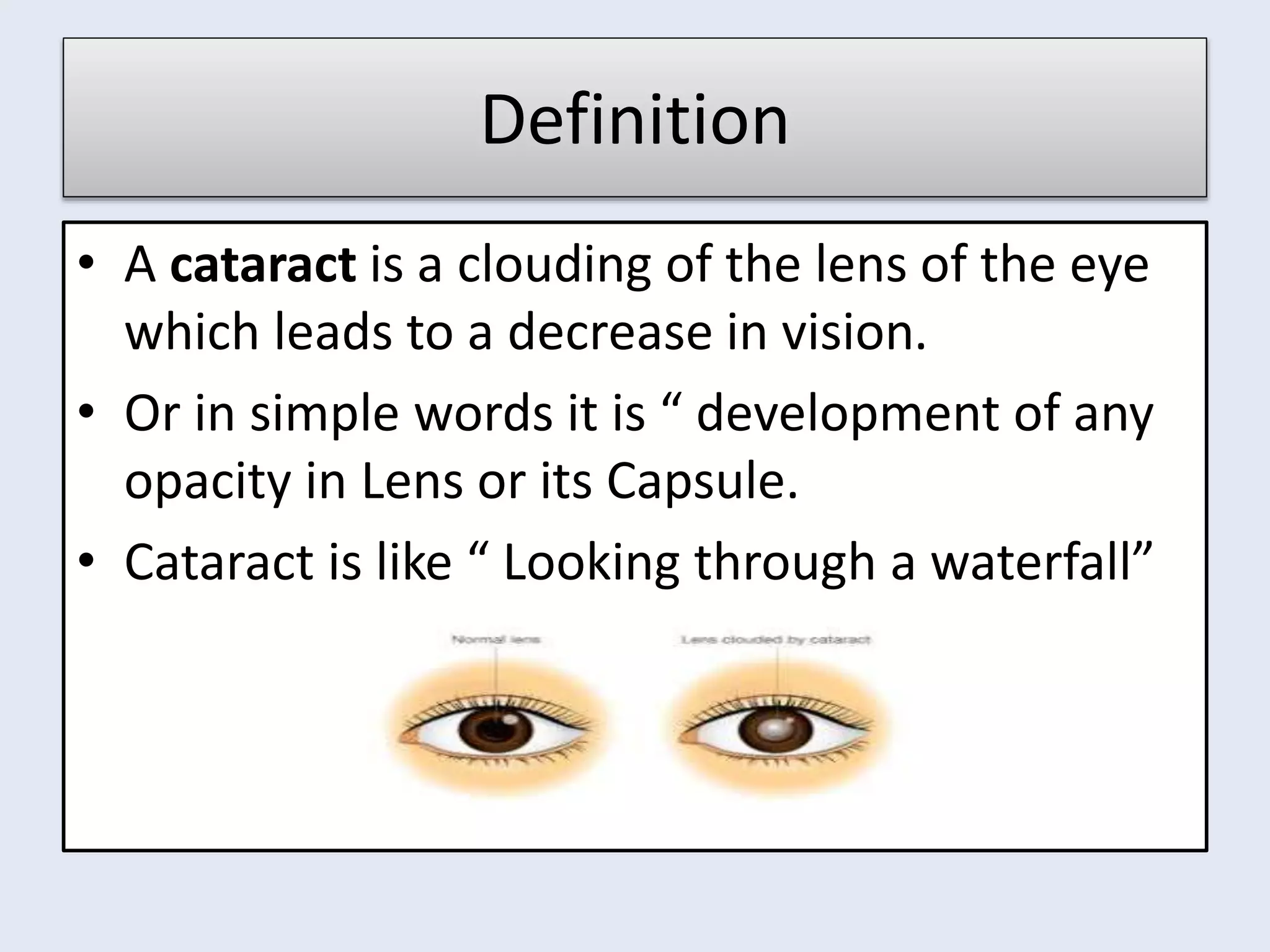
• A cataract is a clouding of the lens of the eye
which leads to a decrease in vision.
• Or in simple words it is “ development of any
opacity in Lens or its Capsule.
• Cataract is like “ Looking through a waterfall”
Reason Behind The Cataract
• Hydration Of Lens.
• Denaturation Of Lens
Fibres.
• Slow Sclerorsis.
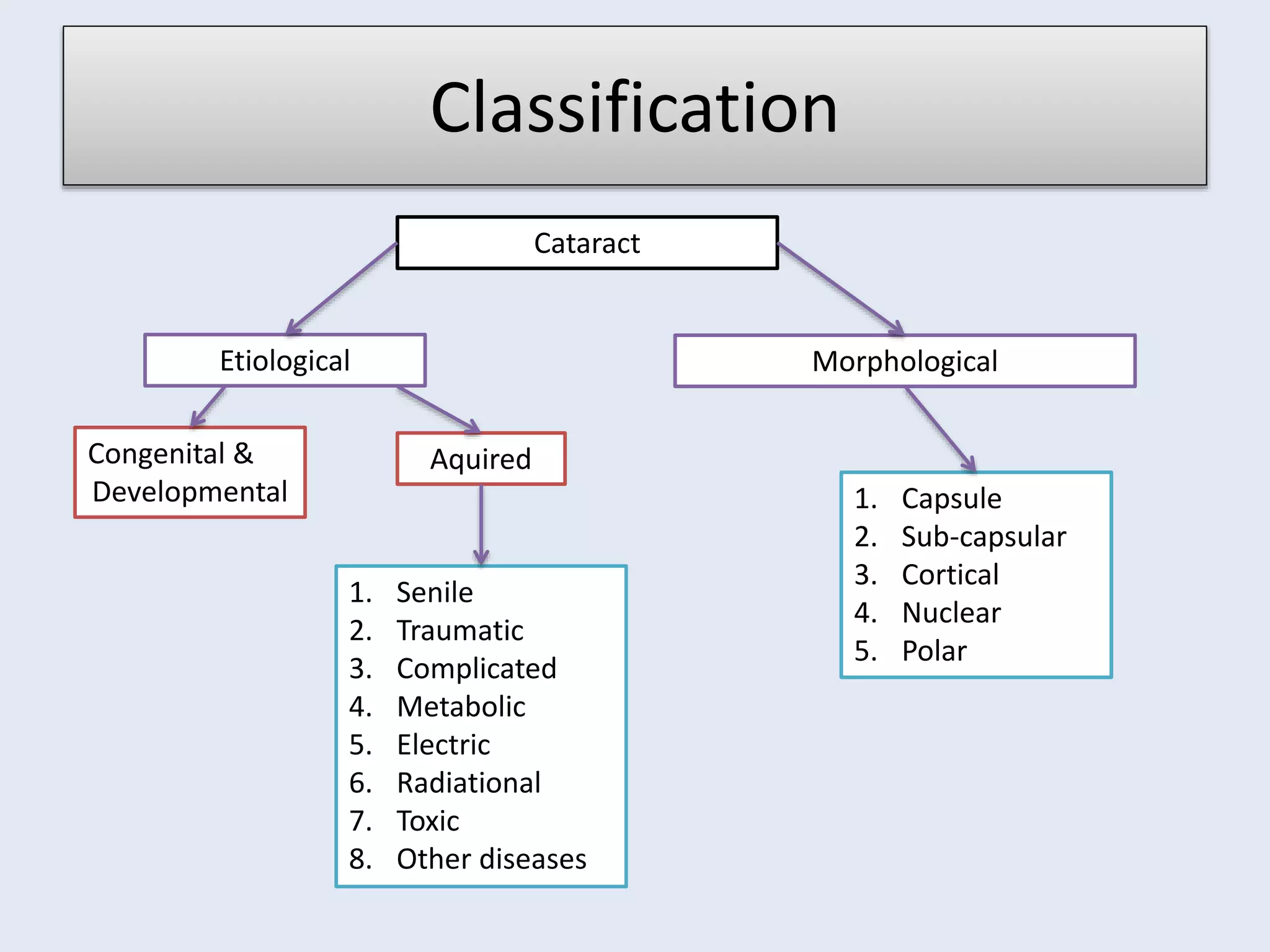
Cataract
Etiological Morphological
Congenital &
Developmental
Aquired
1. Senile
2. Traumatic
3. Complicated
4. Metabolic
5. Electric
6. Radiational
7. Toxic
8. Other diseases
1. Capsule
2. Sub-capsular
3. Cortical
4. Nuclear
5. Polar
Classification
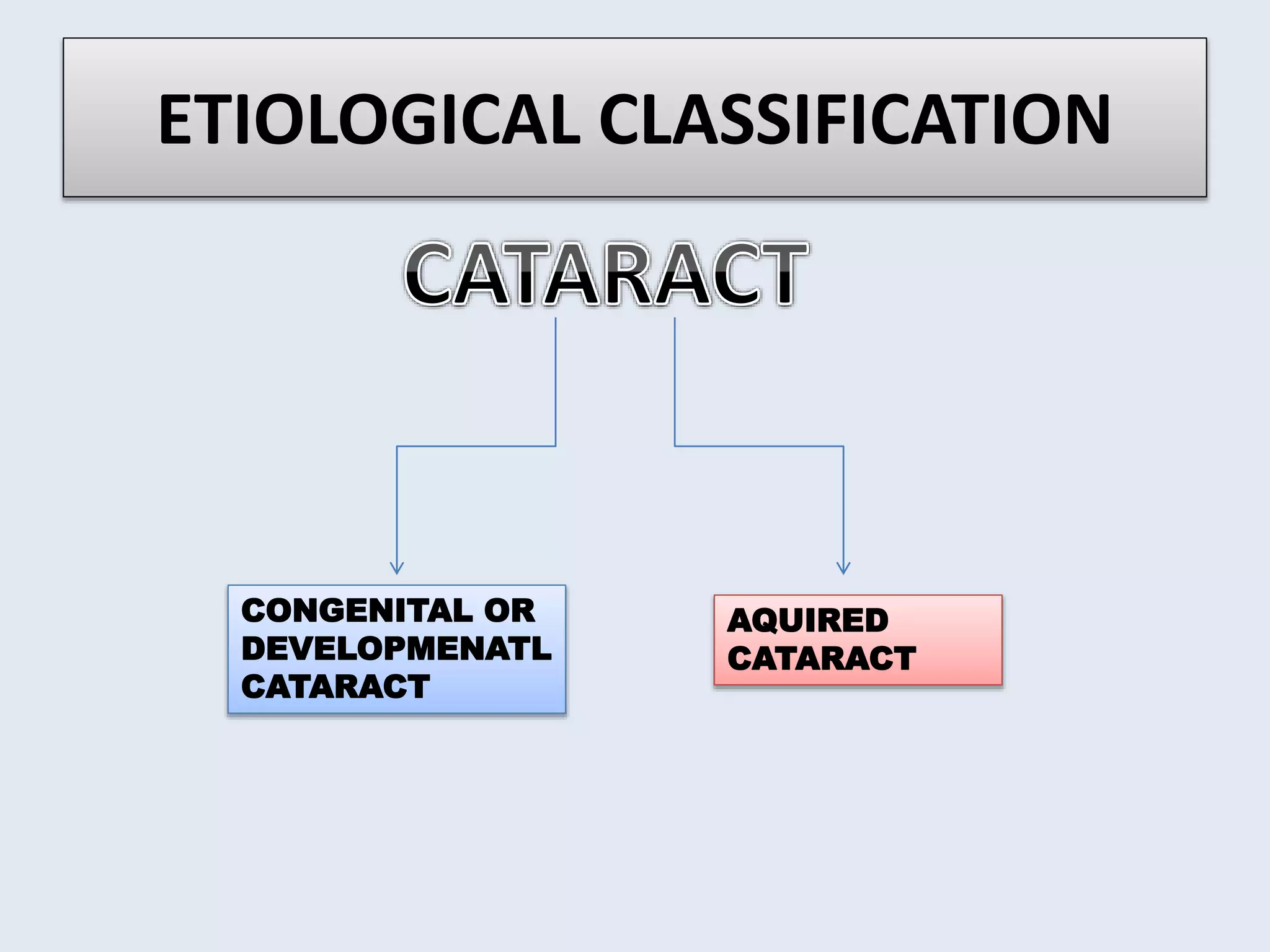
ETIOLOGICAL CLASSIFICATION
CONGENITAL OR
DEVELOPMENATL
CATARACT
AQUIRED
CATARACT
Congenital Cataract
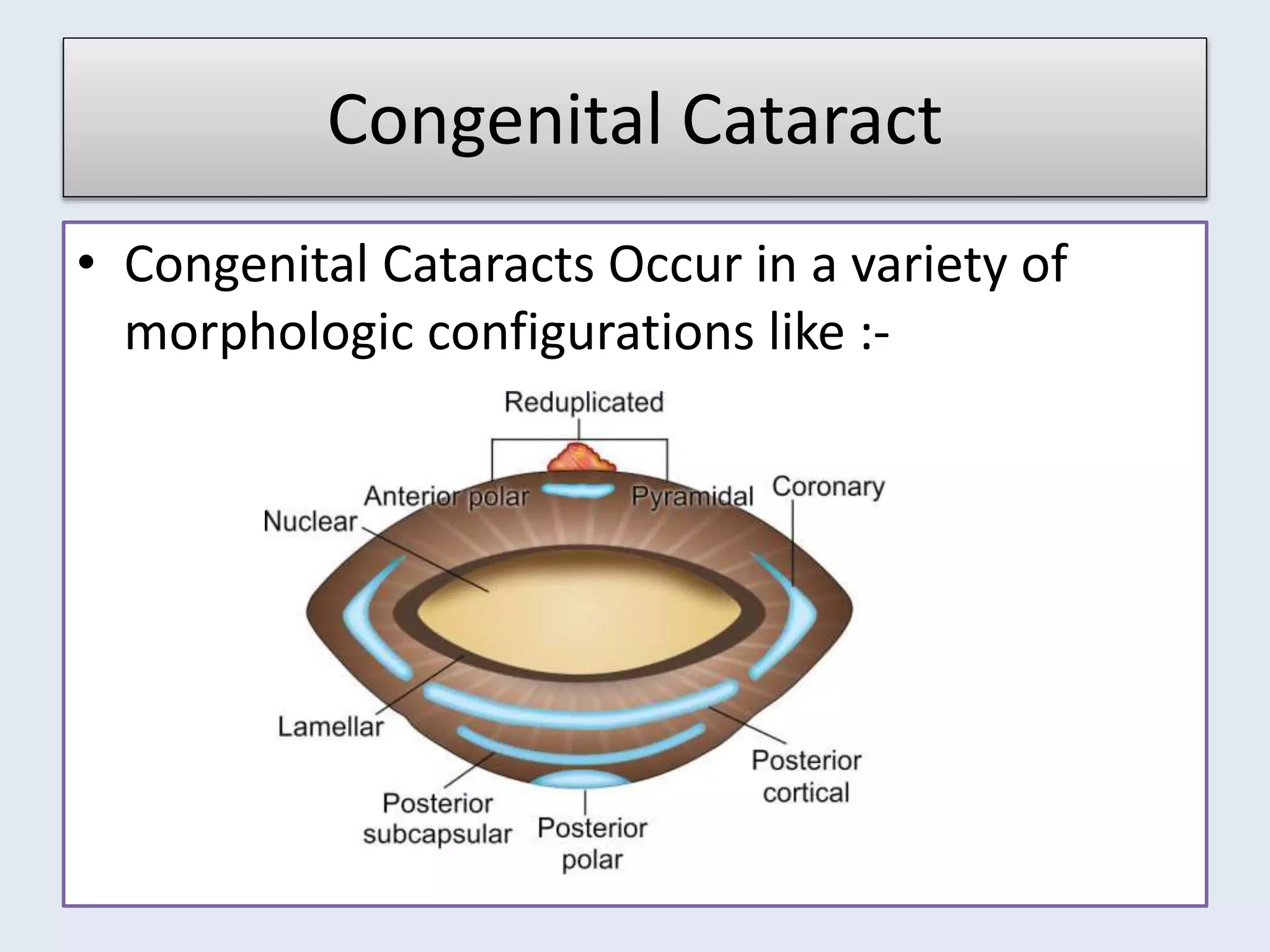
• Congenital Cataracts Occur in a variety of
morphologic configurations like :-
CONGENITAL CATARACT
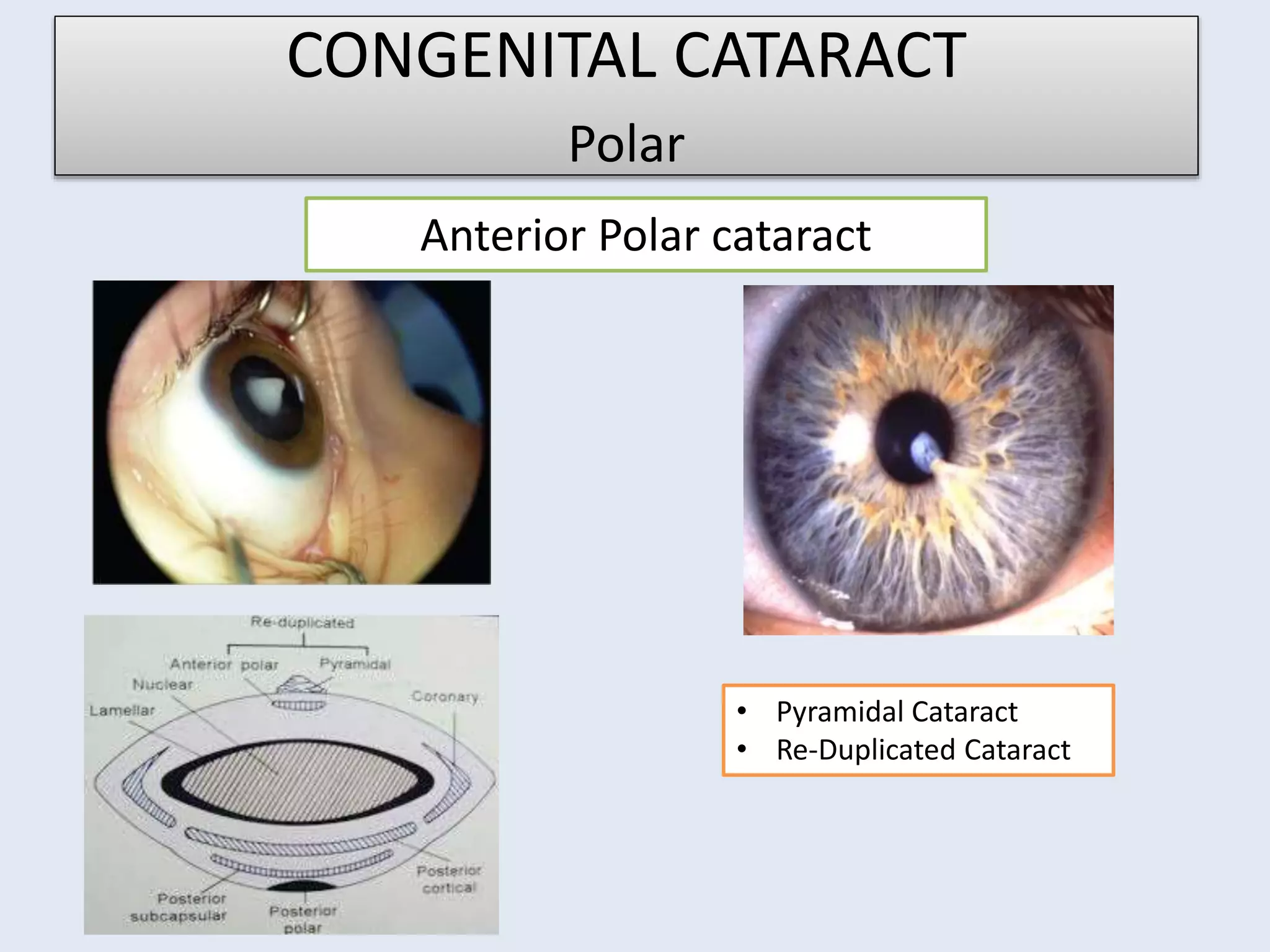
Polar
Anterior Polar cataract
• Pyramidal Cataract
• Re-Duplicated Cataract
CONGENITAL CATARACT
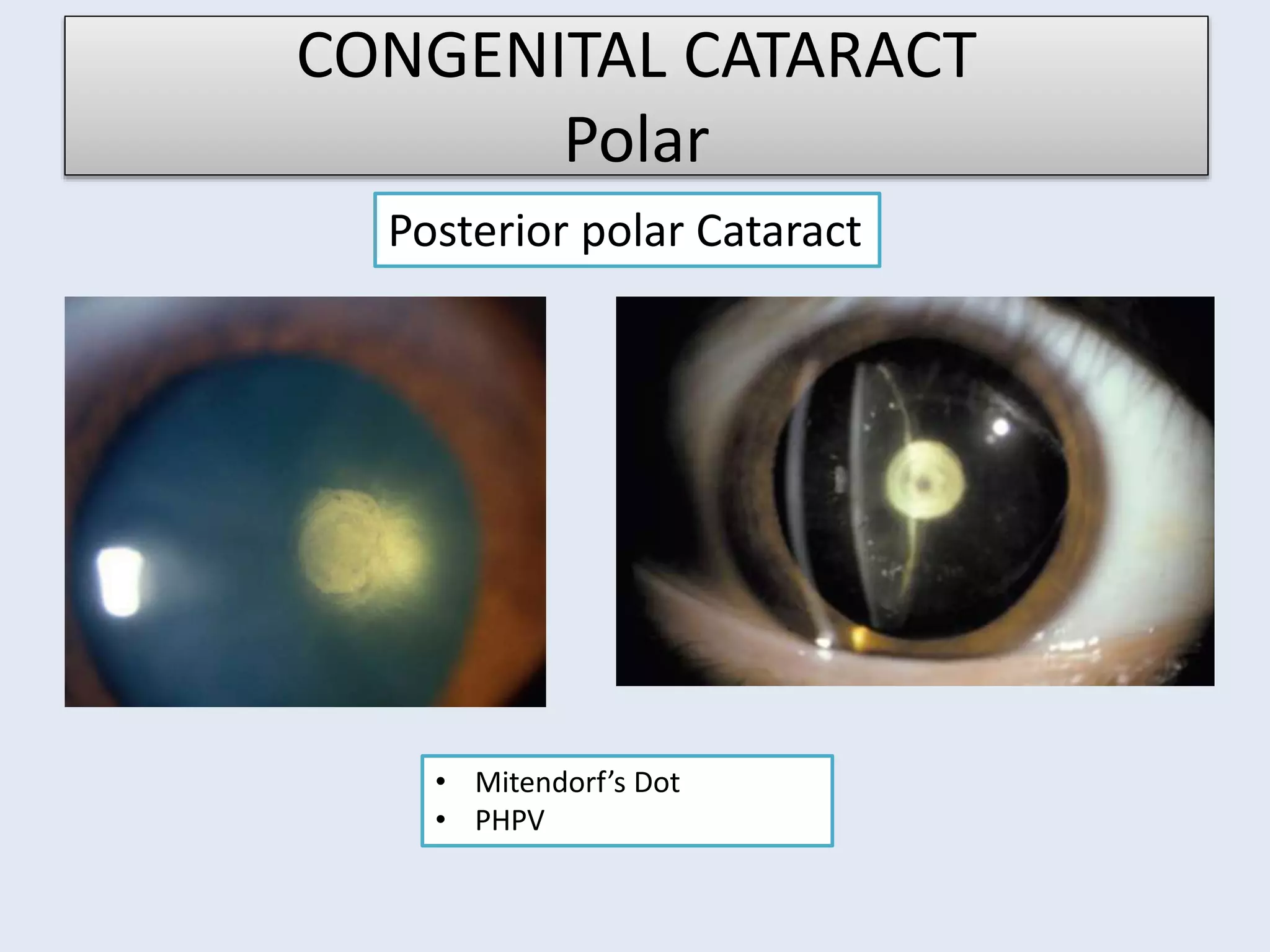
Polar
Posterior polar Cataract
• Mitendorf’s Dot
• PHPV
Congenital Cataract
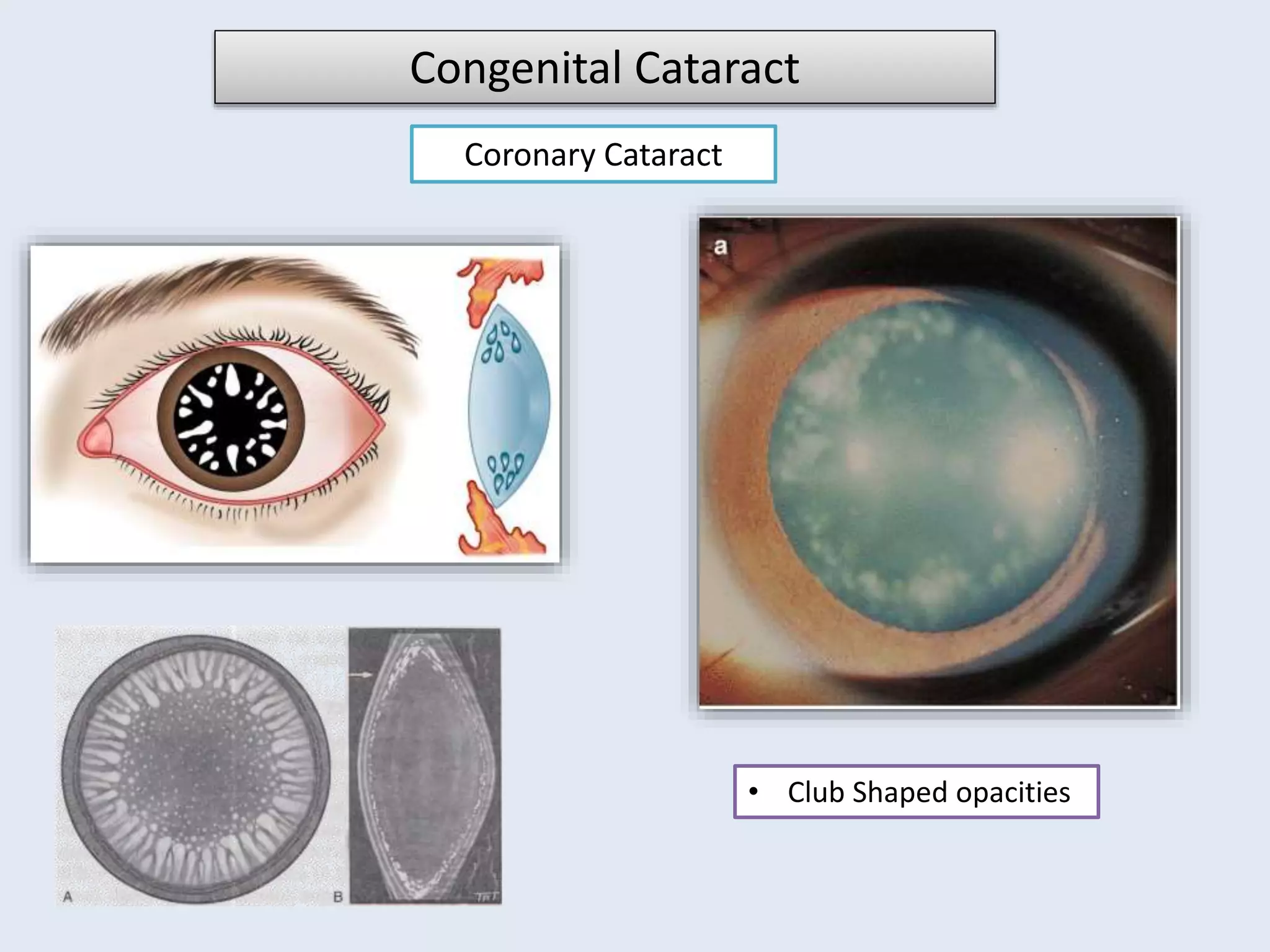
Coronary Cataract
• Club Shaped opacities
CONGENITAL CATARACT
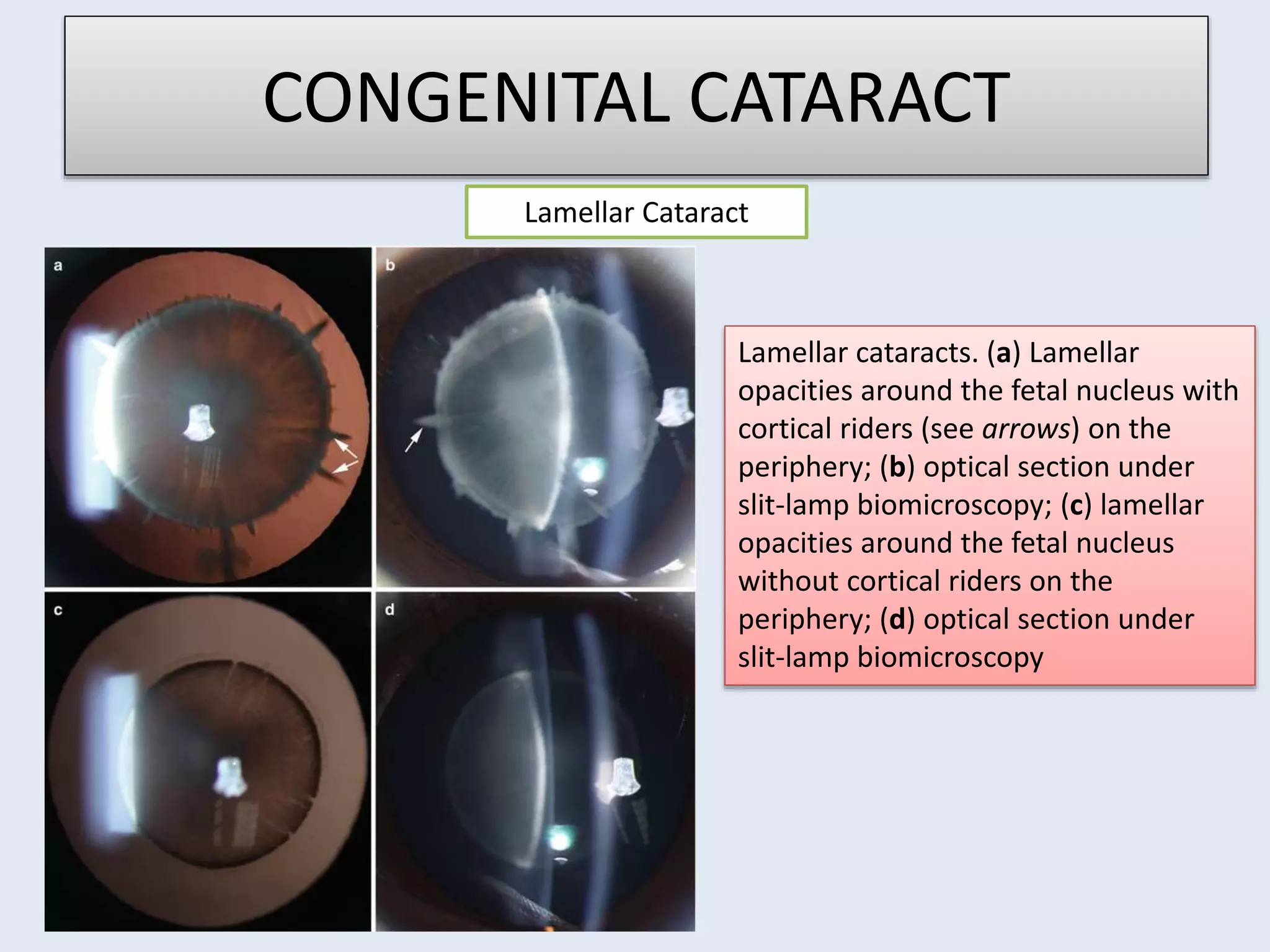
Lamellar cataracts. (a) Lamellar
opacities around the fetal nucleus with
cortical riders (see arrows) on the
periphery; (b) optical section under
slit-lamp biomicroscopy; (c) lamellar
opacities around the fetal nucleus
without cortical riders on the
periphery; (d) optical section under
slit-lamp biomicroscopy
Lamellar Cataract
Congenital Cataract
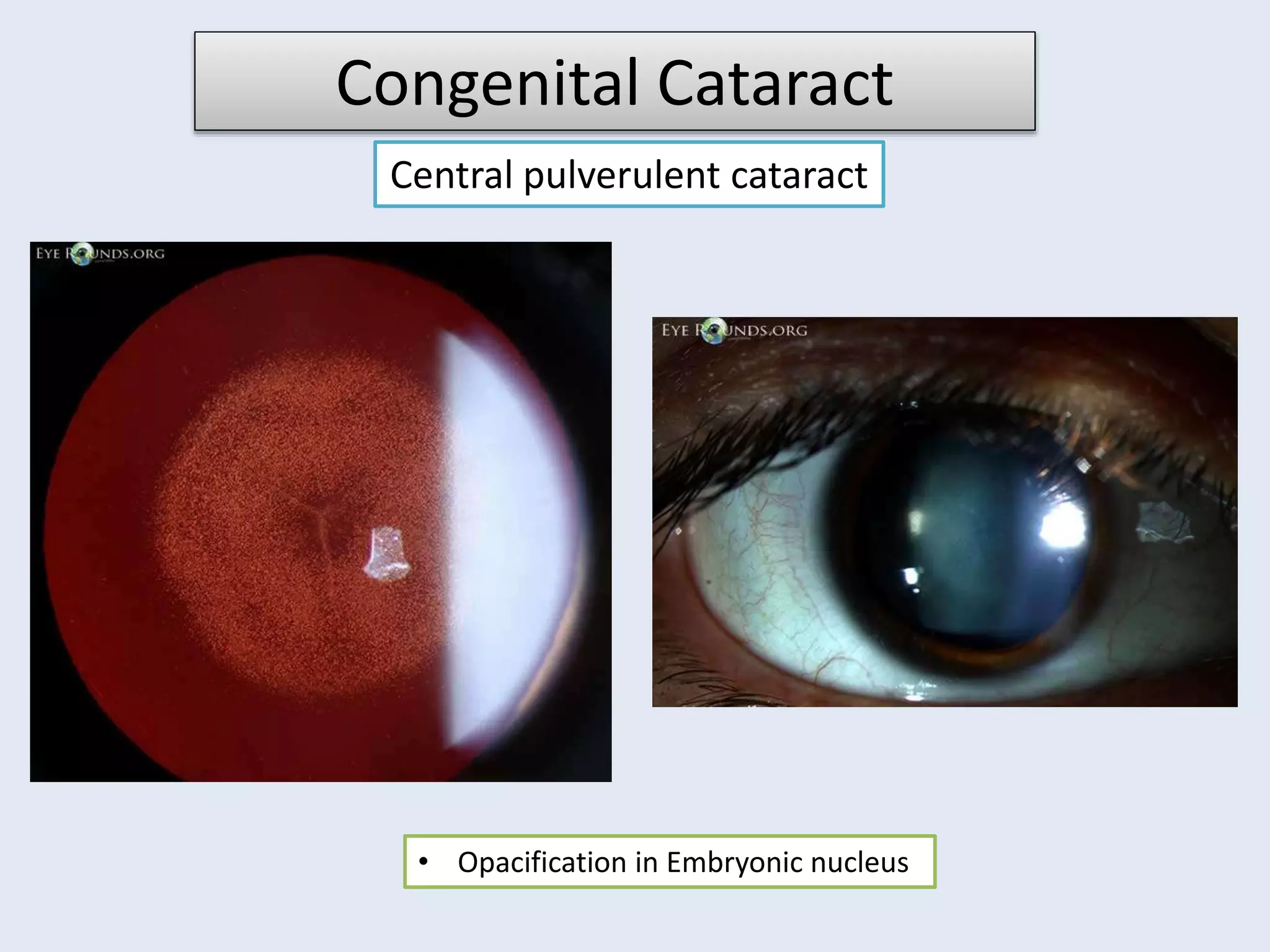
Central pulverulent cataract
• Opacification in Embryonic nucleus
Congenital Cataract
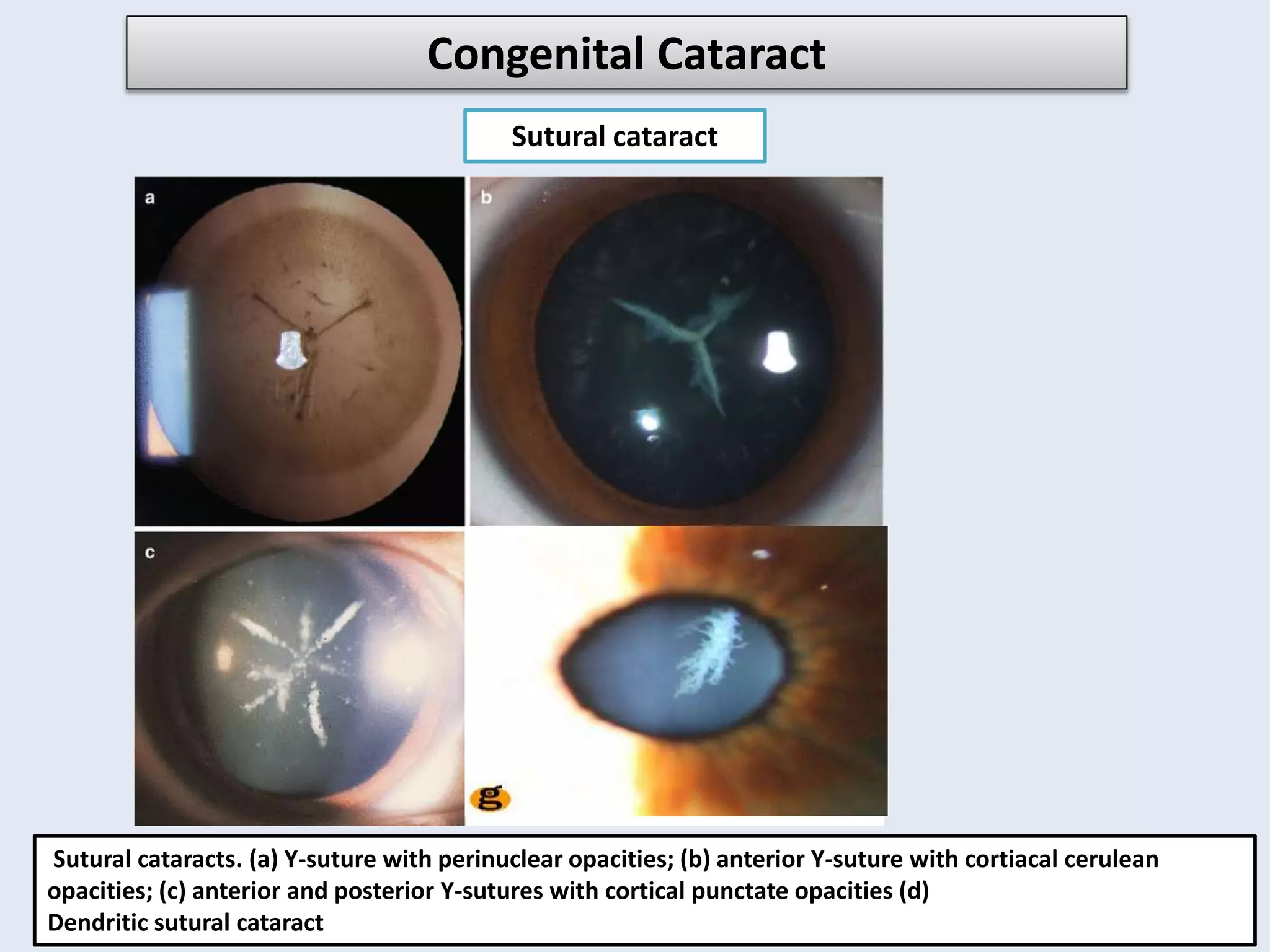
Sutural cataract
Sutural cataracts. (a) Y-suture with perinuclear opacities; (b) anterior Y-suture with cortiacal cerulean
opacities; (c) anterior and posterior Y-sutures with cortical punctate opacities (d)
Dendritic sutural cataract
Congenital Cataract
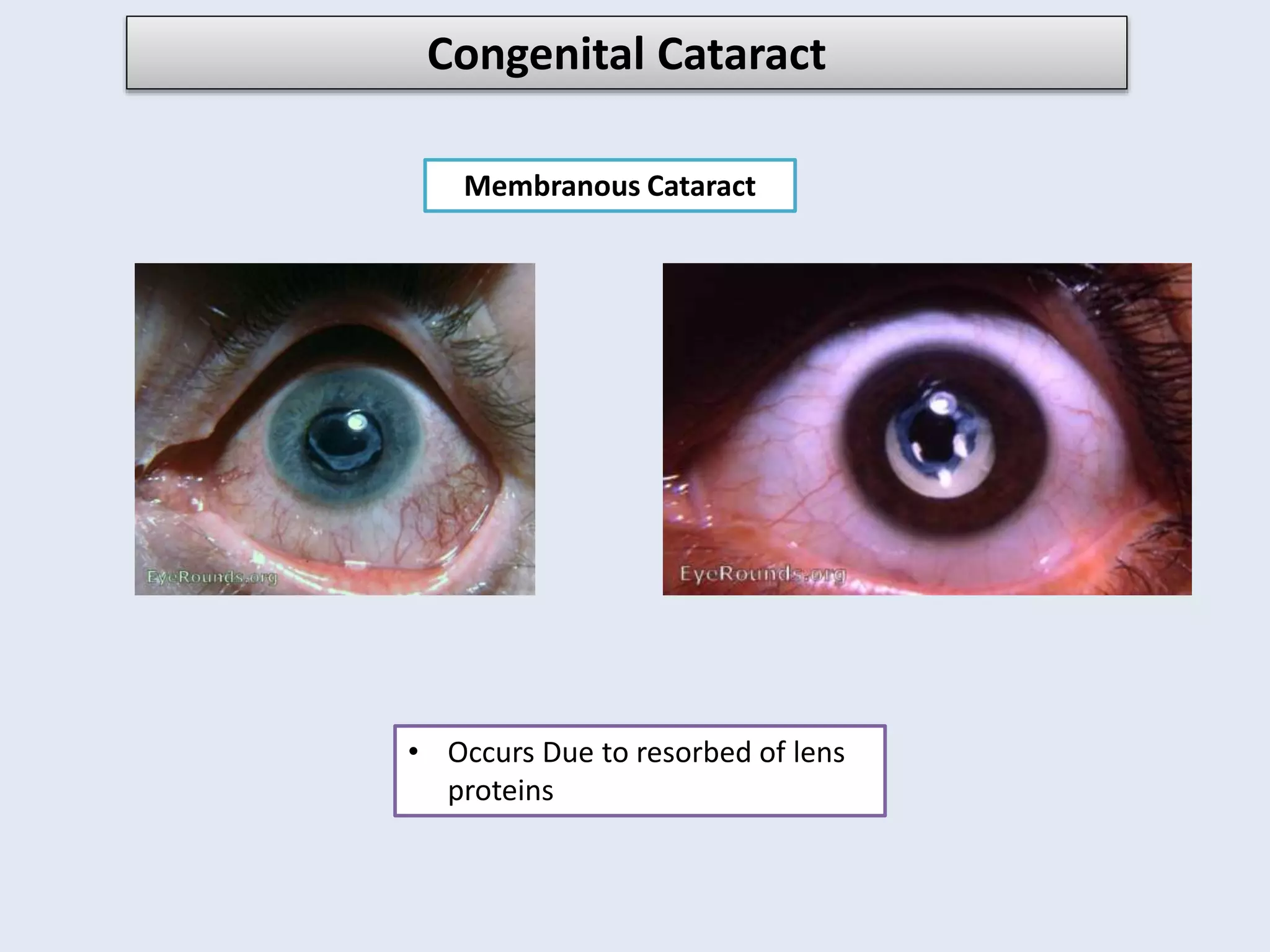
Membranous Cataract
• Occurs Due to resorbed of lens
proteins
Congenital Cataract
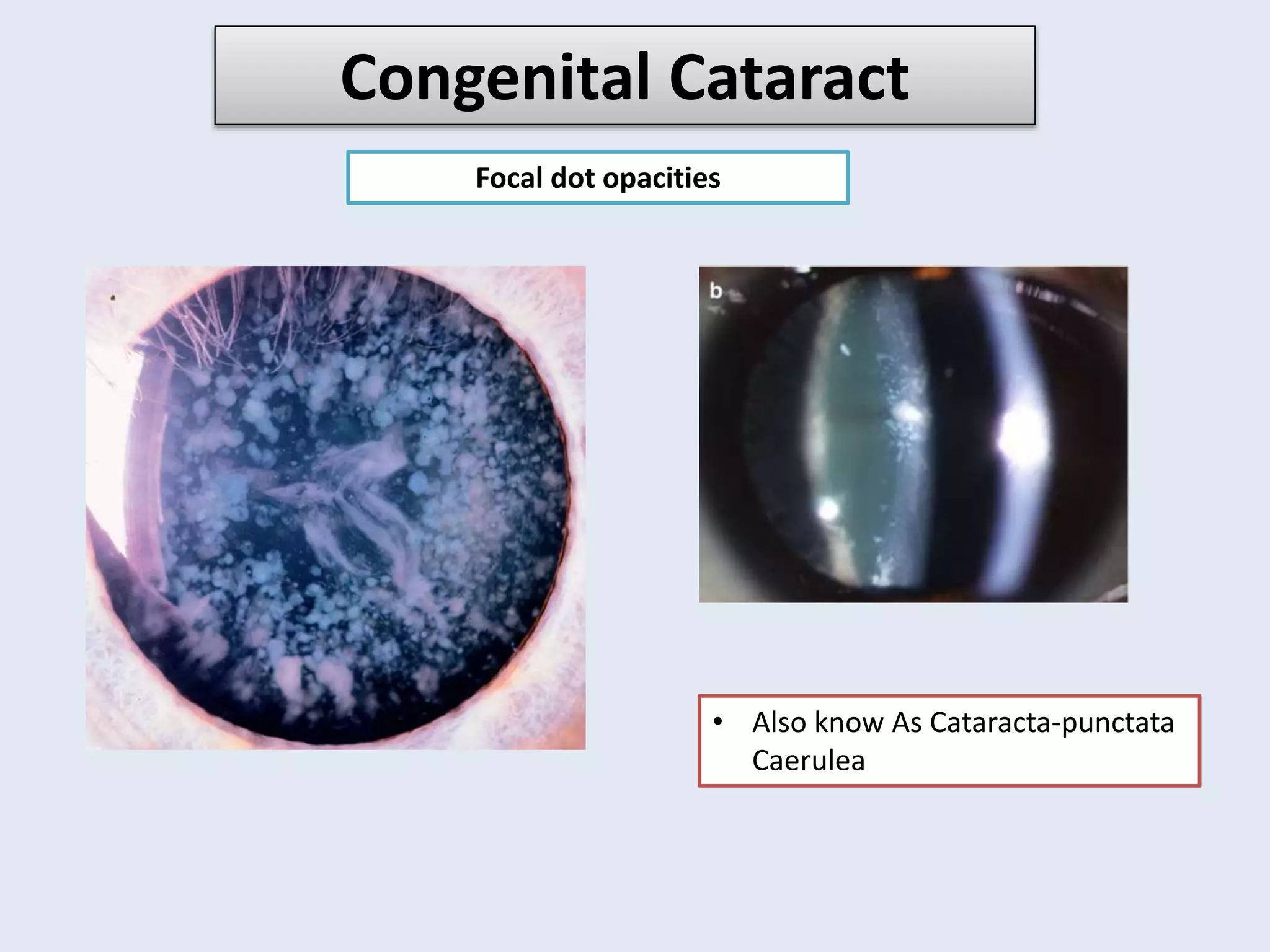
Focal dot opacities
• Also know As Cataracta-punctata
Caerulea
Congenital Cataract
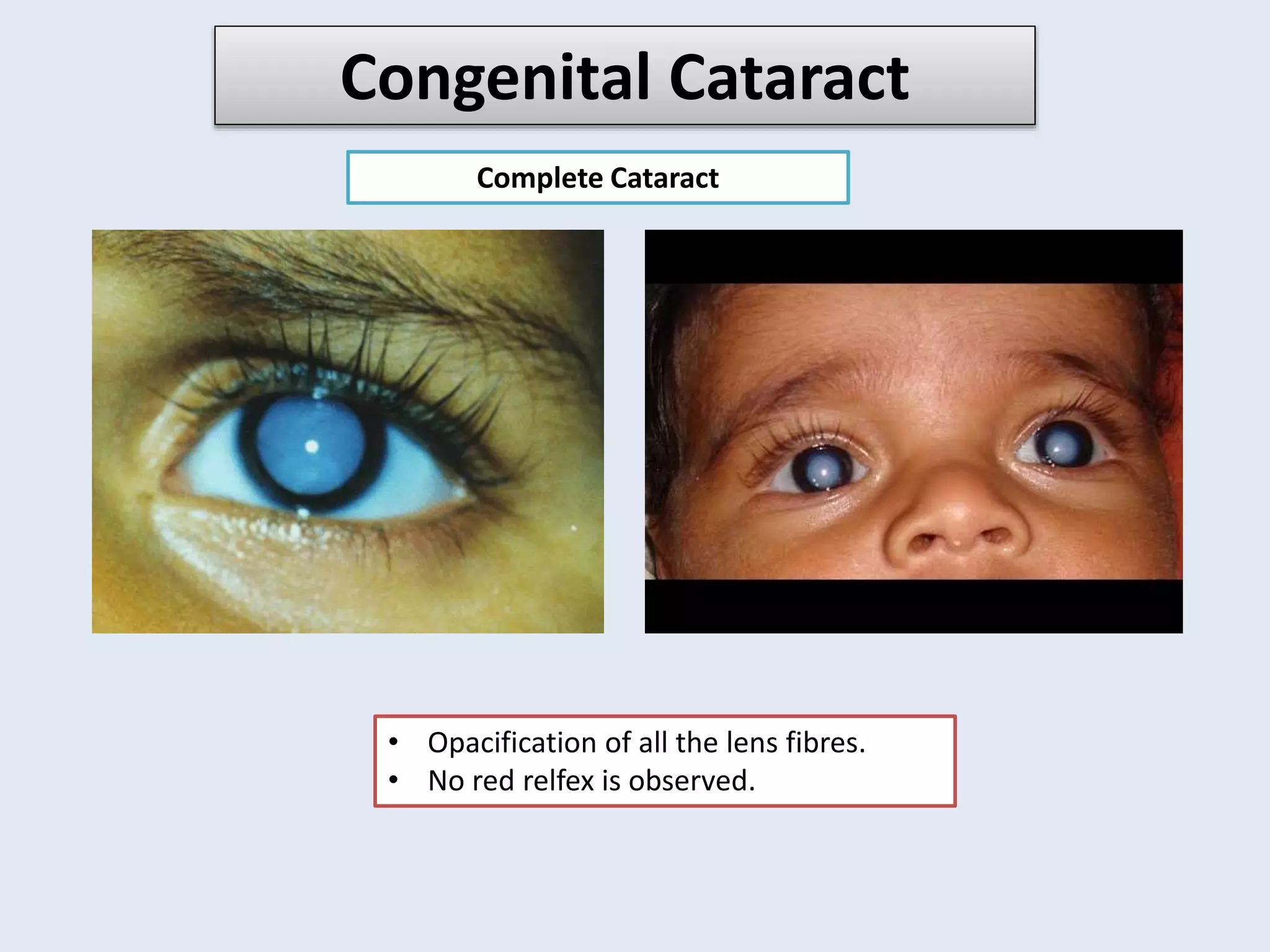
Complete Cataract
• Opacification of all the lens fibres.
• No red relfex is observed.
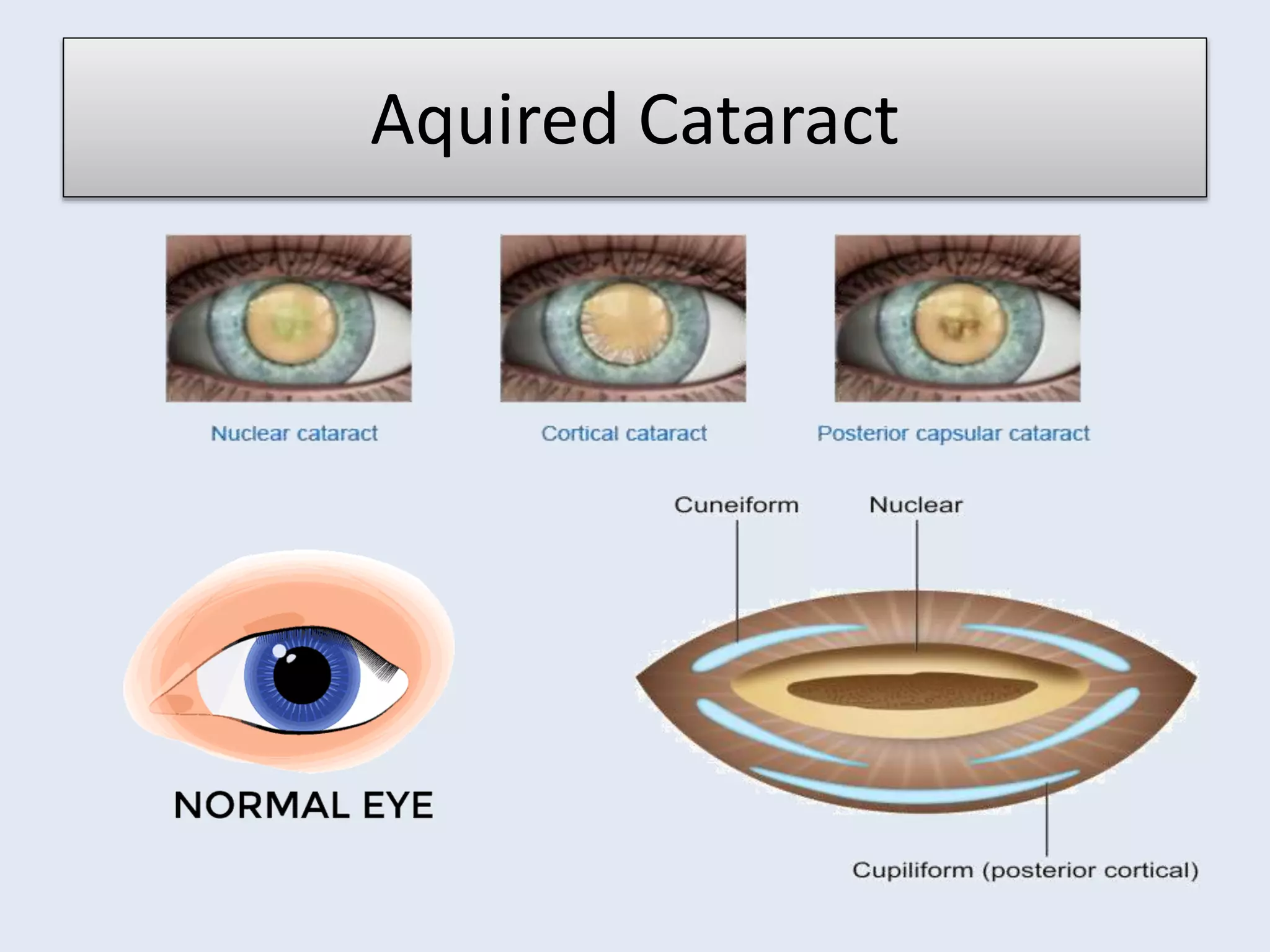
Aquired Cataract
Aquired Cataract
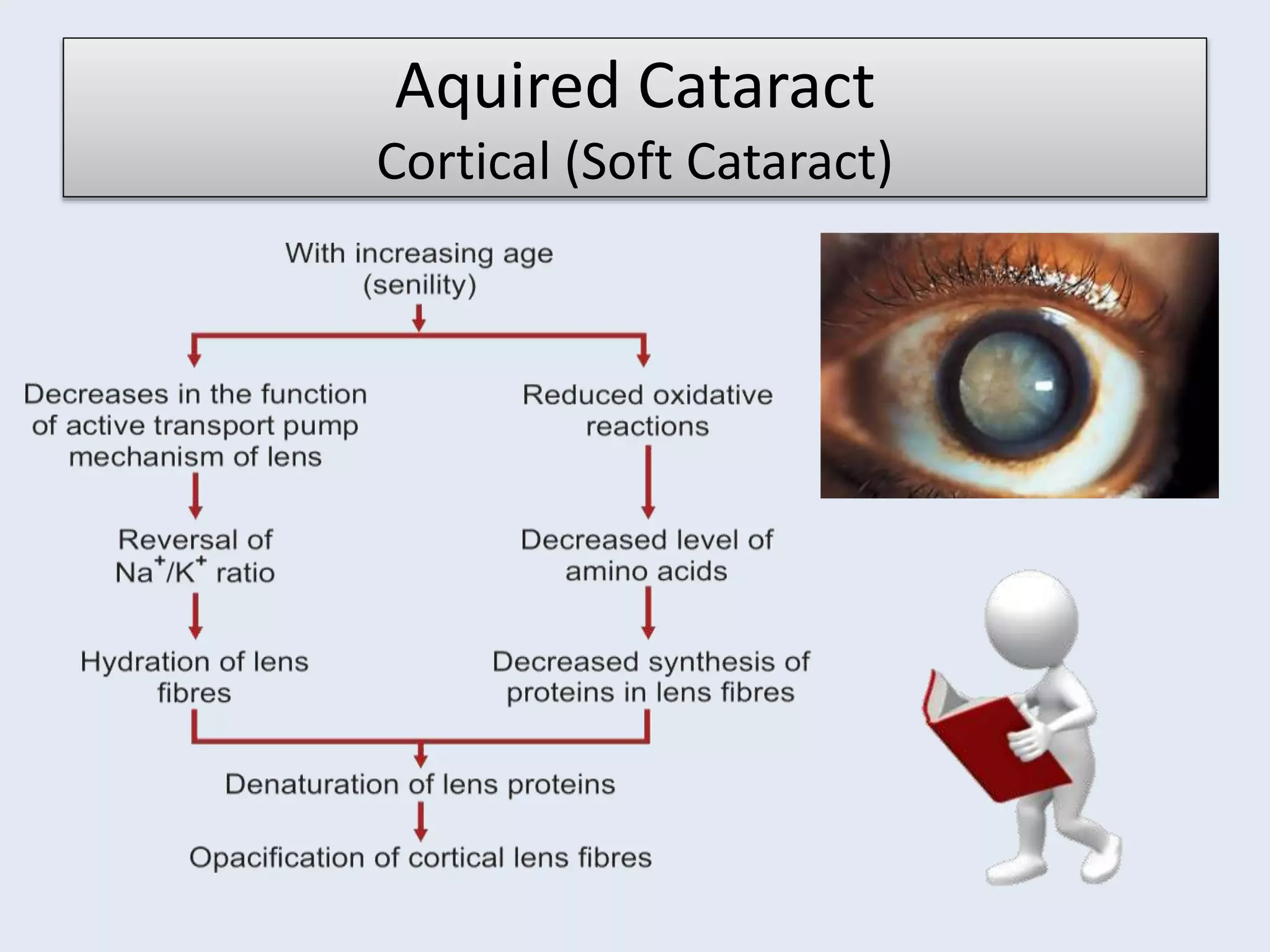
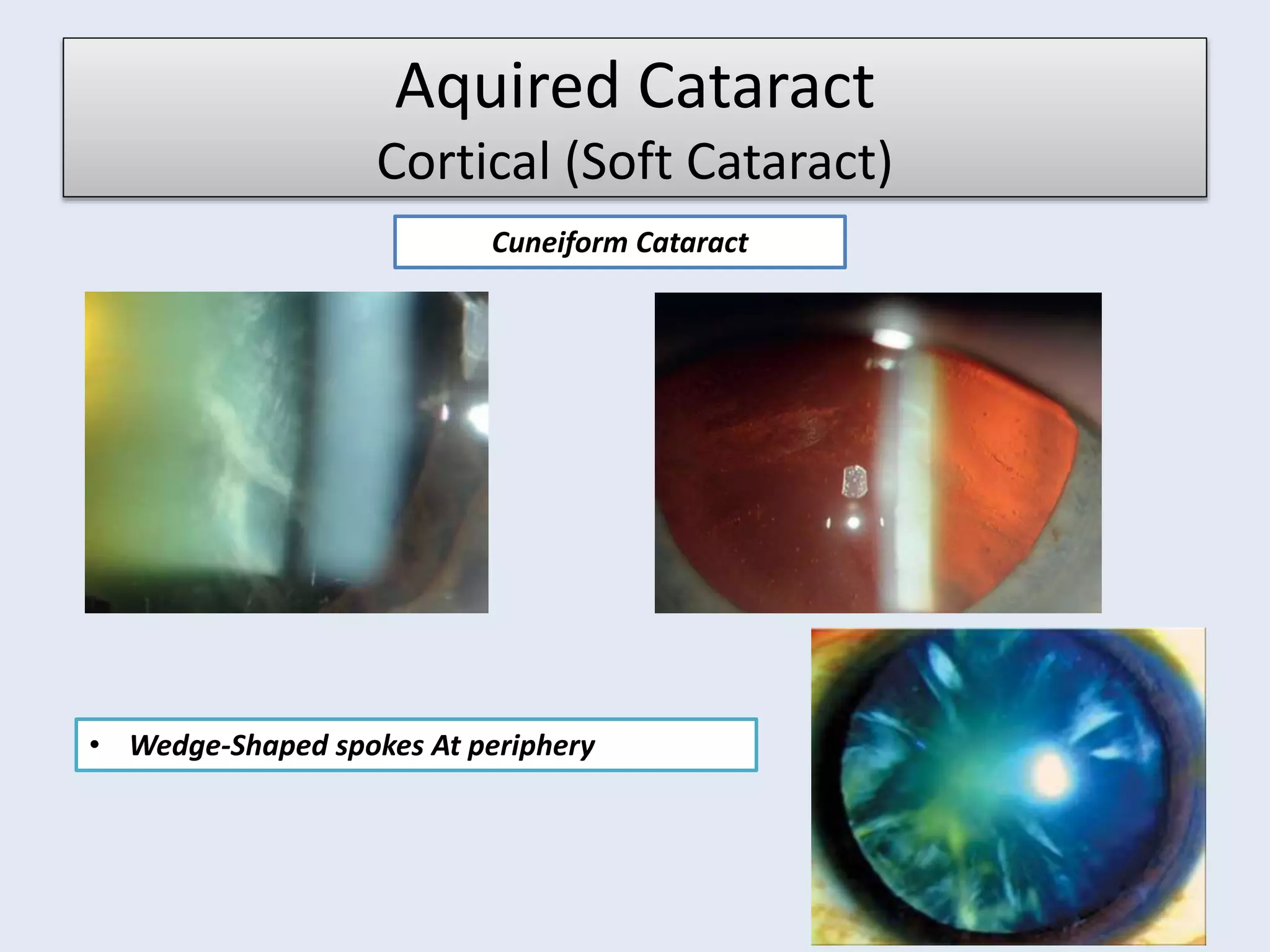
Cortical (Soft Cataract)
Aquired Cataract
Cortical (Soft Cataract)
Cuneiform Cataract
• Wedge-Shaped spokes At periphery
Aquired Cataract
Cortical (Soft Cataract)
Cupuliform Cataract
• Opacity At Axial region of posterior Cortex.
• It Causes Harmalopia.
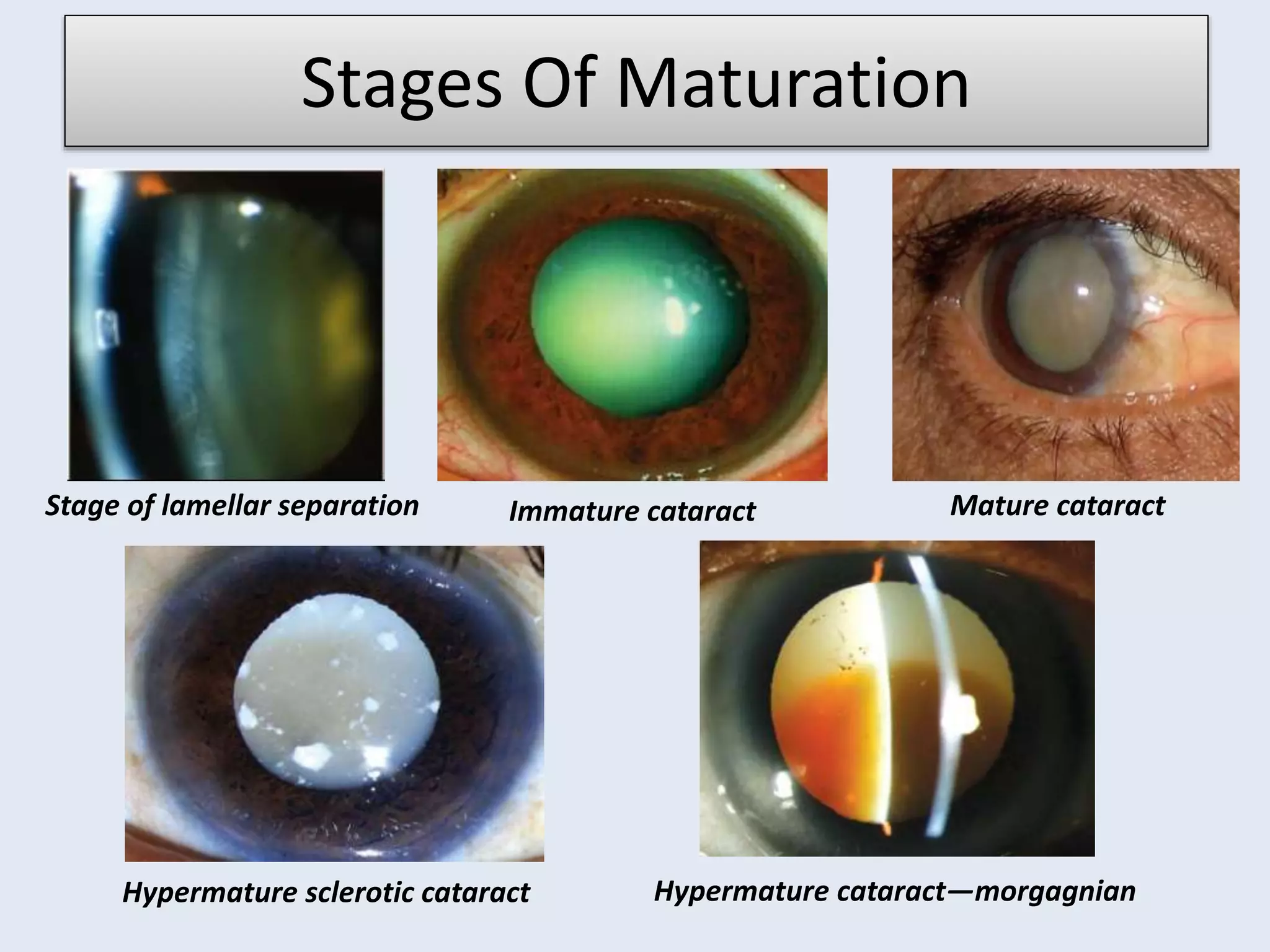
Stages Of Maturation
Stage of lamellar separation Immature cataract Mature cataract
Hypermature cataract—morgagnianHypermature sclerotic cataract
Aquired Cataract
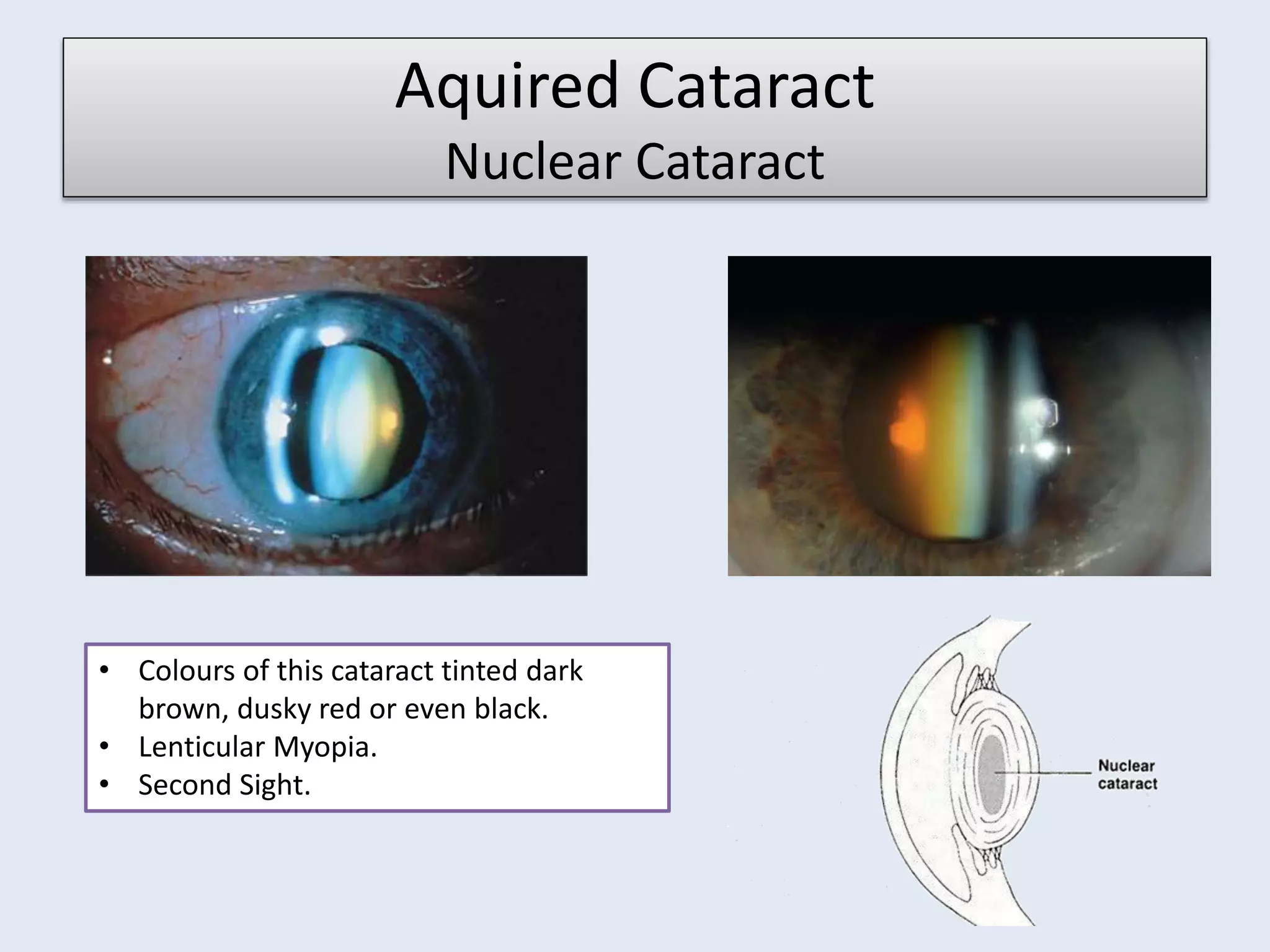
Nuclear Cataract
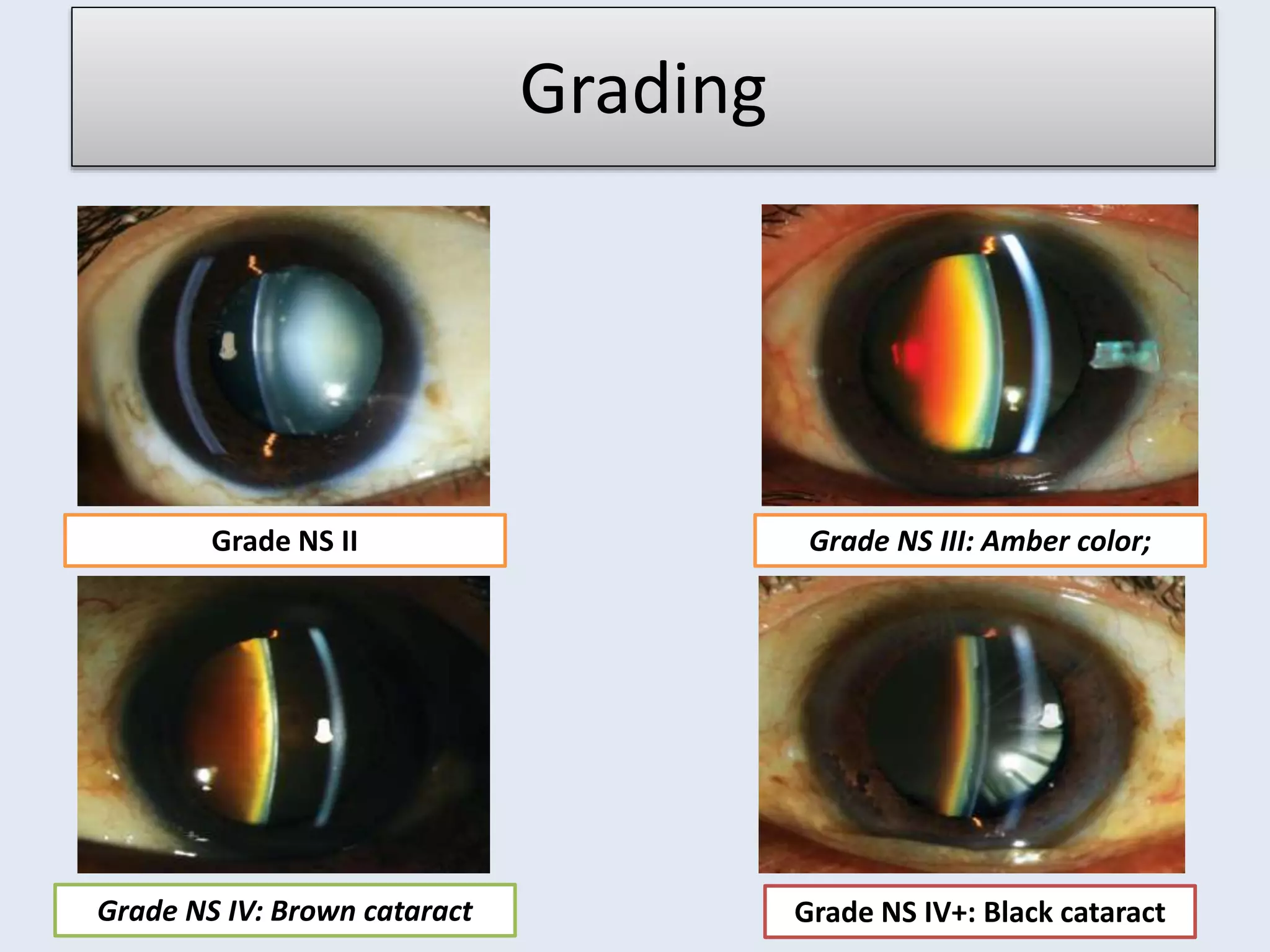
• Colours of this cataract tinted dark
brown, dusky red or even black.
• Lenticular Myopia.
• Second Sight.
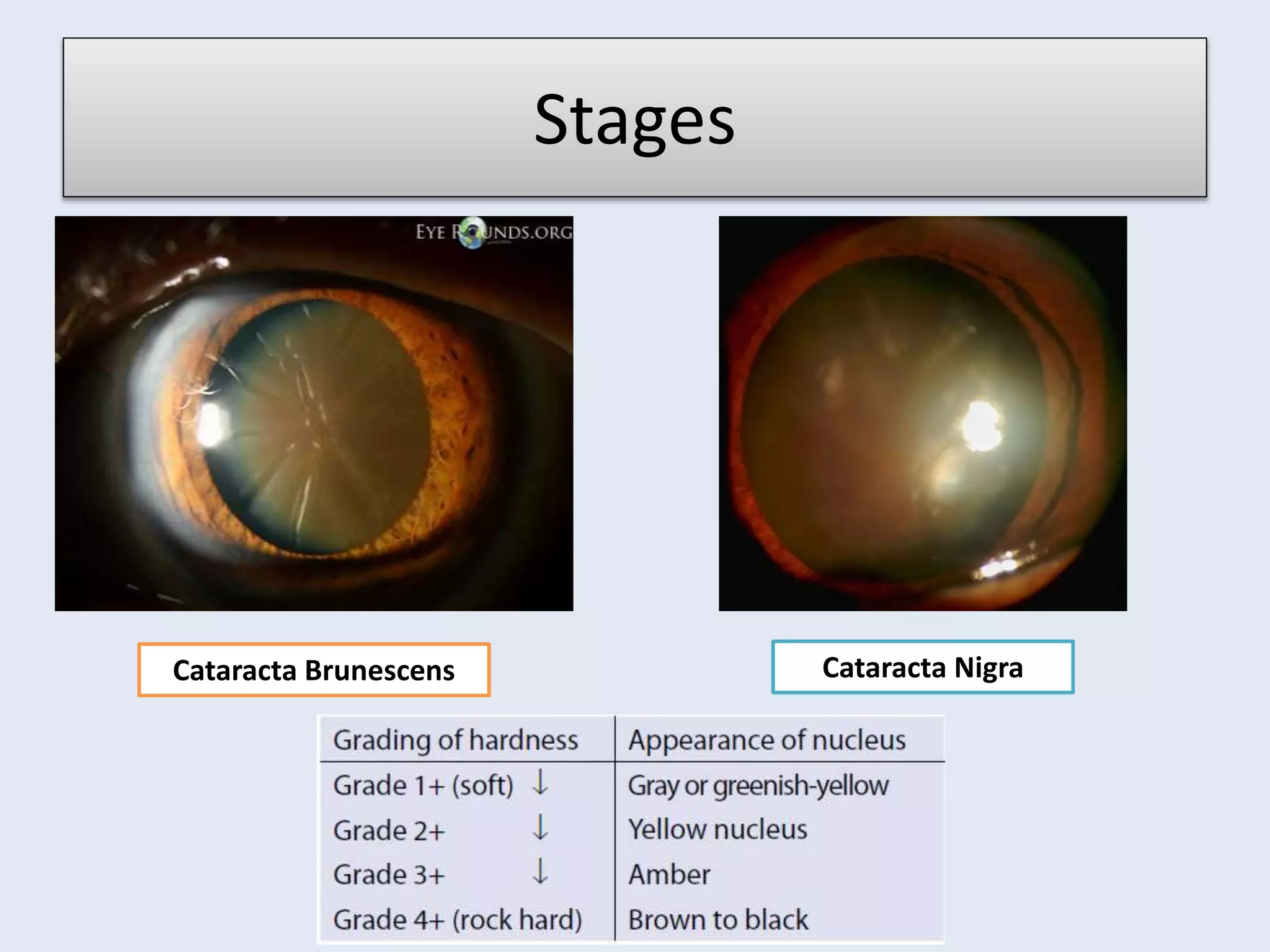
Stages
Cataracta Brunescens Cataracta Nigra
Grading
Grade NS II Grade NS III: Amber color;
Grade NS IV: Brown cataract Grade NS IV+: Black cataract
Aquired Cataract
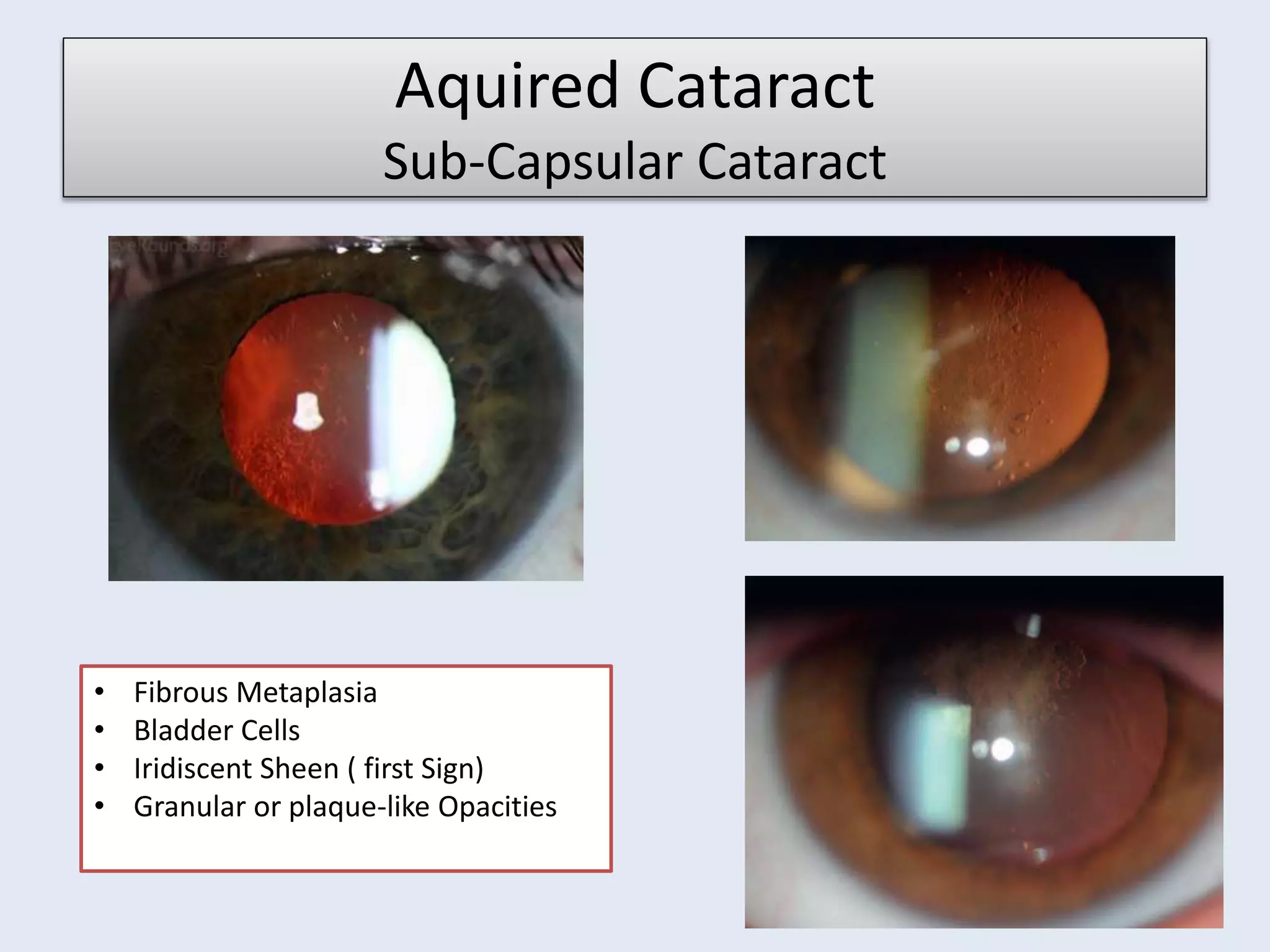
Sub-Capsular Cataract
• Fibrous Metaplasia
• Bladder Cells
• Iridiscent Sheen ( first Sign)
• Granular or plaque-like Opacities
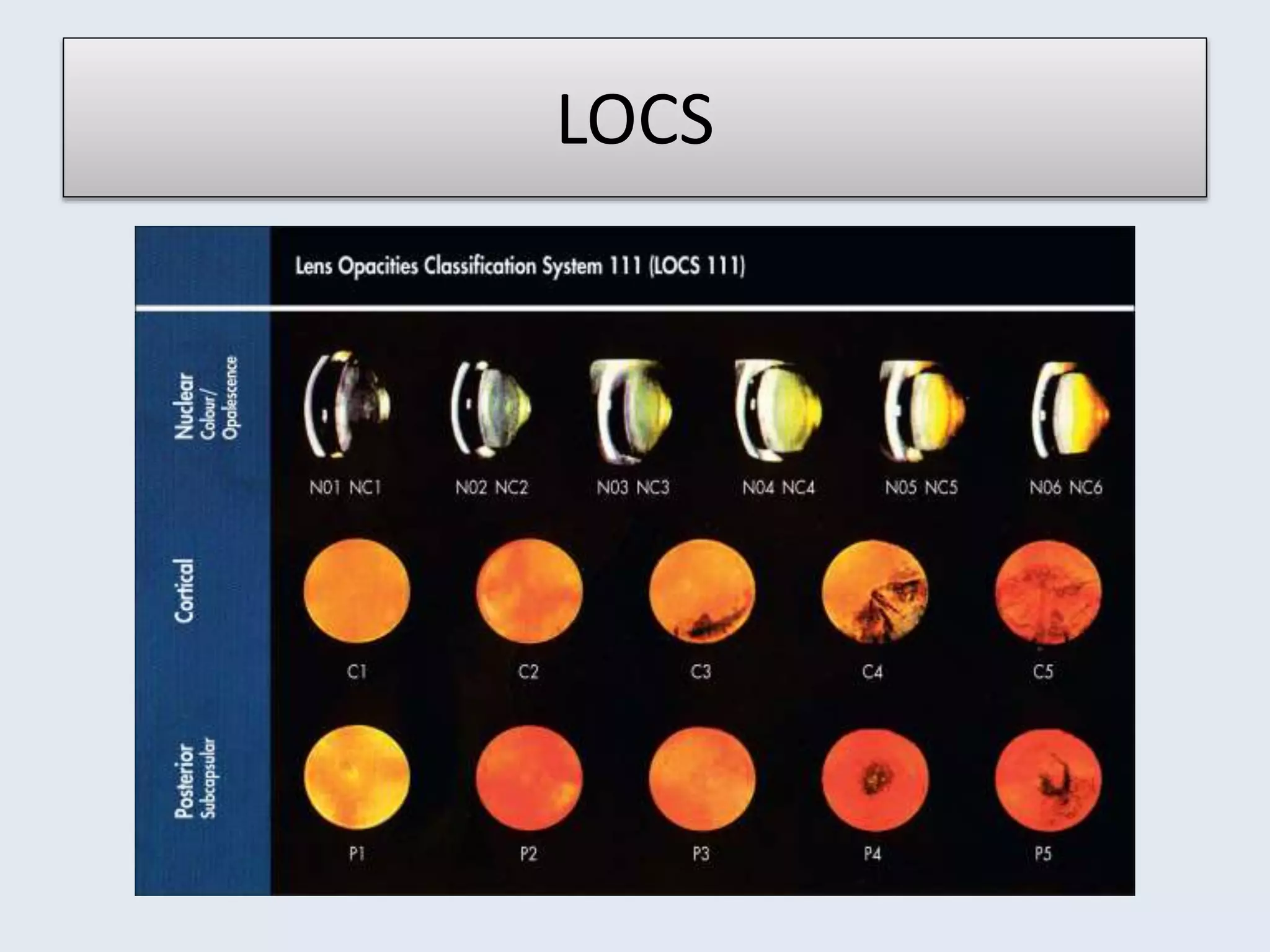
LOCS
Secondary Cataract
Chronic Anterior uveitis Acute congestive angle closure
Glaukomflecken
Hereditary fundus
dystrophies
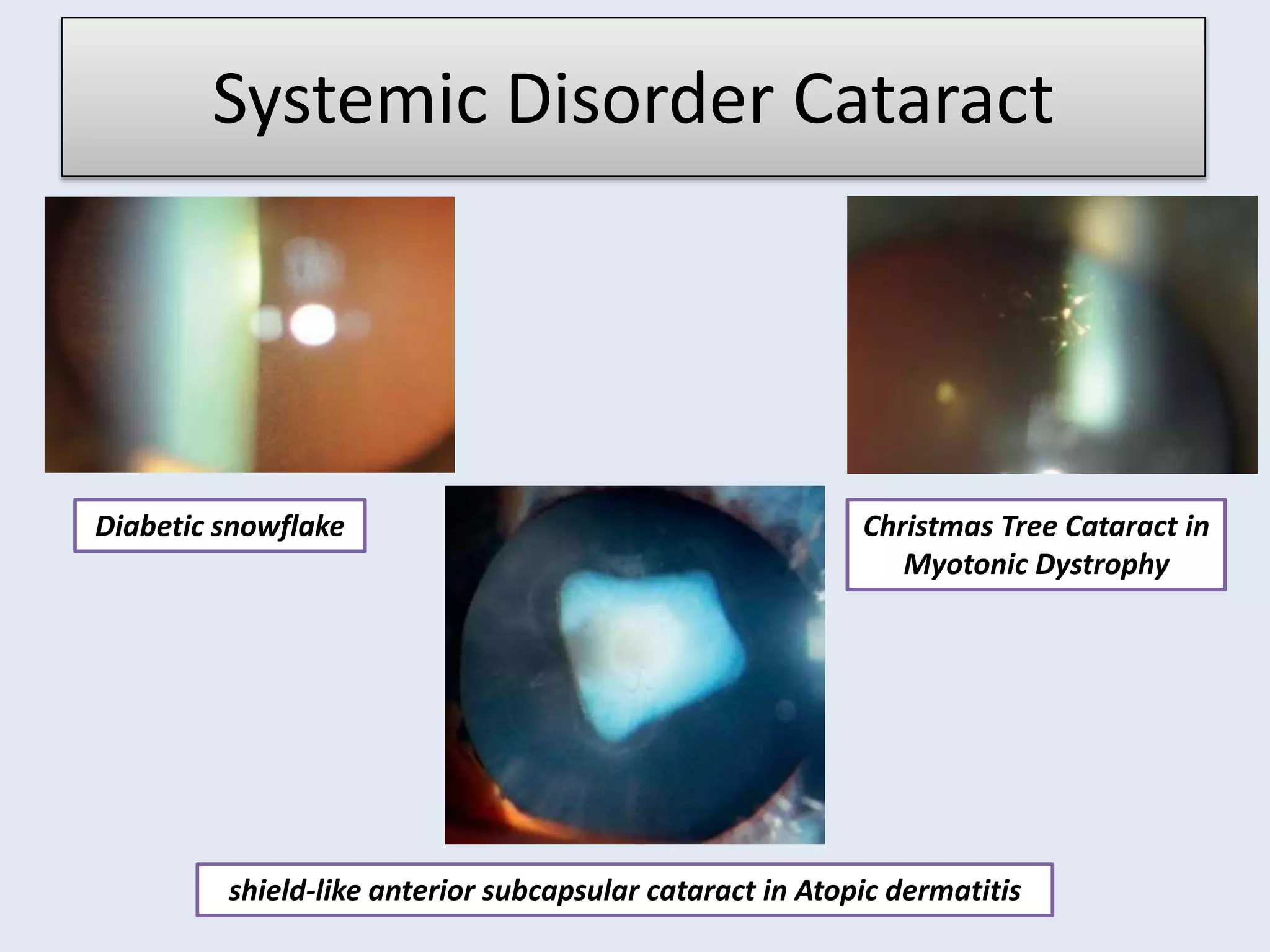
Systemic Disorder Cataract
Diabetic snowflake Christmas Tree Cataract in
Myotonic Dystrophy
shield-like anterior subcapsular cataract in Atopic dermatitis
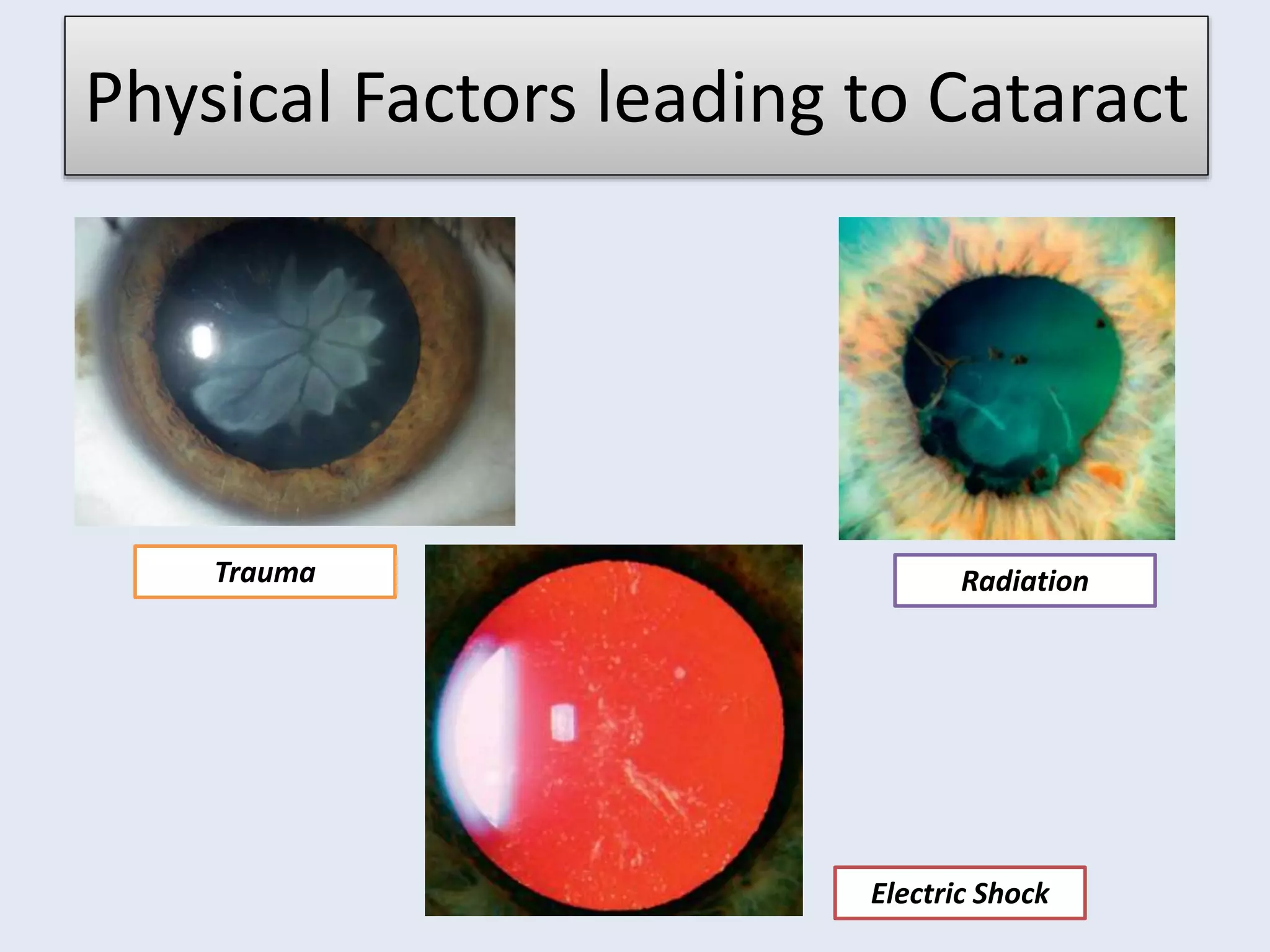
Physical Factors leading to Cataract
Trauma
Electric Shock
Radiation
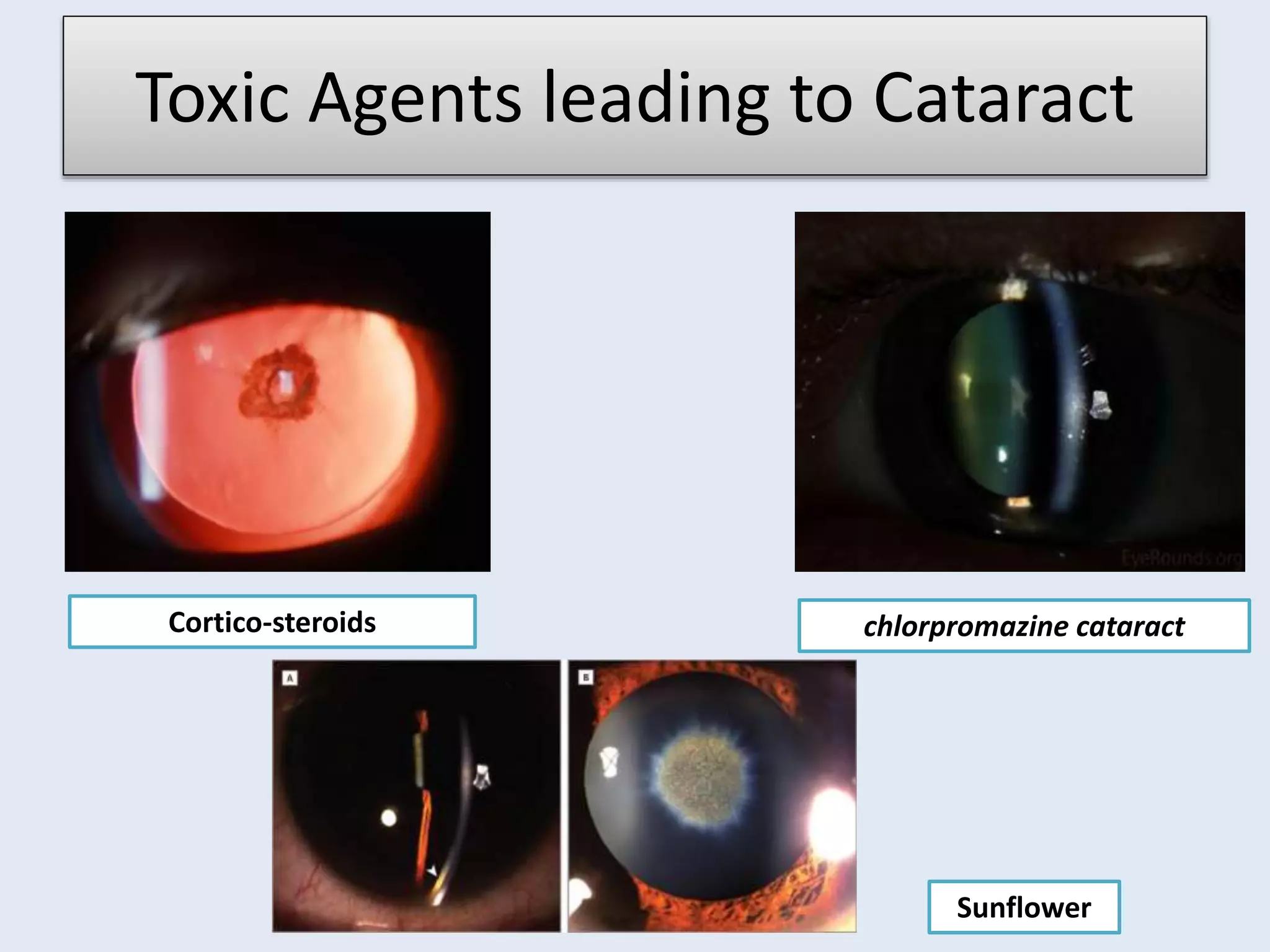
Toxic Agents leading to Cataract
Cortico-steroids chlorpromazine cataract
Sunflower
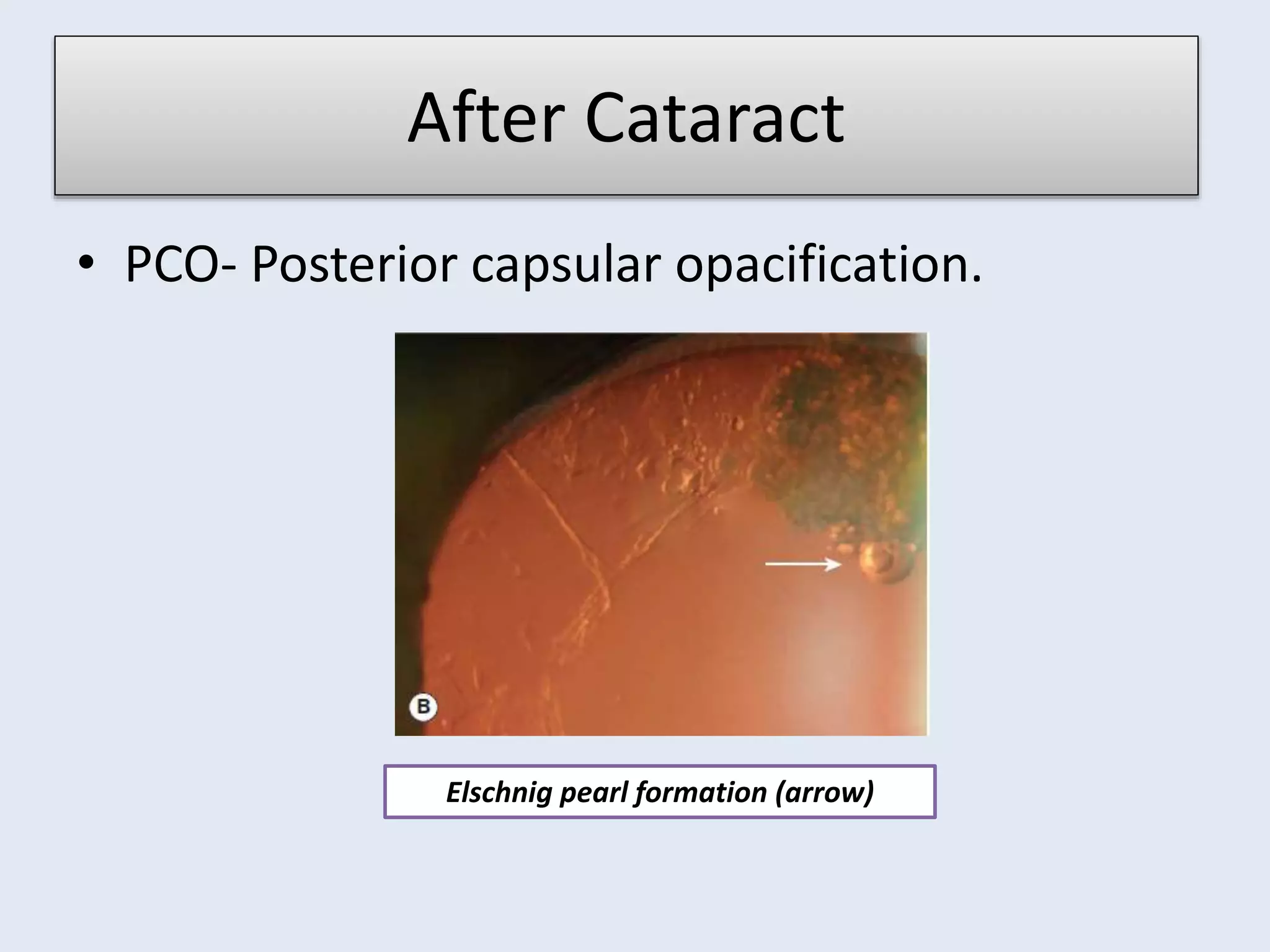
After Cataract
• PCO- Posterior capsular opacification.
Elschnig pearl formation (arrow)
No Slit-Lamp….. No Problem!!
• We Can Also see the cataract with torch light or
Retinoscope just we need to observe the following
things:-
• Color Of the lens
• Iris Shadow
• Vision of the person
One More Question??
• Lens is Named “ Crystalline Lens” just because
it transmit light like a Crystal !! Really??
QUIZ!!
This cataract is so dense that the
cortex has liquefied, allowing the
nucleus to sink to the bottom of
the lens capsule. This special type
of very dense cataract is known as
a Morgagnian cataract.
posterior sclerosing cataractcortical spoking cataract
Summary
References
Any Doubt??
Insta Name :- @mr.cool_buddyEmail- surajdalal2000@gmail.com
Mobile :- +91 9714222217

Types Of Cataract