
UUNNIITT 99..55 CCOONNGGRRUUEENNCCEE 
TTRRAANNSSFFOORRMMAATTIIOONNSS
Warm Up 
A figure has vertices A, B, and C. After a 
transformation, the image of the figure has 
vertices A′, B′, and C′. Draw the pre-image and 
the image on graph paper. Then identify the 
transformation. 
1. A(-3, 1), B(-1, 1), C(-3, 4) 
A′(3, 1), B′(5, 1), C′(3, 4) 
translation 6 units right 
2. A(2, 1), B(5, 1), C(4, 3) 
A′(2, -1), B′(5, -1), C′(4, -3) 
reflection across x-axis
Objectives 
Draw, identify, and describe transformations 
in the coordinate plane. 
Use properties of rigid motions to determine 
whether figures are congruent and to prove 
figures congruent.
Vocabulary 
dilation 
isometry 
rigid transformation
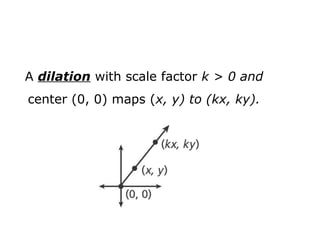
A dilation with scale factor k > 0 and 
center (0, 0) maps (x, y) to (kx, ky).
Remember! 
In a transformation, the original figure is the pre-image. 
The resulting figure is the image.
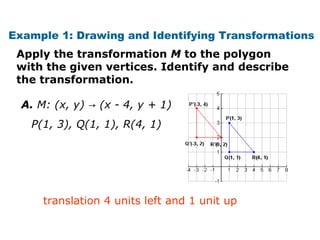
Example 1: Drawing and Identifying Transformations 
Apply the transformation M to the polygon 
with the given vertices. Identify and describe 
the transformation. 
A. M: (x, y) → (x - 4, y + 1) 
P(1, 3), Q(1, 1), R(4, 1) 
translation 4 units left and 1 unit up
Example 1: Continued 
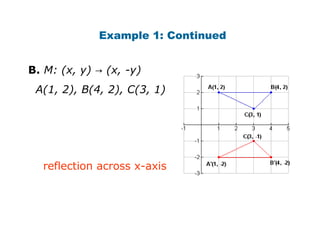
B. M: (x, y) → (x, -y) 
A(1, 2), B(4, 2), C(3, 1) 
reflection across x-axis
Example 1: Continued 
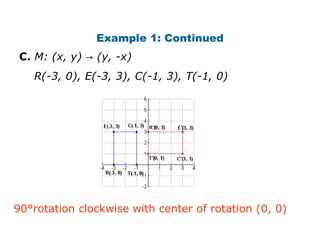
C. M: (x, y) → (y, -x) 
R(-3, 0), E(-3, 3), C(-1, 3), T(-1, 0) 
90°rotation clockwise with center of rotation (0, 0)
Example 1: Continued 
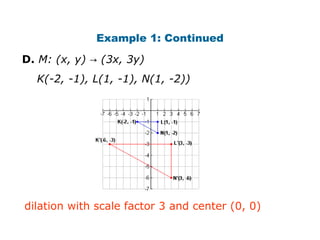
D. M: (x, y) → (3x, 3y) 
K(-2, -1), L(1, -1), N(1, -2)) 
dilation with scale factor 3 and center (0, 0)
Check It Out! Example 1 
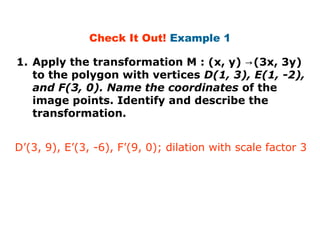
1. Apply the transformation M : (x, y) →(3x, 3y) 
to the polygon with vertices D(1, 3), E(1, -2), 
and F(3, 0). Name the coordinates of the 
image points. Identify and describe the 
transformation. 
D’(3, 9), E’(3, -6), F’(9, 0); dilation with scale factor 3
An isometry is a transformation that 
preserves length, angle measure, and area. 
Because of these properties, an isometry 
produces an image that is congruent to the 
preimage. 
A rigid transformation is another name for 
an isometry.
Example 2: Determining Whether Figures are 
Congruent 
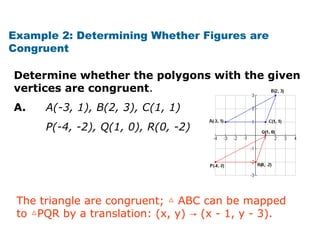
Determine whether the polygons with the given 
vertices are congruent. 
A. A(-3, 1), B(2, 3), C(1, 1) 
P(-4, -2), Q(1, 0), R(0, -2) 
The triangle are congruent; △ ABC can be mapped 
to △PQR by a translation: (x, y) → (x - 1, y - 3).
Example 2: Continued 
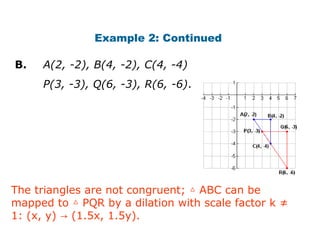
B. A(2, -2), B(4, -2), C(4, -4) 
P(3, -3), Q(6, -3), R(6, -6). 
The triangles are not congruent; △ ABC can be 
mapped to △ PQR by a dilation with scale factor k ≠ 
1: (x, y) → (1.5x, 1.5y).
Check It Out! Example 2 
Determine whether the polygons with the 
given vertices are congruent. Support your 
answer by describing a transformation: 
A(2, -1), B(3, 0), C(2, 3) and P(1, 2), Q(0, 
3), R(-3, 2). 
The triangles are congruent because ABC can be 
mapped to PQR by a rotation: (x, y) → (-y, x).
Example 3: Applying Transformations 
Prove that the polygons with the given vertices 
are congruent. 
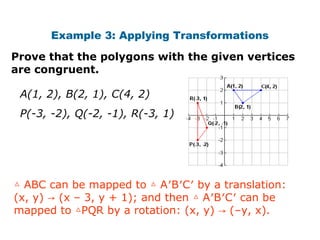
A(1, 2), B(2, 1), C(4, 2) 
P(-3, -2), Q(-2, -1), R(-3, 1) 
△ ABC can be mapped to △ A′B′C′ by a translation: 
(x, y) → (x – 3, y + 1); and then △ A′B′C′ can be 
mapped to △PQR by a rotation: (x, y) → (–y, x).
Check It Out! Example 3 
Prove that the polygons with the given vertices 
are congruent: A(-4, -2), B(-2, 1), C( 2, -2) and 
P(1, 0), Q(3, -3), R(3, 0). 
The triangles are congruent because ABC 
can be mapped to A’B’C’ by a translation 
(x, y) (x + 5, y → + 2); and then A’B’C’ 
can be mapped to ABC by a reflection 
across the x-axis
Helpful Hint 
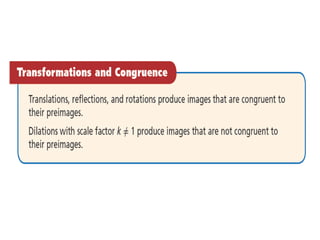
Translations, reflections, and rotations can be called 
congruence transformations.
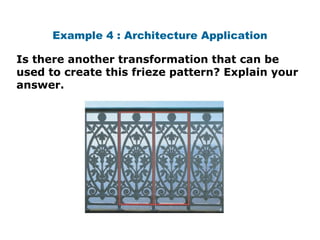
Example 4 : Architecture Application 
Is there another transformation that can be 
used to create this frieze pattern? Explain your 
answer.
Example 4 : Continued 
Repeated reflections can create this frieze pattern; 
a reflection of any section over a line through either 
the left or right side of each section.
Check It Out! Example 4 
Sketch a frieze pattern that can be produced by 
using reflections 
Possible answer: repeated horizontal reflections
Lesson Quiz : Part-I 
Apply the transformation M to the polygon with the 
given vertices. Identify and describe the 
transformation. 
1. M: (x, y) → (3x, 3y) 
A(0, 1), B(2, 1), C(2, -1) 
dilation with scale factor 3 and center (0, 0) 
2. M: (x, y) → (-y, x) 
A(0, 3), B(1, 2), C(4, 5) 
90° rotation counterclockwise with center of 
rotation (0, 0)
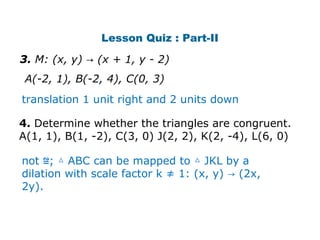
Lesson Quiz : Part-II 
3. M: (x, y) → (x + 1, y - 2) 
A(-2, 1), B(-2, 4), C(0, 3) 
translation 1 unit right and 2 units down 
4. Determine whether the triangles are congruent. 
A(1, 1), B(1, -2), C(3, 0) J(2, 2), K(2, -4), L(6, 0) 
not ≌; △ ABC can be mapped to △ JKL by a 
dilation with scale factor k ≠ 1: (x, y) → (2x, 
2y).
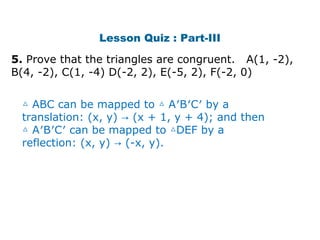
Lesson Quiz : Part-III 
5. Prove that the triangles are congruent. A(1, -2), 
B(4, -2), C(1, -4) D(-2, 2), E(-5, 2), F(-2, 0) 
△ ABC can be mapped to △ A′B′C′ by a 
translation: (x, y) → (x + 1, y + 4); and then 
△ A′B′C′ can be mapped to △DEF by a 
reflection: (x, y) → (-x, y).
All rights belong to their 
respective owners. 
Copyright Disclaimer Under 
Section 107 of the Copyright Act 
1976, allowance is made for 
"fair use" for purposes such as 
criticism, comment, news 
reporting, TEACHING, 
scholarship, and research. 
Fair use is a use permitted by 
copyright statute that might 
otherwise be infringing. 
Non-profit, EDUCATIONAL or 
personal use tips the balance in 
favor of fair use.

Geometry unit 9.5

  • 1.
    UUNNIITT 99..55 CCOONNGGRRUUEENNCCEE TTRRAANNSSFFOORRMMAATTIIOONNSS
  • 2.
    Warm Up Afigure has vertices A, B, and C. After a transformation, the image of the figure has vertices A′, B′, and C′. Draw the pre-image and the image on graph paper. Then identify the transformation. 1. A(-3, 1), B(-1, 1), C(-3, 4) A′(3, 1), B′(5, 1), C′(3, 4) translation 6 units right 2. A(2, 1), B(5, 1), C(4, 3) A′(2, -1), B′(5, -1), C′(4, -3) reflection across x-axis
  • 3.
    Objectives Draw, identify,and describe transformations in the coordinate plane. Use properties of rigid motions to determine whether figures are congruent and to prove figures congruent.
  • 4.
    Vocabulary dilation isometry rigid transformation
  • 5.
    A dilation withscale factor k > 0 and center (0, 0) maps (x, y) to (kx, ky).
  • 6.
    Remember! In atransformation, the original figure is the pre-image. The resulting figure is the image.
  • 7.
    Example 1: Drawingand Identifying Transformations Apply the transformation M to the polygon with the given vertices. Identify and describe the transformation. A. M: (x, y) → (x - 4, y + 1) P(1, 3), Q(1, 1), R(4, 1) translation 4 units left and 1 unit up
  • 8.
    Example 1: Continued B. M: (x, y) → (x, -y) A(1, 2), B(4, 2), C(3, 1) reflection across x-axis
  • 9.
    Example 1: Continued C. M: (x, y) → (y, -x) R(-3, 0), E(-3, 3), C(-1, 3), T(-1, 0) 90°rotation clockwise with center of rotation (0, 0)
  • 10.
    Example 1: Continued D. M: (x, y) → (3x, 3y) K(-2, -1), L(1, -1), N(1, -2)) dilation with scale factor 3 and center (0, 0)
  • 11.
    Check It Out!Example 1 1. Apply the transformation M : (x, y) →(3x, 3y) to the polygon with vertices D(1, 3), E(1, -2), and F(3, 0). Name the coordinates of the image points. Identify and describe the transformation. D’(3, 9), E’(3, -6), F’(9, 0); dilation with scale factor 3
  • 13.
    An isometry isa transformation that preserves length, angle measure, and area. Because of these properties, an isometry produces an image that is congruent to the preimage. A rigid transformation is another name for an isometry.
  • 15.
    Example 2: DeterminingWhether Figures are Congruent Determine whether the polygons with the given vertices are congruent. A. A(-3, 1), B(2, 3), C(1, 1) P(-4, -2), Q(1, 0), R(0, -2) The triangle are congruent; △ ABC can be mapped to △PQR by a translation: (x, y) → (x - 1, y - 3).
  • 16.
    Example 2: Continued B. A(2, -2), B(4, -2), C(4, -4) P(3, -3), Q(6, -3), R(6, -6). The triangles are not congruent; △ ABC can be mapped to △ PQR by a dilation with scale factor k ≠ 1: (x, y) → (1.5x, 1.5y).
  • 17.
    Check It Out!Example 2 Determine whether the polygons with the given vertices are congruent. Support your answer by describing a transformation: A(2, -1), B(3, 0), C(2, 3) and P(1, 2), Q(0, 3), R(-3, 2). The triangles are congruent because ABC can be mapped to PQR by a rotation: (x, y) → (-y, x).
  • 18.
    Example 3: ApplyingTransformations Prove that the polygons with the given vertices are congruent. A(1, 2), B(2, 1), C(4, 2) P(-3, -2), Q(-2, -1), R(-3, 1) △ ABC can be mapped to △ A′B′C′ by a translation: (x, y) → (x – 3, y + 1); and then △ A′B′C′ can be mapped to △PQR by a rotation: (x, y) → (–y, x).
  • 19.
    Check It Out!Example 3 Prove that the polygons with the given vertices are congruent: A(-4, -2), B(-2, 1), C( 2, -2) and P(1, 0), Q(3, -3), R(3, 0). The triangles are congruent because ABC can be mapped to A’B’C’ by a translation (x, y) (x + 5, y → + 2); and then A’B’C’ can be mapped to ABC by a reflection across the x-axis
  • 20.
    Helpful Hint Translations,reflections, and rotations can be called congruence transformations.
  • 21.
    Example 4 :Architecture Application Is there another transformation that can be used to create this frieze pattern? Explain your answer.
  • 22.
    Example 4 :Continued Repeated reflections can create this frieze pattern; a reflection of any section over a line through either the left or right side of each section.
  • 23.
    Check It Out!Example 4 Sketch a frieze pattern that can be produced by using reflections Possible answer: repeated horizontal reflections
  • 24.
    Lesson Quiz :Part-I Apply the transformation M to the polygon with the given vertices. Identify and describe the transformation. 1. M: (x, y) → (3x, 3y) A(0, 1), B(2, 1), C(2, -1) dilation with scale factor 3 and center (0, 0) 2. M: (x, y) → (-y, x) A(0, 3), B(1, 2), C(4, 5) 90° rotation counterclockwise with center of rotation (0, 0)
  • 25.
    Lesson Quiz :Part-II 3. M: (x, y) → (x + 1, y - 2) A(-2, 1), B(-2, 4), C(0, 3) translation 1 unit right and 2 units down 4. Determine whether the triangles are congruent. A(1, 1), B(1, -2), C(3, 0) J(2, 2), K(2, -4), L(6, 0) not ≌; △ ABC can be mapped to △ JKL by a dilation with scale factor k ≠ 1: (x, y) → (2x, 2y).
  • 26.
    Lesson Quiz :Part-III 5. Prove that the triangles are congruent. A(1, -2), B(4, -2), C(1, -4) D(-2, 2), E(-5, 2), F(-2, 0) △ ABC can be mapped to △ A′B′C′ by a translation: (x, y) → (x + 1, y + 4); and then △ A′B′C′ can be mapped to △DEF by a reflection: (x, y) → (-x, y).
  • 27.
    All rights belongto their respective owners. Copyright Disclaimer Under Section 107 of the Copyright Act 1976, allowance is made for "fair use" for purposes such as criticism, comment, news reporting, TEACHING, scholarship, and research. Fair use is a use permitted by copyright statute that might otherwise be infringing. Non-profit, EDUCATIONAL or personal use tips the balance in favor of fair use.