UUNNIITT 99..33 RROOTTAATTIIOONNSS
Warm Up 
1. The translation image of P(–3, –1) is 
P’(1, 3). Find the translation image of 
Q(2, –4). Q’(6, 0) 
Solve for x. Round to the nearest tenth. 
2. cos 30°= 
3. sin 30°= 
x ≈ 43.3 
x = 25
Objective 
Identify and draw rotations.
Remember that a rotation is a transformation 
that turns a figure around a fixed point, called 
the center of rotation. A rotation is an isometry, 
so the image of a rotated figure is congruent to 
the preimage.
Example 1: Identifying Rotations 
Tell whether each transformation appears to 
be a rotation. Explain. 
A. B. 
No; the figure appears 
to be flipped. 
Yes; the figure appears 
to be turned around a 
point.
Check It Out! Example 1 
Tell whether each transformation appears to 
be a rotation. 
No, the figure appears 
to be a translation. 
Yes, the figure 
appears to be turned 
around a point. 
a. b.
Draw a segment from each vertex to the center of 
rotation. Your construction should show that a 
point’s distance to the center of rotation is equal to 
its image’s distance to the center of rotation. The 
angle formed by a point, the center of rotation, and 
the point’s image is the angle by which the figure 
was rotated.
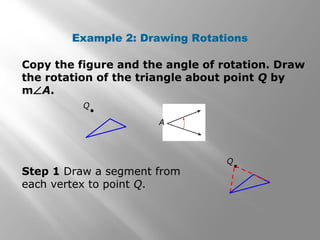
Example 2: Drawing Rotations 
Copy the figure and the angle of rotation. Draw 
the rotation of the triangle about point Q by 
mÐA. 
Step 1 Draw a segment from 
each vertex to point Q. 
Q 
A 
Q
Example 2 Continued 
Step 2 Construct an angle 
congruent to ÐA onto each 
segment. Measure the distance 
from each vertex to point Q and 
mark off this distance on the 
corresponding ray to locate the 
image of each vertex. 
Step 3 Connect the images of 
the vertices. 
Q 
Q
Helpful Hint 
Unless otherwise stated, all rotations in this book 
are counterclockwise.
Check It Out! Example 2 
Copy the figure and the angle of rotation. 
Draw the rotation of the segment about point 
Q by mÐX. 
Step 1 Draw a line from 
each end of the segment 
to point Q.
Check It Out! Example 2 Continued 
Step 2 Construct an angle 
congruent to ÐX on each segment. 
Measure the distance from each 
segment to point P and mark off 
this distance on the corresponding 
ray to locate the image of the new 
segment. 
Step 3 Connect the image of the 
segment.
If the angle of a rotation in the coordinate plane is 
not a multiple of 90°, you can use sine and cosine 
ratios to find the coordinates of the image.
Example 3: Drawing Rotations in the Coordinate 
Plane 
Rotate ΔJKL with vertices J(2, 2), K(4, –5), 
and L(–1, 6) by 180° about the origin. 
The rotation of (x, y) is 
(–x, –y). 
J(2, 2) J’(–2, –2) 
K(4, –5) K’(–4, 5) 
L(–1, 6) L’(1, –6) 
Graph the preimage and image.
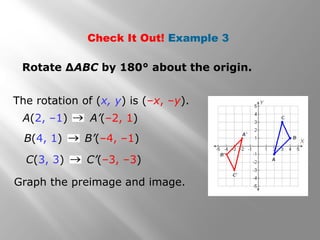
Check It Out! Example 3 
Rotate ΔABC by 180° about the origin. 
The rotation of (x, y) is (–x, –y). 
A(2, –1) A’(–2, 1) 
B(4, 1) B’(–4, –1) 
C(3, 3) C’(–3, –3) 
Graph the preimage and image.
Example 4: Engineering Application 
A Ferris wheel has a 100 ft diameter and takes 
60 s to make a complete rotation. A chair starts 
at (100, 0). After 5 s, what are the coordinates 
of its location to the nearest tenth? 
Step 1 Find the angle of rotation. Five seconds is 
of a complete rotation, or 360° = 30°. 
Step 2 Draw a right triangle 
to represent the car’s location 
(x, y) after a rotation of 30° 
about the origin.
Example 4 Continued 
Step 3 Use the cosine ratio to find the x-coordinate. 
cos 30° = 
x = 100 cos 30° ≈ 86.6 Solve for x. 
Step 4 Use the sine ratio to find the y-coordinate. 
sin 30° = 
y = 100 sin 30° = 50 
Solve for y. 
The chair’s location after 5 s is approximately 
(86.6, 50).
Check It Out! Example 4 
The London Eye observation wheel has a 
radius of 67.5 m and takes 30 minutes to 
make a complete rotation. Find the 
coordinates of the observation car after 6 
minutes. Round to the nearest tenth. 
Step 1 find the angle of rotation. six minutes is 
of a complete rotation, or 360° = 36°. 
 
Step 2 Draw a right triangle 
to represent the car’s location 
(x, y) after a rotation of 36° 
about the origin.  
36° (67.5, 0) 
0 67.5 
(x, y) 
Starting 
position 
67.5
Check It Out! Example 4 
Step 3 Use the cosine ratio to find the x-coordinate. 
cos 36° = 
x = 67.5 cos 36° ≈ 20.9 Solve for x. 
Step 4 Use the sine ratio to find the y-coordinate. 
Solve for y. 
sin 36° = 
y = 67.5 sin 36° = 64.2 
The chair’s location after 6 m is approximately 
(20.9, 64.2).
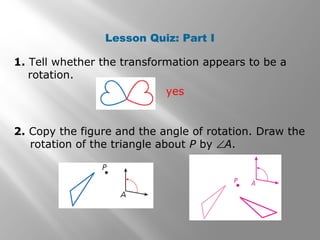
Lesson Quiz: Part I 
1. Tell whether the transformation appears to be a 
rotation. 
yes 
2. Copy the figure and the angle of rotation. Draw the 
rotation of the triangle about P by ÐA.
Lesson Quiz: Part II 
Rotate ΔRST with vertices R(–1, 4), S(2, 1), 
and T(3, –3) about the origin by the given 
angle. 
3. 90° R’(–4, –1), S’(–1, 2), T’(3, 3) 
4. 180° R’(1, –4), S’(–2, –1), T’(–3, 3)
All rights belong to their 
respective owners. 
Copyright Disclaimer Under 
Section 107 of the 
Copyright Act 1976, 
allowance is made for "fair 
use" for purposes such as 
criticism, comment, news 
reporting, TEACHING, 
scholarship, and research. 
Fair use is a use permitted 
by copyright statute that 
might otherwise be 
infringing. 
Non-profit, EDUCATIONAL 
or personal use tips the 
balance in favor of fair use.

Geometry unit 9.3

  • 1.
  • 2.
    Warm Up 1.The translation image of P(–3, –1) is P’(1, 3). Find the translation image of Q(2, –4). Q’(6, 0) Solve for x. Round to the nearest tenth. 2. cos 30°= 3. sin 30°= x ≈ 43.3 x = 25
  • 3.
    Objective Identify anddraw rotations.
  • 4.
    Remember that arotation is a transformation that turns a figure around a fixed point, called the center of rotation. A rotation is an isometry, so the image of a rotated figure is congruent to the preimage.
  • 5.
    Example 1: IdentifyingRotations Tell whether each transformation appears to be a rotation. Explain. A. B. No; the figure appears to be flipped. Yes; the figure appears to be turned around a point.
  • 6.
    Check It Out!Example 1 Tell whether each transformation appears to be a rotation. No, the figure appears to be a translation. Yes, the figure appears to be turned around a point. a. b.
  • 7.
    Draw a segmentfrom each vertex to the center of rotation. Your construction should show that a point’s distance to the center of rotation is equal to its image’s distance to the center of rotation. The angle formed by a point, the center of rotation, and the point’s image is the angle by which the figure was rotated.
  • 9.
    Example 2: DrawingRotations Copy the figure and the angle of rotation. Draw the rotation of the triangle about point Q by mÐA. Step 1 Draw a segment from each vertex to point Q. Q A Q
  • 10.
    Example 2 Continued Step 2 Construct an angle congruent to ÐA onto each segment. Measure the distance from each vertex to point Q and mark off this distance on the corresponding ray to locate the image of each vertex. Step 3 Connect the images of the vertices. Q Q
  • 11.
    Helpful Hint Unlessotherwise stated, all rotations in this book are counterclockwise.
  • 12.
    Check It Out!Example 2 Copy the figure and the angle of rotation. Draw the rotation of the segment about point Q by mÐX. Step 1 Draw a line from each end of the segment to point Q.
  • 13.
    Check It Out!Example 2 Continued Step 2 Construct an angle congruent to ÐX on each segment. Measure the distance from each segment to point P and mark off this distance on the corresponding ray to locate the image of the new segment. Step 3 Connect the image of the segment.
  • 14.
    If the angleof a rotation in the coordinate plane is not a multiple of 90°, you can use sine and cosine ratios to find the coordinates of the image.
  • 15.
    Example 3: DrawingRotations in the Coordinate Plane Rotate ΔJKL with vertices J(2, 2), K(4, –5), and L(–1, 6) by 180° about the origin. The rotation of (x, y) is (–x, –y). J(2, 2) J’(–2, –2) K(4, –5) K’(–4, 5) L(–1, 6) L’(1, –6) Graph the preimage and image.
  • 16.
    Check It Out!Example 3 Rotate ΔABC by 180° about the origin. The rotation of (x, y) is (–x, –y). A(2, –1) A’(–2, 1) B(4, 1) B’(–4, –1) C(3, 3) C’(–3, –3) Graph the preimage and image.
  • 17.
    Example 4: EngineeringApplication A Ferris wheel has a 100 ft diameter and takes 60 s to make a complete rotation. A chair starts at (100, 0). After 5 s, what are the coordinates of its location to the nearest tenth? Step 1 Find the angle of rotation. Five seconds is of a complete rotation, or 360° = 30°. Step 2 Draw a right triangle to represent the car’s location (x, y) after a rotation of 30° about the origin.
  • 18.
    Example 4 Continued Step 3 Use the cosine ratio to find the x-coordinate. cos 30° = x = 100 cos 30° ≈ 86.6 Solve for x. Step 4 Use the sine ratio to find the y-coordinate. sin 30° = y = 100 sin 30° = 50 Solve for y. The chair’s location after 5 s is approximately (86.6, 50).
  • 19.
    Check It Out!Example 4 The London Eye observation wheel has a radius of 67.5 m and takes 30 minutes to make a complete rotation. Find the coordinates of the observation car after 6 minutes. Round to the nearest tenth. Step 1 find the angle of rotation. six minutes is of a complete rotation, or 360° = 36°.  Step 2 Draw a right triangle to represent the car’s location (x, y) after a rotation of 36° about the origin.  36° (67.5, 0) 0 67.5 (x, y) Starting position 67.5
  • 20.
    Check It Out!Example 4 Step 3 Use the cosine ratio to find the x-coordinate. cos 36° = x = 67.5 cos 36° ≈ 20.9 Solve for x. Step 4 Use the sine ratio to find the y-coordinate. Solve for y. sin 36° = y = 67.5 sin 36° = 64.2 The chair’s location after 6 m is approximately (20.9, 64.2).
  • 21.
    Lesson Quiz: PartI 1. Tell whether the transformation appears to be a rotation. yes 2. Copy the figure and the angle of rotation. Draw the rotation of the triangle about P by ÐA.
  • 22.
    Lesson Quiz: PartII Rotate ΔRST with vertices R(–1, 4), S(2, 1), and T(3, –3) about the origin by the given angle. 3. 90° R’(–4, –1), S’(–1, 2), T’(3, 3) 4. 180° R’(1, –4), S’(–2, –1), T’(–3, 3)
  • 23.
    All rights belongto their respective owners. Copyright Disclaimer Under Section 107 of the Copyright Act 1976, allowance is made for "fair use" for purposes such as criticism, comment, news reporting, TEACHING, scholarship, and research. Fair use is a use permitted by copyright statute that might otherwise be infringing. Non-profit, EDUCATIONAL or personal use tips the balance in favor of fair use.