1
Transformations
By
Gowtham T
2
Types of Transformations
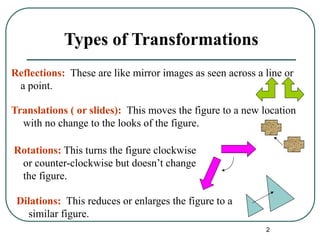
Reflections: These are like mirror images as seen across a line or
a point.
Translations ( or slides): This moves the figure to a new location
with no change to the looks of the figure.
Rotations: This turns the figure clockwise
or counter-clockwise but doesn’t change
the figure.
Dilations: This reduces or enlarges the figure to a
similar figure.
3
Reflections
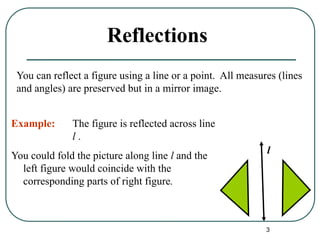
You could fold the picture along line l and the
left figure would coincide with the
corresponding parts of right figure.
l
You can reflect a figure using a line or a point. All measures (lines
and angles) are preserved but in a mirror image.
Example: The figure is reflected across line
l .
4
Reflections – continued…
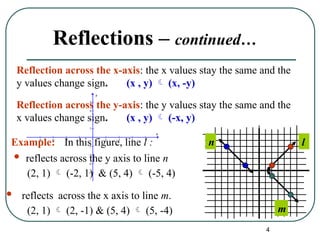
 reflects across the y axis to line n
(2, 1)  (-2, 1) & (5, 4)  (-5, 4)
Reflection across the x-axis: the x values stay the same and the
y values change sign. (x , y)  (x, -y)
Reflection across the y-axis: the y values stay the same and the
x values change sign. (x , y)  (-x, y)
-8 -6 -4 -2 2 4 6 8
-8
-6
-4
-2
2
4
6
8
x
y
Example: In this figure, line l :
 reflects across the x axis to line m.
(2, 1)  (2, -1) & (5, 4)  (5, -4)
l
n
m
5
Reflections across specific lines:
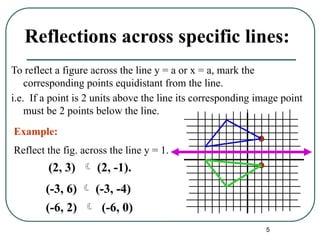
To reflect a figure across the line y = a or x = a, mark the
corresponding points equidistant from the line.
i.e. If a point is 2 units above the line its corresponding image point
must be 2 points below the line.
(-3, 6)  (-3, -4)
(-6, 2)  (-6, 0)
(2, 3)  (2, -1).
Example:
Reflect the fig. across the line y = 1.
6
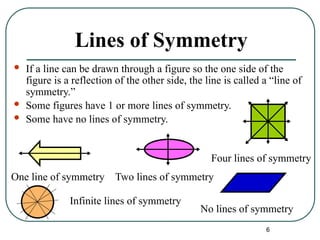
Lines of Symmetry
 If a line can be drawn through a figure so the one side of the
figure is a reflection of the other side, the line is called a “line of
symmetry.”
 Some figures have 1 or more lines of symmetry.
 Some have no lines of symmetry.
One line of symmetry
Infinite lines of symmetry
Four lines of symmetry
Two lines of symmetry
No lines of symmetry
7
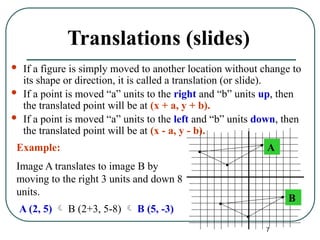
Translations (slides)
 If a figure is simply moved to another location without change to
its shape or direction, it is called a translation (or slide).
 If a point is moved “a” units to the right and “b” units up, then
the translated point will be at (x + a, y + b).
 If a point is moved “a” units to the left and “b” units down, then
the translated point will be at (x - a, y - b).
A
B
Image A translates to image B by
moving to the right 3 units and down 8
units.
Example:
A (2, 5)  B (2+3, 5-8)  B (5, -3)
8
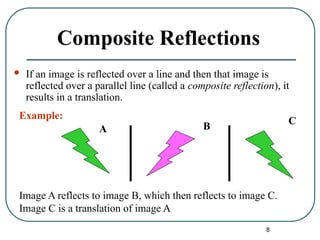
Composite Reflections
 If an image is reflected over a line and then that image is
reflected over a parallel line (called a composite reflection), it
results in a translation.
A B C
Image A reflects to image B, which then reflects to image C.
Image C is a translation of image A
Example:
9
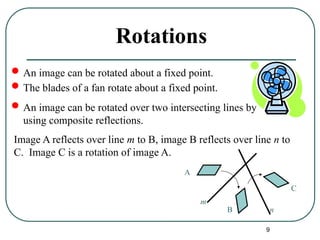
Rotations
An image can be rotated about a fixed point.
The blades of a fan rotate about a fixed point.
An image can be rotated over two intersecting lines by
using composite reflections.
Image A reflects over line m to B, image B reflects over line n to
C. Image C is a rotation of image A.
A
B
C
m
n
10
Rotations
It is a type of transformation where the object is rotated around a fixed
point called the point of rotation.
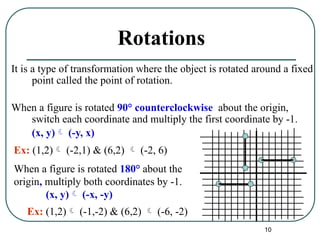
When a figure is rotated 90° counterclockwise about the origin,
switch each coordinate and multiply the first coordinate by -1.
(x, y) (-y, x)
When a figure is rotated 180° about the
origin, multiply both coordinates by -1.
(x, y) (-x, -y)
Ex: (1,2) (-1,-2) & (6,2)  (-6, -2)
Ex: (1,2) (-2,1) & (6,2)  (-2, 6)
11
Angles of rotation
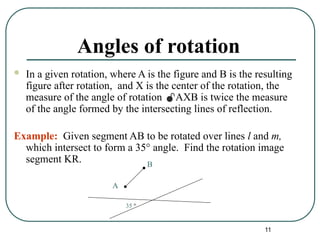
 In a given rotation, where A is the figure and B is the resulting
figure after rotation, and X is the center of the rotation, the
measure of the angle of rotation AXB is twice the measure
of the angle formed by the intersecting lines of reflection.
Example: Given segment AB to be rotated over lines l and m,
which intersect to form a 35° angle. Find the rotation image
segment KR.
A
B
35 °
12
Angles of Rotation . .
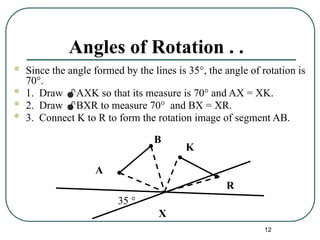
 Since the angle formed by the lines is 35°, the angle of rotation is
70°.
 1. Draw AXK so that its measure is 70° and AX = XK.
 2. Draw BXR to measure 70° and BX = XR.
 3. Connect K to R to form the rotation image of segment AB.
A
B
35 °
X
K
R
13
Dilations
 A dilation is a transformation which changes the size of a figure
but not its shape. This is called a similarity transformation.
 Since a dilation changes figures proportionately, it has a scale
factor k.
• If the absolute value of k is greater than 1, the dilation is an
enlargement.
• If the absolute value of k is between 0 and 1, the dilation is a
reduction.
• If the absolute value of k is equal to 0, the dilation is
congruence transformation. (No size change occurs.)
14
Dilations – continued…
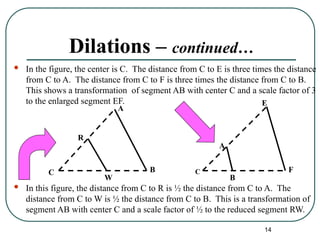
 In the figure, the center is C. The distance from C to E is three times the distance
from C to A. The distance from C to F is three times the distance from C to B.
This shows a transformation of segment AB with center C and a scale factor of 3
to the enlarged segment EF.
 In this figure, the distance from C to R is ½ the distance from C to A. The
distance from C to W is ½ the distance from C to B. This is a transformation of
segment AB with center C and a scale factor of ½ to the reduced segment RW.
C
E
A
F
B
C
R
A
B
W
15
Dilations – examples…
Find the measure of the dilation image of segment AB, 6 units long,
with a scale factor of
1. S.F. = -4: the dilation image will be an enlargment since the
absolute value of the scale factor is greater than 1. The image will
be 24 units long.
2. S.F. = 2/3: since the scale factor is between 0 and 1, the image
will be a reduction. The image will be 2/3 times 6 or 4 units
long.
3. S.F. = 1: since the scale factor is 1, this will be a congruence
transformation. The image will be the same length as the original
segment, 1 unit long.
KutaSoftware: Geometry- All
Transformations Part 1
 https://www.youtube.com/watch?v=w33N
9ZWj4Tk
16
KutaSoftware: Geometry- All
Transformations Part 2
 https://www.youtube.com/watch?v=guav
zJ7tXj0
17

Transformations in Graphics in Augmented Reality & Virtual Reality

  • 1.
  • 2.
    2 Types of Transformations Reflections:These are like mirror images as seen across a line or a point. Translations ( or slides): This moves the figure to a new location with no change to the looks of the figure. Rotations: This turns the figure clockwise or counter-clockwise but doesn’t change the figure. Dilations: This reduces or enlarges the figure to a similar figure.
  • 3.
    3 Reflections You could foldthe picture along line l and the left figure would coincide with the corresponding parts of right figure. l You can reflect a figure using a line or a point. All measures (lines and angles) are preserved but in a mirror image. Example: The figure is reflected across line l .
  • 4.
    4 Reflections – continued… reflects across the y axis to line n (2, 1)  (-2, 1) & (5, 4)  (-5, 4) Reflection across the x-axis: the x values stay the same and the y values change sign. (x , y)  (x, -y) Reflection across the y-axis: the y values stay the same and the x values change sign. (x , y)  (-x, y) -8 -6 -4 -2 2 4 6 8 -8 -6 -4 -2 2 4 6 8 x y Example: In this figure, line l :  reflects across the x axis to line m. (2, 1)  (2, -1) & (5, 4)  (5, -4) l n m
  • 5.
    5 Reflections across specificlines: To reflect a figure across the line y = a or x = a, mark the corresponding points equidistant from the line. i.e. If a point is 2 units above the line its corresponding image point must be 2 points below the line. (-3, 6)  (-3, -4) (-6, 2)  (-6, 0) (2, 3)  (2, -1). Example: Reflect the fig. across the line y = 1.
  • 6.
    6 Lines of Symmetry If a line can be drawn through a figure so the one side of the figure is a reflection of the other side, the line is called a “line of symmetry.”  Some figures have 1 or more lines of symmetry.  Some have no lines of symmetry. One line of symmetry Infinite lines of symmetry Four lines of symmetry Two lines of symmetry No lines of symmetry
  • 7.
    7 Translations (slides)  Ifa figure is simply moved to another location without change to its shape or direction, it is called a translation (or slide).  If a point is moved “a” units to the right and “b” units up, then the translated point will be at (x + a, y + b).  If a point is moved “a” units to the left and “b” units down, then the translated point will be at (x - a, y - b). A B Image A translates to image B by moving to the right 3 units and down 8 units. Example: A (2, 5)  B (2+3, 5-8)  B (5, -3)
  • 8.
    8 Composite Reflections  Ifan image is reflected over a line and then that image is reflected over a parallel line (called a composite reflection), it results in a translation. A B C Image A reflects to image B, which then reflects to image C. Image C is a translation of image A Example:
  • 9.
    9 Rotations An image canbe rotated about a fixed point. The blades of a fan rotate about a fixed point. An image can be rotated over two intersecting lines by using composite reflections. Image A reflects over line m to B, image B reflects over line n to C. Image C is a rotation of image A. A B C m n
  • 10.
    10 Rotations It is atype of transformation where the object is rotated around a fixed point called the point of rotation. When a figure is rotated 90° counterclockwise about the origin, switch each coordinate and multiply the first coordinate by -1. (x, y) (-y, x) When a figure is rotated 180° about the origin, multiply both coordinates by -1. (x, y) (-x, -y) Ex: (1,2) (-1,-2) & (6,2)  (-6, -2) Ex: (1,2) (-2,1) & (6,2)  (-2, 6)
  • 11.
    11 Angles of rotation In a given rotation, where A is the figure and B is the resulting figure after rotation, and X is the center of the rotation, the measure of the angle of rotation AXB is twice the measure of the angle formed by the intersecting lines of reflection. Example: Given segment AB to be rotated over lines l and m, which intersect to form a 35° angle. Find the rotation image segment KR. A B 35 °
  • 12.
    12 Angles of Rotation. .  Since the angle formed by the lines is 35°, the angle of rotation is 70°.  1. Draw AXK so that its measure is 70° and AX = XK.  2. Draw BXR to measure 70° and BX = XR.  3. Connect K to R to form the rotation image of segment AB. A B 35 ° X K R
  • 13.
    13 Dilations  A dilationis a transformation which changes the size of a figure but not its shape. This is called a similarity transformation.  Since a dilation changes figures proportionately, it has a scale factor k. • If the absolute value of k is greater than 1, the dilation is an enlargement. • If the absolute value of k is between 0 and 1, the dilation is a reduction. • If the absolute value of k is equal to 0, the dilation is congruence transformation. (No size change occurs.)
  • 14.
    14 Dilations – continued… In the figure, the center is C. The distance from C to E is three times the distance from C to A. The distance from C to F is three times the distance from C to B. This shows a transformation of segment AB with center C and a scale factor of 3 to the enlarged segment EF.  In this figure, the distance from C to R is ½ the distance from C to A. The distance from C to W is ½ the distance from C to B. This is a transformation of segment AB with center C and a scale factor of ½ to the reduced segment RW. C E A F B C R A B W
  • 15.
    15 Dilations – examples… Findthe measure of the dilation image of segment AB, 6 units long, with a scale factor of 1. S.F. = -4: the dilation image will be an enlargment since the absolute value of the scale factor is greater than 1. The image will be 24 units long. 2. S.F. = 2/3: since the scale factor is between 0 and 1, the image will be a reduction. The image will be 2/3 times 6 or 4 units long. 3. S.F. = 1: since the scale factor is 1, this will be a congruence transformation. The image will be the same length as the original segment, 1 unit long.
  • 16.
    KutaSoftware: Geometry- All TransformationsPart 1  https://www.youtube.com/watch?v=w33N 9ZWj4Tk 16
  • 17.
    KutaSoftware: Geometry- All TransformationsPart 2  https://www.youtube.com/watch?v=guav zJ7tXj0 17