
Holt Geometry 
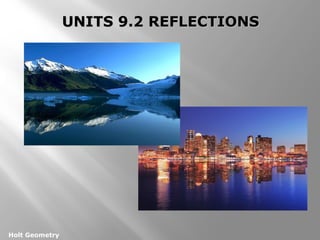
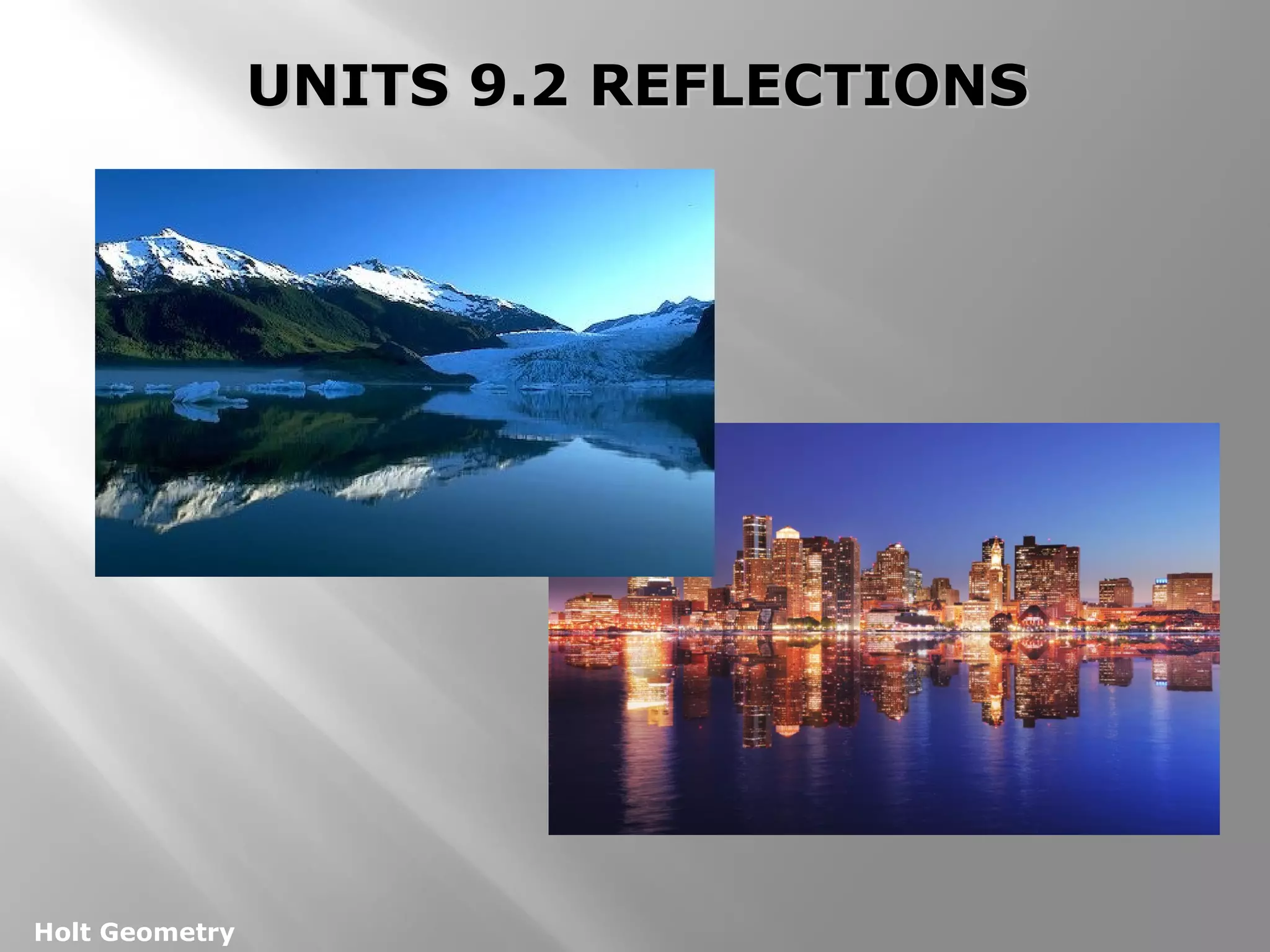
UUNNIITTSS 99..22 RREEFFLLEECCTTIIOONNSS
Warm Up 
Given that ΔABC @ ΔDEF, identify a segment or 
angle congruent to each of the following. 
1. 2. 
3. 4. 
5. 6.
Objective 
Identify and draw reflections.
isometry 
Vocabulary
An isometry is a transformation that does not 
change the shape or size of a figure. Reflections, 
translations, and rotations are all isometries. 
Isometries are also called congruence 
transformations or rigid motions. 
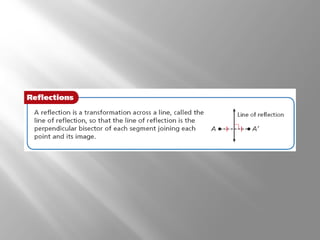
Recall that a reflection is a transformation that 
moves a figure (the preimage) by flipping it across 
a line. The reflected figure is called the image. A 
reflection is an isometry, so the image is always 
congruent to the preimage.
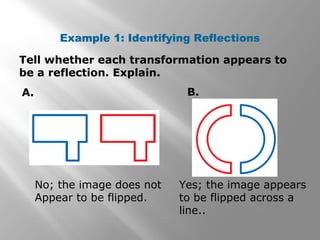
Example 1: Identifying Reflections 
Tell whether each transformation appears to 
be a reflection. Explain. 
A. B. 
No; the image does not 
Appear to be flipped. 
Yes; the image appears 
to be flipped across a 
line..
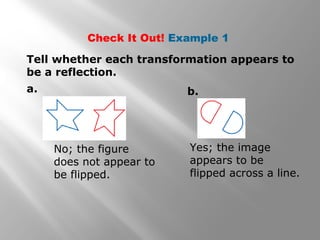
Check It Out! Example 1 
Tell whether each transformation appears to 
be a reflection. 
a. b. 
No; the figure 
does not appear to 
be flipped. 
Yes; the image 
appears to be 
flipped across a line.
Draw a segment from each vertex of the preimage 
to the corresponding vertex of the image. Your 
construction should show that the line of reflection 
is the perpendicular bisector of every segment 
connecting a point and its image.
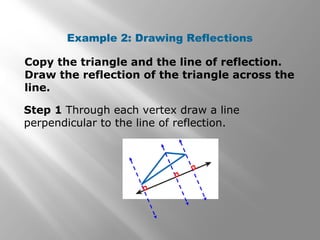
Example 2: Drawing Reflections 
Copy the triangle and the line of reflection. 
Draw the reflection of the triangle across the 
line. 
Step 1 Through each vertex draw a line 
perpendicular to the line of reflection.
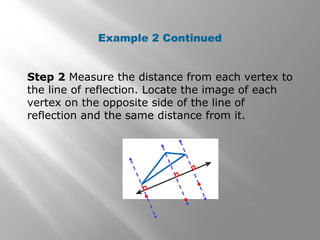
Example 2 Continued 
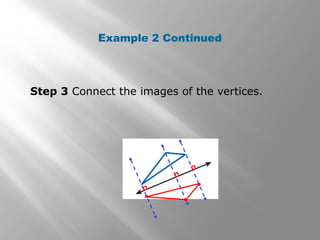
Step 2 Measure the distance from each vertex to 
the line of reflection. Locate the image of each 
vertex on the opposite side of the line of 
reflection and the same distance from it.
Example 2 Continued 
Step 3 Connect the images of the vertices.
Check It Out! Example 2 
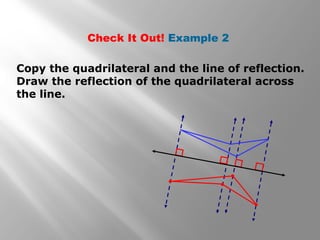
Copy the quadrilateral and the line of reflection. 
Draw the reflection of the quadrilateral across 
the line.
Example 3: Problem-Solving Application 
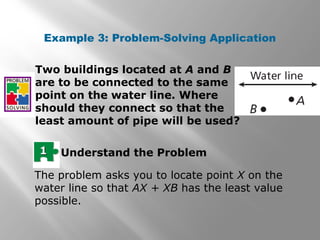
Two buildings located at A and B 
are to be connected to the same 
point on the water line. Where 
should they connect so that the 
least amount of pipe will be used? 
11 Understand the Problem 
The problem asks you to locate point X on the 
water line so that AX + XB has the least value 
possible.
Example 3 Continued 
22 Make a Plan 
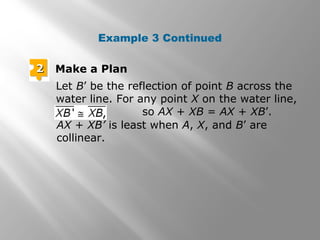
Let B’ be the reflection of point B across the 
water line. For any point X on the water line, 
so AX + XB = AX + XB’. 
AX + XB’ is least when A, X, and B’ are 
collinear.
Example 3 Continued 
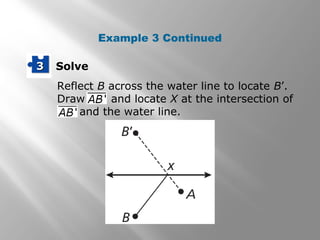
33 Solve 
Reflect B across the water line to locate B’. 
Draw and locate X at the intersection of 
and the water line.
Example 3 Continued 
44 Look Back 
To verify your answer, choose several 
possible locations for X and measure the 
total length of pipe for each location.
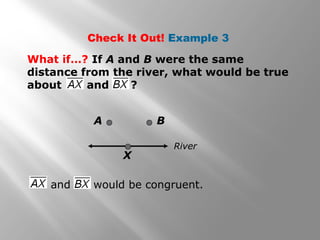
Check It Out! Example 3 
What if…? If A and B were the same 
distance from the river, what would be true 
about and ? 
A B 
River 
X 
and would be congruent.
Example 4A: Drawing Reflections in the Coordinate 
Plane 
Reflect the figure with the given vertices 
across the given line. 
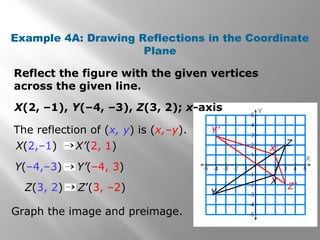
X(2, –1), Y(–4, –3), Z(3, 2); x-axis 
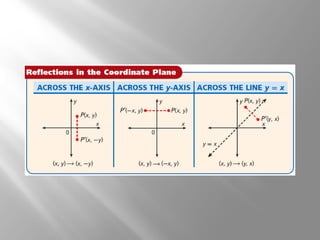
The reflection of (x, y) is (x,–y). 
X(2,–1) X’(2, 1) 
Y(–4,–3) Y’(–4, 3) 
Z(3, 2) Z’(3, –2) 
Graph the image and preimage. 
Y 
X’ Z 
X 
Y’ 
Z’
Example 4B: Drawing Reflections in the Coordinate 
Plane 
Reflect the figure with the given vertices 
across the given line. 
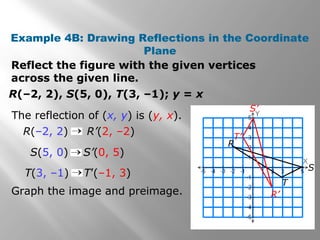
R(–2, 2), S(5, 0), T(3, –1); y = x 
The reflection of (x, y) is (y, x). 
R(–2, 2) R’(2, –2) 
S(5, 0) S’(0, 5) 
T(3, –1) T’(–1, 3) 
Graph the image and preimage. 
S 
R 
T 
S’ 
R’ 
T’
Check It Out! Example 4 
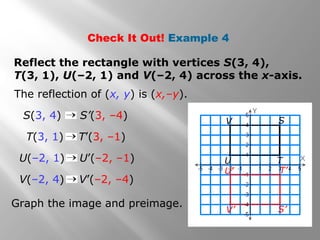
Reflect the rectangle with vertices S(3, 4), 
T(3, 1), U(–2, 1) and V(–2, 4) across the x-axis. 
The reflection of (x, y) is (x,–y). 
S(3, 4) S’(3, –4) 
V S 
T(3, 1) T’(3, –1) 
U(–2, 1) U’(–2, –1) 
U T 
U’ T’ 
V(–2, 4) V’(–2, –4) 
Graph the image and preimage. 
V’ S’
Lesson Quiz: Part I 
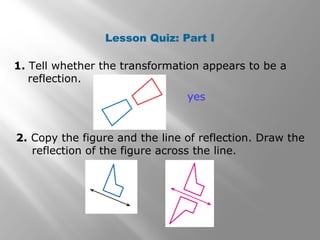
1. Tell whether the transformation appears to be a 
reflection. 
yes 
2. Copy the figure and the line of reflection. Draw the 
reflection of the figure across the line.
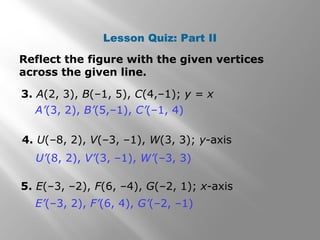
Lesson Quiz: Part II 
Reflect the figure with the given vertices 
across the given line. 
3. A(2, 3), B(–1, 5), C(4,–1); y = x 
A’(3, 2), B’(5,–1), C’(–1, 4) 
4. U(–8, 2), V(–3, –1), W(3, 3); y-axis 
U’(8, 2), V’(3, –1), W’(–3, 3) 
5. E(–3, –2), F(6, –4), G(–2, 1); x-axis 
E’(–3, 2), F’(6, 4), G’(–2, –1)
All rights belong to their 
respective owners. 
Copyright Disclaimer Under 
Section 107 of the 
Copyright Act 1976, 
allowance is made for "fair 
use" for purposes such as 
criticism, comment, news 
reporting, TEACHING, 
scholarship, and research. 
Fair use is a use permitted 
by copyright statute that 
might otherwise be 
infringing. 
Non-profit, EDUCATIONAL 
or personal use tips the 
balance in favor of fair use.

Geometry unit 9.2

  • 1.
    Holt Geometry UUNNIITTSS99..22 RREEFFLLEECCTTIIOONNSS
  • 2.
    Warm Up Giventhat ΔABC @ ΔDEF, identify a segment or angle congruent to each of the following. 1. 2. 3. 4. 5. 6.
  • 3.
    Objective Identify anddraw reflections.
  • 4.
  • 5.
    An isometry isa transformation that does not change the shape or size of a figure. Reflections, translations, and rotations are all isometries. Isometries are also called congruence transformations or rigid motions. Recall that a reflection is a transformation that moves a figure (the preimage) by flipping it across a line. The reflected figure is called the image. A reflection is an isometry, so the image is always congruent to the preimage.
  • 6.
    Example 1: IdentifyingReflections Tell whether each transformation appears to be a reflection. Explain. A. B. No; the image does not Appear to be flipped. Yes; the image appears to be flipped across a line..
  • 7.
    Check It Out!Example 1 Tell whether each transformation appears to be a reflection. a. b. No; the figure does not appear to be flipped. Yes; the image appears to be flipped across a line.
  • 8.
    Draw a segmentfrom each vertex of the preimage to the corresponding vertex of the image. Your construction should show that the line of reflection is the perpendicular bisector of every segment connecting a point and its image.
  • 10.
    Example 2: DrawingReflections Copy the triangle and the line of reflection. Draw the reflection of the triangle across the line. Step 1 Through each vertex draw a line perpendicular to the line of reflection.
  • 11.
    Example 2 Continued Step 2 Measure the distance from each vertex to the line of reflection. Locate the image of each vertex on the opposite side of the line of reflection and the same distance from it.
  • 12.
    Example 2 Continued Step 3 Connect the images of the vertices.
  • 13.
    Check It Out!Example 2 Copy the quadrilateral and the line of reflection. Draw the reflection of the quadrilateral across the line.
  • 14.
    Example 3: Problem-SolvingApplication Two buildings located at A and B are to be connected to the same point on the water line. Where should they connect so that the least amount of pipe will be used? 11 Understand the Problem The problem asks you to locate point X on the water line so that AX + XB has the least value possible.
  • 15.
    Example 3 Continued 22 Make a Plan Let B’ be the reflection of point B across the water line. For any point X on the water line, so AX + XB = AX + XB’. AX + XB’ is least when A, X, and B’ are collinear.
  • 16.
    Example 3 Continued 33 Solve Reflect B across the water line to locate B’. Draw and locate X at the intersection of and the water line.
  • 17.
    Example 3 Continued 44 Look Back To verify your answer, choose several possible locations for X and measure the total length of pipe for each location.
  • 18.
    Check It Out!Example 3 What if…? If A and B were the same distance from the river, what would be true about and ? A B River X and would be congruent.
  • 20.
    Example 4A: DrawingReflections in the Coordinate Plane Reflect the figure with the given vertices across the given line. X(2, –1), Y(–4, –3), Z(3, 2); x-axis The reflection of (x, y) is (x,–y). X(2,–1) X’(2, 1) Y(–4,–3) Y’(–4, 3) Z(3, 2) Z’(3, –2) Graph the image and preimage. Y X’ Z X Y’ Z’
  • 21.
    Example 4B: DrawingReflections in the Coordinate Plane Reflect the figure with the given vertices across the given line. R(–2, 2), S(5, 0), T(3, –1); y = x The reflection of (x, y) is (y, x). R(–2, 2) R’(2, –2) S(5, 0) S’(0, 5) T(3, –1) T’(–1, 3) Graph the image and preimage. S R T S’ R’ T’
  • 22.
    Check It Out!Example 4 Reflect the rectangle with vertices S(3, 4), T(3, 1), U(–2, 1) and V(–2, 4) across the x-axis. The reflection of (x, y) is (x,–y). S(3, 4) S’(3, –4) V S T(3, 1) T’(3, –1) U(–2, 1) U’(–2, –1) U T U’ T’ V(–2, 4) V’(–2, –4) Graph the image and preimage. V’ S’
  • 23.
    Lesson Quiz: PartI 1. Tell whether the transformation appears to be a reflection. yes 2. Copy the figure and the line of reflection. Draw the reflection of the figure across the line.
  • 24.
    Lesson Quiz: PartII Reflect the figure with the given vertices across the given line. 3. A(2, 3), B(–1, 5), C(4,–1); y = x A’(3, 2), B’(5,–1), C’(–1, 4) 4. U(–8, 2), V(–3, –1), W(3, 3); y-axis U’(8, 2), V’(3, –1), W’(–3, 3) 5. E(–3, –2), F(6, –4), G(–2, 1); x-axis E’(–3, 2), F’(6, 4), G’(–2, –1)
  • 25.
    All rights belongto their respective owners. Copyright Disclaimer Under Section 107 of the Copyright Act 1976, allowance is made for "fair use" for purposes such as criticism, comment, news reporting, TEACHING, scholarship, and research. Fair use is a use permitted by copyright statute that might otherwise be infringing. Non-profit, EDUCATIONAL or personal use tips the balance in favor of fair use.