6.7 Similarity Transformations and Coordinate Geometry

6.7

Bell Thinger
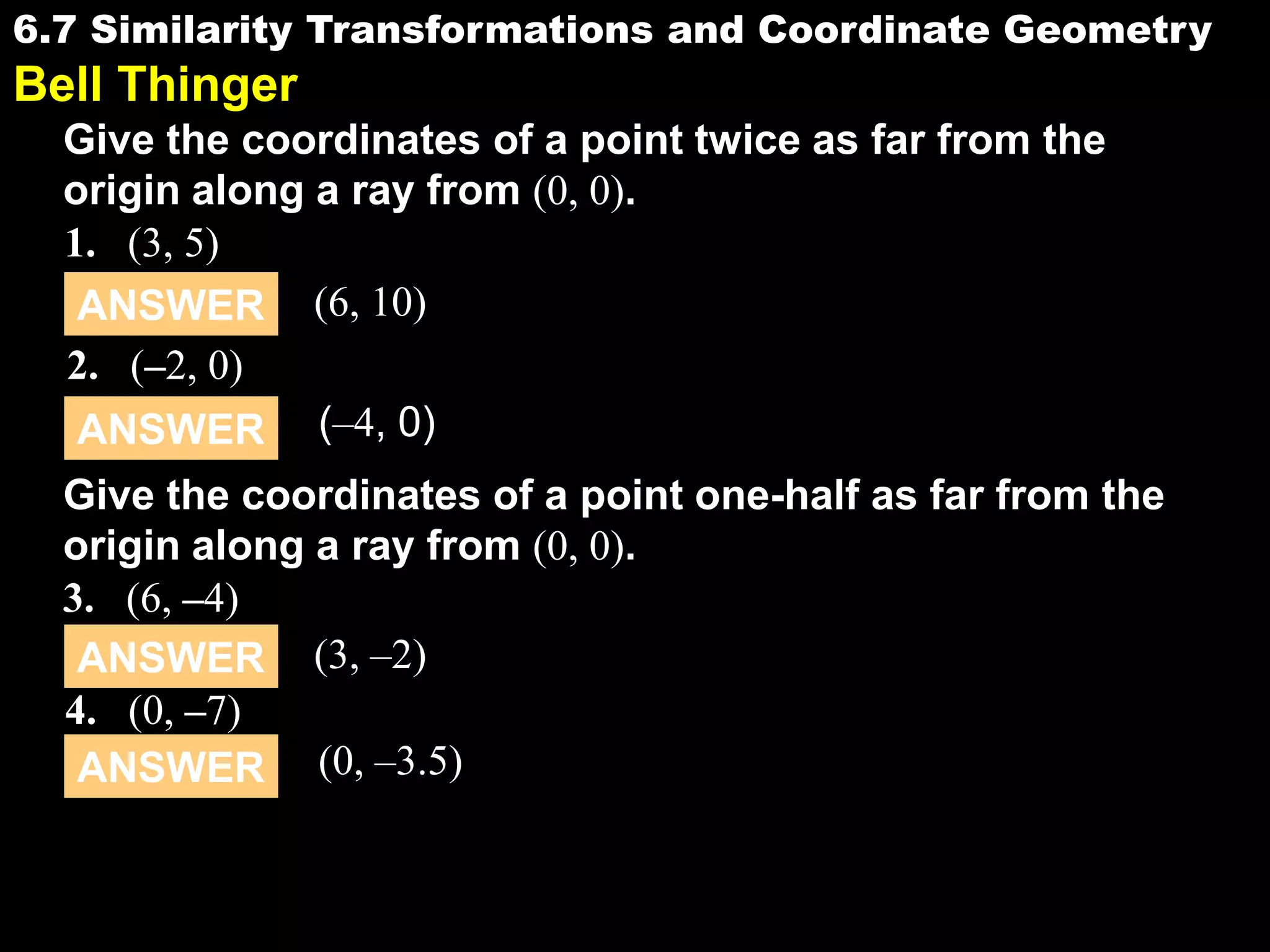
Give the coordinates of a point twice as far from the
origin along a ray from (0, 0).
1. (3, 5)
ANSWER (6, 10)
2. (–2, 0)
ANSWER (–4, 0)

Give the coordinates of a point one-half as far from the
origin along a ray from (0, 0).
3. (6, –4)
ANSWER (3, –2)
4. (0, –7)
ANSWER (0, –3.5)
6.7
Example 1
6.7
Draw a dilation of quadrilateral ABCD with vertices
A(2, 1), B(4, 1), C(4, – 1), and D(1, – 1). Use a scale
factor of 2.
SOLUTION
First draw ABCD. Find the dilation of each vertex by
multiplying its coordinates by 2. Then draw the dilation.

(x, y)

(2x, 2y)

A(2, 1)

L(4, 2)

B(4, 1)

M(8, 2)

C(4, –1)

N(8, –2)

D(1, –1)

P(2, –2)
Example 2
6.7
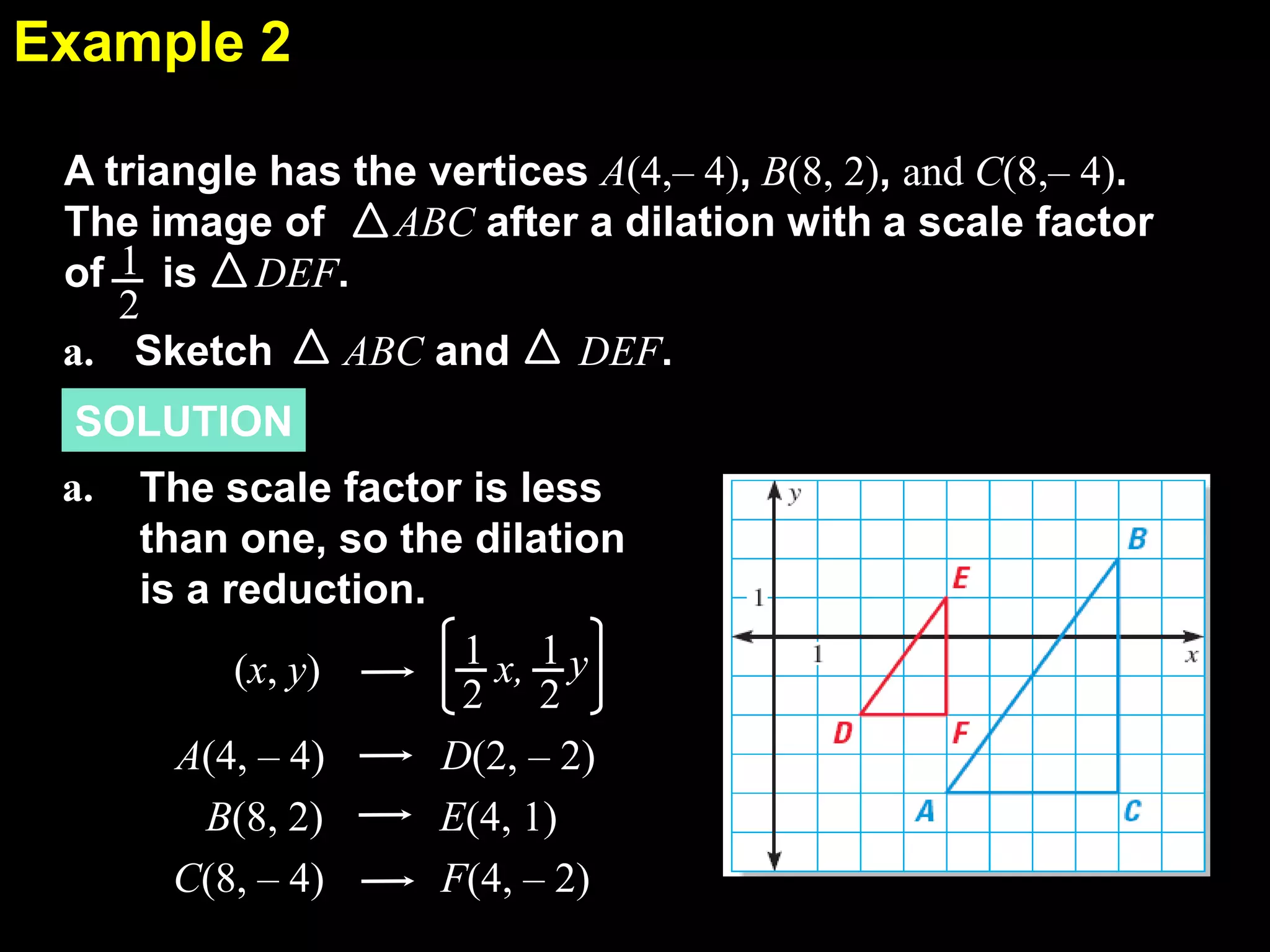
A triangle has the vertices A(4,– 4), B(8, 2), and C(8,– 4).
The image of
ABC after a dilation with a scale factor
of 1 is DEF.
2
ABC and
DEF.
a. Sketch
SOLUTION
a.

The scale factor is less
than one, so the dilation
is a reduction.
1 x, 1 y
(x, y)
2 2
A(4, – 4)
D(2, – 2)
B(8, 2)
E(4, 1)
C(8, – 4)
F(4, – 2)
Example 2
6.7
A triangle has the vertices A(4,– 4), B(8, 2), and C(8,– 4).
The image of
ABC after a dilation with a scale factor
of 1 is DEF.
2
b. Verify that ABC and
DEF are similar.
SOLUTION
b.

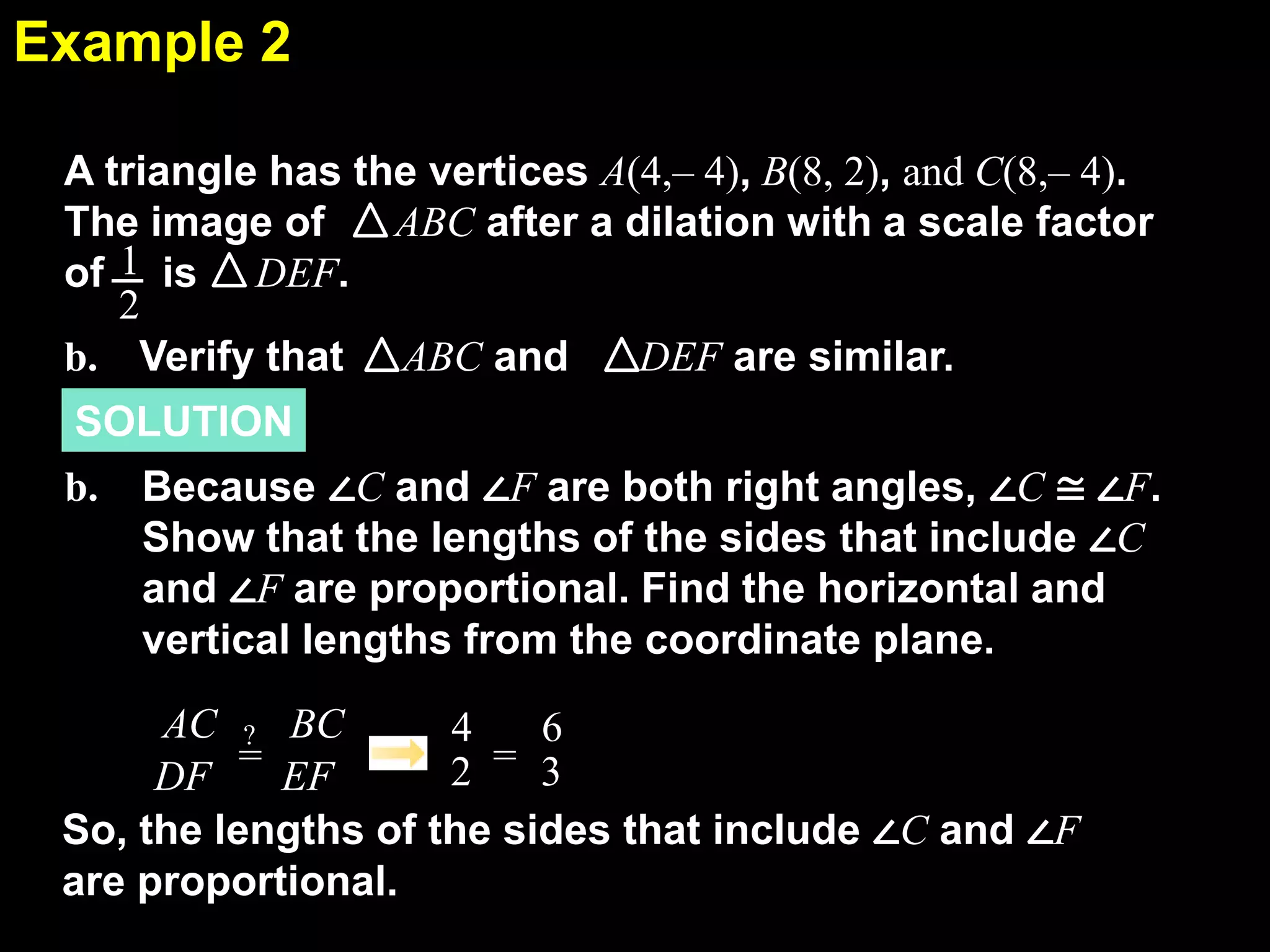
Because ∠C and ∠F are both right angles, ∠C ≅ ∠F.
Show that the lengths of the sides that include ∠C
and ∠F are proportional. Find the horizontal and
vertical lengths from the coordinate plane.

AC ? BC
4
6
2 = 3
DF = EF
So, the lengths of the sides that include ∠C and ∠F
are proportional.
Guided Practice
6.7
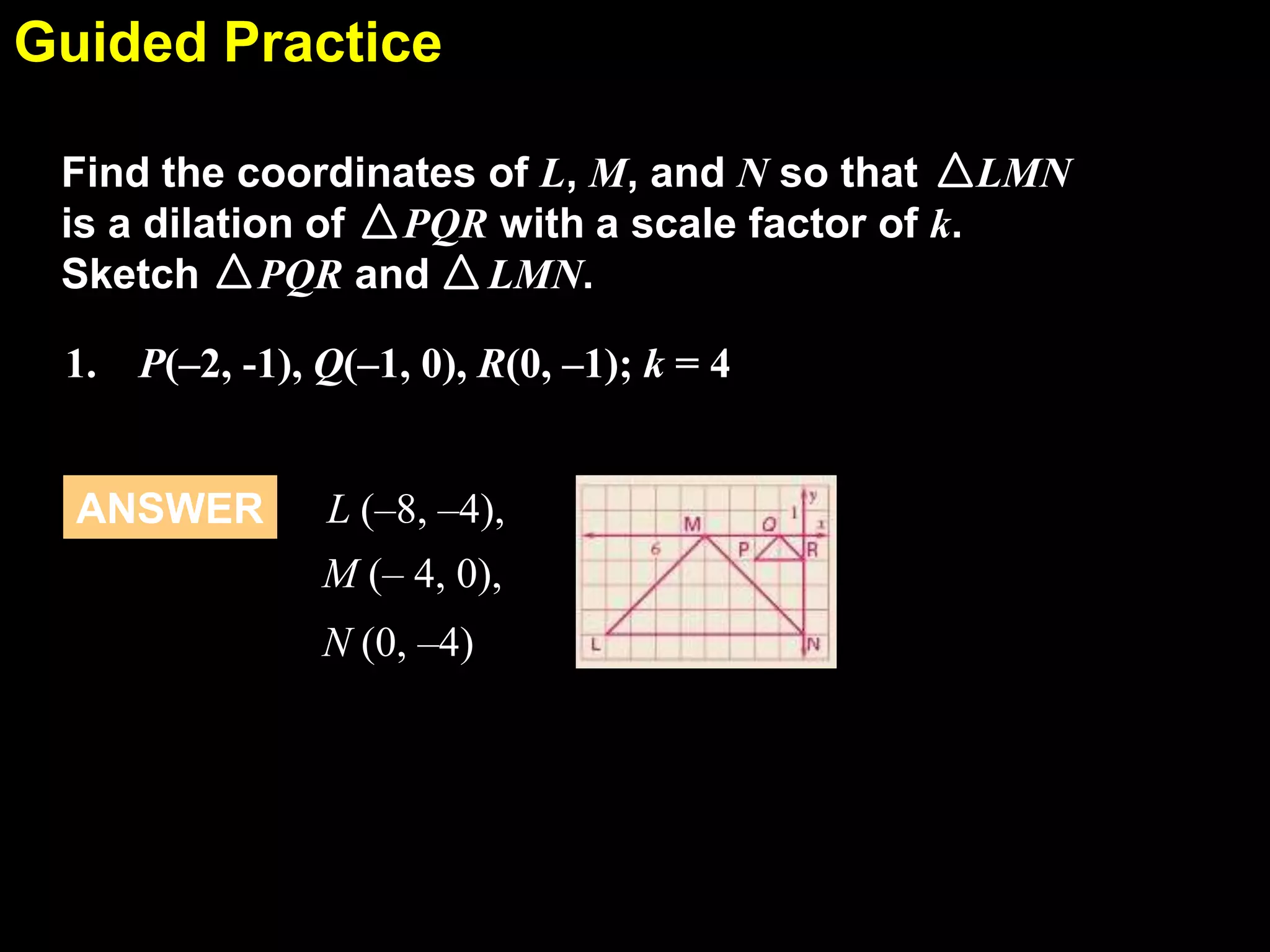
Find the coordinates of L, M, and N so that LMN
is a dilation of PQR with a scale factor of k.
Sketch PQR and LMN.

1. P(–2, -1), Q(–1, 0), R(0, –1); k = 4

ANSWER

L (–8, –4),
M (– 4, 0),
N (0, –4)
Guided Practice
6.7
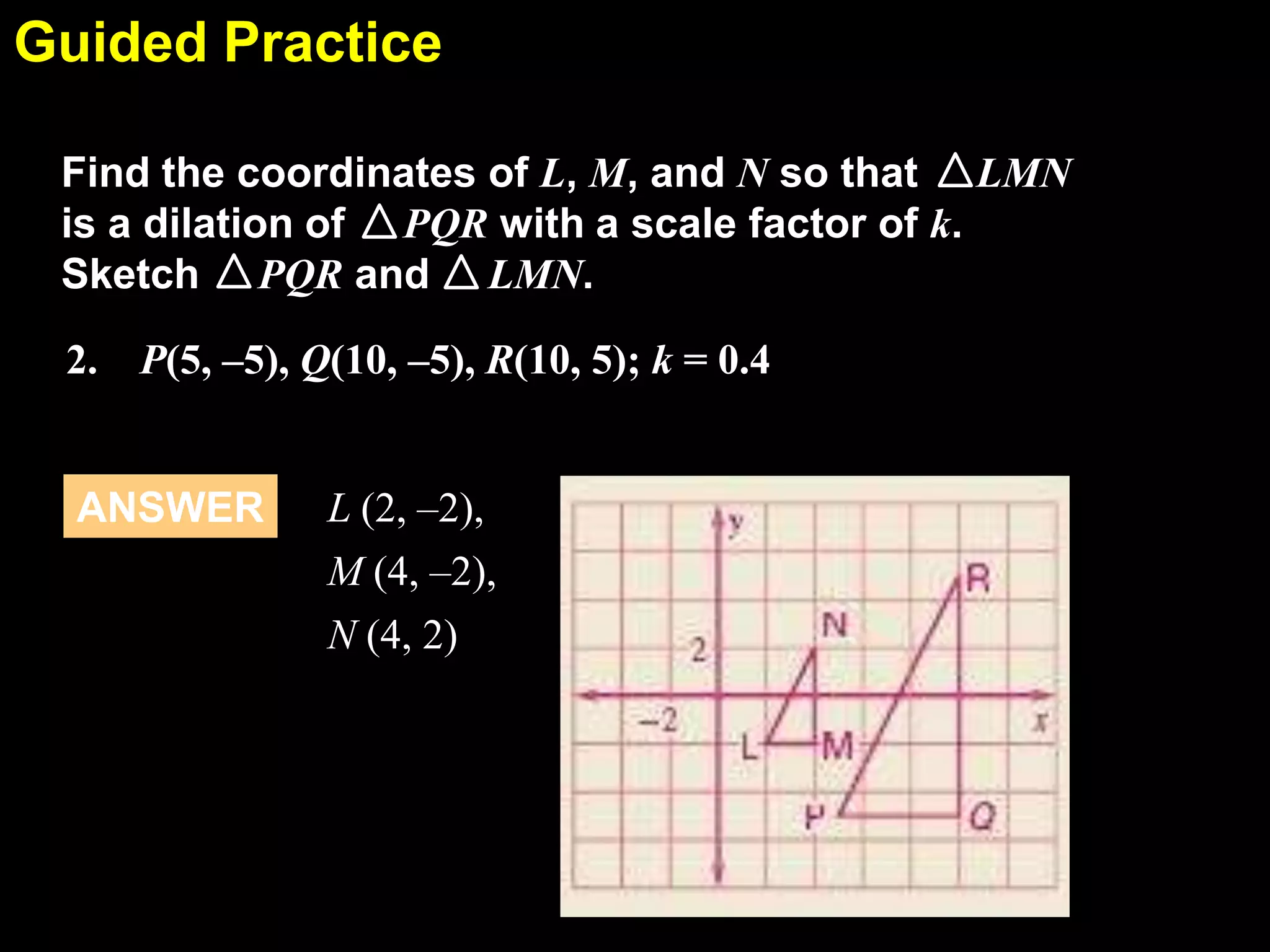
Find the coordinates of L, M, and N so that LMN
is a dilation of PQR with a scale factor of k.
Sketch PQR and LMN.
2. P(5, –5), Q(10, –5), R(10, 5); k = 0.4

ANSWER

L (2, –2),
M (4, –2),
N (4, 2)
Example 3
6.7
Photo Stickers You are making your own photo
stickers. Your photo is 4 inches by 4 inches. The
image on the stickers is 1.1 inches by 1.1 inches.
What is the scale factor of the reduction?
SOLUTION
The scale factor is the ratio of a side length of the
sticker image to a side length of the original photo, or
11
1.1 in.
. In simplest form, the scale factor is
.
40
4 in.
Example 4
6.7

SOLUTION
Determine if EFGH is a dilation of PQRS by checking
whether the same scale factor can be used to obtain
E, F, and G from P, Q, and R.
Example 4
6.7
(x, y)

(kx, ky)

P(3, 0)

E(9, 0)

k=3

Q(1, 1)

F(3, 3)

k=3

R(0, 2)

G(0, 6)

k=3

Because k is the same in each case, the image is a
dilation with a scale factor of 3. So, you can use the
scale factor to find the image H of point S.
S(4, 5)
H(3 . 4, 3 . 5) = H(12, 15)
ANSWER The correct answer is C.

CHECK: Draw rays from the origin through each point
and its image.
Guided Practice
6.7
3.

Suppose a figure containing the origin is dilated.
Explain why the corresponding point in the
image of the figure is also the origin.

ANSWER
A dilation with respect to the origin and scale
factor k can be described as (x, y)
(kx ,ky). If
(x, y) = (0, 0) then (kx, ky) = (k . 0, k . 0) = (0, 0).
Exit Slip
6.7
1.

Draw a dilation with scale factor 2 of ABC with
vertices A(1, 0), B(0, 3) and C(3, 2). Label the image
DEF.

ANSWER
Exit Slip
6.7
2.

ABC has vertices A(0, 0), B(0, 8) and C(6, 0). Draw
a dilation of ABC using a scale factor of 1 . Label
2
the image DEF.

ANSWER
Exit Slip
6.7
PS
3. In the diagram, MR =
. find MN and MR.
SN
RN

ANSWER

48; 30
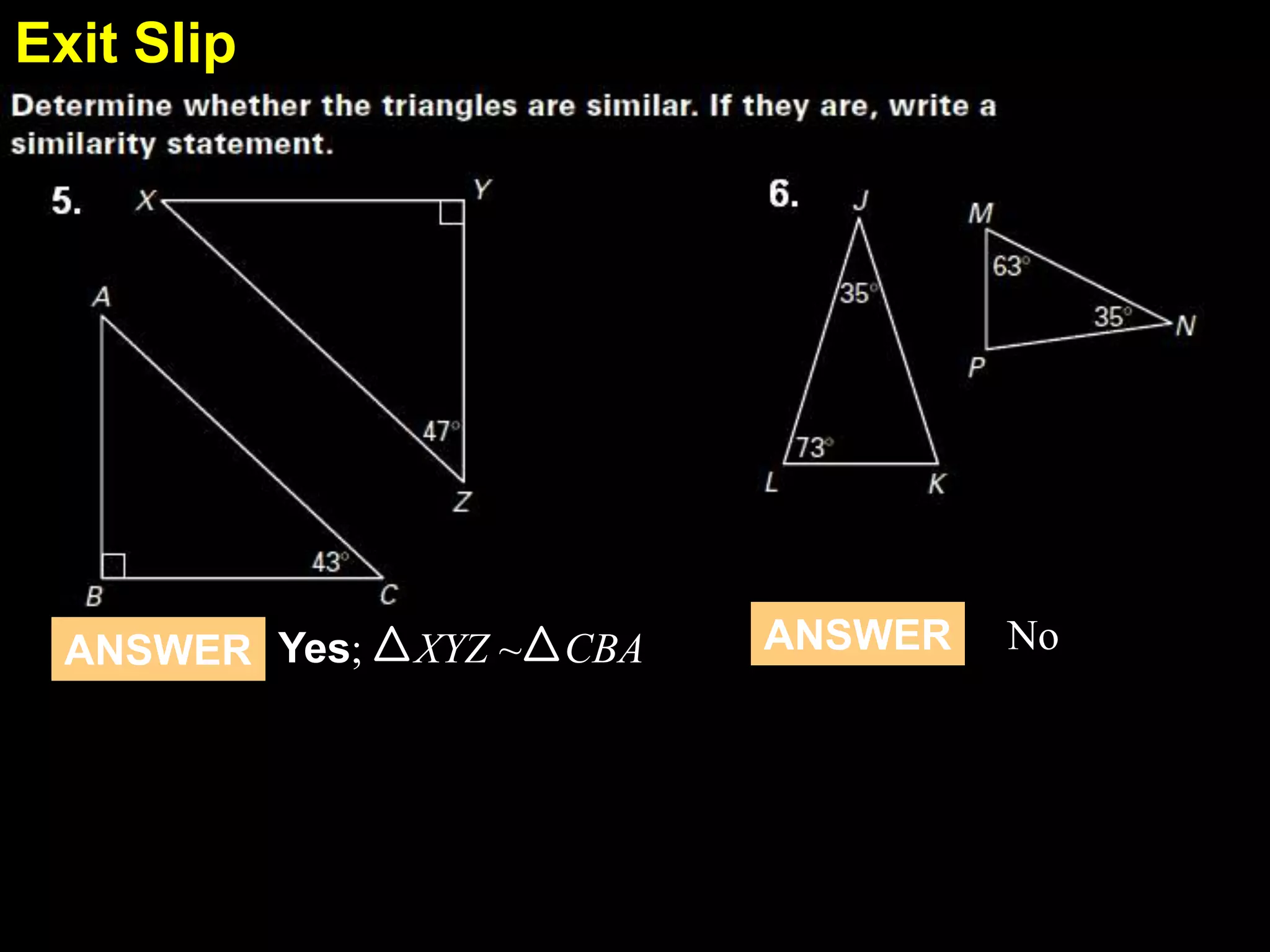
Exit Slip
6.7

ANSWER Yes;

XYZ ~

CBA

ANSWER

No
6.7

Homework
Pg 428-431
#6, 11, 16, 19, 25

6.7 similarity transformations and coordinate geometry

  • 1.
    6.7 Similarity Transformationsand Coordinate Geometry 6.7 Bell Thinger Give the coordinates of a point twice as far from the origin along a ray from (0, 0). 1. (3, 5) ANSWER (6, 10) 2. (–2, 0) ANSWER (–4, 0) Give the coordinates of a point one-half as far from the origin along a ray from (0, 0). 3. (6, –4) ANSWER (3, –2) 4. (0, –7) ANSWER (0, –3.5)
  • 2.
  • 3.
    Example 1 6.7 Draw adilation of quadrilateral ABCD with vertices A(2, 1), B(4, 1), C(4, – 1), and D(1, – 1). Use a scale factor of 2. SOLUTION First draw ABCD. Find the dilation of each vertex by multiplying its coordinates by 2. Then draw the dilation. (x, y) (2x, 2y) A(2, 1) L(4, 2) B(4, 1) M(8, 2) C(4, –1) N(8, –2) D(1, –1) P(2, –2)
  • 4.
    Example 2 6.7 A trianglehas the vertices A(4,– 4), B(8, 2), and C(8,– 4). The image of ABC after a dilation with a scale factor of 1 is DEF. 2 ABC and DEF. a. Sketch SOLUTION a. The scale factor is less than one, so the dilation is a reduction. 1 x, 1 y (x, y) 2 2 A(4, – 4) D(2, – 2) B(8, 2) E(4, 1) C(8, – 4) F(4, – 2)
  • 5.
    Example 2 6.7 A trianglehas the vertices A(4,– 4), B(8, 2), and C(8,– 4). The image of ABC after a dilation with a scale factor of 1 is DEF. 2 b. Verify that ABC and DEF are similar. SOLUTION b. Because ∠C and ∠F are both right angles, ∠C ≅ ∠F. Show that the lengths of the sides that include ∠C and ∠F are proportional. Find the horizontal and vertical lengths from the coordinate plane. AC ? BC 4 6 2 = 3 DF = EF So, the lengths of the sides that include ∠C and ∠F are proportional.
  • 6.
    Guided Practice 6.7 Find thecoordinates of L, M, and N so that LMN is a dilation of PQR with a scale factor of k. Sketch PQR and LMN. 1. P(–2, -1), Q(–1, 0), R(0, –1); k = 4 ANSWER L (–8, –4), M (– 4, 0), N (0, –4)
  • 7.
    Guided Practice 6.7 Find thecoordinates of L, M, and N so that LMN is a dilation of PQR with a scale factor of k. Sketch PQR and LMN. 2. P(5, –5), Q(10, –5), R(10, 5); k = 0.4 ANSWER L (2, –2), M (4, –2), N (4, 2)
  • 8.
    Example 3 6.7 Photo StickersYou are making your own photo stickers. Your photo is 4 inches by 4 inches. The image on the stickers is 1.1 inches by 1.1 inches. What is the scale factor of the reduction? SOLUTION The scale factor is the ratio of a side length of the sticker image to a side length of the original photo, or 11 1.1 in. . In simplest form, the scale factor is . 40 4 in.
  • 9.
    Example 4 6.7 SOLUTION Determine ifEFGH is a dilation of PQRS by checking whether the same scale factor can be used to obtain E, F, and G from P, Q, and R.
  • 10.
    Example 4 6.7 (x, y) (kx,ky) P(3, 0) E(9, 0) k=3 Q(1, 1) F(3, 3) k=3 R(0, 2) G(0, 6) k=3 Because k is the same in each case, the image is a dilation with a scale factor of 3. So, you can use the scale factor to find the image H of point S. S(4, 5) H(3 . 4, 3 . 5) = H(12, 15) ANSWER The correct answer is C. CHECK: Draw rays from the origin through each point and its image.
  • 11.
    Guided Practice 6.7 3. Suppose afigure containing the origin is dilated. Explain why the corresponding point in the image of the figure is also the origin. ANSWER A dilation with respect to the origin and scale factor k can be described as (x, y) (kx ,ky). If (x, y) = (0, 0) then (kx, ky) = (k . 0, k . 0) = (0, 0).
  • 12.
    Exit Slip 6.7 1. Draw adilation with scale factor 2 of ABC with vertices A(1, 0), B(0, 3) and C(3, 2). Label the image DEF. ANSWER
  • 13.
    Exit Slip 6.7 2. ABC hasvertices A(0, 0), B(0, 8) and C(6, 0). Draw a dilation of ABC using a scale factor of 1 . Label 2 the image DEF. ANSWER
  • 14.
    Exit Slip 6.7 PS 3. Inthe diagram, MR = . find MN and MR. SN RN ANSWER 48; 30
  • 15.
  • 16.