Robotics Lecture 3
BY: Mahmoud Hussein
Revision Forward Kinematics Matlab
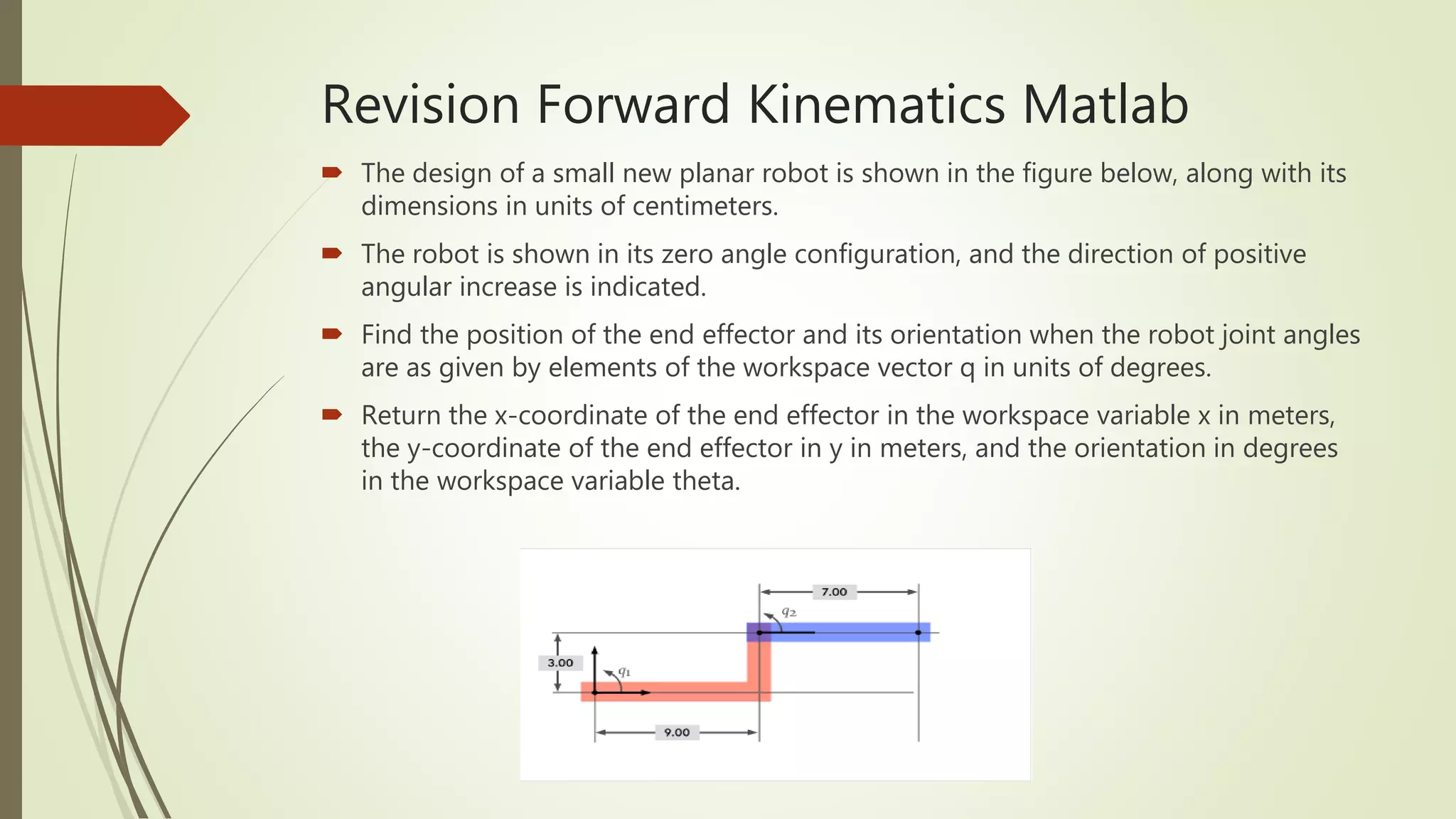
 The design of a small new planar robot is shown in the figure below, along with its
dimensions in units of centimeters.
 The robot is shown in its zero angle configuration, and the direction of positive
angular increase is indicated.
 Find the position of the end effector and its orientation when the robot joint angles
are as given by elements of the workspace vector q in units of degrees.
 Return the x-coordinate of the end effector in the workspace variable x in meters,
the y-coordinate of the end effector in y in meters, and the orientation in degrees
in the workspace variable theta.
Revision Forward Kinematics Matlab
 % DO NOT MODIFY THE FOLLOWING LINES
 q = [30 -20];
 % Find the pose of the end-effector and store in the variable T.
 T = trot2(30,'deg')*transl2(9,3)*trot2(-20,'deg')*transl2(7,0);
 % Find the x-coordinate in metres and store in the variable x.
 a=T;
 x = a(1,3)/100;
 % Find the y-coordinate in metres and store in the variable y.
 y =a(2,3)/100;
 % Find the orientation angle by examining elements of the % rotation submatrix,
element (1,1) which is equal to cos(theta).
 % Store in the variable theta.
 theta = acosd(a(1,1))
Inverse Kinematics
Inverse Kinematics
Inverse Kinematics
Inverse Kinematics
Inverse Kinematics
Inverse Kinematics
Inverse Kinematics
Inverse Kinematics
Inverse Kinematics
Inverse Kinematics
Matlab code
 syms a1 a2 a3 a4 q1 q2 q3 q4
 trchain('Rz(q1)Tz(a1)Ry(q2)Tz(a2)Ry(q3)Tz(a3)Ry(q4)Tz(a4)',[q1 q2 q3 q4])
 mdl_puma560
 T = transl(0.6, 0.1, 0) * rpy2tr(0, 180, 0, 'deg')
 q = p560.ikine6s(T)

Robotics lecture 3

  • 1.
    Robotics Lecture 3 BY:Mahmoud Hussein
  • 2.
    Revision Forward KinematicsMatlab  The design of a small new planar robot is shown in the figure below, along with its dimensions in units of centimeters.  The robot is shown in its zero angle configuration, and the direction of positive angular increase is indicated.  Find the position of the end effector and its orientation when the robot joint angles are as given by elements of the workspace vector q in units of degrees.  Return the x-coordinate of the end effector in the workspace variable x in meters, the y-coordinate of the end effector in y in meters, and the orientation in degrees in the workspace variable theta.
  • 3.
    Revision Forward KinematicsMatlab  % DO NOT MODIFY THE FOLLOWING LINES  q = [30 -20];  % Find the pose of the end-effector and store in the variable T.  T = trot2(30,'deg')*transl2(9,3)*trot2(-20,'deg')*transl2(7,0);  % Find the x-coordinate in metres and store in the variable x.  a=T;  x = a(1,3)/100;  % Find the y-coordinate in metres and store in the variable y.  y =a(2,3)/100;  % Find the orientation angle by examining elements of the % rotation submatrix, element (1,1) which is equal to cos(theta).  % Store in the variable theta.  theta = acosd(a(1,1))
  • 4.
  • 5.
  • 6.
  • 7.
  • 8.
  • 9.
  • 10.
  • 11.
  • 12.
  • 13.
  • 14.
    Matlab code  symsa1 a2 a3 a4 q1 q2 q3 q4  trchain('Rz(q1)Tz(a1)Ry(q2)Tz(a2)Ry(q3)Tz(a3)Ry(q4)Tz(a4)',[q1 q2 q3 q4])  mdl_puma560  T = transl(0.6, 0.1, 0) * rpy2tr(0, 180, 0, 'deg')  q = p560.ikine6s(T)