Unit 6
Quadrilaterals
Part 1
Parallelograms
Modified by Lisa Palen
Definition
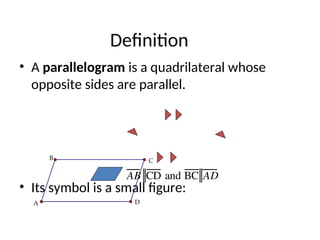
• A parallelogram is a quadrilateral whose
opposite sides are parallel.
• Its symbol is a small figure:
C
B
A D
AB CD and BC AD
Naming a Parallelogram
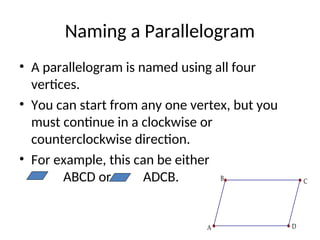
• A parallelogram is named using all four
vertices.
• You can start from any one vertex, but you
must continue in a clockwise or
counterclockwise direction.
• For example, this can be either
ABCD or ADCB. C
B
A D
Basic Properties
• There are four basic properties of all
parallelograms.
• These properties have to do with the angles,
the sides and the diagonals.
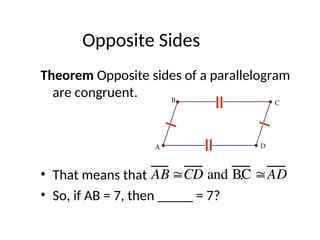
Opposite Sides
Theorem Opposite sides of a parallelogram
are congruent.
• That means that .
• So, if AB = 7, then _____ = 7?
C
B
A D
AB CD and BC AD
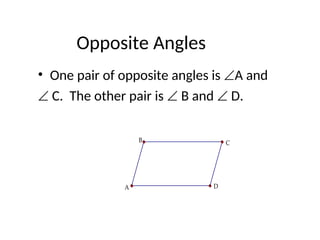
Opposite Angles
• One pair of opposite angles is A and
 C. The other pair is  B and  D.
C
B
A D
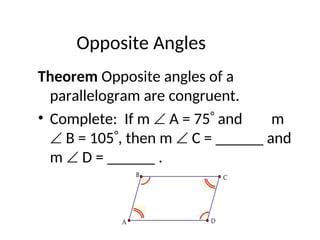
Opposite Angles
Theorem Opposite angles of a
parallelogram are congruent.
• Complete: If m  A = 75 and m
 B = 105, then m  C = ______ and
m  D = ______ .
C
B
A D
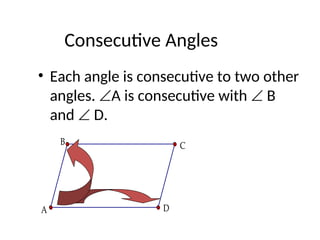
Consecutive Angles
• Each angle is consecutive to two other
angles. A is consecutive with  B
and  D.
C
B
A D
Consecutive Angles in Parallelograms
Theorem Consecutive angles in a parallelogram are
supplementary.
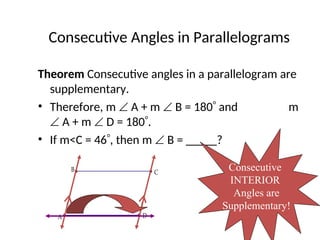
• Therefore, m  A + m  B = 180 and m
 A + m  D = 180.
• If m<C = 46, then m  B = _____?
C
B
A D
Consecutive
INTERIOR
Angles are
Supplementary!
Diagonals
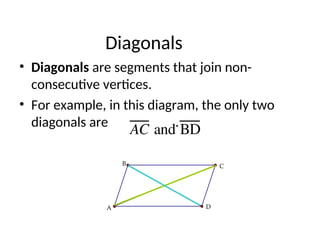
• Diagonals are segments that join non-
consecutive vertices.
• For example, in this diagram, the only two
diagonals are .
AC and BD
C
B
A D
Diagonal Property
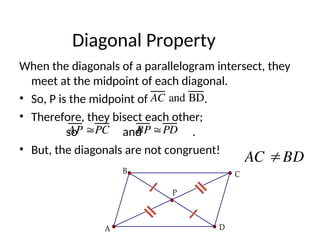
When the diagonals of a parallelogram intersect, they
meet at the midpoint of each diagonal.
• So, P is the midpoint of .
• Therefore, they bisect each other;
so and .
• But, the diagonals are not congruent!
AC and BD
AP PC BP PD
P
C
B
A D
AC BD
Diagonal Property
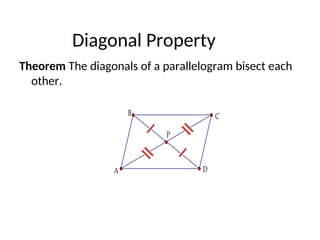
Theorem The diagonals of a parallelogram bisect each
other.
P
C
B
A D
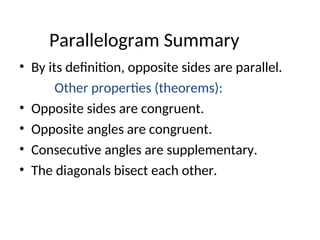
Parallelogram Summary
• By its definition, opposite sides are parallel.
Other properties (theorems):
• Opposite sides are congruent.
• Opposite angles are congruent.
• Consecutive angles are supplementary.
• The diagonals bisect each other.
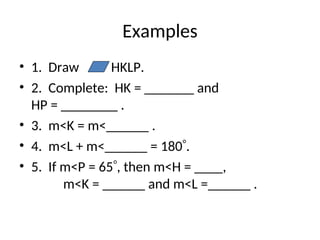
Examples
• 1. Draw HKLP.
• 2. Complete: HK = _______ and
HP = ________ .
• 3. m<K = m<______ .
• 4. m<L + m<______ = 180.
• 5. If m<P = 65, then m<H = ____,
m<K = ______ and m<L =______ .
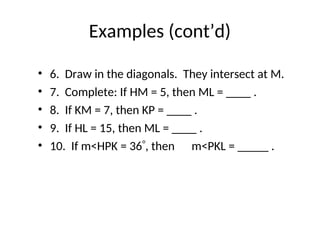
Examples (cont’d)
• 6. Draw in the diagonals. They intersect at M.
• 7. Complete: If HM = 5, then ML = ____ .
• 8. If KM = 7, then KP = ____ .
• 9. If HL = 15, then ML = ____ .
• 10. If m<HPK = 36, then m<PKL = _____ .
Part 2
Tests for
Parallelograms
Review: Properties of
Parallelograms
• Opposite sides are parallel.
• Opposite sides are congruent.
• Opposite angles are congruent.
• Consecutive angles are supplementary.
• The diagonals bisect each other.
How can you tell if a quadrilateral
is a parallelogram?
• Defn: A quadrilateral is a parallelogram iff
opposite sides are parallel.
• Property If a quadrilateral is a parallelogram,
then opposite sides are parallel.
• Test If opposite sides of a quadrilateral are
parallel, then it is a parallelogram.
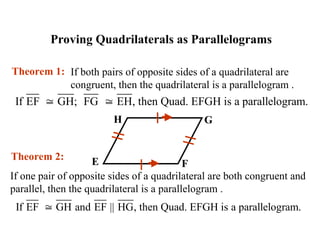
Proving Quadrilaterals as Parallelograms
If both pairs of opposite sides of a quadrilateral are
congruent, then the quadrilateral is a parallelogram .
Theorem 1:
H G
E F
If one pair of opposite sides of a quadrilateral are both congruent and
parallel, then the quadrilateral is a parallelogram .
Theorem 2:
If EF GH; FG EH, then Quad. EFGH is a parallelogram.
 
If EF GH and EF || HG, then Quad. EFGH is a parallelogram.

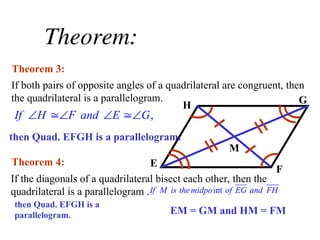
Theorem:
If both pairs of opposite angles of a quadrilateral are congruent, then
the quadrilateral is a parallelogram.
Theorem 3:
If the diagonals of a quadrilateral bisect each other, then the
quadrilateral is a parallelogram .
Theorem 4:
H G
E
F
M
,
If H F and E G
   
then Quad. EFGH is a parallelogram.
int
If M is themidpo of EG and FH
then Quad. EFGH is a
parallelogram. EM = GM and HM = FM
5 ways to prove that a quadrilateral is a parallelogram.
1. Show that both pairs of opposite sides are || . [definition]
2. Show that both pairs of opposite sides are  .
3. Show that one pair of opposite sides are both || and
 .
4. Show that both pairs of opposite angles are  .
5. Show that the diagonals bisect each other .
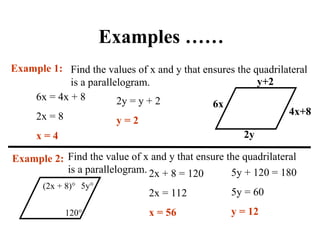
Examples ……
Find the values of x and y that ensures the quadrilateral
is a parallelogram.
Example 1:
6x
4x+8
y+2
2y
6x = 4x + 8
2x = 8
x = 4
2y = y + 2
y = 2
Example 2: Find the value of x and y that ensure the quadrilateral
is a parallelogram.
120°
5y°
(2x + 8)°
2x + 8 = 120
2x = 112
x = 56
5y + 120 = 180
5y = 60
y = 12
Lesson 6-3: Rectangles 23
Part 3
Rectangles
Lesson 6-3: Rectangles 24
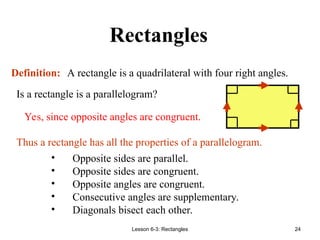
Rectangles
• Opposite sides are parallel.
• Opposite sides are congruent.
• Opposite angles are congruent.
• Consecutive angles are supplementary.
• Diagonals bisect each other.
Definition: A rectangle is a quadrilateral with four right angles.
Is a rectangle is a parallelogram?
Thus a rectangle has all the properties of a parallelogram.
Yes, since opposite angles are congruent.
Lesson 6-3: Rectangles 25
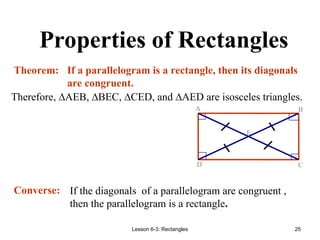
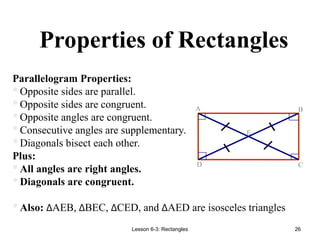
Properties of Rectangles
Therefore, ∆AEB, ∆BEC, ∆CED, and ∆AED are isosceles triangles.
If a parallelogram is a rectangle, then its diagonals
are congruent.
E
D C
B
A
Theorem:
Converse: If the diagonals of a parallelogram are congruent ,
then the parallelogram is a rectangle.
Lesson 6-3: Rectangles 26
Properties of Rectangles
E
D C
B
A
Parallelogram Properties:
Opposite sides are parallel.
Opposite sides are congruent.
Opposite angles are congruent.
Consecutive angles are supplementary.
Diagonals bisect each other.
Plus:
All angles are right angles.
Diagonals are congruent.
Also: ∆AEB, ∆BEC, ∆CED, and ∆AED are isosceles triangles
Lesson 6-3: Rectangles 27
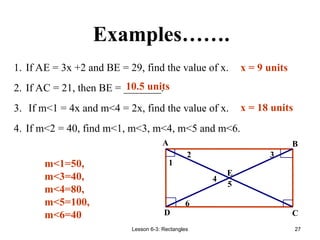
Examples…….
1. If AE = 3x +2 and BE = 29, find the value of x.
2. If AC = 21, then BE = _______.
3. If m<1 = 4x and m<4 = 2x, find the value of x.
4. If m<2 = 40, find m<1, m<3, m<4, m<5 and m<6.
m<1=50,
m<3=40,
m<4=80,
m<5=100,
m<6=40
10.5 units
x = 9 units
x = 18 units
6
5
4
3
2
1
E
D C
B
A
Lesson 6-4: Rhombus & Square 28
Part 4
Rhombi
and
Squares
Lesson 6-4: Rhombus & Square 29
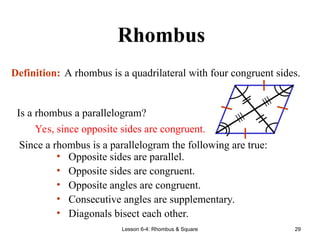
Rhombus
Definition: A rhombus is a quadrilateral with four congruent sides.
Since a rhombus is a parallelogram the following are true:
• Opposite sides are parallel.
• Opposite sides are congruent.
• Opposite angles are congruent.
• Consecutive angles are supplementary.
• Diagonals bisect each other.
≡
≡
Is a rhombus a parallelogram?
Yes, since opposite sides are congruent.
Lesson 6-4: Rhombus & Square 30
Rhombus
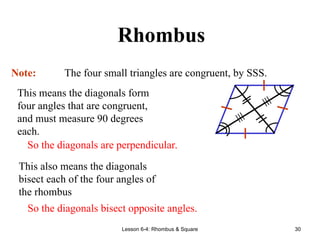
Note: The four small triangles are congruent, by SSS.
≡
≡
This means the diagonals form
four angles that are congruent,
and must measure 90 degrees
each.
So the diagonals are perpendicular.
This also means the diagonals
bisect each of the four angles of
the rhombus
So the diagonals bisect opposite angles.
Lesson 6-4: Rhombus & Square 31
Properties of a Rhombus
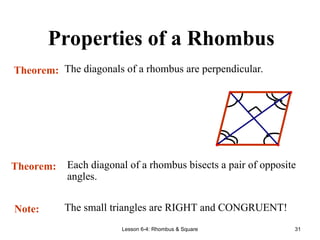
Theorem: The diagonals of a rhombus are perpendicular.
Theorem: Each diagonal of a rhombus bisects a pair of opposite
angles.
Note: The small triangles are RIGHT and CONGRUENT!
Lesson 6-4: Rhombus & Square 32
Properties of a Rhombus
.
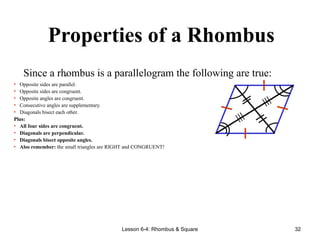
Since a rhombus is a parallelogram the following are true:
• Opposite sides are parallel.
• Opposite sides are congruent.
• Opposite angles are congruent.
• Consecutive angles are supplementary.
• Diagonals bisect each other.
Plus:
• All four sides are congruent.
• Diagonals are perpendicular.
• Diagonals bisect opposite angles.
• Also remember: the small triangles are RIGHT and CONGRUENT!
≡
≡
Lesson 6-4: Rhombus & Square 33
Rhombus Examples .....
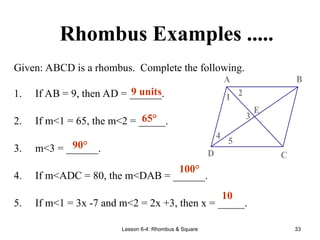
Given: ABCD is a rhombus. Complete the following.
1. If AB = 9, then AD = ______.
2. If m<1 = 65, the m<2 = _____.
3. m<3 = ______.
4. If m<ADC = 80, the m<DAB = ______.
5. If m<1 = 3x -7 and m<2 = 2x +3, then x = _____.
5
4
3
2
1
E
D C
B
A
9 units
65°
90°
100°
10
34
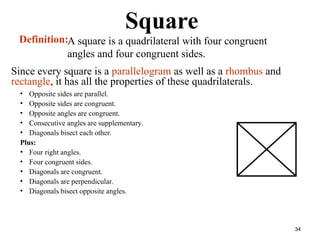
Square
• Opposite sides are parallel.
• Opposite sides are congruent.
• Opposite angles are congruent.
• Consecutive angles are supplementary.
• Diagonals bisect each other.
Plus:
• Four right angles.
• Four congruent sides.
• Diagonals are congruent.
• Diagonals are perpendicular.
• Diagonals bisect opposite angles.
Definition:A square is a quadrilateral with four congruent
angles and four congruent sides.
Since every square is a parallelogram as well as a rhombus and
rectangle, it has all the properties of these quadrilaterals.
Lesson 6-4: Rhombus & Square 35
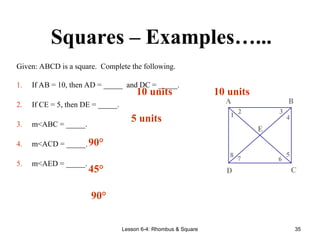
Squares – Examples…...
Given: ABCD is a square. Complete the following.
1. If AB = 10, then AD = _____ and DC = _____.
2. If CE = 5, then DE = _____.
3. m<ABC = _____.
4. m<ACD = _____.
5. m<AED = _____.
8 7 6
5
4
3
2
1
E
D C
B
A
10 units 10 units
5 units
90°
45°
90°
Lesson 6-5: Trapezoid & Kites 36
Part 5
Trapezoids
and Kites
Lesson 6-5: Trapezoid & Kites 37
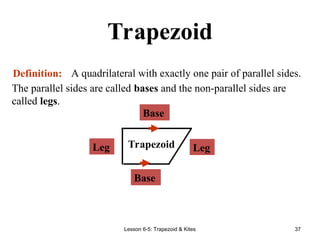
Trapezoid
A quadrilateral with exactly one pair of parallel sides.
Definition:
Base
Leg Trapezoid
The parallel sides are called bases and the non-parallel sides are
called legs.
Leg
Base
Lesson 6-5: Trapezoid & Kites 38
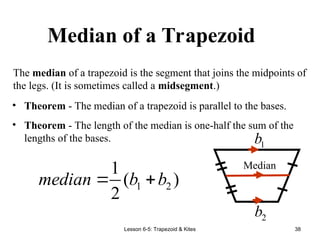
The median of a trapezoid is the segment that joins the midpoints of
the legs. (It is sometimes called a midsegment.)
• Theorem - The median of a trapezoid is parallel to the bases.
• Theorem - The length of the median is one-half the sum of the
lengths of the bases.
Median
1
b
2
b
1 2
1
( )
2
median b b
 
Median of a Trapezoid
Lesson 6-5: Trapezoid & Kites 39
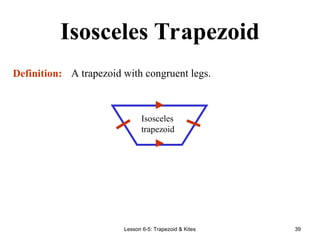
Isosceles Trapezoid
A trapezoid with congruent legs.
Definition:
Isosceles
trapezoid
Lesson 6-5: Trapezoid & Kites 40
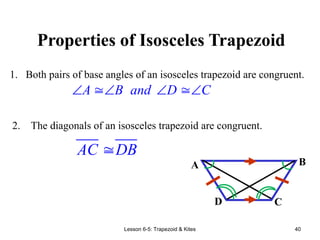
Properties of Isosceles Trapezoid
A B and D C
   
2. The diagonals of an isosceles trapezoid are congruent.
1. Both pairs of base angles of an isosceles trapezoid are congruent.
A B
C
D

AC DB
Lesson 6-5: Trapezoid & Kites 41
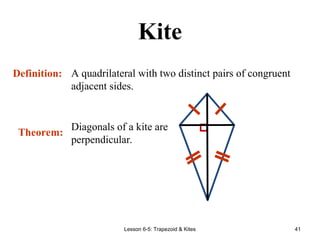
Kite
A quadrilateral with two distinct pairs of congruent
adjacent sides.
Definition:
Theorem:
Diagonals of a kite are
perpendicular.
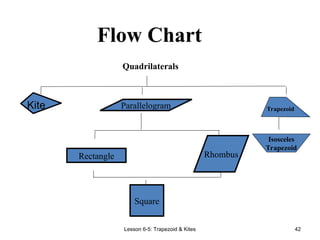
Lesson 6-5: Trapezoid & Kites 42
Isosceles
Trapezoid
Quadrilaterals
Rectangle
Parallelogram
Rhombus
Square
Flow Chart
Trapezoid
Kite

This ppt explains how to use quadilaters

  • 1.
  • 2.
    Definition • A parallelogramis a quadrilateral whose opposite sides are parallel. • Its symbol is a small figure: C B A D AB CD and BC AD
  • 3.
    Naming a Parallelogram •A parallelogram is named using all four vertices. • You can start from any one vertex, but you must continue in a clockwise or counterclockwise direction. • For example, this can be either ABCD or ADCB. C B A D
  • 4.
    Basic Properties • Thereare four basic properties of all parallelograms. • These properties have to do with the angles, the sides and the diagonals.
  • 5.
    Opposite Sides Theorem Oppositesides of a parallelogram are congruent. • That means that . • So, if AB = 7, then _____ = 7? C B A D AB CD and BC AD
  • 6.
    Opposite Angles • Onepair of opposite angles is A and  C. The other pair is  B and  D. C B A D
  • 7.
    Opposite Angles Theorem Oppositeangles of a parallelogram are congruent. • Complete: If m  A = 75 and m  B = 105, then m  C = ______ and m  D = ______ . C B A D
  • 8.
    Consecutive Angles • Eachangle is consecutive to two other angles. A is consecutive with  B and  D. C B A D
  • 9.
    Consecutive Angles inParallelograms Theorem Consecutive angles in a parallelogram are supplementary. • Therefore, m  A + m  B = 180 and m  A + m  D = 180. • If m<C = 46, then m  B = _____? C B A D Consecutive INTERIOR Angles are Supplementary!
  • 10.
    Diagonals • Diagonals aresegments that join non- consecutive vertices. • For example, in this diagram, the only two diagonals are . AC and BD C B A D
  • 11.
    Diagonal Property When thediagonals of a parallelogram intersect, they meet at the midpoint of each diagonal. • So, P is the midpoint of . • Therefore, they bisect each other; so and . • But, the diagonals are not congruent! AC and BD AP PC BP PD P C B A D AC BD
  • 12.
    Diagonal Property Theorem Thediagonals of a parallelogram bisect each other. P C B A D
  • 13.
    Parallelogram Summary • Byits definition, opposite sides are parallel. Other properties (theorems): • Opposite sides are congruent. • Opposite angles are congruent. • Consecutive angles are supplementary. • The diagonals bisect each other.
  • 14.
    Examples • 1. DrawHKLP. • 2. Complete: HK = _______ and HP = ________ . • 3. m<K = m<______ . • 4. m<L + m<______ = 180. • 5. If m<P = 65, then m<H = ____, m<K = ______ and m<L =______ .
  • 15.
    Examples (cont’d) • 6.Draw in the diagonals. They intersect at M. • 7. Complete: If HM = 5, then ML = ____ . • 8. If KM = 7, then KP = ____ . • 9. If HL = 15, then ML = ____ . • 10. If m<HPK = 36, then m<PKL = _____ .
  • 16.
  • 17.
    Review: Properties of Parallelograms •Opposite sides are parallel. • Opposite sides are congruent. • Opposite angles are congruent. • Consecutive angles are supplementary. • The diagonals bisect each other.
  • 18.
    How can youtell if a quadrilateral is a parallelogram? • Defn: A quadrilateral is a parallelogram iff opposite sides are parallel. • Property If a quadrilateral is a parallelogram, then opposite sides are parallel. • Test If opposite sides of a quadrilateral are parallel, then it is a parallelogram.
  • 19.
    Proving Quadrilaterals asParallelograms If both pairs of opposite sides of a quadrilateral are congruent, then the quadrilateral is a parallelogram . Theorem 1: H G E F If one pair of opposite sides of a quadrilateral are both congruent and parallel, then the quadrilateral is a parallelogram . Theorem 2: If EF GH; FG EH, then Quad. EFGH is a parallelogram.   If EF GH and EF || HG, then Quad. EFGH is a parallelogram. 
  • 20.
    Theorem: If both pairsof opposite angles of a quadrilateral are congruent, then the quadrilateral is a parallelogram. Theorem 3: If the diagonals of a quadrilateral bisect each other, then the quadrilateral is a parallelogram . Theorem 4: H G E F M , If H F and E G     then Quad. EFGH is a parallelogram. int If M is themidpo of EG and FH then Quad. EFGH is a parallelogram. EM = GM and HM = FM
  • 21.
    5 ways toprove that a quadrilateral is a parallelogram. 1. Show that both pairs of opposite sides are || . [definition] 2. Show that both pairs of opposite sides are  . 3. Show that one pair of opposite sides are both || and  . 4. Show that both pairs of opposite angles are  . 5. Show that the diagonals bisect each other .
  • 22.
    Examples …… Find thevalues of x and y that ensures the quadrilateral is a parallelogram. Example 1: 6x 4x+8 y+2 2y 6x = 4x + 8 2x = 8 x = 4 2y = y + 2 y = 2 Example 2: Find the value of x and y that ensure the quadrilateral is a parallelogram. 120° 5y° (2x + 8)° 2x + 8 = 120 2x = 112 x = 56 5y + 120 = 180 5y = 60 y = 12
  • 23.
    Lesson 6-3: Rectangles23 Part 3 Rectangles
  • 24.
    Lesson 6-3: Rectangles24 Rectangles • Opposite sides are parallel. • Opposite sides are congruent. • Opposite angles are congruent. • Consecutive angles are supplementary. • Diagonals bisect each other. Definition: A rectangle is a quadrilateral with four right angles. Is a rectangle is a parallelogram? Thus a rectangle has all the properties of a parallelogram. Yes, since opposite angles are congruent.
  • 25.
    Lesson 6-3: Rectangles25 Properties of Rectangles Therefore, ∆AEB, ∆BEC, ∆CED, and ∆AED are isosceles triangles. If a parallelogram is a rectangle, then its diagonals are congruent. E D C B A Theorem: Converse: If the diagonals of a parallelogram are congruent , then the parallelogram is a rectangle.
  • 26.
    Lesson 6-3: Rectangles26 Properties of Rectangles E D C B A Parallelogram Properties: Opposite sides are parallel. Opposite sides are congruent. Opposite angles are congruent. Consecutive angles are supplementary. Diagonals bisect each other. Plus: All angles are right angles. Diagonals are congruent. Also: ∆AEB, ∆BEC, ∆CED, and ∆AED are isosceles triangles
  • 27.
    Lesson 6-3: Rectangles27 Examples……. 1. If AE = 3x +2 and BE = 29, find the value of x. 2. If AC = 21, then BE = _______. 3. If m<1 = 4x and m<4 = 2x, find the value of x. 4. If m<2 = 40, find m<1, m<3, m<4, m<5 and m<6. m<1=50, m<3=40, m<4=80, m<5=100, m<6=40 10.5 units x = 9 units x = 18 units 6 5 4 3 2 1 E D C B A
  • 28.
    Lesson 6-4: Rhombus& Square 28 Part 4 Rhombi and Squares
  • 29.
    Lesson 6-4: Rhombus& Square 29 Rhombus Definition: A rhombus is a quadrilateral with four congruent sides. Since a rhombus is a parallelogram the following are true: • Opposite sides are parallel. • Opposite sides are congruent. • Opposite angles are congruent. • Consecutive angles are supplementary. • Diagonals bisect each other. ≡ ≡ Is a rhombus a parallelogram? Yes, since opposite sides are congruent.
  • 30.
    Lesson 6-4: Rhombus& Square 30 Rhombus Note: The four small triangles are congruent, by SSS. ≡ ≡ This means the diagonals form four angles that are congruent, and must measure 90 degrees each. So the diagonals are perpendicular. This also means the diagonals bisect each of the four angles of the rhombus So the diagonals bisect opposite angles.
  • 31.
    Lesson 6-4: Rhombus& Square 31 Properties of a Rhombus Theorem: The diagonals of a rhombus are perpendicular. Theorem: Each diagonal of a rhombus bisects a pair of opposite angles. Note: The small triangles are RIGHT and CONGRUENT!
  • 32.
    Lesson 6-4: Rhombus& Square 32 Properties of a Rhombus . Since a rhombus is a parallelogram the following are true: • Opposite sides are parallel. • Opposite sides are congruent. • Opposite angles are congruent. • Consecutive angles are supplementary. • Diagonals bisect each other. Plus: • All four sides are congruent. • Diagonals are perpendicular. • Diagonals bisect opposite angles. • Also remember: the small triangles are RIGHT and CONGRUENT! ≡ ≡
  • 33.
    Lesson 6-4: Rhombus& Square 33 Rhombus Examples ..... Given: ABCD is a rhombus. Complete the following. 1. If AB = 9, then AD = ______. 2. If m<1 = 65, the m<2 = _____. 3. m<3 = ______. 4. If m<ADC = 80, the m<DAB = ______. 5. If m<1 = 3x -7 and m<2 = 2x +3, then x = _____. 5 4 3 2 1 E D C B A 9 units 65° 90° 100° 10
  • 34.
    34 Square • Opposite sidesare parallel. • Opposite sides are congruent. • Opposite angles are congruent. • Consecutive angles are supplementary. • Diagonals bisect each other. Plus: • Four right angles. • Four congruent sides. • Diagonals are congruent. • Diagonals are perpendicular. • Diagonals bisect opposite angles. Definition:A square is a quadrilateral with four congruent angles and four congruent sides. Since every square is a parallelogram as well as a rhombus and rectangle, it has all the properties of these quadrilaterals.
  • 35.
    Lesson 6-4: Rhombus& Square 35 Squares – Examples…... Given: ABCD is a square. Complete the following. 1. If AB = 10, then AD = _____ and DC = _____. 2. If CE = 5, then DE = _____. 3. m<ABC = _____. 4. m<ACD = _____. 5. m<AED = _____. 8 7 6 5 4 3 2 1 E D C B A 10 units 10 units 5 units 90° 45° 90°
  • 36.
    Lesson 6-5: Trapezoid& Kites 36 Part 5 Trapezoids and Kites
  • 37.
    Lesson 6-5: Trapezoid& Kites 37 Trapezoid A quadrilateral with exactly one pair of parallel sides. Definition: Base Leg Trapezoid The parallel sides are called bases and the non-parallel sides are called legs. Leg Base
  • 38.
    Lesson 6-5: Trapezoid& Kites 38 The median of a trapezoid is the segment that joins the midpoints of the legs. (It is sometimes called a midsegment.) • Theorem - The median of a trapezoid is parallel to the bases. • Theorem - The length of the median is one-half the sum of the lengths of the bases. Median 1 b 2 b 1 2 1 ( ) 2 median b b   Median of a Trapezoid
  • 39.
    Lesson 6-5: Trapezoid& Kites 39 Isosceles Trapezoid A trapezoid with congruent legs. Definition: Isosceles trapezoid
  • 40.
    Lesson 6-5: Trapezoid& Kites 40 Properties of Isosceles Trapezoid A B and D C     2. The diagonals of an isosceles trapezoid are congruent. 1. Both pairs of base angles of an isosceles trapezoid are congruent. A B C D  AC DB
  • 41.
    Lesson 6-5: Trapezoid& Kites 41 Kite A quadrilateral with two distinct pairs of congruent adjacent sides. Definition: Theorem: Diagonals of a kite are perpendicular.
  • 42.
    Lesson 6-5: Trapezoid& Kites 42 Isosceles Trapezoid Quadrilaterals Rectangle Parallelogram Rhombus Square Flow Chart Trapezoid Kite