Solving Radical
Equations
In this chapter, you will learn to:
•Solve equations involving radical expressions
•Solve problems involving radicals
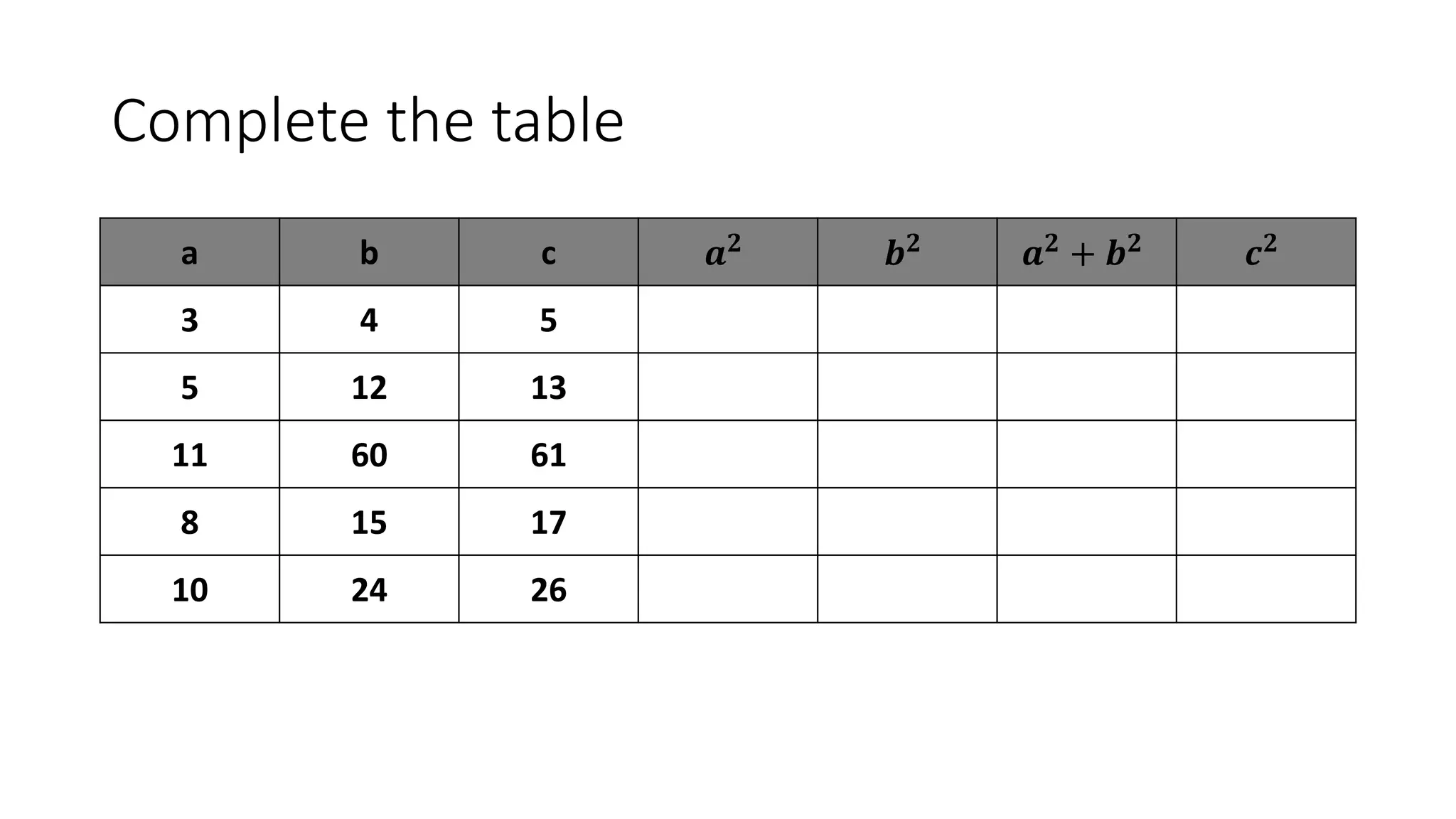
Complete the table
a b c 𝒂 𝟐
𝒃 𝟐
𝒂 𝟐
+ 𝒃 𝟐
𝒄 𝟐
3 4 5
5 12 13
11 60 61
8 15 17
10 24 26
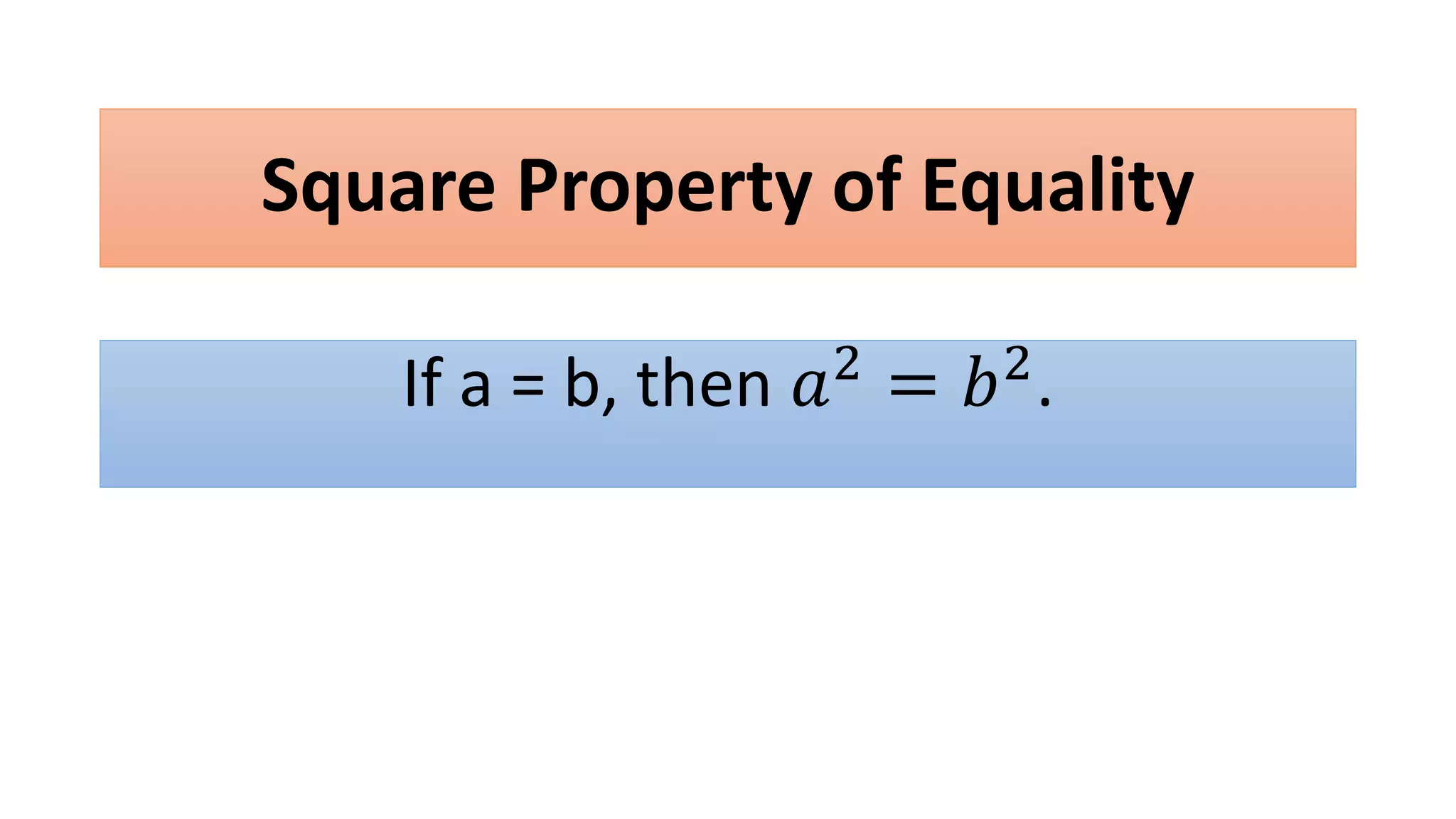
Square Property of Equality
If a = b, then 𝑎2 = 𝑏2.
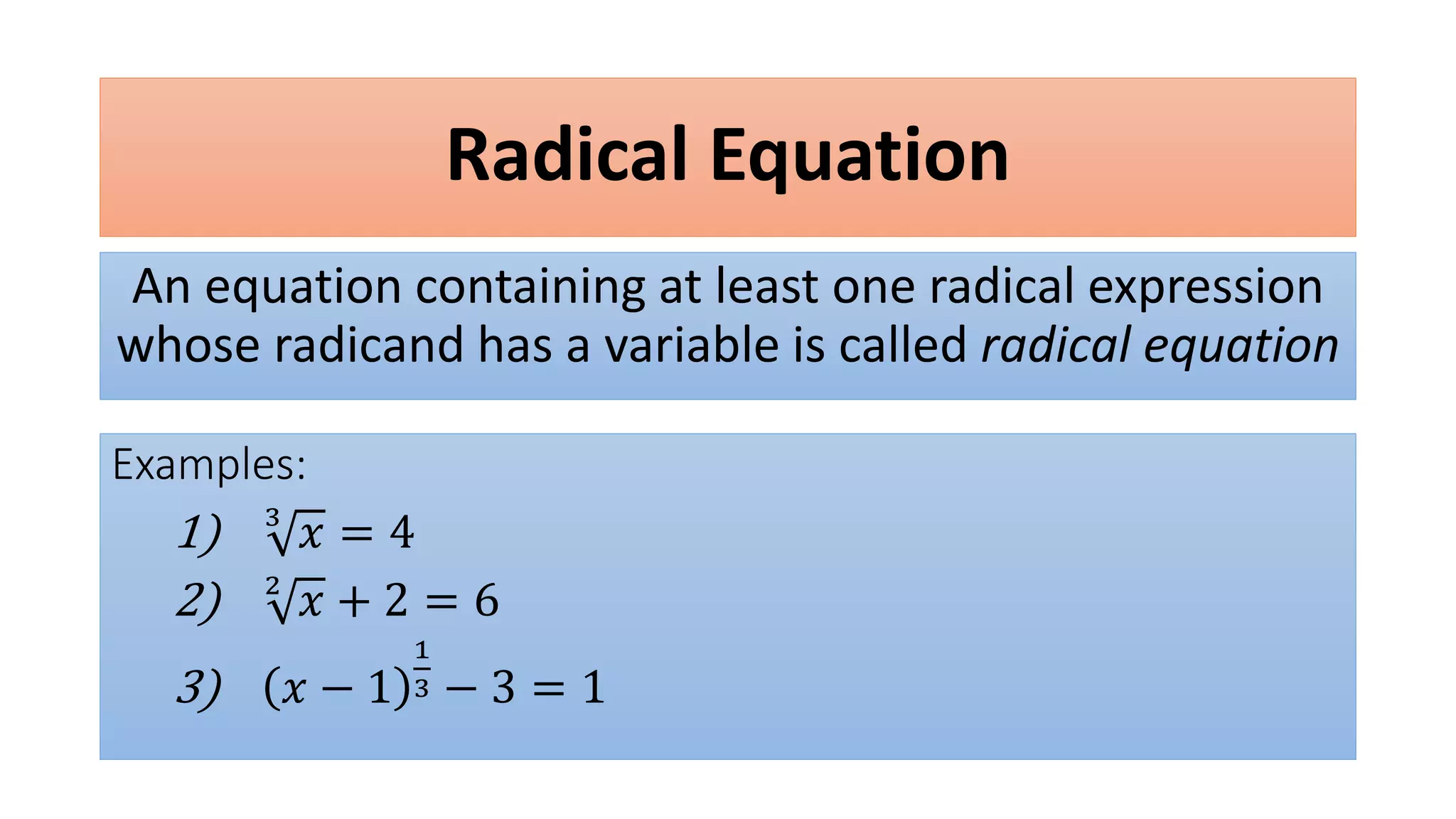
Radical Equation
An equation containing at least one radical expression
whose radicand has a variable is called radical equation
Examples:
1) 3
𝑥 = 4
2) 2
𝑥 + 2 = 6
3) 𝑥 − 1
1
3 − 3 = 1
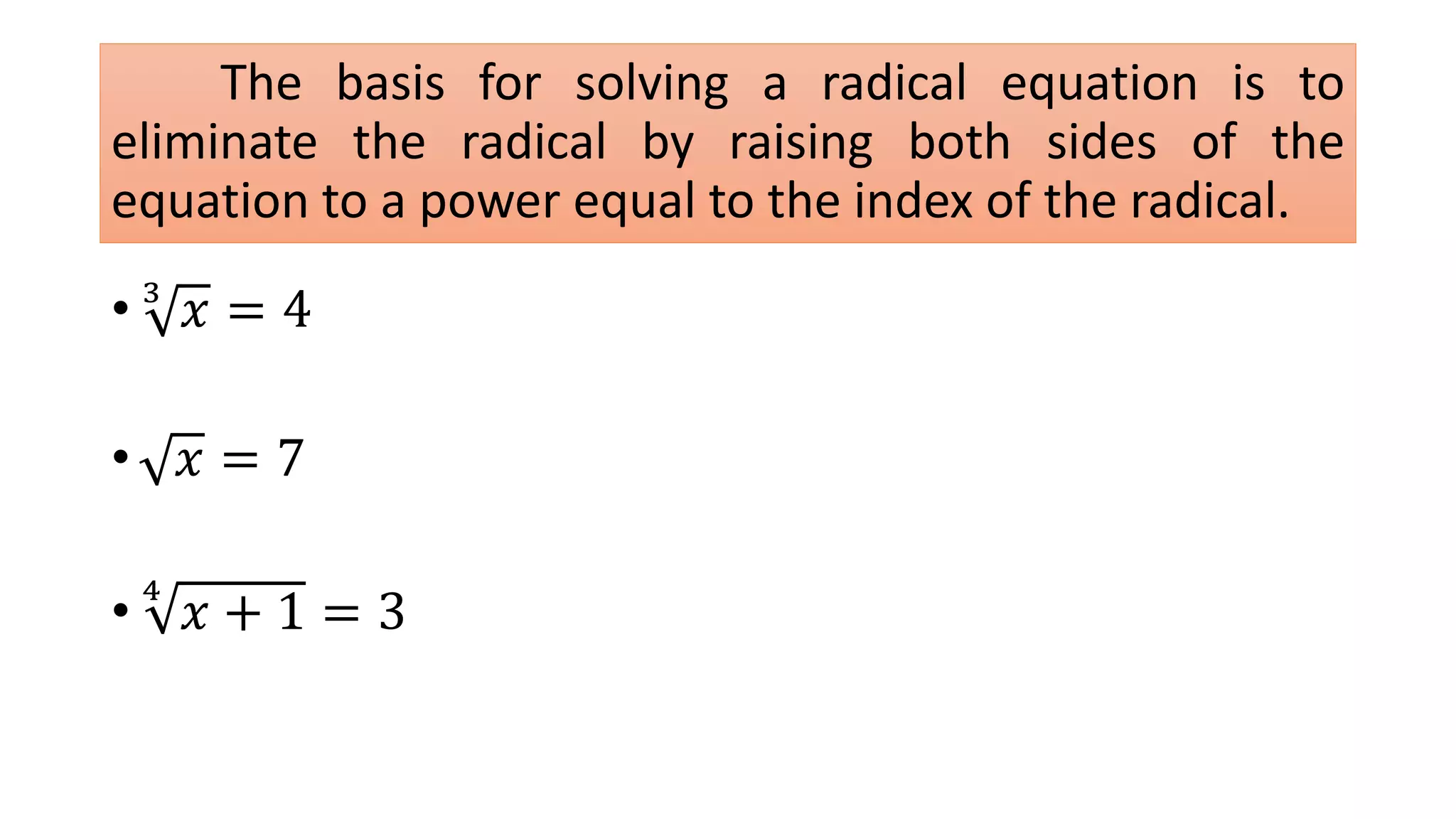
The basis for solving a radical equation is to
eliminate the radical by raising both sides of the
equation to a power equal to the index of the radical.
• 3
𝑥 = 4
• 𝑥 = 7
•
4
𝑥 + 1 = 3
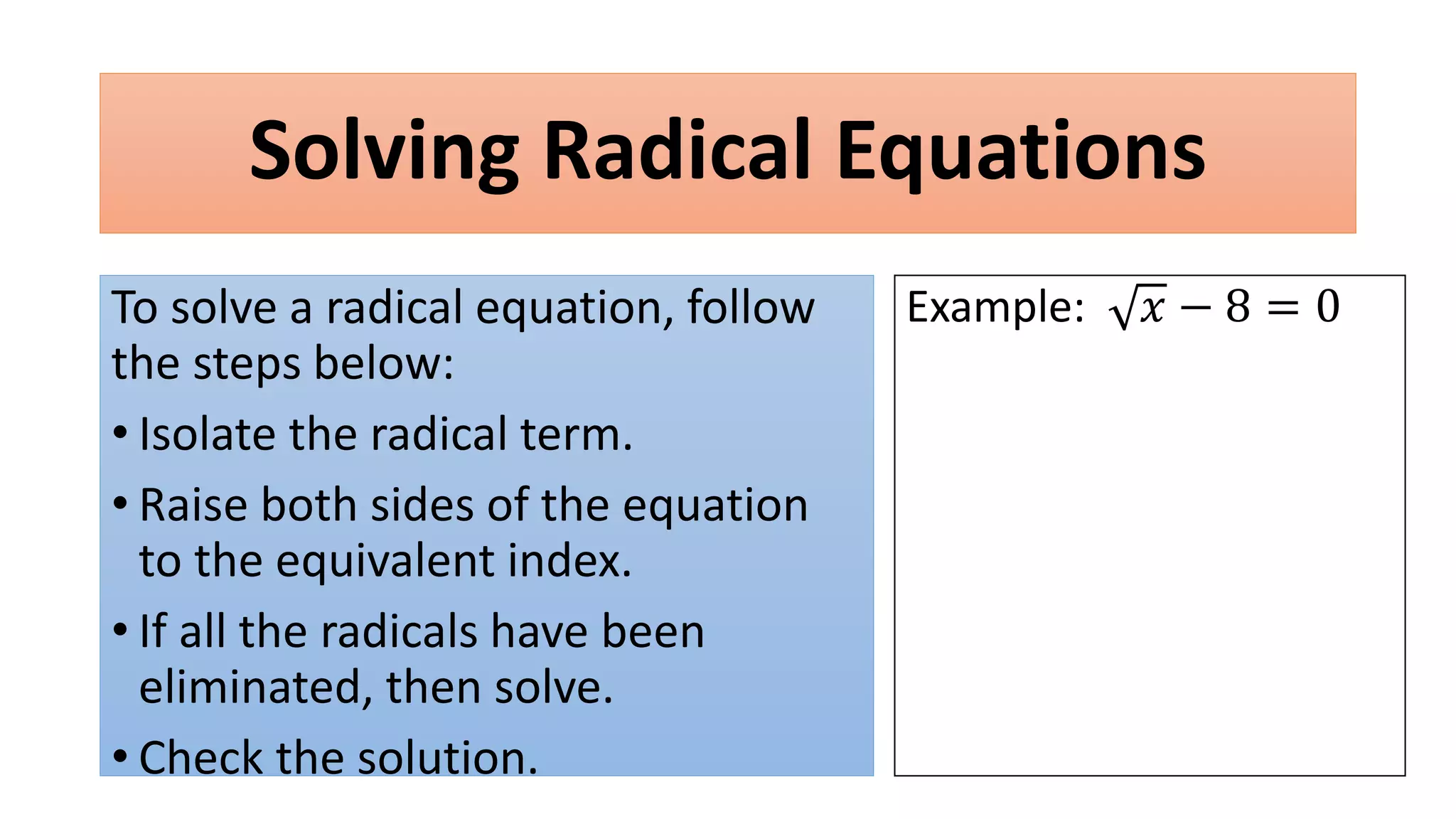
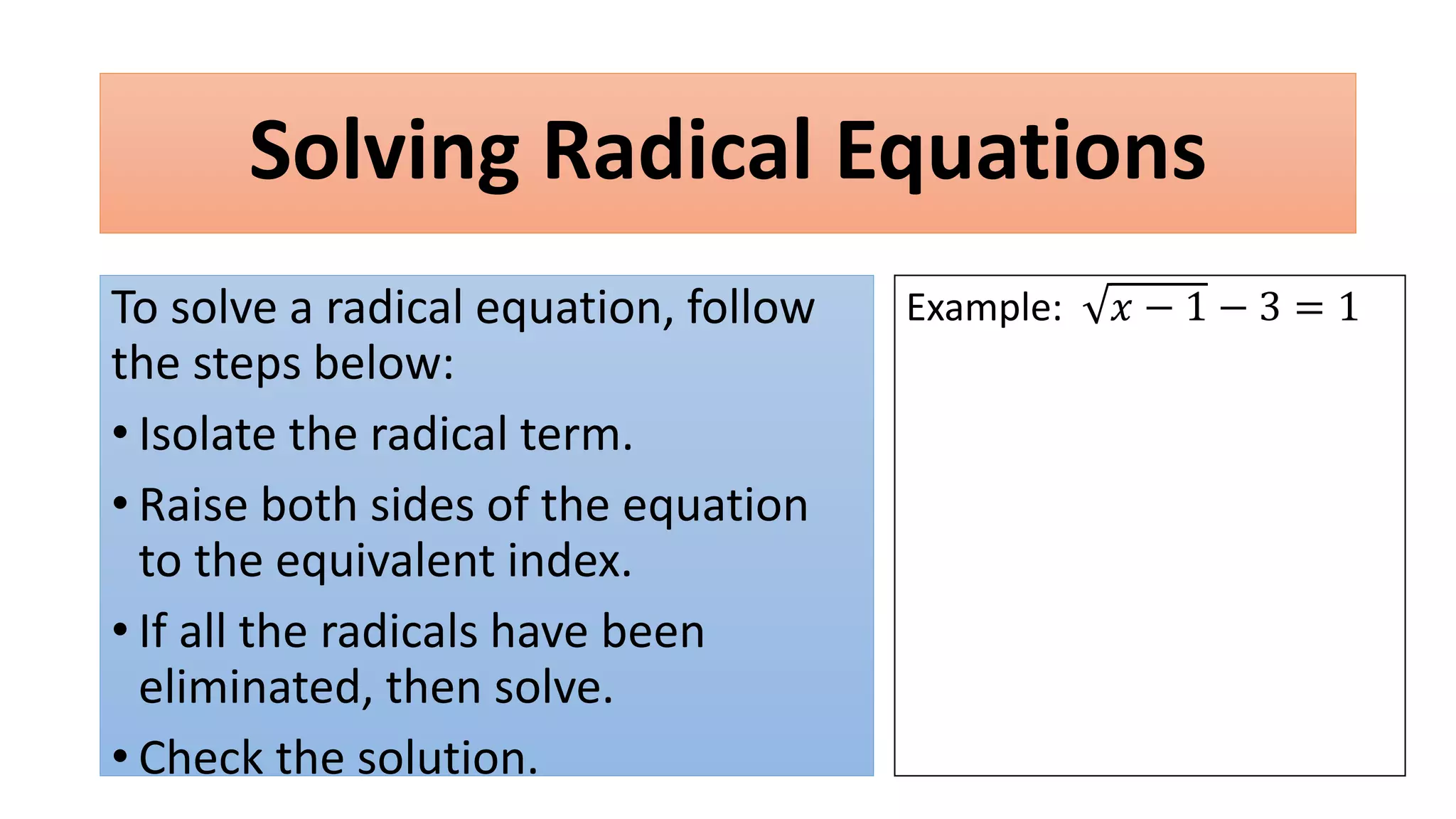
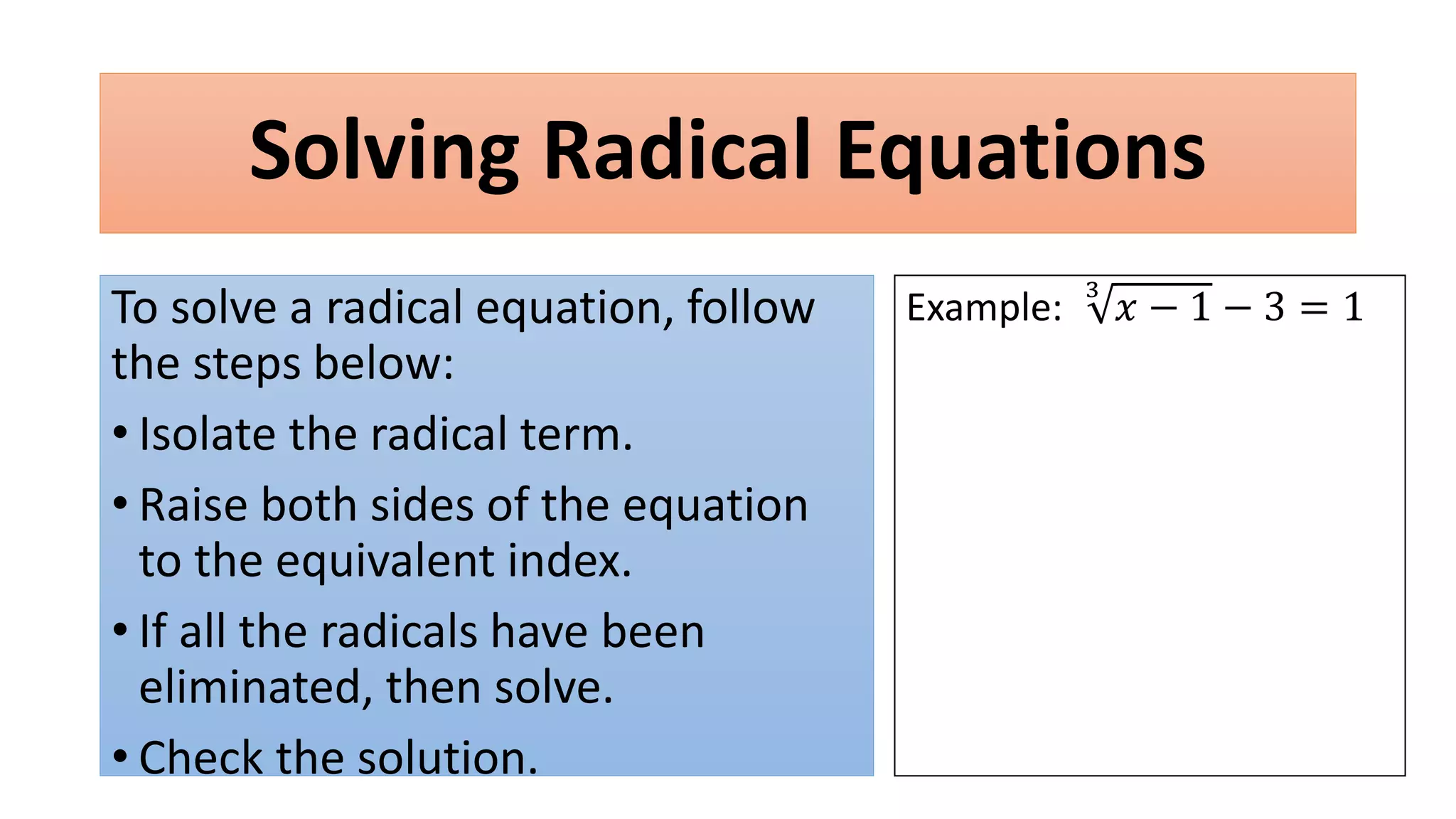
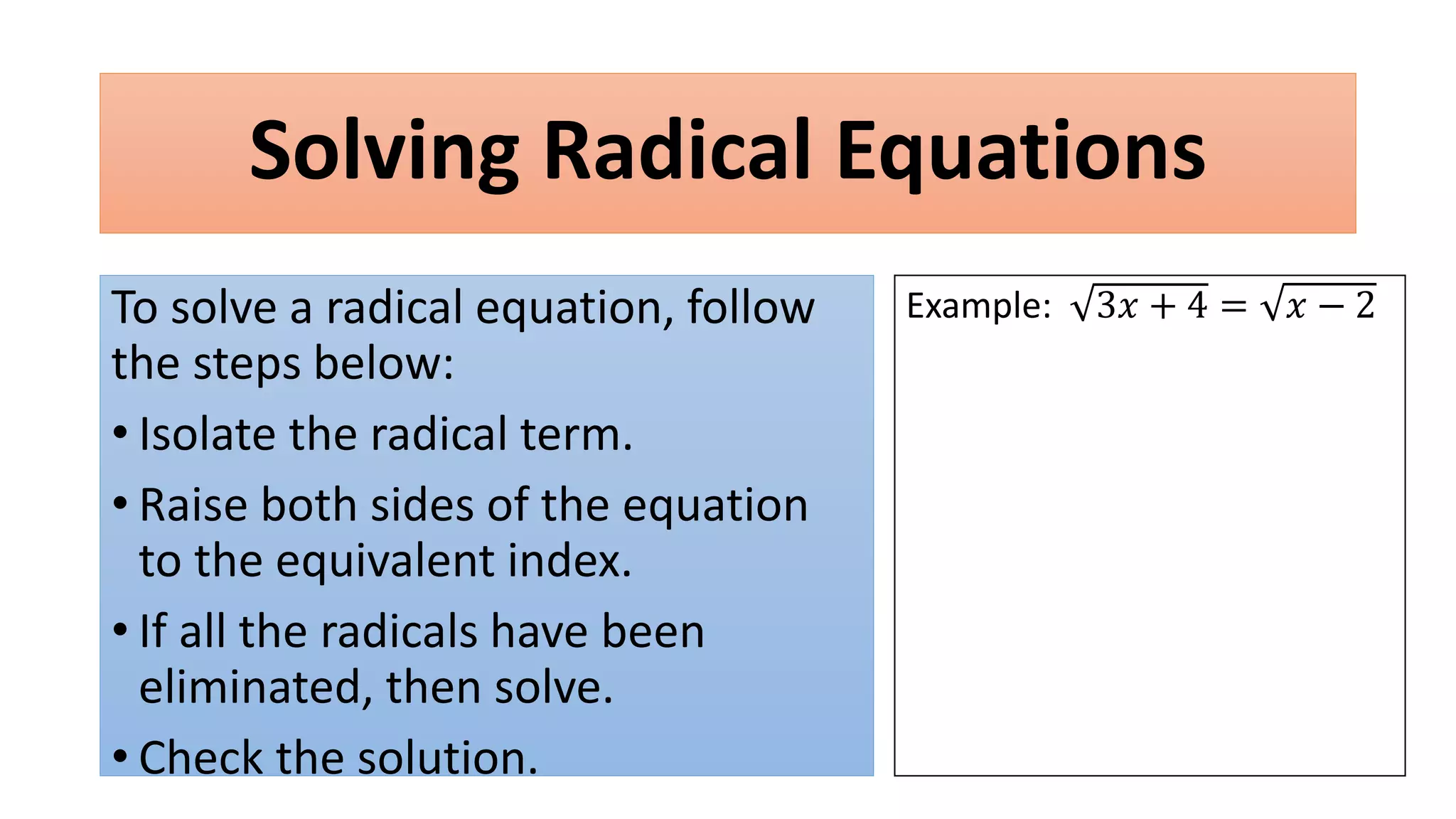
Solving Radical Equations
To solve a radical equation, follow
the steps below:
• Isolate the radical term.
• Raise both sides of the equation
to the equivalent index.
• If all the radicals have been
eliminated, then solve.
• Check the solution.
Example: 𝑥 − 8 = 0
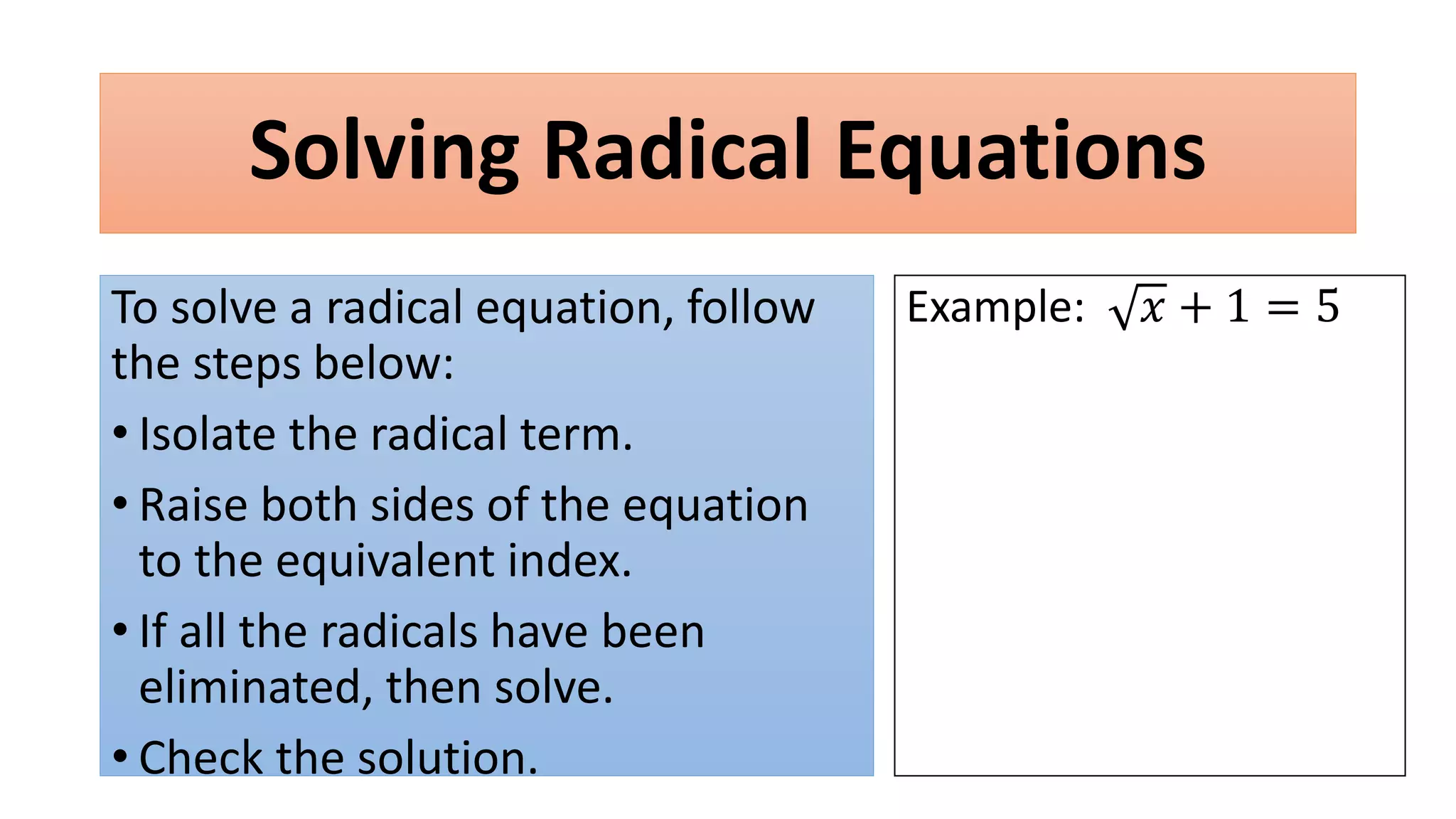
Solving Radical Equations
To solve a radical equation, follow
the steps below:
• Isolate the radical term.
• Raise both sides of the equation
to the equivalent index.
• If all the radicals have been
eliminated, then solve.
• Check the solution.
Example: 𝑥 + 1 = 5
Solving Radical Equations
To solve a radical equation, follow
the steps below:
• Isolate the radical term.
• Raise both sides of the equation
to the equivalent index.
• If all the radicals have been
eliminated, then solve.
• Check the solution.
Example: 𝑥 − 1 − 3 = 1
Solving Radical Equations
To solve a radical equation, follow
the steps below:
• Isolate the radical term.
• Raise both sides of the equation
to the equivalent index.
• If all the radicals have been
eliminated, then solve.
• Check the solution.
Example:
3
𝑥 − 1 − 3 = 1
Solving Radical Equations
To solve a radical equation, follow
the steps below:
• Isolate the radical term.
• Raise both sides of the equation
to the equivalent index.
• If all the radicals have been
eliminated, then solve.
• Check the solution.
Example: 3𝑥 + 4 = 𝑥 − 2
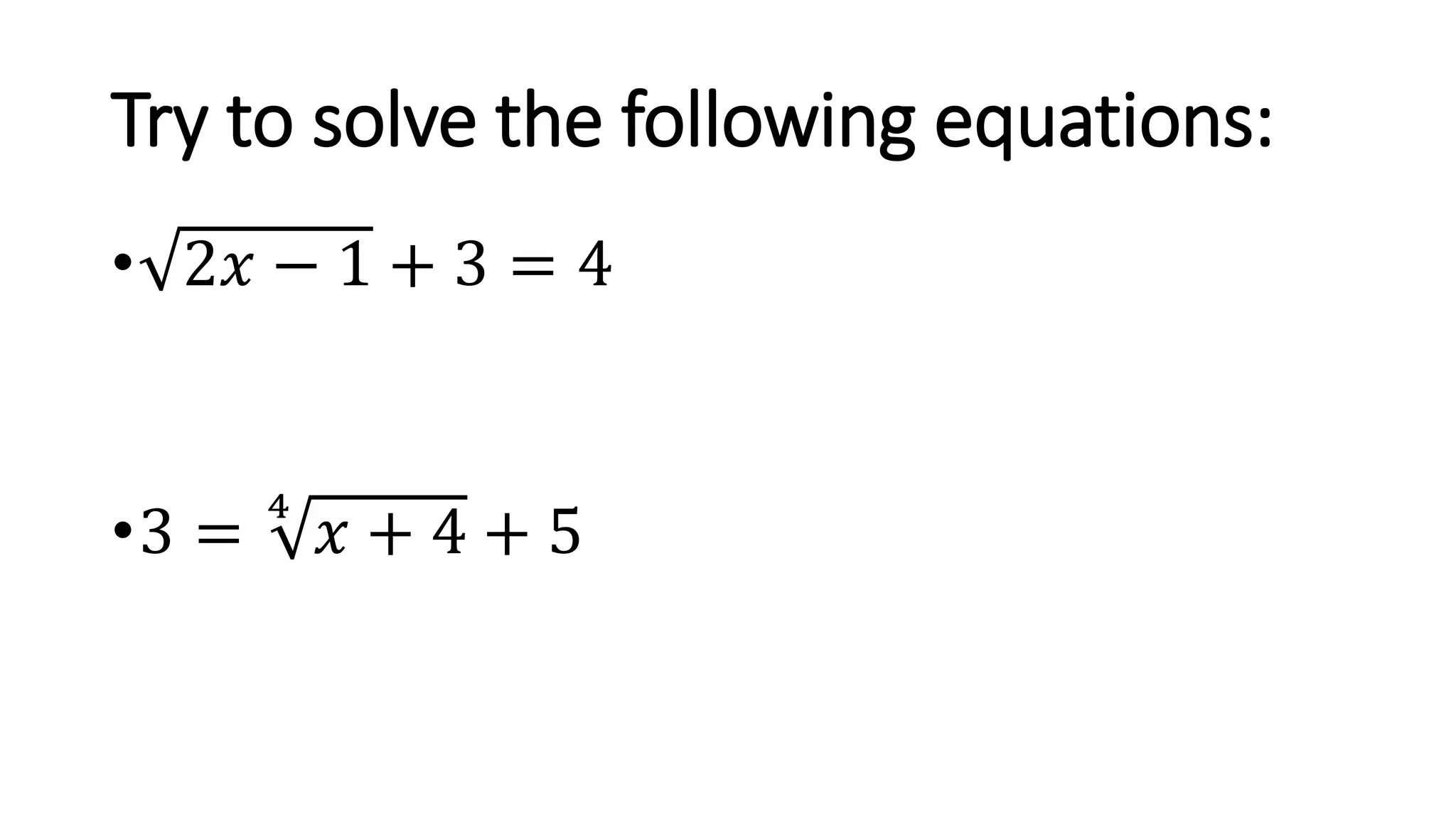
Try to solve the following equations:
• 2𝑥 − 1 + 3 = 4
•3 =
4
𝑥 + 4 + 5
Solve each and check:
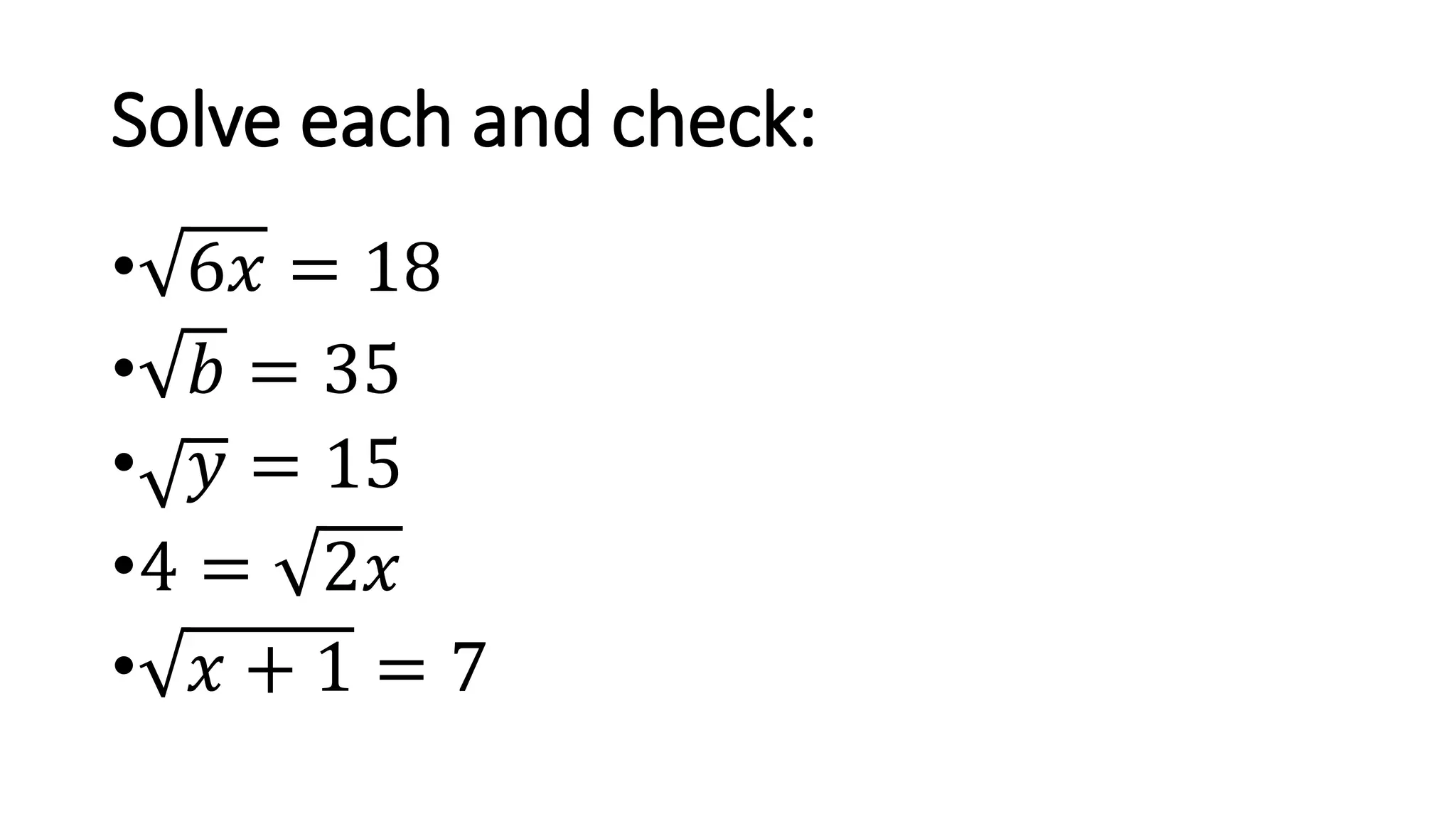
• 6𝑥 = 18
• 𝑏 = 35
• 𝑦 = 15
•4 = 2𝑥
• 𝑥 + 1 = 7
To be continue…
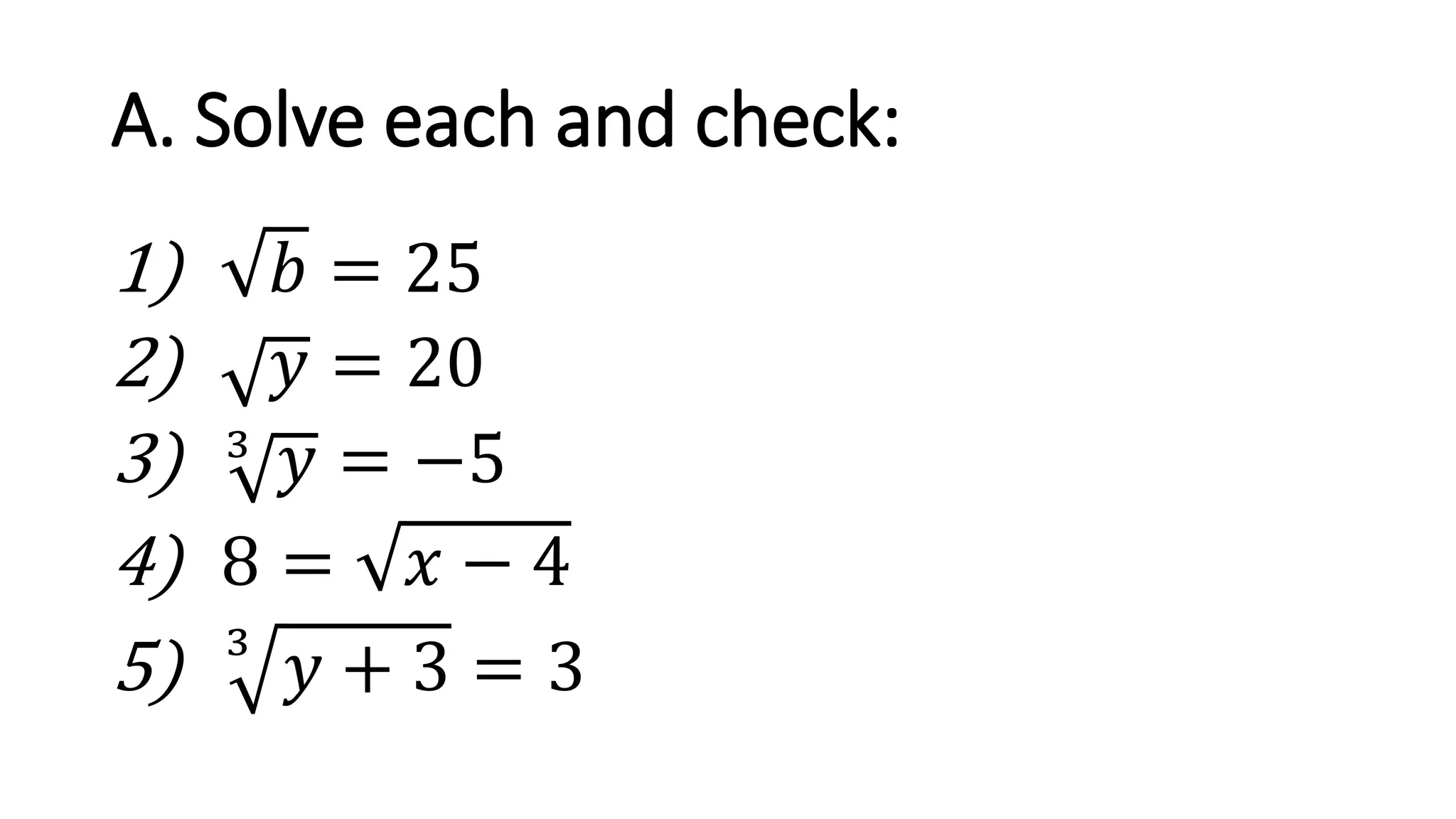
A. Solve each and check:
1) 𝑏 = 25
2) 𝑦 = 20
3) 3
𝑦 = −5
4) 8 = 𝑥 − 4
5) 3
𝑦 + 3 = 3
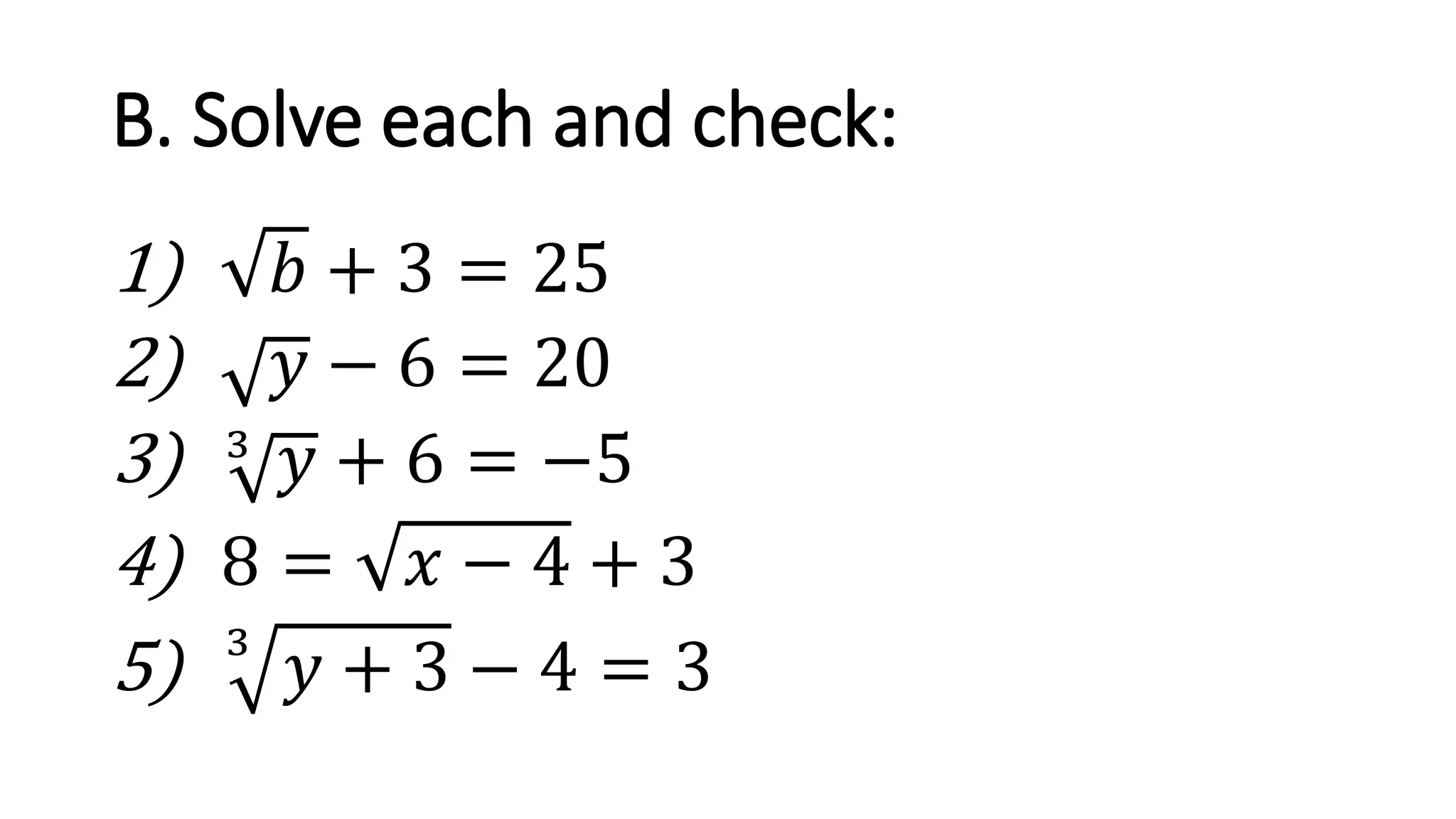
B. Solve each and check:
1) 𝑏 + 3 = 25
2) 𝑦 − 6 = 20
3) 3
𝑦 + 6 = −5
4) 8 = 𝑥 − 4 + 3
5) 3
𝑦 + 3 − 4 = 3
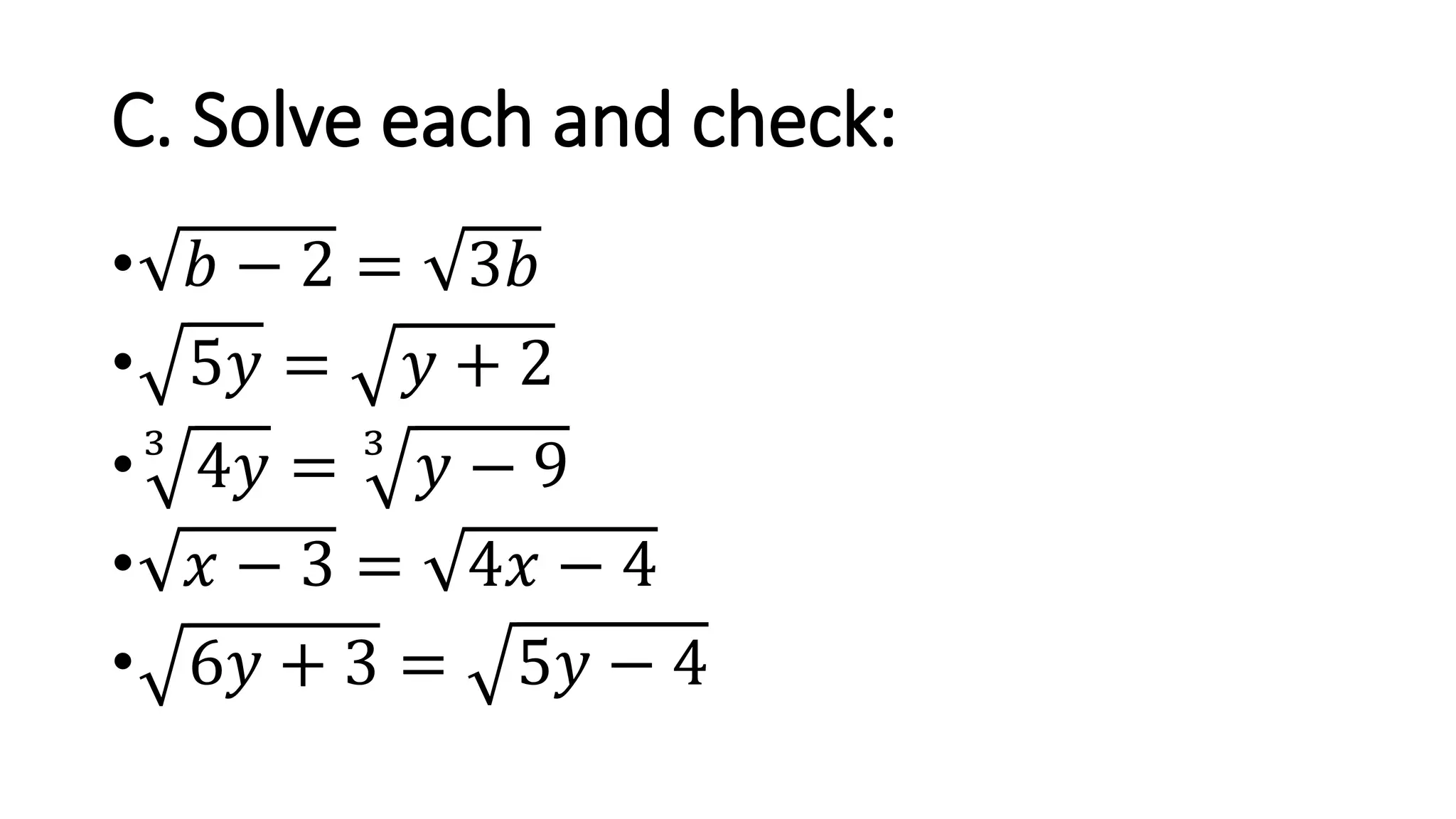
C. Solve each and check:
• 𝑏 − 2 = 3𝑏
• 5𝑦 = 𝑦 + 2
•3
4𝑦 = 3
𝑦 − 9
• 𝑥 − 3 = 4𝑥 − 4
• 6𝑦 + 3 = 5𝑦 − 4
To be continue…
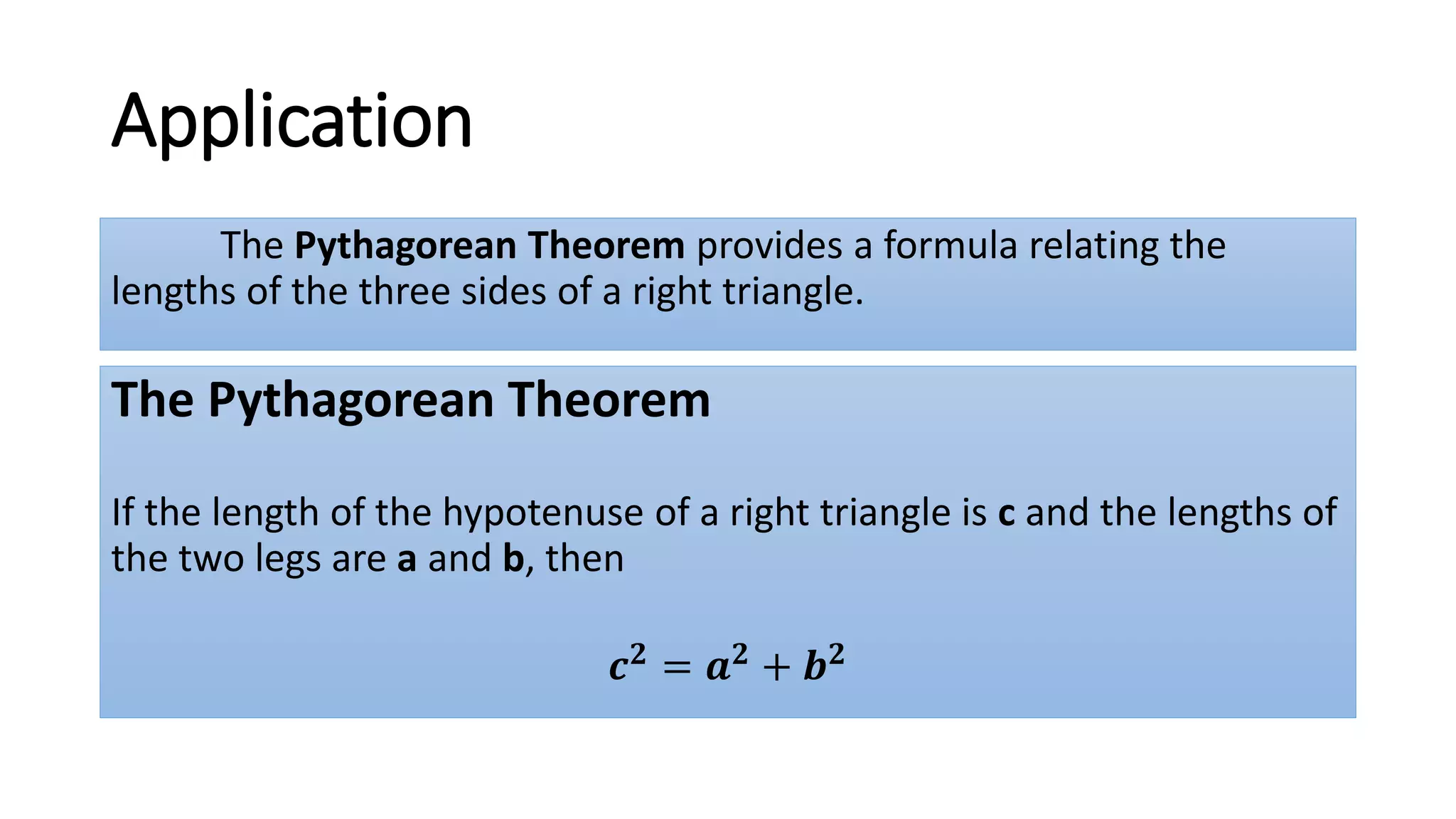
Application
The Pythagorean Theorem provides a formula relating the
lengths of the three sides of a right triangle.
The Pythagorean Theorem
If the length of the hypotenuse of a right triangle is c and the lengths of
the two legs are a and b, then
𝒄 𝟐 = 𝒂 𝟐 + 𝒃 𝟐
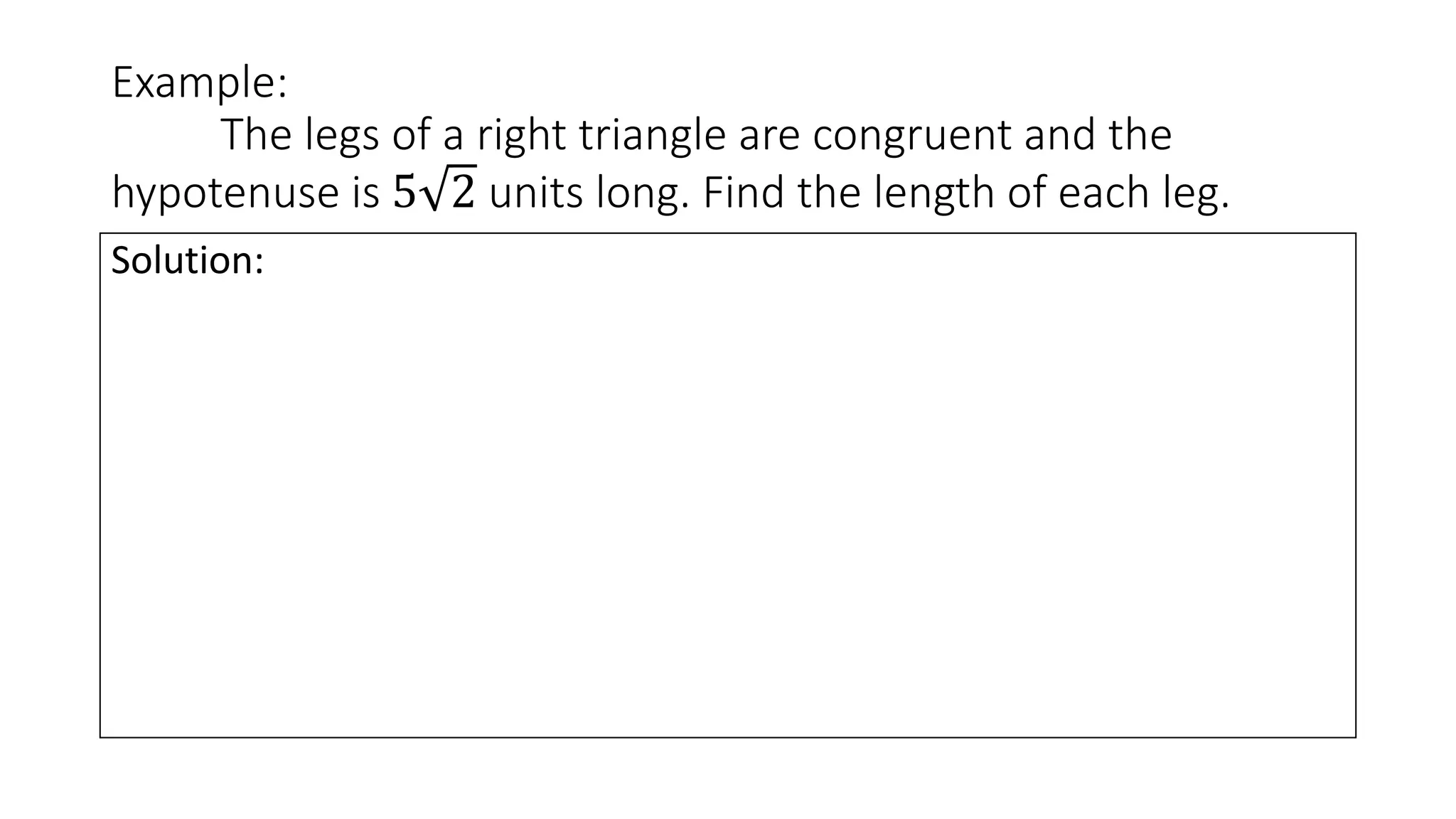
Example:
The legs of a right triangle are congruent and the
hypotenuse is 5 2 units long. Find the length of each leg.
Solution:
Example:
The legs of a right triangle are congruent and the
hypotenuse is 7 3 units long. Find the length of each leg.
Solution:
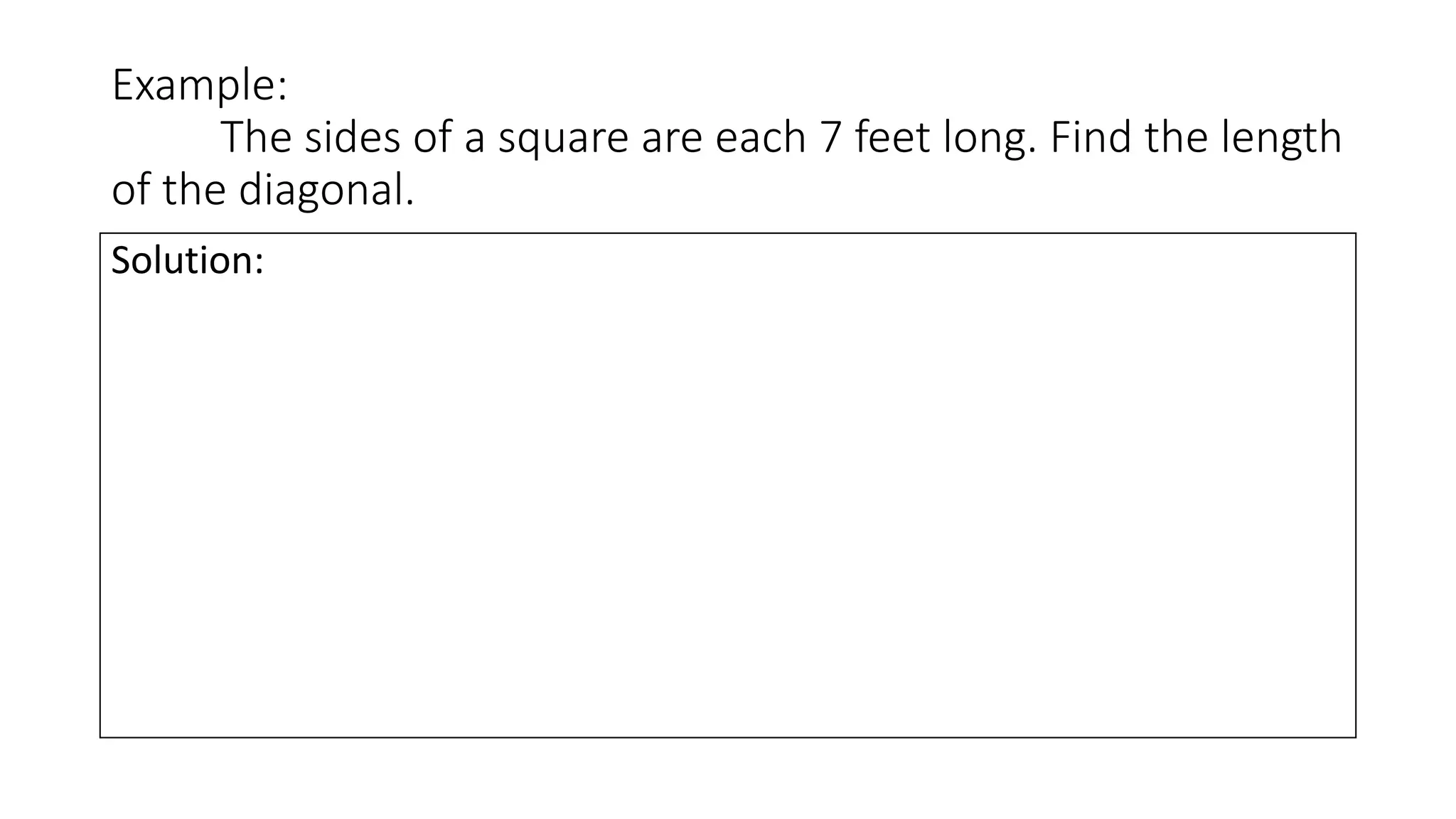
Example:
The sides of a square are each 7 feet long. Find the length
of the diagonal.
Solution:
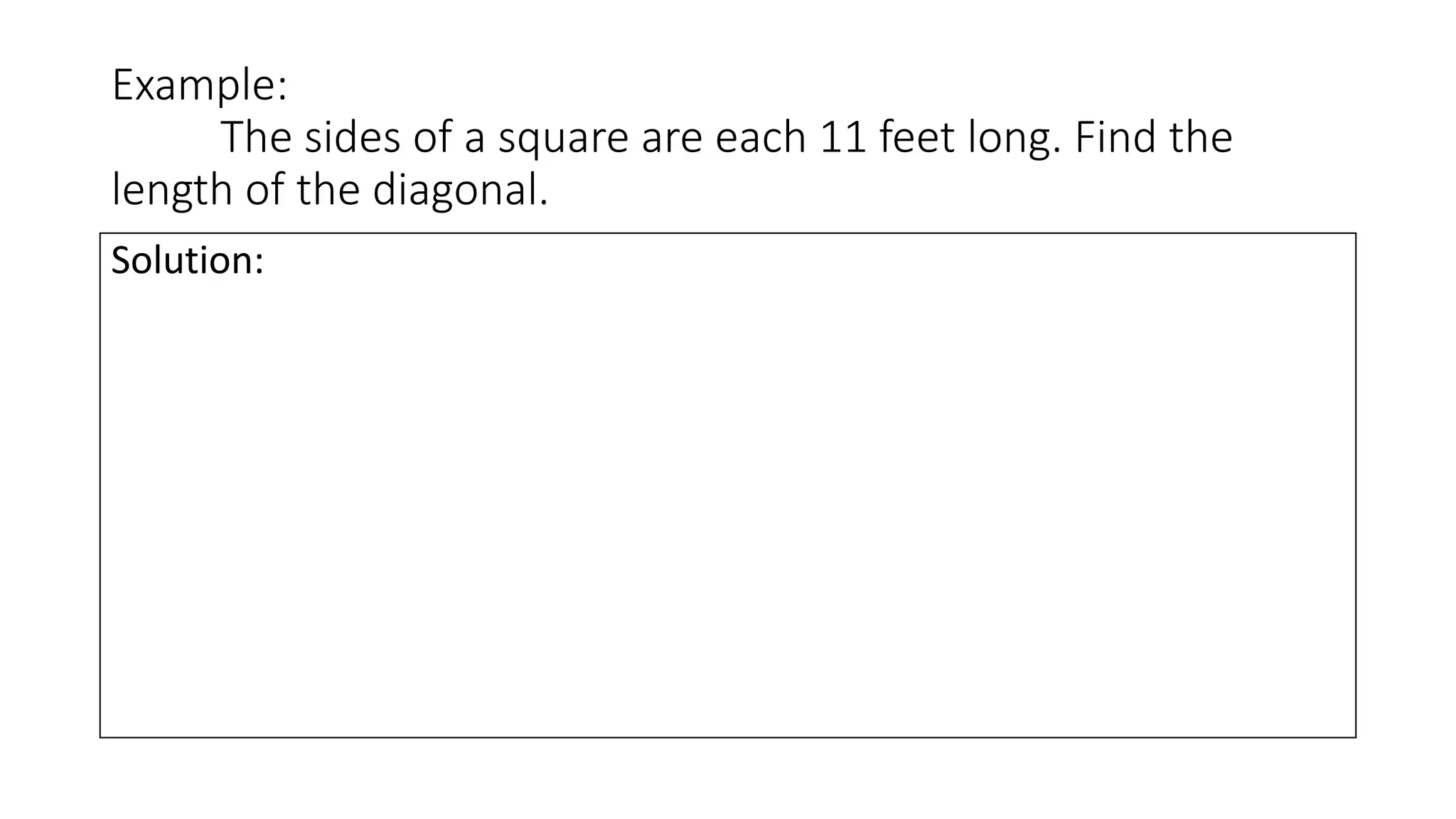
Example:
The sides of a square are each 11 feet long. Find the
length of the diagonal.
Solution:
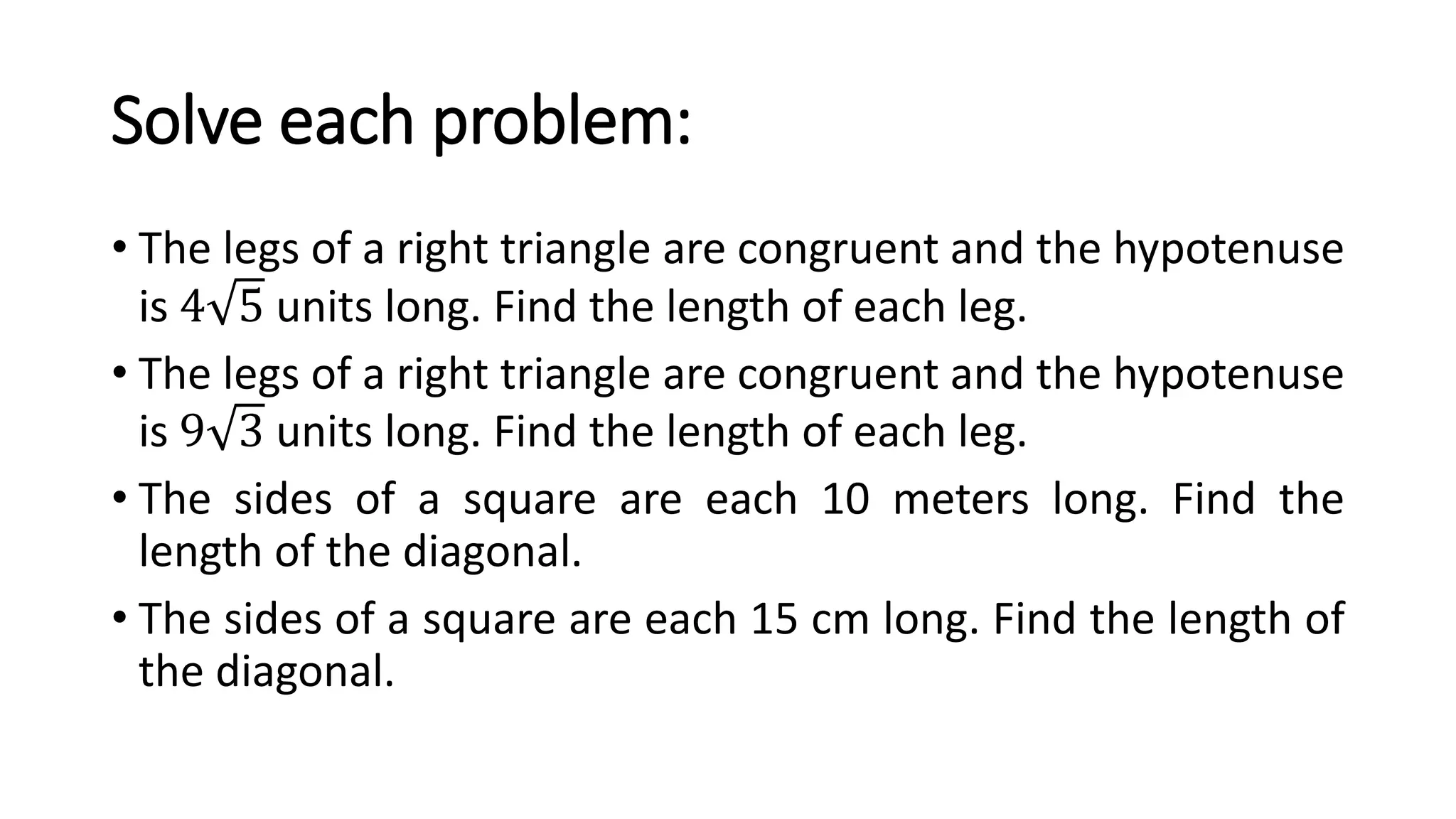
Solve each problem:
• The legs of a right triangle are congruent and the hypotenuse
is 4 5 units long. Find the length of each leg.
• The legs of a right triangle are congruent and the hypotenuse
is 9 3 units long. Find the length of each leg.
• The sides of a square are each 10 meters long. Find the
length of the diagonal.
• The sides of a square are each 15 cm long. Find the length of
the diagonal.
To be continue…
Solving Problems
involving Radical
Equations
Example:
Find the length of the side of a square whose area is 64
square centimeters.
Solution:
Example:
Find the length of the side of a square whose area is 50
square centimeters.
Solution:
Example:
Find the length of the side of a square garden whose area
is 180 square meters.
Solution:
Example:
Find the length of the side of a square whose diagonal is
25 centimeters.
Solution:
Example:
Find the length of the side of a square whose diagonal is
18 centimeters.
Solution:

Solving radical equations

  • 1.
  • 2.
    In this chapter,you will learn to: •Solve equations involving radical expressions •Solve problems involving radicals
  • 3.
    Complete the table ab c 𝒂 𝟐 𝒃 𝟐 𝒂 𝟐 + 𝒃 𝟐 𝒄 𝟐 3 4 5 5 12 13 11 60 61 8 15 17 10 24 26
  • 4.
    Square Property ofEquality If a = b, then 𝑎2 = 𝑏2.
  • 5.
    Radical Equation An equationcontaining at least one radical expression whose radicand has a variable is called radical equation Examples: 1) 3 𝑥 = 4 2) 2 𝑥 + 2 = 6 3) 𝑥 − 1 1 3 − 3 = 1
  • 6.
    The basis forsolving a radical equation is to eliminate the radical by raising both sides of the equation to a power equal to the index of the radical. • 3 𝑥 = 4 • 𝑥 = 7 • 4 𝑥 + 1 = 3
  • 7.
    Solving Radical Equations Tosolve a radical equation, follow the steps below: • Isolate the radical term. • Raise both sides of the equation to the equivalent index. • If all the radicals have been eliminated, then solve. • Check the solution. Example: 𝑥 − 8 = 0
  • 8.
    Solving Radical Equations Tosolve a radical equation, follow the steps below: • Isolate the radical term. • Raise both sides of the equation to the equivalent index. • If all the radicals have been eliminated, then solve. • Check the solution. Example: 𝑥 + 1 = 5
  • 9.
    Solving Radical Equations Tosolve a radical equation, follow the steps below: • Isolate the radical term. • Raise both sides of the equation to the equivalent index. • If all the radicals have been eliminated, then solve. • Check the solution. Example: 𝑥 − 1 − 3 = 1
  • 10.
    Solving Radical Equations Tosolve a radical equation, follow the steps below: • Isolate the radical term. • Raise both sides of the equation to the equivalent index. • If all the radicals have been eliminated, then solve. • Check the solution. Example: 3 𝑥 − 1 − 3 = 1
  • 11.
    Solving Radical Equations Tosolve a radical equation, follow the steps below: • Isolate the radical term. • Raise both sides of the equation to the equivalent index. • If all the radicals have been eliminated, then solve. • Check the solution. Example: 3𝑥 + 4 = 𝑥 − 2
  • 12.
    Try to solvethe following equations: • 2𝑥 − 1 + 3 = 4 •3 = 4 𝑥 + 4 + 5
  • 13.
    Solve each andcheck: • 6𝑥 = 18 • 𝑏 = 35 • 𝑦 = 15 •4 = 2𝑥 • 𝑥 + 1 = 7
  • 14.
  • 15.
    A. Solve eachand check: 1) 𝑏 = 25 2) 𝑦 = 20 3) 3 𝑦 = −5 4) 8 = 𝑥 − 4 5) 3 𝑦 + 3 = 3
  • 16.
    B. Solve eachand check: 1) 𝑏 + 3 = 25 2) 𝑦 − 6 = 20 3) 3 𝑦 + 6 = −5 4) 8 = 𝑥 − 4 + 3 5) 3 𝑦 + 3 − 4 = 3
  • 17.
    C. Solve eachand check: • 𝑏 − 2 = 3𝑏 • 5𝑦 = 𝑦 + 2 •3 4𝑦 = 3 𝑦 − 9 • 𝑥 − 3 = 4𝑥 − 4 • 6𝑦 + 3 = 5𝑦 − 4
  • 18.
  • 19.
    Application The Pythagorean Theoremprovides a formula relating the lengths of the three sides of a right triangle. The Pythagorean Theorem If the length of the hypotenuse of a right triangle is c and the lengths of the two legs are a and b, then 𝒄 𝟐 = 𝒂 𝟐 + 𝒃 𝟐
  • 20.
    Example: The legs ofa right triangle are congruent and the hypotenuse is 5 2 units long. Find the length of each leg. Solution:
  • 21.
    Example: The legs ofa right triangle are congruent and the hypotenuse is 7 3 units long. Find the length of each leg. Solution:
  • 22.
    Example: The sides ofa square are each 7 feet long. Find the length of the diagonal. Solution:
  • 23.
    Example: The sides ofa square are each 11 feet long. Find the length of the diagonal. Solution:
  • 24.
    Solve each problem: •The legs of a right triangle are congruent and the hypotenuse is 4 5 units long. Find the length of each leg. • The legs of a right triangle are congruent and the hypotenuse is 9 3 units long. Find the length of each leg. • The sides of a square are each 10 meters long. Find the length of the diagonal. • The sides of a square are each 15 cm long. Find the length of the diagonal.
  • 25.
    To be continue… SolvingProblems involving Radical Equations
  • 26.
    Example: Find the lengthof the side of a square whose area is 64 square centimeters. Solution:
  • 27.
    Example: Find the lengthof the side of a square whose area is 50 square centimeters. Solution:
  • 28.
    Example: Find the lengthof the side of a square garden whose area is 180 square meters. Solution:
  • 29.
    Example: Find the lengthof the side of a square whose diagonal is 25 centimeters. Solution:
  • 30.
    Example: Find the lengthof the side of a square whose diagonal is 18 centimeters. Solution: