Instructional Planning (iPlan)
(With inclusion of the provisions of
D.O. No. 8, s. 2015 and D.O. 42, s.
2016)
Detailed Lesson Plan (DLP) Format
DLP No.: Learning Area: Grade Level: Quarter: Duration:
1 Mathematics 9 3rd 75 minutes
Learning
Competency/ies:
(Taken from the Curriculum
Guide)
Code:
Key Concepts /
Understandings to
be Developed
A quadrilateral is a closed shape and a type of polygon that has four
sides, four vertices and four angles. It is formed by joining four non-
collinear points. The sum of interior angles of quadrilaterals is
always equal to 360 degrees. A parallelogram is a two-dimensional
geometrical shape whose sides are parallel to each other. It is a type
of polygon having four sides (also called quadrilateral), where the
pair of parallel sides are equal in length.
Domain
Adapted Cognitive Process Dimensions
(D.O. No. 8, s. 2015)
1. Objectives:
Within 45 minutes of interactive and
collaborative activities, students with 75%
accuracy level will be able to:
Knowledge
Categories:
Remembering Identify the different types of quadrilaterals,
such as squares, rectangles, rhombuses, kites,
trapezoids, and parallelograms on the given
examples.
Understanding
Skills
Applying
Analyzing Analyze the relationships between the
properties of quadrilaterals in the given
examples.
Evaluating
Creating
Attitude
Categories:
1.Receiving Phenomena
2.Responding to Phenomena
3.Valuing
4.Organization
5. Internalizing values
Values
Categories:
1. Receiving Phenomena
2. Responding to Phenomena
3. Valuing Appreciate the importance of geometry in
everyday life by recognizing quadrilaterals in
the environment.
4. Organization
5. Internalizing values
2. Content Quadrilaterals and Parallelogram
3. Learning Resources PowerPoint presentation, laptop, worksheets,
graphing paper, Mathematics Curriculum Guide
and Geometry textbook, name box.
4. Procedures
4.1 Introductory Activity (10 minutes) Set the mood of the learners with a prayer and
an energizer.
1. Greet the class
2. Call on someone to lead the prayer.
3. Greet the class.
4. Introduce the energizer:
ENERGIZER: THE FANTASTIC FOUR (With the aid of
PowerPoint Presentation)
Mechanics:
On the next slide, you’ll see two shapes, each
with an instruction above it.
1. Find the shape with exactly FOUR sides.
2. Follow the instructions above that
shape.
3. The whole class should participate.
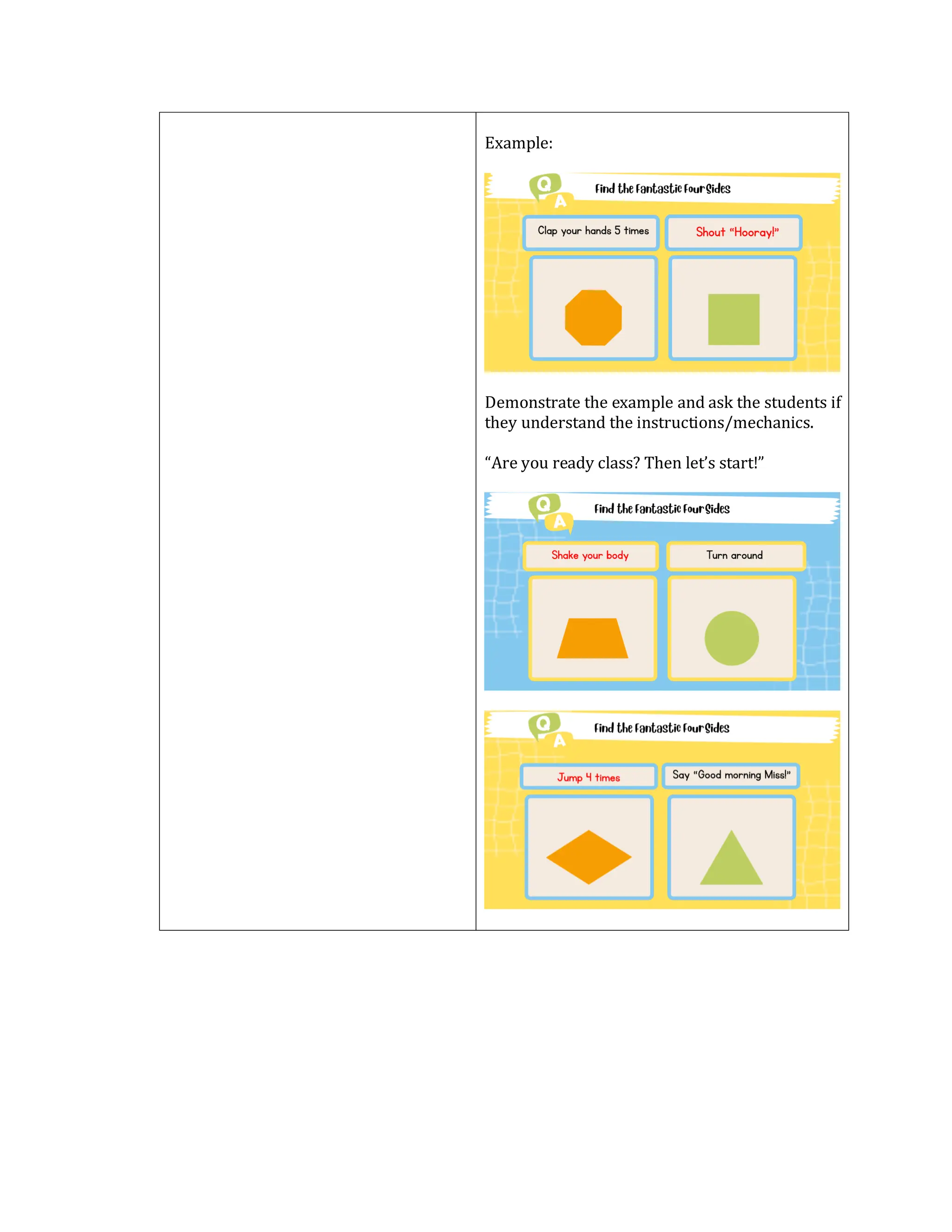
Example:
Demonstrate the example and ask the students if
they understand the instructions/mechanics.
“Are you ready class? Then let’s start!”
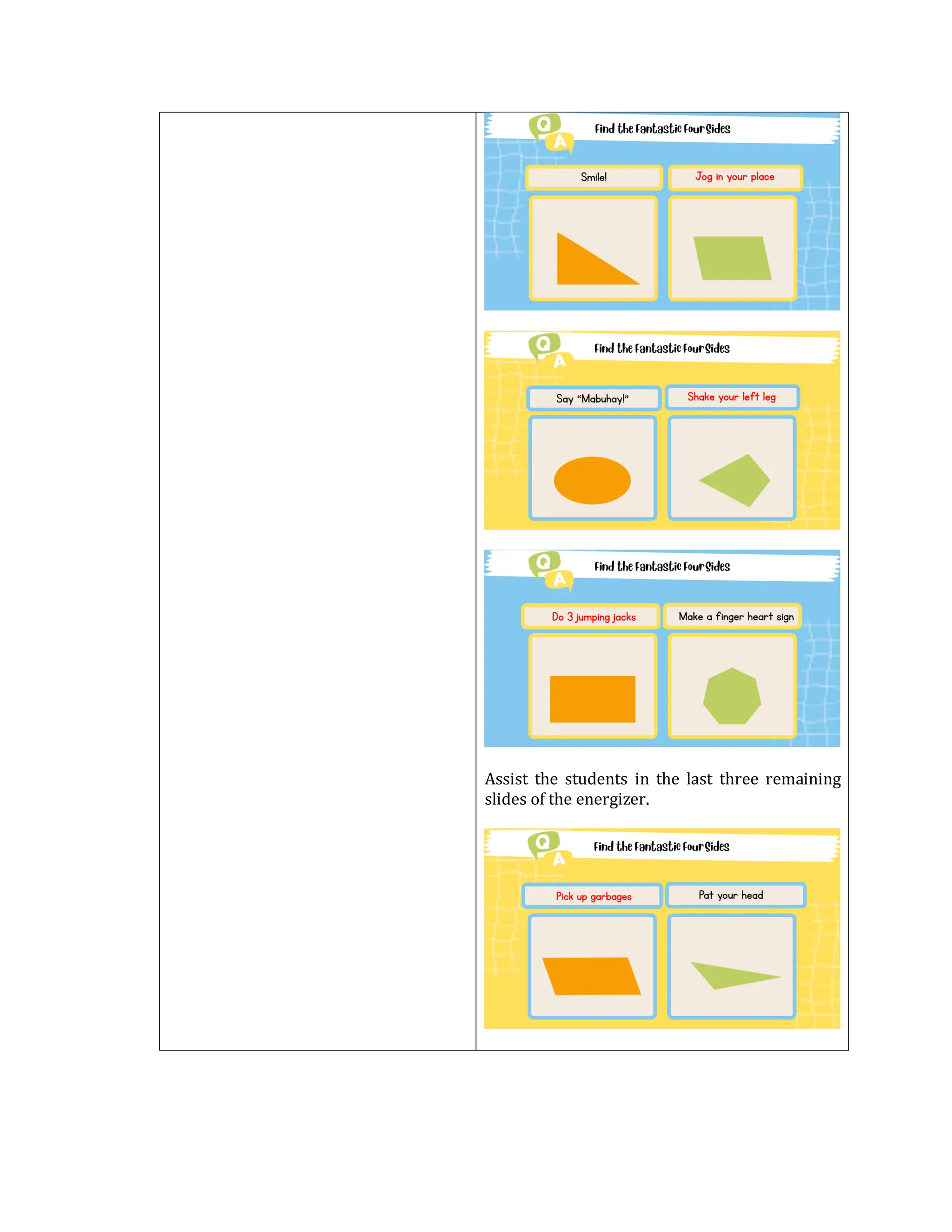
Assist the students in the last three remaining
slides of the energizer.
1. Praise the students for the job well done.
2. Ask the secretary for absent students.
3. Introduce the questioning/participation
method to the class. (box containing all of the
names of the students)
4. Ask the students if they are energized
and what they feel.
5. In connection with the energizer ask the
following for a recap about
Quadrilaterals:
(Encourage students’ participation)
 What did you observe during our
energizer earlier? (Expected Answer:
Shapes)
 What are the things that we need to
find? (Expected Answer: A shape that has
four sides)
 What do you think is our topic
today? (Expected Answer: A four-sided
polygons; Quadrilaterals)
 What do you already know about
quadrilaterals?
 Examples of Quadrilaterals
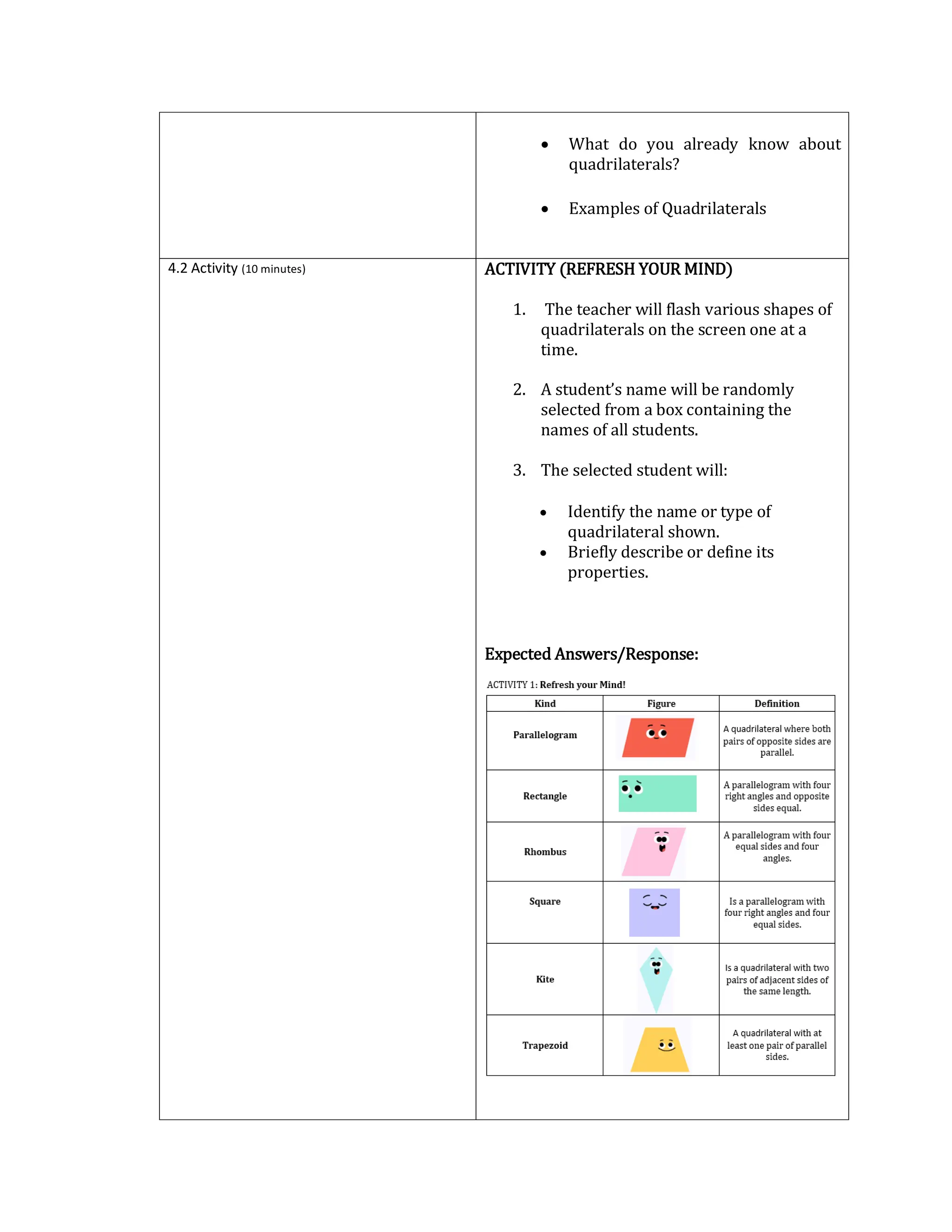
4.2 Activity (10 minutes) ACTIVITY (REFRESH YOUR MIND)
1. The teacher will flash various shapes of
quadrilaterals on the screen one at a
time.
2. A student’s name will be randomly
selected from a box containing the
names of all students.
3. The selected student will:
 Identify the name or type of
quadrilateral shown.
 Briefly describe or define its
properties.
Expected Answers/Response:
4.3 Lesson Development (25 minutes)
1. Introduction to Quadrilaterals (5 minutes)
Begin by defining what quadrilaterals are:
“Is a closed shape and a type of polygon that has
four sides, four vertices and four angles. It is
formed by joining four non-collinear points. The
sum of interior angles of quadrilaterals is always
equal to 360 degrees”.
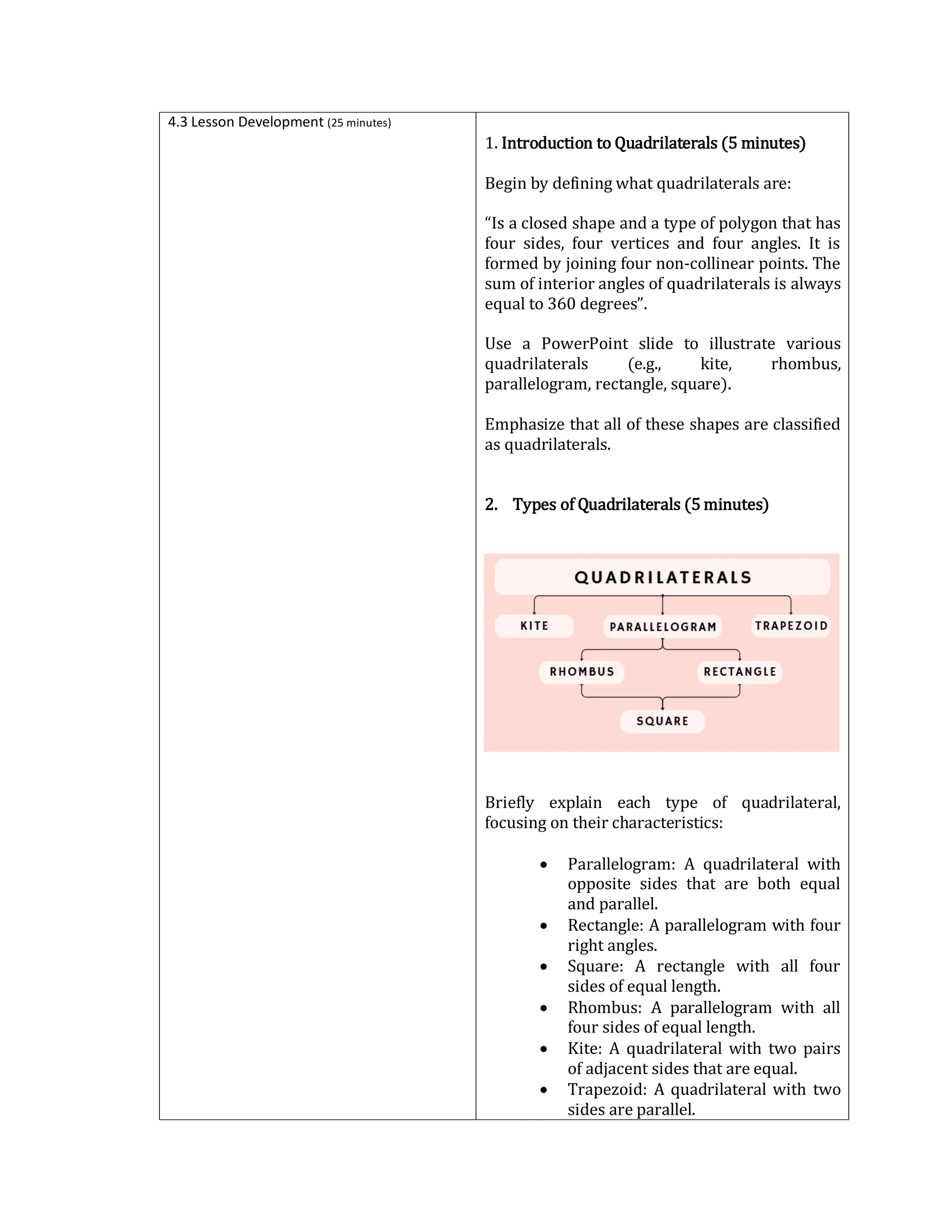
Use a PowerPoint slide to illustrate various
quadrilaterals (e.g., kite, rhombus,
parallelogram, rectangle, square).
Emphasize that all of these shapes are classified
as quadrilaterals.
2. Types of Quadrilaterals (5 minutes)
Briefly explain each type of quadrilateral,
focusing on their characteristics:
 Parallelogram: A quadrilateral with
opposite sides that are both equal
and parallel.
 Rectangle: A parallelogram with four
right angles.
 Square: A rectangle with all four
sides of equal length.
 Rhombus: A parallelogram with all
four sides of equal length.
 Kite: A quadrilateral with two pairs
of adjacent sides that are equal.
 Trapezoid: A quadrilateral with two
sides are parallel.
As you explain each type, reference visuals in
the PowerPoint that depict these shapes,
fostering visual learning.
3. Properties ofParallelogram (10 minutes)
Use a comprehensive PowerPoint slide
listing all properties of parallelograms,
including:
a) In a parallelogram, any two opposite
sides are congruent.
b) In a parallelogram, any two opposite
angles are congruent.
c) In a parallelogram, any two consecutive
angles are supplementary.
d) The diagonals of a parallelogram bisect
each other.
e) A diagonal of a parallelogram forms two
congruent triangles.
Engaging Example for Each Property:
As you discuss each property, write out a brief
example on the board for visual clarity:
a) Example for any two opposite sides are
congruent: Draw a rectangle and label
sides AB = CD, AD || BC.
b) Example for any two opposite angles are
congruent: Draw a rhombus and label
angles ∠A = ∠C, ∠B = ∠D.
c) Example for Consecutive Angles
Supplementary: Use a rectangle to show
that ∠A + ∠B = 180°.
d) Example for Diagonal Bisection: Draw a
parallelogram and show that diagonals
AC and BD meet at point O, with AO =
OC and BO = OD.
e) Example for Congruent Triangles: Label
triangles AOB and COD formed by
diagonals in your parallelogram
illustration.
4. Example Problem (5 minutes)
Write the following example on the board:
"In parallelogram ABCD, if AB = 8 cm, BC = 5
cm, and ∠A = 70°, find AB, AD, and angle D."
Explain how to approach this problem step-by-
step:
Identify that since AB = CD (opposite sides), CD
must also equal 8 cm.
Confirm that since BC = AD (opposite sides), AD
must equal 5 cm.
Explain that opposite angles are equal, so ∠C
will also be 70°.
To find ∠D, use the property that consecutive
angles are supplementary: ∠A + ∠B = 180°,
therefore ∠B = 180° - 70° = 110°; consequently,
∠D will also equal 110°.
Encourage students to ask questions about each
property and visualize the relationships you'll
be discussing in the next sections of the lesson.
4.4 Abstraction (5 minutes) In summarization, discuss the following: (requires
student participation)
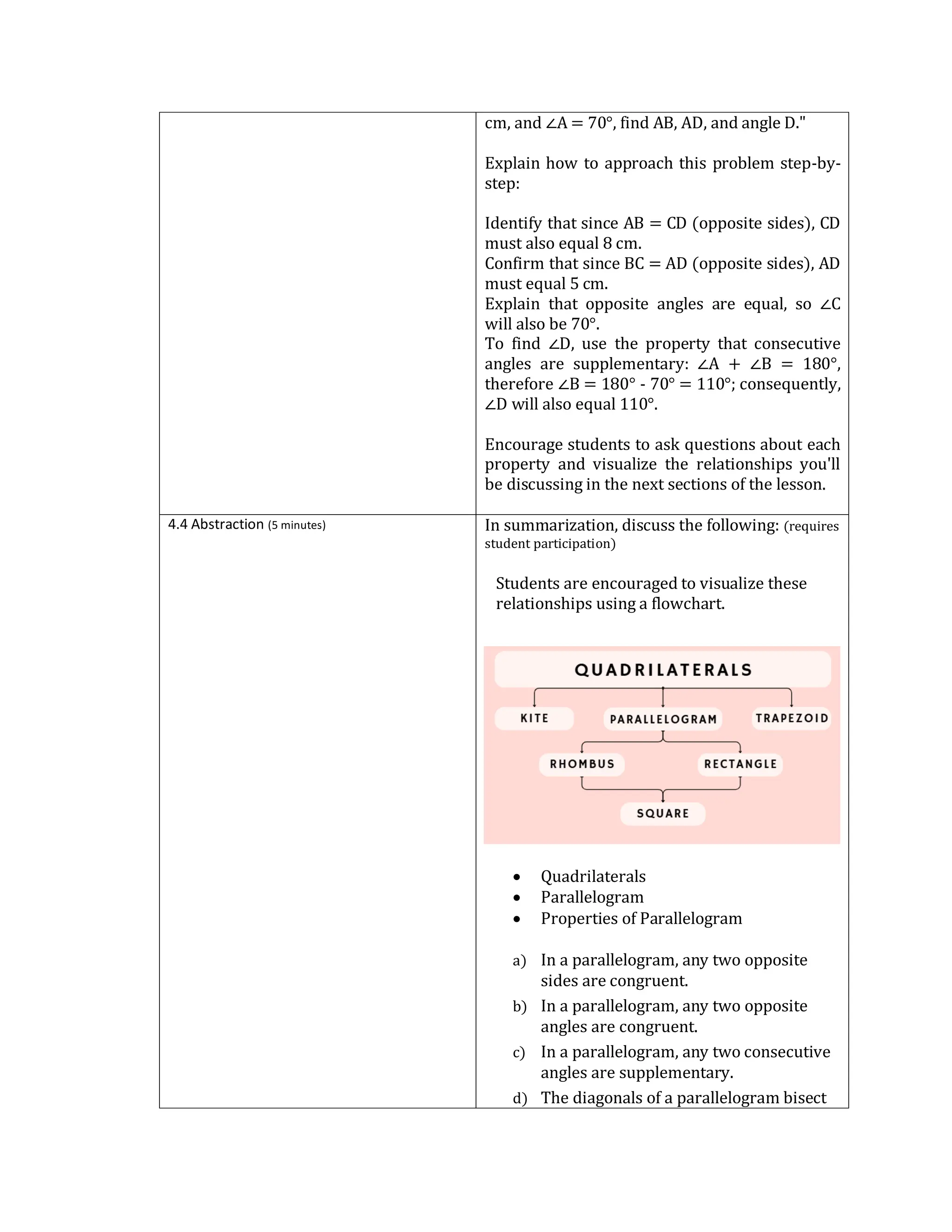
Students are encouraged to visualize these
relationships using a flowchart.
 Quadrilaterals
 Parallelogram
 Properties of Parallelogram
a) In a parallelogram, any two opposite
sides are congruent.
b) In a parallelogram, any two opposite
angles are congruent.
c) In a parallelogram, any two consecutive
angles are supplementary.
d) The diagonals of a parallelogram bisect
each other.
e) A diagonal of a parallelogram forms two
congruent triangles.
4.5 Application (15 minutes) GROUP ACTIVITY: PLOT, CONNECT, IDENTIFY
1. Introduction to the Activity (2 minutes):
 Directions will be shown in the
PowerPoint Presentation.
 Briefly explain the task: “Today,
you will work in groups to plot
points on a graph, connect them to
create quadrilaterals, and
determine if the figures you create
are parallelograms. Remember to
think about the properties of the
shapes as you plot and connect!”
2. Demonstration of Example(3 minutes):
 On the blackboard, write the set of
points: (-1, 2), (-1, 0), (1, 0), (1, 2).
 Demonstrate how to plot each
point on the graph:
 Start with the x-axis and find -1
(left), then move up to 2 to place
the first point.
 Continue this for each point,
explaining how to read the
coordinates.
 After plotting all points, use a ruler
to connect them in the given order.
Discuss the resulting figure with
the students, asking questions like:
 “What kind of quadrilateral do we
have here?”
 “How do you know it’s a
parallelogram?”
3. Group Activity (7 minutes):
 Group the students into five groups
and assign seats afterward.
 Provide each group with a printed
graphing paper and a new set of
points to plot. The sets of points
can be as follows (shown in the
slides):
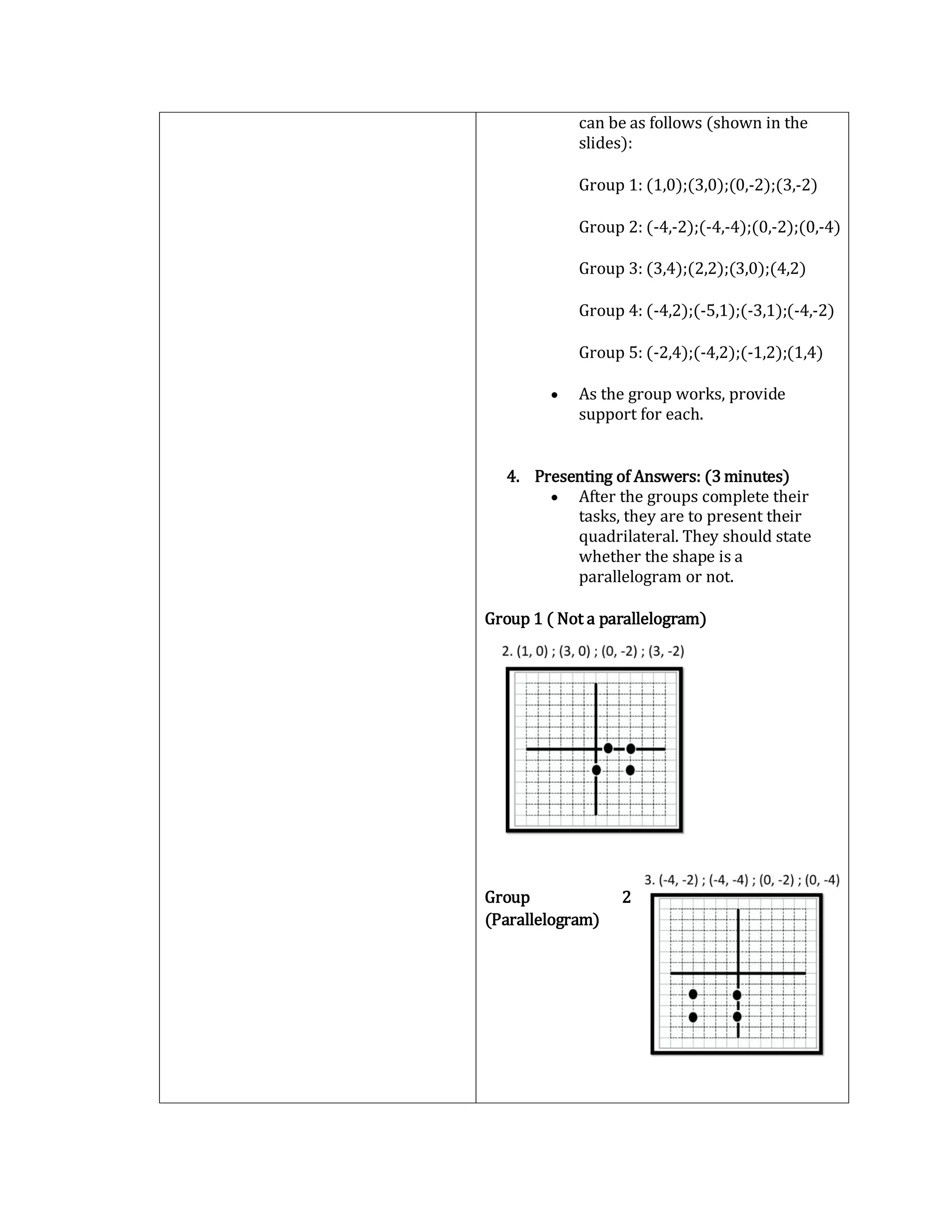
Group 1: (1,0);(3,0);(0,-2);(3,-2)
Group 2: (-4,-2);(-4,-4);(0,-2);(0,-4)
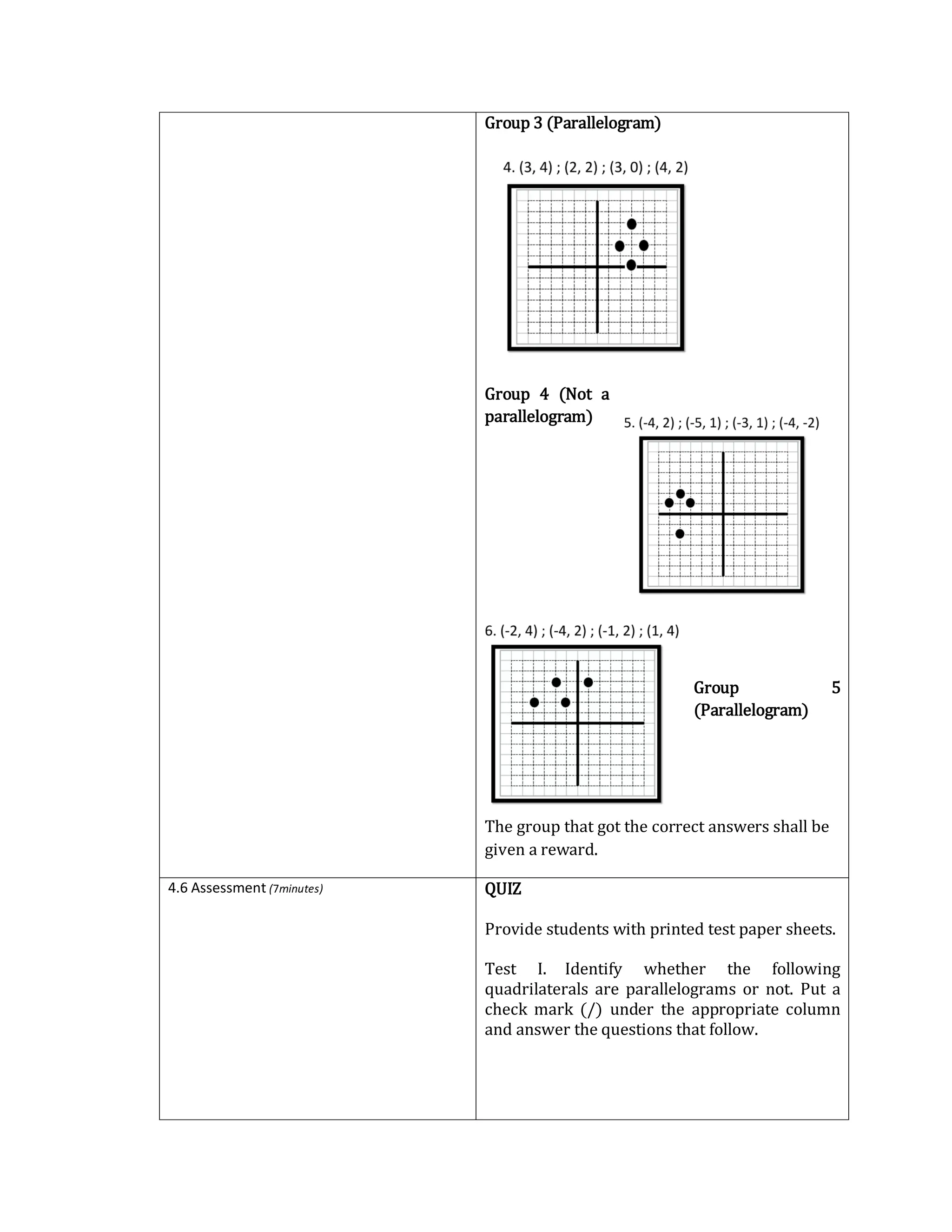
Group 3: (3,4);(2,2);(3,0);(4,2)
Group 4: (-4,2);(-5,1);(-3,1);(-4,-2)
Group 5: (-2,4);(-4,2);(-1,2);(1,4)
 As the group works, provide
support for each.
4. Presenting of Answers: (3 minutes)
 After the groups complete their
tasks, they are to present their
quadrilateral. They should state
whether the shape is a
parallelogram or not.
Group 1 ( Not a parallelogram)
Group 2
(Parallelogram)
Group 3 (Parallelogram)
Group 4 (Not a
parallelogram)
Group 5
(Parallelogram)
The group that got the correct answers shall be
given a reward.
4.6 Assessment (7minutes) QUIZ
Provide students with printed test paper sheets.
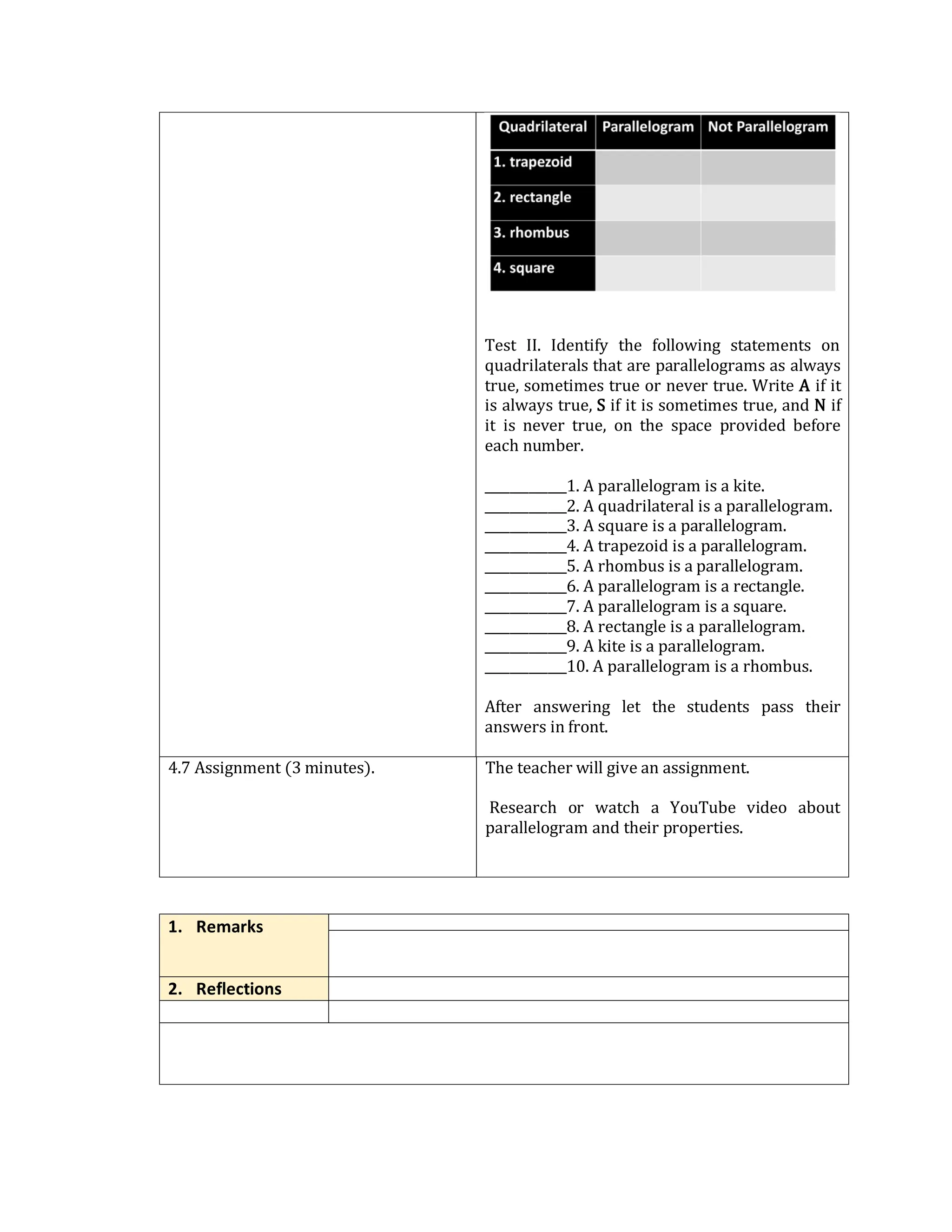
Test I. Identify whether the following
quadrilaterals are parallelograms or not. Put a
check mark (/) under the appropriate column
and answer the questions that follow.
Test II. Identify the following statements on
quadrilaterals that are parallelograms as always
true, sometimes true or never true. Write A if it
is always true, S if it is sometimes true, and N if
it is never true, on the space provided before
each number.
_____________1. A parallelogram is a kite.
_____________2. A quadrilateral is a parallelogram.
_____________3. A square is a parallelogram.
_____________4. A trapezoid is a parallelogram.
_____________5. A rhombus is a parallelogram.
_____________6. A parallelogram is a rectangle.
_____________7. A parallelogram is a square.
_____________8. A rectangle is a parallelogram.
_____________9. A kite is a parallelogram.
_____________10. A parallelogram is a rhombus.
After answering let the students pass their
answers in front.
4.7 Assignment (3 minutes). The teacher will give an assignment.
Research or watch a YouTube video about
parallelogram and their properties.
1. Remarks
2. Reflections
Prepared by:
Name: Aira P. Legaspi School: Cebu Technological University
Position/Designation: Student Division: Cebu
Contact Number: 09755489256 Email address: airalegaspi46@gmail.com
Checked by:

Detailed Lesson Plan in Grade 9 Math -Quadrilaterals

  • 1.
    Instructional Planning (iPlan) (Withinclusion of the provisions of D.O. No. 8, s. 2015 and D.O. 42, s. 2016) Detailed Lesson Plan (DLP) Format DLP No.: Learning Area: Grade Level: Quarter: Duration: 1 Mathematics 9 3rd 75 minutes Learning Competency/ies: (Taken from the Curriculum Guide) Code: Key Concepts / Understandings to be Developed A quadrilateral is a closed shape and a type of polygon that has four sides, four vertices and four angles. It is formed by joining four non- collinear points. The sum of interior angles of quadrilaterals is always equal to 360 degrees. A parallelogram is a two-dimensional geometrical shape whose sides are parallel to each other. It is a type of polygon having four sides (also called quadrilateral), where the pair of parallel sides are equal in length. Domain Adapted Cognitive Process Dimensions (D.O. No. 8, s. 2015) 1. Objectives: Within 45 minutes of interactive and collaborative activities, students with 75% accuracy level will be able to: Knowledge Categories: Remembering Identify the different types of quadrilaterals, such as squares, rectangles, rhombuses, kites, trapezoids, and parallelograms on the given examples. Understanding Skills Applying Analyzing Analyze the relationships between the properties of quadrilaterals in the given examples. Evaluating Creating
  • 2.
    Attitude Categories: 1.Receiving Phenomena 2.Responding toPhenomena 3.Valuing 4.Organization 5. Internalizing values Values Categories: 1. Receiving Phenomena 2. Responding to Phenomena 3. Valuing Appreciate the importance of geometry in everyday life by recognizing quadrilaterals in the environment. 4. Organization 5. Internalizing values 2. Content Quadrilaterals and Parallelogram 3. Learning Resources PowerPoint presentation, laptop, worksheets, graphing paper, Mathematics Curriculum Guide and Geometry textbook, name box. 4. Procedures 4.1 Introductory Activity (10 minutes) Set the mood of the learners with a prayer and an energizer. 1. Greet the class 2. Call on someone to lead the prayer. 3. Greet the class. 4. Introduce the energizer: ENERGIZER: THE FANTASTIC FOUR (With the aid of PowerPoint Presentation) Mechanics: On the next slide, you’ll see two shapes, each with an instruction above it. 1. Find the shape with exactly FOUR sides. 2. Follow the instructions above that shape. 3. The whole class should participate.
  • 3.
    Example: Demonstrate the exampleand ask the students if they understand the instructions/mechanics. “Are you ready class? Then let’s start!”
  • 4.
    Assist the studentsin the last three remaining slides of the energizer.
  • 5.
    1. Praise thestudents for the job well done. 2. Ask the secretary for absent students. 3. Introduce the questioning/participation method to the class. (box containing all of the names of the students) 4. Ask the students if they are energized and what they feel. 5. In connection with the energizer ask the following for a recap about Quadrilaterals: (Encourage students’ participation)  What did you observe during our energizer earlier? (Expected Answer: Shapes)  What are the things that we need to find? (Expected Answer: A shape that has four sides)  What do you think is our topic today? (Expected Answer: A four-sided polygons; Quadrilaterals)
  • 6.
     What doyou already know about quadrilaterals?  Examples of Quadrilaterals 4.2 Activity (10 minutes) ACTIVITY (REFRESH YOUR MIND) 1. The teacher will flash various shapes of quadrilaterals on the screen one at a time. 2. A student’s name will be randomly selected from a box containing the names of all students. 3. The selected student will:  Identify the name or type of quadrilateral shown.  Briefly describe or define its properties. Expected Answers/Response:
  • 7.
    4.3 Lesson Development(25 minutes) 1. Introduction to Quadrilaterals (5 minutes) Begin by defining what quadrilaterals are: “Is a closed shape and a type of polygon that has four sides, four vertices and four angles. It is formed by joining four non-collinear points. The sum of interior angles of quadrilaterals is always equal to 360 degrees”. Use a PowerPoint slide to illustrate various quadrilaterals (e.g., kite, rhombus, parallelogram, rectangle, square). Emphasize that all of these shapes are classified as quadrilaterals. 2. Types of Quadrilaterals (5 minutes) Briefly explain each type of quadrilateral, focusing on their characteristics:  Parallelogram: A quadrilateral with opposite sides that are both equal and parallel.  Rectangle: A parallelogram with four right angles.  Square: A rectangle with all four sides of equal length.  Rhombus: A parallelogram with all four sides of equal length.  Kite: A quadrilateral with two pairs of adjacent sides that are equal.  Trapezoid: A quadrilateral with two sides are parallel.
  • 8.
    As you explaineach type, reference visuals in the PowerPoint that depict these shapes, fostering visual learning. 3. Properties ofParallelogram (10 minutes) Use a comprehensive PowerPoint slide listing all properties of parallelograms, including: a) In a parallelogram, any two opposite sides are congruent. b) In a parallelogram, any two opposite angles are congruent. c) In a parallelogram, any two consecutive angles are supplementary. d) The diagonals of a parallelogram bisect each other. e) A diagonal of a parallelogram forms two congruent triangles. Engaging Example for Each Property: As you discuss each property, write out a brief example on the board for visual clarity: a) Example for any two opposite sides are congruent: Draw a rectangle and label sides AB = CD, AD || BC. b) Example for any two opposite angles are congruent: Draw a rhombus and label angles ∠A = ∠C, ∠B = ∠D. c) Example for Consecutive Angles Supplementary: Use a rectangle to show that ∠A + ∠B = 180°. d) Example for Diagonal Bisection: Draw a parallelogram and show that diagonals AC and BD meet at point O, with AO = OC and BO = OD. e) Example for Congruent Triangles: Label triangles AOB and COD formed by diagonals in your parallelogram illustration. 4. Example Problem (5 minutes) Write the following example on the board: "In parallelogram ABCD, if AB = 8 cm, BC = 5
  • 9.
    cm, and ∠A= 70°, find AB, AD, and angle D." Explain how to approach this problem step-by- step: Identify that since AB = CD (opposite sides), CD must also equal 8 cm. Confirm that since BC = AD (opposite sides), AD must equal 5 cm. Explain that opposite angles are equal, so ∠C will also be 70°. To find ∠D, use the property that consecutive angles are supplementary: ∠A + ∠B = 180°, therefore ∠B = 180° - 70° = 110°; consequently, ∠D will also equal 110°. Encourage students to ask questions about each property and visualize the relationships you'll be discussing in the next sections of the lesson. 4.4 Abstraction (5 minutes) In summarization, discuss the following: (requires student participation) Students are encouraged to visualize these relationships using a flowchart.  Quadrilaterals  Parallelogram  Properties of Parallelogram a) In a parallelogram, any two opposite sides are congruent. b) In a parallelogram, any two opposite angles are congruent. c) In a parallelogram, any two consecutive angles are supplementary. d) The diagonals of a parallelogram bisect
  • 10.
    each other. e) Adiagonal of a parallelogram forms two congruent triangles.
  • 11.
    4.5 Application (15minutes) GROUP ACTIVITY: PLOT, CONNECT, IDENTIFY 1. Introduction to the Activity (2 minutes):  Directions will be shown in the PowerPoint Presentation.  Briefly explain the task: “Today, you will work in groups to plot points on a graph, connect them to create quadrilaterals, and determine if the figures you create are parallelograms. Remember to think about the properties of the shapes as you plot and connect!” 2. Demonstration of Example(3 minutes):  On the blackboard, write the set of points: (-1, 2), (-1, 0), (1, 0), (1, 2).  Demonstrate how to plot each point on the graph:  Start with the x-axis and find -1 (left), then move up to 2 to place the first point.  Continue this for each point, explaining how to read the coordinates.  After plotting all points, use a ruler to connect them in the given order. Discuss the resulting figure with the students, asking questions like:  “What kind of quadrilateral do we have here?”  “How do you know it’s a parallelogram?” 3. Group Activity (7 minutes):  Group the students into five groups and assign seats afterward.  Provide each group with a printed graphing paper and a new set of points to plot. The sets of points
  • 12.
    can be asfollows (shown in the slides): Group 1: (1,0);(3,0);(0,-2);(3,-2) Group 2: (-4,-2);(-4,-4);(0,-2);(0,-4) Group 3: (3,4);(2,2);(3,0);(4,2) Group 4: (-4,2);(-5,1);(-3,1);(-4,-2) Group 5: (-2,4);(-4,2);(-1,2);(1,4)  As the group works, provide support for each. 4. Presenting of Answers: (3 minutes)  After the groups complete their tasks, they are to present their quadrilateral. They should state whether the shape is a parallelogram or not. Group 1 ( Not a parallelogram) Group 2 (Parallelogram)
  • 13.
    Group 3 (Parallelogram) Group4 (Not a parallelogram) Group 5 (Parallelogram) The group that got the correct answers shall be given a reward. 4.6 Assessment (7minutes) QUIZ Provide students with printed test paper sheets. Test I. Identify whether the following quadrilaterals are parallelograms or not. Put a check mark (/) under the appropriate column and answer the questions that follow.
  • 14.
    Test II. Identifythe following statements on quadrilaterals that are parallelograms as always true, sometimes true or never true. Write A if it is always true, S if it is sometimes true, and N if it is never true, on the space provided before each number. _____________1. A parallelogram is a kite. _____________2. A quadrilateral is a parallelogram. _____________3. A square is a parallelogram. _____________4. A trapezoid is a parallelogram. _____________5. A rhombus is a parallelogram. _____________6. A parallelogram is a rectangle. _____________7. A parallelogram is a square. _____________8. A rectangle is a parallelogram. _____________9. A kite is a parallelogram. _____________10. A parallelogram is a rhombus. After answering let the students pass their answers in front. 4.7 Assignment (3 minutes). The teacher will give an assignment. Research or watch a YouTube video about parallelogram and their properties. 1. Remarks 2. Reflections
  • 15.
    Prepared by: Name: AiraP. Legaspi School: Cebu Technological University Position/Designation: Student Division: Cebu Contact Number: 09755489256 Email address: airalegaspi46@gmail.com Checked by: