Bahauddin Zakariya University Multan – Bahadur Sub Campus, Layyah
Course: Philosophy
Presented to: Mr. Riaz Khan Dasti
Presented by: Malik Muhammad Ali
Roll no. BSENL-17-25
Topic: Argument Forms
Argument form:
The statement of the propositional calculus are propositions, they can
be combined to form logical arguments, complete with one or more
premises and a single conclusion that may follow validity from them.
For example A É B (D.B) É ~E (𝐴Ú𝐸) É (DºB)
𝐴
𝐵
𝐷.𝐵
~E
𝐴Ú𝐸
𝐷ºB
All the three arguments share a same structure. The main É is the first
premises of each statement, the second statement is the antecedent of
that statement; and the conclusion is the consequent. We can exhibit it
more clearly as p É q:
𝑝
𝑞
Many arguments are the substitution of a same argument from. We can
see from above example. If we change B . D then B . D will be the first
premises of second argument.
Testing Validity:
Recognizing individual arguments as substitution-instances of more
general argument forms are an important skill because, as we’ve
already seen, the validity of any argument depends solely upon its
logical form. It is also the form of argument when all the premises are
right but the conclusion is false. The same truth table is used for this to
determine the argument form. If all the possible combination of truth
table is true and it verifies the conclusion then it will be valid and it will
be a valid form of argument. If all the structure of premises is true but
the conclusion is false then it is invalid and argument form is invalid.
Modus Ponens:
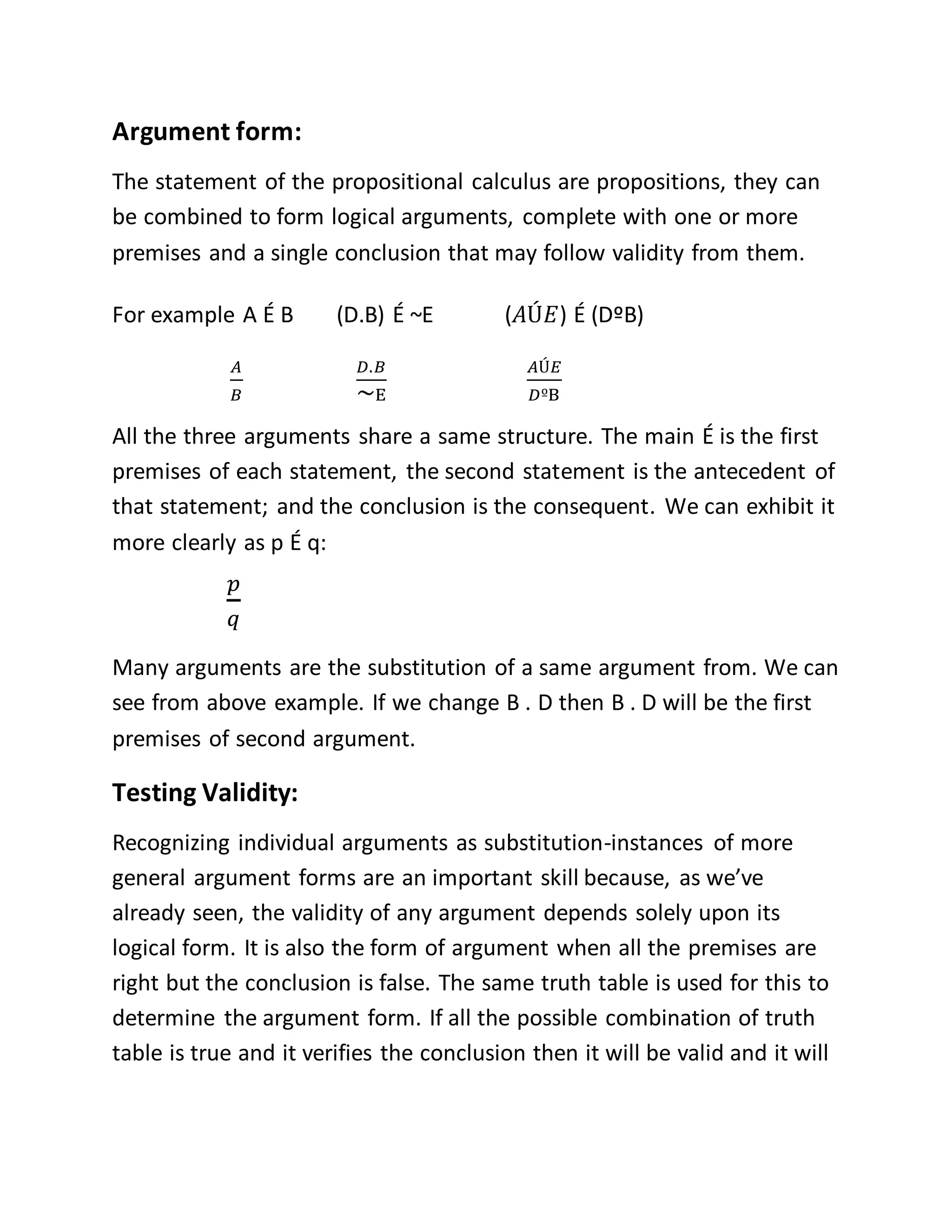
Consider an example when we construct a truth-table that lits each of
the four combinations of truth-table. Where p É q
𝑝
𝑞
1st
Premise 2nd
Premise Conclusion
p q p É q p Q
T T T T T
T F F T F
F T T F T
F F T F F
In mathematics (calculus) it is also called implication or conditional. In
this the conclusion will only false when hypothesis is true and
conclusion is false.
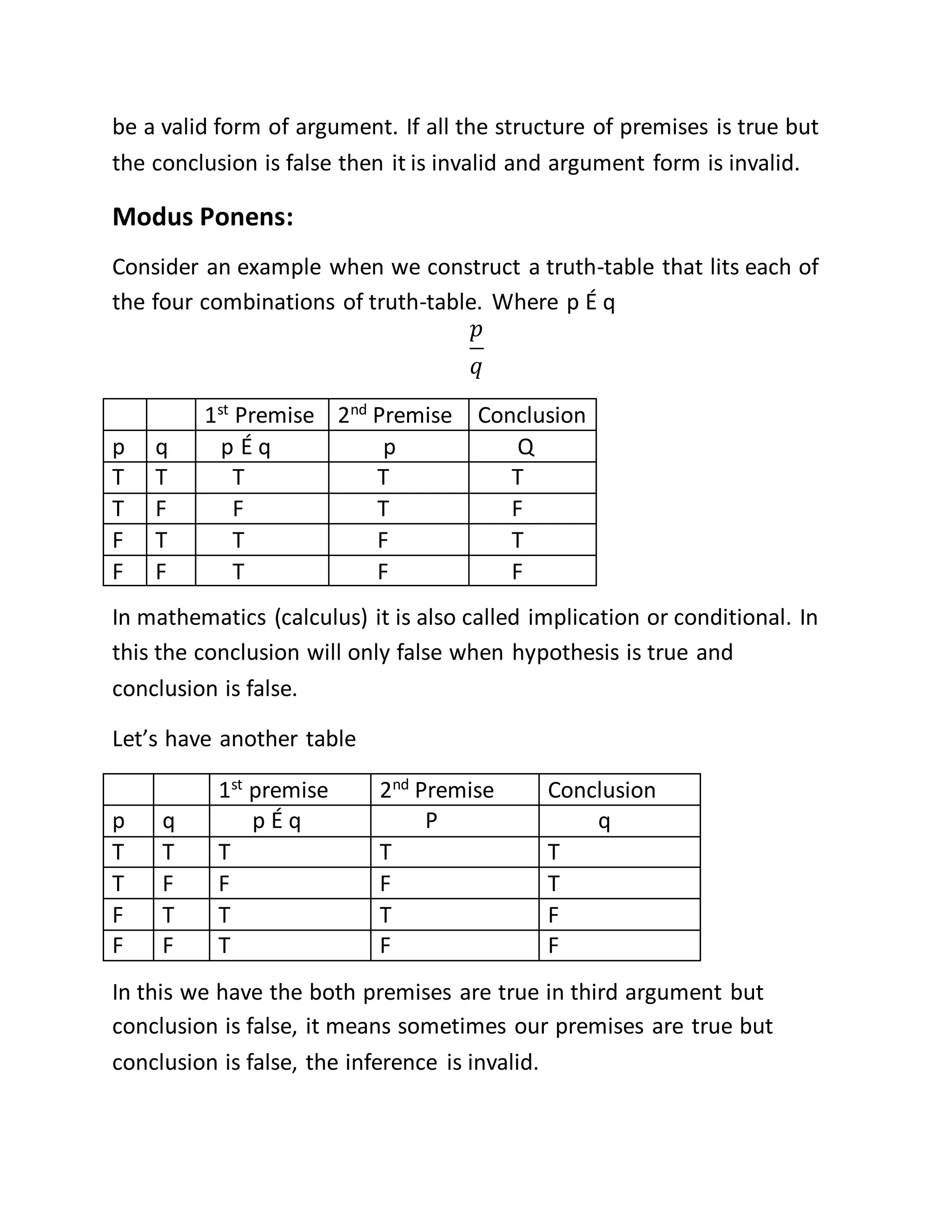
Let’s have another table
1st premise 2nd Premise Conclusion
p q p É q P q
T T T T T
T F F F T
F T T T F
F F T F F
In this we have the both premises are true in third argument but
conclusion is false, it means sometimes our premises are true but
conclusion is false, the inference is invalid.
E.g. 1. If the moon is made of blue cheese, then pig fly.
2. The moon is made of blue cheese.
3. Therefore, pigs fly. This forms argument as follow as p → q
Modus Tollens:
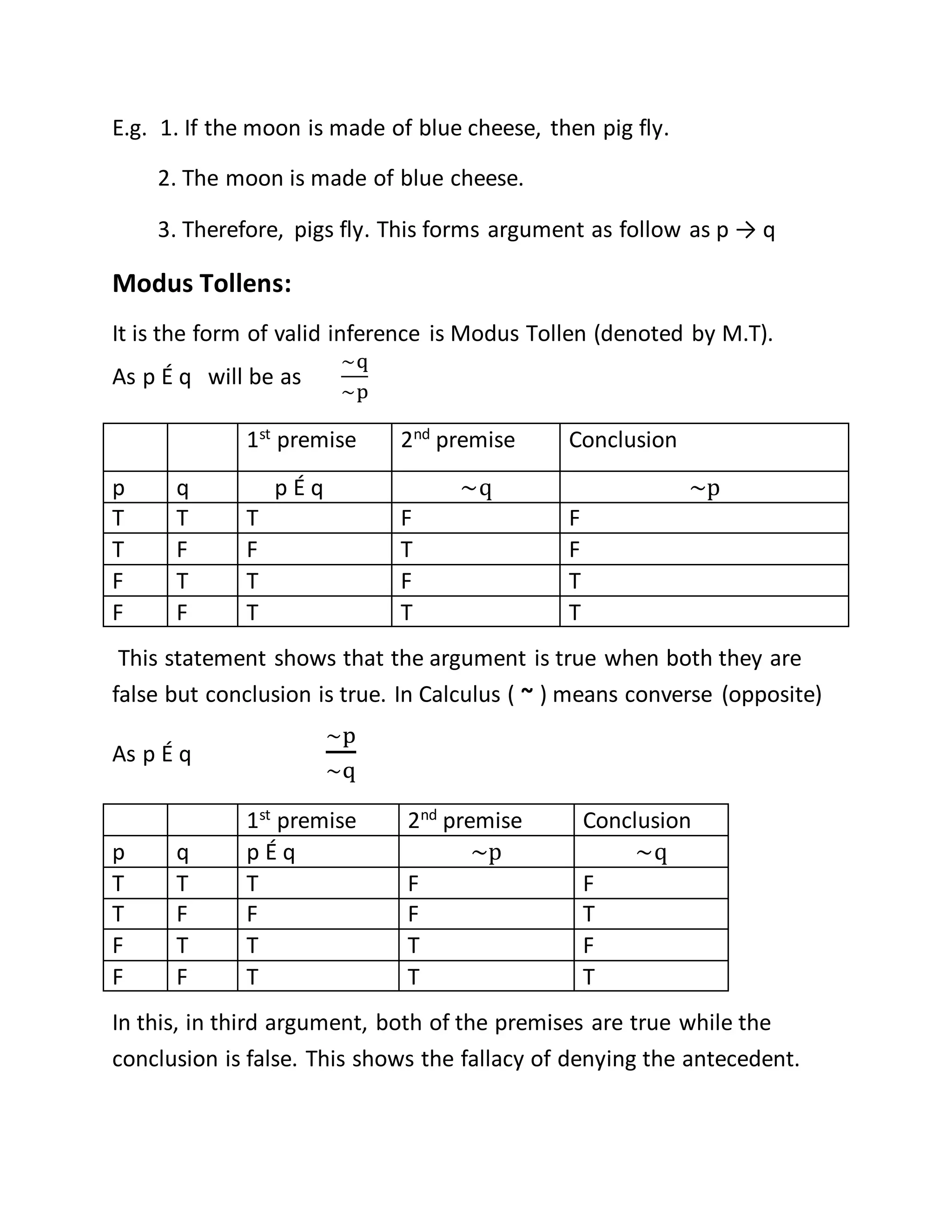
It is the form of valid inference is Modus Tollen (denoted by M.T).
As p É q will be as
~q
~p
1st
premise 2nd
premise Conclusion
p q p É q ~q ~p
T T T F F
T F F T F
F T T F T
F F T T T
This statement shows that the argument is true when both they are
false but conclusion is true. In Calculus ( ~ ) means converse (opposite)
As p É q
~p
~q
1st
premise 2nd
premise Conclusion
p q p É q ~p ~q
T T T F F
T F F F T
F T T T F
F F T T T
In this, in third argument, both of the premises are true while the
conclusion is false. This shows the fallacy of denying the antecedent.
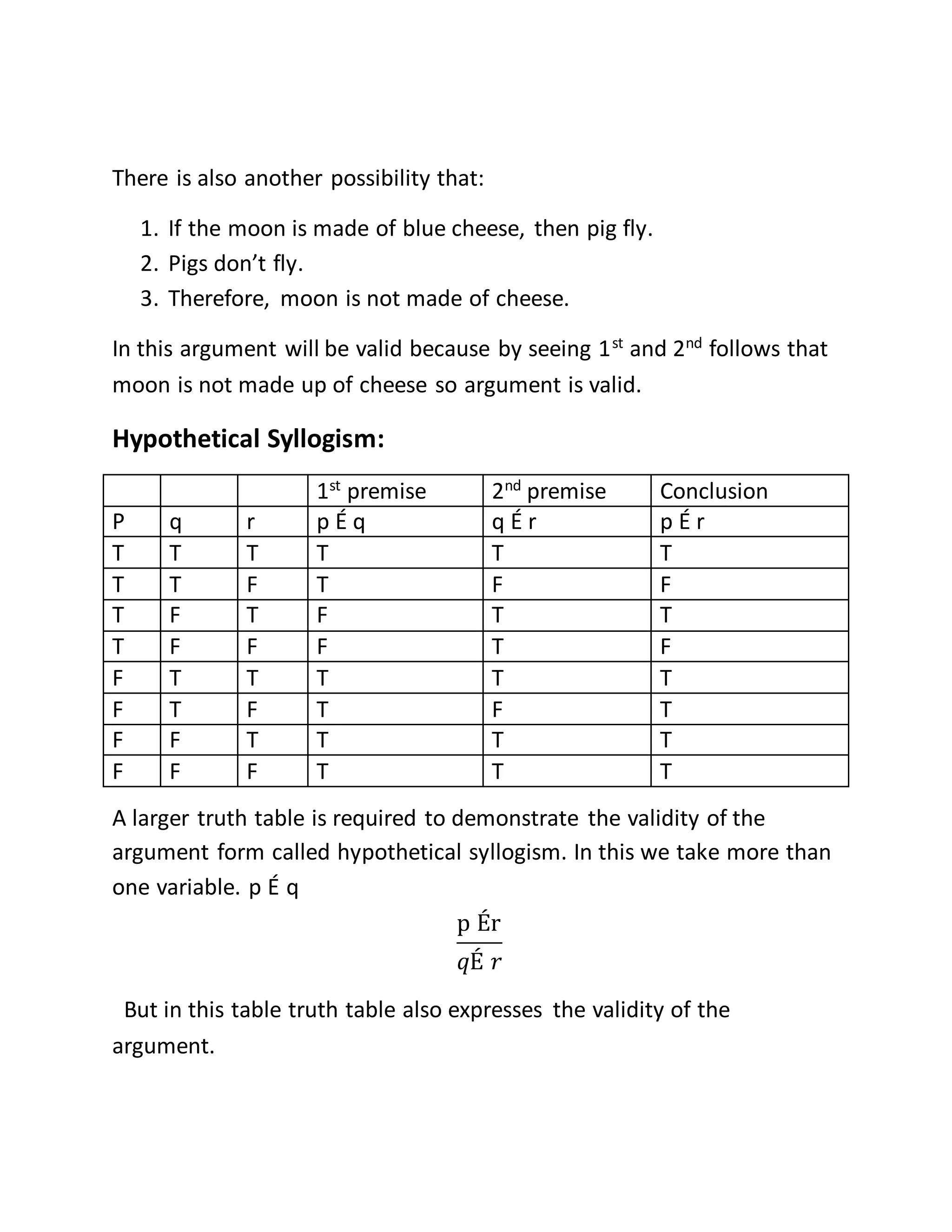
There is also another possibility that:
1. If the moon is made of blue cheese, then pig fly.
2. Pigs don’t fly.
3. Therefore, moon is not made of cheese.
In this argument will be valid because by seeing 1st
and 2nd
follows that
moon is not made up of cheese so argument is valid.
Hypothetical Syllogism:
1st
premise 2nd
premise Conclusion
P q r p É q q É r p É r
T T T T T T
T T F T F F
T F T F T T
T F F F T F
F T T T T T
F T F T F T
F F T T T T
F F F T T T
A larger truth table is required to demonstrate the validity of the
argument form called hypothetical syllogism. In this we take more than
one variable. p É q
p Ér
𝑞É 𝑟
But in this table truth table also expresses the validity of the
argument.
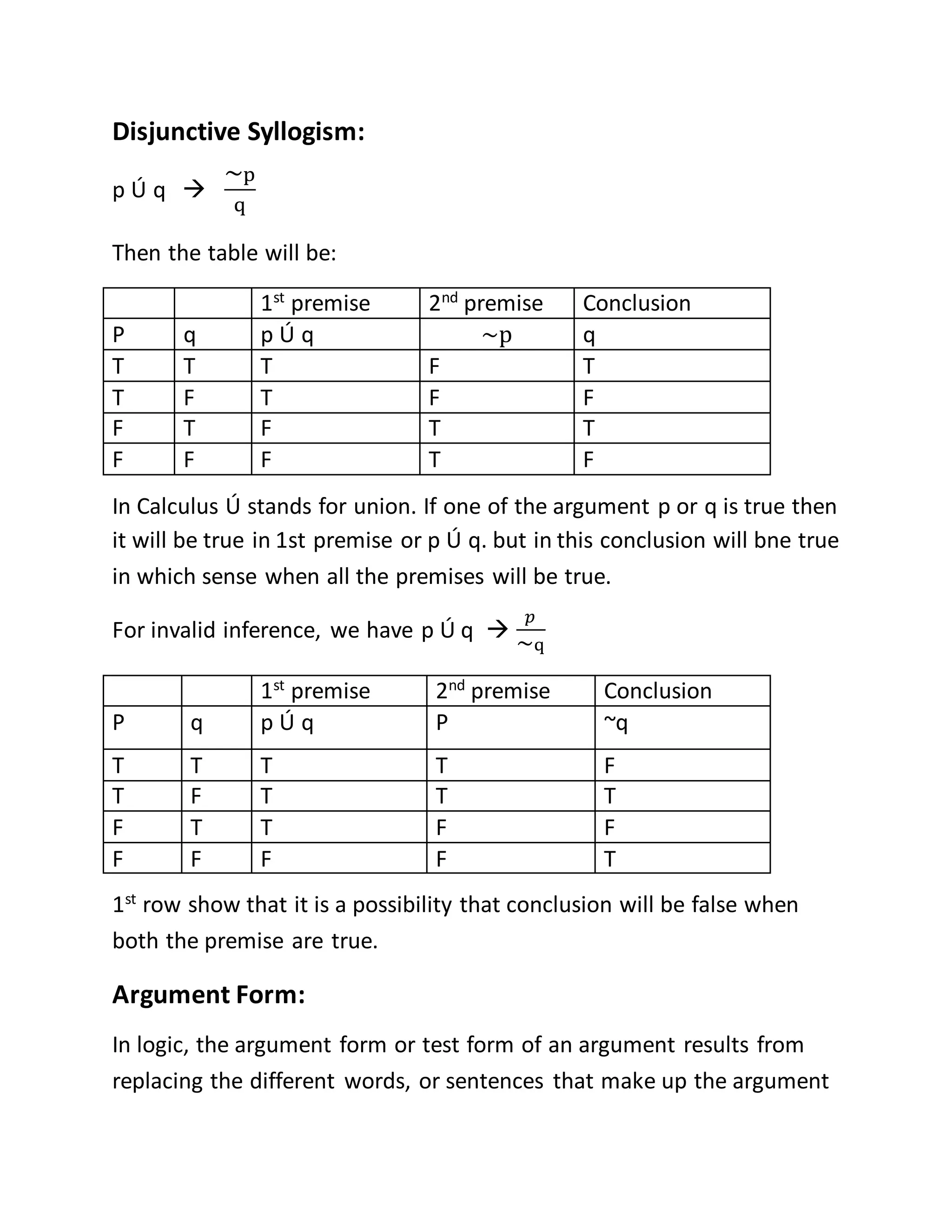
Disjunctive Syllogism:
p Ú q 
~p
q
Then the table will be:
1st
premise 2nd
premise Conclusion
P q p Ú q ~p q
T T T F T
T F T F F
F T F T T
F F F T F
In Calculus Ú stands for union. If one of the argument p or q is true then
it will be true in 1st premise or p Ú q. but in this conclusion will bne true
in which sense when all the premises will be true.
For invalid inference, we have p Ú q 
𝑝
~q
1st
premise 2nd
premise Conclusion
P q p Ú q P ~q
T T T T F
T F T T T
F T T F F
F F F F T
1st
row show that it is a possibility that conclusion will be false when
both the premise are true.
Argument Form:
In logic, the argument form or test form of an argument results from
replacing the different words, or sentences that make up the argument
With letters, along the line of algebra; the letters represent logical
variables.
Here is an example:
A
All humans are mortal. Socrates is human. Therefore, Socrates is
mortal. By re-writing the arguments.
B
All humans are mortal.
Socrates is human.
Therefore, Socrates is mortal.
Replace them with letters.
C
All S are P.
A is S.
Therefore a is P.
In this we have used S for human or humans, P for mortal and a for
Socrates. In this C is the original form of argument in A. we must have
to consider one thing that form of argument is what makes an
argument valid or cogent.
Logic Keys:
“Not” is symbolized as ¬
“If-then” is symbolized as →
“and” is symbolized as ˄
“or” is symbolized as ˅
“if and only if” is symbolized as ↔
The major task of logic is to deduct the logical consequences of a set of
sentences. In this order we have to identify the logic in logical
sentences.
If the premises are intended to provide conclusive support for the
conclusion, the argument is deductive one. If the premises are
intended to support the conclusion only to a lesser degree, the
argument is inductive one.
Immediate Inference:
The simplest possible arguments that can be constructed from
categorical propositions are those with one premise and, one
conclusion.
A: All A’s are B’s. All B’s are A’s
E: No A’s are B’s. No B’s are A’s.
I: Some A’s are not B’s. Some B’s are not A’s.
O: Some A’s are not B’s. Some B’s are not A’s.
i
No snakes are birds. Some pets are cats.
No birds are snakes.
Some pets are cats.
By immediate inferences we analyze the complex form of argument.
Categorical Syllogism:
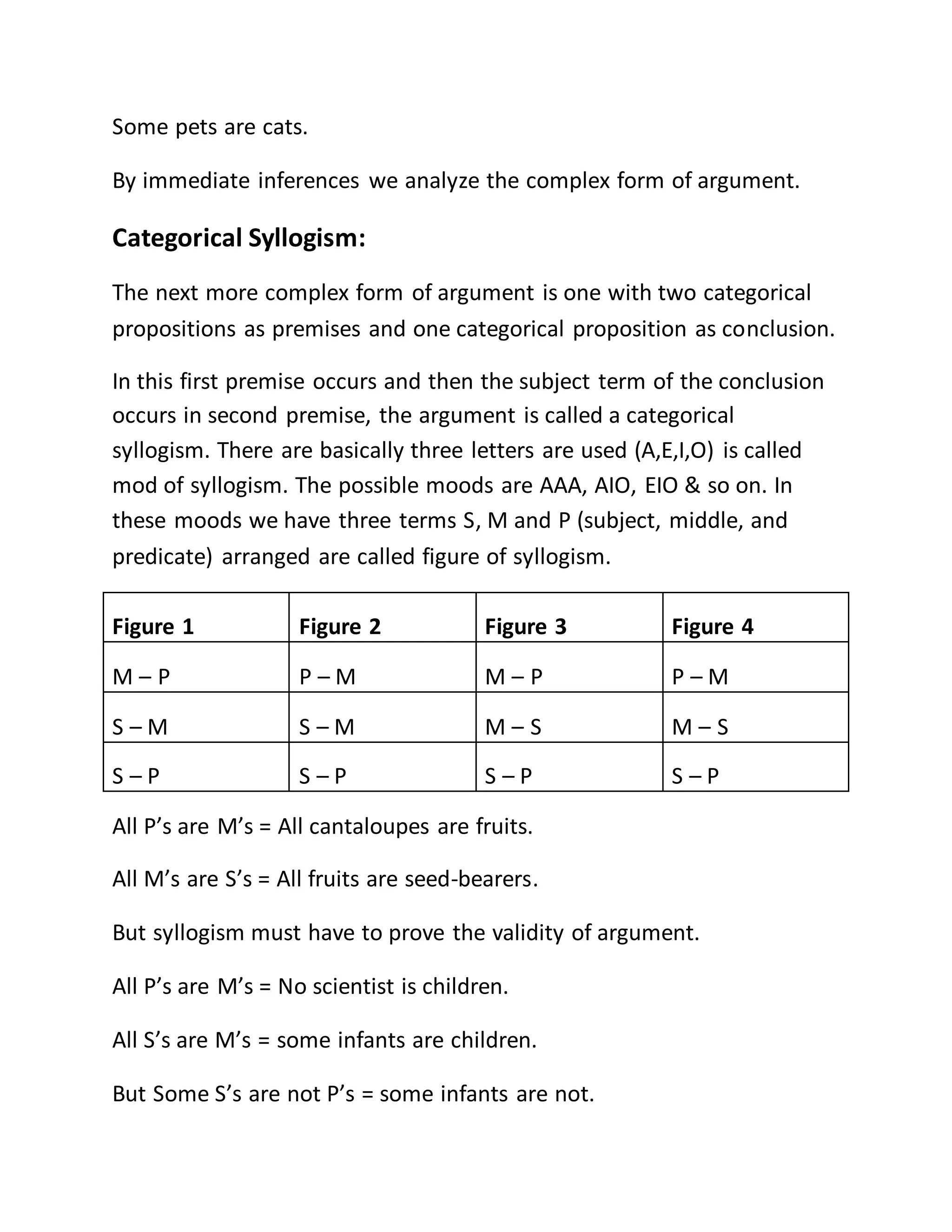
The next more complex form of argument is one with two categorical
propositions as premises and one categorical proposition as conclusion.
In this first premise occurs and then the subject term of the conclusion
occurs in second premise, the argument is called a categorical
syllogism. There are basically three letters are used (A,E,I,O) is called
mod of syllogism. The possible moods are AAA, AIO, EIO & so on. In
these moods we have three terms S, M and P (subject, middle, and
predicate) arranged are called figure of syllogism.
Figure 1 Figure 2 Figure 3 Figure 4
M – P P – M M – P P – M
S – M S – M M – S M – S
S – P S – P S – P S – P
All P’s are M’s = All cantaloupes are fruits.
All M’s are S’s = All fruits are seed-bearers.
But syllogism must have to prove the validity of argument.
All P’s are M’s = No scientist is children.
All S’s are M’s = some infants are children.
But Some S’s are not P’s = some infants are not.
References:
1- http:/www.scribd.com > doc > The-Professional-Qualities (7/6/19)
2- http:/cms.gcg11.ac.in > attachments > articles_on_professional-
qualities (4/6/19)
3- http:/en.m.eikipedia.com > Human_Rights > Fitting_Personality (7/6/19)
4- http:/www.theradicalacademy.org/personality_traits (1/6/19).
5- http:/www.scribd.com > Books of personality_and_professional
qualities

Argument Forms

  • 1.
    Bahauddin Zakariya UniversityMultan – Bahadur Sub Campus, Layyah Course: Philosophy Presented to: Mr. Riaz Khan Dasti Presented by: Malik Muhammad Ali Roll no. BSENL-17-25 Topic: Argument Forms
  • 2.
    Argument form: The statementof the propositional calculus are propositions, they can be combined to form logical arguments, complete with one or more premises and a single conclusion that may follow validity from them. For example A É B (D.B) É ~E (𝐴Ú𝐸) É (DºB) 𝐴 𝐵 𝐷.𝐵 ~E 𝐴Ú𝐸 𝐷ºB All the three arguments share a same structure. The main É is the first premises of each statement, the second statement is the antecedent of that statement; and the conclusion is the consequent. We can exhibit it more clearly as p É q: 𝑝 𝑞 Many arguments are the substitution of a same argument from. We can see from above example. If we change B . D then B . D will be the first premises of second argument. Testing Validity: Recognizing individual arguments as substitution-instances of more general argument forms are an important skill because, as we’ve already seen, the validity of any argument depends solely upon its logical form. It is also the form of argument when all the premises are right but the conclusion is false. The same truth table is used for this to determine the argument form. If all the possible combination of truth table is true and it verifies the conclusion then it will be valid and it will
  • 3.
    be a validform of argument. If all the structure of premises is true but the conclusion is false then it is invalid and argument form is invalid. Modus Ponens: Consider an example when we construct a truth-table that lits each of the four combinations of truth-table. Where p É q 𝑝 𝑞 1st Premise 2nd Premise Conclusion p q p É q p Q T T T T T T F F T F F T T F T F F T F F In mathematics (calculus) it is also called implication or conditional. In this the conclusion will only false when hypothesis is true and conclusion is false. Let’s have another table 1st premise 2nd Premise Conclusion p q p É q P q T T T T T T F F F T F T T T F F F T F F In this we have the both premises are true in third argument but conclusion is false, it means sometimes our premises are true but conclusion is false, the inference is invalid.
  • 4.
    E.g. 1. Ifthe moon is made of blue cheese, then pig fly. 2. The moon is made of blue cheese. 3. Therefore, pigs fly. This forms argument as follow as p → q Modus Tollens: It is the form of valid inference is Modus Tollen (denoted by M.T). As p É q will be as ~q ~p 1st premise 2nd premise Conclusion p q p É q ~q ~p T T T F F T F F T F F T T F T F F T T T This statement shows that the argument is true when both they are false but conclusion is true. In Calculus ( ~ ) means converse (opposite) As p É q ~p ~q 1st premise 2nd premise Conclusion p q p É q ~p ~q T T T F F T F F F T F T T T F F F T T T In this, in third argument, both of the premises are true while the conclusion is false. This shows the fallacy of denying the antecedent.
  • 5.
    There is alsoanother possibility that: 1. If the moon is made of blue cheese, then pig fly. 2. Pigs don’t fly. 3. Therefore, moon is not made of cheese. In this argument will be valid because by seeing 1st and 2nd follows that moon is not made up of cheese so argument is valid. Hypothetical Syllogism: 1st premise 2nd premise Conclusion P q r p É q q É r p É r T T T T T T T T F T F F T F T F T T T F F F T F F T T T T T F T F T F T F F T T T T F F F T T T A larger truth table is required to demonstrate the validity of the argument form called hypothetical syllogism. In this we take more than one variable. p É q p Ér 𝑞É 𝑟 But in this table truth table also expresses the validity of the argument.
  • 6.
    Disjunctive Syllogism: p Úq  ~p q Then the table will be: 1st premise 2nd premise Conclusion P q p Ú q ~p q T T T F T T F T F F F T F T T F F F T F In Calculus Ú stands for union. If one of the argument p or q is true then it will be true in 1st premise or p Ú q. but in this conclusion will bne true in which sense when all the premises will be true. For invalid inference, we have p Ú q  𝑝 ~q 1st premise 2nd premise Conclusion P q p Ú q P ~q T T T T F T F T T T F T T F F F F F F T 1st row show that it is a possibility that conclusion will be false when both the premise are true. Argument Form: In logic, the argument form or test form of an argument results from replacing the different words, or sentences that make up the argument
  • 7.
    With letters, alongthe line of algebra; the letters represent logical variables. Here is an example: A All humans are mortal. Socrates is human. Therefore, Socrates is mortal. By re-writing the arguments. B All humans are mortal. Socrates is human. Therefore, Socrates is mortal. Replace them with letters. C All S are P. A is S. Therefore a is P. In this we have used S for human or humans, P for mortal and a for Socrates. In this C is the original form of argument in A. we must have to consider one thing that form of argument is what makes an argument valid or cogent. Logic Keys: “Not” is symbolized as ¬
  • 8.
    “If-then” is symbolizedas → “and” is symbolized as ˄ “or” is symbolized as ˅ “if and only if” is symbolized as ↔ The major task of logic is to deduct the logical consequences of a set of sentences. In this order we have to identify the logic in logical sentences. If the premises are intended to provide conclusive support for the conclusion, the argument is deductive one. If the premises are intended to support the conclusion only to a lesser degree, the argument is inductive one. Immediate Inference: The simplest possible arguments that can be constructed from categorical propositions are those with one premise and, one conclusion. A: All A’s are B’s. All B’s are A’s E: No A’s are B’s. No B’s are A’s. I: Some A’s are not B’s. Some B’s are not A’s. O: Some A’s are not B’s. Some B’s are not A’s. i No snakes are birds. Some pets are cats. No birds are snakes.
  • 9.
    Some pets arecats. By immediate inferences we analyze the complex form of argument. Categorical Syllogism: The next more complex form of argument is one with two categorical propositions as premises and one categorical proposition as conclusion. In this first premise occurs and then the subject term of the conclusion occurs in second premise, the argument is called a categorical syllogism. There are basically three letters are used (A,E,I,O) is called mod of syllogism. The possible moods are AAA, AIO, EIO & so on. In these moods we have three terms S, M and P (subject, middle, and predicate) arranged are called figure of syllogism. Figure 1 Figure 2 Figure 3 Figure 4 M – P P – M M – P P – M S – M S – M M – S M – S S – P S – P S – P S – P All P’s are M’s = All cantaloupes are fruits. All M’s are S’s = All fruits are seed-bearers. But syllogism must have to prove the validity of argument. All P’s are M’s = No scientist is children. All S’s are M’s = some infants are children. But Some S’s are not P’s = some infants are not.
  • 10.
    References: 1- http:/www.scribd.com >doc > The-Professional-Qualities (7/6/19) 2- http:/cms.gcg11.ac.in > attachments > articles_on_professional- qualities (4/6/19) 3- http:/en.m.eikipedia.com > Human_Rights > Fitting_Personality (7/6/19) 4- http:/www.theradicalacademy.org/personality_traits (1/6/19). 5- http:/www.scribd.com > Books of personality_and_professional qualities