Downloaded 604 times
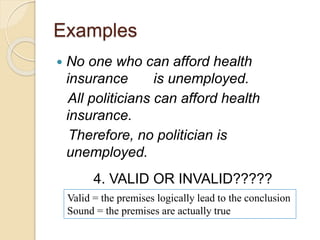
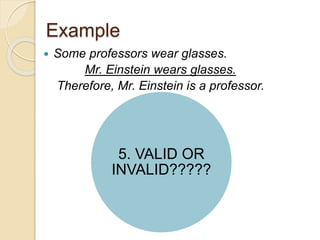
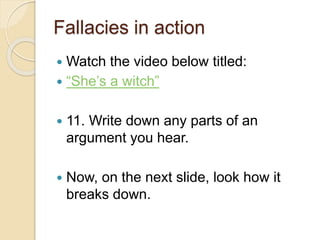
![The argument
First, inductive – the mob attempts to
arrive at conclusion by using evidence
◦ Witch’s nose, clothing, hat, and wart
◦ All false premises except wart
◦ Non-witches have warts
1. The failed inductive argument:
The woman has a witch's nose, (false premise)
2. and [she is wearing] witch's clothing, (false premise)
3. and [she is wearing] a witch's hat. (false premise)
4. She has a wart (insufficient for the conclusion)
5. Only witches have witches' noses, clothing, hats, and warts.
6. Therefore, she's a witch!](https://image.slidesharecdn.com/inductiveanddeductiveforonlineclass-141121220821-conversion-gate02/85/Inductive-Deductive-and-Fallacies-29-320.jpg)
![Sir Bedevere's Deductive
Argument
1. If she weighs the same as a duck, she'll float. (false, confuses
weight with density)
2. she does weigh the same as a duck; (true in this case, if the scales
are to be trusted)
3. [conclusion #1] Therefore, she'll float. (valid but unsound)
4. If she floats, she is made of wood. (false, many other things float)
5. She does float; (false/based on conclusion #1)
6. [conclusion #2] Therefore, she's made of wood. (valid but unsound)
7. If she's made of wood, she's a witch. (assumed by all in the scene to
be true)
8. She is made of wood; (false/based on conclusion #2)
9. [conclusion #3] Therefore, she's a witch! (valid but unsound)
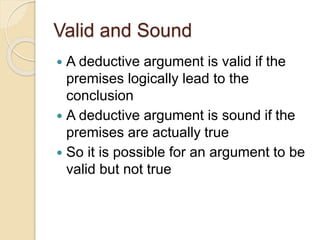
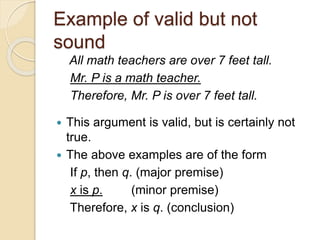
Valid = the premises logically lead to the conclusion
Sound = the premises are actually true
Slides 35 and 36 from Mooney’s Theology Blog](https://image.slidesharecdn.com/inductiveanddeductiveforonlineclass-141121220821-conversion-gate02/85/Inductive-Deductive-and-Fallacies-30-320.jpg)
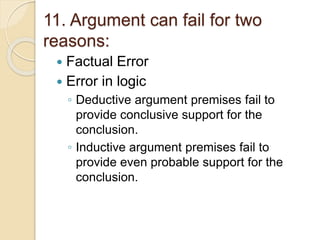
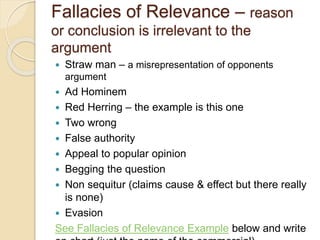
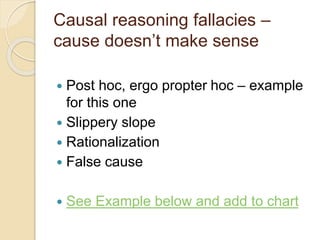
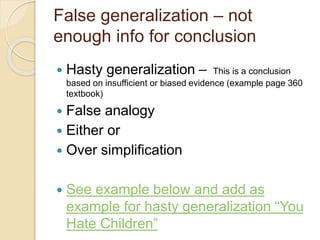
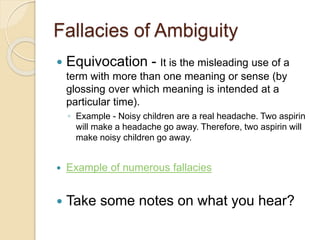
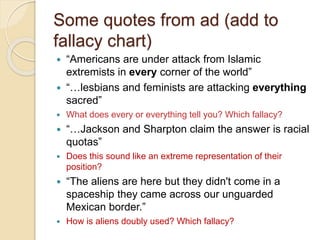
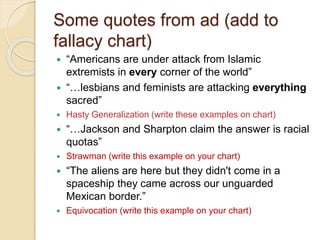

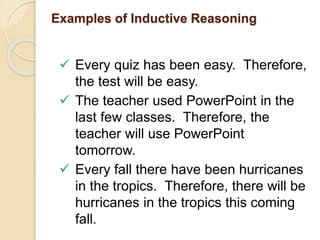
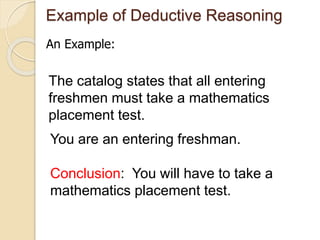
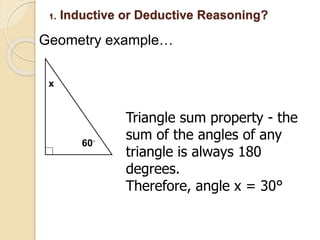
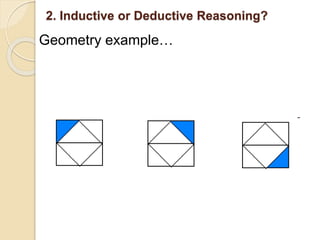
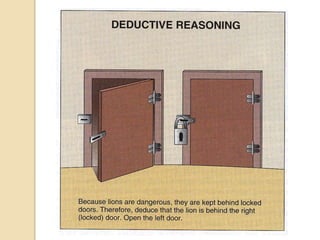
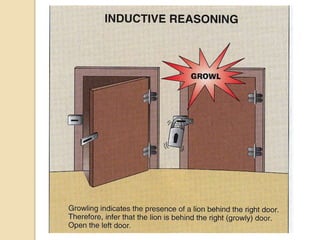
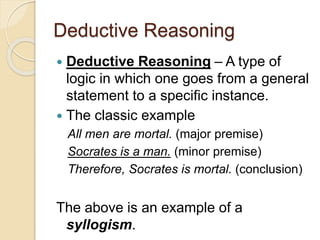
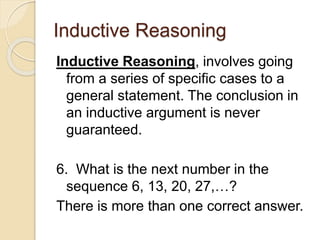
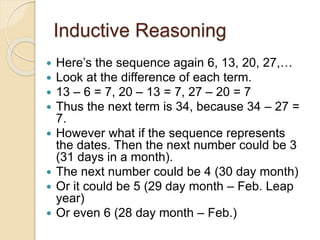
The document discusses different types of reasoning and logical fallacies. It begins by defining deductive reasoning, which uses facts and rules to arrive at a conclusion, and inductive reasoning, which uses patterns to arrive at a conjecture. Examples of each are provided. Common fallacies are also explained, including fallacies of relevance where the argument is irrelevant, causal fallacies where the cause does not make logical sense, false generalizations from insufficient evidence, and fallacies of ambiguity from equivocal language. Overall, the document provides an overview of deductive and inductive reasoning as well as common logical fallacies that can undermine arguments.


