Image Source: http://www.noosaconcepts.com.au
Image Source: Google Images
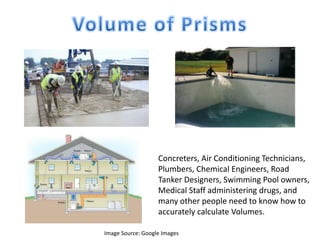
Concreters, Air Conditioning Technicians,
Plumbers, Chemical Engineers, Road
Tanker Designers, Swimming Pool owners,
Medical Staff administering drugs, and
many other people need to know how to
accurately calculate Volumes.
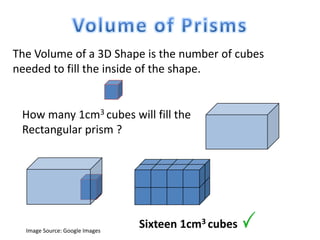
How many 1cm3 cubes will fill the
Rectangular prism ?
The Volume of a 3D Shape is the number of cubes
needed to fill the inside of the shape.
Sixteen 1cm3 cubesImage Source: Google Images
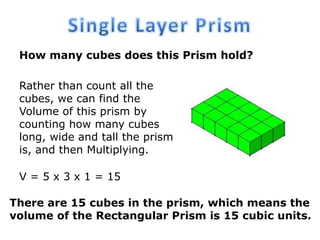
How many cubes does this Prism hold?
Rather than count all the
cubes, we can find the
Volume of this prism by
counting how many cubes
long, wide and tall the prism
is, and then Multiplying.
V = 5 x 3 x 1 = 15
There are 15 cubes in the prism, which means the
volume of the Rectangular Prism is 15 cubic units.
How many cubes does this Prism hold?
Rather than count all the
cubes, we can find the
Volume of this prism by
counting how many cubes
long, wide, and tall the prism
is, and then Multiplying.
V = 5 x 3 x 2 = 30
There are 30 cubes in the prism, which means the
volume of the Rectangular Prism is 30 cubic units.
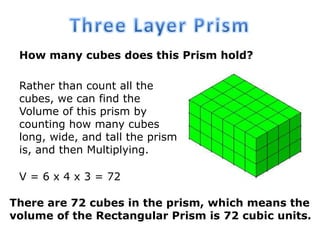
How many cubes does this Prism hold?
Rather than count all the
cubes, we can find the
Volume of this prism by
counting how many cubes
long, wide, and tall the prism
is, and then Multiplying.
V = 6 x 4 x 3 = 72
There are 72 cubes in the prism, which means the
volume of the Rectangular Prism is 72 cubic units.
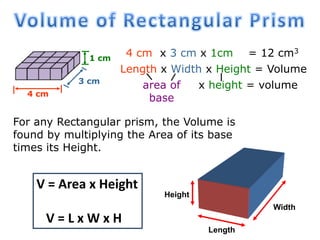
4 cm x 3 cm x 1cm = 12 cm3
Length x Width x Height = Volume
area of
base
x height = volume
For any Rectangular prism, the Volume is
found by multiplying the Area of its base
times its Height.
1 cm
4 cm
3 cm
Height
Length
Width
V = Area x Height
V = L x W x H
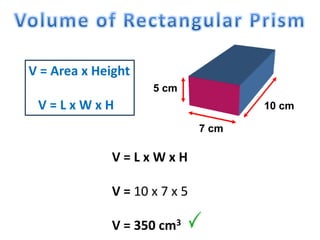
5 cm
7 cm
10 cm
V = Area x Height
V = L x W x H
V = L x W x H
V = 10 x 7 x 5
V = 350 cm3
Cylinder
Cuboid or
Rectangular
Prism
Triangular Prism
Trapezoid Prism
Volume of Prism = Area of Base x Height
Area of Base
3D Images Sourced from : http://colleenyoung.wordpress.com/
Area of Circle = π x R2
R
Area of Rectangle
= Length x Width
W
L
b
h
Area of Triangle
= ½ x base x height
h
b
Area of Trapezium
= ½ x (a + b) x h
a
Area of Triangle = ½ x b x h
= ½ x 8 x 4
Volume = Area x Height between triangle ends
= 16 x 6
= 96 cm3
8 cm
6 cm
4 cm
4.9cm
= 16 cm2
3D Image Sourced from : http://colleenyoung.wordpress.com/
Area of Trapezium Base = ½ x(a + b) x h
= ½ x (1.5 + 6.5) x 4.2
8 cm
6.5cm
4.2 cm
= 16.8 cm2
(Do not round off decimal areas)
Volume = Area x Height between trapezium ends
= 16.8 x 8
= 134.4 cm3
= 134 cm3
3D Image Sourced from : http://colleenyoung.wordpress.com/
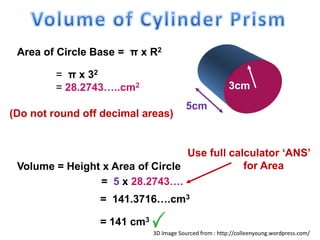
5cm
3cm
Area of Circle Base = π x R2
= π x 32
= 28.2743…..cm2
Volume = Height x Area of Circle
= 5 x 28.2743….
= 141 cm3
Use full calculator ‘ANS’
for Area
= 141.3716….cm3
(Do not round off decimal areas)
3D Image Sourced from : http://colleenyoung.wordpress.com/
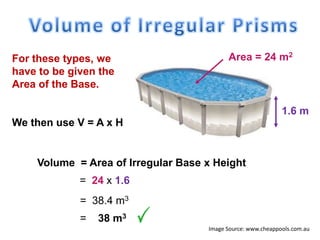
1.6 m
For these types, we
have to be given the
Area of the Base.
We then use V = A x H
Area = 24 m2
Volume = Area of Irregular Base x Height
= 24 x 1.6
= 38.4 m3
= 38 m3
Image Source: www.cheappools.com.au
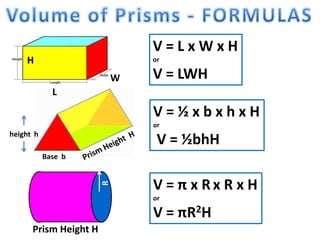
L
H
W
V = L x W x H
or
V = LWH
Base b
height h
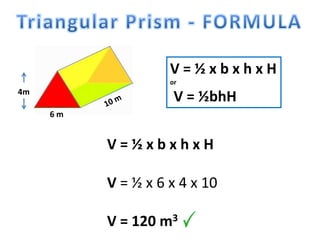
V = ½ x b x h x H
or
V = ½bhH
Prism Height H
R
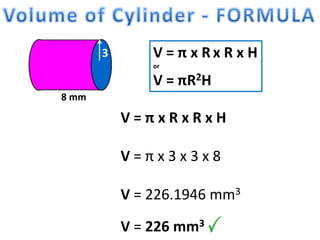
V = π x Rx R x H
or
V = πR2H
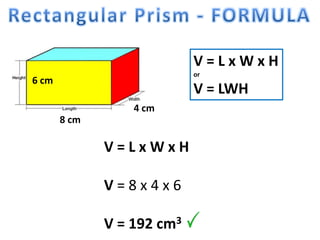
8 cm
6 cm
4 cm
V = L x W x H
V = 8 x 4 x 6
V = 192 cm3
V = L x W x H
or
V = LWH
6 m
4m
V = ½ x b x h x H
or
V = ½bhH
V = ½ x b x h x H
V = ½ x 6 x 4 x 10
V = 120 m3
8 mm
3 V = π x R x R x H
or
V = πR2H
V = π x R x R x H
V = π x 3 x 3 x 8
V = 226.1946 mm3
V = 226 mm3
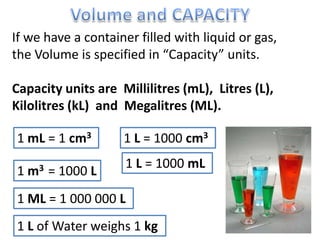
If we have a container filled with liquid or gas,
the Volume is specified in “Capacity” units.
Capacity units are Millilitres (mL), Litres (L),
Kilolitres (kL) and Megalitres (ML).
1 mL = 1 cm3 1 L = 1000 cm3
1 L = 1000 mL
1 ML = 1 000 000 L
1 m3 = 1000 L
1 L of Water weighs 1 kg
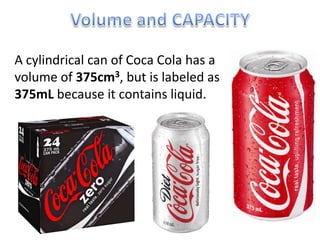
A cylindrical can of Coca Cola has a
volume of 375cm3, but is labeled as
375mL because it contains liquid.
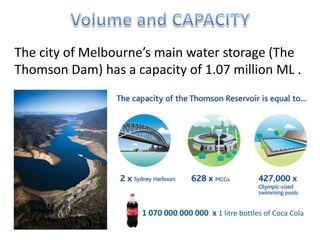
The city of Melbourne’s main water storage (The
Thomson Dam) has a capacity of 1.07 million ML .
1 070 000 000 000 x 1 litre bottles of Coca Cola
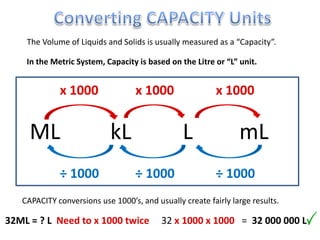
In the Metric System, Capacity is based on the Litre or “L” unit.
ML kL L mL
x 1000 x 1000 x 1000
÷ 1000 ÷ 1000 ÷ 1000
32ML = ? L Need to x 1000 twice 32 x 1000 x 1000 = 32 000 000 L
CAPACITY conversions use 1000’s, and usually create fairly large results.
The Volume of Liquids and Solids is usually measured as a “Capacity”.
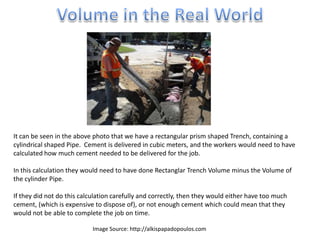
It can be seen in the above photo that we have a rectangular prism shaped Trench, containing a
cylindrical shaped Pipe. Cement is delivered in cubic meters, and the workers would need to have
calculated how much cement needed to be delivered for the job.
In this calculation they would need to have done Rectanglar Trench Volume minus the Volume of
the cylinder Pipe.
If they did not do this calculation carefully and correctly, then they would either have too much
cement, (which is expensive to dispose of), or not enough cement which could mean that they
would not be able to complete the job on time.
Image Source: http://alkispapadopoulos.com
http://passyworldofmathematics.com/
All slides are exclusive Copyright of Passy’s World of Mathematics
Visit our site for Free Mathematics PowerPoints

Volume of Prisms

  • 1.
  • 2.
    Image Source: GoogleImages Concreters, Air Conditioning Technicians, Plumbers, Chemical Engineers, Road Tanker Designers, Swimming Pool owners, Medical Staff administering drugs, and many other people need to know how to accurately calculate Volumes.
  • 3.
    How many 1cm3cubes will fill the Rectangular prism ? The Volume of a 3D Shape is the number of cubes needed to fill the inside of the shape. Sixteen 1cm3 cubesImage Source: Google Images
  • 4.
    How many cubesdoes this Prism hold? Rather than count all the cubes, we can find the Volume of this prism by counting how many cubes long, wide and tall the prism is, and then Multiplying. V = 5 x 3 x 1 = 15 There are 15 cubes in the prism, which means the volume of the Rectangular Prism is 15 cubic units.
  • 5.
    How many cubesdoes this Prism hold? Rather than count all the cubes, we can find the Volume of this prism by counting how many cubes long, wide, and tall the prism is, and then Multiplying. V = 5 x 3 x 2 = 30 There are 30 cubes in the prism, which means the volume of the Rectangular Prism is 30 cubic units.
  • 6.
    How many cubesdoes this Prism hold? Rather than count all the cubes, we can find the Volume of this prism by counting how many cubes long, wide, and tall the prism is, and then Multiplying. V = 6 x 4 x 3 = 72 There are 72 cubes in the prism, which means the volume of the Rectangular Prism is 72 cubic units.
  • 7.
    4 cm x3 cm x 1cm = 12 cm3 Length x Width x Height = Volume area of base x height = volume For any Rectangular prism, the Volume is found by multiplying the Area of its base times its Height. 1 cm 4 cm 3 cm Height Length Width V = Area x Height V = L x W x H
  • 8.
    5 cm 7 cm 10cm V = Area x Height V = L x W x H V = L x W x H V = 10 x 7 x 5 V = 350 cm3
  • 9.
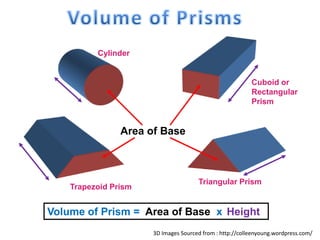
    Cylinder Cuboid or Rectangular Prism Triangular Prism TrapezoidPrism Volume of Prism = Area of Base x Height Area of Base 3D Images Sourced from : http://colleenyoung.wordpress.com/
  • 10.
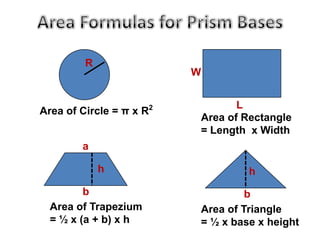
    Area of Circle= π x R2 R Area of Rectangle = Length x Width W L b h Area of Triangle = ½ x base x height h b Area of Trapezium = ½ x (a + b) x h a
  • 11.
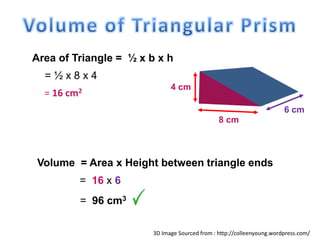
    Area of Triangle= ½ x b x h = ½ x 8 x 4 Volume = Area x Height between triangle ends = 16 x 6 = 96 cm3 8 cm 6 cm 4 cm 4.9cm = 16 cm2 3D Image Sourced from : http://colleenyoung.wordpress.com/
  • 12.
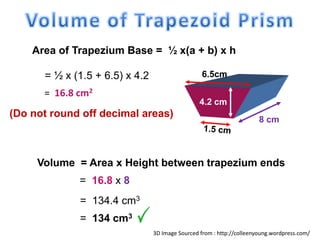
    Area of TrapeziumBase = ½ x(a + b) x h = ½ x (1.5 + 6.5) x 4.2 8 cm 6.5cm 4.2 cm = 16.8 cm2 (Do not round off decimal areas) Volume = Area x Height between trapezium ends = 16.8 x 8 = 134.4 cm3 = 134 cm3 3D Image Sourced from : http://colleenyoung.wordpress.com/
  • 13.
    5cm 3cm Area of CircleBase = π x R2 = π x 32 = 28.2743…..cm2 Volume = Height x Area of Circle = 5 x 28.2743…. = 141 cm3 Use full calculator ‘ANS’ for Area = 141.3716….cm3 (Do not round off decimal areas) 3D Image Sourced from : http://colleenyoung.wordpress.com/
  • 14.
    1.6 m For thesetypes, we have to be given the Area of the Base. We then use V = A x H Area = 24 m2 Volume = Area of Irregular Base x Height = 24 x 1.6 = 38.4 m3 = 38 m3 Image Source: www.cheappools.com.au
  • 15.
    L H W V = Lx W x H or V = LWH Base b height h V = ½ x b x h x H or V = ½bhH Prism Height H R V = π x Rx R x H or V = πR2H
  • 16.
    8 cm 6 cm 4cm V = L x W x H V = 8 x 4 x 6 V = 192 cm3 V = L x W x H or V = LWH
  • 17.
    6 m 4m V =½ x b x h x H or V = ½bhH V = ½ x b x h x H V = ½ x 6 x 4 x 10 V = 120 m3
  • 18.
    8 mm 3 V= π x R x R x H or V = πR2H V = π x R x R x H V = π x 3 x 3 x 8 V = 226.1946 mm3 V = 226 mm3
  • 19.
    If we havea container filled with liquid or gas, the Volume is specified in “Capacity” units. Capacity units are Millilitres (mL), Litres (L), Kilolitres (kL) and Megalitres (ML). 1 mL = 1 cm3 1 L = 1000 cm3 1 L = 1000 mL 1 ML = 1 000 000 L 1 m3 = 1000 L 1 L of Water weighs 1 kg
  • 20.
    A cylindrical canof Coca Cola has a volume of 375cm3, but is labeled as 375mL because it contains liquid.
  • 21.
    The city ofMelbourne’s main water storage (The Thomson Dam) has a capacity of 1.07 million ML . 1 070 000 000 000 x 1 litre bottles of Coca Cola
  • 22.
    In the MetricSystem, Capacity is based on the Litre or “L” unit. ML kL L mL x 1000 x 1000 x 1000 ÷ 1000 ÷ 1000 ÷ 1000 32ML = ? L Need to x 1000 twice 32 x 1000 x 1000 = 32 000 000 L CAPACITY conversions use 1000’s, and usually create fairly large results. The Volume of Liquids and Solids is usually measured as a “Capacity”.
  • 23.
    It can beseen in the above photo that we have a rectangular prism shaped Trench, containing a cylindrical shaped Pipe. Cement is delivered in cubic meters, and the workers would need to have calculated how much cement needed to be delivered for the job. In this calculation they would need to have done Rectanglar Trench Volume minus the Volume of the cylinder Pipe. If they did not do this calculation carefully and correctly, then they would either have too much cement, (which is expensive to dispose of), or not enough cement which could mean that they would not be able to complete the job on time. Image Source: http://alkispapadopoulos.com
  • 24.
    http://passyworldofmathematics.com/ All slides areexclusive Copyright of Passy’s World of Mathematics Visit our site for Free Mathematics PowerPoints