
UNIT 3.3 PROVING LINESUNIT 3.3 PROVING LINES
PARALLELPARALLEL
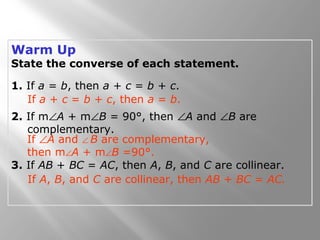
Warm Up
State the converse of each statement.
1. If a = b, then a + c = b + c.
2. If m∠A + m∠B = 90°, then ∠A and ∠B are
complementary.
3. If AB + BC = AC, then A, B, and C are collinear.
If a + c = b + c, then a = b.
If ∠A and ∠ B are complementary,
then m∠A + m∠B =90°.
If A, B, and C are collinear, then AB + BC = AC.
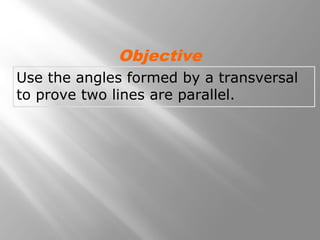
Use the angles formed by a transversal
to prove two lines are parallel.
Objective
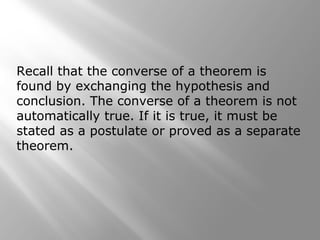
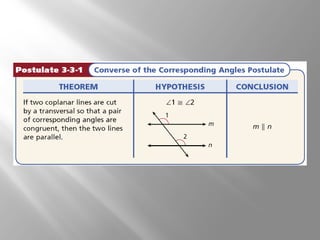
Recall that the converse of a theorem is
found by exchanging the hypothesis and
conclusion. The converse of a theorem is not
automatically true. If it is true, it must be
stated as a postulate or proved as a separate
theorem.
Use the Converse of the Corresponding Angles
Postulate and the given information to show
that ℓ || m.
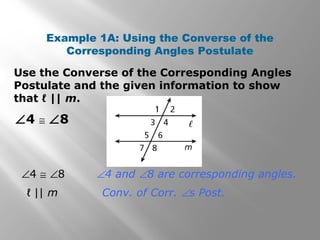
Example 1A: Using the Converse of the
Corresponding Angles Postulate
∠4 ≅ ∠8
∠4 ≅ ∠8 ∠4 and ∠8 are corresponding angles.
ℓ || m Conv. of Corr. ∠s Post.
Use the Converse of the Corresponding Angles
Postulate and the given information to show
that ℓ || m.
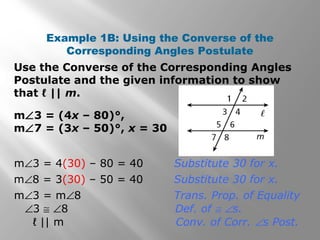
Example 1B: Using the Converse of the
Corresponding Angles Postulate
m∠3 = (4x – 80)°,
m∠7 = (3x – 50)°, x = 30
m∠3 = 4(30) – 80 = 40 Substitute 30 for x.
m∠8 = 3(30) – 50 = 40 Substitute 30 for x.
ℓ || m Conv. of Corr. ∠s Post.
∠3 ≅ ∠8 Def. of ≅ ∠s.
m∠3 = m∠8 Trans. Prop. of Equality
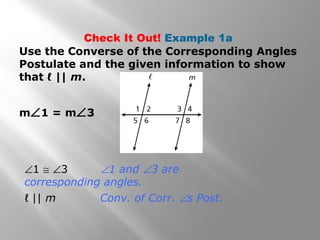
Check It Out! Example 1a
Use the Converse of the Corresponding Angles
Postulate and the given information to show
that ℓ || m.
m∠1 = m∠3
∠1 ≅ ∠3 ∠1 and ∠3 are
corresponding angles.
ℓ || m Conv. of Corr. ∠s Post.
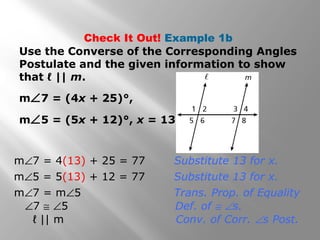
Check It Out! Example 1b
Use the Converse of the Corresponding Angles
Postulate and the given information to show
that ℓ || m.
m∠7 = (4x + 25)°,
m∠5 = (5x + 12)°, x = 13
m∠7 = 4(13) + 25 = 77 Substitute 13 for x.
m∠5 = 5(13) + 12 = 77 Substitute 13 for x.
ℓ || m Conv. of Corr. ∠s Post.
∠7 ≅ ∠5 Def. of ≅ ∠s.
m∠7 = m∠5 Trans. Prop. of Equality
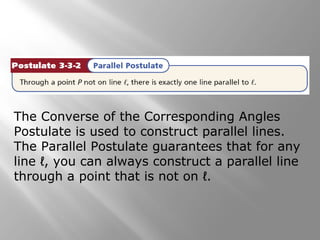
The Converse of the Corresponding Angles
Postulate is used to construct parallel lines.
The Parallel Postulate guarantees that for any
line ℓ, you can always construct a parallel line
through a point that is not on ℓ.
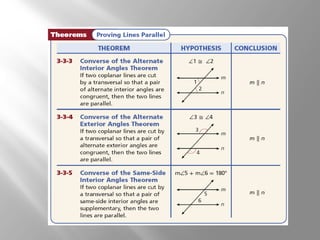
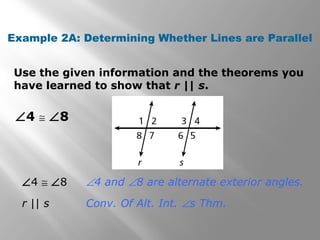
Use the given information and the theorems you
have learned to show that r || s.
Example 2A: Determining Whether Lines are Parallel
∠4 ≅ ∠8
∠4 ≅ ∠8 ∠4 and ∠8 are alternate exterior angles.
r || s Conv. Of Alt. Int. ∠s Thm.
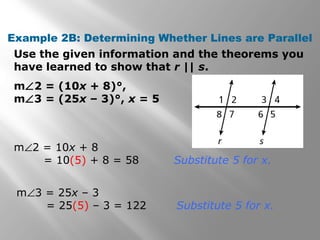
m∠2 = (10x + 8)°,
m∠3 = (25x – 3)°, x = 5
Use the given information and the theorems you
have learned to show that r || s.
Example 2B: Determining Whether Lines are Parallel
m∠2 = 10x + 8
= 10(5) + 8 = 58 Substitute 5 for x.
m∠3 = 25x – 3
= 25(5) – 3 = 122 Substitute 5 for x.
m∠2 = (10x + 8)°,
m∠3 = (25x – 3)°, x = 5
Use the given information and the theorems you
have learned to show that r || s.
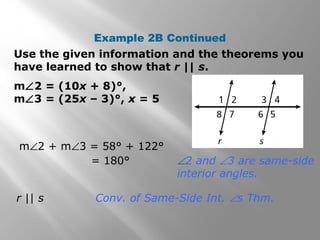
Example 2B Continued
r || s Conv. of Same-Side Int. ∠s Thm.
m∠2 + m∠3 = 58° + 122°
= 180° ∠2 and ∠3 are same-side
interior angles.
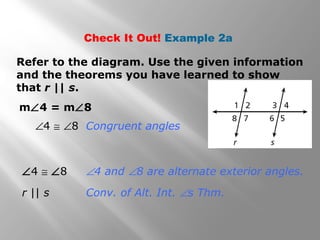
Check It Out! Example 2a
m∠4 = m∠8
Refer to the diagram. Use the given information
and the theorems you have learned to show
that r || s.
∠4 ≅ ∠8 ∠4 and ∠8 are alternate exterior angles.
r || s Conv. of Alt. Int. ∠s Thm.
∠4 ≅ ∠8 Congruent angles
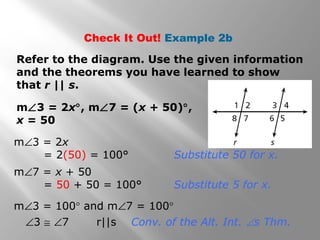
Check It Out! Example 2b
Refer to the diagram. Use the given information
and the theorems you have learned to show
that r || s.
m∠3 = 2x°, m∠7 = (x + 50)°,
x = 50
m∠3 = 100° and m∠7 = 100°
∠3 ≅ ∠7 r||s Conv. of the Alt. Int. ∠s Thm.
m∠3 = 2x
= 2(50) = 100° Substitute 50 for x.
m∠7 = x + 50
= 50 + 50 = 100° Substitute 5 for x.
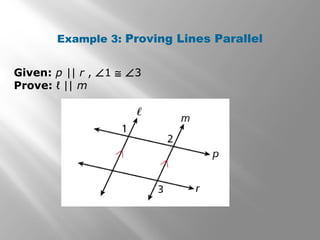
Example 3: Proving Lines Parallel
Given: p || r , ∠1 ≅ ∠3
Prove: ℓ || m
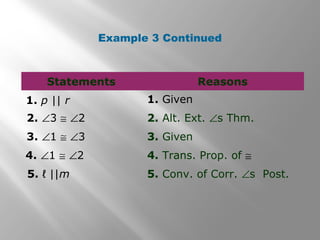
Example 3 Continued
Statements Reasons
1. p || r
5. ℓ ||m
2. ∠3 ≅ ∠2
3. ∠1 ≅ ∠3
4. ∠1 ≅ ∠2
2. Alt. Ext. ∠s Thm.
1. Given
3. Given
4. Trans. Prop. of ≅
5. Conv. of Corr. ∠s Post.
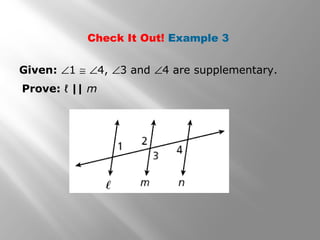
Check It Out! Example 3
Given: ∠1 ≅ ∠4, ∠3 and ∠4 are supplementary.
Prove: ℓ || m
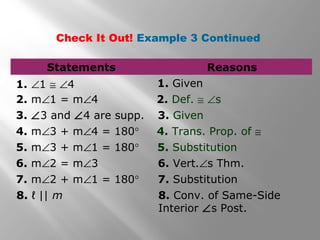
Check It Out! Example 3 Continued
Statements Reasons
1. ∠1 ≅ ∠4 1. Given
2. m∠1 = m∠4 2. Def. ≅ ∠s
3. ∠3 and ∠4 are supp. 3. Given
4. m∠3 + m∠4 = 180° 4. Trans. Prop. of ≅
5. m∠3 + m∠1 = 180° 5. Substitution
6. m∠2 = m∠3 6. Vert.∠s Thm.
7. m∠2 + m∠1 = 180° 7. Substitution
8. ℓ || m 8. Conv. of Same-Side
Interior ∠s Post.
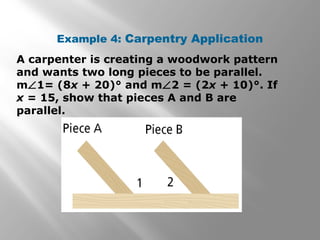
Example 4: Carpentry Application
A carpenter is creating a woodwork pattern
and wants two long pieces to be parallel.
m∠1= (8x + 20)° and m∠2 = (2x + 10)°. If
x = 15, show that pieces A and B are
parallel.
Example 4 Continued
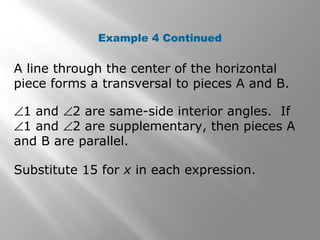
A line through the center of the horizontal
piece forms a transversal to pieces A and B.
∠1 and ∠2 are same-side interior angles. If
∠1 and ∠2 are supplementary, then pieces A
and B are parallel.
Substitute 15 for x in each expression.
Example 4 Continued
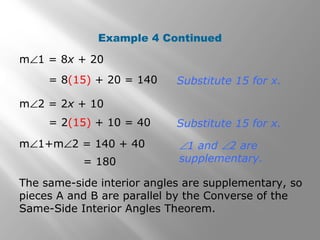
m∠1 = 8x + 20
= 8(15) + 20 = 140
m∠2 = 2x + 10
= 2(15) + 10 = 40
m∠1+m∠2 = 140 + 40
= 180
Substitute 15 for x.
∠1 and ∠2 are
supplementary.
The same-side interior angles are supplementary, so
pieces A and B are parallel by the Converse of the
Same-Side Interior Angles Theorem.
Check It Out! Example 4
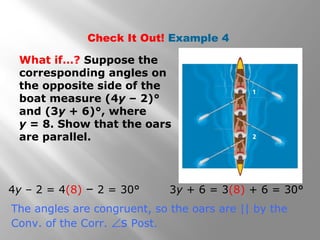
What if…? Suppose the
corresponding angles on
the opposite side of the
boat measure (4y – 2)°
and (3y + 6)°, where
y = 8. Show that the oars
are parallel.
4y – 2 = 4(8) – 2 = 30° 3y + 6 = 3(8) + 6 = 30°
The angles are congruent, so the oars are || by the
Conv. of the Corr. ∠s Post.
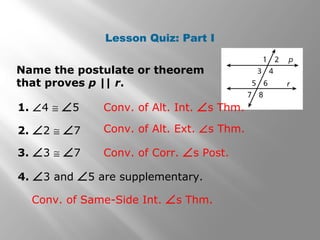
Lesson Quiz: Part I
Name the postulate or theorem
that proves p || r.
1. ∠4 ≅ ∠5 Conv. of Alt. Int. ∠s Thm.
2. ∠2 ≅ ∠7 Conv. of Alt. Ext. ∠s Thm.
3. ∠3 ≅ ∠7 Conv. of Corr. ∠s Post.
4. ∠3 and ∠5 are supplementary.
Conv. of Same-Side Int. ∠s Thm.
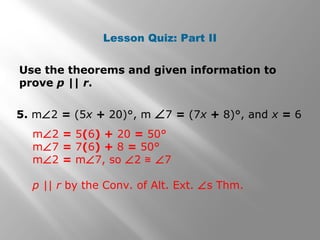
Lesson Quiz: Part II
Use the theorems and given information to
prove p || r.
5. m∠2 = (5x + 20)°, m ∠7 = (7x + 8)°, and x = 6
m∠2 = 5(6) + 20 = 50°
m∠7 = 7(6) + 8 = 50°
m∠2 = m∠7, so ∠2 ≅ ∠7
p || r by the Conv. of Alt. Ext. ∠s Thm.
All rights belong to their
respective owners.
Copyright Disclaimer Under
Section 107 of the
Copyright Act 1976,
allowance is made for "fair
use" for purposes such as
criticism, comment, news
reporting, TEACHING,
scholarship, and research.
Fair use is a use permitted
by copyright statute that
might otherwise be
infringing.
Non-profit, EDUCATIONAL
or personal use tips the
balance in favor of fair use.

Geometry 201 unit 3.3

  • 1.
    UNIT 3.3 PROVINGLINESUNIT 3.3 PROVING LINES PARALLELPARALLEL
  • 2.
    Warm Up State theconverse of each statement. 1. If a = b, then a + c = b + c. 2. If m∠A + m∠B = 90°, then ∠A and ∠B are complementary. 3. If AB + BC = AC, then A, B, and C are collinear. If a + c = b + c, then a = b. If ∠A and ∠ B are complementary, then m∠A + m∠B =90°. If A, B, and C are collinear, then AB + BC = AC.
  • 3.
    Use the anglesformed by a transversal to prove two lines are parallel. Objective
  • 4.
    Recall that theconverse of a theorem is found by exchanging the hypothesis and conclusion. The converse of a theorem is not automatically true. If it is true, it must be stated as a postulate or proved as a separate theorem.
  • 6.
    Use the Converseof the Corresponding Angles Postulate and the given information to show that ℓ || m. Example 1A: Using the Converse of the Corresponding Angles Postulate ∠4 ≅ ∠8 ∠4 ≅ ∠8 ∠4 and ∠8 are corresponding angles. ℓ || m Conv. of Corr. ∠s Post.
  • 7.
    Use the Converseof the Corresponding Angles Postulate and the given information to show that ℓ || m. Example 1B: Using the Converse of the Corresponding Angles Postulate m∠3 = (4x – 80)°, m∠7 = (3x – 50)°, x = 30 m∠3 = 4(30) – 80 = 40 Substitute 30 for x. m∠8 = 3(30) – 50 = 40 Substitute 30 for x. ℓ || m Conv. of Corr. ∠s Post. ∠3 ≅ ∠8 Def. of ≅ ∠s. m∠3 = m∠8 Trans. Prop. of Equality
  • 8.
    Check It Out!Example 1a Use the Converse of the Corresponding Angles Postulate and the given information to show that ℓ || m. m∠1 = m∠3 ∠1 ≅ ∠3 ∠1 and ∠3 are corresponding angles. ℓ || m Conv. of Corr. ∠s Post.
  • 9.
    Check It Out!Example 1b Use the Converse of the Corresponding Angles Postulate and the given information to show that ℓ || m. m∠7 = (4x + 25)°, m∠5 = (5x + 12)°, x = 13 m∠7 = 4(13) + 25 = 77 Substitute 13 for x. m∠5 = 5(13) + 12 = 77 Substitute 13 for x. ℓ || m Conv. of Corr. ∠s Post. ∠7 ≅ ∠5 Def. of ≅ ∠s. m∠7 = m∠5 Trans. Prop. of Equality
  • 10.
    The Converse ofthe Corresponding Angles Postulate is used to construct parallel lines. The Parallel Postulate guarantees that for any line ℓ, you can always construct a parallel line through a point that is not on ℓ.
  • 12.
    Use the giveninformation and the theorems you have learned to show that r || s. Example 2A: Determining Whether Lines are Parallel ∠4 ≅ ∠8 ∠4 ≅ ∠8 ∠4 and ∠8 are alternate exterior angles. r || s Conv. Of Alt. Int. ∠s Thm.
  • 13.
    m∠2 = (10x+ 8)°, m∠3 = (25x – 3)°, x = 5 Use the given information and the theorems you have learned to show that r || s. Example 2B: Determining Whether Lines are Parallel m∠2 = 10x + 8 = 10(5) + 8 = 58 Substitute 5 for x. m∠3 = 25x – 3 = 25(5) – 3 = 122 Substitute 5 for x.
  • 14.
    m∠2 = (10x+ 8)°, m∠3 = (25x – 3)°, x = 5 Use the given information and the theorems you have learned to show that r || s. Example 2B Continued r || s Conv. of Same-Side Int. ∠s Thm. m∠2 + m∠3 = 58° + 122° = 180° ∠2 and ∠3 are same-side interior angles.
  • 15.
    Check It Out!Example 2a m∠4 = m∠8 Refer to the diagram. Use the given information and the theorems you have learned to show that r || s. ∠4 ≅ ∠8 ∠4 and ∠8 are alternate exterior angles. r || s Conv. of Alt. Int. ∠s Thm. ∠4 ≅ ∠8 Congruent angles
  • 16.
    Check It Out!Example 2b Refer to the diagram. Use the given information and the theorems you have learned to show that r || s. m∠3 = 2x°, m∠7 = (x + 50)°, x = 50 m∠3 = 100° and m∠7 = 100° ∠3 ≅ ∠7 r||s Conv. of the Alt. Int. ∠s Thm. m∠3 = 2x = 2(50) = 100° Substitute 50 for x. m∠7 = x + 50 = 50 + 50 = 100° Substitute 5 for x.
  • 17.
    Example 3: ProvingLines Parallel Given: p || r , ∠1 ≅ ∠3 Prove: ℓ || m
  • 18.
    Example 3 Continued StatementsReasons 1. p || r 5. ℓ ||m 2. ∠3 ≅ ∠2 3. ∠1 ≅ ∠3 4. ∠1 ≅ ∠2 2. Alt. Ext. ∠s Thm. 1. Given 3. Given 4. Trans. Prop. of ≅ 5. Conv. of Corr. ∠s Post.
  • 19.
    Check It Out!Example 3 Given: ∠1 ≅ ∠4, ∠3 and ∠4 are supplementary. Prove: ℓ || m
  • 20.
    Check It Out!Example 3 Continued Statements Reasons 1. ∠1 ≅ ∠4 1. Given 2. m∠1 = m∠4 2. Def. ≅ ∠s 3. ∠3 and ∠4 are supp. 3. Given 4. m∠3 + m∠4 = 180° 4. Trans. Prop. of ≅ 5. m∠3 + m∠1 = 180° 5. Substitution 6. m∠2 = m∠3 6. Vert.∠s Thm. 7. m∠2 + m∠1 = 180° 7. Substitution 8. ℓ || m 8. Conv. of Same-Side Interior ∠s Post.
  • 21.
    Example 4: CarpentryApplication A carpenter is creating a woodwork pattern and wants two long pieces to be parallel. m∠1= (8x + 20)° and m∠2 = (2x + 10)°. If x = 15, show that pieces A and B are parallel.
  • 22.
    Example 4 Continued Aline through the center of the horizontal piece forms a transversal to pieces A and B. ∠1 and ∠2 are same-side interior angles. If ∠1 and ∠2 are supplementary, then pieces A and B are parallel. Substitute 15 for x in each expression.
  • 23.
    Example 4 Continued m∠1= 8x + 20 = 8(15) + 20 = 140 m∠2 = 2x + 10 = 2(15) + 10 = 40 m∠1+m∠2 = 140 + 40 = 180 Substitute 15 for x. Substitute 15 for x. ∠1 and ∠2 are supplementary. The same-side interior angles are supplementary, so pieces A and B are parallel by the Converse of the Same-Side Interior Angles Theorem.
  • 24.
    Check It Out!Example 4 What if…? Suppose the corresponding angles on the opposite side of the boat measure (4y – 2)° and (3y + 6)°, where y = 8. Show that the oars are parallel. 4y – 2 = 4(8) – 2 = 30° 3y + 6 = 3(8) + 6 = 30° The angles are congruent, so the oars are || by the Conv. of the Corr. ∠s Post.
  • 25.
    Lesson Quiz: PartI Name the postulate or theorem that proves p || r. 1. ∠4 ≅ ∠5 Conv. of Alt. Int. ∠s Thm. 2. ∠2 ≅ ∠7 Conv. of Alt. Ext. ∠s Thm. 3. ∠3 ≅ ∠7 Conv. of Corr. ∠s Post. 4. ∠3 and ∠5 are supplementary. Conv. of Same-Side Int. ∠s Thm.
  • 26.
    Lesson Quiz: PartII Use the theorems and given information to prove p || r. 5. m∠2 = (5x + 20)°, m ∠7 = (7x + 8)°, and x = 6 m∠2 = 5(6) + 20 = 50° m∠7 = 7(6) + 8 = 50° m∠2 = m∠7, so ∠2 ≅ ∠7 p || r by the Conv. of Alt. Ext. ∠s Thm.
  • 27.
    All rights belongto their respective owners. Copyright Disclaimer Under Section 107 of the Copyright Act 1976, allowance is made for "fair use" for purposes such as criticism, comment, news reporting, TEACHING, scholarship, and research. Fair use is a use permitted by copyright statute that might otherwise be infringing. Non-profit, EDUCATIONAL or personal use tips the balance in favor of fair use.