1
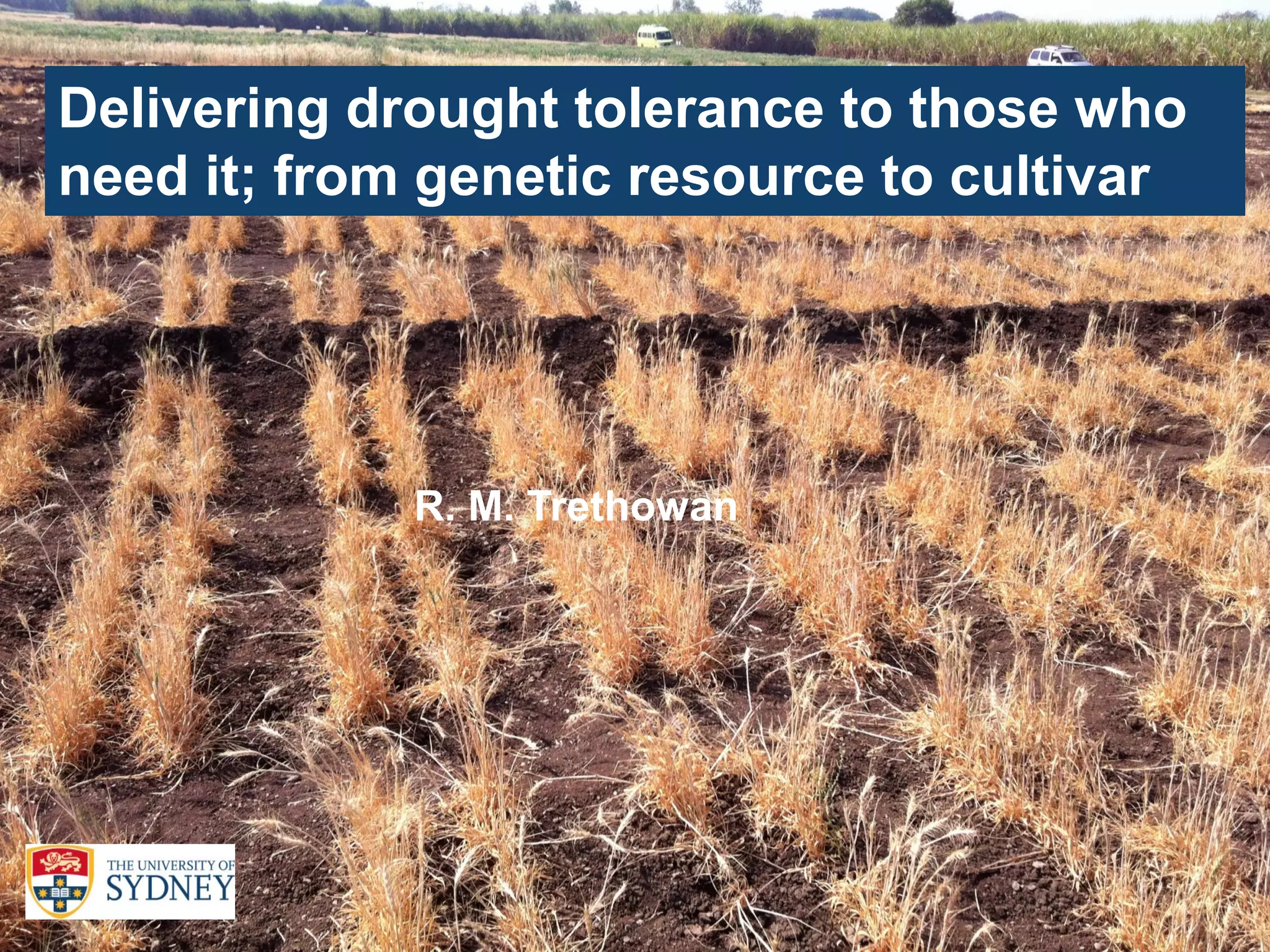
Delivering drought tolerance to those who
need it; from genetic resource to cultivar
R. M. Trethowan
2
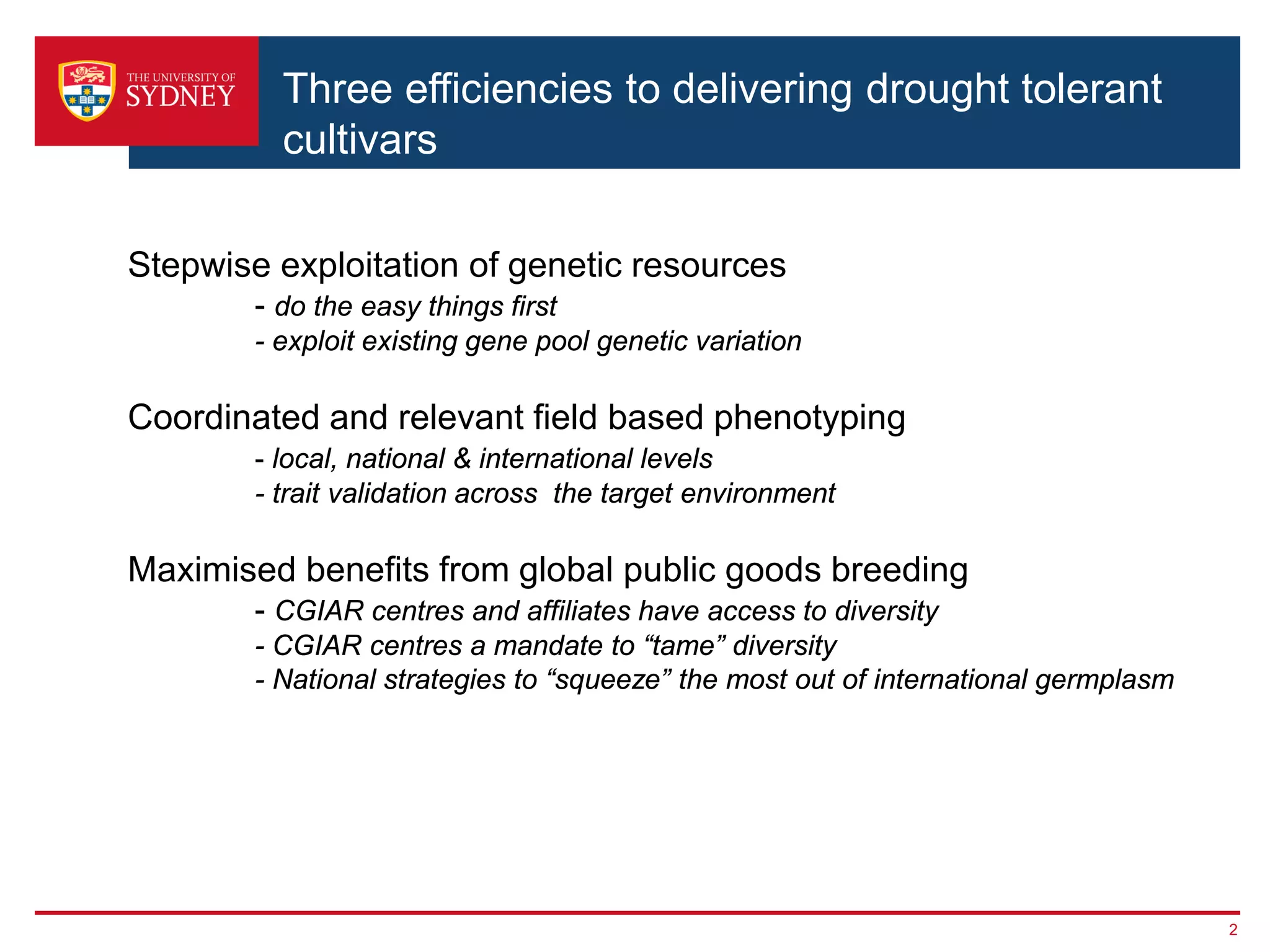
Stepwise exploitation of genetic resources
- do the easy things first
- exploit existing gene pool genetic variation
Coordinated and relevant field based phenotyping
- local, national & international levels
- trait validation across the target environment
Maximised benefits from global public goods breeding
- CGIAR centres and affiliates have access to diversity
- CGIAR centres a mandate to “tame” diversity
- National strategies to “squeeze” the most out of international germplasm
Three efficiencies to delivering drought tolerant
cultivars
3
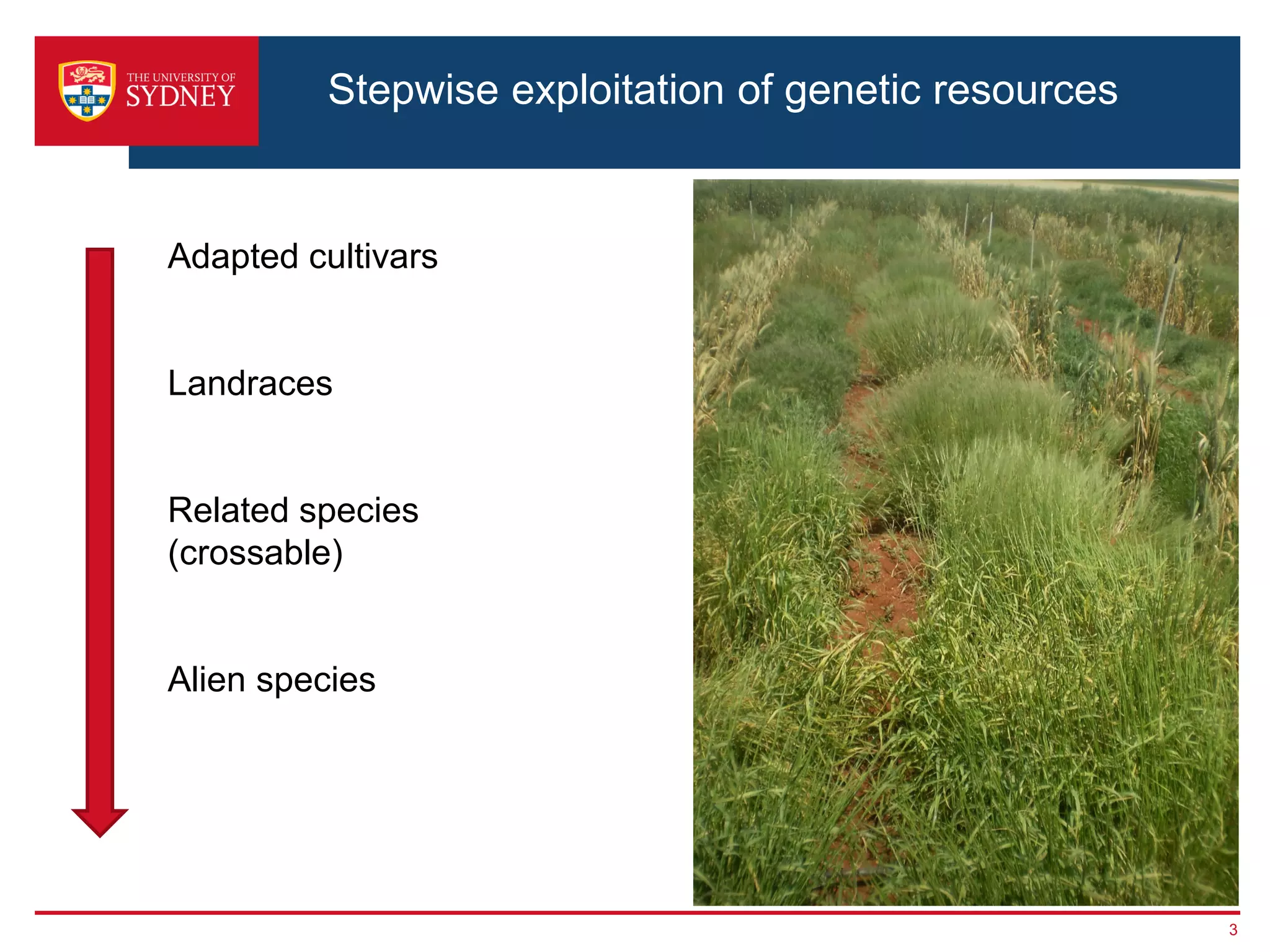
Stepwise exploitation of genetic resources
Adapted cultivars
Landraces
Related species
(crossable)
Alien species
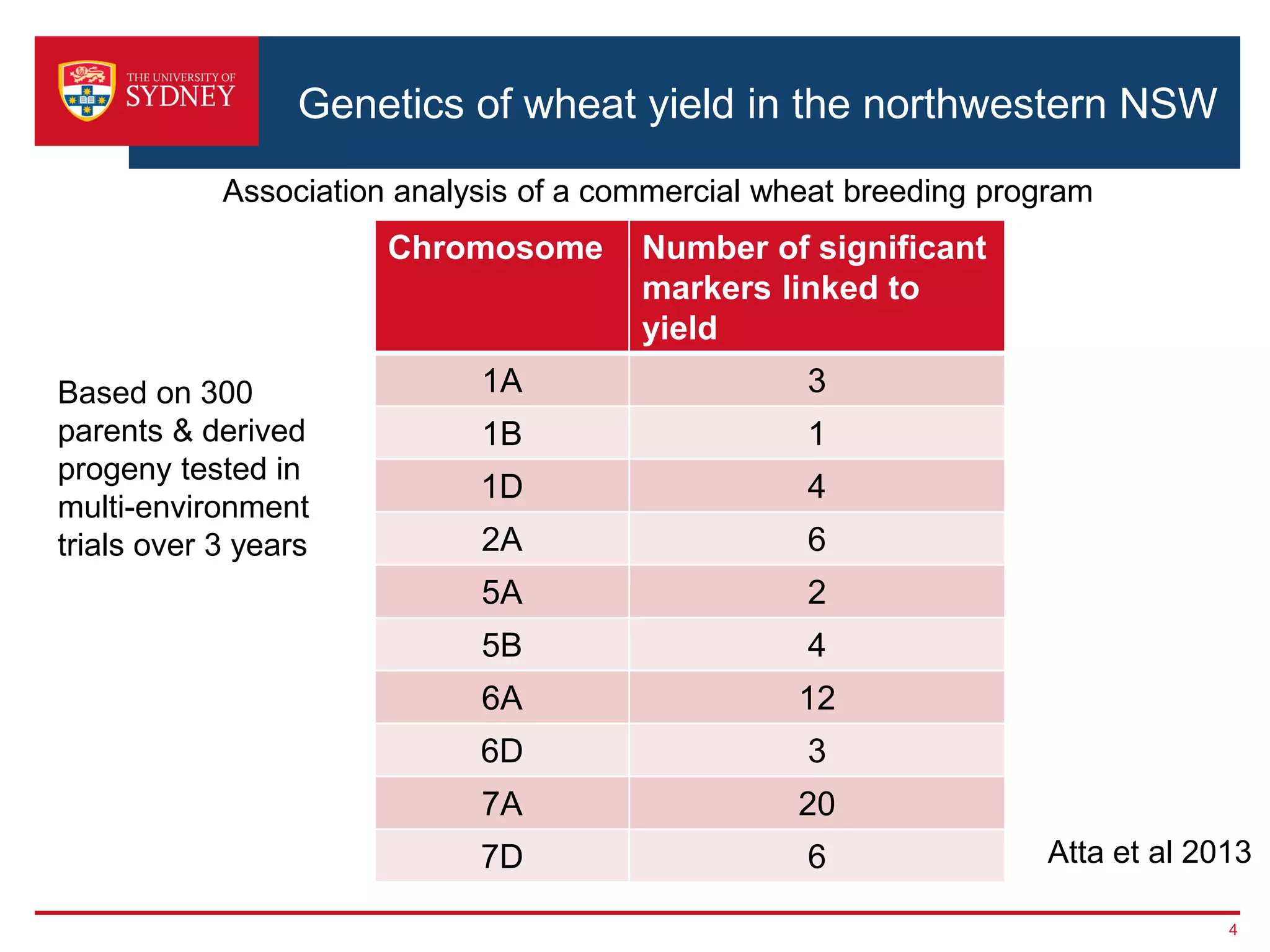
Genetics of wheat yield in the northwestern NSW
Chromosome Number of significant
markers linked to
yield
1A 3
1B 1
1D 4
2A 6
5A 2
5B 4
6A 12
6D 3
7A 20
7D 6
4
Association analysis of a commercial wheat breeding program
Atta et al 2013
Based on 300
parents & derived
progeny tested in
multi-environment
trials over 3 years
Better breeding strategies to improve WUE:
targeting crown rot resistance in NSW
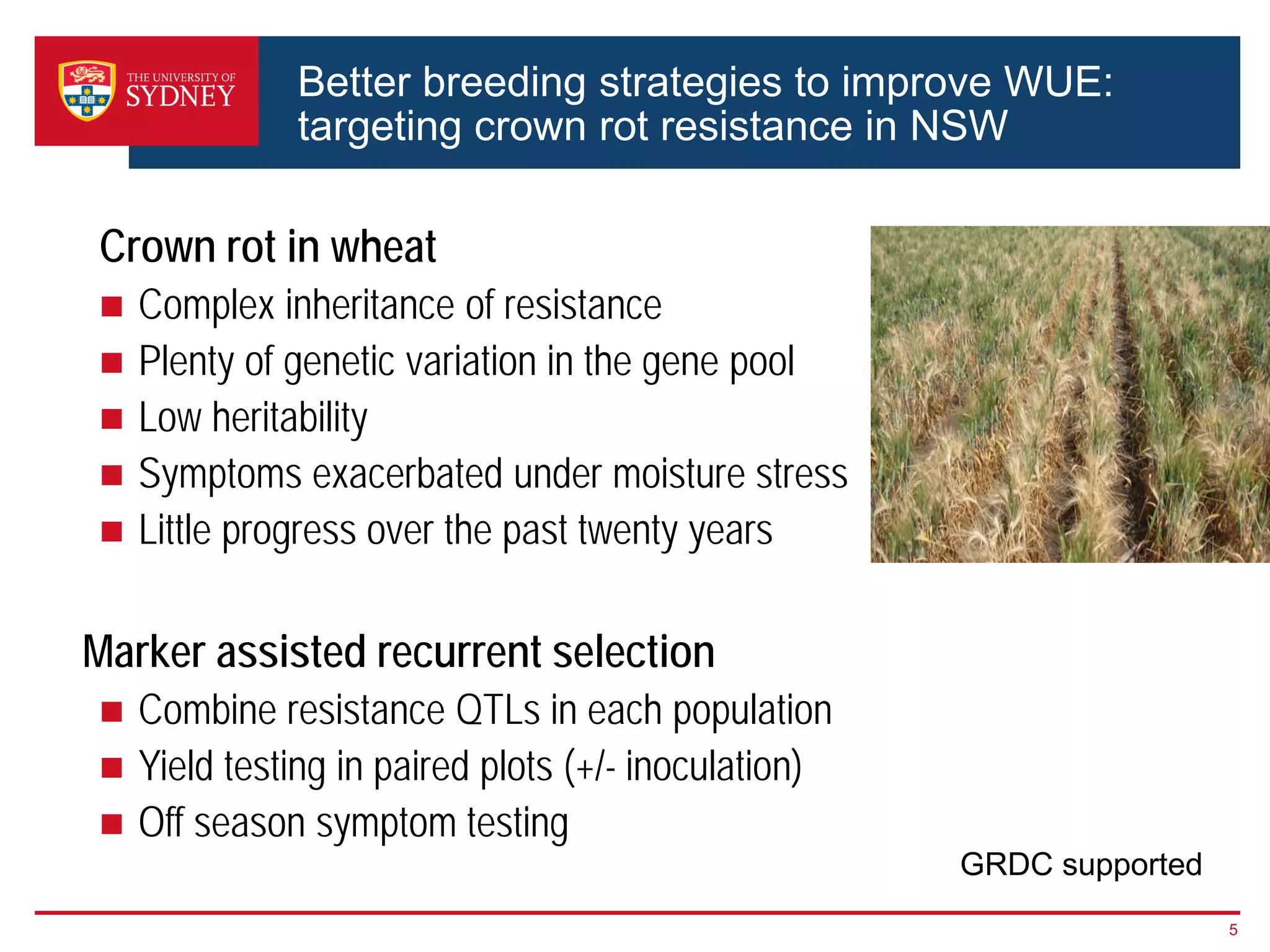
Crown rot in wheat
 Complex inheritance of resistance
 Plenty of genetic variation in the gene pool
 Low heritability
 Symptoms exacerbated under moisture stress
 Little progress over the past twenty years
Marker assisted recurrent selection
 Combine resistance QTLs in each population
 Yield testing in paired plots (+/- inoculation)
 Off season symptom testing
5
GRDC supported
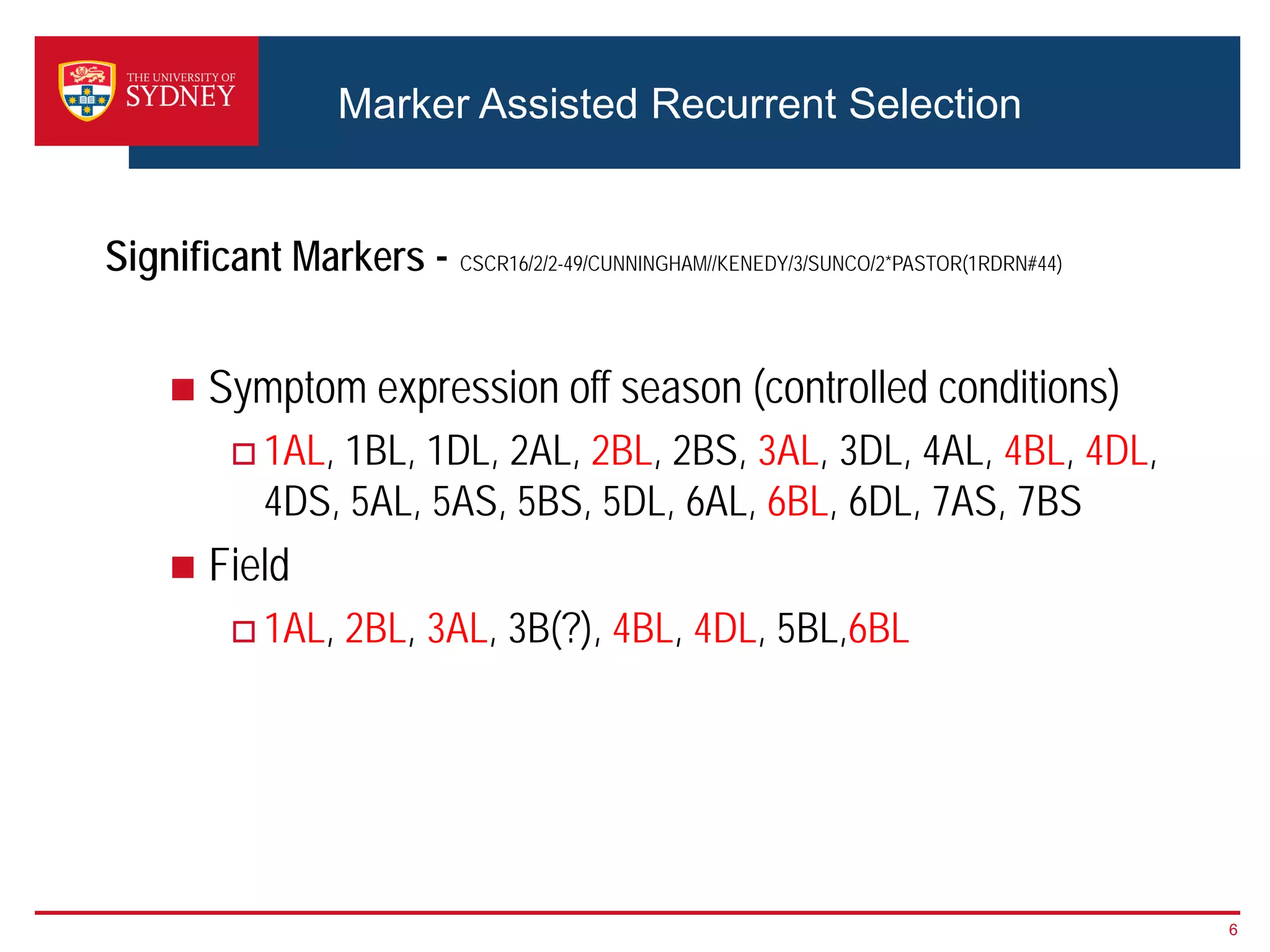
Marker Assisted Recurrent Selection
Significant Markers - CSCR16/2/2-49/CUNNINGHAM//KENEDY/3/SUNCO/2*PASTOR(1RDRN#44)
 Symptom expression off season (controlled conditions)
 1AL, 1BL, 1DL, 2AL, 2BL, 2BS, 3AL, 3DL, 4AL, 4BL, 4DL,
4DS, 5AL, 5AS, 5BS, 5DL, 6AL, 6BL, 6DL, 7AS, 7BS
 Field
 1AL, 2BL, 3AL, 3B(?), 4BL, 4DL, 5BL,6BL
6
T. dicoccum or
durum
A. tauschii
AABBDD
DD
+
AABB
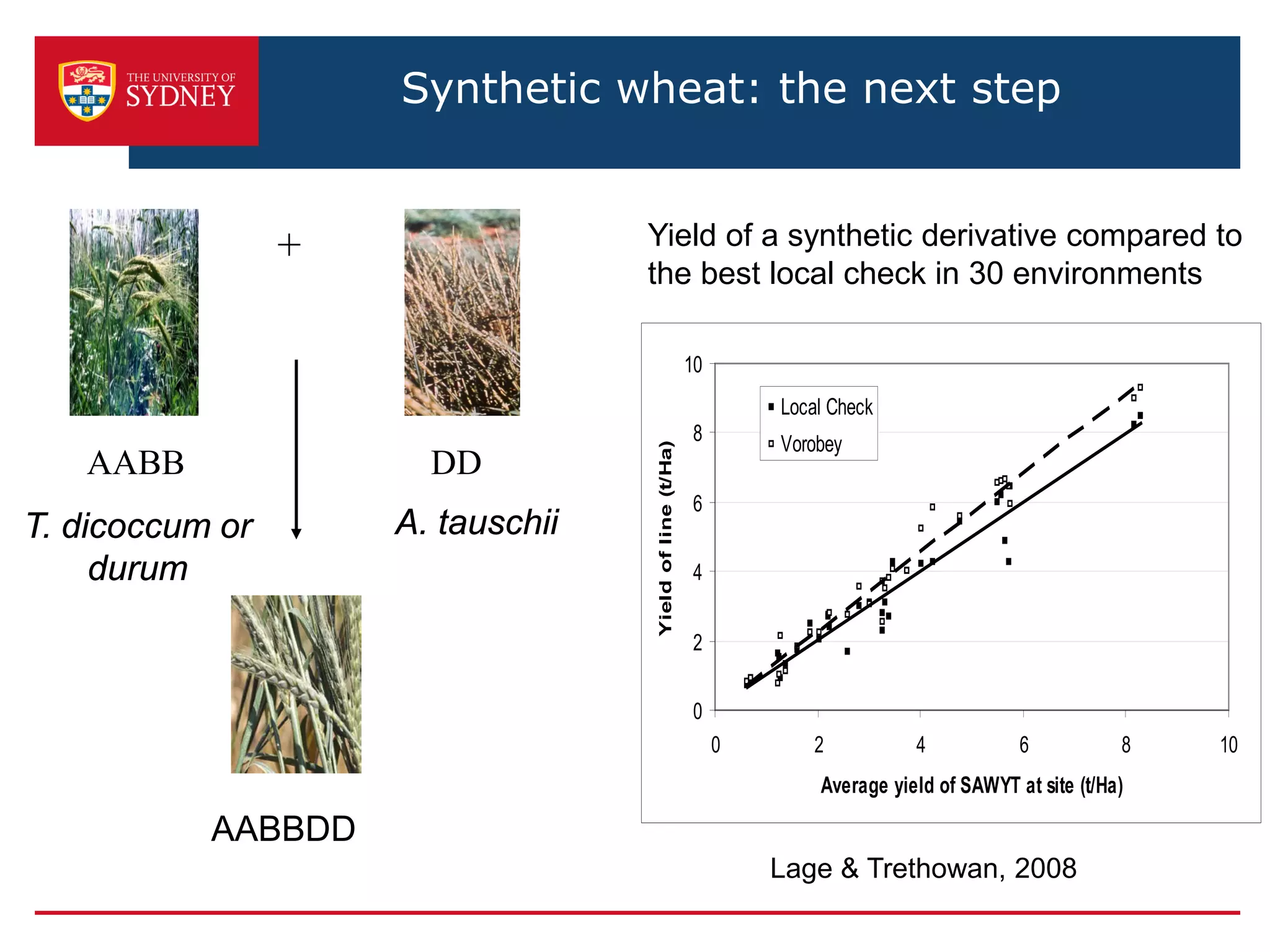
Synthetic wheat: the next step
Yield of a synthetic derivative compared to
the best local check in 30 environments
0
2
4
6
8
10
0 2 4 6 8 10
Average yield of SAWYT at site (t/Ha)
Yieldofline(t/Ha)
Local Check
Vorobey
Lage & Trethowan, 2008
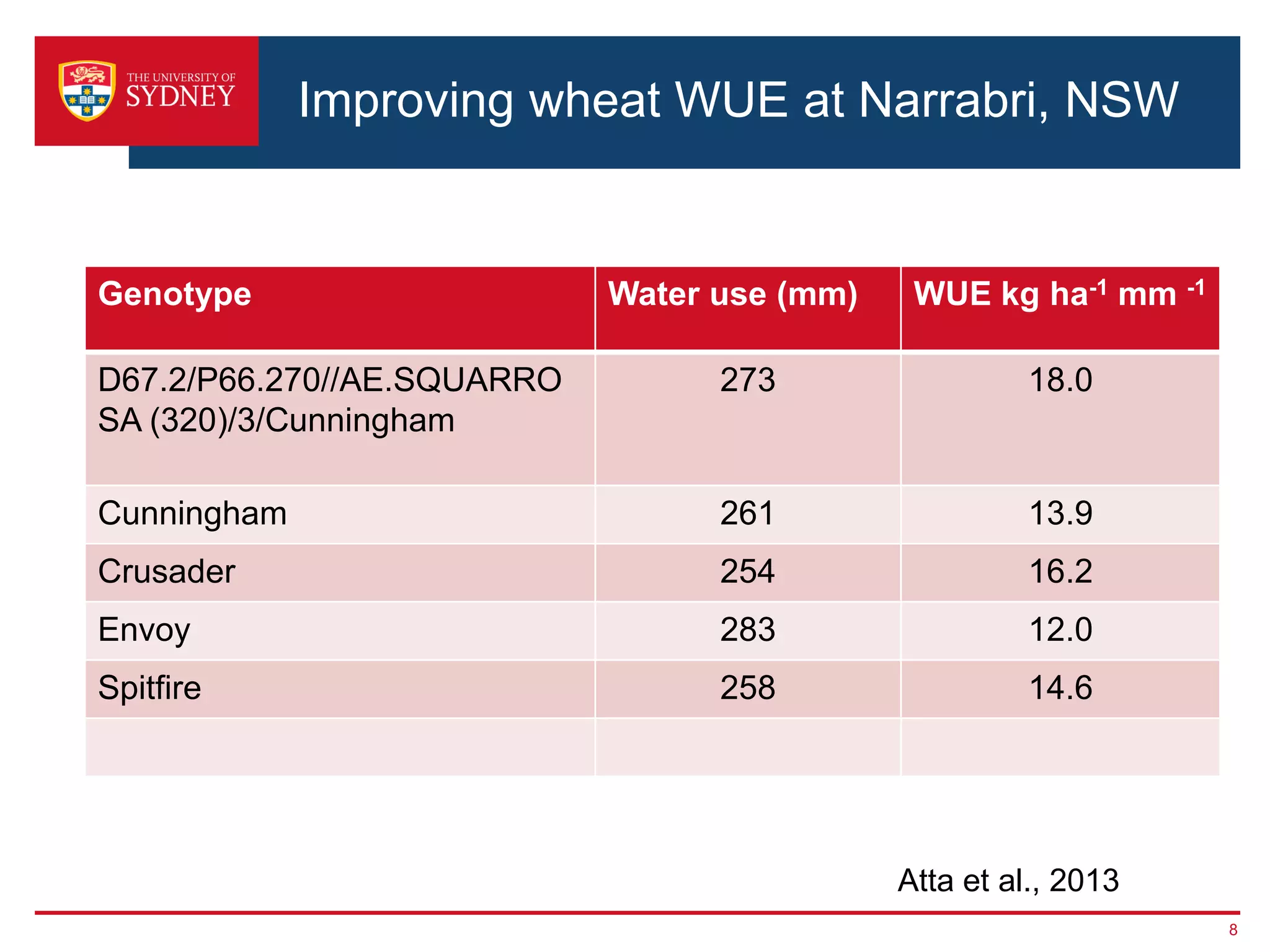
Improving wheat WUE at Narrabri, NSW
Genotype Water use (mm) WUE kg ha-1 mm -1
D67.2/P66.270//AE.SQUARRO
SA (320)/3/Cunningham
273 18.0
Cunningham 261 13.9
Crusader 254 16.2
Envoy 283 12.0
Spitfire 258 14.6
8
Atta et al., 2013
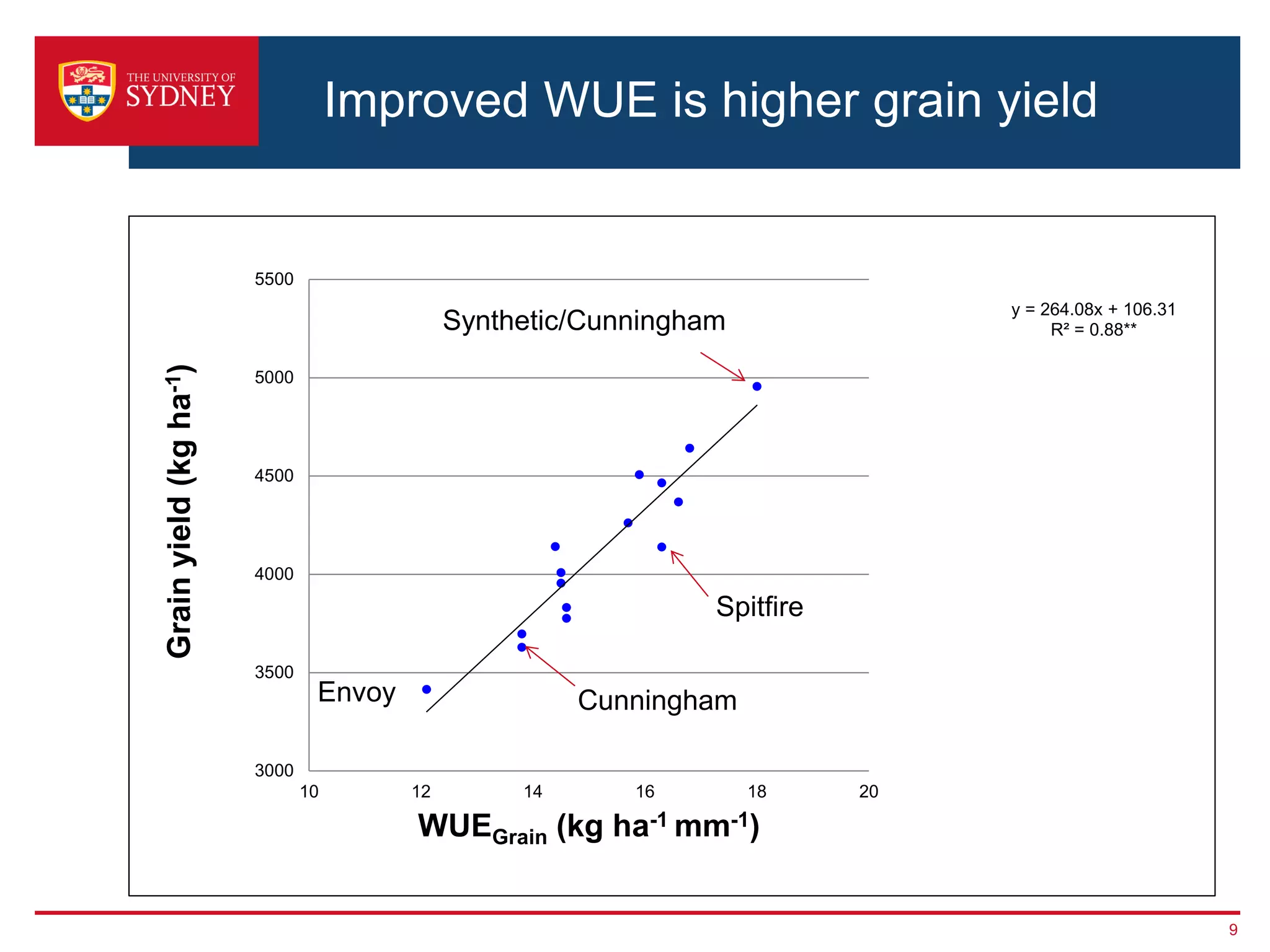
Improved WUE is higher grain yield
9
y = 264.08x + 106.31
R² = 0.88**
3000
3500
4000
4500
5000
5500
10 12 14 16 18 20
Grainyield(kgha-1)
WUEGrain (kg ha-1 mm-1)
Envoy Cunningham
Synthetic/Cunningham
Spitfire
10
Coordinated & relevant
phenotyping
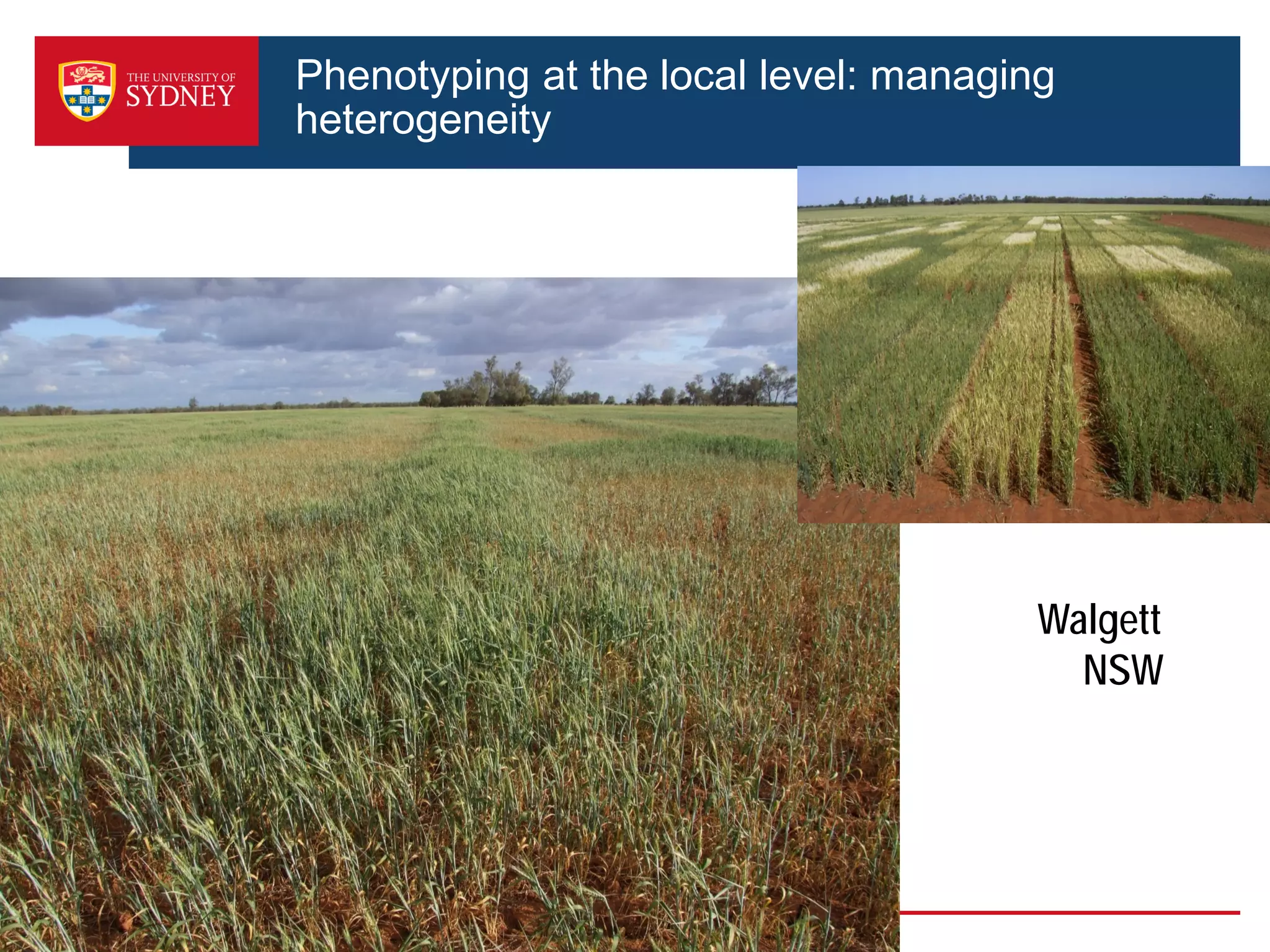
Phenotyping at the local level: managing
heterogeneity
Walgett
NSW
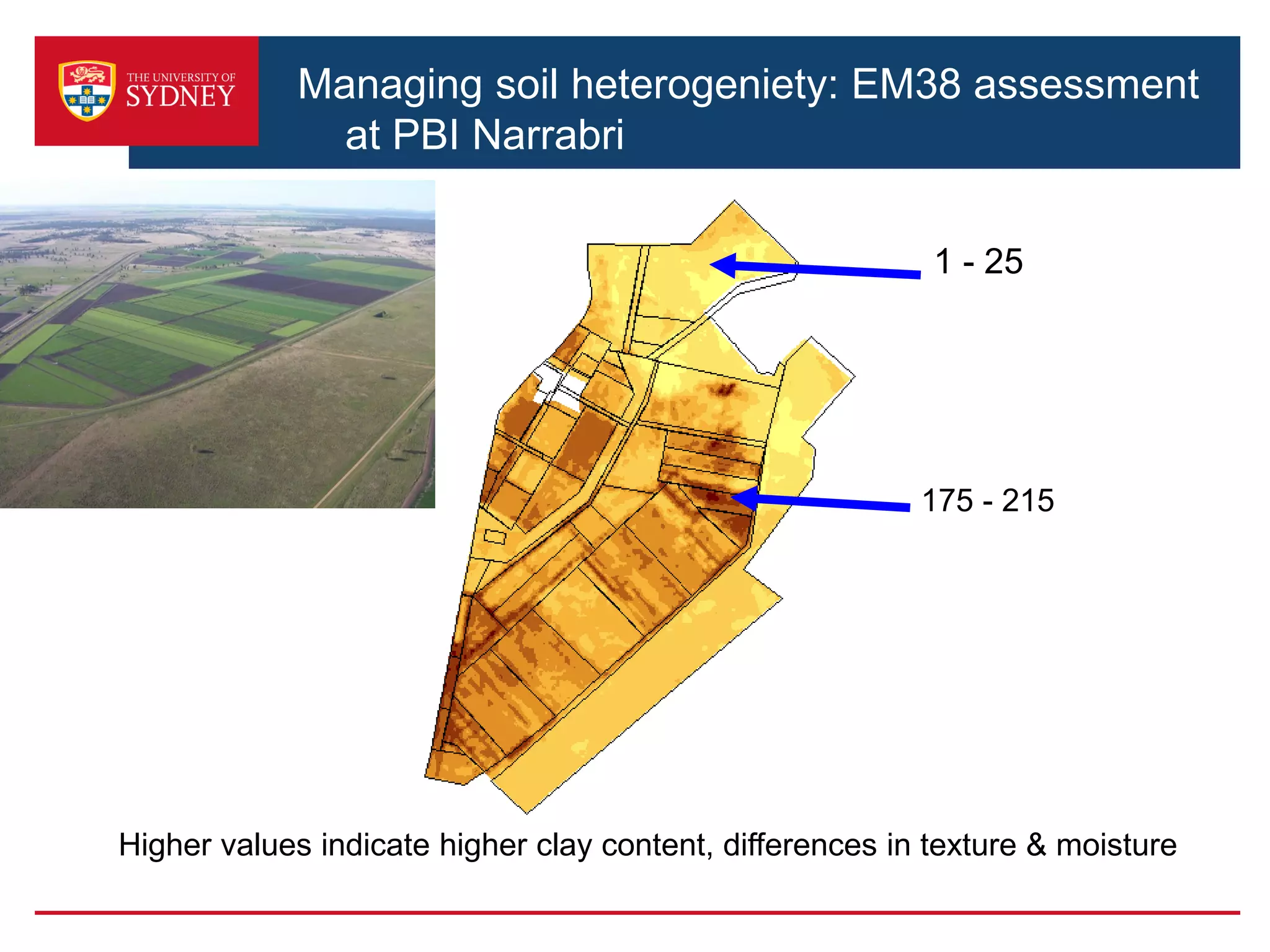
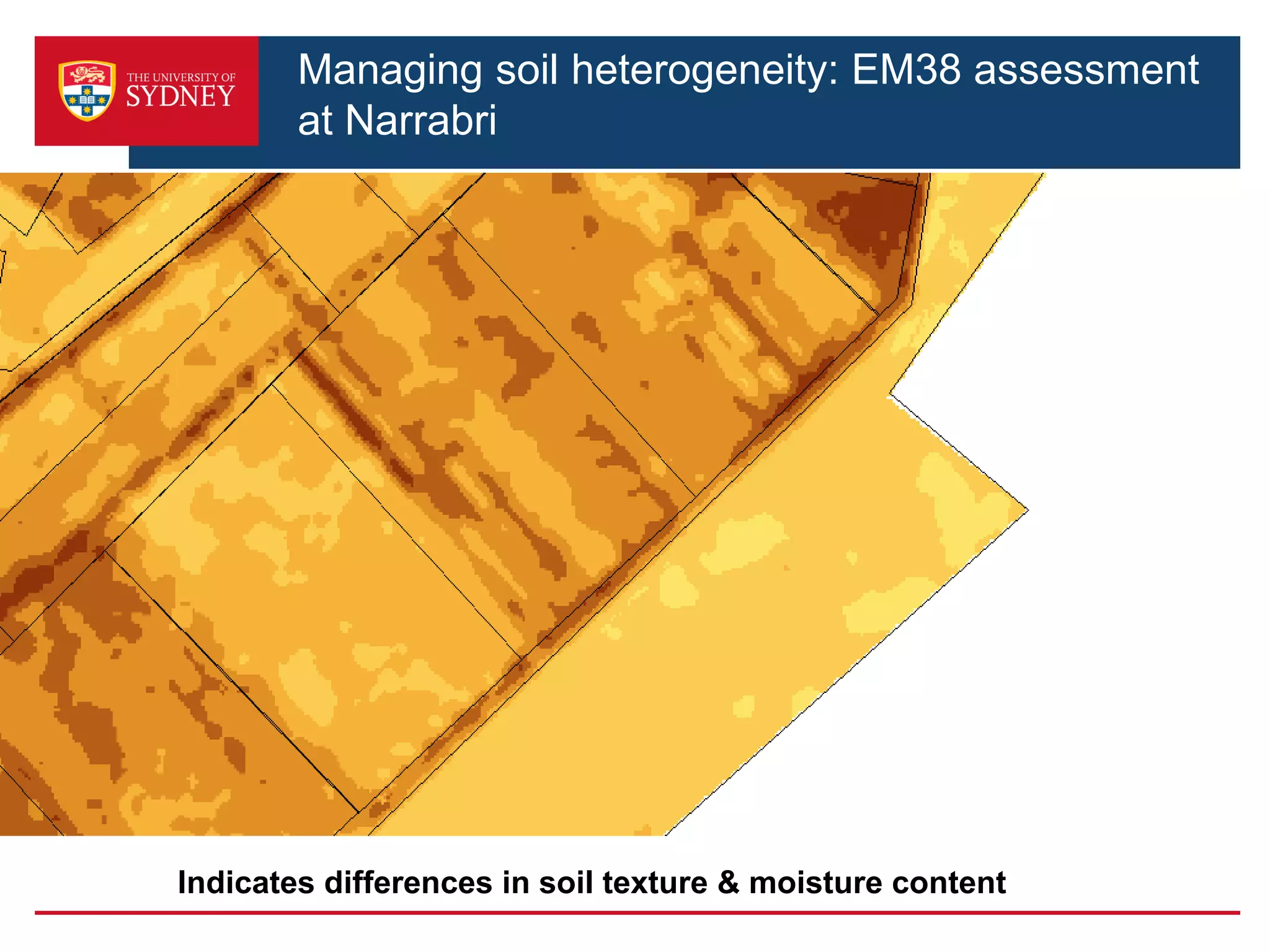
Managing soil heterogeniety: EM38 assessment
at PBI Narrabri
1 - 25
175 - 215
Higher values indicate higher clay content, differences in texture & moisture
Indicates differences in soil texture & moisture content
Managing soil heterogeneity: EM38 assessment
at Narrabri
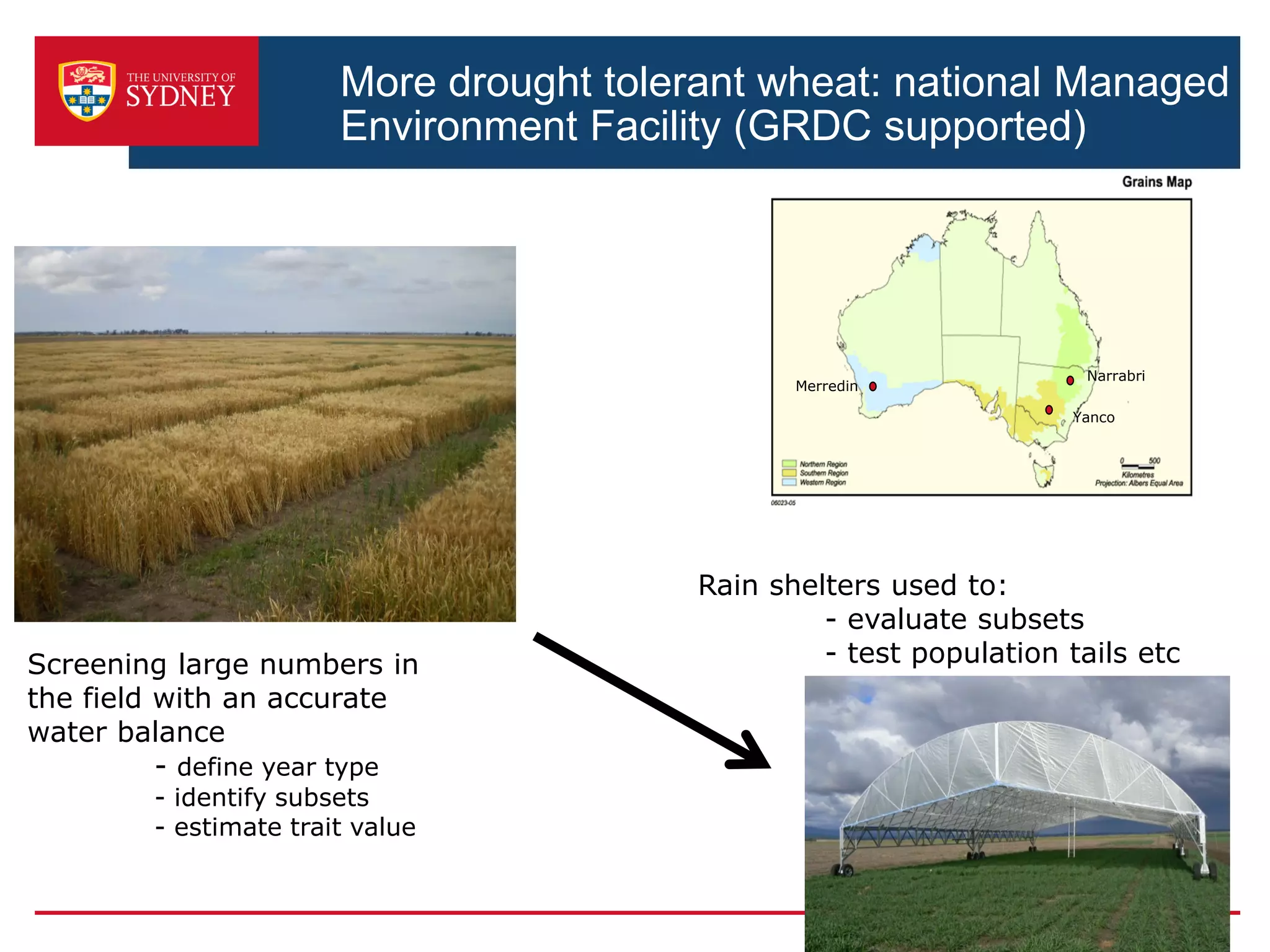
More drought tolerant wheat: national Managed
Environment Facility (GRDC supported)
Screening large numbers in
the field with an accurate
water balance
- define year type
- identify subsets
- estimate trait value
Rain shelters used to:
- evaluate subsets
- test population tails etc
Narrabri
Yanco
Merredin
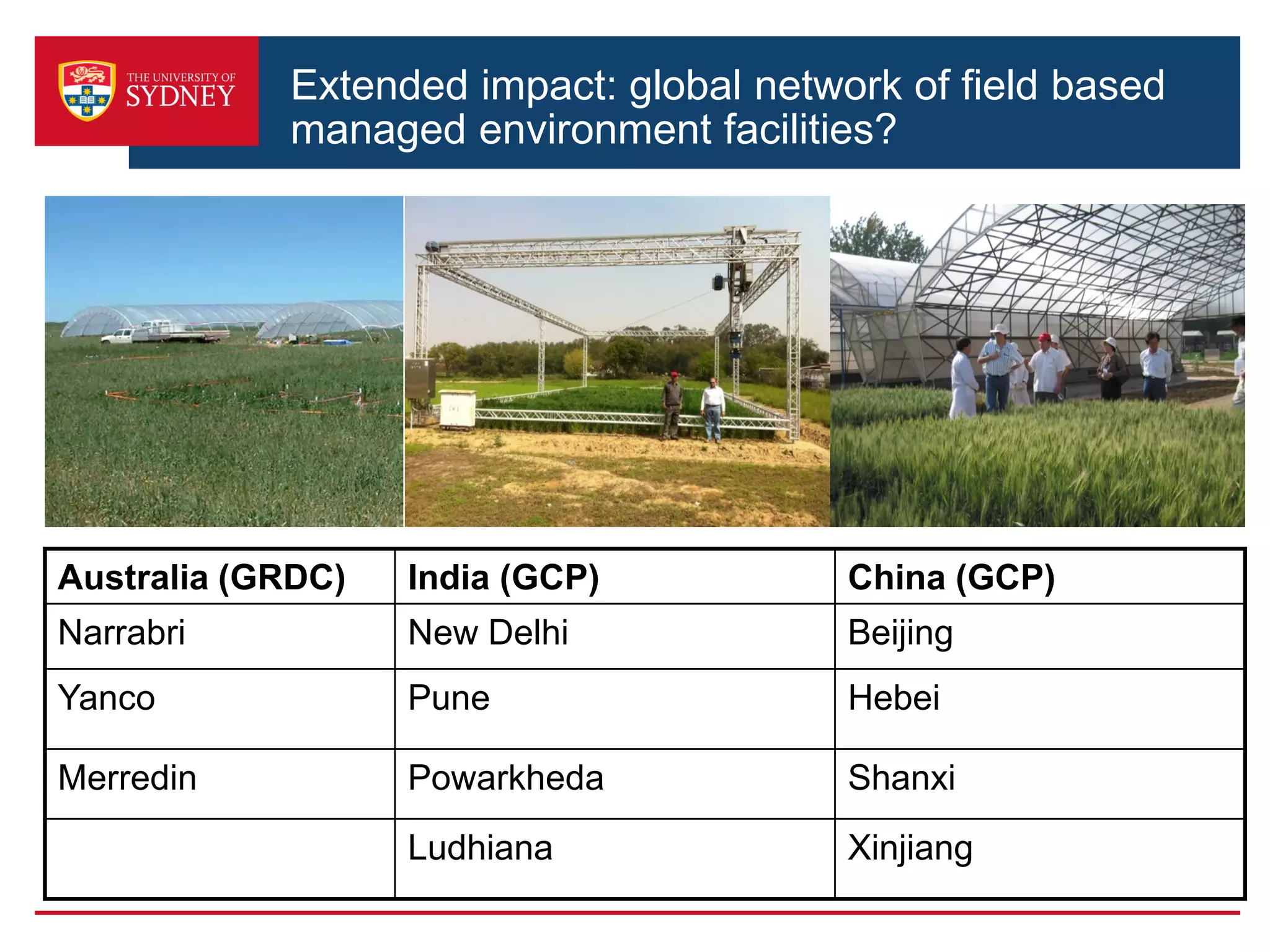
Extended impact: global network of field based
managed environment facilities?
Australia (GRDC) India (GCP) China (GCP)
Narrabri New Delhi Beijing
Yanco Pune Hebei
Merredin Powarkheda Shanxi
Ludhiana Xinjiang
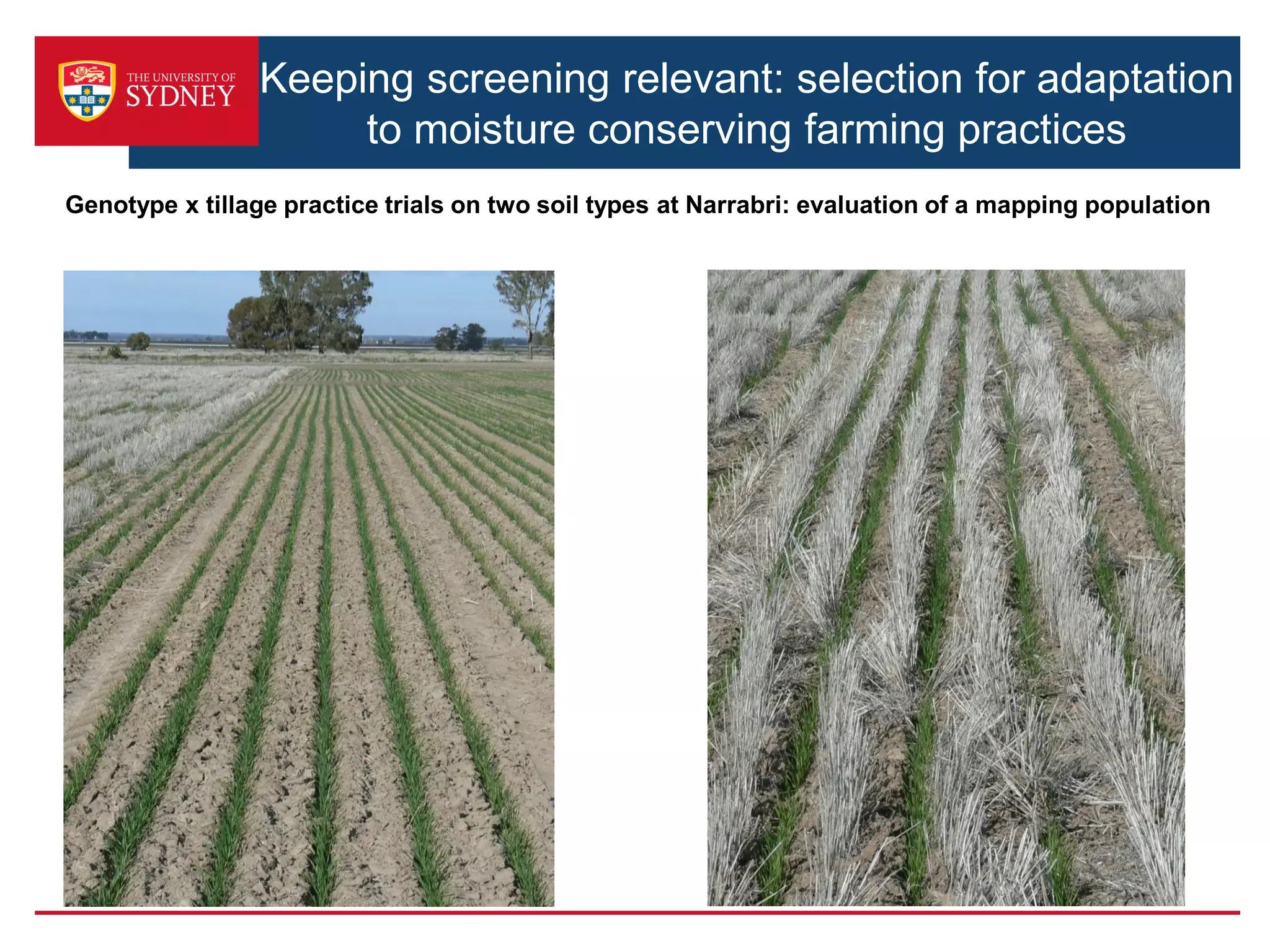
Genotype x tillage practice trials on two soil types at Narrabri: evaluation of a mapping population
Keeping screening relevant: selection for adaptation
to moisture conserving farming practices
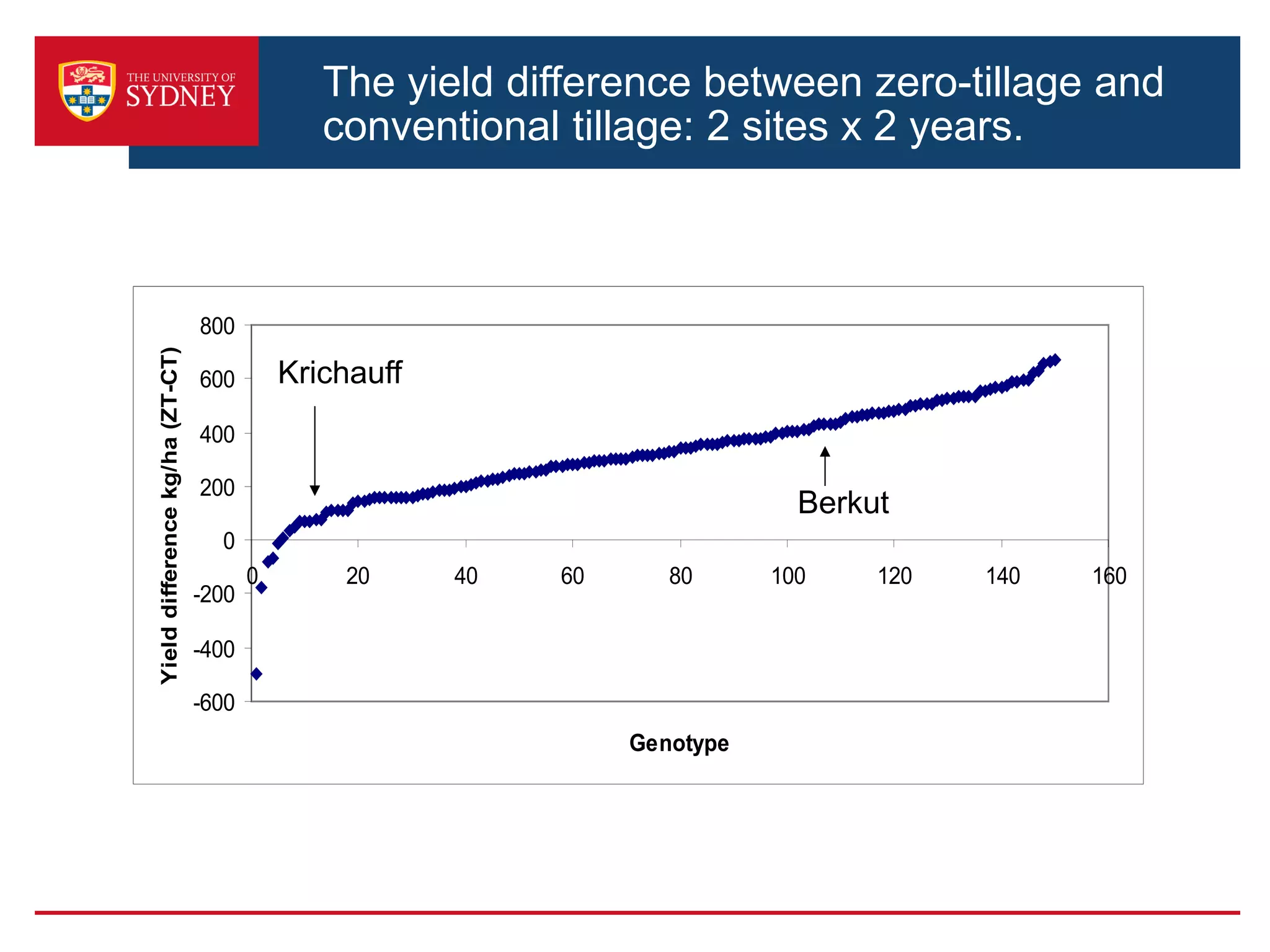
The yield difference between zero-tillage and
conventional tillage: 2 sites x 2 years.
-600
-400
-200
0
200
400
600
800
0 20 40 60 80 100 120 140 160
Genotype
Yielddifferencekg/ha(ZT-CT)
Krichauff
Berkut
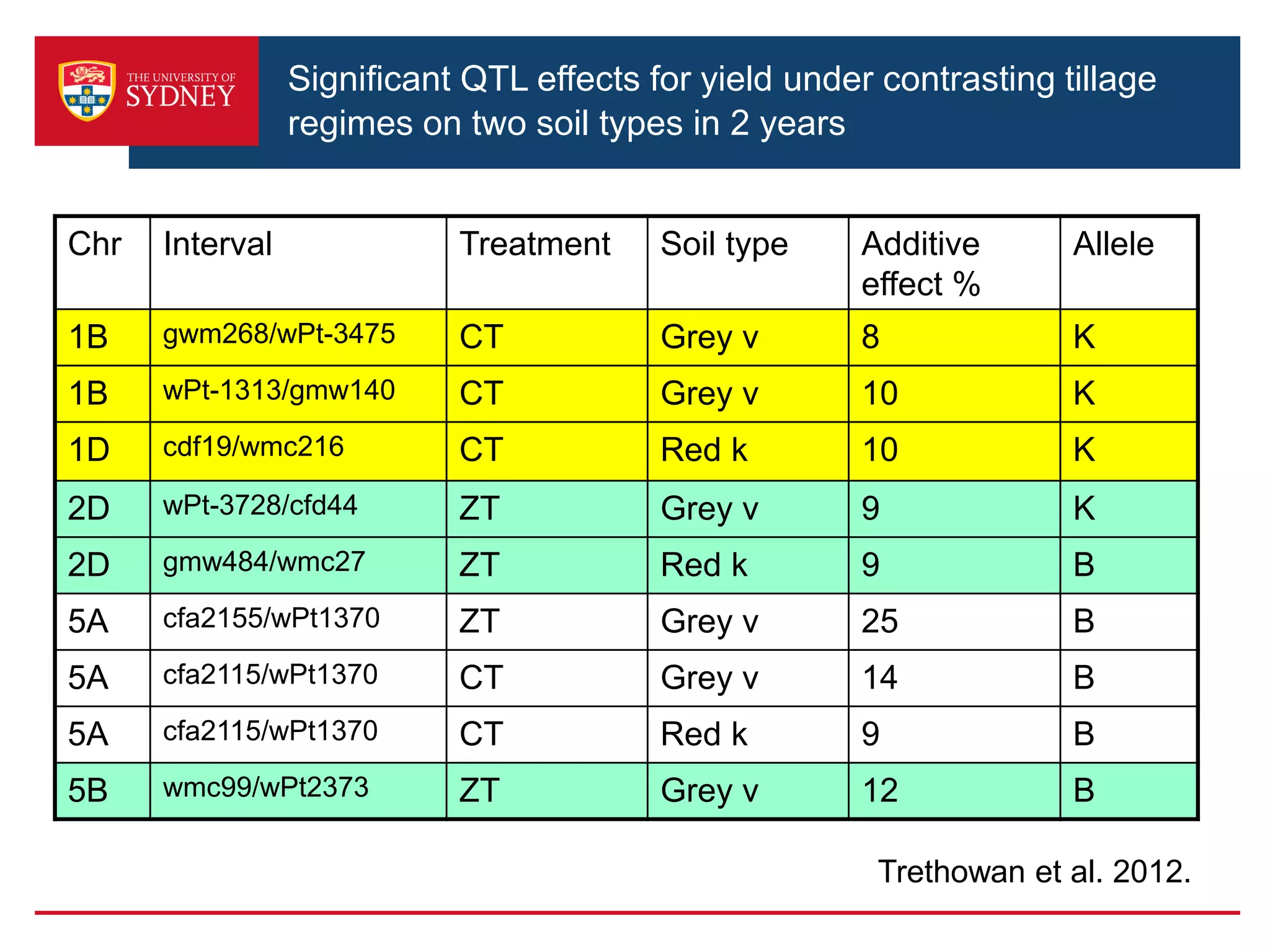
Significant QTL effects for yield under contrasting tillage
regimes on two soil types in 2 years
Chr Interval Treatment Soil type Additive
effect %
Allele
1B gwm268/wPt-3475 CT Grey v 8 K
1B wPt-1313/gmw140 CT Grey v 10 K
1D cdf19/wmc216 CT Red k 10 K
2D wPt-3728/cfd44 ZT Grey v 9 K
2D gmw484/wmc27 ZT Red k 9 B
5A cfa2155/wPt1370 ZT Grey v 25 B
5A cfa2115/wPt1370 CT Grey v 14 B
5A cfa2115/wPt1370 CT Red k 9 B
5B wmc99/wPt2373 ZT Grey v 12 B
Trethowan et al. 2012.
19
Maximise the benefits of global
public goods research
20
The CGIAR has:
 Multiple crop focus
 Access to genetic diversity
 Resources to introduce this diversity into adapted materials
 The network to distribute materials globally
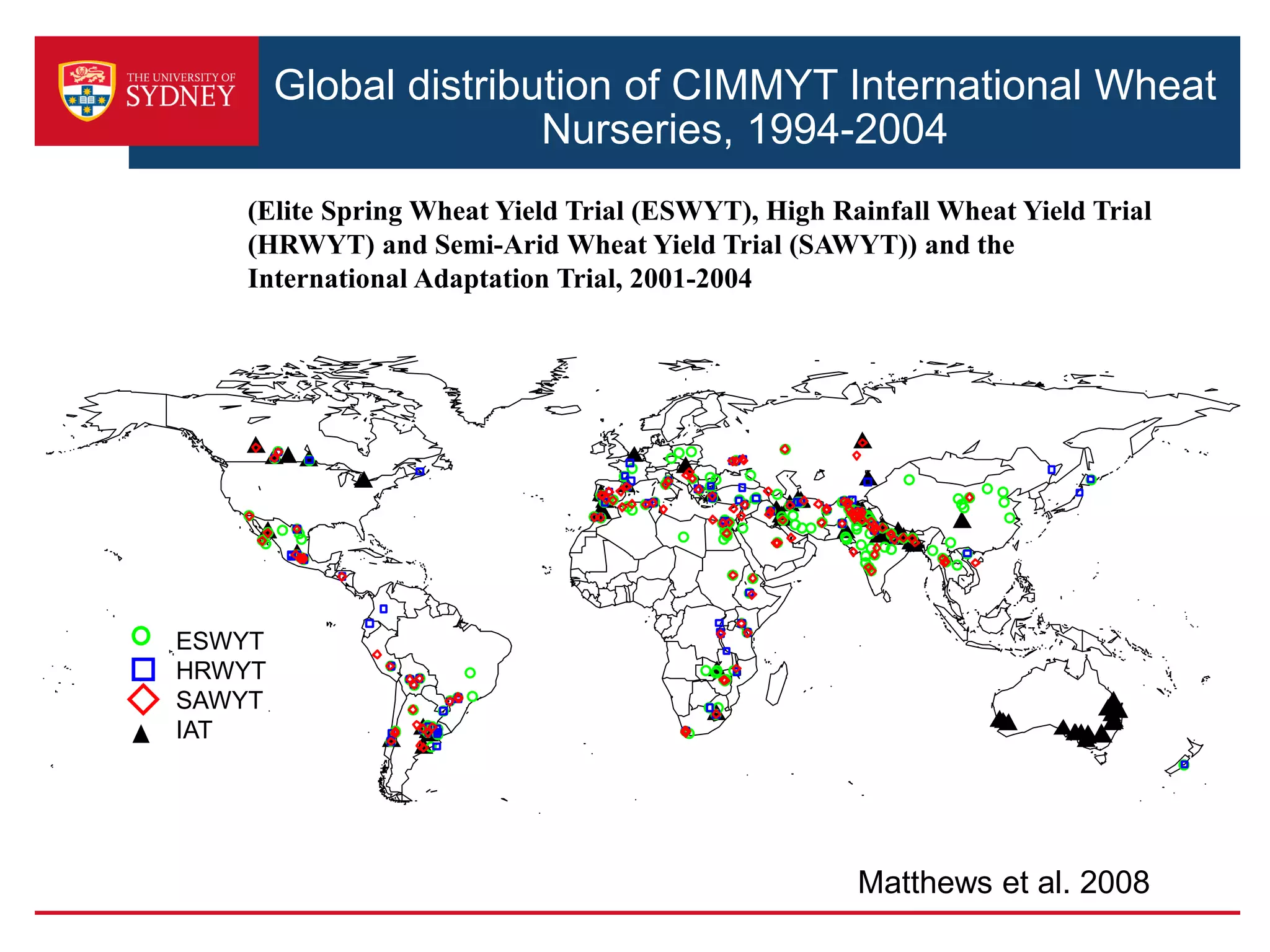
Global distribution of CIMMYT International Wheat
Nurseries, 1994-2004
ESWYT
HRWYT
SAWYT
IAT
(Elite Spring Wheat Yield Trial (ESWYT), High Rainfall Wheat Yield Trial
(HRWYT) and Semi-Arid Wheat Yield Trial (SAWYT)) and the
International Adaptation Trial, 2001-2004
Matthews et al. 2008
Probe genotypes for soil borne constraints
(International Adaptation Trial)
Probe genotypes are:
 Genetically similar (either near-isogenic or same background)
 Similar yield in the absence of the stress
 Differentiate in the presence of the stress
Thirty seven different probe genotype comparisons in the IAT
including soil borne diseases and abiotic constraints:
Matthews et al., 2011
GRDC supported
30
o
S
30
o
S
0
o
0
o
30
o
N
30
o
N
60
o
N
60
o
N
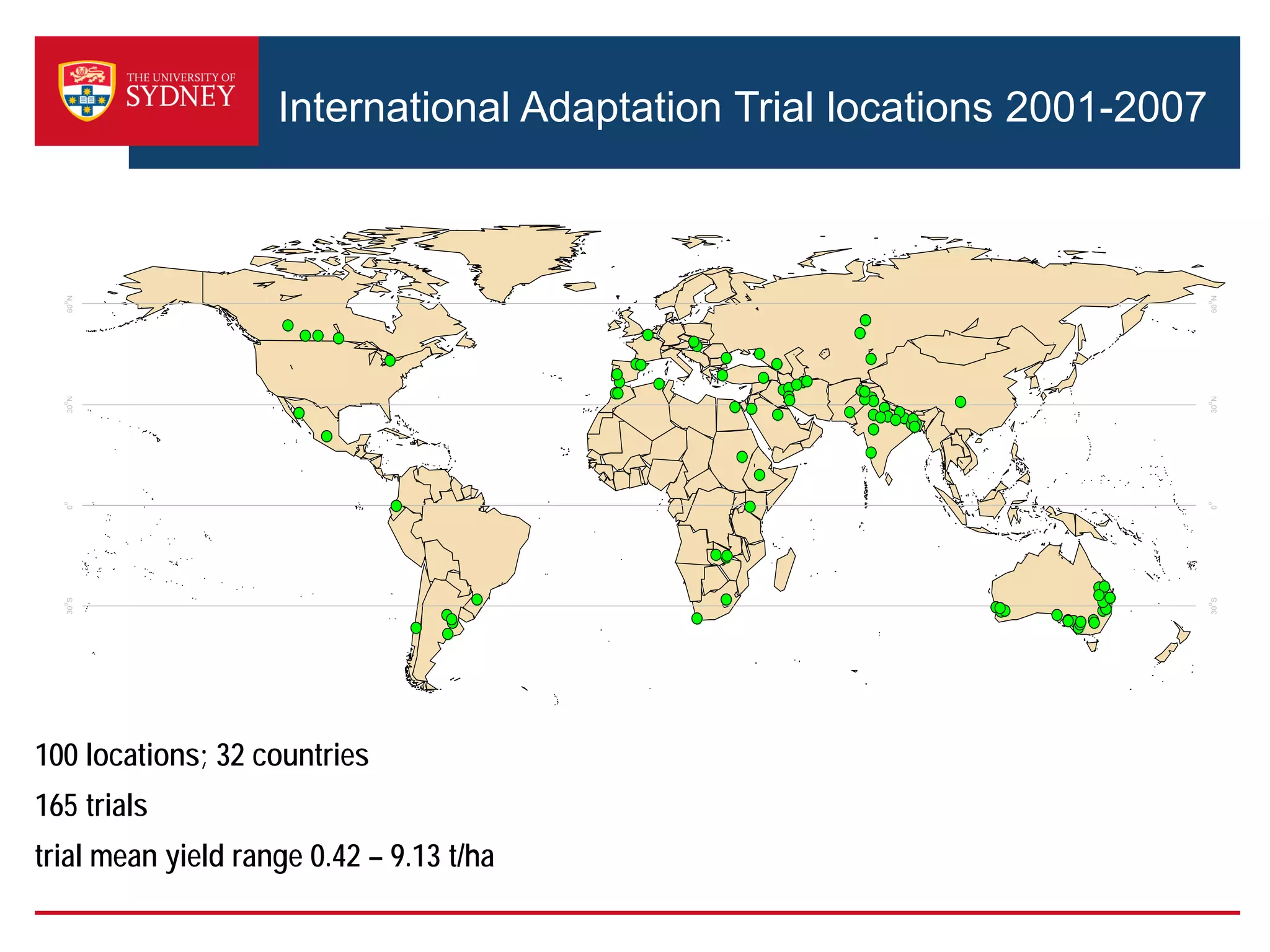
International Adaptation Trial locations 2001-2007
100 locations; 32 countries
165 trials
trial mean yield range 0.42 – 9.13 t/ha
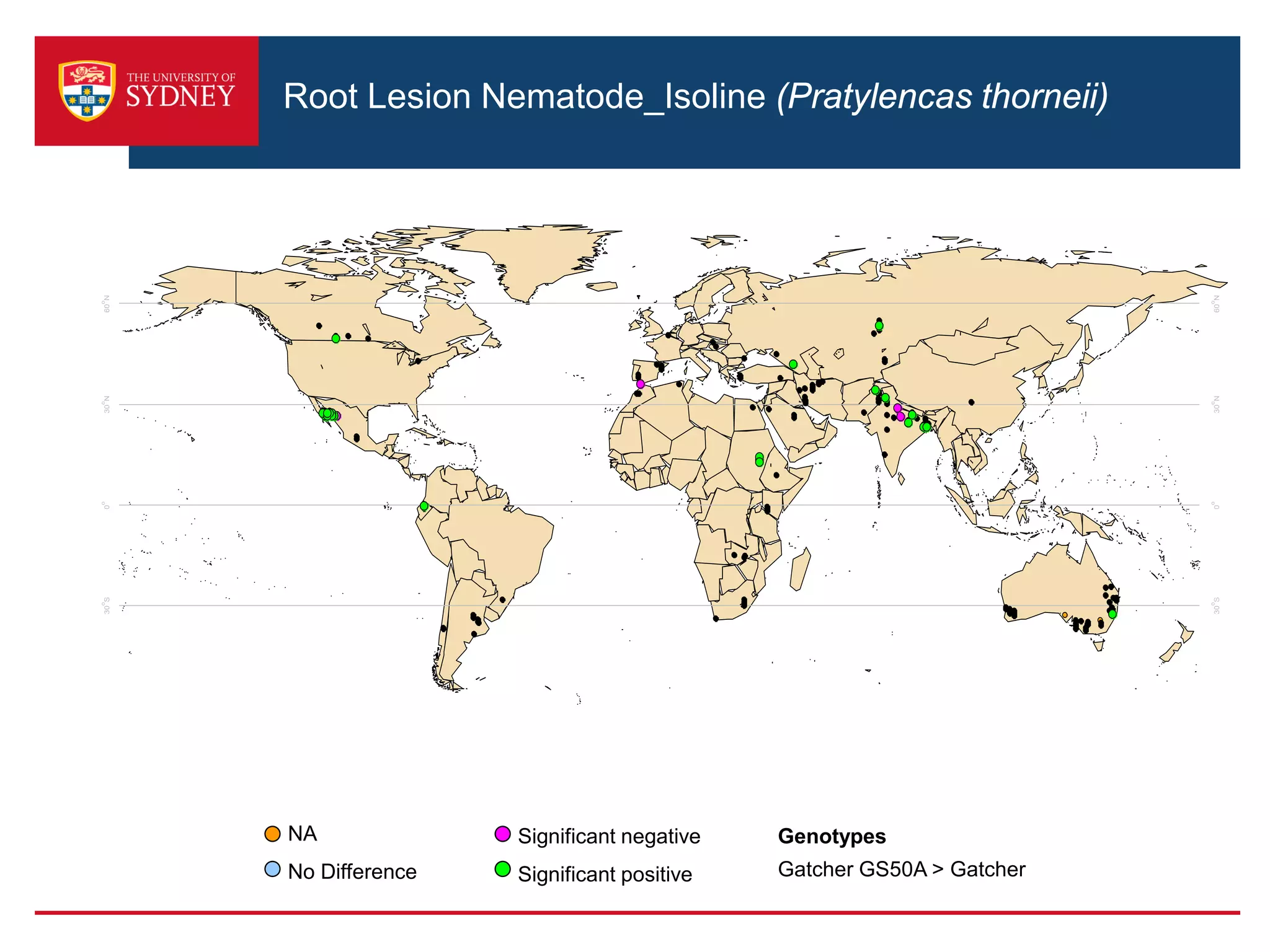
Root Lesion Nematode_Isoline (Pratylencas thorneii)
NA
No Difference
Significant negative
Significant positive
Genotypes
Gatcher GS50A > Gatcher
30
o
S
30
o
S
0
o
0
o
30
o
N
30
o
N
60
o
N
60
o
N
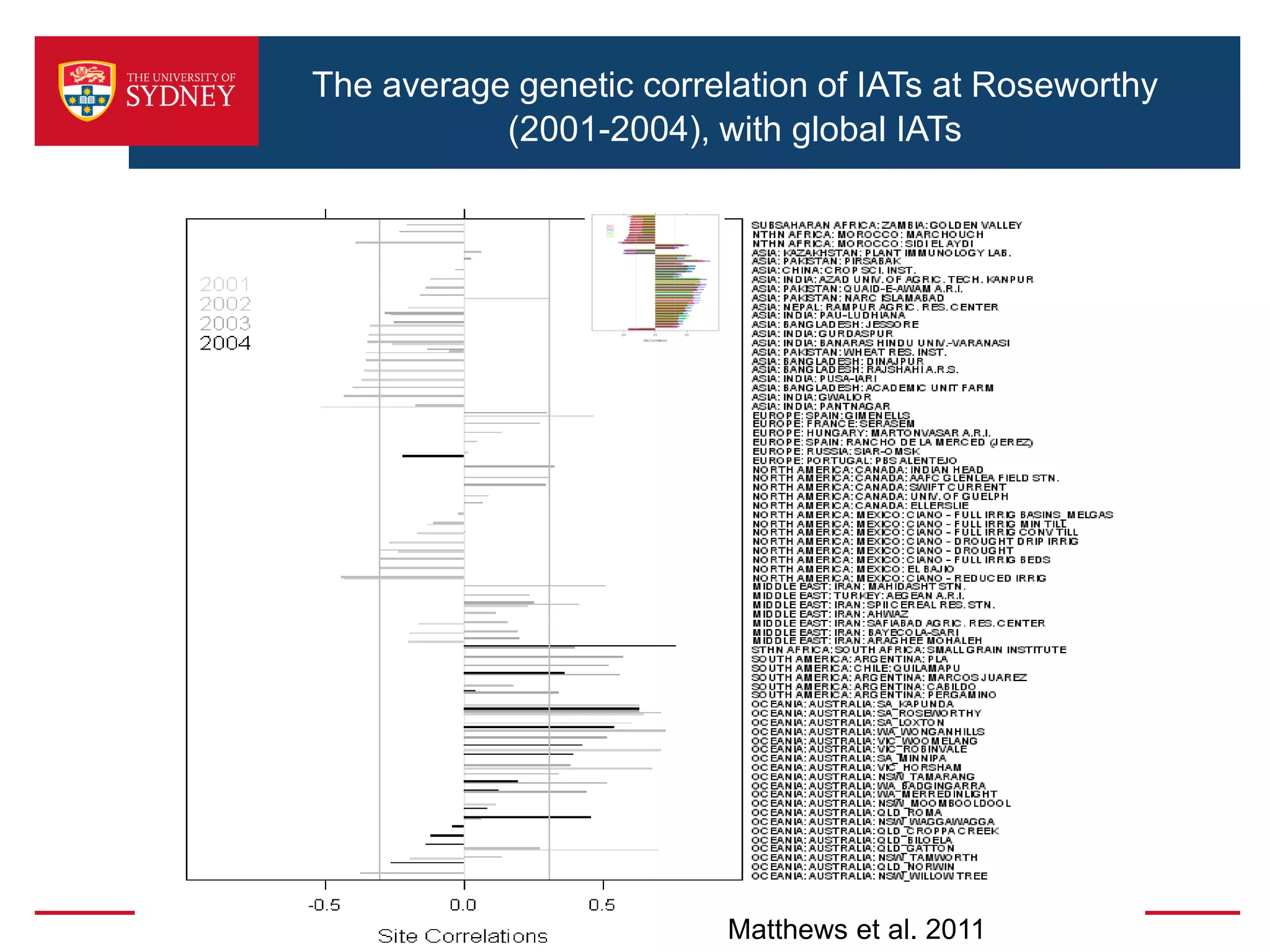
The average genetic correlation of IATs at Roseworthy
(2001-2004), with global IATs
Matthews et al. 2011
CIMMYT Australia ICARDA Germplasm Evaluation
(CAIGE)
 Improved access to (and exploitation of) CIMMYT and ICARDA
germplasm by Australian wheat breeders
 Co-ordinated germplasm introduction, quarantine, evaluation &
data management
 Two-way flow of information between Australia and the CGIAR
centres (CAIGE website)
Supported by the GRDC
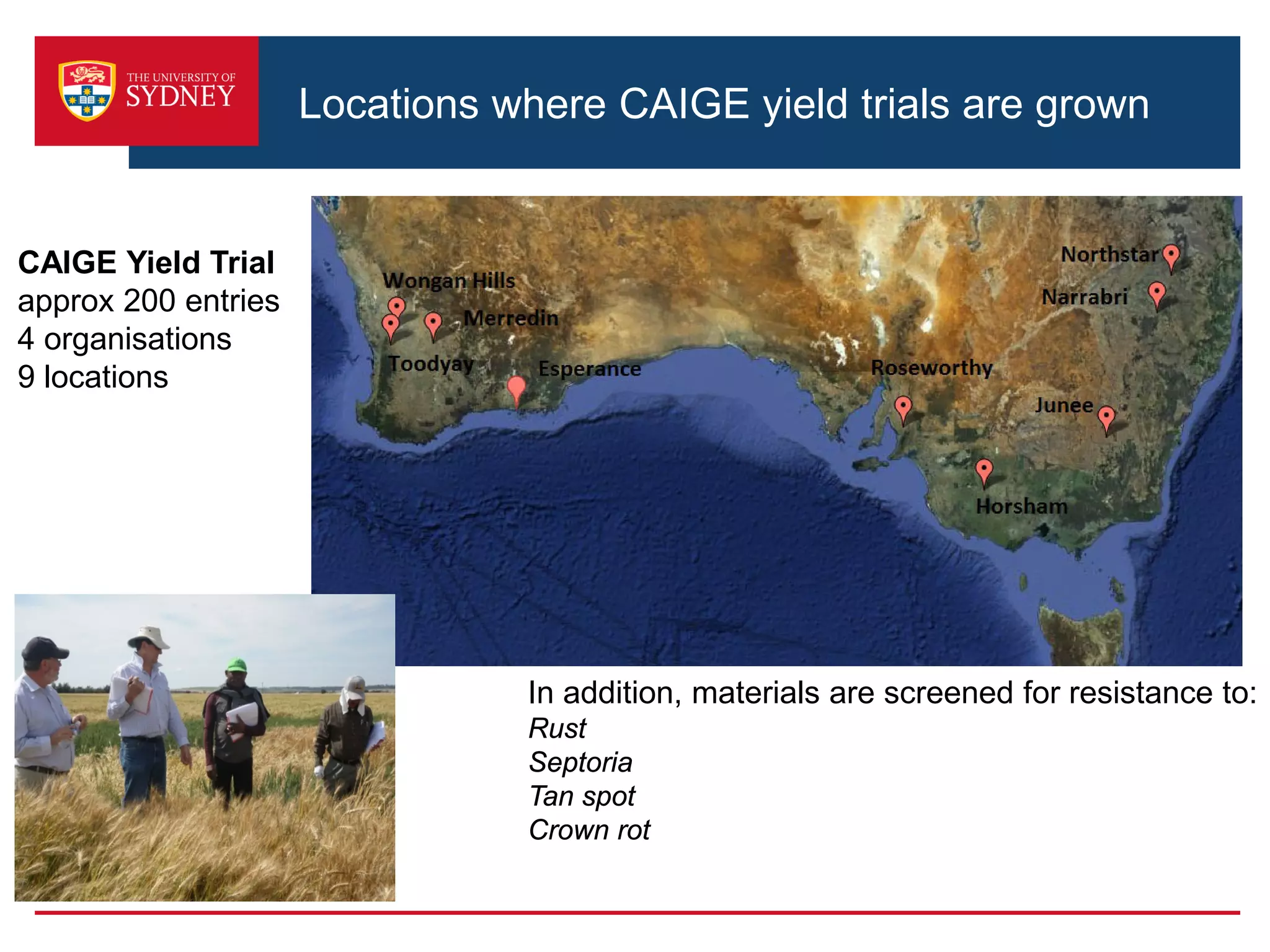
Locations where CAIGE yield trials are grown
CAIGE Yield Trial
approx 200 entries
4 organisations
9 locations
In addition, materials are screened for resistance to:
Rust
Septoria
Tan spot
Crown rot
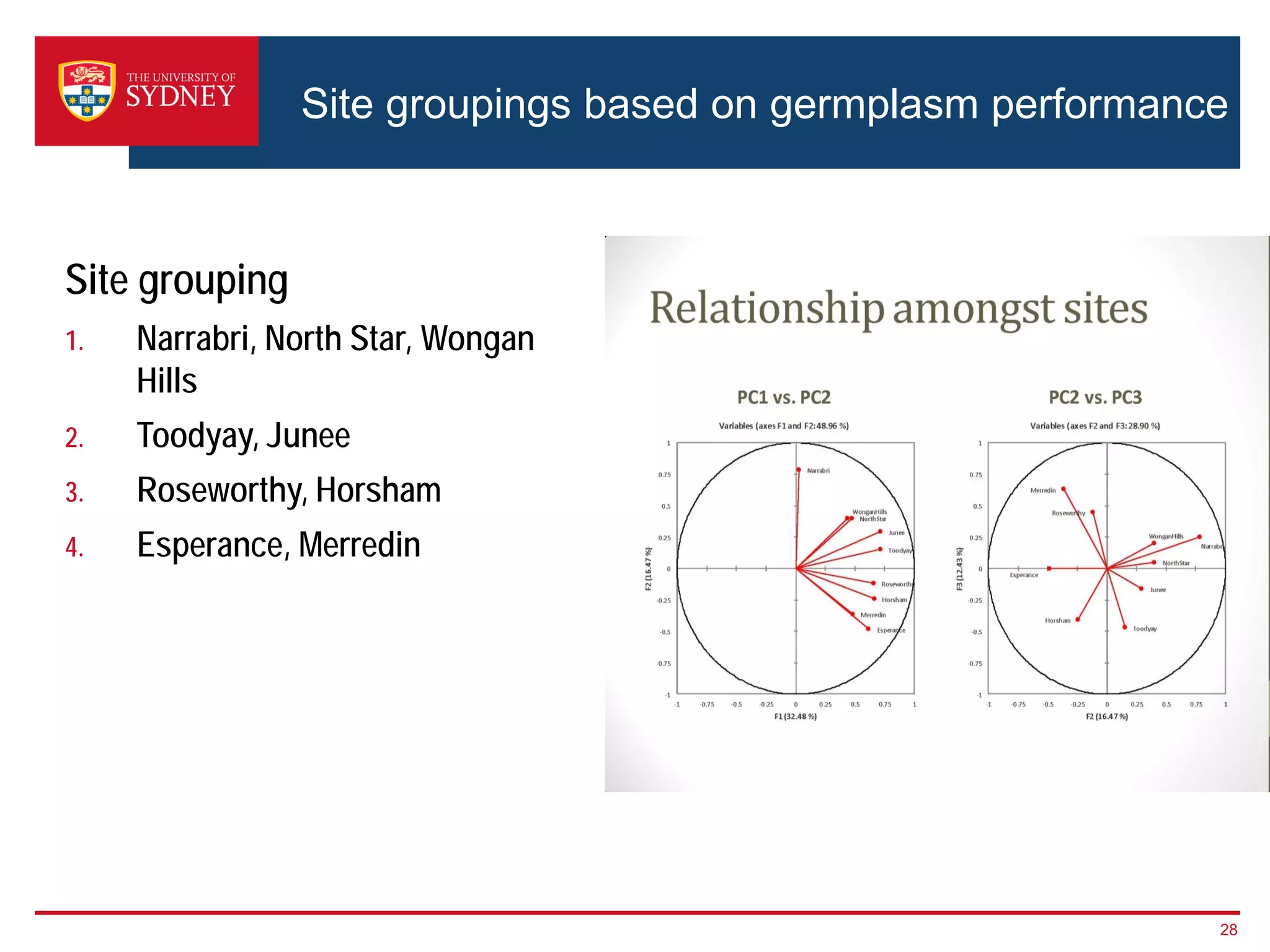
Site groupings based on germplasm performance
Site grouping
1. Narrabri, North Star, Wongan
Hills
2. Toodyay, Junee
3. Roseworthy, Horsham
4. Esperance, Merredin
28
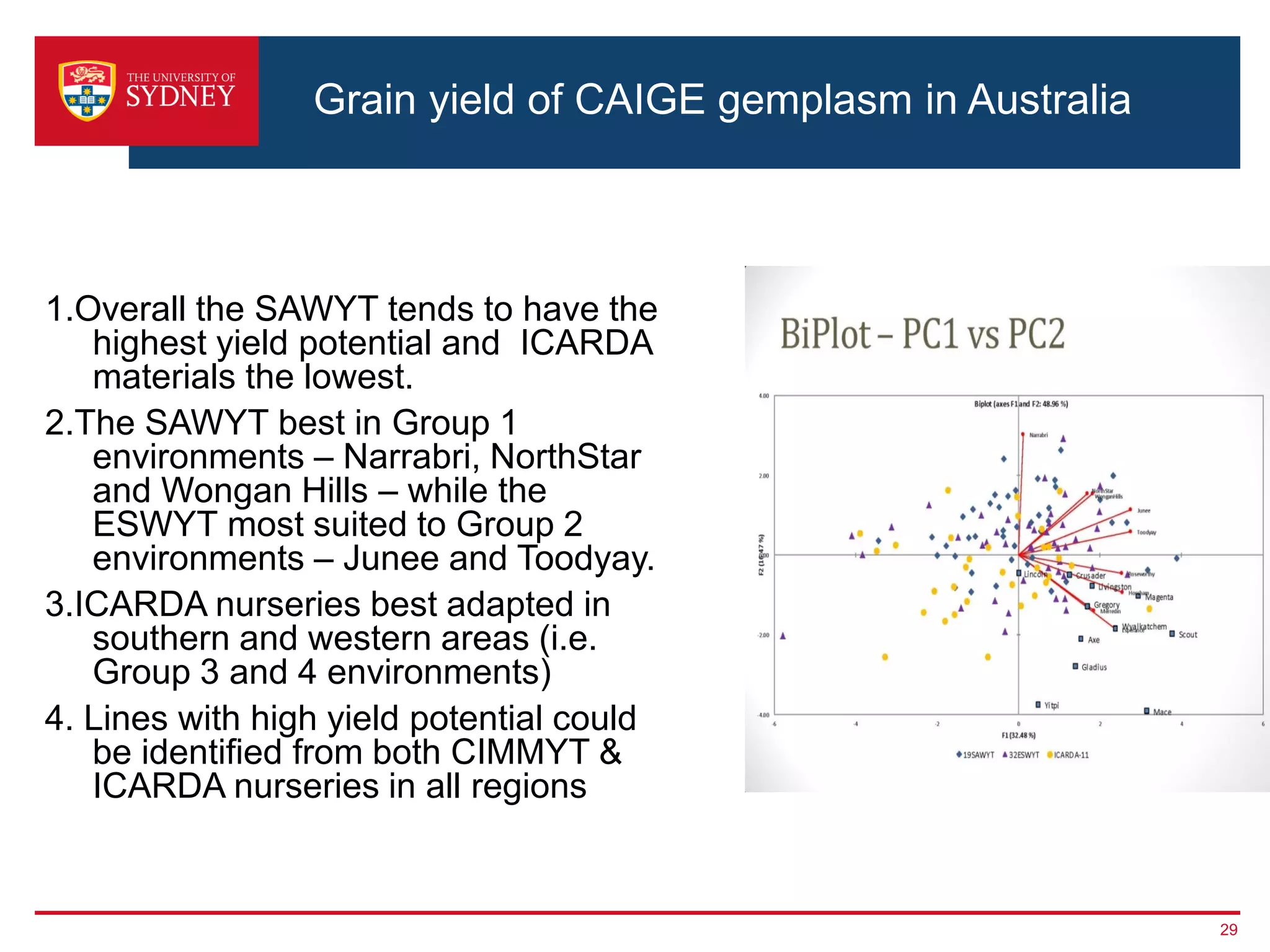
1.Overall the SAWYT tends to have the
highest yield potential and ICARDA
materials the lowest.
2.The SAWYT best in Group 1
environments – Narrabri, NorthStar
and Wongan Hills – while the
ESWYT most suited to Group 2
environments – Junee and Toodyay.
3.ICARDA nurseries best adapted in
southern and western areas (i.e.
Group 3 and 4 environments)
4. Lines with high yield potential could
be identified from both CIMMYT &
ICARDA nurseries in all regions
29
Grain yield of CAIGE gemplasm in Australia
Acknowledgements
Funding:
GRDC, ACIAR, Generation Challenge Program & the Wheat
Research Foundation
Collaboration:
Australia’s wheat breeding groups & companies
CIMMYT, ICARDA, ICAR (India) & CAAS (China)
30

GRM 2013: Delivering drought tolerance to those who need it: From genetic resources to cultivar – R Trethowan

  • 1.
    1 Delivering drought toleranceto those who need it; from genetic resource to cultivar R. M. Trethowan
  • 2.
    2 Stepwise exploitation ofgenetic resources - do the easy things first - exploit existing gene pool genetic variation Coordinated and relevant field based phenotyping - local, national & international levels - trait validation across the target environment Maximised benefits from global public goods breeding - CGIAR centres and affiliates have access to diversity - CGIAR centres a mandate to “tame” diversity - National strategies to “squeeze” the most out of international germplasm Three efficiencies to delivering drought tolerant cultivars
  • 3.
    3 Stepwise exploitation ofgenetic resources Adapted cultivars Landraces Related species (crossable) Alien species
  • 4.
    Genetics of wheatyield in the northwestern NSW Chromosome Number of significant markers linked to yield 1A 3 1B 1 1D 4 2A 6 5A 2 5B 4 6A 12 6D 3 7A 20 7D 6 4 Association analysis of a commercial wheat breeding program Atta et al 2013 Based on 300 parents & derived progeny tested in multi-environment trials over 3 years
  • 5.
    Better breeding strategiesto improve WUE: targeting crown rot resistance in NSW Crown rot in wheat  Complex inheritance of resistance  Plenty of genetic variation in the gene pool  Low heritability  Symptoms exacerbated under moisture stress  Little progress over the past twenty years Marker assisted recurrent selection  Combine resistance QTLs in each population  Yield testing in paired plots (+/- inoculation)  Off season symptom testing 5 GRDC supported
  • 6.
    Marker Assisted RecurrentSelection Significant Markers - CSCR16/2/2-49/CUNNINGHAM//KENEDY/3/SUNCO/2*PASTOR(1RDRN#44)  Symptom expression off season (controlled conditions)  1AL, 1BL, 1DL, 2AL, 2BL, 2BS, 3AL, 3DL, 4AL, 4BL, 4DL, 4DS, 5AL, 5AS, 5BS, 5DL, 6AL, 6BL, 6DL, 7AS, 7BS  Field  1AL, 2BL, 3AL, 3B(?), 4BL, 4DL, 5BL,6BL 6
  • 7.
    T. dicoccum or durum A.tauschii AABBDD DD + AABB Synthetic wheat: the next step Yield of a synthetic derivative compared to the best local check in 30 environments 0 2 4 6 8 10 0 2 4 6 8 10 Average yield of SAWYT at site (t/Ha) Yieldofline(t/Ha) Local Check Vorobey Lage & Trethowan, 2008
  • 8.
    Improving wheat WUEat Narrabri, NSW Genotype Water use (mm) WUE kg ha-1 mm -1 D67.2/P66.270//AE.SQUARRO SA (320)/3/Cunningham 273 18.0 Cunningham 261 13.9 Crusader 254 16.2 Envoy 283 12.0 Spitfire 258 14.6 8 Atta et al., 2013
  • 9.
    Improved WUE ishigher grain yield 9 y = 264.08x + 106.31 R² = 0.88** 3000 3500 4000 4500 5000 5500 10 12 14 16 18 20 Grainyield(kgha-1) WUEGrain (kg ha-1 mm-1) Envoy Cunningham Synthetic/Cunningham Spitfire
  • 10.
  • 11.
    Phenotyping at thelocal level: managing heterogeneity Walgett NSW
  • 12.
    Managing soil heterogeniety:EM38 assessment at PBI Narrabri 1 - 25 175 - 215 Higher values indicate higher clay content, differences in texture & moisture
  • 13.
    Indicates differences insoil texture & moisture content Managing soil heterogeneity: EM38 assessment at Narrabri
  • 14.
    More drought tolerantwheat: national Managed Environment Facility (GRDC supported) Screening large numbers in the field with an accurate water balance - define year type - identify subsets - estimate trait value Rain shelters used to: - evaluate subsets - test population tails etc Narrabri Yanco Merredin
  • 15.
    Extended impact: globalnetwork of field based managed environment facilities? Australia (GRDC) India (GCP) China (GCP) Narrabri New Delhi Beijing Yanco Pune Hebei Merredin Powarkheda Shanxi Ludhiana Xinjiang
  • 16.
    Genotype x tillagepractice trials on two soil types at Narrabri: evaluation of a mapping population Keeping screening relevant: selection for adaptation to moisture conserving farming practices
  • 17.
    The yield differencebetween zero-tillage and conventional tillage: 2 sites x 2 years. -600 -400 -200 0 200 400 600 800 0 20 40 60 80 100 120 140 160 Genotype Yielddifferencekg/ha(ZT-CT) Krichauff Berkut
  • 18.
    Significant QTL effectsfor yield under contrasting tillage regimes on two soil types in 2 years Chr Interval Treatment Soil type Additive effect % Allele 1B gwm268/wPt-3475 CT Grey v 8 K 1B wPt-1313/gmw140 CT Grey v 10 K 1D cdf19/wmc216 CT Red k 10 K 2D wPt-3728/cfd44 ZT Grey v 9 K 2D gmw484/wmc27 ZT Red k 9 B 5A cfa2155/wPt1370 ZT Grey v 25 B 5A cfa2115/wPt1370 CT Grey v 14 B 5A cfa2115/wPt1370 CT Red k 9 B 5B wmc99/wPt2373 ZT Grey v 12 B Trethowan et al. 2012.
  • 19.
    19 Maximise the benefitsof global public goods research
  • 20.
    20 The CGIAR has: Multiple crop focus  Access to genetic diversity  Resources to introduce this diversity into adapted materials  The network to distribute materials globally
  • 21.
    Global distribution ofCIMMYT International Wheat Nurseries, 1994-2004 ESWYT HRWYT SAWYT IAT (Elite Spring Wheat Yield Trial (ESWYT), High Rainfall Wheat Yield Trial (HRWYT) and Semi-Arid Wheat Yield Trial (SAWYT)) and the International Adaptation Trial, 2001-2004 Matthews et al. 2008
  • 22.
    Probe genotypes forsoil borne constraints (International Adaptation Trial) Probe genotypes are:  Genetically similar (either near-isogenic or same background)  Similar yield in the absence of the stress  Differentiate in the presence of the stress Thirty seven different probe genotype comparisons in the IAT including soil borne diseases and abiotic constraints: Matthews et al., 2011 GRDC supported
  • 23.
    30 o S 30 o S 0 o 0 o 30 o N 30 o N 60 o N 60 o N International Adaptation Triallocations 2001-2007 100 locations; 32 countries 165 trials trial mean yield range 0.42 – 9.13 t/ha
  • 24.
    Root Lesion Nematode_Isoline(Pratylencas thorneii) NA No Difference Significant negative Significant positive Genotypes Gatcher GS50A > Gatcher 30 o S 30 o S 0 o 0 o 30 o N 30 o N 60 o N 60 o N
  • 25.
    The average geneticcorrelation of IATs at Roseworthy (2001-2004), with global IATs Matthews et al. 2011
  • 26.
    CIMMYT Australia ICARDAGermplasm Evaluation (CAIGE)  Improved access to (and exploitation of) CIMMYT and ICARDA germplasm by Australian wheat breeders  Co-ordinated germplasm introduction, quarantine, evaluation & data management  Two-way flow of information between Australia and the CGIAR centres (CAIGE website) Supported by the GRDC
  • 27.
    Locations where CAIGEyield trials are grown CAIGE Yield Trial approx 200 entries 4 organisations 9 locations In addition, materials are screened for resistance to: Rust Septoria Tan spot Crown rot
  • 28.
    Site groupings basedon germplasm performance Site grouping 1. Narrabri, North Star, Wongan Hills 2. Toodyay, Junee 3. Roseworthy, Horsham 4. Esperance, Merredin 28
  • 29.
    1.Overall the SAWYTtends to have the highest yield potential and ICARDA materials the lowest. 2.The SAWYT best in Group 1 environments – Narrabri, NorthStar and Wongan Hills – while the ESWYT most suited to Group 2 environments – Junee and Toodyay. 3.ICARDA nurseries best adapted in southern and western areas (i.e. Group 3 and 4 environments) 4. Lines with high yield potential could be identified from both CIMMYT & ICARDA nurseries in all regions 29 Grain yield of CAIGE gemplasm in Australia
  • 30.
    Acknowledgements Funding: GRDC, ACIAR, GenerationChallenge Program & the Wheat Research Foundation Collaboration: Australia’s wheat breeding groups & companies CIMMYT, ICARDA, ICAR (India) & CAAS (China) 30