Genetic and gene mapping by recombination
Arif
PHD student ABT
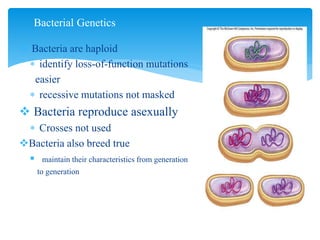
 Bacteria are haploid
 identify loss-of-function mutations
easier
 recessive mutations not masked
 Bacteria reproduce asexually
 Crosses not used
Bacteria also breed true
 maintain their characteristics from generation
to generation
Bacterial Genetics
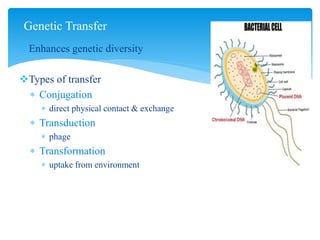
Enhances genetic diversity
Types of transfer
 Conjugation
 direct physical contact & exchange
 Transduction
 phage
 Transformation
 uptake from environment
Genetic Transfer
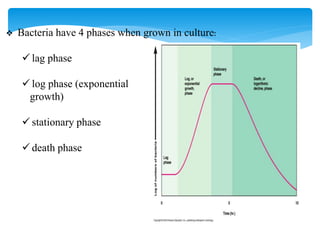
 Bacteria have 4 phases when grown in culture:
 lag phase
 log phase (exponential
growth)
 stationary phase
 death phase
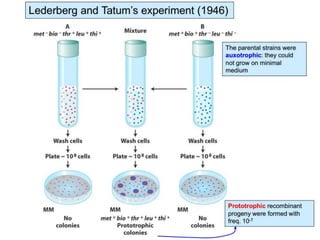
1. Discovered by Joshua Lederberg and Edward Tatum in 1946.
2. Unidirectional transfer of genetic material between donor and
recipient bacteria cells by direct contact.
3. Segment (rarely all) of the donor’s chromosome recombines
with the homologous recipient chromosome.
4. Recipients containing donor DNA are called transconjugants
Conjugation
Conjugation-transfer of the sex factor F:
1. William Hayes (1953) demonstrated that genetic exchange in E. coli occurs in only one
direction.
2. Genetic transfer is mediated by sex factor F.
3. Donor is F+ and recipient is F-.
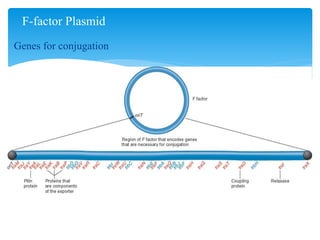
4. F is a self-replicating, circular DNA plasmid (1/40 the size of the main chromosome).
5. F plasmid contains an origin sequence (O), which initiates DNA transfer. It also
contains genes for hair-like cell surface (F-pili or sex-pili), which aid in contact
between cells.
6. No conjugation can occur between cells of the same mating type.
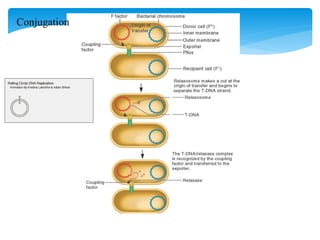
7. Conjugation begins when the F plasmid is nicked at the origin, and a single strand is
transferred using the rolling circle mechanism.
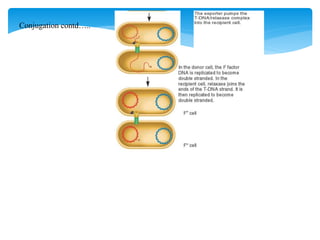
8. When transfer is complete, both cells are F+ double-stranded
Genes for conjugation
F-factor Plasmid
Conjugation
Conjugation contd…..
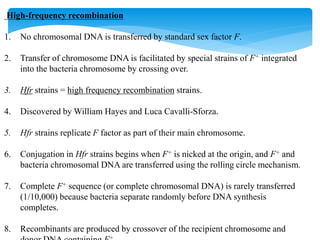
High-frequency recombination
1. No chromosomal DNA is transferred by standard sex factor F.
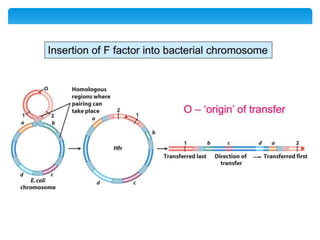
2. Transfer of chromosome DNA is facilitated by special strains of F+ integrated
into the bacteria chromosome by crossing over.
3. Hfr strains = high frequency recombination strains.
4. Discovered by William Hayes and Luca Cavalli-Sforza.
5. Hfr strains replicate F factor as part of their main chromosome.
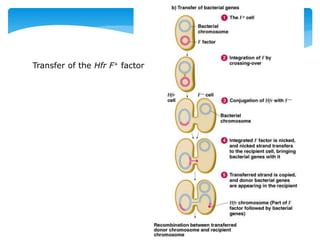
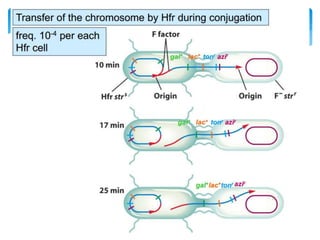
6. Conjugation in Hfr strains begins when F+ is nicked at the origin, and F+ and
bacteria chromosomal DNA are transferred using the rolling circle mechanism.
7. Complete F+ sequence (or complete chromosomal DNA) is rarely transferred
(1/10,000) because bacteria separate randomly before DNA synthesis
completes.
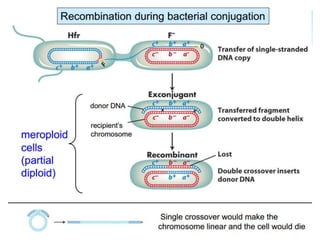
8. Recombinants are produced by crossover of the recipient chromosome and
+
Transfer of the Hfr F+ factor
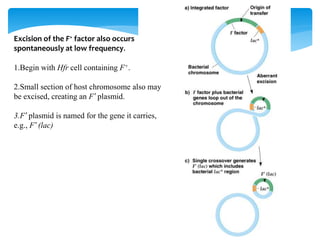
Excision of the F+ factor also occurs
spontaneously at low frequency.
1.Begin with Hfr cell containing F+.
2.Small section of host chromosome also may
be excised, creating an F’ plasmid.
3.F’ plasmid is named for the gene it carries,
e.g., F’ (lac)
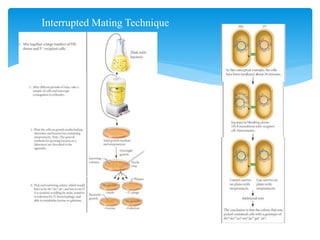
Interrupted Mating Technique
Using conjugation to map bacterial genes:
1. Begin with two different Hfr strains selected from F+ x F- crosses and
perform an interrupted mating experiment.
2. HfrH thr+ leu+ aziR tonR lac+ gal+ strR
F- thr leu aziS tons lac gal strS
3. Mix 2 cell types in medium at 37°C.
4. Remove at experimental time points and agitate to separate conjugating
pairs.
5. Analyze recombinants with selective media.
6. Order in which genes are transferred reflects linear sequence on
chromosomes and time in media.
7. Frequency of recombinants declines as donor gene enters recipient later.
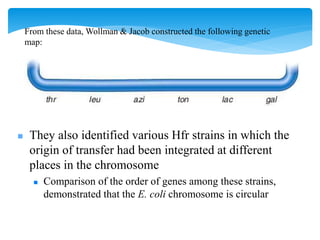
From these data, Wollman & Jacob constructed the following genetic
map:
 They also identified various Hfr strains in which the
origin of transfer had been integrated at different
places in the chromosome
 Comparison of the order of genes among these strains,
demonstrated that the E. coli chromosome is circular
The E. coli Chromosome
Conjugation experiments have been used to map
genes on the E. coli chromosome
The E. coli genetic map is 100 minutes long
Approximately the time it takes to transfer the complete
chromosome in an Hfr mating
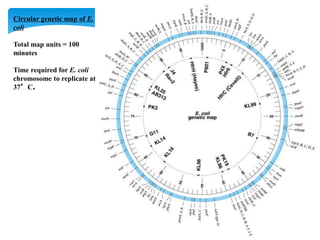
Circular genetic map of E.
coli
Total map units = 100
minutes
Time required for E. coli
chromosome to replicate at
37°C.
Copyright ©The McGraw-Hill Companies, Inc. Permission required for reproduction or display
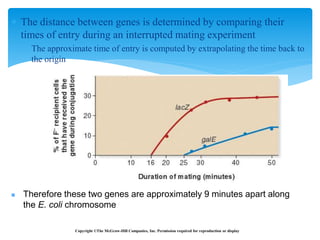
 The distance between genes is determined by comparing their
times of entry during an interrupted mating experiment
 The approximate time of entry is computed by extrapolating the time back to
the origin
 Therefore these two genes are approximately 9 minutes apart along
the E. coli chromosome
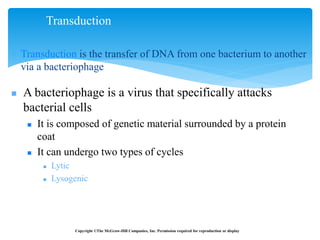
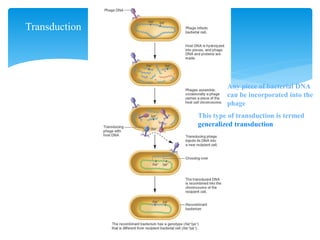
 Transduction is the transfer of DNA from one bacterium to another
via a bacteriophage
Transduction
Copyright ©The McGraw-Hill Companies, Inc. Permission required for reproduction or display
 A bacteriophage is a virus that specifically attacks
bacterial cells
 It is composed of genetic material surrounded by a protein
coat
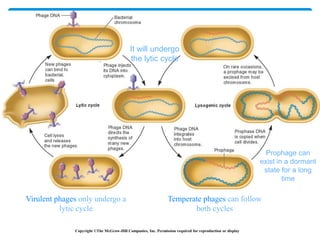
 It can undergo two types of cycles
 Lytic
 Lysogenic
Copyright ©The McGraw-Hill Companies, Inc. Permission required for reproduction or display
Virulent phages only undergo a
lytic cycle
Temperate phages can follow
both cycles
Prophage can
exist in a dormant
state for a long
time
It will undergo
the lytic cycle
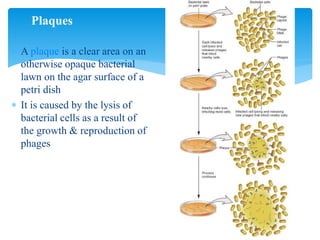
 A plaque is a clear area on an
otherwise opaque bacterial
lawn on the agar surface of a
petri dish
 It is caused by the lysis of
bacterial cells as a result of
the growth & reproduction of
phages
Plaques
Any piece of bacterial DNA
can be incorporated into the
phage
This type of transduction is termed
generalized transduction
Transduction
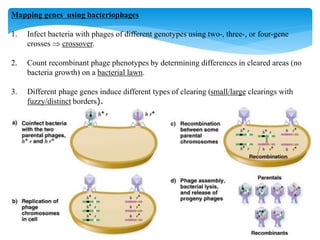
Mapping genes using bacteriophages
1. Infect bacteria with phages of different genotypes using two-, three-, or four-gene
crosses  crossover.
2. Count recombinant phage phenotypes by determining differences in cleared areas (no
bacteria growth) on a bacterial lawn.
3. Different phage genes induce different types of clearing (small/large clearings with
fuzzy/distinct borders).
 Bacteria take up extracellular DNA
 Discovered by Frederick Griffith,1928, while working
with strains of Streptococcus pneumoniae
 There are two types
 Natural transformation
 DNA uptake occurs without outside help
 Artificial transformation
 DNA uptake occurs with the help of special techniques
Transformation
Copyright ©The McGraw-Hill Companies, Inc. Permission required for reproduction or display
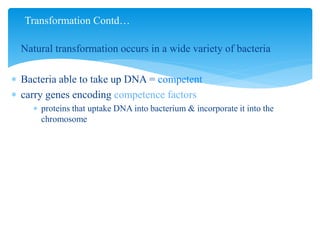
 Natural transformation occurs in a wide variety of bacteria
 Bacteria able to take up DNA = competent
 carry genes encoding competence factors
 proteins that uptake DNA into bacterium & incorporate it into the
chromosome
Transformation Contd…
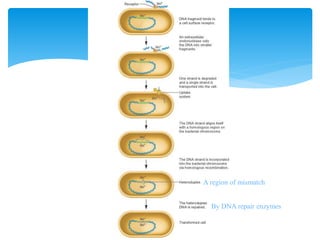
A region of mismatch
By DNA repair enzymes
 Sometimes, the DNA that enters the cell is not
homologous to any genes on the chromosome
 It may be incorporated at a random site on the chromosome
 This process is termed nonhomologous recombination
 Like cotransduction, transformation mapping is used for
genes that are relatively close together
Copyright ©The McGraw-Hill Companies, Inc. Permission required for reproduction or display
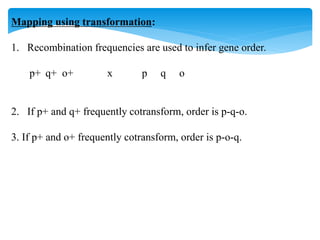
Mapping using transformation:
1. Recombination frequencies are used to infer gene order.
p+ q+ o+ x p q o
2. If p+ and q+ frequently cotransform, order is p-q-o.
3. If p+ and o+ frequently cotransform, order is p-o-q.
THANKS>>>>

Gene and genetic mapping by recombination

  • 1.
    Genetic and genemapping by recombination Arif PHD student ABT
  • 2.
     Bacteria arehaploid  identify loss-of-function mutations easier  recessive mutations not masked  Bacteria reproduce asexually  Crosses not used Bacteria also breed true  maintain their characteristics from generation to generation Bacterial Genetics
  • 3.
    Enhances genetic diversity Typesof transfer  Conjugation  direct physical contact & exchange  Transduction  phage  Transformation  uptake from environment Genetic Transfer
  • 4.
     Bacteria have4 phases when grown in culture:  lag phase  log phase (exponential growth)  stationary phase  death phase
  • 5.
    1. Discovered byJoshua Lederberg and Edward Tatum in 1946. 2. Unidirectional transfer of genetic material between donor and recipient bacteria cells by direct contact. 3. Segment (rarely all) of the donor’s chromosome recombines with the homologous recipient chromosome. 4. Recipients containing donor DNA are called transconjugants Conjugation
  • 7.
    Conjugation-transfer of thesex factor F: 1. William Hayes (1953) demonstrated that genetic exchange in E. coli occurs in only one direction. 2. Genetic transfer is mediated by sex factor F. 3. Donor is F+ and recipient is F-. 4. F is a self-replicating, circular DNA plasmid (1/40 the size of the main chromosome). 5. F plasmid contains an origin sequence (O), which initiates DNA transfer. It also contains genes for hair-like cell surface (F-pili or sex-pili), which aid in contact between cells. 6. No conjugation can occur between cells of the same mating type. 7. Conjugation begins when the F plasmid is nicked at the origin, and a single strand is transferred using the rolling circle mechanism. 8. When transfer is complete, both cells are F+ double-stranded
  • 8.
  • 9.
  • 10.
  • 11.
    High-frequency recombination 1. Nochromosomal DNA is transferred by standard sex factor F. 2. Transfer of chromosome DNA is facilitated by special strains of F+ integrated into the bacteria chromosome by crossing over. 3. Hfr strains = high frequency recombination strains. 4. Discovered by William Hayes and Luca Cavalli-Sforza. 5. Hfr strains replicate F factor as part of their main chromosome. 6. Conjugation in Hfr strains begins when F+ is nicked at the origin, and F+ and bacteria chromosomal DNA are transferred using the rolling circle mechanism. 7. Complete F+ sequence (or complete chromosomal DNA) is rarely transferred (1/10,000) because bacteria separate randomly before DNA synthesis completes. 8. Recombinants are produced by crossover of the recipient chromosome and +
  • 12.
    Transfer of theHfr F+ factor
  • 13.
    Excision of theF+ factor also occurs spontaneously at low frequency. 1.Begin with Hfr cell containing F+. 2.Small section of host chromosome also may be excised, creating an F’ plasmid. 3.F’ plasmid is named for the gene it carries, e.g., F’ (lac)
  • 14.
  • 16.
    Using conjugation tomap bacterial genes: 1. Begin with two different Hfr strains selected from F+ x F- crosses and perform an interrupted mating experiment. 2. HfrH thr+ leu+ aziR tonR lac+ gal+ strR F- thr leu aziS tons lac gal strS 3. Mix 2 cell types in medium at 37°C. 4. Remove at experimental time points and agitate to separate conjugating pairs. 5. Analyze recombinants with selective media. 6. Order in which genes are transferred reflects linear sequence on chromosomes and time in media. 7. Frequency of recombinants declines as donor gene enters recipient later.
  • 17.
    From these data,Wollman & Jacob constructed the following genetic map:  They also identified various Hfr strains in which the origin of transfer had been integrated at different places in the chromosome  Comparison of the order of genes among these strains, demonstrated that the E. coli chromosome is circular
  • 18.
    The E. coliChromosome Conjugation experiments have been used to map genes on the E. coli chromosome The E. coli genetic map is 100 minutes long Approximately the time it takes to transfer the complete chromosome in an Hfr mating
  • 19.
    Circular genetic mapof E. coli Total map units = 100 minutes Time required for E. coli chromosome to replicate at 37°C.
  • 22.
    Copyright ©The McGraw-HillCompanies, Inc. Permission required for reproduction or display  The distance between genes is determined by comparing their times of entry during an interrupted mating experiment  The approximate time of entry is computed by extrapolating the time back to the origin  Therefore these two genes are approximately 9 minutes apart along the E. coli chromosome
  • 23.
     Transduction isthe transfer of DNA from one bacterium to another via a bacteriophage Transduction Copyright ©The McGraw-Hill Companies, Inc. Permission required for reproduction or display  A bacteriophage is a virus that specifically attacks bacterial cells  It is composed of genetic material surrounded by a protein coat  It can undergo two types of cycles  Lytic  Lysogenic
  • 24.
    Copyright ©The McGraw-HillCompanies, Inc. Permission required for reproduction or display Virulent phages only undergo a lytic cycle Temperate phages can follow both cycles Prophage can exist in a dormant state for a long time It will undergo the lytic cycle
  • 25.
     A plaqueis a clear area on an otherwise opaque bacterial lawn on the agar surface of a petri dish  It is caused by the lysis of bacterial cells as a result of the growth & reproduction of phages Plaques
  • 26.
    Any piece ofbacterial DNA can be incorporated into the phage This type of transduction is termed generalized transduction Transduction
  • 27.
    Mapping genes usingbacteriophages 1. Infect bacteria with phages of different genotypes using two-, three-, or four-gene crosses  crossover. 2. Count recombinant phage phenotypes by determining differences in cleared areas (no bacteria growth) on a bacterial lawn. 3. Different phage genes induce different types of clearing (small/large clearings with fuzzy/distinct borders).
  • 28.
     Bacteria takeup extracellular DNA  Discovered by Frederick Griffith,1928, while working with strains of Streptococcus pneumoniae  There are two types  Natural transformation  DNA uptake occurs without outside help  Artificial transformation  DNA uptake occurs with the help of special techniques Transformation Copyright ©The McGraw-Hill Companies, Inc. Permission required for reproduction or display
  • 29.
     Natural transformationoccurs in a wide variety of bacteria  Bacteria able to take up DNA = competent  carry genes encoding competence factors  proteins that uptake DNA into bacterium & incorporate it into the chromosome Transformation Contd…
  • 30.
    A region ofmismatch By DNA repair enzymes
  • 31.
     Sometimes, theDNA that enters the cell is not homologous to any genes on the chromosome  It may be incorporated at a random site on the chromosome  This process is termed nonhomologous recombination  Like cotransduction, transformation mapping is used for genes that are relatively close together Copyright ©The McGraw-Hill Companies, Inc. Permission required for reproduction or display
  • 32.
    Mapping using transformation: 1.Recombination frequencies are used to infer gene order. p+ q+ o+ x p q o 2. If p+ and q+ frequently cotransform, order is p-q-o. 3. If p+ and o+ frequently cotransform, order is p-o-q.
  • 33.