Chapter 15

The Chromosomal Basis of
Inheritance
PowerPoint Lectures for
Biology, Seventh Edition
Neil Campbell and Jane Reece

Lectures by Chris Romero
Copyright © 2005 Pearson Education, Inc. publishing as Benjamin Cummings
• Overview: Locating Genes on Chromosomes
• Genes
– Are located on chromosomes
– Can be visualized using certain techniques

Figure 15.1
Copyright © 2005 Pearson Education, Inc. publishing as Benjamin Cummings
• Concept 15.1: Mendelian inheritance has its
physical basis in the behavior of chromosomes
• Several researchers proposed in the early
1900s that genes are located on chromosomes
• The behavior of chromosomes during meiosis
was said to account for Mendel’s laws of
segregation and independent assortment

Copyright © 2005 Pearson Education, Inc. publishing as Benjamin Cummings
• The chromosome theory of inheritance states
that
– Mendelian genes have specific loci on
chromosomes
– Chromosomes undergo segregation and
independent assortment

Copyright © 2005 Pearson Education, Inc. publishing as Benjamin Cummings
• The chromosomal basis of Mendel’s laws
P Generation
Starting with two true-breeding pea plants,
we follow two genes through the F1 and F2
generations. The two genes specify seed
color (allele Y for yellow and allele y for
Y
green) and seed shape (allele R for round
and allele r for wrinkled). These two genes are
on different chromosomes. (Peas have seven
chromosome pairs, but only two pairs are
illustrated here.)

Yellow-round
seeds (YYRR)
Y
R

r
R

r

y
Meiosis
Fertilization

y

R Y

Gametes

Green-wrinkled
seeds (yyrr)

y

r

All F1 plants produce
yellow-round seeds (YyRr)

R

F1 Generation

R

y

r

y

r

Y

Y
Meiosis

LAW OF SEGREGATION

Y
1 The R and r alleles segregate
R
at anaphase I, yielding
two types of daughter
cells for this locus.
Y

r
Anaphase I
y

Y

1 Alleles at both loci segregate
in anaphase I, yielding four
types of daughter cells
R
depending on the chromosome
arrangement at metaphase I.
Compare the arrangement of
y
the R and r alleles in the cells
on the left and right

r

R

y

y

Metaphase II
Y

y

Y

Y
R

R

r

Y

r

r

1 yr
4

F2 Generation
3 Fertilization
recombines the
R and r alleles
at random.

Y

Y

r

1
YR
4

Figure 15.2

y

r

r

Y
Gametes

LAW OF INDEPENDENT ASSORTMENT

R

Y

Two equally
probable
arrangements
of chromosomes
at metaphase I

y

R

2 Each gamete
gets one long
chromosome
with either the
R or r allele.

r

r

R

1 yr
4

2 Each gamete gets
a long and a short
chromosome in
one of four allele
combinations.
y

y
R

R
1
yR
4

Fertilization among the F1 plants

9

Copyright © 2005 Pearson Education, Inc. publishing as Benjamin Cummings

:3

:3

:1

3 Fertilization results
in the 9:3:3:1
phenotypic ratio in
the F2 generation.
Morgan’s Experimental Evidence: Scientific Inquiry

• Thomas Hunt Morgan
– Provided convincing evidence that
chromosomes are the location of Mendel’s
heritable factors

Copyright © 2005 Pearson Education, Inc. publishing as Benjamin Cummings
Morgan’s Choice of Experimental Organism
• Morgan worked with fruit flies
– Because they breed at a high rate
– A new generation can be bred every two
weeks
– They have only four pairs of chromosomes

Copyright © 2005 Pearson Education, Inc. publishing as Benjamin Cummings
• Morgan first observed and noted
– Wild type, or normal, phenotypes that were
common in the fly populations

• Traits alternative to the wild type
– Are called mutant phenotypes

Figure 15.3
Copyright © 2005 Pearson Education, Inc. publishing as Benjamin Cummings
Correlating Behavior of a Gene’s Alleles with
Behavior of a Chromosome Pair
• In one experiment Morgan mated male flies
with white eyes (mutant) with female flies with
red eyes (wild type)
– The F1 generation all had red eyes
– The F2 generation showed the 3:1 red:white
eye ratio, but only males had white eyes

Copyright © 2005 Pearson Education, Inc. publishing as Benjamin Cummings
• Morgan determined
– That the white-eye mutant allele must be
located on the X chromosome
EXPERIMENT Morgan mated a wild-type (red-eyed) female
with a mutant white-eyed male. The F1 offspring all had red eyes.
P
Generation

X

F1
Generation
Morgan then bred an F1 red-eyed female to an F1 red-eyed male to
produce the F2 generation.
RESULTS
The F2 generation showed a typical Mendelian
3:1 ratio of red eyes to white eyes. However, no females displayed the
white-eye trait; they all had red eyes. Half the males had white eyes,
and half had red eyes.
F2
Generation

Figure 15.4
Copyright © 2005 Pearson Education, Inc. publishing as Benjamin Cummings
CONCLUSION Since all F1 offspring had red eyes, the mutant
white-eye trait (w) must be recessive to the wild-type red-eye trait (w+).
Since the recessive trait—white eyes—was expressed only in males in
the F2 generation, Morgan hypothesized that the eye-color gene is
located on the X chromosome and that there is no corresponding locus
on the Y chromosome, as diagrammed here.
P
Generation

W+

X
X

X
W+

W

W

Ova
(eggs)
F1
Generation

X
Y

Sperm
W+

W+

W+

W

W+

Ova
(eggs)

F2
Generation

Sperm
W+

W

W+

W+

W+
W

W

W+

Copyright © 2005 Pearson Education, Inc. publishing as Benjamin Cummings
• Morgan’s discovery that transmission of the X
chromosome in fruit flies correlates with
inheritance of the eye-color trait
– Was the first solid evidence indicating that a
specific gene is associated with a specific
chromosome

Copyright © 2005 Pearson Education, Inc. publishing as Benjamin Cummings
• Concept 15.2: Linked genes tend to be
inherited together because they are located
near each other on the same chromosome
• Each chromosome
– Has hundreds or thousands of genes

Copyright © 2005 Pearson Education, Inc. publishing as Benjamin Cummings
How Linkage Affects Inheritance: Scientific Inquiry

• Morgan did other experiments with fruit flies
– To see how linkage affects the inheritance of
two different characters

Copyright © 2005 Pearson Education, Inc. publishing as Benjamin Cummings
• Morgan crossed flies
– That differed in traits of two different
characters
P Generation
(homozygous)
EXPERIMENT
Morgan first mated true-breeding
Wild type
wild-type flies with black, vestigial-winged flies to produce
(gray body,
heterozygous F1 dihybrids, all of which are wild-type in
normal wings)
appearance. He then mated wild-type F1 dihybrid females with
b+ b+ vg+ vg+
black, vestigial-winged males, producing 2,300 F2 offspring,
which he “scored” (classified according to
F1 dihybrid
phenotype).
(wild type)
(gray body,
normal wings)

CONCLUSION

If these two genes were on
different chromosomes, the alleles from the F1 dihybrid
would sort into gametes independently, and we would
expect to see equal numbers of the four types of offspring.
If these two genes were on the same chromosome,
we would expect each allele combination, B+ vg+ and b vg,
to stay together as gametes formed. In this case, only
offspring with parental phenotypes would be produced.
Since most offspring had a parental phenotype, Morgan
concluded that the genes for body color and wing size
are located on the same chromosome. However, the
production of a small number of offspring with
nonparental phenotypes indicated that some mechanism
occasionally breaks the linkage between genes on the
same chromosome.

Figure 15.5
Copyright © 2005 Pearson Education, Inc. publishing as Benjamin Cummings

Double mutant
(black body,
vestigial wings)

Double mutant
(black body,
vestigial wings)

x

b b vg vg
Double mutant
(black body,
vestigial wings)
b b vg vg

Double mutant
TESTCROSS
(black body, x
vestigial wings)

b+ b vg+ vg

RESULTS

b vg

b+vg+

b vg

965
944
Wild type
Black(gray-normal) vestigial

b+ vg

b vg+

206
Grayvestigial

185
Blacknormal

Sperm
b+ b vg+ vg b b vg vg b+ b vg vgb b vg+ vg
Parental-type
offspring

Recombinant (nonparental-type)
offspring
• Morgan determined that
– Genes that are close together on the same
chromosome are linked and do not assort
independently
– Unlinked genes are either on separate
chromosomes of are far apart on the same
chromosome and assort independently
b+ vg+
Parents
in testcross

Most
offspring

X

b vg

b vg

b+ vg+
b vg

Copyright © 2005 Pearson Education, Inc. publishing as Benjamin Cummings

b vg

b vg
or
b vg
Genetic Recombination and Linkage

Copyright © 2005 Pearson Education, Inc. publishing as Benjamin Cummings
Recombination of Unlinked Genes: Independent
Assortment of Chromosomes
• When Mendel followed the inheritance of two
characters
– He observed that some offspring have
combinations of traits that do not match either
parent in the P generation
Gametes from yellow-round
heterozygous parent (YyRr)
YR
Gametes from greenwrinkled homozygous
recessive parent (yyrr)

yr

Yr

yR

Yyrr

yyRr

yr
YyRr

yyrr

Parentaltype offspring
Copyright © 2005 Pearson Education, Inc. publishing as Benjamin Cummings

Recombinant
offspring
• Recombinant offspring
– Are those that show new combinations of the
parental traits

• When 50% of all offspring are recombinants
– Geneticists say that there is a 50% frequency
of recombination

Copyright © 2005 Pearson Education, Inc. publishing as Benjamin Cummings
Recombination of Linked Genes: Crossing Over
• Morgan discovered that genes can be linked
– But due to the appearance of recombinant
phenotypes, the linkage appeared incomplete

Copyright © 2005 Pearson Education, Inc. publishing as Benjamin Cummings
• Morgan proposed that
– Some process must occasionally break the
physical connection between genes on the
same chromosome
– Crossing over of homologous chromosomes
was the mechanism

Copyright © 2005 Pearson Education, Inc. publishing as Benjamin Cummings
• Linked genes
– Exhibit recombination frequencies less than 50%
Testcross
parents

b+ vg+
Gray body,
normal wings
b vg
(F1 dihybrid)
Replication of
chromosomes
b+ vg

b vg

Black body,
vestigial wings
b vg (double mutant)
Replication of
chromosomes
b vg

×

b+ vg+
vg
b
b vg

Meiosis I: Crossing
over between b and vg
loci produces new allele
combinations.

b vg
vg
b
b vg

Meiosis II: Segregation
of chromatids produces
recombinant gametes
with the new allele
combinations.
Gametes

Meiosis I and II:
Even if crossing over
occurs, no new allele
combinations are
produced.

Recombinant
chromosome

Ova

Sperm
b+vg+

b vg

b vg
+

b vg+
b vg

Testcross
offspring

b+ vg+
Sperm
b vg

Figure 15.6

b vg

944
965
BlackWild type
(gray-normal) vestigial
b+ vg+
b vg+
b vg

b vg

b+ vg
206
Grayvestigial
b+ vg+
b vg

b vg+ Ova
185
BlackRecombination
normal
b vg+ frequency
b vg

Parental-type offspring Recombinant offspring

Copyright © 2005 Pearson Education, Inc. publishing as Benjamin Cummings

391 recombinants

= 2,300 total offspring ×

100 = 17%
Linkage Mapping: Using Recombination Data:
Scientific Inquiry
• A genetic map
– Is an ordered list of the genetic loci along a
particular chromosome
– Can be developed using recombination
frequencies

Copyright © 2005 Pearson Education, Inc. publishing as Benjamin Cummings
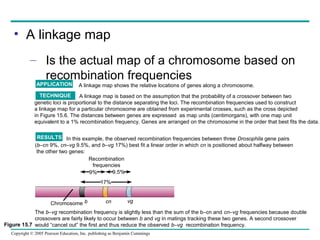
• A linkage map
– Is the actual map of a chromosome based on
recombination frequencies
APPLICATION

A linkage map shows the relative locations of genes along a chromosome.

TECHNIQUE
A linkage map is based on the assumption that the probability of a crossover between two
genetic loci is proportional to the distance separating the loci. The recombination frequencies used to construct
a linkage map for a particular chromosome are obtained from experimental crosses, such as the cross depicted
in Figure 15.6. The distances between genes are expressed as map units (centimorgans), with one map unit
equivalent to a 1% recombination frequency. Genes are arranged on the chromosome in the order that best fits the data.
RESULTS In this example, the observed recombination frequencies between three Drosophila gene pairs
(b–cn 9%, cn–vg 9.5%, and b–vg 17%) best fit a linear order in which cn is positioned about halfway between
the other two genes:
Recombination
frequencies
9.5%
9%
17%

Chromosome b

cn

vg

The b–vg recombination frequency is slightly less than the sum of the b–cn and cn–vg frequencies because double
crossovers are fairly likely to occur between b and vg in matings tracking these two genes. A second crossover
Figure 15.7 would “cancel out” the first and thus reduce the observed b–vg recombination frequency.
Copyright © 2005 Pearson Education, Inc. publishing as Benjamin Cummings
• The farther apart genes are on a chromosome
– The more likely they are to be separated
during crossing over

Copyright © 2005 Pearson Education, Inc. publishing as Benjamin Cummings
• Many fruit fly genes
– Were mapped initially using recombination
frequencies
I
Y

II

X

IV
III

Mutant phenotypes
Short
aristae

Black
body

0

Figure 15.8

Long aristae
(appendages
on head)

Cinnabar Vestigial Brown
eyes
wings
eyes

48.5 57.5 67.0

Gray
body

Red
eyes

Normal
wings

Wild-type phenotypes

Copyright © 2005 Pearson Education, Inc. publishing as Benjamin Cummings

104.5

Red
eyes
• Concept 15.3: Sex-linked genes exhibit unique
patterns of inheritance

Copyright © 2005 Pearson Education, Inc. publishing as Benjamin Cummings
The Chromosomal Basis of Sex
• An organism’s sex
– Is an inherited phenotypic character
determined by the presence or absence of
certain chromosomes

Copyright © 2005 Pearson Education, Inc. publishing as Benjamin Cummings
• In humans and other mammals
– There are two varieties of sex chromosomes,
X and Y
44 +
XY

22 +
X

Sperm

44 +
XX

(a) The X-Y system
Figure 15.9a
Copyright © 2005 Pearson Education, Inc. publishing as Benjamin Cummings

44 +
XX

Parents

22 +
Y

22 +
XY

Ova

Zygotes
(offspring)

44 +
XY
• Different systems of sex determination
– Are found in other organisms
22 +
XX

22 +
X

76 +
ZW

76 +
ZZ

16

16

(b) The X–0 system

(c) The Z–W system

(Diploid)

Figure 15.9b–d

(d) The haplo-diploid system

Copyright © 2005 Pearson Education, Inc. publishing as Benjamin Cummings

(Haploid)
Inheritance of Sex-Linked Genes
• The sex chromosomes
– Have genes for many characters unrelated to
sex

• A gene located on either sex chromosome
– Is called a sex-linked gene

Copyright © 2005 Pearson Education, Inc. publishing as Benjamin Cummings
• Sex-linked genes
– Follow specific patterns of inheritance
XaY
XAXA
(a) A father with the disorder will transmit the
mutant allele to all daughters but to no
sons. When the mother is a dominant
Sperm
Xa Y
homozygote, the daughters will have the
normal phenotype but will be carriers of
Ova XA XAXa XAY
the mutation.
A a
A
XA X Y X Y

XAXa ×
(b) If a carrier mates with a male of
normal phenotype, there is a 50%
chance that each daughter will be a
carrier like her mother, and a 50%
chance that each son will have the
disorder.

XA

XAY

Y

Sperm

Ova XA XAXA XAY
Xa XaYA XaY

(c) If a carrier mates with a male who
has the disorder, there is a 50%
chance that each child born to them
will have the disorder, regardless of
sex. Daughters who do not have the
disorder will be carriers, where as
males without the disorder will be
completely free of the recessive
allele.

Figure 15.10a–c
Copyright © 2005 Pearson Education, Inc. publishing as Benjamin Cummings

XAXa ×

Xa

XaY

Y

Ova XA XAXa XAY
Xa XaYa XaY

Sperm
• Some recessive alleles found on the X
chromosome in humans cause certain types of
disorders
– Color blindness
– Duchenne muscular dystrophy
– Hemophilia

Copyright © 2005 Pearson Education, Inc. publishing as Benjamin Cummings
X inactivation in Female Mammals
• In mammalian females
– One of the two X chromosomes in each cell is
randomly inactivated during embryonic
development

Copyright © 2005 Pearson Education, Inc. publishing as Benjamin Cummings
• If a female is heterozygous for a particular
gene located on the X chromosome
– She will be a mosaic for that character
Two cell populations
in adult cat:
Active X
Early embryo:
X chromosomes

Allele for
black fur

Cell division
Inactive X
and X
chromosome Inactive X
inactivation

Active X

Figure 15.11
Copyright © 2005 Pearson Education, Inc. publishing as Benjamin Cummings

Orange
fur

Black
fur
• Concept 15.4: Alterations of chromosome
number or structure cause some genetic
disorders
• Large-scale chromosomal alterations
– Often lead to spontaneous abortions or cause
a variety of developmental disorders

Copyright © 2005 Pearson Education, Inc. publishing as Benjamin Cummings
Abnormal Chromosome Number
• When nondisjunction occurs
– Pairs of homologous chromosomes do not
separate normally during meiosis
– Gametes contain two copies or no copies of a
particular chromosome
Meiosis I

Nondisjunction
Meiosis II

Nondisjunction
Gametes

n+1

Figure 15.12a, b

n+1

n−1

n+1
n –1
n–1
Number of chromosomes

(a) Nondisjunction of homologous
chromosomes in meiosis I

Copyright © 2005 Pearson Education, Inc. publishing as Benjamin Cummings

n

n

(b) Nondisjunction of sister
chromatids in meiosis II
• Aneuploidy
– Results from the fertilization of gametes in
which nondisjunction occurred
– Is a condition in which offspring have an
abnormal number of a particular chromosome

Copyright © 2005 Pearson Education, Inc. publishing as Benjamin Cummings
• If a zygote is trisomic
– It has three copies of a particular chromosome

• If a zygote is monosomic
– It has only one copy of a particular
chromosome

Copyright © 2005 Pearson Education, Inc. publishing as Benjamin Cummings
• Polyploidy
– Is a condition in which there are more than two
complete sets of chromosomes in an organism

Figure 15.13
Copyright © 2005 Pearson Education, Inc. publishing as Benjamin Cummings
Alterations of Chromosome Structure
• Breakage of a chromosome can lead to four
types of changes in chromosome structure
– Deletion
– Duplication
– Inversion
– Translocation

Copyright © 2005 Pearson Education, Inc. publishing as Benjamin Cummings
• Alterations of chromosome structure
(a) A deletion removes a chromosomal
segment.

(b) A duplication repeats a segment.

(c) An inversion reverses a segment within
a chromosome.
(d) A translocation moves a segment from
one chromosome to another,
nonhomologous one. In a reciprocal
translocation, the most common type,
nonhomologous chromosomes exchange
fragments. Nonreciprocal translocations
also occur, in which a chromosome
transfers a fragment without receiving a
fragment in return.

A B C D E

F G H

A B C D E

F G H

A B C D E

F G H

A B C D E

F G H

Deletion

Duplication

Inversion

A B C E

F G H

A B C B C D E

A D C B E

F G H

M N O C D E
Reciprocal
translocation

M N O P Q

Figure 15.14a–d
Copyright © 2005 Pearson Education, Inc. publishing as Benjamin Cummings

R

A B P

Q

F G H

R

F G H
Human Disorders Due to Chromosomal Alterations

• Alterations of chromosome number and
structure
– Are associated with a number of serious
human disorders

Copyright © 2005 Pearson Education, Inc. publishing as Benjamin Cummings
Down Syndrome
• Down syndrome
– Is usually the result of an extra chromosome
21, trisomy 21

Figure 15.15
Copyright © 2005 Pearson Education, Inc. publishing as Benjamin Cummings
Aneuploidy of Sex Chromosomes
• Nondisjunction of sex chromosomes
– Produces a variety of aneuploid conditions

Copyright © 2005 Pearson Education, Inc. publishing as Benjamin Cummings
• Klinefelter syndrome
– Is the result of an extra chromosome in a male,
producing XXY individuals

• Turner syndrome
– Is the result of monosomy X, producing an X0
karyotype

Copyright © 2005 Pearson Education, Inc. publishing as Benjamin Cummings
Disorders Caused by Structurally Altered Chromosomes

• Cri du chat
– Is a disorder caused by a deletion in a
chromosome

Copyright © 2005 Pearson Education, Inc. publishing as Benjamin Cummings
• Certain cancers
– Are caused by translocations of chromosomes

Normal chromosome 9

Reciprocal
translocation

Translocated chromosome 9

Philadelphia
chromosome
Normal chromosome 22

Figure 15.16

Copyright © 2005 Pearson Education, Inc. publishing as Benjamin Cummings

Translocated chromosome 22
• Concept 15.5: Some inheritance patterns are
exceptions to the standard chromosome theory
• Two normal exceptions to Mendelian genetics
include
– Genes located in the nucleus
– Genes located outside the nucleus

Copyright © 2005 Pearson Education, Inc. publishing as Benjamin Cummings
Genomic Imprinting
• In mammals
– The phenotypic effects of certain genes
depend on which allele is inherited from the
mother and which is inherited from the father

Copyright © 2005 Pearson Education, Inc. publishing as Benjamin Cummings
• Genomic imprinting
– Involves the silencing of certain genes that are
“stamped” with an imprint during gamete
production
Normal Igf2 allele
(expressed)

Paternal
chromosome

Maternal
chromosome
Normal Igf2 allele
Wild-type mouse
with imprint
(normal size)
(not expressed)
(a) A wild-type mouse is homozygous for the normal igf2 allele.
Normal Igf2 allele
Paternal
Maternal
Mutant
lgf2 allele

Normal size mouse

Mutant
lgf2 allele
Paternal
Maternal

Figure 15.17a, b

Dwarf mouse
Normal Igf2 allele
with imprint
(b) When a normal Igf2 allele is inherited from the father, heterozygous mice grow to normal size.
But when a mutant allele is inherited from the father, heterozygous mice have the dwarf
phenotype.

Copyright © 2005 Pearson Education, Inc. publishing as Benjamin Cummings
Inheritance of Organelle Genes
• Extranuclear genes
– Are genes found in organelles in the cytoplasm

Copyright © 2005 Pearson Education, Inc. publishing as Benjamin Cummings
• The inheritance of traits controlled by genes
present in the chloroplasts or mitochondria
– Depends solely on the maternal parent
because the zygote’s cytoplasm comes from
the egg

Figure 15.18
Copyright © 2005 Pearson Education, Inc. publishing as Benjamin Cummings
• Some diseases affecting the muscular and
nervous systems
– Are caused by defects in mitochondrial genes
that prevent cells from making enough ATP

Copyright © 2005 Pearson Education, Inc. publishing as Benjamin Cummings

15 chromosomalinheritance text

  • 1.
    Chapter 15 The ChromosomalBasis of Inheritance PowerPoint Lectures for Biology, Seventh Edition Neil Campbell and Jane Reece Lectures by Chris Romero Copyright © 2005 Pearson Education, Inc. publishing as Benjamin Cummings
  • 2.
    • Overview: LocatingGenes on Chromosomes • Genes – Are located on chromosomes – Can be visualized using certain techniques Figure 15.1 Copyright © 2005 Pearson Education, Inc. publishing as Benjamin Cummings
  • 3.
    • Concept 15.1:Mendelian inheritance has its physical basis in the behavior of chromosomes • Several researchers proposed in the early 1900s that genes are located on chromosomes • The behavior of chromosomes during meiosis was said to account for Mendel’s laws of segregation and independent assortment Copyright © 2005 Pearson Education, Inc. publishing as Benjamin Cummings
  • 4.
    • The chromosometheory of inheritance states that – Mendelian genes have specific loci on chromosomes – Chromosomes undergo segregation and independent assortment Copyright © 2005 Pearson Education, Inc. publishing as Benjamin Cummings
  • 5.
    • The chromosomalbasis of Mendel’s laws P Generation Starting with two true-breeding pea plants, we follow two genes through the F1 and F2 generations. The two genes specify seed color (allele Y for yellow and allele y for Y green) and seed shape (allele R for round and allele r for wrinkled). These two genes are on different chromosomes. (Peas have seven chromosome pairs, but only two pairs are illustrated here.) Yellow-round seeds (YYRR) Y R r R r y Meiosis Fertilization y R Y Gametes Green-wrinkled seeds (yyrr) y r All F1 plants produce yellow-round seeds (YyRr) R F1 Generation R y r y r Y Y Meiosis LAW OF SEGREGATION Y 1 The R and r alleles segregate R at anaphase I, yielding two types of daughter cells for this locus. Y r Anaphase I y Y 1 Alleles at both loci segregate in anaphase I, yielding four types of daughter cells R depending on the chromosome arrangement at metaphase I. Compare the arrangement of y the R and r alleles in the cells on the left and right r R y y Metaphase II Y y Y Y R R r Y r r 1 yr 4 F2 Generation 3 Fertilization recombines the R and r alleles at random. Y Y r 1 YR 4 Figure 15.2 y r r Y Gametes LAW OF INDEPENDENT ASSORTMENT R Y Two equally probable arrangements of chromosomes at metaphase I y R 2 Each gamete gets one long chromosome with either the R or r allele. r r R 1 yr 4 2 Each gamete gets a long and a short chromosome in one of four allele combinations. y y R R 1 yR 4 Fertilization among the F1 plants 9 Copyright © 2005 Pearson Education, Inc. publishing as Benjamin Cummings :3 :3 :1 3 Fertilization results in the 9:3:3:1 phenotypic ratio in the F2 generation.
  • 6.
    Morgan’s Experimental Evidence:Scientific Inquiry • Thomas Hunt Morgan – Provided convincing evidence that chromosomes are the location of Mendel’s heritable factors Copyright © 2005 Pearson Education, Inc. publishing as Benjamin Cummings
  • 7.
    Morgan’s Choice ofExperimental Organism • Morgan worked with fruit flies – Because they breed at a high rate – A new generation can be bred every two weeks – They have only four pairs of chromosomes Copyright © 2005 Pearson Education, Inc. publishing as Benjamin Cummings
  • 8.
    • Morgan firstobserved and noted – Wild type, or normal, phenotypes that were common in the fly populations • Traits alternative to the wild type – Are called mutant phenotypes Figure 15.3 Copyright © 2005 Pearson Education, Inc. publishing as Benjamin Cummings
  • 9.
    Correlating Behavior ofa Gene’s Alleles with Behavior of a Chromosome Pair • In one experiment Morgan mated male flies with white eyes (mutant) with female flies with red eyes (wild type) – The F1 generation all had red eyes – The F2 generation showed the 3:1 red:white eye ratio, but only males had white eyes Copyright © 2005 Pearson Education, Inc. publishing as Benjamin Cummings
  • 10.
    • Morgan determined –That the white-eye mutant allele must be located on the X chromosome EXPERIMENT Morgan mated a wild-type (red-eyed) female with a mutant white-eyed male. The F1 offspring all had red eyes. P Generation X F1 Generation Morgan then bred an F1 red-eyed female to an F1 red-eyed male to produce the F2 generation. RESULTS The F2 generation showed a typical Mendelian 3:1 ratio of red eyes to white eyes. However, no females displayed the white-eye trait; they all had red eyes. Half the males had white eyes, and half had red eyes. F2 Generation Figure 15.4 Copyright © 2005 Pearson Education, Inc. publishing as Benjamin Cummings
  • 11.
    CONCLUSION Since allF1 offspring had red eyes, the mutant white-eye trait (w) must be recessive to the wild-type red-eye trait (w+). Since the recessive trait—white eyes—was expressed only in males in the F2 generation, Morgan hypothesized that the eye-color gene is located on the X chromosome and that there is no corresponding locus on the Y chromosome, as diagrammed here. P Generation W+ X X X W+ W W Ova (eggs) F1 Generation X Y Sperm W+ W+ W+ W W+ Ova (eggs) F2 Generation Sperm W+ W W+ W+ W+ W W W+ Copyright © 2005 Pearson Education, Inc. publishing as Benjamin Cummings
  • 12.
    • Morgan’s discoverythat transmission of the X chromosome in fruit flies correlates with inheritance of the eye-color trait – Was the first solid evidence indicating that a specific gene is associated with a specific chromosome Copyright © 2005 Pearson Education, Inc. publishing as Benjamin Cummings
  • 13.
    • Concept 15.2:Linked genes tend to be inherited together because they are located near each other on the same chromosome • Each chromosome – Has hundreds or thousands of genes Copyright © 2005 Pearson Education, Inc. publishing as Benjamin Cummings
  • 14.
    How Linkage AffectsInheritance: Scientific Inquiry • Morgan did other experiments with fruit flies – To see how linkage affects the inheritance of two different characters Copyright © 2005 Pearson Education, Inc. publishing as Benjamin Cummings
  • 15.
    • Morgan crossedflies – That differed in traits of two different characters P Generation (homozygous) EXPERIMENT Morgan first mated true-breeding Wild type wild-type flies with black, vestigial-winged flies to produce (gray body, heterozygous F1 dihybrids, all of which are wild-type in normal wings) appearance. He then mated wild-type F1 dihybrid females with b+ b+ vg+ vg+ black, vestigial-winged males, producing 2,300 F2 offspring, which he “scored” (classified according to F1 dihybrid phenotype). (wild type) (gray body, normal wings) CONCLUSION If these two genes were on different chromosomes, the alleles from the F1 dihybrid would sort into gametes independently, and we would expect to see equal numbers of the four types of offspring. If these two genes were on the same chromosome, we would expect each allele combination, B+ vg+ and b vg, to stay together as gametes formed. In this case, only offspring with parental phenotypes would be produced. Since most offspring had a parental phenotype, Morgan concluded that the genes for body color and wing size are located on the same chromosome. However, the production of a small number of offspring with nonparental phenotypes indicated that some mechanism occasionally breaks the linkage between genes on the same chromosome. Figure 15.5 Copyright © 2005 Pearson Education, Inc. publishing as Benjamin Cummings Double mutant (black body, vestigial wings) Double mutant (black body, vestigial wings) x b b vg vg Double mutant (black body, vestigial wings) b b vg vg Double mutant TESTCROSS (black body, x vestigial wings) b+ b vg+ vg RESULTS b vg b+vg+ b vg 965 944 Wild type Black(gray-normal) vestigial b+ vg b vg+ 206 Grayvestigial 185 Blacknormal Sperm b+ b vg+ vg b b vg vg b+ b vg vgb b vg+ vg Parental-type offspring Recombinant (nonparental-type) offspring
  • 16.
    • Morgan determinedthat – Genes that are close together on the same chromosome are linked and do not assort independently – Unlinked genes are either on separate chromosomes of are far apart on the same chromosome and assort independently b+ vg+ Parents in testcross Most offspring X b vg b vg b+ vg+ b vg Copyright © 2005 Pearson Education, Inc. publishing as Benjamin Cummings b vg b vg or b vg
  • 17.
    Genetic Recombination andLinkage Copyright © 2005 Pearson Education, Inc. publishing as Benjamin Cummings
  • 18.
    Recombination of UnlinkedGenes: Independent Assortment of Chromosomes • When Mendel followed the inheritance of two characters – He observed that some offspring have combinations of traits that do not match either parent in the P generation Gametes from yellow-round heterozygous parent (YyRr) YR Gametes from greenwrinkled homozygous recessive parent (yyrr) yr Yr yR Yyrr yyRr yr YyRr yyrr Parentaltype offspring Copyright © 2005 Pearson Education, Inc. publishing as Benjamin Cummings Recombinant offspring
  • 19.
    • Recombinant offspring –Are those that show new combinations of the parental traits • When 50% of all offspring are recombinants – Geneticists say that there is a 50% frequency of recombination Copyright © 2005 Pearson Education, Inc. publishing as Benjamin Cummings
  • 20.
    Recombination of LinkedGenes: Crossing Over • Morgan discovered that genes can be linked – But due to the appearance of recombinant phenotypes, the linkage appeared incomplete Copyright © 2005 Pearson Education, Inc. publishing as Benjamin Cummings
  • 21.
    • Morgan proposedthat – Some process must occasionally break the physical connection between genes on the same chromosome – Crossing over of homologous chromosomes was the mechanism Copyright © 2005 Pearson Education, Inc. publishing as Benjamin Cummings
  • 22.
    • Linked genes –Exhibit recombination frequencies less than 50% Testcross parents b+ vg+ Gray body, normal wings b vg (F1 dihybrid) Replication of chromosomes b+ vg b vg Black body, vestigial wings b vg (double mutant) Replication of chromosomes b vg × b+ vg+ vg b b vg Meiosis I: Crossing over between b and vg loci produces new allele combinations. b vg vg b b vg Meiosis II: Segregation of chromatids produces recombinant gametes with the new allele combinations. Gametes Meiosis I and II: Even if crossing over occurs, no new allele combinations are produced. Recombinant chromosome Ova Sperm b+vg+ b vg b vg + b vg+ b vg Testcross offspring b+ vg+ Sperm b vg Figure 15.6 b vg 944 965 BlackWild type (gray-normal) vestigial b+ vg+ b vg+ b vg b vg b+ vg 206 Grayvestigial b+ vg+ b vg b vg+ Ova 185 BlackRecombination normal b vg+ frequency b vg Parental-type offspring Recombinant offspring Copyright © 2005 Pearson Education, Inc. publishing as Benjamin Cummings 391 recombinants = 2,300 total offspring × 100 = 17%
  • 23.
    Linkage Mapping: UsingRecombination Data: Scientific Inquiry • A genetic map – Is an ordered list of the genetic loci along a particular chromosome – Can be developed using recombination frequencies Copyright © 2005 Pearson Education, Inc. publishing as Benjamin Cummings
  • 24.
    • A linkagemap – Is the actual map of a chromosome based on recombination frequencies APPLICATION A linkage map shows the relative locations of genes along a chromosome. TECHNIQUE A linkage map is based on the assumption that the probability of a crossover between two genetic loci is proportional to the distance separating the loci. The recombination frequencies used to construct a linkage map for a particular chromosome are obtained from experimental crosses, such as the cross depicted in Figure 15.6. The distances between genes are expressed as map units (centimorgans), with one map unit equivalent to a 1% recombination frequency. Genes are arranged on the chromosome in the order that best fits the data. RESULTS In this example, the observed recombination frequencies between three Drosophila gene pairs (b–cn 9%, cn–vg 9.5%, and b–vg 17%) best fit a linear order in which cn is positioned about halfway between the other two genes: Recombination frequencies 9.5% 9% 17% Chromosome b cn vg The b–vg recombination frequency is slightly less than the sum of the b–cn and cn–vg frequencies because double crossovers are fairly likely to occur between b and vg in matings tracking these two genes. A second crossover Figure 15.7 would “cancel out” the first and thus reduce the observed b–vg recombination frequency. Copyright © 2005 Pearson Education, Inc. publishing as Benjamin Cummings
  • 25.
    • The fartherapart genes are on a chromosome – The more likely they are to be separated during crossing over Copyright © 2005 Pearson Education, Inc. publishing as Benjamin Cummings
  • 26.
    • Many fruitfly genes – Were mapped initially using recombination frequencies I Y II X IV III Mutant phenotypes Short aristae Black body 0 Figure 15.8 Long aristae (appendages on head) Cinnabar Vestigial Brown eyes wings eyes 48.5 57.5 67.0 Gray body Red eyes Normal wings Wild-type phenotypes Copyright © 2005 Pearson Education, Inc. publishing as Benjamin Cummings 104.5 Red eyes
  • 27.
    • Concept 15.3:Sex-linked genes exhibit unique patterns of inheritance Copyright © 2005 Pearson Education, Inc. publishing as Benjamin Cummings
  • 28.
    The Chromosomal Basisof Sex • An organism’s sex – Is an inherited phenotypic character determined by the presence or absence of certain chromosomes Copyright © 2005 Pearson Education, Inc. publishing as Benjamin Cummings
  • 29.
    • In humansand other mammals – There are two varieties of sex chromosomes, X and Y 44 + XY 22 + X Sperm 44 + XX (a) The X-Y system Figure 15.9a Copyright © 2005 Pearson Education, Inc. publishing as Benjamin Cummings 44 + XX Parents 22 + Y 22 + XY Ova Zygotes (offspring) 44 + XY
  • 30.
    • Different systemsof sex determination – Are found in other organisms 22 + XX 22 + X 76 + ZW 76 + ZZ 16 16 (b) The X–0 system (c) The Z–W system (Diploid) Figure 15.9b–d (d) The haplo-diploid system Copyright © 2005 Pearson Education, Inc. publishing as Benjamin Cummings (Haploid)
  • 31.
    Inheritance of Sex-LinkedGenes • The sex chromosomes – Have genes for many characters unrelated to sex • A gene located on either sex chromosome – Is called a sex-linked gene Copyright © 2005 Pearson Education, Inc. publishing as Benjamin Cummings
  • 32.
    • Sex-linked genes –Follow specific patterns of inheritance XaY XAXA (a) A father with the disorder will transmit the mutant allele to all daughters but to no sons. When the mother is a dominant Sperm Xa Y homozygote, the daughters will have the normal phenotype but will be carriers of Ova XA XAXa XAY the mutation. A a A XA X Y X Y XAXa × (b) If a carrier mates with a male of normal phenotype, there is a 50% chance that each daughter will be a carrier like her mother, and a 50% chance that each son will have the disorder. XA XAY Y Sperm Ova XA XAXA XAY Xa XaYA XaY (c) If a carrier mates with a male who has the disorder, there is a 50% chance that each child born to them will have the disorder, regardless of sex. Daughters who do not have the disorder will be carriers, where as males without the disorder will be completely free of the recessive allele. Figure 15.10a–c Copyright © 2005 Pearson Education, Inc. publishing as Benjamin Cummings XAXa × Xa XaY Y Ova XA XAXa XAY Xa XaYa XaY Sperm
  • 33.
    • Some recessivealleles found on the X chromosome in humans cause certain types of disorders – Color blindness – Duchenne muscular dystrophy – Hemophilia Copyright © 2005 Pearson Education, Inc. publishing as Benjamin Cummings
  • 34.
    X inactivation inFemale Mammals • In mammalian females – One of the two X chromosomes in each cell is randomly inactivated during embryonic development Copyright © 2005 Pearson Education, Inc. publishing as Benjamin Cummings
  • 35.
    • If afemale is heterozygous for a particular gene located on the X chromosome – She will be a mosaic for that character Two cell populations in adult cat: Active X Early embryo: X chromosomes Allele for black fur Cell division Inactive X and X chromosome Inactive X inactivation Active X Figure 15.11 Copyright © 2005 Pearson Education, Inc. publishing as Benjamin Cummings Orange fur Black fur
  • 36.
    • Concept 15.4:Alterations of chromosome number or structure cause some genetic disorders • Large-scale chromosomal alterations – Often lead to spontaneous abortions or cause a variety of developmental disorders Copyright © 2005 Pearson Education, Inc. publishing as Benjamin Cummings
  • 37.
    Abnormal Chromosome Number •When nondisjunction occurs – Pairs of homologous chromosomes do not separate normally during meiosis – Gametes contain two copies or no copies of a particular chromosome Meiosis I Nondisjunction Meiosis II Nondisjunction Gametes n+1 Figure 15.12a, b n+1 n−1 n+1 n –1 n–1 Number of chromosomes (a) Nondisjunction of homologous chromosomes in meiosis I Copyright © 2005 Pearson Education, Inc. publishing as Benjamin Cummings n n (b) Nondisjunction of sister chromatids in meiosis II
  • 38.
    • Aneuploidy – Resultsfrom the fertilization of gametes in which nondisjunction occurred – Is a condition in which offspring have an abnormal number of a particular chromosome Copyright © 2005 Pearson Education, Inc. publishing as Benjamin Cummings
  • 39.
    • If azygote is trisomic – It has three copies of a particular chromosome • If a zygote is monosomic – It has only one copy of a particular chromosome Copyright © 2005 Pearson Education, Inc. publishing as Benjamin Cummings
  • 40.
    • Polyploidy – Isa condition in which there are more than two complete sets of chromosomes in an organism Figure 15.13 Copyright © 2005 Pearson Education, Inc. publishing as Benjamin Cummings
  • 41.
    Alterations of ChromosomeStructure • Breakage of a chromosome can lead to four types of changes in chromosome structure – Deletion – Duplication – Inversion – Translocation Copyright © 2005 Pearson Education, Inc. publishing as Benjamin Cummings
  • 42.
    • Alterations ofchromosome structure (a) A deletion removes a chromosomal segment. (b) A duplication repeats a segment. (c) An inversion reverses a segment within a chromosome. (d) A translocation moves a segment from one chromosome to another, nonhomologous one. In a reciprocal translocation, the most common type, nonhomologous chromosomes exchange fragments. Nonreciprocal translocations also occur, in which a chromosome transfers a fragment without receiving a fragment in return. A B C D E F G H A B C D E F G H A B C D E F G H A B C D E F G H Deletion Duplication Inversion A B C E F G H A B C B C D E A D C B E F G H M N O C D E Reciprocal translocation M N O P Q Figure 15.14a–d Copyright © 2005 Pearson Education, Inc. publishing as Benjamin Cummings R A B P Q F G H R F G H
  • 43.
    Human Disorders Dueto Chromosomal Alterations • Alterations of chromosome number and structure – Are associated with a number of serious human disorders Copyright © 2005 Pearson Education, Inc. publishing as Benjamin Cummings
  • 44.
    Down Syndrome • Downsyndrome – Is usually the result of an extra chromosome 21, trisomy 21 Figure 15.15 Copyright © 2005 Pearson Education, Inc. publishing as Benjamin Cummings
  • 45.
    Aneuploidy of SexChromosomes • Nondisjunction of sex chromosomes – Produces a variety of aneuploid conditions Copyright © 2005 Pearson Education, Inc. publishing as Benjamin Cummings
  • 46.
    • Klinefelter syndrome –Is the result of an extra chromosome in a male, producing XXY individuals • Turner syndrome – Is the result of monosomy X, producing an X0 karyotype Copyright © 2005 Pearson Education, Inc. publishing as Benjamin Cummings
  • 47.
    Disorders Caused byStructurally Altered Chromosomes • Cri du chat – Is a disorder caused by a deletion in a chromosome Copyright © 2005 Pearson Education, Inc. publishing as Benjamin Cummings
  • 48.
    • Certain cancers –Are caused by translocations of chromosomes Normal chromosome 9 Reciprocal translocation Translocated chromosome 9 Philadelphia chromosome Normal chromosome 22 Figure 15.16 Copyright © 2005 Pearson Education, Inc. publishing as Benjamin Cummings Translocated chromosome 22
  • 49.
    • Concept 15.5:Some inheritance patterns are exceptions to the standard chromosome theory • Two normal exceptions to Mendelian genetics include – Genes located in the nucleus – Genes located outside the nucleus Copyright © 2005 Pearson Education, Inc. publishing as Benjamin Cummings
  • 50.
    Genomic Imprinting • Inmammals – The phenotypic effects of certain genes depend on which allele is inherited from the mother and which is inherited from the father Copyright © 2005 Pearson Education, Inc. publishing as Benjamin Cummings
  • 51.
    • Genomic imprinting –Involves the silencing of certain genes that are “stamped” with an imprint during gamete production Normal Igf2 allele (expressed) Paternal chromosome Maternal chromosome Normal Igf2 allele Wild-type mouse with imprint (normal size) (not expressed) (a) A wild-type mouse is homozygous for the normal igf2 allele. Normal Igf2 allele Paternal Maternal Mutant lgf2 allele Normal size mouse Mutant lgf2 allele Paternal Maternal Figure 15.17a, b Dwarf mouse Normal Igf2 allele with imprint (b) When a normal Igf2 allele is inherited from the father, heterozygous mice grow to normal size. But when a mutant allele is inherited from the father, heterozygous mice have the dwarf phenotype. Copyright © 2005 Pearson Education, Inc. publishing as Benjamin Cummings
  • 52.
    Inheritance of OrganelleGenes • Extranuclear genes – Are genes found in organelles in the cytoplasm Copyright © 2005 Pearson Education, Inc. publishing as Benjamin Cummings
  • 53.
    • The inheritanceof traits controlled by genes present in the chloroplasts or mitochondria – Depends solely on the maternal parent because the zygote’s cytoplasm comes from the egg Figure 15.18 Copyright © 2005 Pearson Education, Inc. publishing as Benjamin Cummings
  • 54.
    • Some diseasesaffecting the muscular and nervous systems – Are caused by defects in mitochondrial genes that prevent cells from making enough ATP Copyright © 2005 Pearson Education, Inc. publishing as Benjamin Cummings