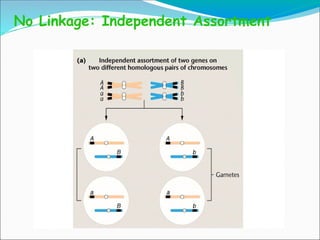
The source of recombination
There are two meiotic processes that cause
recombination.
(1) Independent assortment of genes of different
chromosome pairs.
(2) Crossing over between genes on the same
chromosome pairs.
Independent assortment
Law of Independent Assortment the "Second
Law”
• The Law of Independent Assortment states that alleles
for separate traits are passed independently of one
another i.e from parents to offspring.
• That is, the biological selection of an allele for one trait
has nothing to do with the selection of an allele for any
other trait.
• Mendel found support for this law in his dihybrid cross
experiments .
• In dihybrid crosses, however, he found a 9:3:3:1 ratios.
This shows that each of the two alleles is inherited
independently from the other.
No Linkage: Independent Assortment
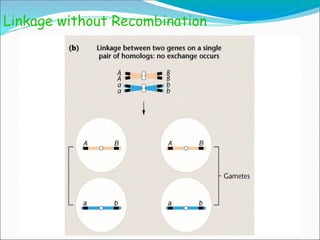
Linkage without Recombination
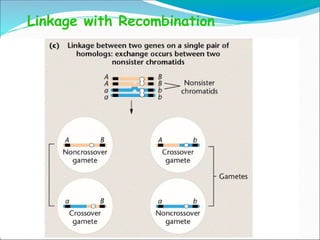
Linkage with Recombination
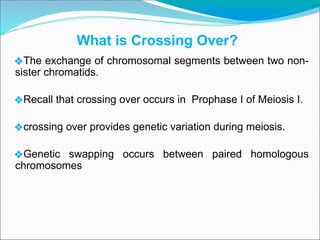
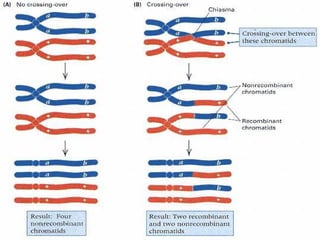
What is Crossing Over?
❖The exchange of chromosomal segments between two non-
sister chromatids.
❖Recall that crossing over occurs in Prophase I of Meiosis I.
❖crossing over provides genetic variation during meiosis.
❖Genetic swapping occurs between paired homologous
chromosomes
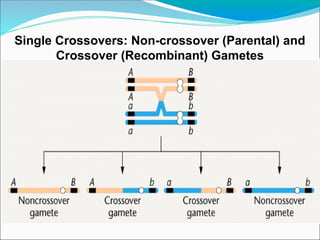
Single Crossovers: Non-crossover (Parental) and
Crossover (Recombinant) Gametes
The total recombination frequency (RF)
❖It is number of new phenotypes compared to the total
phenotypes.
❖It's 25%+25%=50% . This 50% RF is always observed for
genes on different chromosome pairs .However, the loci
that are very far a part on the same chromosome an also
show an RF value of 50%.
❖Ex: AaBb (AB, Ab, aB, ab).
❖map unit: The unit of distance in a genetic map.
❖ 1 map unit is equal to 1 percent recombination.
1 RF = 1 map unit = 1 centimorgan (cM)
The total recombination frequency (RF)
⚫In case of crossing over : The recombination frequency is less than
50% due to the linkage between genes.
⚫1 RF = 1 map unit = 1 centimorgen (CM)
⚫Genetic linkage is a term which describes the
tendency of certain loci or alleles to be inherited
together. Genetic loci on the same chromosome are
physically close to one another and tend to stay
together during meiosis.
⚫
Linkage
Bateson and Punnett (1905) in peas
✔No independent assortment = No mendelian ratio
⚫Morgan (1910) carried out an experiment by which he confirmed the
work of Bateson and Punnett
⚫He also used another case of linkage between the eye color ,wing
shape , and body color on the chromosome
Types of Linkage
1
-
Cis (Coupling ) linkage
The 2 dominant alleles tend to be together on the
same chromosome ,and 2 recessive alleles tend to
be together on the other chromosome
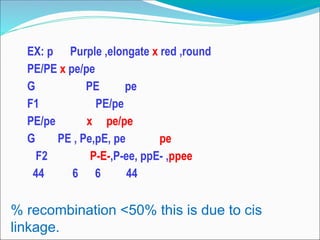
% recombination <50% this is due to cis
linkage.
EX: p Purple ,elongate x red ,round
PE/PE x pe/pe
G PE pe
F1 PE/pe
PE/pe x pe/pe
G PE , Pe,pE, pe pe
F2 P-E-,P-ee, ppE- ,ppee
44
6
6
44
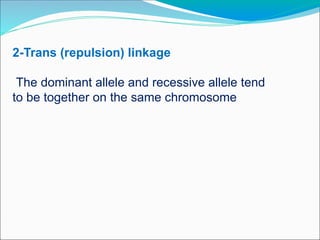
2-Trans (repulsion) linkage
The dominant allele and recessive allele tend
to be together on the same chromosome
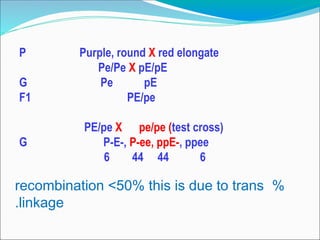
%
recombination <50% this is due to trans
linkage
.
P Purple, round X red elongate
Pe/Pe X pE/pE
G Pe pE
F1 PE/pe
PE/pe X pe/pe (test cross)
G P-E-, P-ee, ppE-, ppee
6 44 44 6
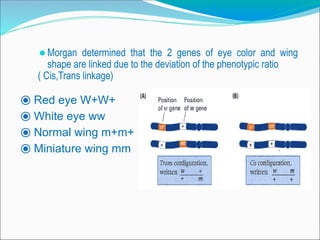
⚫Morgan determined that the 2 genes of eye color and wing
shape are linked due to the deviation of the phenotypic ratio
( Cis,Trans linkage)
⦿ Red eye W+W+
⦿ White eye ww
⦿ Normal wing m+m+
⦿ Miniature wing mm
Genetic Mapping
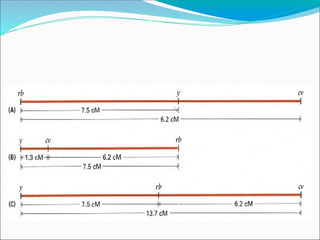
⚫The linkage of the genes in a chromosome can
be represented in the form of a genetic map,
which shows the linear order of the genes
along the chromosome with the distances
between adjacent genes proportional to the
frequency of recombination between them.
⚫A genetic map is also called a linkage map or a
chromosome map.
⚫The concept of genetic mapping was first developed by
Morgan's student, Alfred H. Sturtevant, in 1913.
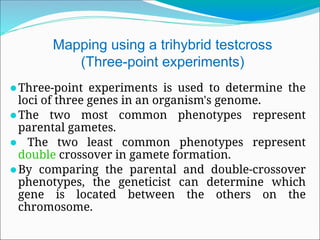
Mapping using a trihybrid testcross
(Three-point experiments)
⚫Three-point experiments is used to determine the
loci of three genes in an organism's genome.
⚫The two most common phenotypes represent
parental gametes.
⚫ The two least common phenotypes represent
double crossover in gamete formation.
⚫By comparing the parental and double-crossover
phenotypes, the geneticist can determine which
gene is located between the others on the
chromosome.
Chromosome Interference
❖ The crossing over in one region prevents the crossing
over in the adjacent regions.
❖ In higher organisms it has been found that one
chiasma formation reduces the probability of another
chiasma formation in an immediately adjacent region
of the chromosome.
❖ The interaction prevents the double crossing over
events
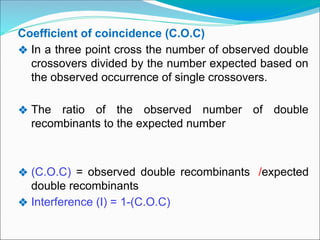
Coefficient of coincidence (C.O.C)
❖ In a three point cross the number of observed double
crossovers divided by the number expected based on
the observed occurrence of single crossovers.
❖ The ratio of the observed number of double
recombinants to the expected number
❖ (C.O.C) = observed double recombinants /expected
double recombinants
❖ Interference (I) = 1-(C.O.C)
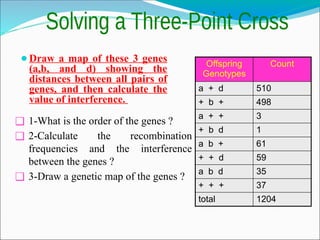
⚫Draw a map of these 3 genes
(a,b, and d) showing the
distances between all pairs of
genes, and then calculate the
value of interference.
Offspring
Genotypes
Count
a + d 510
+ b + 498
a + + 3
+ b d 1
a b + 61
+ + d 59
a b d 35
+ + + 37
total 1204
❑ 1-What is the order of the genes ?
❑ 2-Calculate the recombination
frequencies and the interference
between the genes ?
❑ 3-Draw a genetic map of the genes ?
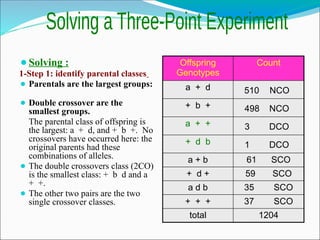
⚫Solving :
1-Step 1: identify parental classes
⚫ Parentals are the largest groups:
⚫ Double crossover are the
smallest groups.
The parental class of offspring is
the largest: a + d, and + b +. No
crossovers have occurred here: the
original parents had these
combinations of alleles.
⚫ The double crossovers class (2CO)
is the smallest class: + b d and a
+ +.
⚫ The other two pairs are the two
single crossover classes.
Offspring
Genotypes
Count
a + d 510 NCO
+ b + 498 NCO
a + + 3 DCO
+ d b 1 DCO
a + b 61 SCO
+ d + 59 SCO
a d b 35 SCO
+ + + 37 SCO
total 1204
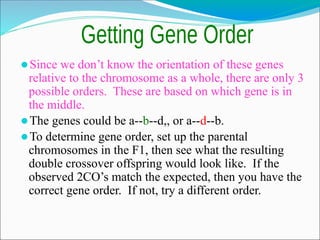
⚫Since we don’t know the orientation of these genes
relative to the chromosome as a whole, there are only 3
possible orders. These are based on which gene is in
the middle.
⚫The genes could be a--b--d,, or a--d--b.
⚫To determine gene order, set up the parental
chromosomes in the F1, then see what the resulting
double crossover offspring would look like. If the
observed 2CO’s match the expected, then you have the
correct gene order. If not, try a different order.
⚫recombinant offspring(SCO1)= total of
recombinant offspring(SCO1 or 2)+ observed
double recombinants / Total offspring
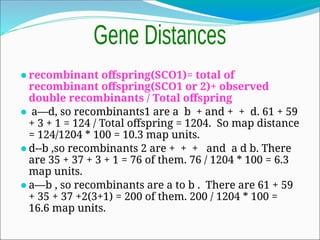
⚫ a—d, so recombinants1 are a b + and + + d. 61 + 59
+ 3 + 1 = 124 / Total offspring = 1204. So map distance
= 124/1204 * 100 = 10.3 map units.
⚫d--b ,so recombinants 2 are + + + and a d b. There
are 35 + 37 + 3 + 1 = 76 of them. 76 / 1204 * 100 = 6.3
map units.
⚫a—b , so recombinants are a to b . There are 61 + 59
+ 35 + 37 +2(3+1) = 200 of them. 200 / 1204 * 100 =
16.6 map units.
Interference and Map
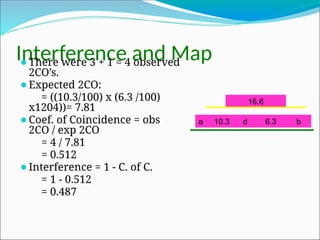
⚫There were 3 + 1 = 4 observed
2CO’s.
⚫Expected 2CO:
= ((10.3/100) x (6.3 /100)
x1204))= 7.81
⚫Coef. of Coincidence = obs
2CO / exp 2CO
= 4 / 7.81
= 0.512
⚫Interference = 1 - C. of C.
= 1 - 0.512
= 0.487
a 10.3 d 6.3 b
16.6
Steps to Solving 3-Point experiment
Problems
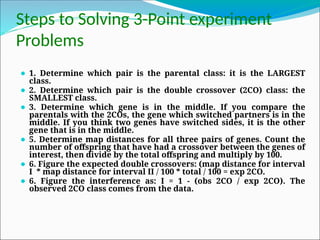
⚫ 1. Determine which pair is the parental class: it is the LARGEST
class.
⚫ 2. Determine which pair is the double crossover (2CO) class: the
SMALLEST class.
⚫ 3. Determine which gene is in the middle. If you compare the
parentals with the 2COs, the gene which switched partners is in the
middle. If you think two genes have switched sides, it is the other
gene that is in the middle.
⚫ 5. Determine map distances for all three pairs of genes. Count the
number of offspring that have had a crossover between the genes of
interest, then divide by the total offspring and multiply by 100.
⚫ 6. Figure the expected double crossovers: (map distance for interval
I * map distance for interval II / 100 * total / 100 = exp 2CO.
⚫ 6. Figure the interference as: I = 1 - (obs 2CO / exp 2CO). The
observed 2CO class comes from the data.
580
ct+
cv+
v
592
ct
cv
v+
45
ct+
cv
v
40
ct
cv+
v+
89
ct
cv
v
94
ct+
cv+
v+
3
ct
cv+
v
5
ct+
cv
v+
1448
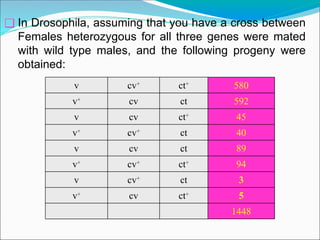
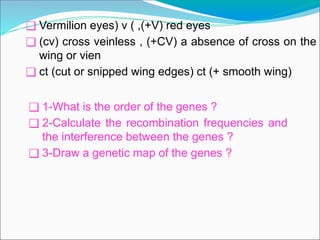
❑ In Drosophila, assuming that you have a cross between
Females heterozygous for all three genes were mated
with wild type males, and the following progeny were
obtained:
❑ 1-What is the order of the genes ?
❑ 2-Calculate the recombination frequencies and
the interference between the genes ?
❑ 3-Draw a genetic map of the genes ?
❑ Vermilion eyes) v ( ,(+V) red eyes
❑ (cv) cross veinless , (+CV) a absence of cross on the
wing or vien
❑ ct (cut or snipped wing edges) ct (+ smooth wing)
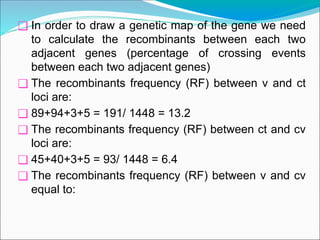
❑ In order to draw a genetic map of the gene we need
to calculate the recombinants between each two
adjacent genes (percentage of crossing events
between each two adjacent genes)
❑ The recombinants frequency (RF) between v and ct
loci are:
❑ 89+94+3+5 = 191/ 1448 = 13.2
❑ The recombinants frequency (RF) between ct and cv
loci are:
❑ 45+40+3+5 = 93/ 1448 = 6.4
❑ The recombinants frequency (RF) between v and cv
equal to:
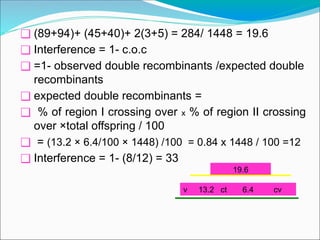
❑ (89+94)+ (45+40)+ 2(3+5) = 284/ 1448 = 19.6
❑ Interference = 1- c.o.c
❑ =1- observed double recombinants /expected double
recombinants
❑ expected double recombinants =
❑ % of region I crossing over x % of region II crossing
over ×total offspring / 100
❑ = (13.2 × 6.4/100 × 1448) /100 = 0.84 x 1448 / 100 =12
❑ Interference = 1- (8/12) = 33
v 13.2 ct 6.4 cv
19.6
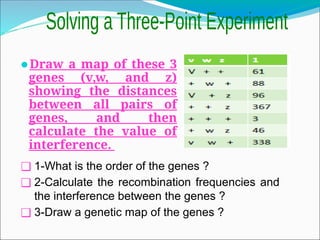
⚫Draw a map of these 3
genes (v,w, and z)
showing the distances
between all pairs of
genes, and then
calculate the value of
interference.
❑ 1-What is the order of the genes ?
❑ 2-Calculate the recombination frequencies and
the interference between the genes ?
❑ 3-Draw a genetic map of the genes ?
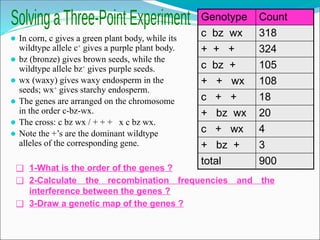
⚫ In corn, c gives a green plant body, while its
wildtype allele c+
gives a purple plant body.
⚫ bz (bronze) gives brown seeds, while the
wildtype allele bz+
gives purple seeds.
⚫ wx (waxy) gives waxy endosperm in the
seeds; wx+
gives starchy endosperm.
⚫ The genes are arranged on the chromosome
in the order c-bz-wx.
⚫ The cross: c bz wx / + + + x c bz wx.
⚫ Note the +’s are the dominant wildtype
alleles of the corresponding gene.
Genotype Count
c bz wx 318
+ + + 324
c bz + 105
+ + wx 108
c + + 18
+ bz wx 20
c + wx 4
+ bz + 3
total 900
❑ 1-What is the order of the genes ?
❑ 2-Calculate the recombination frequencies and the
interference between the genes ?
❑ 3-Draw a genetic map of the genes ?
Sec.1-Crossing Over..... and Mapping.pptx

Sec.1-Crossing Over..... and Mapping.pptx

  • 2.
    The source ofrecombination There are two meiotic processes that cause recombination. (1) Independent assortment of genes of different chromosome pairs. (2) Crossing over between genes on the same chromosome pairs.
  • 3.
  • 4.
    Law of IndependentAssortment the "Second Law” • The Law of Independent Assortment states that alleles for separate traits are passed independently of one another i.e from parents to offspring. • That is, the biological selection of an allele for one trait has nothing to do with the selection of an allele for any other trait. • Mendel found support for this law in his dihybrid cross experiments . • In dihybrid crosses, however, he found a 9:3:3:1 ratios. This shows that each of the two alleles is inherited independently from the other.

  • 5.
  • 6.
  • 7.
  • 8.
    What is CrossingOver? ❖The exchange of chromosomal segments between two non- sister chromatids. ❖Recall that crossing over occurs in Prophase I of Meiosis I. ❖crossing over provides genetic variation during meiosis. ❖Genetic swapping occurs between paired homologous chromosomes
  • 9.
    Single Crossovers: Non-crossover(Parental) and Crossover (Recombinant) Gametes
  • 10.
    The total recombinationfrequency (RF) ❖It is number of new phenotypes compared to the total phenotypes. ❖It's 25%+25%=50% . This 50% RF is always observed for genes on different chromosome pairs .However, the loci that are very far a part on the same chromosome an also show an RF value of 50%. ❖Ex: AaBb (AB, Ab, aB, ab). ❖map unit: The unit of distance in a genetic map. ❖ 1 map unit is equal to 1 percent recombination. 1 RF = 1 map unit = 1 centimorgan (cM)
  • 11.
    The total recombinationfrequency (RF) ⚫In case of crossing over : The recombination frequency is less than 50% due to the linkage between genes. ⚫1 RF = 1 map unit = 1 centimorgen (CM)
  • 13.
    ⚫Genetic linkage isa term which describes the tendency of certain loci or alleles to be inherited together. Genetic loci on the same chromosome are physically close to one another and tend to stay together during meiosis. ⚫ Linkage Bateson and Punnett (1905) in peas ✔No independent assortment = No mendelian ratio
  • 14.
    ⚫Morgan (1910) carriedout an experiment by which he confirmed the work of Bateson and Punnett ⚫He also used another case of linkage between the eye color ,wing shape , and body color on the chromosome
  • 15.
    Types of Linkage 1 - Cis(Coupling ) linkage The 2 dominant alleles tend to be together on the same chromosome ,and 2 recessive alleles tend to be together on the other chromosome
  • 16.
    % recombination <50%this is due to cis linkage. EX: p Purple ,elongate x red ,round PE/PE x pe/pe G PE pe F1 PE/pe PE/pe x pe/pe G PE , Pe,pE, pe pe F2 P-E-,P-ee, ppE- ,ppee 44 6 6 44
  • 17.
    2-Trans (repulsion) linkage Thedominant allele and recessive allele tend to be together on the same chromosome
  • 18.
    % recombination <50% thisis due to trans linkage . P Purple, round X red elongate Pe/Pe X pE/pE G Pe pE F1 PE/pe PE/pe X pe/pe (test cross) G P-E-, P-ee, ppE-, ppee 6 44 44 6
  • 19.
    ⚫Morgan determined thatthe 2 genes of eye color and wing shape are linked due to the deviation of the phenotypic ratio ( Cis,Trans linkage) ⦿ Red eye W+W+ ⦿ White eye ww ⦿ Normal wing m+m+ ⦿ Miniature wing mm
  • 20.
    Genetic Mapping ⚫The linkageof the genes in a chromosome can be represented in the form of a genetic map, which shows the linear order of the genes along the chromosome with the distances between adjacent genes proportional to the frequency of recombination between them.
  • 21.
    ⚫A genetic mapis also called a linkage map or a chromosome map. ⚫The concept of genetic mapping was first developed by Morgan's student, Alfred H. Sturtevant, in 1913.
  • 23.
    Mapping using atrihybrid testcross (Three-point experiments) ⚫Three-point experiments is used to determine the loci of three genes in an organism's genome. ⚫The two most common phenotypes represent parental gametes. ⚫ The two least common phenotypes represent double crossover in gamete formation. ⚫By comparing the parental and double-crossover phenotypes, the geneticist can determine which gene is located between the others on the chromosome.
  • 24.
    Chromosome Interference ❖ Thecrossing over in one region prevents the crossing over in the adjacent regions. ❖ In higher organisms it has been found that one chiasma formation reduces the probability of another chiasma formation in an immediately adjacent region of the chromosome. ❖ The interaction prevents the double crossing over events
  • 25.
    Coefficient of coincidence(C.O.C) ❖ In a three point cross the number of observed double crossovers divided by the number expected based on the observed occurrence of single crossovers. ❖ The ratio of the observed number of double recombinants to the expected number ❖ (C.O.C) = observed double recombinants /expected double recombinants ❖ Interference (I) = 1-(C.O.C)
  • 26.
    ⚫Draw a mapof these 3 genes (a,b, and d) showing the distances between all pairs of genes, and then calculate the value of interference. Offspring Genotypes Count a + d 510 + b + 498 a + + 3 + b d 1 a b + 61 + + d 59 a b d 35 + + + 37 total 1204 ❑ 1-What is the order of the genes ? ❑ 2-Calculate the recombination frequencies and the interference between the genes ? ❑ 3-Draw a genetic map of the genes ?
  • 27.
    ⚫Solving : 1-Step 1:identify parental classes ⚫ Parentals are the largest groups: ⚫ Double crossover are the smallest groups. The parental class of offspring is the largest: a + d, and + b +. No crossovers have occurred here: the original parents had these combinations of alleles. ⚫ The double crossovers class (2CO) is the smallest class: + b d and a + +. ⚫ The other two pairs are the two single crossover classes. Offspring Genotypes Count a + d 510 NCO + b + 498 NCO a + + 3 DCO + d b 1 DCO a + b 61 SCO + d + 59 SCO a d b 35 SCO + + + 37 SCO total 1204
  • 28.
    ⚫Since we don’tknow the orientation of these genes relative to the chromosome as a whole, there are only 3 possible orders. These are based on which gene is in the middle. ⚫The genes could be a--b--d,, or a--d--b. ⚫To determine gene order, set up the parental chromosomes in the F1, then see what the resulting double crossover offspring would look like. If the observed 2CO’s match the expected, then you have the correct gene order. If not, try a different order.
  • 29.
    ⚫recombinant offspring(SCO1)= totalof recombinant offspring(SCO1 or 2)+ observed double recombinants / Total offspring ⚫ a—d, so recombinants1 are a b + and + + d. 61 + 59 + 3 + 1 = 124 / Total offspring = 1204. So map distance = 124/1204 * 100 = 10.3 map units. ⚫d--b ,so recombinants 2 are + + + and a d b. There are 35 + 37 + 3 + 1 = 76 of them. 76 / 1204 * 100 = 6.3 map units. ⚫a—b , so recombinants are a to b . There are 61 + 59 + 35 + 37 +2(3+1) = 200 of them. 200 / 1204 * 100 = 16.6 map units.
  • 30.
    Interference and Map ⚫Therewere 3 + 1 = 4 observed 2CO’s. ⚫Expected 2CO: = ((10.3/100) x (6.3 /100) x1204))= 7.81 ⚫Coef. of Coincidence = obs 2CO / exp 2CO = 4 / 7.81 = 0.512 ⚫Interference = 1 - C. of C. = 1 - 0.512 = 0.487 a 10.3 d 6.3 b 16.6
  • 31.
    Steps to Solving3-Point experiment Problems ⚫ 1. Determine which pair is the parental class: it is the LARGEST class. ⚫ 2. Determine which pair is the double crossover (2CO) class: the SMALLEST class. ⚫ 3. Determine which gene is in the middle. If you compare the parentals with the 2COs, the gene which switched partners is in the middle. If you think two genes have switched sides, it is the other gene that is in the middle. ⚫ 5. Determine map distances for all three pairs of genes. Count the number of offspring that have had a crossover between the genes of interest, then divide by the total offspring and multiply by 100. ⚫ 6. Figure the expected double crossovers: (map distance for interval I * map distance for interval II / 100 * total / 100 = exp 2CO. ⚫ 6. Figure the interference as: I = 1 - (obs 2CO / exp 2CO). The observed 2CO class comes from the data.
  • 32.
    580 ct+ cv+ v 592 ct cv v+ 45 ct+ cv v 40 ct cv+ v+ 89 ct cv v 94 ct+ cv+ v+ 3 ct cv+ v 5 ct+ cv v+ 1448 ❑ In Drosophila,assuming that you have a cross between Females heterozygous for all three genes were mated with wild type males, and the following progeny were obtained:
  • 33.
    ❑ 1-What isthe order of the genes ? ❑ 2-Calculate the recombination frequencies and the interference between the genes ? ❑ 3-Draw a genetic map of the genes ? ❑ Vermilion eyes) v ( ,(+V) red eyes ❑ (cv) cross veinless , (+CV) a absence of cross on the wing or vien ❑ ct (cut or snipped wing edges) ct (+ smooth wing)
  • 34.
    ❑ In orderto draw a genetic map of the gene we need to calculate the recombinants between each two adjacent genes (percentage of crossing events between each two adjacent genes) ❑ The recombinants frequency (RF) between v and ct loci are: ❑ 89+94+3+5 = 191/ 1448 = 13.2 ❑ The recombinants frequency (RF) between ct and cv loci are: ❑ 45+40+3+5 = 93/ 1448 = 6.4 ❑ The recombinants frequency (RF) between v and cv equal to:
  • 35.
    ❑ (89+94)+ (45+40)+2(3+5) = 284/ 1448 = 19.6 ❑ Interference = 1- c.o.c ❑ =1- observed double recombinants /expected double recombinants ❑ expected double recombinants = ❑ % of region I crossing over x % of region II crossing over ×total offspring / 100 ❑ = (13.2 × 6.4/100 × 1448) /100 = 0.84 x 1448 / 100 =12 ❑ Interference = 1- (8/12) = 33 v 13.2 ct 6.4 cv 19.6
  • 36.
    ⚫Draw a mapof these 3 genes (v,w, and z) showing the distances between all pairs of genes, and then calculate the value of interference. ❑ 1-What is the order of the genes ? ❑ 2-Calculate the recombination frequencies and the interference between the genes ? ❑ 3-Draw a genetic map of the genes ?
  • 37.
    ⚫ In corn,c gives a green plant body, while its wildtype allele c+ gives a purple plant body. ⚫ bz (bronze) gives brown seeds, while the wildtype allele bz+ gives purple seeds. ⚫ wx (waxy) gives waxy endosperm in the seeds; wx+ gives starchy endosperm. ⚫ The genes are arranged on the chromosome in the order c-bz-wx. ⚫ The cross: c bz wx / + + + x c bz wx. ⚫ Note the +’s are the dominant wildtype alleles of the corresponding gene. Genotype Count c bz wx 318 + + + 324 c bz + 105 + + wx 108 c + + 18 + bz wx 20 c + wx 4 + bz + 3 total 900 ❑ 1-What is the order of the genes ? ❑ 2-Calculate the recombination frequencies and the interference between the genes ? ❑ 3-Draw a genetic map of the genes ?