



GENETIC CODE
ANDTRANSLATION Dr. V.P.Acharya
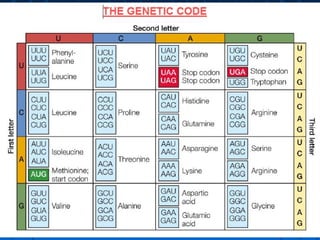
GENETIC CODEGENETIC CODE
Definition:Definition: System of nucleotideSystem of nucleotide
sequences of mRNA that designatessequences of mRNA that designates
particular amino acid sequences inparticular amino acid sequences in
the process of translation.the process of translation.
 Genetic code is the relation betweenGenetic code is the relation between
the sequence bases in DNA and thethe sequence bases in DNA and the
sequence of amino acids in proteinsequence of amino acids in protein
 Code words for amino acids--Code words for amino acids--CodonsCodons
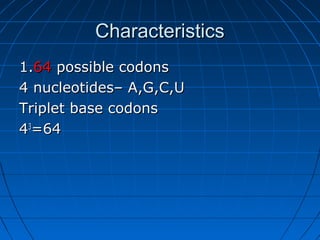
CharacteristicsCharacteristics
1.1.6464 possible codonspossible codons
4 nucleotides– A,G,C,U4 nucleotides– A,G,C,U
Triplet base codonsTriplet base codons
4433
=64=64
2.2. UNIVERSALUNIVERSAL
Few exceptions– AUA codes for Met inFew exceptions– AUA codes for Met in
mitochondriamitochondria
AUA– Ile in cytoplasmAUA– Ile in cytoplasm
UGA– stop codon in CytoplasmUGA– stop codon in Cytoplasm
UGA– Trp in MtUGA– Trp in Mt
Bacteria– GUG,UUG, AUU,CUGBacteria– GUG,UUG, AUU,CUG
initiating codonsinitiating codons
3.3. Stop codon and Initiating codonStop codon and Initiating codon
AUG– Start codonAUG– Start codon
UAA,UGA and UAG– stop/ non-senseUAA,UGA and UAG– stop/ non-sense
codoncodon
Exception– 21Exception– 21stst
AA Selenocystine--AA Selenocystine--
UGAUGA
4.Genetic code is4.Genetic code is degeneratedegenerate
5. It is5. It is unambiguousunambiguous
6. Code is6. Code is non-overlappingnon-overlapping andand
without punctuationwithout punctuation
7.7. Wobbling phenomenonWobbling phenomenon —reduced—reduced
stringency between the 3stringency between the 3rdrd
base ofbase of
codon and complementary base ofcodon and complementary base of
anticodonanticodon
Mitochondria have different codesMitochondria have different codes
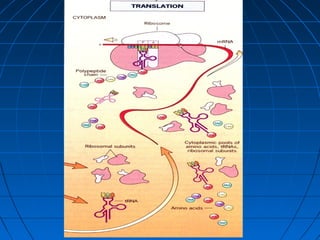
TRANSLATION
Translation (An Overview)Translation (An Overview)
 Translation is defined as protein synthesis.Translation is defined as protein synthesis.
 Occurs on ribosomes--mRNAOccurs on ribosomes--mRNA Potein→Potein→
 mRNA is translated in the 5’ to 3’mRNA is translated in the 5’ to 3’
direction.direction.
 Highly regulatedHighly regulated
 Very fast– 20AA/secVery fast– 20AA/sec
 Amino acids are brought to the ribosomeAmino acids are brought to the ribosome
bound to a specific tRNA molecule.bound to a specific tRNA molecule.
 The mRNA and tRNA are responsible forThe mRNA and tRNA are responsible for
the correct recognition of each amino acidthe correct recognition of each amino acid
in the growing polypeptidein the growing polypeptide
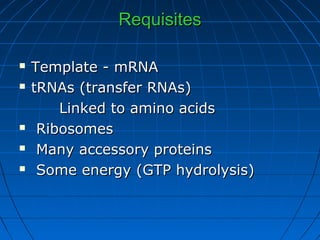
RequisitesRequisites
 Template - mRNATemplate - mRNA
 tRNAs (transfer RNAs)tRNAs (transfer RNAs)
Linked to amino acidsLinked to amino acids
 RibosomesRibosomes
 Many accessory proteinsMany accessory proteins
 Some energy (GTP hydrolysis)Some energy (GTP hydrolysis)
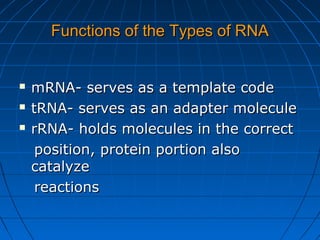
Functions of the Types of RNAFunctions of the Types of RNA
 mRNA- serves as a template codemRNA- serves as a template code
 tRNA- serves as an adapter moleculetRNA- serves as an adapter molecule
 rRNA- holds molecules in the correctrRNA- holds molecules in the correct
position, protein portion alsoposition, protein portion also
catalyzecatalyze
reactionsreactions
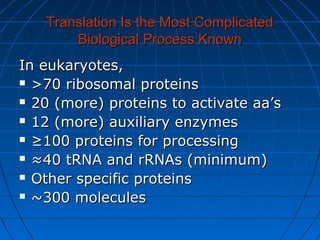
Translation Is the Most ComplicatedTranslation Is the Most Complicated
Biological Process KnownBiological Process Known
In eukaryotes,In eukaryotes,
 >70 ribosomal proteins>70 ribosomal proteins
 20 (more) proteins to activate aa’s20 (more) proteins to activate aa’s
 12 (more) auxiliary enzymes12 (more) auxiliary enzymes
 ≥≥100 proteins for processing100 proteins for processing
 ≈≈40 tRNA and rRNAs (minimum)40 tRNA and rRNAs (minimum)
 Other specific proteinsOther specific proteins
 ~300 molecules~300 molecules
Five stagesFive stages
 PreinitiationPreinitiation
 InitiationInitiation
 ElongationElongation
 TerminationTermination
 Post-translational modificationPost-translational modification
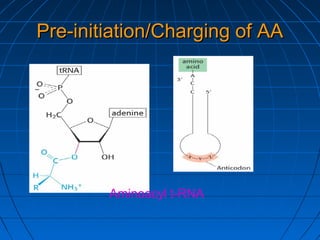
Pre-initiation/Charging of AAPre-initiation/Charging of AA
Aminoacyl t-RNA
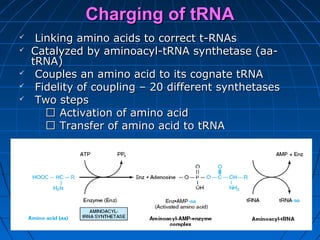
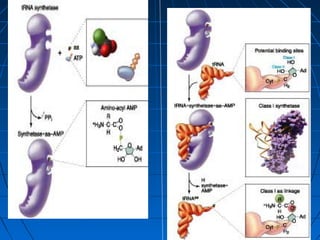
Charging of tRNACharging of tRNA
 Linking amino acids to correct t-RNAsLinking amino acids to correct t-RNAs
 Catalyzed by aminoacyl-tRNA synthetase (aa-Catalyzed by aminoacyl-tRNA synthetase (aa-
tRNA)tRNA)
 Couples an amino acid to its cognate tRNACouples an amino acid to its cognate tRNA
 Fidelity of coupling – 20 different synthetasesFidelity of coupling – 20 different synthetases
 Two stepsTwo steps
􀁺􀁺 Activation of amino acidActivation of amino acid
􀁺􀁺 Transfer of amino acid to tRNATransfer of amino acid to tRNA
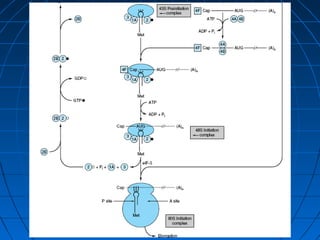
InitiationInitiation
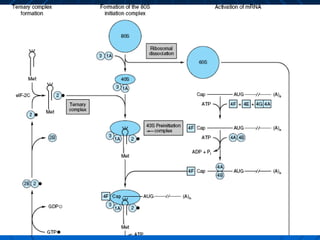
 Attachment of initiator tRNA (Met-tRNA)Attachment of initiator tRNA (Met-tRNA)
to start codon on mRNA and assembly ofto start codon on mRNA and assembly of
ribosomal subunitsribosomal subunits
i)i) Dissociation of ribosomes–Dissociation of ribosomes–
80s ribosomes80s ribosomes 40s+60s→40s+60s→
eIF-3 & eIF-1A Bind to newly dissociated→eIF-3 & eIF-1A Bind to newly dissociated→
40s unit40s unit
↓↓
 Allows other translation factors to bindAllows other translation factors to bind
 Delays reassociation of 40s with 60sDelays reassociation of 40s with 60s
ii) Formation of 43s pre-initiationii) Formation of 43s pre-initiation
complexcomplex
GTP + eIF-2GTP + eIF-2
↓↓
Bind to met-t-RNABind to met-t-RNAii
(Ternary(Ternary
complex)complex)
↓↓
43s pre-initiation complex formed43s pre-initiation complex formed
(40s ribosome+ eIF-2+GTP+eIF-(40s ribosome+ eIF-2+GTP+eIF-
3+eIF-1A)3+eIF-1A)
iii) Formation of 48s initiation complexiii) Formation of 48s initiation complex
 Binding of mRNA to 43s pre-initiationBinding of mRNA to 43s pre-initiation
complexcomplex
 eIF-4F= eIF-4E + eIF-4G—eIF-4AeIF-4F= eIF-4E + eIF-4G—eIF-4A
 4F binds to 5’ cap of mRNA through 4E4F binds to 5’ cap of mRNA through 4E
↓↓
4A &4B come and bind4A &4B come and bind
↓↓ATPATP
mRNA binds to 43s PICmRNA binds to 43s PIC
↓↓
48s initiation complex formed48s initiation complex formed
(40s ribosome+ eIF-3,1A,2+ GTP +mRNA + eIF-4F)(40s ribosome+ eIF-3,1A,2+ GTP +mRNA + eIF-4F)
Prokaryotes–Prokaryotes– Shine-DalgarnoShine-Dalgarno
sequence-sequence--a sequence of nucleotide-a sequence of nucleotide
bases on m-RNA that facilitates m-bases on m-RNA that facilitates m-
RNA binding to the pre-initiationRNA binding to the pre-initiation
complexcomplex
Eukaryotes–Eukaryotes– Kozak consensusKozak consensus
sequencesequence
 Formation of PICFormation of PIC
↓↓
Melting of secondary str at 5’ endMelting of secondary str at 5’ end
↓↓
Complex scans m-RNA for a suitableComplex scans m-RNA for a suitable
iv) Formation of 80s initiation complex—iv) Formation of 80s initiation complex—
48s IC combines with 60s ribosome48s IC combines with 60s ribosome
↓↓
Hydrolysis of GTP bound to eIF-2 byHydrolysis of GTP bound to eIF-2 by
eIF-5eIF-5
↓↓
Release of initiation factors andRelease of initiation factors and
recycledrecycled
↓↓
Rapid reassociation of 40s and 60s toRapid reassociation of 40s and 60s to
form 80s ribosomeform 80s ribosome
metmet
Regulation of initiationRegulation of initiation
 eIF-4F– rate of translationeIF-4F– rate of translation
 4E– recognises the cap of mRNA4E– recognises the cap of mRNA
 4G– Scaffolding protein4G– Scaffolding protein
-- binds to helicase complex that-- binds to helicase complex that
helps in unwinding the RNAhelps in unwinding the RNA
 eIF-2– controls to some extenteIF-2– controls to some extent
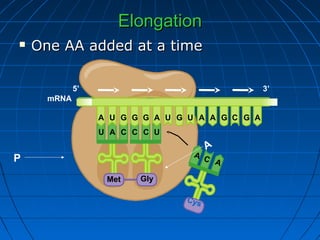
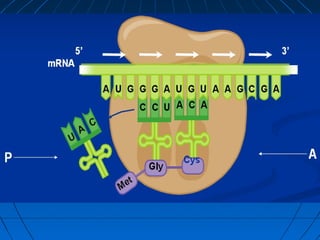
ElongationElongation
 One AA added at a timeOne AA added at a time
CU A
Met
mRNA
5’ 3’
C C U
Gly
U U U CG G G G GGA A A A A
A
AC
Cys
P
A
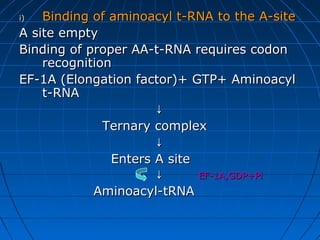
i)i) Binding of aminoacyl t-RNA to the A-siteBinding of aminoacyl t-RNA to the A-site
A site emptyA site empty
Binding of proper AA-t-RNA requires codonBinding of proper AA-t-RNA requires codon
recognitionrecognition
EF-1A (Elongation factor)+ GTP+ AminoacylEF-1A (Elongation factor)+ GTP+ Aminoacyl
t-RNAt-RNA
↓↓
Ternary complexTernary complex
↓↓
Enters A siteEnters A site
↓↓ EF-1A,GDP+PiEF-1A,GDP+Pi
Aminoacyl-tRNAAminoacyl-tRNA
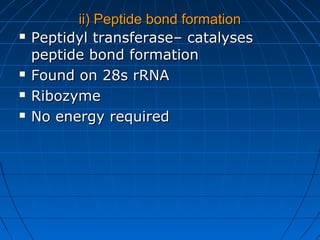
ii) Peptide bond formationii) Peptide bond formation
 Peptidyl transferase– catalysesPeptidyl transferase– catalyses
peptide bond formationpeptide bond formation
 Found on 28s rRNAFound on 28s rRNA
 RibozymeRibozyme
 No energy requiredNo energy required
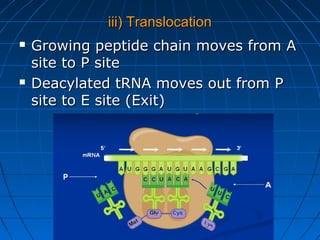
iii) Translocationiii) Translocation
 Growing peptide chain moves from AGrowing peptide chain moves from A
site to P sitesite to P site
 Deacylated tRNA moves out from PDeacylated tRNA moves out from P
site to E site (Exit)site to E site (Exit)
 EF-2 factor bindsEF-2 factor binds
↓↓
Displaces peptidyl tRNA from A site toDisplaces peptidyl tRNA from A site to
P siteP site
↓↓
Energy from GTP; mRNA moves byEnergy from GTP; mRNA moves by
one codonone codon
 Process of peptide synthesis occursProcess of peptide synthesis occurs
until a termination codon is reacheduntil a termination codon is reached
Termi nat i on
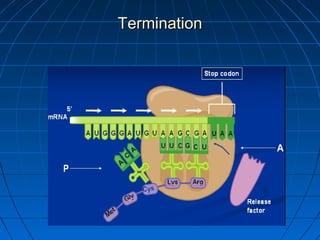
TerminationTermination
 Stop codon appears on A siteStop codon appears on A site
 No tRNA availableNo tRNA available
 Releasing factorReleasing factor (RF-1)(RF-1) recognises itsrecognises its
presence in A sitepresence in A site
 RF-1+RF-3+GTPRF-1+RF-3+GTP Hydrolysis of bond→ Hydrolysis of bond→
between peptide and tRNA occupyingbetween peptide and tRNA occupying
P site ↓P site ↓
Protein, tRNA, 60s & 40sProtein, tRNA, 60s & 40s
ribosomes, GDP releasedribosomes, GDP released
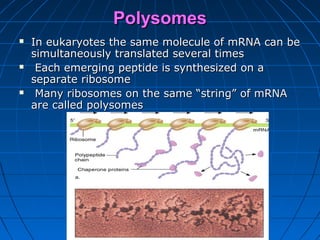
PolysomesPolysomes
 In eukaryotes the same molecule of mRNA can beIn eukaryotes the same molecule of mRNA can be
simultaneously translated several timessimultaneously translated several times
 Each emerging peptide is synthesized on aEach emerging peptide is synthesized on a
separate ribosomeseparate ribosome
 Many ribosomes on the same “string” of mRNAMany ribosomes on the same “string” of mRNA
are called polysomesare called polysomes
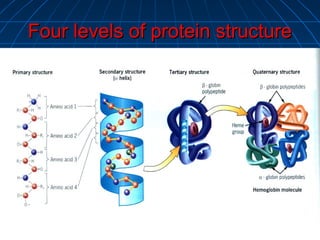
Four levels of protein structureFour levels of protein structure
Chaperones and protein foldingChaperones and protein folding
 Heat shock proteinsHeat shock proteins
Hsp70Hsp70
Chaperonin (Hsp60)Chaperonin (Hsp60)
 Prevent aggregationPrevent aggregation
 Put all the hydrophobic ends insidePut all the hydrophobic ends inside
 Misfolding causes diseases e.g.Misfolding causes diseases e.g.
Cystic fibrosis, Prion diseasesCystic fibrosis, Prion diseases
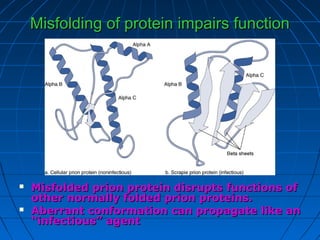
Misfolding of protein impairs functionMisfolding of protein impairs function
 Misfolded prion protein disrupts functions ofMisfolded prion protein disrupts functions of
other normally folded prion proteins.other normally folded prion proteins.
 Aberrant conformation can propagate like anAberrant conformation can propagate like an
“infectious” agent“infectious” agent
Inhibitors of TranslationInhibitors of Translation
A.A. Reversible inhibitorReversible inhibitor
a.Tetracyclin– Binds to 30s ribosomea.Tetracyclin– Binds to 30s ribosome
↓↓
Inhibit attachment of aminoacyl tRNA toInhibit attachment of aminoacyl tRNA to
the A sitethe A site
b. Chloramphenicol– Inhibits peptidylb. Chloramphenicol– Inhibits peptidyl
transferasetransferase
c. Erythromycin & Clindamycin– Preventc. Erythromycin & Clindamycin– Prevent
translocationtranslocation
B. Irreversible inhibitorB. Irreversible inhibitor
Streptomycin andStreptomycin and
Aminoglycosides—Bind to 30sAminoglycosides—Bind to 30s
ribosomal sub-unitribosomal sub-unit
Low conc.- Misreading of proteinLow conc.- Misreading of protein
↓↓
Useless bacterial proteinsUseless bacterial proteins
Pharma. Conc.- Inhibit IC synthesisPharma. Conc.- Inhibit IC synthesis
↓↓
Protein synthesis inhibitedProtein synthesis inhibited
C. Inhibitors in mammalsC. Inhibitors in mammals
1.1. Puromycin– Structural analogue ofPuromycin– Structural analogue of
tyrosinyl t-RNAtyrosinyl t-RNA
2.2. Cycloheximide– Inhibits peptidylCycloheximide– Inhibits peptidyl
transferasetransferase
3.3. Diphtheria toxin—Inactivation ofDiphtheria toxin—Inactivation of
EF-2 by attachment of ADP to EF-2EF-2 by attachment of ADP to EF-2
4.4. Ricin– Inactivates 28s rRNARicin– Inactivates 28s rRNA
POST-TRANSLATIONALPOST-TRANSLATIONAL
MODIFICATIONMODIFICATION
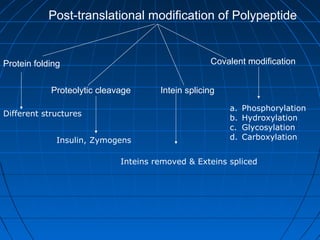
Post-translational modification of Polypeptide
Protein folding
Proteolytic cleavage Intein splicing
Covalent modification
Different structures
Insulin, Zymogens
Inteins removed & Exteins spliced
a. Phosphorylation
b. Hydroxylation
c. Glycosylation
d. Carboxylation
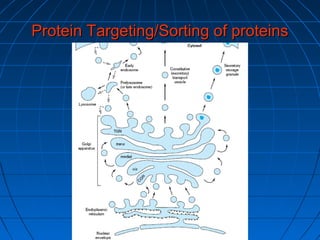
Protein Targeting/Sorting of proteinsProtein Targeting/Sorting of proteins
Take a Break

Genetic code and translation

  • 1.
  • 2.
    GENETIC CODEGENETIC CODE Definition:Definition:System of nucleotideSystem of nucleotide sequences of mRNA that designatessequences of mRNA that designates particular amino acid sequences inparticular amino acid sequences in the process of translation.the process of translation.  Genetic code is the relation betweenGenetic code is the relation between the sequence bases in DNA and thethe sequence bases in DNA and the sequence of amino acids in proteinsequence of amino acids in protein  Code words for amino acids--Code words for amino acids--CodonsCodons
  • 4.
    CharacteristicsCharacteristics 1.1.6464 possible codonspossiblecodons 4 nucleotides– A,G,C,U4 nucleotides– A,G,C,U Triplet base codonsTriplet base codons 4433 =64=64
  • 5.
    2.2. UNIVERSALUNIVERSAL Few exceptions–AUA codes for Met inFew exceptions– AUA codes for Met in mitochondriamitochondria AUA– Ile in cytoplasmAUA– Ile in cytoplasm UGA– stop codon in CytoplasmUGA– stop codon in Cytoplasm UGA– Trp in MtUGA– Trp in Mt Bacteria– GUG,UUG, AUU,CUGBacteria– GUG,UUG, AUU,CUG initiating codonsinitiating codons
  • 6.
    3.3. Stop codonand Initiating codonStop codon and Initiating codon AUG– Start codonAUG– Start codon UAA,UGA and UAG– stop/ non-senseUAA,UGA and UAG– stop/ non-sense codoncodon Exception– 21Exception– 21stst AA Selenocystine--AA Selenocystine-- UGAUGA 4.Genetic code is4.Genetic code is degeneratedegenerate 5. It is5. It is unambiguousunambiguous
  • 7.
    6. Code is6.Code is non-overlappingnon-overlapping andand without punctuationwithout punctuation 7.7. Wobbling phenomenonWobbling phenomenon —reduced—reduced stringency between the 3stringency between the 3rdrd base ofbase of codon and complementary base ofcodon and complementary base of anticodonanticodon Mitochondria have different codesMitochondria have different codes
  • 8.
  • 9.
    Translation (An Overview)Translation(An Overview)  Translation is defined as protein synthesis.Translation is defined as protein synthesis.  Occurs on ribosomes--mRNAOccurs on ribosomes--mRNA Potein→Potein→  mRNA is translated in the 5’ to 3’mRNA is translated in the 5’ to 3’ direction.direction.  Highly regulatedHighly regulated  Very fast– 20AA/secVery fast– 20AA/sec  Amino acids are brought to the ribosomeAmino acids are brought to the ribosome bound to a specific tRNA molecule.bound to a specific tRNA molecule.  The mRNA and tRNA are responsible forThe mRNA and tRNA are responsible for the correct recognition of each amino acidthe correct recognition of each amino acid in the growing polypeptidein the growing polypeptide
  • 11.
    RequisitesRequisites  Template -mRNATemplate - mRNA  tRNAs (transfer RNAs)tRNAs (transfer RNAs) Linked to amino acidsLinked to amino acids  RibosomesRibosomes  Many accessory proteinsMany accessory proteins  Some energy (GTP hydrolysis)Some energy (GTP hydrolysis)
  • 12.
    Functions of theTypes of RNAFunctions of the Types of RNA  mRNA- serves as a template codemRNA- serves as a template code  tRNA- serves as an adapter moleculetRNA- serves as an adapter molecule  rRNA- holds molecules in the correctrRNA- holds molecules in the correct position, protein portion alsoposition, protein portion also catalyzecatalyze reactionsreactions
  • 13.
    Translation Is theMost ComplicatedTranslation Is the Most Complicated Biological Process KnownBiological Process Known In eukaryotes,In eukaryotes,  >70 ribosomal proteins>70 ribosomal proteins  20 (more) proteins to activate aa’s20 (more) proteins to activate aa’s  12 (more) auxiliary enzymes12 (more) auxiliary enzymes  ≥≥100 proteins for processing100 proteins for processing  ≈≈40 tRNA and rRNAs (minimum)40 tRNA and rRNAs (minimum)  Other specific proteinsOther specific proteins  ~300 molecules~300 molecules
  • 14.
    Five stagesFive stages PreinitiationPreinitiation  InitiationInitiation  ElongationElongation  TerminationTermination  Post-translational modificationPost-translational modification
  • 15.
  • 16.
    Charging of tRNAChargingof tRNA  Linking amino acids to correct t-RNAsLinking amino acids to correct t-RNAs  Catalyzed by aminoacyl-tRNA synthetase (aa-Catalyzed by aminoacyl-tRNA synthetase (aa- tRNA)tRNA)  Couples an amino acid to its cognate tRNACouples an amino acid to its cognate tRNA  Fidelity of coupling – 20 different synthetasesFidelity of coupling – 20 different synthetases  Two stepsTwo steps 􀁺􀁺 Activation of amino acidActivation of amino acid 􀁺􀁺 Transfer of amino acid to tRNATransfer of amino acid to tRNA
  • 18.
    InitiationInitiation  Attachment ofinitiator tRNA (Met-tRNA)Attachment of initiator tRNA (Met-tRNA) to start codon on mRNA and assembly ofto start codon on mRNA and assembly of ribosomal subunitsribosomal subunits i)i) Dissociation of ribosomes–Dissociation of ribosomes– 80s ribosomes80s ribosomes 40s+60s→40s+60s→ eIF-3 & eIF-1A Bind to newly dissociated→eIF-3 & eIF-1A Bind to newly dissociated→ 40s unit40s unit ↓↓  Allows other translation factors to bindAllows other translation factors to bind  Delays reassociation of 40s with 60sDelays reassociation of 40s with 60s
  • 19.
    ii) Formation of43s pre-initiationii) Formation of 43s pre-initiation complexcomplex GTP + eIF-2GTP + eIF-2 ↓↓ Bind to met-t-RNABind to met-t-RNAii (Ternary(Ternary complex)complex) ↓↓ 43s pre-initiation complex formed43s pre-initiation complex formed (40s ribosome+ eIF-2+GTP+eIF-(40s ribosome+ eIF-2+GTP+eIF- 3+eIF-1A)3+eIF-1A)
  • 20.
    iii) Formation of48s initiation complexiii) Formation of 48s initiation complex  Binding of mRNA to 43s pre-initiationBinding of mRNA to 43s pre-initiation complexcomplex  eIF-4F= eIF-4E + eIF-4G—eIF-4AeIF-4F= eIF-4E + eIF-4G—eIF-4A  4F binds to 5’ cap of mRNA through 4E4F binds to 5’ cap of mRNA through 4E ↓↓ 4A &4B come and bind4A &4B come and bind ↓↓ATPATP mRNA binds to 43s PICmRNA binds to 43s PIC ↓↓ 48s initiation complex formed48s initiation complex formed (40s ribosome+ eIF-3,1A,2+ GTP +mRNA + eIF-4F)(40s ribosome+ eIF-3,1A,2+ GTP +mRNA + eIF-4F)
  • 23.
    Prokaryotes–Prokaryotes– Shine-DalgarnoShine-Dalgarno sequence-sequence--a sequenceof nucleotide-a sequence of nucleotide bases on m-RNA that facilitates m-bases on m-RNA that facilitates m- RNA binding to the pre-initiationRNA binding to the pre-initiation complexcomplex Eukaryotes–Eukaryotes– Kozak consensusKozak consensus sequencesequence  Formation of PICFormation of PIC ↓↓ Melting of secondary str at 5’ endMelting of secondary str at 5’ end ↓↓ Complex scans m-RNA for a suitableComplex scans m-RNA for a suitable
  • 24.
    iv) Formation of80s initiation complex—iv) Formation of 80s initiation complex— 48s IC combines with 60s ribosome48s IC combines with 60s ribosome ↓↓ Hydrolysis of GTP bound to eIF-2 byHydrolysis of GTP bound to eIF-2 by eIF-5eIF-5 ↓↓ Release of initiation factors andRelease of initiation factors and recycledrecycled ↓↓ Rapid reassociation of 40s and 60s toRapid reassociation of 40s and 60s to form 80s ribosomeform 80s ribosome metmet
  • 25.
    Regulation of initiationRegulationof initiation  eIF-4F– rate of translationeIF-4F– rate of translation  4E– recognises the cap of mRNA4E– recognises the cap of mRNA  4G– Scaffolding protein4G– Scaffolding protein -- binds to helicase complex that-- binds to helicase complex that helps in unwinding the RNAhelps in unwinding the RNA  eIF-2– controls to some extenteIF-2– controls to some extent
  • 26.
    ElongationElongation  One AAadded at a timeOne AA added at a time CU A Met mRNA 5’ 3’ C C U Gly U U U CG G G G GGA A A A A A AC Cys P A
  • 27.
    i)i) Binding ofaminoacyl t-RNA to the A-siteBinding of aminoacyl t-RNA to the A-site A site emptyA site empty Binding of proper AA-t-RNA requires codonBinding of proper AA-t-RNA requires codon recognitionrecognition EF-1A (Elongation factor)+ GTP+ AminoacylEF-1A (Elongation factor)+ GTP+ Aminoacyl t-RNAt-RNA ↓↓ Ternary complexTernary complex ↓↓ Enters A siteEnters A site ↓↓ EF-1A,GDP+PiEF-1A,GDP+Pi Aminoacyl-tRNAAminoacyl-tRNA
  • 29.
    ii) Peptide bondformationii) Peptide bond formation  Peptidyl transferase– catalysesPeptidyl transferase– catalyses peptide bond formationpeptide bond formation  Found on 28s rRNAFound on 28s rRNA  RibozymeRibozyme  No energy requiredNo energy required
  • 30.
    iii) Translocationiii) Translocation Growing peptide chain moves from AGrowing peptide chain moves from A site to P sitesite to P site  Deacylated tRNA moves out from PDeacylated tRNA moves out from P site to E site (Exit)site to E site (Exit)
  • 31.
     EF-2 factorbindsEF-2 factor binds ↓↓ Displaces peptidyl tRNA from A site toDisplaces peptidyl tRNA from A site to P siteP site ↓↓ Energy from GTP; mRNA moves byEnergy from GTP; mRNA moves by one codonone codon  Process of peptide synthesis occursProcess of peptide synthesis occurs until a termination codon is reacheduntil a termination codon is reached
  • 32.
  • 33.
  • 34.
     Stop codonappears on A siteStop codon appears on A site  No tRNA availableNo tRNA available  Releasing factorReleasing factor (RF-1)(RF-1) recognises itsrecognises its presence in A sitepresence in A site  RF-1+RF-3+GTPRF-1+RF-3+GTP Hydrolysis of bond→ Hydrolysis of bond→ between peptide and tRNA occupyingbetween peptide and tRNA occupying P site ↓P site ↓ Protein, tRNA, 60s & 40sProtein, tRNA, 60s & 40s ribosomes, GDP releasedribosomes, GDP released
  • 35.
    PolysomesPolysomes  In eukaryotesthe same molecule of mRNA can beIn eukaryotes the same molecule of mRNA can be simultaneously translated several timessimultaneously translated several times  Each emerging peptide is synthesized on aEach emerging peptide is synthesized on a separate ribosomeseparate ribosome  Many ribosomes on the same “string” of mRNAMany ribosomes on the same “string” of mRNA are called polysomesare called polysomes
  • 36.
    Four levels ofprotein structureFour levels of protein structure
  • 37.
    Chaperones and proteinfoldingChaperones and protein folding  Heat shock proteinsHeat shock proteins Hsp70Hsp70 Chaperonin (Hsp60)Chaperonin (Hsp60)  Prevent aggregationPrevent aggregation  Put all the hydrophobic ends insidePut all the hydrophobic ends inside  Misfolding causes diseases e.g.Misfolding causes diseases e.g. Cystic fibrosis, Prion diseasesCystic fibrosis, Prion diseases
  • 38.
    Misfolding of proteinimpairs functionMisfolding of protein impairs function  Misfolded prion protein disrupts functions ofMisfolded prion protein disrupts functions of other normally folded prion proteins.other normally folded prion proteins.  Aberrant conformation can propagate like anAberrant conformation can propagate like an “infectious” agent“infectious” agent
  • 39.
    Inhibitors of TranslationInhibitorsof Translation A.A. Reversible inhibitorReversible inhibitor a.Tetracyclin– Binds to 30s ribosomea.Tetracyclin– Binds to 30s ribosome ↓↓ Inhibit attachment of aminoacyl tRNA toInhibit attachment of aminoacyl tRNA to the A sitethe A site b. Chloramphenicol– Inhibits peptidylb. Chloramphenicol– Inhibits peptidyl transferasetransferase c. Erythromycin & Clindamycin– Preventc. Erythromycin & Clindamycin– Prevent translocationtranslocation
  • 40.
    B. Irreversible inhibitorB.Irreversible inhibitor Streptomycin andStreptomycin and Aminoglycosides—Bind to 30sAminoglycosides—Bind to 30s ribosomal sub-unitribosomal sub-unit Low conc.- Misreading of proteinLow conc.- Misreading of protein ↓↓ Useless bacterial proteinsUseless bacterial proteins Pharma. Conc.- Inhibit IC synthesisPharma. Conc.- Inhibit IC synthesis ↓↓ Protein synthesis inhibitedProtein synthesis inhibited
  • 41.
    C. Inhibitors inmammalsC. Inhibitors in mammals 1.1. Puromycin– Structural analogue ofPuromycin– Structural analogue of tyrosinyl t-RNAtyrosinyl t-RNA 2.2. Cycloheximide– Inhibits peptidylCycloheximide– Inhibits peptidyl transferasetransferase 3.3. Diphtheria toxin—Inactivation ofDiphtheria toxin—Inactivation of EF-2 by attachment of ADP to EF-2EF-2 by attachment of ADP to EF-2 4.4. Ricin– Inactivates 28s rRNARicin– Inactivates 28s rRNA
  • 43.
  • 44.
    Post-translational modification ofPolypeptide Protein folding Proteolytic cleavage Intein splicing Covalent modification Different structures Insulin, Zymogens Inteins removed & Exteins spliced a. Phosphorylation b. Hydroxylation c. Glycosylation d. Carboxylation
  • 45.
    Protein Targeting/Sorting ofproteinsProtein Targeting/Sorting of proteins
  • 46.