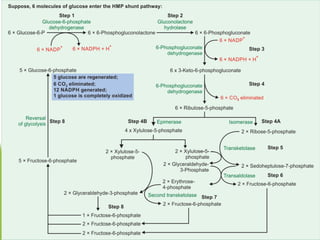
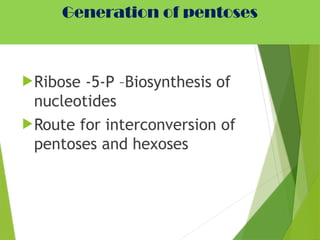
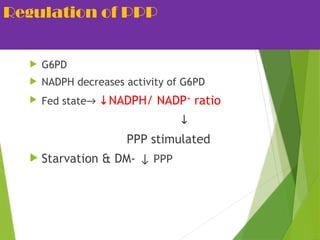
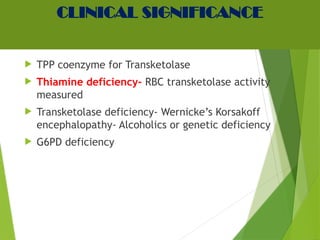
Alternate glucose metabolicpathway
More anabolic than catabolic
NO ATP generation
NO ATP consumption
Ideal for tissues needing reducing power rather
than energy
Gives metabolic flexibility to tissues
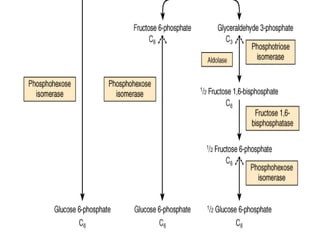
Can provide intermediates of glycolysis-
Fructose-6-P, G-3-P
Can fulfill NADPH demand, Nucleotide demand,
Energy demand
6.
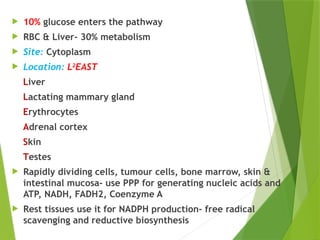
10% glucoseenters the pathway
RBC & Liver- 30% metabolism
Site: Cytoplasm
Location: L2
EAST
Liver
Lactating mammary gland
Erythrocytes
Adrenal cortex
Skin
Testes
Rapidly dividing cells, tumour cells, bone marrow, skin &
intestinal mucosa- use PPP for generating nucleic acids and
ATP, NADH, FADH2, Coenzyme A
Rest tissues use it for NADPH production- free radical
scavenging and reductive biosynthesis
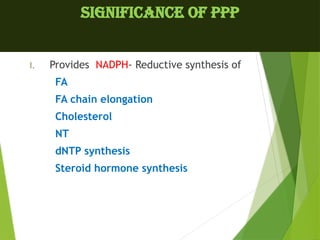
SIGNIFICANCE OF PPP
I.Provides NADPH- Reductive synthesis of
FA
FA chain elongation
Cholesterol
NT
dNTP synthesis
Steroid hormone synthesis
19.
NADH -reducingreactions in catabolic pathways,
e.g. pyruvate to lactate.
Enters the electron transport chain- ATP is generated.
• NADPH is used for reductive biosynthetic reactions
• NADPH is not entering the electron transport chain; and
NADPH will not generate ATP.
NADP differs from NAD in having an additional phosphate group.
These two coenzymes are specific for enzymes;
They are not interchangeable.
NAD and NADP are Different
20.
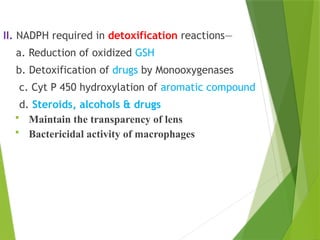
II. NADPH requiredin detoxification reactions—
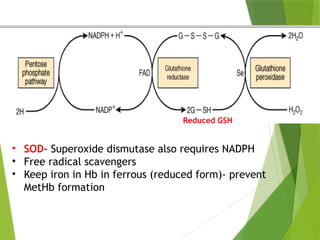
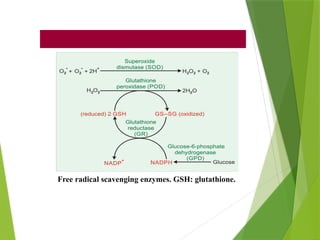
a. Reduction of oxidized GSH
b. Detoxification of drugs by Monooxygenases
c. Cyt P 450 hydroxylation of aromatic compound
d. Steroids, alcohols & drugs
Maintain the transparency of lens
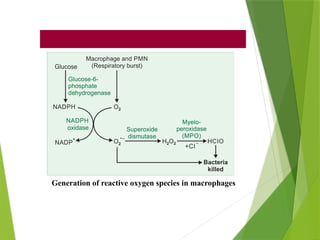
Bactericidal activity of macrophages
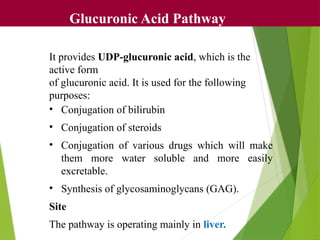
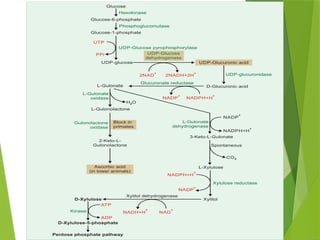
It provides UDP-glucuronicacid, which is the
active form
of glucuronic acid. It is used for the following
purposes:
• Conjugation of bilirubin
• Conjugation of steroids
• Conjugation of various drugs which will make
them more water soluble and more easily
excretable.
• Synthesis of glycosaminoglycans (GAG).
Site
The pathway is operating mainly in liver.
Glucuronic Acid Pathway
26.
Vitamin C Synthesisin Lower Animals
The enzyme L-gulonolactone oxidase is absent in human
beings, primates, guinea pigs and bats. Hence ascorbic acid
cannot be synthesized by human beings.
Essential Pentosuria
It is an inborn error of metabolism. In the pathway, L-
xylulose is converted to D-xylulose by two enzymes,
xylitol dehydrogenase and xylulose reductase. Absence of
any of these enzymes leads to pentosuria.
L-xylulose is excreted in urine and gives a positive
Benedict’s test. Barbiturates, aminopyrine, etc. will induce
uronic acid pathway and will increase xylulosuria in such
patients. This condition does not produce any harm; but it
should be differentiated from diabetes mellitus.