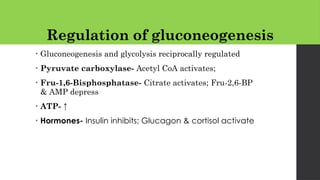
How and why glucose need to be synthesised from different non-carbohydrate sources and its level in blood is maintained. Its regulation and applied importance. Futile cycles, hyperlactatemia explained.
Why constant glucosemaintenance level is
essential??
• Brain & nervous system, renal medulla, RBCs, testes,
embryonic tissues- glucose is major/ sole source of
energy
• Brain- 120g/day; more than half the glucose stored as
glycogen in mm. & liver
• Supply of glucose from this store is not always
adequate- in between meals, longer fasts, rigorous
exercises
4.
Neo= new; Gluco=Glucose;genesis= synthesis
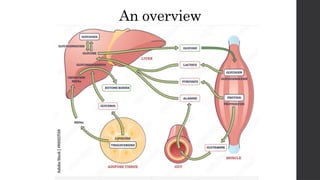
• New glucose synthesis from non-carbohydrate
sources
• Lactate, Pyruvate
• Glucogenic AA
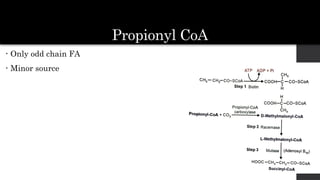
• Glycerol
• Propionyl CoA derived from odd chain FA
5.
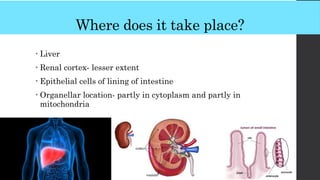
Where does ittake place?
• Liver
• Renal cortex- lesser extent
• Epithelial cells of lining of intestine
• Organellar location- partly in cytoplasm and partly in
mitochondria
Gluconeogenesis is notexact reversal of glycolysis
Key gluconeogenetic enzymes
Pyruvate carboxylase
Phosphoenolpyruvate carboxykinase
Fru-1,6-bisphosphatase
Glucose--phosphatase
8.
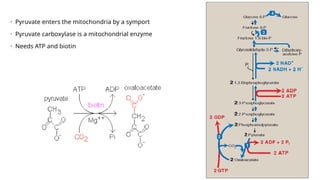
• Pyruvate entersthe mitochondria by a symport
• Pyruvate carboxylase is a mitochondrial enzyme
• Needs ATP and biotin
9.
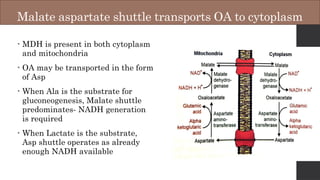
Malate aspartate shuttletransports OA to cytoplasm
• MDH is present in both cytoplasm
and mitochondria
• OA may be transported in the form
of Asp
• When Ala is the substrate for
gluconeogenesis, Malate shuttle
predominates- NADH generation
is required
• When Lactate is the substrate,
Asp shuttle operates as already
enough NADH available
10.
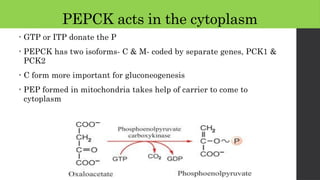
PEPCK acts inthe cytoplasm
• GTP or ITP donate the P
• PEPCK has two isoforms- C & M- coded by separate genes, PCK1 &
PCK2
• C form more important for gluconeogenesis
• PEP formed in mitochondria takes help of carrier to come to
cytoplasm
11.
Formation of Fru-1,6-BPis freely reversible
• Hydrolytic step
• Further change from Fru-6-P to Glu-6-P- Freely reversible
12.
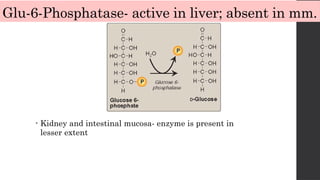
Glu-6-Phosphatase- active inliver; absent in mm.
• Kidney and intestinal mucosa- enzyme is present in
lesser extent
13.
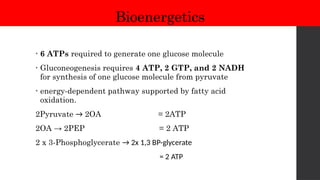
Bioenergetics
• 6 ATPsrequired to generate one glucose molecule
• Gluconeogenesis requires 4 ATP, 2 GTP, and 2 NADH
for synthesis of one glucose molecule from pyruvate
• energy-dependent pathway supported by fatty acid
oxidation.
2Pyruvate → 2OA = 2ATP
2OA → 2PEP = 2 ATP
2 x 3-Phosphoglycerate → 2x 1,3 BP-glycerate
= 2 ATP
14.
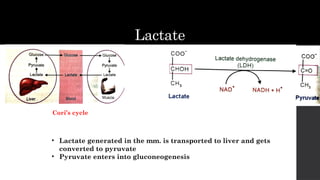
Lactate
Cori’s cycle
• Lactategenerated in the mm. is transported to liver and gets
converted to pyruvate
• Pyruvate enters into gluconeogenesis
15.
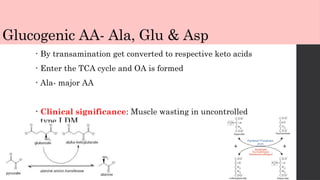
Glucogenic AA- Ala,Glu & Asp
• By transamination get converted to respective keto acids
• Enter the TCA cycle and OA is formed
• Ala- major AA
• Clinical significance: Muscle wasting in uncontrolled
type I DM
16.
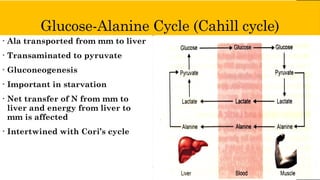
Glucose-Alanine Cycle (Cahillcycle)
• Ala transported from mm to liver
• Transaminated to pyruvate
• Gluconeogenesis
• Important in starvation
• Net transfer of N from mm to
liver and energy from liver to
mm is affected
• Intertwined with Cori’s cycle
17.
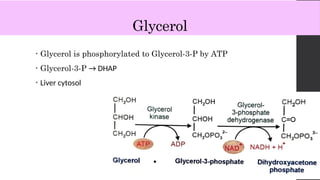
Glycerol
• Glycerol isphosphorylated to Glycerol-3-P by ATP
• Glycerol-3-P → DHAP
• Liver cytosol
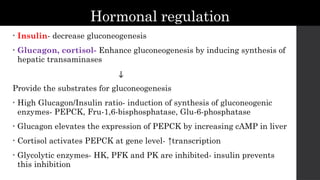
Hormonal regulation
• Insulin-decrease gluconeogenesis
• Glucagon, cortisol- Enhance gluconeogenesis by inducing synthesis of
hepatic transaminases
↓
Provide the substrates for gluconeogenesis
• High Glucagon/Insulin ratio- induction of synthesis of gluconeogenic
enzymes- PEPCK, Fru-1,6-bisphosphatase, Glu-6-phosphatase
• Glucagon elevates the expression of PEPCK by increasing cAMP in liver
• Cortisol activates PEPCK at gene level- ↑transcription
• Glycolytic enzymes- HK, PFK and PK are inhibited- insulin prevents
this inhibition
21.
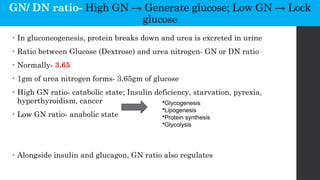
GN/ DN ratio-High GN → Generate glucose; Low GN → Lock
glucose
• In gluconeogenesis, protein breaks down and urea is excreted in urine
• Ratio between Glucose (Dextrose) and urea nitrogen- GN or DN ratio
• Normally- 3.65
• 1gm of urea nitrogen forms- 3.65gm of glucose
• High GN ratio- catabolic state; Insulin deficiency, starvation, pyrexia,
hyperthyroidism, cancer
• Low GN ratio- anabolic state
• Alongside insulin and glucagon, GN ratio also regulates
•Glycogenesis
•Lipogenesis
•Protein synthesis
•Glycolysis
22.
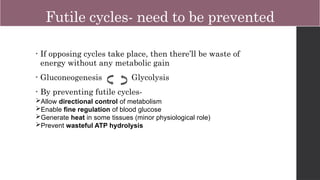
Futile cycles- needto be prevented
• If opposing cycles take place, then there’ll be waste of
energy without any metabolic gain
• Gluconeogenesis Glycolysis
• By preventing futile cycles-
Allow directional control of metabolism
Enable fine regulation of blood glucose
Generate heat in some tissues (minor physiological role)
Prevent wasteful ATP hydrolysis
23.
Clinical significance
• Pyruvatecarboxylase deficiency- inherited disease; mental retardation,
Lactic acidosis, hypoglycemia & hyperammonemia
• PEPCK deficiency- hypoglycemia, lactic acidosis, hypotonia &
hepatomegaly
• Fru-1,6-BPase deficiency- Hypoglycemia, ketosis and lactic acidosis
• PDH deficiency (inherited)- Hyperlactatemia
• As poisoning- PDH deficiency by quenching SH groups of lipoamide
component
• Ethanol- inhibits gluconeogenesis; raised NADH released from ethanol
metabolism, leads to hyperlactatemia
24.
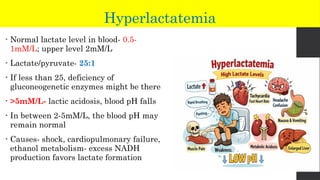
Hyperlactatemia
• Normal lactatelevel in blood- 0.5-
1mM/L; upper level 2mM/L
• Lactate/pyruvate- 25:1
• If less than 25, deficiency of
gluconeogenetic enzymes might be there
• >5mM/L- lactic acidosis, blood pH falls
• In between 2-5mM/L, the blood pH may
remain normal
• Causes- shock, cardiopulmonary failure,
ethanol metabolism- excess NADH
production favors lactate formation
25.
For more ppton medical biochemistry
www.drvpacharya.com