TCA CYCLE / CITRIC ACID CYCLE/ KREB’S
CYCLE
DR. VIYATPRAJNA ACHARYA MD, PhD
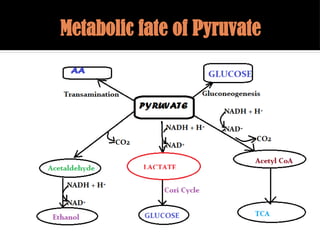
Metabolic fate of Pyruvate
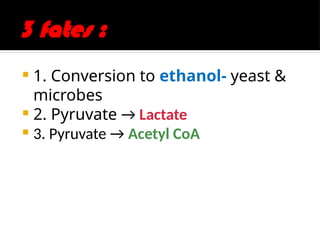
3 fates :
 1. Conversion to ethanol- yeast &
microbes
 2. Pyruvate → Lactate
 3. Pyruvate → Acetyl CoA
Pyruvate → Acetyl CoA
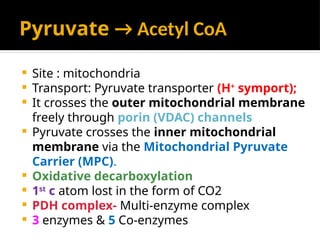
 Site : mitochondria
 Transport: Pyruvate transporter (H+
symport);
 It crosses the outer mitochondrial membrane
freely through porin (VDAC) channels
 Pyruvate crosses the inner mitochondrial
membrane via the Mitochondrial Pyruvate
Carrier (MPC).
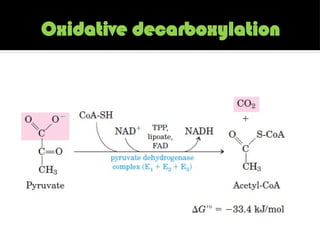
 Oxidative decarboxylation
 1st
c atom lost in the form of CO2
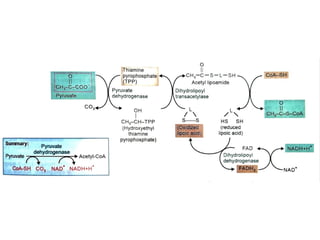
 PDH complex- Multi-enzyme complex
 3 enzymes & 5 Co-enzymes
Oxidative decarboxylation
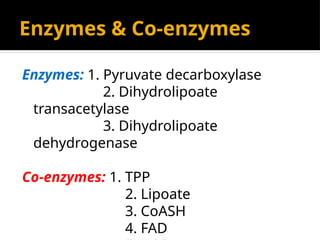
Enzymes & Co-enzymes
Enzymes: 1. Pyruvate decarboxylase
2. Dihydrolipoate
transacetylase
3. Dihydrolipoate
dehydrogenase
Co-enzymes: 1. TPP
2. Lipoate
3. CoASH
4. FAD
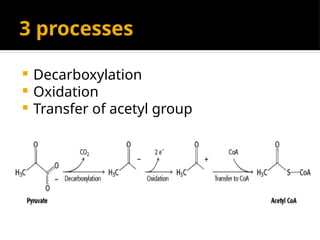
3 processes
 Decarboxylation
 Oxidation
 Transfer of acetyl group
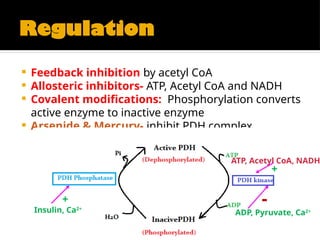
Regulation
 Feedback inhibition by acetyl CoA
 Allosteric inhibitors- ATP, Acetyl CoA and NADH
 Covalent modifications: Phosphorylation converts
active enzyme to inactive enzyme
 Arsenide & Mercury- inhibit PDH complex
Insulin, Ca2+
+
ATP, Acetyl CoA, NADH
+
ADP, Pyruvate, Ca2+
-
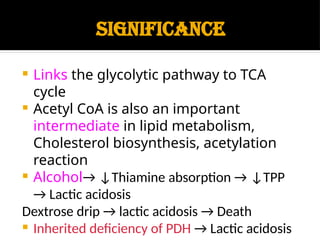
Significance
 Links the glycolytic pathway to TCA
cycle
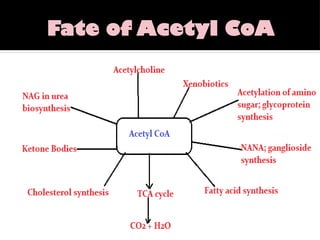
 Acetyl CoA is also an important
intermediate in lipid metabolism,
Cholesterol biosynthesis, acetylation
reaction
 Alcohol→ ↓Thiamine absorption → ↓TPP
→ Lactic acidosis
Dextrose drip → lactic acidosis → Death
 Inherited deficiency of PDH → Lactic acidosis
Fate of Acetyl CoA
TCA CYCLE
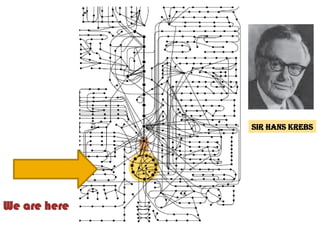
We are here
Sir Hans Krebs
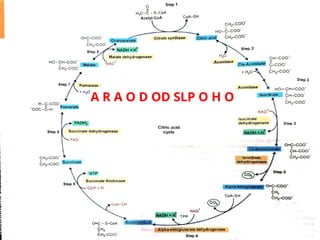
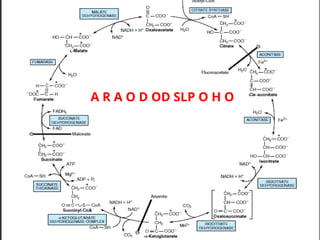
A R A O D OD SLP O H O
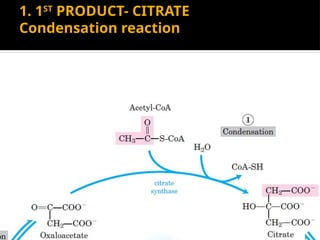
1. 1ST
PRODUCT- CITRATE
Condensation reaction
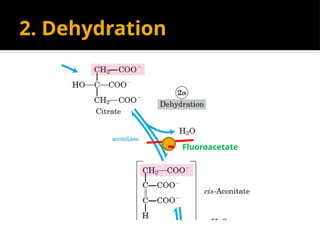
2. Dehydration
- Fluoroacetate
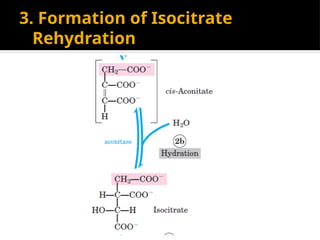
3. Formation of Isocitrate
Rehydration
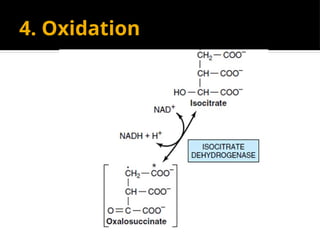
4. Oxidation
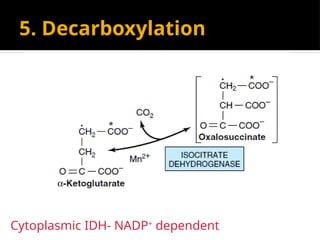
5. Decarboxylation
Cytoplasmic IDH- NADP+
dependent
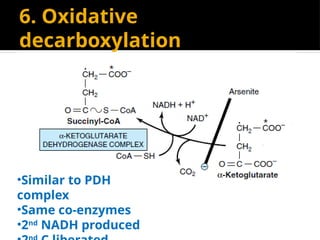
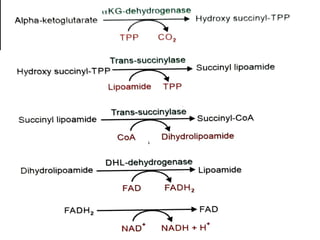
6. Oxidative
decarboxylation
•Similar to PDH
complex
•Same co-enzymes
•2nd
NADH produced
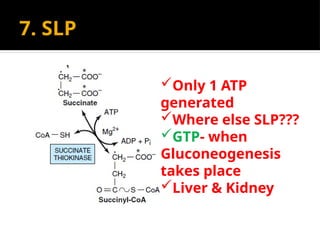
7. SLP
Only 1 ATP
generated
Where else SLP???
GTP- when
Gluconeogenesis
takes place
Liver & Kidney
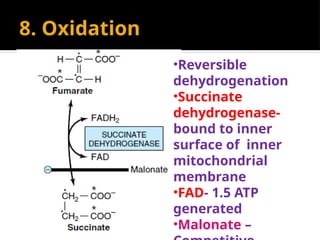
8. Oxidation
•Reversible
dehydrogenation
•Succinate
dehydrogenase-
bound to inner
surface of inner
mitochondrial
membrane
•FAD- 1.5 ATP
generated
•Malonate –
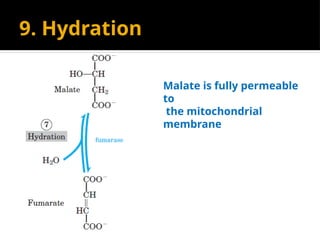
9. Hydration
Malate is fully permeable
to
the mitochondrial
membrane
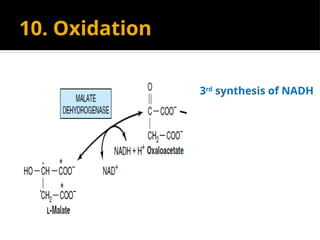
10. Oxidation
3rd
synthesis of NADH
A R A O D OD SLP O H O
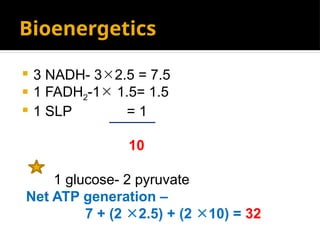
Bioenergetics
 3 NADH- 32.5 = 7.5
 1 FADH2-1 1.5= 1.5
 1 SLP = 1
10
1 glucose- 2 pyruvate
Net ATP generation –
7 + (2 2.5) + (2 10) = 32
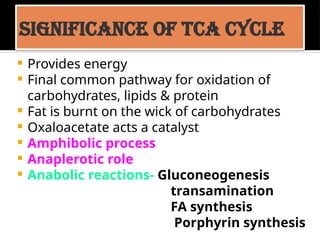
Significance of TCA cycle
 Provides energy
 Final common pathway for oxidation of
carbohydrates, lipids & protein
 Fat is burnt on the wick of carbohydrates
 Oxaloacetate acts a catalyst
 Amphibolic process
 Anaplerotic role
 Anabolic reactions- Gluconeogenesis
transamination
FA synthesis
Porphyrin synthesis
Aspire intensely, but without impatience
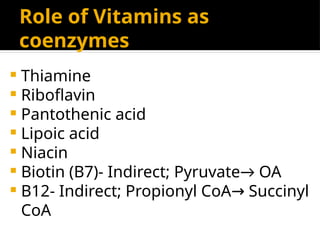
Role of Vitamins as
coenzymes
 Thiamine
 Riboflavin
 Pantothenic acid
 Lipoic acid
 Niacin
 Biotin (B7)- Indirect; Pyruvate→ OA
 B12- Indirect; Propionyl CoA Succinyl
→
CoA
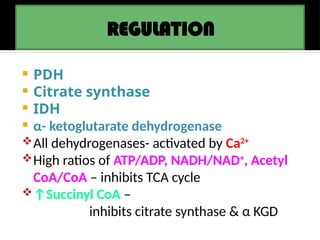
REGULATION
 PDH
 Citrate synthase
 IDH
 α- ketoglutarate dehydrogenase
All dehydrogenases- activated by Ca2+
High ratios of ATP/ADP, NADH/NAD+
, Acetyl
CoA/CoA – inhibits TCA cycle
↑Succinyl CoA –
inhibits citrate synthase & α KGD
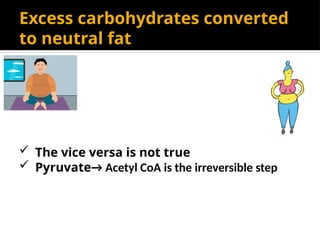
Excess carbohydrates converted
to neutral fat
 The vice versa is not true
 Pyruvate→ Acetyl CoA is the irreversible step
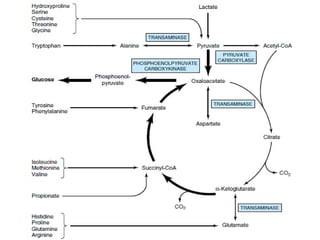
ANAPLEROTIC REACTIONS
Anaplerosis = to fill up
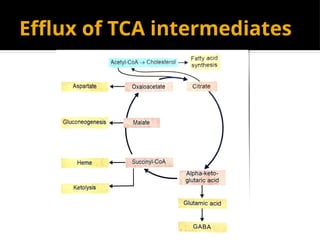
 TCA intermediates move out for
different metabolic processes- 4C
compounds
 Rate of TCA cycle declines
 Special reactions (Anaplerotic
reactions)- replenish the TCA
intermediates
Efflux of TCA intermediates
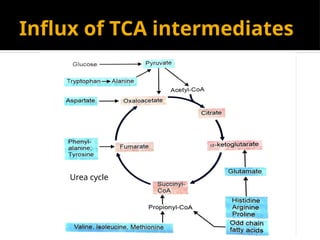
Influx of TCA intermediates
Urea cycle
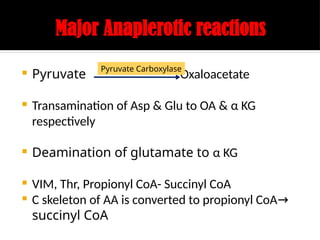
Major Anaplerotic reactions
 Pyruvate Oxaloacetate
 Transamination of Asp & Glu to OA & α KG
respectively
 Deamination of glutamate to α KG
 VIM, Thr, Propionyl CoA- Succinyl CoA
 C skeleton of AA is converted to propionyl CoA→
succinyl CoA
Pyruvate Carboxylase
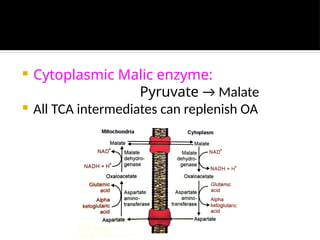
 Cytoplasmic Malic enzyme:
Pyruvate → Malate
 All TCA intermediates can replenish OA
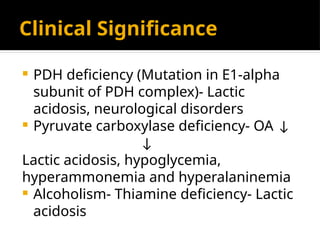
Clinical Significance
 PDH deficiency (Mutation in E1-alpha
subunit of PDH complex)- Lactic
acidosis, neurological disorders
 Pyruvate carboxylase deficiency- OA ↓
↓
Lactic acidosis, hypoglycemia,
hyperammonemia and hyperalaninemia
 Alcoholism- Thiamine deficiency- Lactic
acidosis
www.drvpacharya.com
For more PPT on Medical Biochemistry