5 Glycogen metabolism- glycogenesis and glycogenolysis
Detail description of synthesis and catabolism of glycogen. The significance and applied importance. Glycogen metabolism in sportperson and clinical significance.
The learner willbe able to:
• Why glycogen??
• Synthesis and degradation of glycogen
• Regulation of glycogen metabolism and role of cyclic AMP
• Major glycogen storage diseases and their salient features
Specific Learning Objectives
4.
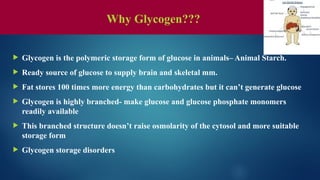
Glycogen isthe polymeric storage form of glucose in animals– Animal Starch.
Ready source of glucose to supply brain and skeletal mm.
Fat stores 100 times more energy than carbohydrates but it can’t generate glucose
Glycogen is highly branched- make glucose and glucose phosphate monomers
readily available
This branched structure doesn’t raise osmolarity of the cytosol and more suitable
storage form
Glycogen storage disorders
Why Glycogen???
5.
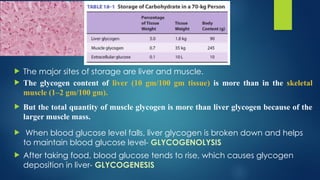
The majorsites of storage are liver and muscle.
The glycogen content of liver (10 gm/100 gm tissue) is more than in the skeletal
muscle (1–2 gm/100 gm).
But the total quantity of muscle glycogen is more than liver glycogen because of the
larger muscle mass.
When blood glucose level falls, liver glycogen is broken down and helps
to maintain blood glucose level- GLYCOGENOLYSIS
After taking food, blood glucose tends to rise, which causes glycogen
deposition in liver- GLYCOGENESIS
6.
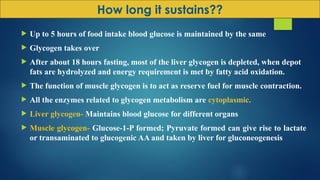
Up to5 hours of food intake blood glucose is maintained by the same
Glycogen takes over
After about 18 hours fasting, most of the liver glycogen is depleted, when depot
fats are hydrolyzed and energy requirement is met by fatty acid oxidation.
The function of muscle glycogen is to act as reserve fuel for muscle contraction.
All the enzymes related to glycogen metabolism are cytoplasmic.
Liver glycogen- Maintains blood glucose for different organs
Muscle glycogen- Glucose-1-P formed; Pyruvate formed can give rise to lactate
or transaminated to glucogenic AA and taken by liver for gluconeogenesis
How long it sustains??
8.
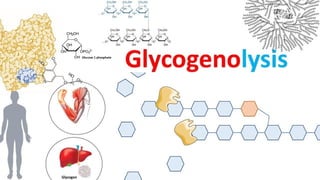
1. Glycogen Phosphorylase
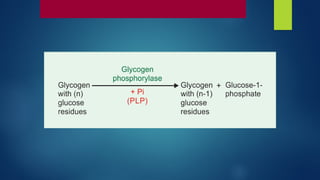
•Glycogen phosphorylase removes glucose as
glucose-1-phosphate from glycogen (phosphorolysis).
• It contains Pyridoxal phosphate (PLP) as a prosthetic group.
• The alpha-1,4 linkages in the glycogen are cleaved.
• It removes glucose units one at a time.
• Enzyme sequentially hydrolyses alpha-1,4 glycosidic linkages, till it reaches a glucose
residue, 3-4 glucose units away from a branch point.
• It cannot attack the 1,6 linkage at branch point.
• If glycogen phosphorylase alone acts on a glycogen molecule, the final product is a highly
branched molecule; it is called limit dextrin.
Degradation of Glycogen (Glycogenolysis)
10.
2. Debranching bybifunctional (two) Enzymes
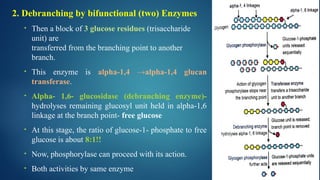
• Then a block of 3 glucose residues (trisaccharide
unit) are
transferred from the branching point to another
branch.
• This enzyme is alpha-1,4 →alpha-1,4 glucan
transferase.
• Alpha- 1,6- glucosidase (debranching enzyme)-
hydrolyses remaining glucosyl unit held in alpha-1,6
linkage at the branch point- free glucose
• At this stage, the ratio of glucose-1- phosphate to free
glucose is about 8:1!!
• Now, phosphorylase can proceed with its action.
• Both activities by same enzyme
11.
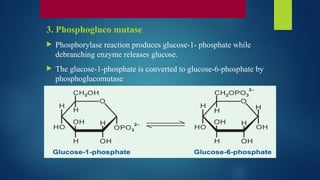
3. Phosphogluco mutase
Phosphorylase reaction produces glucose-1- phosphate while
debranching enzyme releases glucose.
The glucose-1-phosphate is converted to glucose-6-phosphate by
phosphoglucomutase
12.
4. Glucose-6-phosphatase inLiver
Hepatic glucose-6-phosphatase hydrolyses glucose-6-
phosphate to glucose.
The free glucose is released to the blood stream.
Muscle will not release glucose to the blood stream,
because muscle tissue does not contain glucose-6-
phosphatase--glucose-6-phosphate undergoes glycolysis
to produce ATP for muscle contraction.
13.
In muscle,the energy yield from one glucose
residue
derived from glycogen is 3 ATP molecules,
because no
ATP is required for initial phosphorylation of
glucose (step 1 of glycolysis).
If glycolysis starts from free glucose only 2 ATPs
are produced.
Bioenergetics
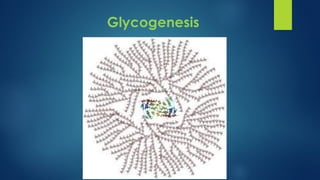
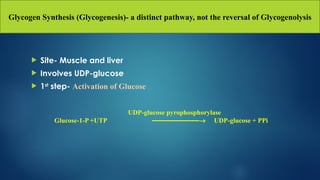
Glycogen Synthesis (Glycogenesis)-a distinct pathway, not the reversal of Glycogenolysis
Site- Muscle and liver
Involves UDP-glucose
1st
step- Activation of Glucose
UDP-glucose pyrophosphorylase
Glucose-1-P +UTP ———————® UDP-glucose + PPi
17.
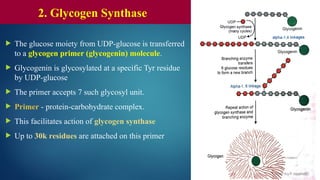
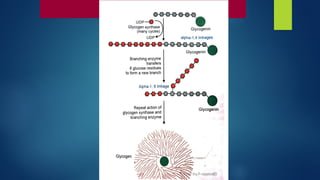
The glucosemoiety from UDP-glucose is transferred
to a glycogen primer (glycogenin) molecule.
Glycogenin is glycosylated at a specific Tyr residue
by UDP-glucose
The primer accepts 7 such glycosyl unit.
Primer - protein-carbohydrate complex.
This facilitates action of glycogen synthase
Up to 30k residues are attached on this primer
2. Glycogen Synthase
18.
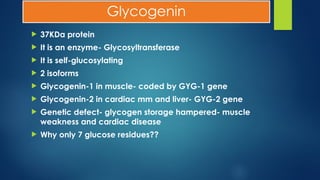
Glycogenin
37KDa protein
It is an enzyme- Glycosyltransferase
It is self-glucosylating
2 isoforms
Glycogenin-1 in muscle- coded by GYG-1 gene
Glycogenin-2 in cardiac mm and liver- GYG-2 gene
Genetic defect- glycogen storage hampered- muscle
weakness and cardiac disease
Why only 7 glucose residues??
19.
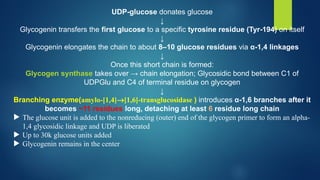
UDP-glucose donates glucose
↓
Glycogenintransfers the first glucose to a specific tyrosine residue (Tyr-194) on itself
↓
Glycogenin elongates the chain to about 8–10 glucose residues via α-1,4 linkages
↓
Once this short chain is formed:
Glycogen synthase takes over → chain elongation; Glycosidic bond between C1 of
UDPGlu and C4 of terminal residue on glycogen
↓
Branching enzyme(amylo-[1,4]®[1,6]-transglucosidase ) introduces α-1,6 branches after it
becomes ~11 residues long, detaching at least 6 residue long chain
The glucose unit is added to the nonreducing (outer) end of the glycogen primer to form an alpha-
1,4 glycosidic linkage and UDP is liberated
Up to 30k glucose units added
Glycogenin remains in the center
21.
The syntheticand degradative pathways are reciprocally
regulated to prevent futile cycles.
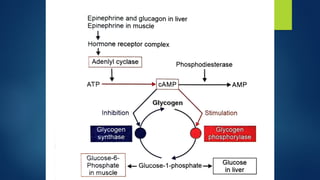
The phosphorylated form of glycogen phosphorylase is active; but glycogen
synthase becomes inactive on phosphorylation.
The covalently modified phosphorylase is active even without AMP.
The covalent modification of glycogen phosphorylase and synthase is by a cyclic AMP
mediated cascade.
Specific protein kinases bring about phosphorylation and protein phosphatases cause
dephosphorylation.
Regulation of Glycogen Metabolism
23.
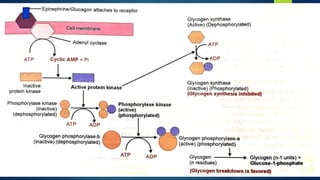
Both liverand muscle phosphorylases are activated by a
cyclic AMP mediated activation cascade triggered by the
hormonal signal.
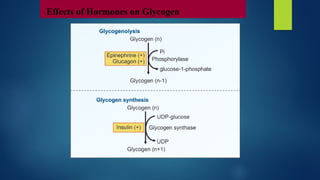
The hormones epinephrine and glucagon can activate
liver glycogen phosphorylase but glucagon has no effect
on the muscle.
When the hormone binds to a specific receptor on the
plasma membrane, the enzyme adenyl cyclase is activated
which converts ATP to cyclic AMP (cAMP).
When level of cyclic AMP rises, it will activate a protein
kinase.
The protein kinase is inactive when the catalytic (C) and
regulatory (R) subunits are associated with each other.
Generation of Cyclic AMP (cAMP)
25.
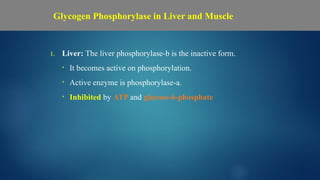
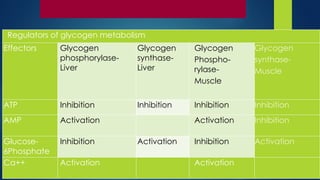
1. Liver: Theliver phosphorylase-b is the inactive form.
• It becomes active on phosphorylation.
• Active enzyme is phosphorylase-a.
• Inhibited by ATP and glucose-6-phosphate
Glycogen Phosphorylase in Liver and Muscle
26.
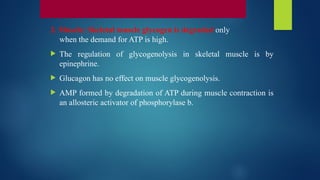
2. Muscle: Skeletalmuscle glycogen is degraded only
when the demand for ATP is high.
The regulation of glycogenolysis in skeletal muscle is by
epinephrine.
Glucagon has no effect on muscle glycogenolysis.
AMP formed by degradation of ATP during muscle contraction is
an allosteric activator of phosphorylase b.
27.
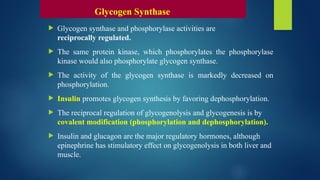
Glycogen synthaseand phosphorylase activities are
reciprocally regulated.
The same protein kinase, which phosphorylates the phosphorylase
kinase would also phosphorylate glycogen synthase.
The activity of the glycogen synthase is markedly decreased on
phosphorylation.
Insulin promotes glycogen synthesis by favoring dephosphorylation.
The reciprocal regulation of glycogenolysis and glycogenesis is by
covalent modification (phosphorylation and dephosphorylation).
Insulin and glucagon are the major regulatory hormones, although
epinephrine has stimulatory effect on glycogenolysis in both liver and
muscle.
Glycogen Synthase
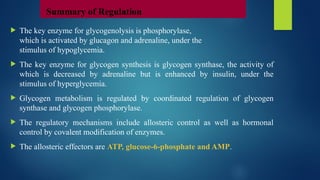
The keyenzyme for glycogenolysis is phosphorylase,
which is activated by glucagon and adrenaline, under the
stimulus of hypoglycemia.
The key enzyme for glycogen synthesis is glycogen synthase, the activity of
which is decreased by adrenaline but is enhanced by insulin, under the
stimulus of hyperglycemia.
Glycogen metabolism is regulated by coordinated regulation of glycogen
synthase and glycogen phosphorylase.
The regulatory mechanisms include allosteric control as well as hormonal
control by covalent modification of enzymes.
The allosteric effectors are ATP, glucose-6-phosphate and AMP.
Summary of Regulation
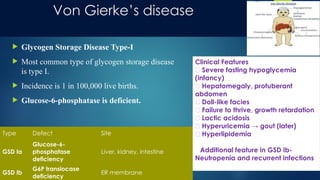
Von Gierke’s disease
Glycogen Storage Disease Type-I
Most common type of glycogen storage disease
is type I.
Incidence is 1 in 100,000 live births.
Glucose-6-phosphatase is deficient.
Type Defect Site
GSD Ia
Glucose-6-
phosphatase
deficiency
Liver, kidney, intestine
GSD Ib
G6P translocase
deficiency
ER membrane
Clinical Features
🔹 Severe fasting hypoglycemia
(infancy)
🔹 Hepatomegaly, protuberant
abdomen
🔹 Doll-like facies
🔹 Failure to thrive, growth retardation
🔹 Lactic acidosis
🔹 Hyperuricemia → gout (later)
🔹 Hyperlipidemia
Additional feature in
🔸Additional feature in GSD Ib-
Neutropenia and recurrent infections
33.
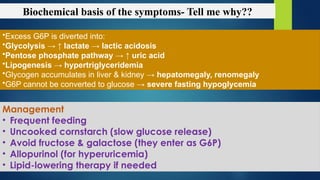
Biochemical basis ofthe symptoms- Tell me why??
•Excess G6P is diverted into:
•Glycolysis → ↑ lactate → lactic acidosis
•Pentose phosphate pathway → ↑ uric acid
•Lipogenesis → hypertriglyceridemia
•Glycogen accumulates in liver & kidney → hepatomegaly, renomegaly
•G6P cannot be converted to glucose → severe fasting hypoglycemia
Management
• Frequent feeding
• Uncooked cornstarch (slow glucose release)
• Avoid fructose & galactose (they enter as G6P)
• Allopurinol (for hyperuricemia)
• Lipid-lowering therapy if needed
34.
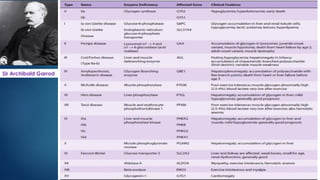
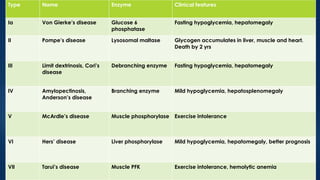
Type Name EnzymeClinical features
Ia Von Gierke’s disease Glucose 6
phosphatase
Fasting hypoglycemia, hepatomegaly
II Pompe’s disease Lysosomal maltase Glycogen accumulates in liver, muscle and heart.
Death by 2 yrs
III Limit dextrinosis, Cori’s
disease
Debranching enzyme Fasting hypoglycemia, hepatomegaly
IV Amylopectinosis,
Anderson’s disease
Branching enzyme Mild hypoglycemia, hepatosplenomegaly
V McArdle’s disease Muscle phosphorylase Exercise intolerance
VI Hers’ disease Liver phosphorylase Mild hypoglycemia, hepatomegaly, better prognosis
VII Tarui’s disease Muscle PFK Exercise intolerance, hemolytic anemia
35.
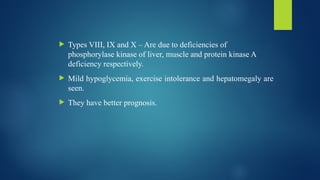
Types VIII,IX and X – Are due to deficiencies of
phosphorylase kinase of liver, muscle and protein kinase A
deficiency respectively.
Mild hypoglycemia, exercise intolerance and hepatomegaly are
seen.
They have better prognosis.
36.
Endurance athletes buildglycogen store
Marathon runners, Long-distance cyclists, Triathletes, Cross-
country skiers, Long-distance swimmers
•Exercise duration: Long (minutes to hours)
•Intensity: Low to moderate (below anaerobic threshold for most of
the activity)
They practice Carbohydrate loading
Exercise to exhaustion – When after exercise glycogen is
exhausted, carbohydrate meal is loaded
↓
Faster glycogen synthesis, less branch points and larger storage
This spares muscle glycogen exhaustion
37.
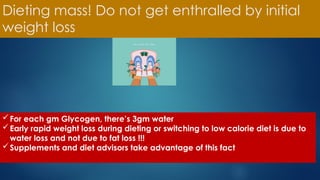
Dieting mass! Donot get enthralled by initial
weight loss
For each gm Glycogen, there’s 3gm water
Early rapid weight loss during dieting or switching to low calorie diet is due to
water loss and not due to fat loss !!!
Supplements and diet advisors take advantage of this fact
38.
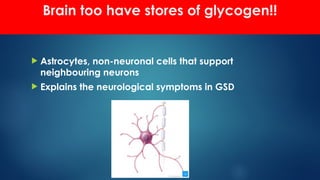
Brain too havestores of glycogen!!
Astrocytes, non-neuronal cells that support
neighbouring neurons
Explains the neurological symptoms in GSD
39.
For more PPTon medical Biochemistry
www.drvpacharya.com