General Computer
By
Dr. I. Uma Maheswari
Iuma_Maheswari@yahoo.co.in
Introduction
 A Computer is an electronic data processing
machine.
 It accepts input data (facts) process them
and produces the required result (the
output).
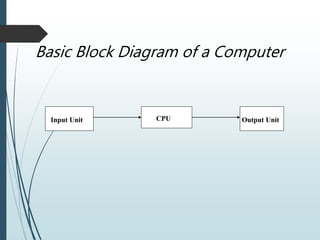
Basic Block Diagram of a Computer
Input Unit CPU Output Unit
Organization of a Computer
There are three basic units in a computer.
They are
Input Unit
Output Unit
Central Processing Unit (CPU)
CPU is further classified into three Units. They are
 Arithmetic and Logical Unit
 Memory Unit
 Control Unit
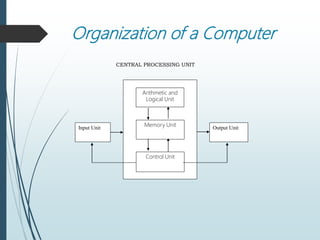
Organization of a Computer
Arithmetic and
Logical Unit
Memory Unit
Input Unit Output Unit
Control Unit
CENTRAL PROCESSING UNIT
Input Unit:
The input unit reads the necessary data
and the instructions given to the
computer.
Most commonly used input device are
mouse and the keyboard.
Output Unit:
The Output unit presents the results
obtained by the computer to the
user. The output unit is normally a
printer or a Visual Display Unit.
Memory Unit:
The memory unit is used to store
instructions and data that will be
used for computation. Two types
of memory are provided. They
are
 Main Memory
 Auxiliary Memory
Main Memory
 Main memory also known as primary memory.
 It is made up of electronic semi-conductor
devices and resides in the Central Processing Unit
(CPU).
 The data stored in the main memory are lost
when the electronic power supply is cut off. This
is called as a volatile memory
 RAM is the abbreviation of Random Access Memory. This
is also the computer's main memory where the computer
stores all the data and instructions it receives from input
and the results as it works through its calculation.
 RAM is a short-term memory or volatile memory.
 Random access memory requires some time for access to
each data and is considered to be the fastest memory.
Auxiliary memory
Auxiliary memory also known as
secondary memory/non-volatile
memory.
The auxiliary memory has a bulk
storage area.
 Magnetic drums magnetic tape and magnetic disks
are some examples of auxiliary memory devices.
 Used to store data permanently and are connected to
the computer system as required.
 Most commonly used auxiliary memories are hard
disk and floppy disk.
ROM is the abbreviation of Read Only
Memory.
It is permanently in-built in the
computer at the time of production.
It stores a set of instructions
permanently, which can only be read
and executed.
The information stored in ROM cannot
be altered or erased.
 ROM's are non-volatile.
 Variations of this type of memory are available where
flexibility is provided to a certain extent.
 PROM (Programmable Read Only Memory) is a
memory that can be programmed by a user according
to his wish.
 To erase the contents of a PROM and reprogram
another type of ROM called Erasable Programmable
Read only Memory (EPROM) is used.
Arithmetic Logic Unit:
The arithmetic logic unit is capable of
performing the operations of addition,
subtraction, multiplication and division as
well as some logical operations like
comparisons.
After the data is processed here, the result
returned to the memory unit for storage.
Control Unit:
 The Control unit sequences the operation of the
computer, controlling the actions of all other units.
 The control circuitry interprets the instructions given
to the computer and directs the rest of the machine
its operation.

General computer - Introduction to computers

  • 1.
    General Computer By Dr. I.Uma Maheswari Iuma_Maheswari@yahoo.co.in
  • 2.
    Introduction  A Computeris an electronic data processing machine.  It accepts input data (facts) process them and produces the required result (the output).
  • 3.
    Basic Block Diagramof a Computer Input Unit CPU Output Unit
  • 4.
    Organization of aComputer There are three basic units in a computer. They are Input Unit Output Unit Central Processing Unit (CPU)
  • 5.
    CPU is furtherclassified into three Units. They are  Arithmetic and Logical Unit  Memory Unit  Control Unit
  • 6.
    Organization of aComputer Arithmetic and Logical Unit Memory Unit Input Unit Output Unit Control Unit CENTRAL PROCESSING UNIT
  • 7.
    Input Unit: The inputunit reads the necessary data and the instructions given to the computer. Most commonly used input device are mouse and the keyboard.
  • 8.
    Output Unit: The Outputunit presents the results obtained by the computer to the user. The output unit is normally a printer or a Visual Display Unit.
  • 9.
    Memory Unit: The memoryunit is used to store instructions and data that will be used for computation. Two types of memory are provided. They are  Main Memory  Auxiliary Memory
  • 10.
    Main Memory  Mainmemory also known as primary memory.  It is made up of electronic semi-conductor devices and resides in the Central Processing Unit (CPU).  The data stored in the main memory are lost when the electronic power supply is cut off. This is called as a volatile memory
  • 11.
     RAM isthe abbreviation of Random Access Memory. This is also the computer's main memory where the computer stores all the data and instructions it receives from input and the results as it works through its calculation.  RAM is a short-term memory or volatile memory.  Random access memory requires some time for access to each data and is considered to be the fastest memory.
  • 12.
    Auxiliary memory Auxiliary memoryalso known as secondary memory/non-volatile memory. The auxiliary memory has a bulk storage area.
  • 13.
     Magnetic drumsmagnetic tape and magnetic disks are some examples of auxiliary memory devices.  Used to store data permanently and are connected to the computer system as required.  Most commonly used auxiliary memories are hard disk and floppy disk.
  • 14.
    ROM is theabbreviation of Read Only Memory. It is permanently in-built in the computer at the time of production. It stores a set of instructions permanently, which can only be read and executed. The information stored in ROM cannot be altered or erased.
  • 15.
     ROM's arenon-volatile.  Variations of this type of memory are available where flexibility is provided to a certain extent.  PROM (Programmable Read Only Memory) is a memory that can be programmed by a user according to his wish.  To erase the contents of a PROM and reprogram another type of ROM called Erasable Programmable Read only Memory (EPROM) is used.
  • 16.
    Arithmetic Logic Unit: Thearithmetic logic unit is capable of performing the operations of addition, subtraction, multiplication and division as well as some logical operations like comparisons. After the data is processed here, the result returned to the memory unit for storage.
  • 17.
    Control Unit:  TheControl unit sequences the operation of the computer, controlling the actions of all other units.  The control circuitry interprets the instructions given to the computer and directs the rest of the machine its operation.