Types of
Motherboard
Motherboard
Speed of
motherboardComponents of
motherboard
A
s form factor?
which components are
a Motherboard is called
r.
B
erboard:
C
herboard:
rd depends on
), RAM Bus, CPU
CPU to the
n range
MHz’s.
affect a
D
What is it…
• A bus is a set (group) of parallel lines that information
(data, addresses, instructions, and other information)
travels on inside a computer.
• A Bus is a system that moves data from one source to
another.
• Information travels on buses as a series of electrical
pulses, each pulse representing a one bit or a zero bit
BUSES
Buses
 Channel that allows devices
inside computer to
communicate with each other.
• connects processor and RAM
• determines number of bits
transmitted at one time
• Word size is the number of
bits processor can interpret
and execute at a given time.
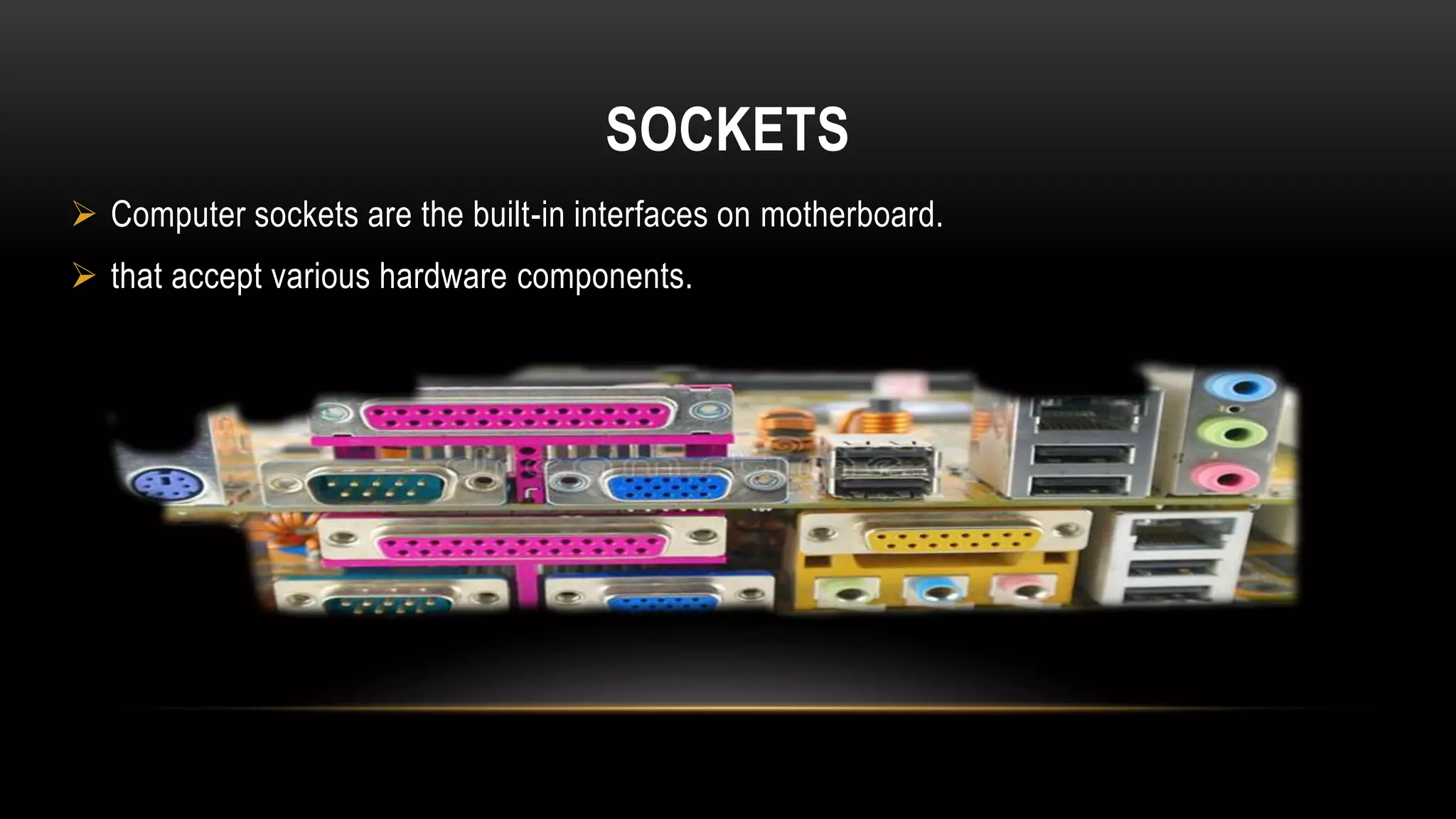
SOCKETS
 Computer sockets are the built-in interfaces on motherboard.
 that accept various hardware components.
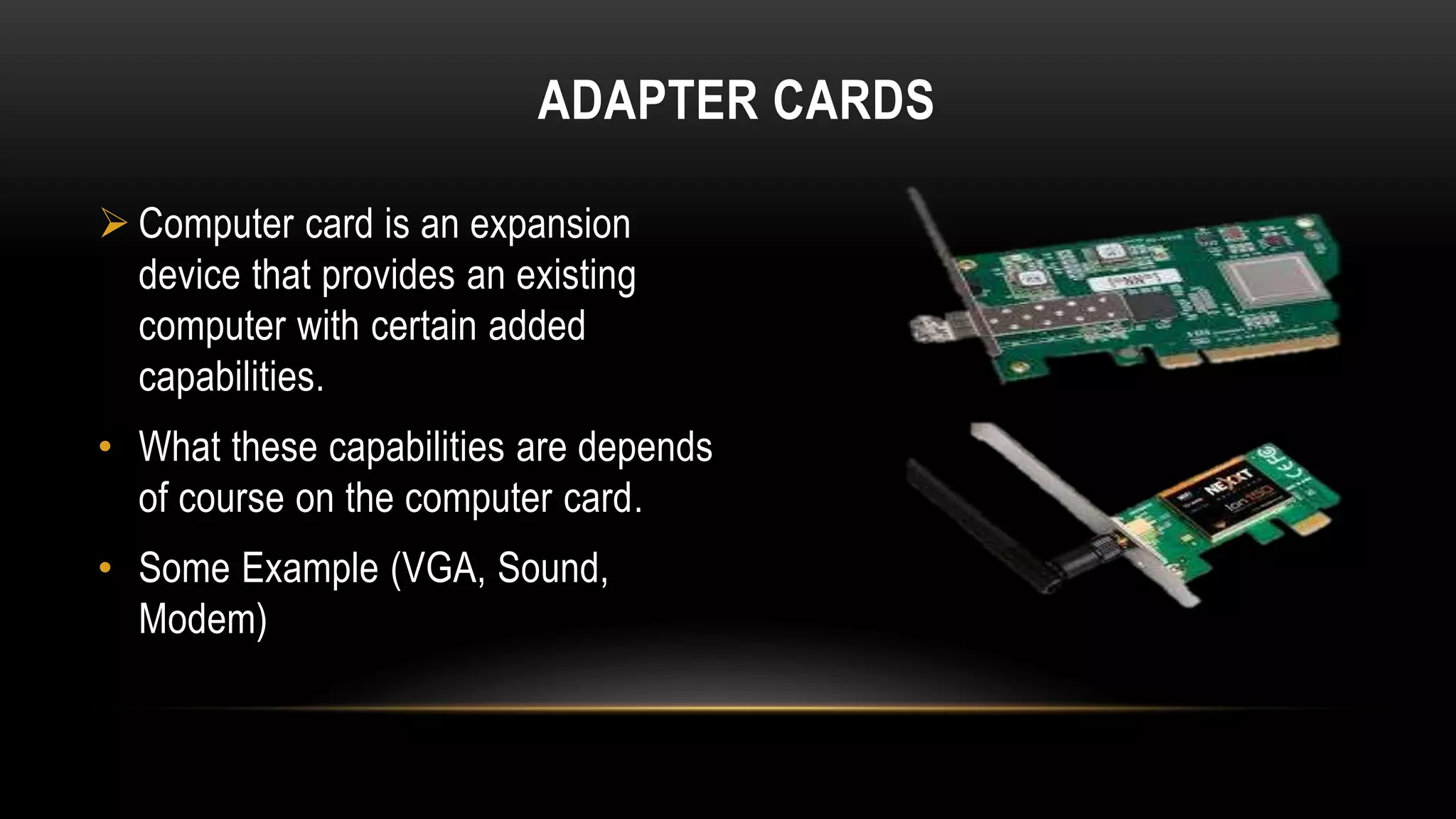
ADAPTER CARDS
 Computer card is an expansion
device that provides an existing
computer with certain added
capabilities.
• What these capabilities are depends
of course on the computer card.
• Some Example (VGA, Sound,
Modem)
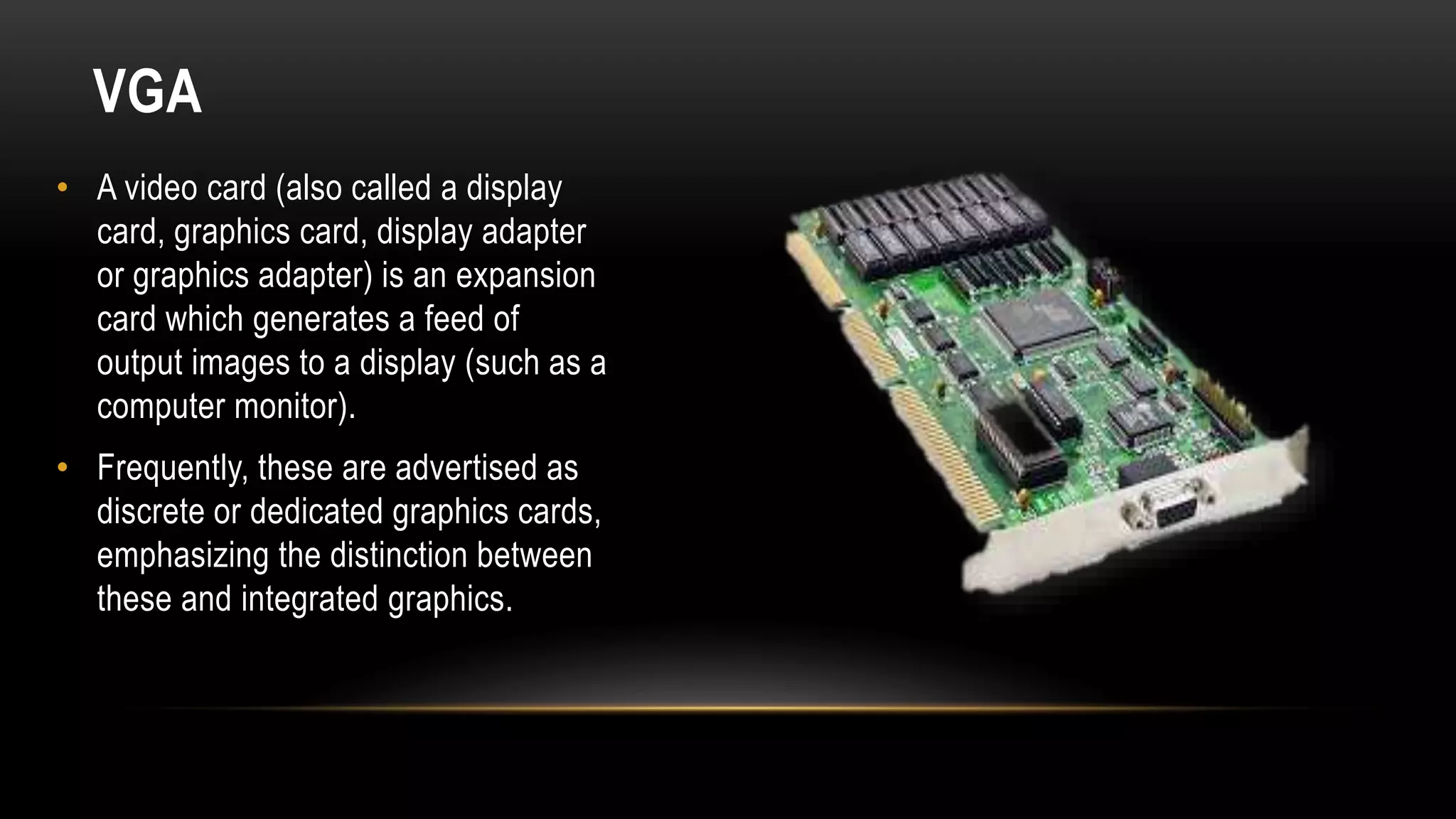
VGA
• A video card (also called a display
card, graphics card, display adapter
or graphics adapter) is an expansion
card which generates a feed of
output images to a display (such as a
computer monitor).
• Frequently, these are advertised as
discrete or dedicated graphics cards,
emphasizing the distinction between
these and integrated graphics.
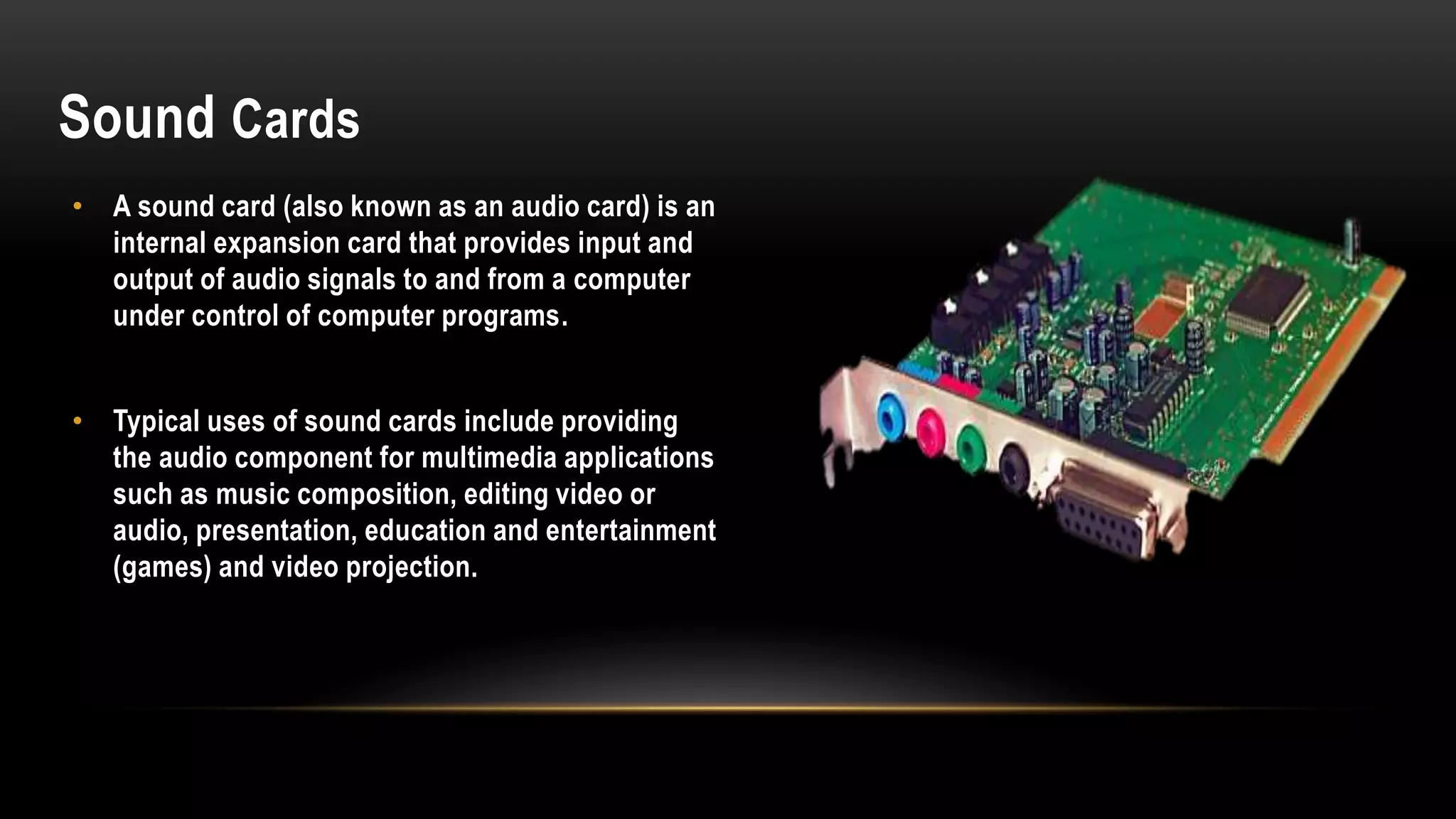
Sound Cards
• A sound card (also known as an audio card) is an
internal expansion card that provides input and
output of audio signals to and from a computer
under control of computer programs.
• Typical uses of sound cards include providing
the audio component for multimedia applications
such as music composition, editing video or
audio, presentation, education and entertainment
(games) and video projection.
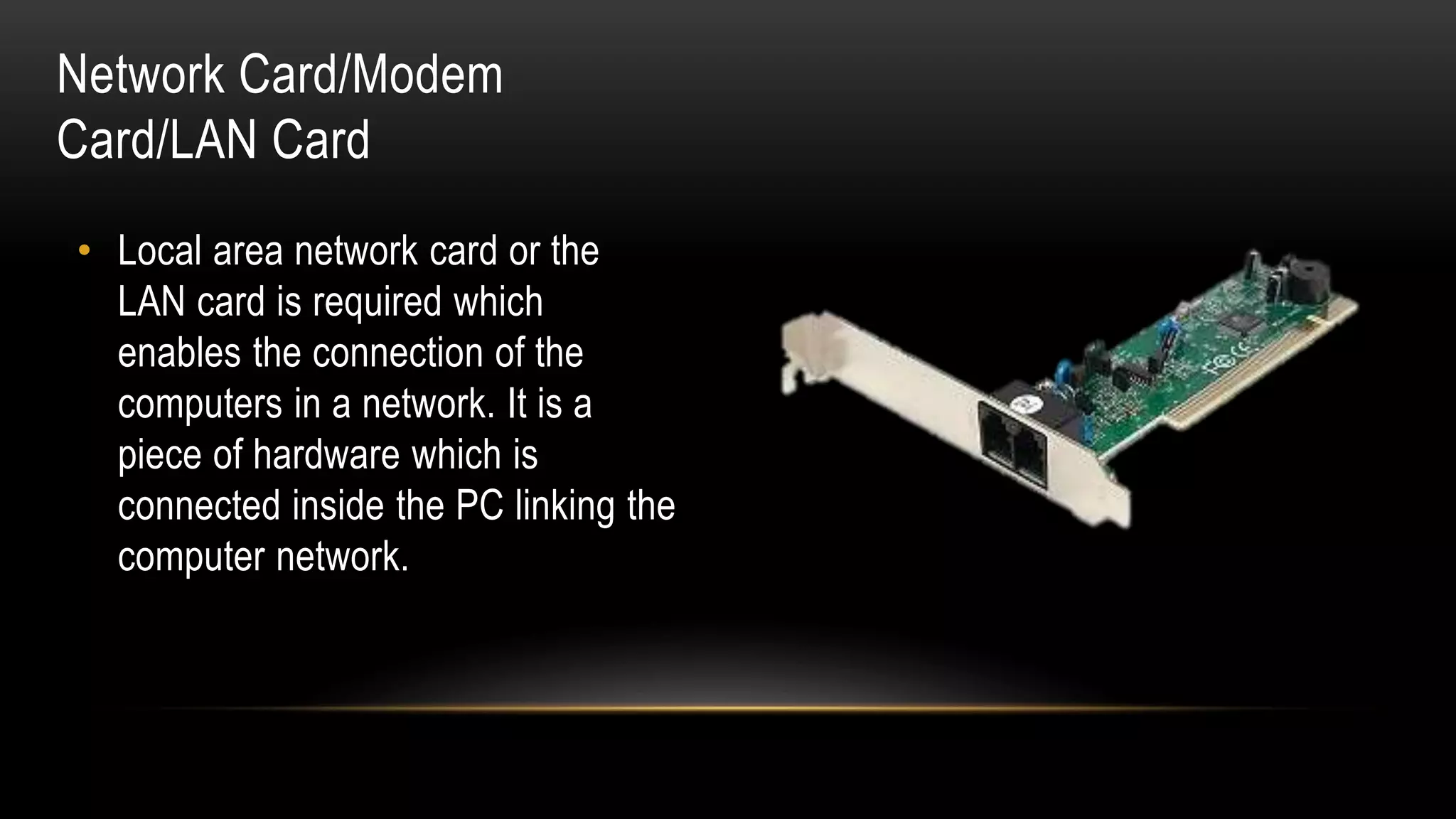
• Local area network card or the
LAN card is required which
enables the connection of the
computers in a network. It is a
piece of hardware which is
connected inside the PC linking the
computer network.
Network Card/Modem
Card/LAN Card
INTERFACE
 Command line Interface
 Graphical User Interface
CLI
CLI (Command Line
Interface):
A command-line interface (CLI), also known
as command-line user interface, console user
interface and character user interface (CUI), is a
means of interacting with a computer program
where the user (or client) issues commands to
the program in the form of successive lines of
text (command lines).
GUL
Copy
Ctrl+C
Paste Ctrl+V
Cut Ctrl+X
Bold Ctrl+B
Italic Ctrl+I
Underline Ctrl+U
Copy
GUI
GUI (Graphical User Interface):
GUI also known as Graphical user
interfaces (GUIs).
 Mouse driven and icon based
 Windows
 Are allocated to the use of a particular
program or process
 Contain a title bar, menu bar and widgets
GUI
Command Line Interface Graphical User Interface
Ease
It is difficult to remember its commands. It is also
difficult to type commands for different tasks.
It is easy to use. It is very easy to remember
different sequence of activities to perform a certain
task.
Control
Users have excellent control on the file system. User have better control on the file system. But in
some cases they need to use the command line
interface to complete a task.
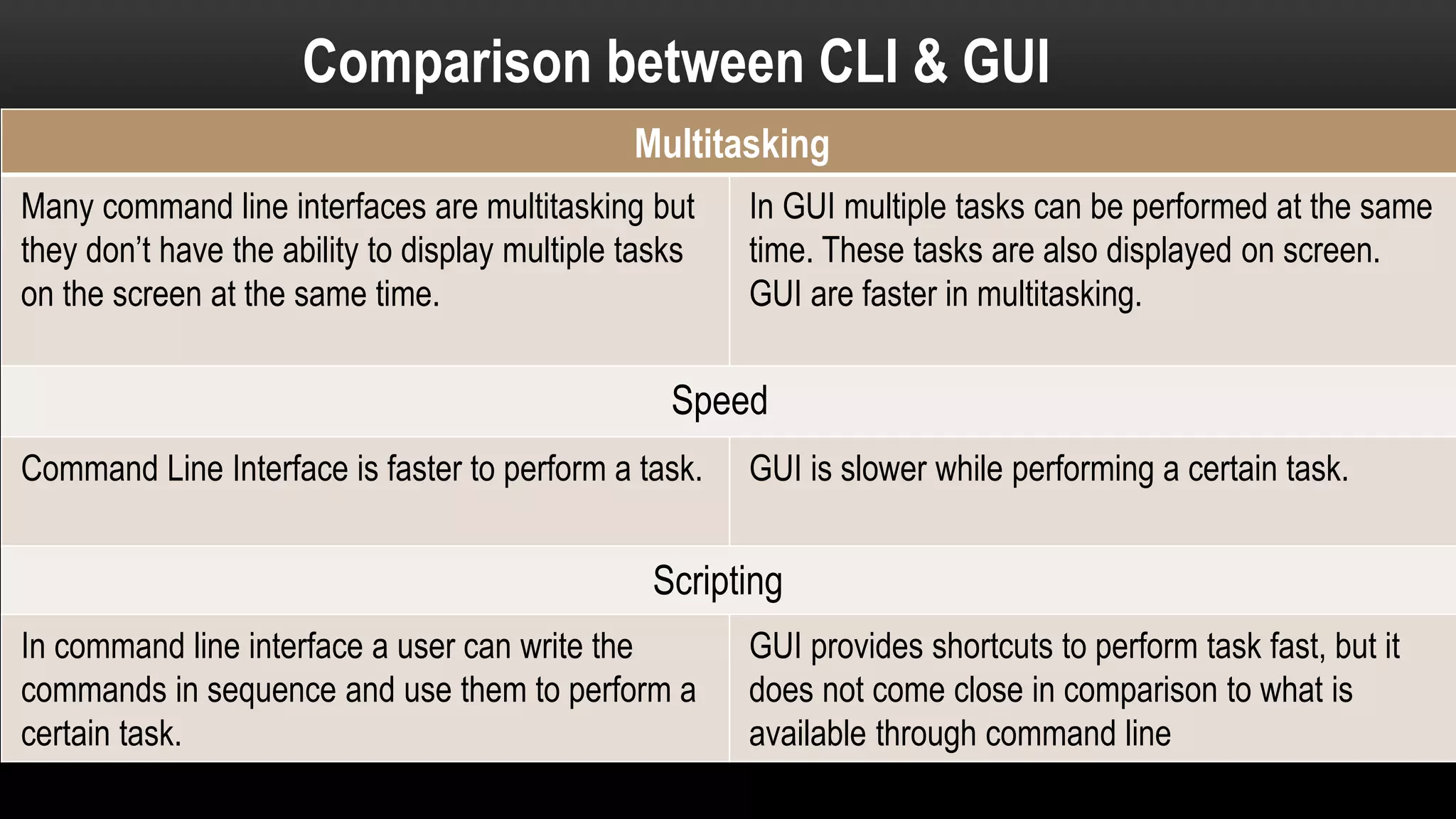
Comparison between CLI & GUI
Multitasking
Many command line interfaces are multitasking but
they don’t have the ability to display multiple tasks
on the screen at the same time.
In GUI multiple tasks can be performed at the same
time. These tasks are also displayed on screen.
GUI are faster in multitasking.
Speed
Command Line Interface is faster to perform a task. GUI is slower while performing a certain task.
Scripting
In command line interface a user can write the
commands in sequence and use them to perform a
certain task.
GUI provides shortcuts to perform task fast, but it
does not come close in comparison to what is
available through command line
Comparison between CLI & GUI
THANKS FOR YOUR ATTENTION

Components of Computer

  • 4.
    Types of Motherboard Motherboard Speed of motherboardComponentsof motherboard A s form factor? which components are a Motherboard is called r. B erboard: C herboard: rd depends on ), RAM Bus, CPU CPU to the n range MHz’s. affect a D
  • 6.
    What is it… •A bus is a set (group) of parallel lines that information (data, addresses, instructions, and other information) travels on inside a computer. • A Bus is a system that moves data from one source to another. • Information travels on buses as a series of electrical pulses, each pulse representing a one bit or a zero bit
  • 7.
  • 8.
    Buses  Channel thatallows devices inside computer to communicate with each other. • connects processor and RAM • determines number of bits transmitted at one time • Word size is the number of bits processor can interpret and execute at a given time.
  • 9.
    SOCKETS  Computer socketsare the built-in interfaces on motherboard.  that accept various hardware components.
  • 10.
    ADAPTER CARDS  Computercard is an expansion device that provides an existing computer with certain added capabilities. • What these capabilities are depends of course on the computer card. • Some Example (VGA, Sound, Modem)
  • 11.
    VGA • A videocard (also called a display card, graphics card, display adapter or graphics adapter) is an expansion card which generates a feed of output images to a display (such as a computer monitor). • Frequently, these are advertised as discrete or dedicated graphics cards, emphasizing the distinction between these and integrated graphics.
  • 12.
    Sound Cards • Asound card (also known as an audio card) is an internal expansion card that provides input and output of audio signals to and from a computer under control of computer programs. • Typical uses of sound cards include providing the audio component for multimedia applications such as music composition, editing video or audio, presentation, education and entertainment (games) and video projection.
  • 13.
    • Local areanetwork card or the LAN card is required which enables the connection of the computers in a network. It is a piece of hardware which is connected inside the PC linking the computer network. Network Card/Modem Card/LAN Card
  • 14.
    INTERFACE  Command lineInterface  Graphical User Interface
  • 15.
    CLI CLI (Command Line Interface): Acommand-line interface (CLI), also known as command-line user interface, console user interface and character user interface (CUI), is a means of interacting with a computer program where the user (or client) issues commands to the program in the form of successive lines of text (command lines).
  • 16.
    GUL Copy Ctrl+C Paste Ctrl+V Cut Ctrl+X BoldCtrl+B Italic Ctrl+I Underline Ctrl+U Copy
  • 17.
    GUI GUI (Graphical UserInterface): GUI also known as Graphical user interfaces (GUIs).  Mouse driven and icon based  Windows  Are allocated to the use of a particular program or process  Contain a title bar, menu bar and widgets
  • 18.
  • 19.
    Command Line InterfaceGraphical User Interface Ease It is difficult to remember its commands. It is also difficult to type commands for different tasks. It is easy to use. It is very easy to remember different sequence of activities to perform a certain task. Control Users have excellent control on the file system. User have better control on the file system. But in some cases they need to use the command line interface to complete a task. Comparison between CLI & GUI
  • 20.
    Multitasking Many command lineinterfaces are multitasking but they don’t have the ability to display multiple tasks on the screen at the same time. In GUI multiple tasks can be performed at the same time. These tasks are also displayed on screen. GUI are faster in multitasking. Speed Command Line Interface is faster to perform a task. GUI is slower while performing a certain task. Scripting In command line interface a user can write the commands in sequence and use them to perform a certain task. GUI provides shortcuts to perform task fast, but it does not come close in comparison to what is available through command line Comparison between CLI & GUI
  • 21.
    THANKS FOR YOURATTENTION