Computer Components
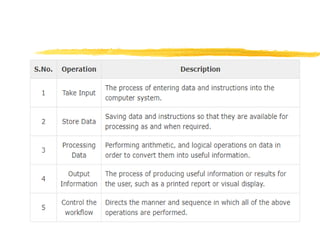
All types of computers follow the same basic
logical structure and perform the following five
basic operations for converting raw input data
into information useful to their users
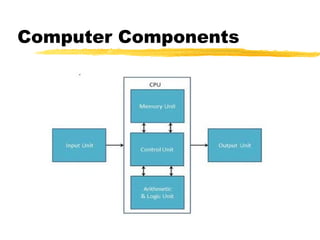
Computer Components
Input Unit
This unit contains devices with the help of
which we enter data into the computer.
This unit creates a link between the user
and the computer. The input devices
translate the information into a form
understandable by the computer.
CPU (Central Processing Unit)
CPU is considered as the brain of the
computer. CPU performs all types of data
processing operations. It stores data,
intermediate results, and instructions
(program). It controls the operation of all
parts of the computer.
Contt…..
CPU itself has the following three
components −
ALU (Arithmetic Logic Unit)
Memory Unit
Control Unit
ALU (Arithmetic Logic Unit)
This unit consists of two subsections
namely,
Arithmetic Section
Logic Section
Contt….
Arithmetic Section
Function of arithmetic section is to perform arithmetic
operations like addition, subtraction, multiplication, and
division. All complex operations are done by making
repetitive use of the above operations.
Logic Section
Function of logic section is to perform logic operations
such as comparing, selecting, matching, and merging of
data.
Memory or Storage Unit
This unit can store instructions, data, and intermediate
results. This unit supplies information to other units of
the computer when needed. It is also known as internal
storage unit or the main memory or the primary storage
or Random Access Memory (RAM).
Its size affects speed, power, and capability. Primary
memory and secondary memory are two types of
memories in the computer. Functions of the memory unit
are −
Contt….
It stores all the data and the instructions required for
processing.
It stores intermediate results of processing.
It stores the final results of processing before these
results are released to an output device.
All inputs and outputs are transmitted through the main
memory.
Control Unit
This unit controls the operations of all parts of the
computer but does not carry out any actual data
processing operations.
Functions of this unit are −
It is responsible for controlling the transfer of data and
instructions among other units of a computer.
It manages and coordinates all the units of the
computer.
Contt…
It obtains the instructions from the
memory, interprets them, and directs the
operation of the computer.
It communicates with Input/Output
devices for transfer of data or results from
storage.
It does not process or store data.
Output Unit
The output unit consists of devices with the help of
which we get the information from the computer.
This unit is a link between the computer and the users.
Output devices translate the computer's output into a
form understandable by the users.

Computer components

  • 1.
  • 2.
    All types ofcomputers follow the same basic logical structure and perform the following five basic operations for converting raw input data into information useful to their users
  • 4.
  • 5.
    Input Unit This unitcontains devices with the help of which we enter data into the computer. This unit creates a link between the user and the computer. The input devices translate the information into a form understandable by the computer.
  • 6.
    CPU (Central ProcessingUnit) CPU is considered as the brain of the computer. CPU performs all types of data processing operations. It stores data, intermediate results, and instructions (program). It controls the operation of all parts of the computer.
  • 7.
    Contt….. CPU itself hasthe following three components − ALU (Arithmetic Logic Unit) Memory Unit Control Unit
  • 8.
    ALU (Arithmetic LogicUnit) This unit consists of two subsections namely, Arithmetic Section Logic Section
  • 9.
    Contt…. Arithmetic Section Function ofarithmetic section is to perform arithmetic operations like addition, subtraction, multiplication, and division. All complex operations are done by making repetitive use of the above operations. Logic Section Function of logic section is to perform logic operations such as comparing, selecting, matching, and merging of data.
  • 10.
    Memory or StorageUnit This unit can store instructions, data, and intermediate results. This unit supplies information to other units of the computer when needed. It is also known as internal storage unit or the main memory or the primary storage or Random Access Memory (RAM). Its size affects speed, power, and capability. Primary memory and secondary memory are two types of memories in the computer. Functions of the memory unit are −
  • 11.
    Contt…. It stores allthe data and the instructions required for processing. It stores intermediate results of processing. It stores the final results of processing before these results are released to an output device. All inputs and outputs are transmitted through the main memory.
  • 12.
    Control Unit This unitcontrols the operations of all parts of the computer but does not carry out any actual data processing operations. Functions of this unit are − It is responsible for controlling the transfer of data and instructions among other units of a computer. It manages and coordinates all the units of the computer.
  • 13.
    Contt… It obtains theinstructions from the memory, interprets them, and directs the operation of the computer. It communicates with Input/Output devices for transfer of data or results from storage. It does not process or store data.
  • 14.
    Output Unit The outputunit consists of devices with the help of which we get the information from the computer. This unit is a link between the computer and the users. Output devices translate the computer's output into a form understandable by the users.