The document discusses the functional components of a computer. It explains that a computer accepts input, stores data, processes data, provides output, and controls operations. It then describes each of these functions in more detail. Specifically, it notes that input involves entering data, storage saves data permanently, processing performs calculations on stored data, and output produces results. Control coordinates all internal operations. The document further breaks down the processing function among the arithmetic logical unit, control unit, and central processing unit. The arithmetic logical unit performs calculations, the control unit coordinates operations, and the central processing unit directs different parts of the computer.
In this document
Powered by AI
Overview of computers as electronic devices performing various functions including input, processing, and output.
Description of the input process, where data is entered into the computer for processing.
Explains data storage, its necessity for fast processing, and the functions of primary storage units.
Details on the processing operations performed by the CPU, including arithmetic and logical operations.
Describes the output process, producing results from processed data and the need for storage before final output.
Discusses the control unit's role in executing instructions and managing the input, processing, and output operations.
Identifies the three main functional units of a computer: ALU, CU, and CPU.
Describes the ALU's function in processing data, performing calculations and logical operations.
Explains the control unit's coordinator role in processing instructions and managing control signals.
Defines the CPU's role as the brain of the computer, making decisions and directing operations.
Conclusion of the presentation with acknowledgments and credits.
A Computer canprocess data, pictures, sound and
graphics. They can solve highly complicated problems
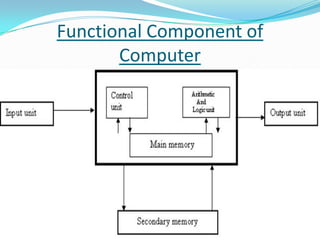
quickly and accurately. A computer as shown in
Fig. performs basically five major computer operations
or functions irrespective of their size and make. These
are
1) it accepts data or instructions by way of input,
2) it stores data,
3) it can process data as required by the user,
4) it gives results in the form of output, and
5) it controls all operations inside a computer.
6.
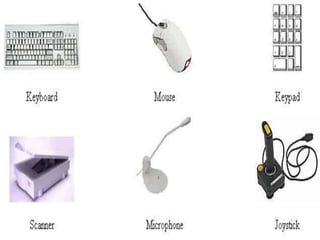
1. Input:
Thisis the process of entering data and programs in to
the computer system. You should know that computer is
an electronic machine like any other machine which
takes as inputs raw data and performs some processing
giving out processed data. Therefore, the input unit
takes data from us to the computer in an organized
manner for processing.
8.
2. Storage:
The process of saving data and instructions permanently
is known as storage. Data has to be fed into the system before
the actual processing starts. It is because the processing
speed of Central Processing Unit (CPU) is so fast that the
data has to be provided to CPU with the same speed.
Therefore the data is first stored in the storage unit for faster
access and processing. This storage unit or the primary
storage of the computer system is designed to do the above
functionality. It provides space for storing data and
instructions.
The storage unit performs the following major functions:
• All data and instructions are stored here before and after
processing.
• Intermediate results of processing are also stored here.
9.
3. Processing:
The task of performing operations like arithmetic and
logical operations is called processing. The Central
Processing Unit (CPU) takes data and instructions from the
storage unit and makes all sorts of calculations based on the
instructions given and the type of data provided. It is then
sent back to the storage unit.
10.
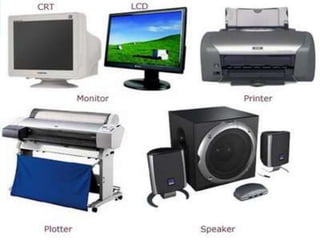
4. Output:
This is the process of producing results from the data for
getting useful information. Similarly the output produced by
the computer after processing must also be kept somewhere
inside the computer before being given to you in human
readable form. Again the output is also stored inside the
computer for further processing.
12.
5. Control:
The manner how instructions are executed and the
above operations are performed. Controlling of all
operations like input, processing and output are
performed by control unit. It takes care of step by step
processing of all operations inside the computer.
13.
FUNCTIONAL UNITS
In orderto carry out the operations mentioned in the
previous section the computer allocates the task between its
various functional units. The computer system is divided into
three separate units for its operation. They are
1)arithmetic logical unit
2) control unit.
3) central processing unit.
14.
Arithmetic Logical Unit(ALU)
After you enter data through the input device it is
stored in the primary storage unit. The actual
processing of the data and instruction are performed
by Arithmetic Logical Unit. The major operations
performed by the ALU are addition, subtraction,
multiplication, division, logic and comparison. Data is
transferred to ALU from storage unit when required.
After processing the output is returned back to storage
unit for further processing or getting stored.
15.
Control Unit (CU)
The next component of computer is the Control Unit,
which acts like the supervisor seeing that things are done in
proper fashion. Control Unit is responsible for coordinating
various operations using time signal. The control unit
determines the sequence in which computer programs and
instructions are executed. Things like processing of programs
stored in the main memory, interpretation of the
instructions and issuing of signals for other units of the
computer to execute them. It also acts as a switch board
operator when several users access the computer
simultaneously. Thereby it coordinates the activities of
computer’s peripheral equipment as they perform the input
and output.
16.
Central Processing Unit(CPU)
The ALU and the CU of a computer system are jointly
known as the central processing unit. You may call CPU as
the brain of any computer system. It is just like brain that
takes all major decisions, makes all sorts of calculations and
directs different parts of the computer functions by
activating and controlling the operations.
17.
Thank You
Made by:- Sandeep Menon
Class :- XI-Sci
Roll no. :- 11119
Submitted to :- Santosh Sir