INFORMATION TECHNOLOGY


IT is the term used to describe technologies
which enable the users to record, store, process,
retrieve, transmit and receive information.
WHAT IS A COMPUTER ?

A physical device that takes data as input,
transforms these data according to stored
instructions and output the processed information
BASIC ANATOMY OF COMPUTER


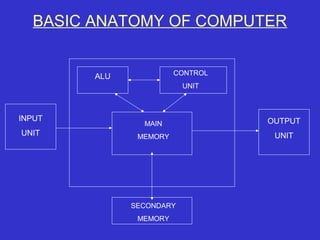
        ALU             CONTROL
                          UNIT


INPUT                             OUTPUT
                MAIN
UNIT           MEMORY              UNIT


              SECONDARY
               MEMORY
• Central Processing Unit (CPU) – It manipulates
 raw data into a more useful form and controls other
 parts of the computer system. It is referred as the
 “brain” of the computer system. CPU has three main
 parts:
        – Memory Unit
        – Control Unit
        – Arithmetic Logic Unit (ALU)
• Control Unit – Obtains instructions from the
  computer systems’ memory, interprets them and
  notifies the other components in the system to carry
  them out.
• Control unit has special storage locations called
  registers.

• Main registers of control unit:
   – Instruction register- holds instruction currently being
     executed.
   – Instruction address register- holds the address of the next
     instruction to be executed.
   – General purpose register-hold data for temporary storage.
   – Storage address register and storage data register- hold
     the address & content respectively of a storage instruction
     prior to data being placed into a location transferred from it.
• Arithmetic and Logic Unit (ALU) – It processes data
  obtained from memory under the direction of the
  control unit. It performs the computers’ principal
  logical and arithmetic operations.

• Main registers of ALU:
  – Accumulator- used when the unit is performing arithmetic
    operations.
  – Program counter- keeps track of the items of information
    stored in the memory cell.
• Memory Unit – The place where computer programs
  and data are stored during processing.
• Divided in to storage locations called bytes.
• It has the following characteristics:
         – Volatile
         – Randomly accessed
         – Fast
         – Expensive
•   Main memory has three functions:-
– it stores all or part of the software program that is
  being executed.
– it also stores the operating system program that
  manage the operation of the computer.
– it holds data that the program is using.
• Random access Memory – it consists of
  storage locations in which data can be stored
  and retrieved directly.
• Read Only Memory (ROM) : which can only be read,
  is non-volatile,can not be written to or altered, can be
  changed by removing old ROM chips & inserting new
  ROM chips containing new programs.
• Types of ROM:
   PROM (Programmable Read Only Memory)-allows
   to read a program into it.
   EPROM (Erasable Programmable Read Only
   Memory)-allows programs in ROM to be altered with
   special equipment.
• Input unit – gather data & convert them in to
 electronic form. Example:---Keyboard, Terminals,
 Touch Screen, Joy Stick, Light Pen, Digitiser.

• Output unit- display data after they have been
  processed. Example:---Display Screen, Printers,
  Plotters.
• Secondary storage-used for long term storage of
  data outside the CPU. It is non-volatile. Magnetic
  disks,optical disk,magnetic tape are few secondary
  storage devices.

I tf

  • 1.
    INFORMATION TECHNOLOGY IT isthe term used to describe technologies which enable the users to record, store, process, retrieve, transmit and receive information.
  • 2.
    WHAT IS ACOMPUTER ? A physical device that takes data as input, transforms these data according to stored instructions and output the processed information
  • 3.
    BASIC ANATOMY OFCOMPUTER ALU CONTROL UNIT INPUT OUTPUT MAIN UNIT MEMORY UNIT SECONDARY MEMORY
  • 4.
    • Central ProcessingUnit (CPU) – It manipulates raw data into a more useful form and controls other parts of the computer system. It is referred as the “brain” of the computer system. CPU has three main parts: – Memory Unit – Control Unit – Arithmetic Logic Unit (ALU)
  • 5.
    • Control Unit– Obtains instructions from the computer systems’ memory, interprets them and notifies the other components in the system to carry them out. • Control unit has special storage locations called registers. • Main registers of control unit: – Instruction register- holds instruction currently being executed. – Instruction address register- holds the address of the next instruction to be executed. – General purpose register-hold data for temporary storage. – Storage address register and storage data register- hold the address & content respectively of a storage instruction prior to data being placed into a location transferred from it.
  • 6.
    • Arithmetic andLogic Unit (ALU) – It processes data obtained from memory under the direction of the control unit. It performs the computers’ principal logical and arithmetic operations. • Main registers of ALU: – Accumulator- used when the unit is performing arithmetic operations. – Program counter- keeps track of the items of information stored in the memory cell.
  • 7.
    • Memory Unit– The place where computer programs and data are stored during processing. • Divided in to storage locations called bytes. • It has the following characteristics: – Volatile – Randomly accessed – Fast – Expensive • Main memory has three functions:- – it stores all or part of the software program that is being executed. – it also stores the operating system program that manage the operation of the computer. – it holds data that the program is using.
  • 8.
    • Random accessMemory – it consists of storage locations in which data can be stored and retrieved directly. • Read Only Memory (ROM) : which can only be read, is non-volatile,can not be written to or altered, can be changed by removing old ROM chips & inserting new ROM chips containing new programs. • Types of ROM: PROM (Programmable Read Only Memory)-allows to read a program into it. EPROM (Erasable Programmable Read Only Memory)-allows programs in ROM to be altered with special equipment.
  • 9.
    • Input unit– gather data & convert them in to electronic form. Example:---Keyboard, Terminals, Touch Screen, Joy Stick, Light Pen, Digitiser. • Output unit- display data after they have been processed. Example:---Display Screen, Printers, Plotters. • Secondary storage-used for long term storage of data outside the CPU. It is non-volatile. Magnetic disks,optical disk,magnetic tape are few secondary storage devices.